
A recessed self-test emergency spotlight from a Chinese supplier is a twin-head luminaire designed to mount flush in a ceiling cavity, with automatic battery and lamp monitoring that removes the need for monthly manual key tests. The right unit for your project depends on three facts: the cut-out size and ceiling void depth of the host fixture, whether your local code demands 90 minutes, 2 hours or 3 hours of emergency duration, and which conformity mark the inspector will accept—CE for the EU and UKCA for Great Britain under EN 60598-2-22 and EN 1838, UL 924 for North America, or AS/NZS 2293 for Australia and New Zealand.
This page explains how to qualify a real manufacturer rather than a trading office, what test records and third-party documentation to demand, and how payment structure and sample lead time reveal actual production depth.
In-House SMT and Assembly Capacity
A supplier with surface-mount technology (SMT) lines in-house or under long-term partnership can adjust LED board layouts for specific lumen packages and thermal requirements. Ask for a factory video showing Yamaha or Panasonic pick-and-place machines handling the 2835 or 3030 LED arrays typical in twin spots, and verify the reflow oven profile for aluminium PCB substrates. Trading offices cannot show this. Assembly lines should include automated wire harness crimping for the changeover relay and battery pack connection, plus torque-calibrated fastening for the adjustable lamp heads. A real manufacturer quotes 7–10 days for a customised sample of a recessed twin spot; a trader typically needs 15–25 days because they must broker production elsewhere.
Battery Sourcing and Traceability
The battery pack determines both emergency duration and shipping classification. LiFePO4 3.2V 1500mAh to 3000mAh packs are increasingly common for 3-hour duration at 3W to 5W per head, offering 500 to 800 cycles at 80 percent depth of discharge. Li-ion 18650 3.7V 2000mAh to 2600mAh alternatives are smaller but carry stricter UN 38.3 transport restrictions and IATA/IMDG documentation requirements for air and sea freight. NiCd 3.6V 1200mAh to 1800mAh remains specified for extreme temperature ranges, though cadmium content complicates EU Battery Regulation compliance. Demand cell-level purchase invoices and incoming inspection records. A manufacturer with traceability can name the cell supplier—typically EVE Energy, Lishen or BAK for Chinese-origin packs—and provide lot numbers for the cells in your specific order.
Discharge and Duration Test Records
EN 60598-2-22 requires emergency output to reach the declared lumen level for the full rated duration. For a typical recessed twin spot, this means 500lm to 900lm per head at 100 percent of normal output for maintained operation, or the same absolute lumens at a defined percentage for non-maintained wiring. Ask for discharge curves at 25°C ambient and at the product’s rated temperature extreme, usually 0°C to 40°C or -10°C to 50°C. The records should show voltage sag under load: a 3.2V LiFePO4 pack driving a constant current inverter at 350mA to 700mA output should hold above 2.8V for at least 110 percent of rated duration to account for cell ageing.
Ageing and Hipot Test Stations
Every unit should undergo a minimum 24-hour ageing burn-in at full load before final test. Hipot (dielectric withstand) testing at 1500V AC or 1800V DC for 60 seconds verifies insulation between mains input and accessible metal parts. Ask how many stations are active and whether the supplier holds calibration certificates for their Chroma or GW Instek test equipment. A factory with 50-plus ageing racks and automated logging is manufacturing; one that mentions “partner factory testing” without specifics is brokering.
Third-Party Test Reports for the Destination Market
Do not accept a generic “CE certificate.” Request the complete EN 60598-2-22 and EN 62034 test report for self-test functionality, including the 50-operation endurance test for the changeover relay and the fault-mode simulation records. For UK export, ask for the EN 1838 photometric data showing minimum 1 lux on the floor for escape routes, and confirm the test lab appears on the UKAS or EU MRA signatory list. For UL 924 markets, demand the full test report including the 90-minute duration verification and the temperature rise data at maximum ambient. For AS/NZS 2293, the classification system (Class W, C, D or E) must match the installation height and spacing your designer specified.
Sample Lead Time and Payment Structure
Standard recessed self-test twin spots in white or black polycarbonate housing, IP20 to IP44, with 90-minute LiFePO4 duration and maintained/non-maintained switchable wiring, sample in 7–10 working days from a real manufacturer. Customisation—RAL colour, DALI self-test instead of standalone automatic test, or 3-hour duration with larger cell pack—adds 5–7 days. Payment terms reveal manufacturing depth: factories accept 30 percent TT deposit, 70 percent before shipment for first orders; trading offices often demand 50 percent deposit or insist on back-to-back letters of credit because they lack cash flow for component procurement. FOB Shenzhen pricing for standard specification ranges from USD 12 to USD 18 per unit at 500-piece MOQ, with 3-hour or DALI variants at USD 18 to USD 26. CIF add roughly 8–12 percent for UK or EU port delivery.
After-Sales Engineering Capability
A manufacturer employs firmware engineers who can adjust the self-test interval—monthly function tests and annual duration tests per EN 62034—or modify the DALI command set for integration with your building management system. Ask for a direct video call with the engineer who would handle your technical file, not just the salesperson. Trading offices route queries through multiple intermediaries, adding days to any firmware or optical adjustment. Confirm whether the supplier keeps replacement battery packs and LED modules in stock for 5-year service life support, and whether they can issue component-level test reports for your own luminaire OEM certifications if you are private-labelling.
Types and Configurations of Self-test Twin Spot Emergency Light
Types and Configurations of Self-test Twin Spot Emergency Light
| Type or Class | Typical Rating or Output | Duration or Runtime | Best Suited For | Notes |
|---|---|---|---|---|
| Reduced-power non-maintained twin spot with manual test | 3W–5W emergency per head, 25–35% of normal lumen output | 90 minutes to 3 hours | Warehouses, small retail, cost-driven projects | Lowest unit cost; requires manual monthly key switch testing per BS 5266-1 |
| Reduced-power non-maintained twin spot with automatic self-test | 3W–5W emergency per head, 25–35% of normal lumen output | 90 minutes to 3 hours | Schools, offices, any site with limited maintenance staff | Self-test per EN 62034 reduces labour; battery failure flagged by LED status |
| Full-power maintained twin spot with DALI self-test | 8W–15W emergency per head, 100% of normal lumen output | 90 minutes to 2 hours | Hospitals, theatres, high-risk task areas | Maintained wiring keeps lamp live during normal operation; DALI-2 interface for BMS integration |
| High-bay dedicated twin spot with wide-beam optics | 10W–20W emergency, 2000–4000 lumens per head | 90 minutes to 3 hours | Manufacturing halls, hangars, racking aisles above 6m | Requires EN 1838 minimum 1 lux on floor at height; often paired with LED high-bay emergency driver |
| Weatherproof IP65 twin spot with lithium battery | 5W–10W emergency per head | 2 hours to 3 hours | Car parks, loading bays, external canopies | LiFePO4 3.2V 3000mAh–6000mAh packs preferred for low-temperature performance; IK08 minimum for vandal resistance |
| Recessed architectural twin spot with low-profile housing | 3W–6W emergency per head, 300–600 lumens | 90 minutes to 2 hours | Hotels, galleries, ceiling-integrated designs | Cut-out typically 150mm–200mm; limited heat dissipation restricts maximum wattage |
Reduced-Power Non-Maintained Twin Spot with Manual Test
This configuration represents the baseline for industrial and warehouse specification. The inverter delivers 3W to 5W DC per head at 12V–24V, typically 350mA–700mA constant current, from a NiCd 3.6V 1500mAh or Li-ion 18650 3.7V 2200mAh battery pack. Normal mains input is AC 85–265V 50/60Hz. Emergency output runs 25% to 35% of the lamp’s normal lumens—sufficient for escape route identification but inadequate for task continuation. The changeover relay isolates the battery from the charging circuit when mains fails. Buyers are electrical contractors on tight capex budgets and wholesalers serving markets where labour costs are low enough to absorb manual testing regimes. What it cannot do: it offers no fault logging, no remote monitoring capability, and a failed battery may only be discovered at the monthly key-test moment, risking non-compliance with BS 5266-1 or local variants. Charge time from deep discharge is 24 hours typical; cycle life for NiCd is 300–500 cycles versus 500–800 for Li-ion.
Reduced-Power Non-Maintained Twin Spot with Automatic Self-Test
The same electrical architecture as the manual version, but with a microcontroller executing automatic duration tests per EN 62034—typically a brief functional test every 30 days and a full 90-minute duration test annually. Battery chemistry shifts toward LiFePO4 3.2V 3000mAh packs for longer cycle life (800–1500 cycles) and reduced replacement frequency. The self-test circuit adds approximately US$4–6 to the BOM, reflected in a unit price of US$30–US$40 at 300-piece MOQ versus US$22–US$28 for manual-test equivalents. Facility managers and M&E consultants specify this for schools, care homes, and multi-tenant offices where access for manual testing is disruptive or where staff turnover makes test record-keeping unreliable. What it cannot do: it still delivers only fractional emergency output, so it does not satisfy applications requiring full normal light levels during evacuation. The self-test electronics also introduce a standby load of 0.5W–1W, marginally increasing annual energy consumption.
Full-Power Maintained Twin Spot with DALI Self-Test
This class bridges hệ thống chiếu sáng khẩn cấp and functional illumination. The lamp remains energised during normal operation via a maintained wiring configuration; on mains failure, the emergency driver instantaneously switches to battery-derived full-power output—8W to 15W per head, 100% of normal lumen output, typically 800–1500 lumens for a quality COB or SMD spot. The inverter output window is wider than reduced-power types: DC 24V–50V at 350mA–700mA, driving loads up to 30W total. Battery packs scale to LiFePO4 6.4V 6000mAh or Li-ion 2S2P 7.4V 4400mAh configurations. DALI-2 test facility enables scheduled testing, addressable fault reporting, and integration with building management systems per EN 62034. Theatre lighting designers, hospital M&E teams, and specifiers in jurisdictions with strict maintained-lighting mandates (parts of the Middle East, certain ASEAN codes) are the primary buyers. What it cannot do: the maintained wiring requirement—permanent live, switched live, and neutral to each luminaire—complicates retrofit and increases installation cost. Battery capacity must support full wattage, so duration is typically capped at 90 minutes or 2 hours, not 3 hours, unless the battery mass becomes prohibitive. Unit price at 300-piece MOQ ranges US$55–US$80.
High-Bay Dedicated Twin Spot with Wide-Beam Optics
Designed specifically for mounting heights above 6 metres, this type addresses EN 1838’s requirement for minimum 1 lux at floor level on escape routes—difficult to achieve with standard narrow-beam spots from 8m–12m mounting. Each head delivers 10W–20W emergency, 2000–4000 lumens, through 60°–120° optics, driven by a dedicated inverter or by an LED emergency driver for LED high bays with external twin-spot heads. Input voltage is often AC 100–277V to serve North American and Middle East markets. Battery configurations include LiFePO4 12.8V 3000mAh packs for 3-hour duration at 10W, or 12.8V 6000mAh for 3-hour at 20W. Industrial procurement officers and warehouse operators buy this; it is rarely specified by residential or small-commercial contractors. What it cannot do: the wide beam sacrifices punch distance—illuminance falls below 1 lux beyond the designed coverage cone, so spacing calculations are critical. IP65 housings are standard but the large battery and driver assembly limits aesthetic integration; this is not a product for hotel lobbies.
Weatherproof IP65 Twin Spot with Lithium Battery
External applications demand sealed construction, UV-stabilised polycarbonate or die-cast aluminium housings, and battery chemistry that performs across temperature extremes. LiFePO4 3.2V 3000mAh to 6.4V 6000mAh packs dominate over NiCd for this class because their discharge curve holds voltage above the inverter’s cut-off threshold at -10°C, where NiCd capacity collapses by 30%–50%. Input is AC 220–240V or 100–277V depending on destination. IK08 impact resistance is the practical minimum for car parks and loading bays. Charge time is 12–16 hours to 80% capacity; full charge 24 hours. Cycle life 800–1200 for LiFePO4 versus 200–400 for equivalent NiCd. Buyers are facilities managers for retail parks, transport hubs, and infrastructure operators in the UK, Northern Europe, and the Gulf states where exterior hệ thống chiếu sáng khẩn cấp is code-mandated. What it cannot do: the sealed housing complicates battery replacement—many designs require partial disassembly, increasing maintenance cost over the product life. Lithium battery transport requires UN 38.3 test reports and IATA/IMDG-compliant packaging, adding US$200–US$400 per shipment documentation cost and restricting air-freight options for urgent orders.
Recessed Architectural Twin Spot with Low-Profile Housing
The search phrase “Recessed Self-test Emergency Spotlight Supplier in China” identifies this niche directly. Low-profile housings—typically 40mm–60mm ceiling void depth—accommodate plasterboard or suspended ceilings where surface mounting is visually unacceptable. Output is constrained by thermal management: 3W–6W per head, 300–600 lumens, from SMD LED arrays, with emergency duration 90 minutes to 2 hours from Li-ion 18650 3.7V 2200mAh or LiFePO4 3.2V 2500mAh packs. Cut-out diameters range 150mm–200mm; PCB-mounted driver with self-test micro, changeover relay, and terminal block must fit within the same envelope. Input AC 220–240V 50Hz for European markets; 100–277V variants for project flexibility. Hotel chains, gallery fit-out contractors, and premium retail specifiers buy this. What it cannot do: the restricted ceiling void limits battery size, so 3-hour duration is rarely achievable above 4W per head. Recessed installation also complicates access for testing and battery replacement—specifiers should confirm that the bezel allows tool-free removal or that the driver is accessible from below via a hinge mechanism. Lead time for tooled housings is 45–60 days versus 20–30 days for standard surface-mount products; MOQ for custom recessed families is typically 500–1000 pieces.
Supplier Qualification: Manufacturer versus Trading Office
Buyers evaluating a “Recessed Self-test Emergency Spotlight Supplier in China” should verify the following capabilities before placing orders, particularly for life-safety products where component traceability and test documentation are audit-critical.
In-House or Partnered SMT and Assembly Capacity. Ask for video or live virtual tour of SMT lines, reflow ovens, and final assembly stations. A genuine manufacturer can state machine models (e.g., Yamaha YSM series, Panasonic NPM), PCB copper weight processed (typically 1oz–2oz for emergency drivers, 2oz–3oz for high-current battery packs), and daily throughput. Trading offices deflect or provide generic footage.
Battery Sourcing and Traceability. Demand cell-level documentation: manufacturer (e.g., EVE Energy, Lishen, BAK), model number, batch code, and UN 38.3 test summary for the exact cell variant. The pack assembler should provide BMS protection specifications—overcharge threshold, discharge cut-off, cell balancing method—and welding method (spot-welded nickel strip versus soldered, which risks cell damage).
Discharge and Duration Test Records. Every production batch should have sampled discharge records at 25°C ambient and at the rated extreme temperature. Ask for a sample test report showing 90-minute or 3-hour actual runtime, end-point voltage, and lumen maintenance at duration end. A manufacturer maintains this data; a trader forwards whatever the subcontractor provides, often inconsistently.
Ageing and Hipot Test Stations. Emergency drivers require 100% functional test and sampled ageing (typically 4–8 hours at 40°C–45°C ambient) to infant-mortality failures. Hipot (dielectric withstand) testing to 1500V AC or 1800V DC per IEC 61347-2-7 should be logged per unit serial number. Request to see test station photographs and data logs.
Third-Party Test Reports for the Destination Market. Do not accept “CE certified” as a statement of compliance. Ask for the test report number, issuing laboratory, and standard list: EN 60598-2-22 for luminaire construction, EN 62034 for self-test performance, EN 1838 for photometric requirements, plus EMC (EN 55015, EN 61547) and LVD (EN 60598-1). For UK export, BS 5266-1 compliance should be demonstrable. For North America, UL 924 or CSA C22.2 No. 141 reports. For Australia, AS/NZS 2293.2. Verify the report covers the exact model number and battery configuration being purchased—variant reports for similar products are insufficient.
Sample Lead Time and Payment Structure. Genuine manufacturers with tooled housings deliver samples in 7–14 days for standard products, 21–30 days for recessed or customised variants. Payment terms of 30% deposit, 70% against copy of B/L are standard for first orders; trading offices often demand 100% advance or use escrow structures that obscure the actual factory relationship.
After-Sales Engineering Capability. Request schematic-level explanation of the self-test algorithm: how it distinguishes between mains failure and lamp failure, how it handles the annual duration test if the building is occupied, how fault codes are displayed (LED blink pattern, audible alarm, DALI register). A manufacturer employs firmware engineers who can modify timing or add DALI commands; a trader cannot answer below the user-manual level.

Specifications and How to Read Them
| Parameter | Entry Level | Mid Range | High Specification |
|---|---|---|---|
| Normal LED load | 2 × 3W COB spots, 6W total | 2 × 4W COB spots, 8W total | 2 × 5W COB spots, 10W total |
| Emergency output per head | 180 lm | 280 lm | 380 lm |
| Emergency output as % of normal | 100% | 100% | 100% |
| Emergency duration | 90 minutes | 120 minutes | 180 minutes |
| Input voltage | AC 220-240V 50Hz | AC 85-265V 50/60Hz | AC 100-277V 50/60Hz |
| DC output window to LED | 6-12V DC 350mA | 6-18V DC 450mA | 9-24V DC 500mA |
| Battery chemistry | NiCd 3.6V 1500mAh | Li-ion 18650 7.4V 2200mAh | LiFePO4 6.4V 3000mAh |
| Charge time to 90% | 24 hours | 16 hours | 12 hours |
| Cycle life | 300-400 cycles | 500-600 cycles | 800-1200 cycles |
| Test facility | Manual test key | Auto self-test per EN 62034 | Self-test + DALI-2 |
| Wiring mode | Không được bảo trì | Non-maintained or maintained | Non-maintained or maintained |
| IP / IK rating | IP20 / IK04 | IP65 / IK07 | IP65 / IK08 |
| Ambient temperature | 0°C to +40°C | -10°C to +45°C | -20°C to +50°C |
| Housing | Steel with powder coat | Die-cast aluminium | Die-cast aluminium with stainless steel bezel |
| Dimensions (L×W×H) | 260 × 80 × 60 mm | 300 × 90 × 75 mm | 340 × 100 × 85 mm |
| Mounting | Surface wall bracket | Surface or recessed 65mm cutout | Surface, recessed 75mm cutout, or pendant |
| Reference FOB price at 300 pcs | US$30-35 / piece | US$42-52 / piece | US$65-80 / piece |
How to Read Each Line of the Datasheet
Input voltage range and frequency
AC 85-265V covers global mains except Japan 100V and parts of North America on 277V distribution. AC 100-277V is the safer spec for export to the United States and Canada. A narrow 220-240V 50Hz unit costs less because it omits the wide-range PFC front end, but it will fail or run hot on 208V three-phase derived supplies common in UK commercial installations. Check the label: 50/60Hz dual rating matters for Middle East and Southeast Asian projects.
Driven load in watts
This is the normal-mode LED consumption, not the emergency output. Twin spots are rated per head: 2 × 3W means two 3W COB LEDs. The emergency inverter does not need to match this figure exactly; it needs to deliver the lumen target for the required duration. A 6W normal load with 100% emergency output still draws roughly 6W from the battery, but at lower voltage and higher current. Ask for the inverter efficiency figure: 80% is common, 85% is achievable with synchronous rectification.
DC output voltage window and current
The inverter is a constant-current device. 6-18V DC 450mA means it will drive any LED array whose forward voltage falls in that range at the stated current. If your LED module wants 24V, the inverter will run in current-limit and the output will be dim or unstable. This is the most common compatibility failure between emergency driver and luminaire. Verify the LED Vf curve at operating temperature, not just room temperature.
Emergency output in lumens and as percentage of normal
EN 1838 requires minimum 1 lux on the escape route for open areas, and 5 lux for high-risk task areas. For twin spots mounted at 2.5-3m height, 180 lm per head achieves roughly 8-10 lux at floor level directly beneath. 100% output means the emergency lumen package equals the normal lumen package; this is achievable with LED but was rare with halogen twin spots. Lower percentages exist—50% or 70%—but buyers should confirm the calculation matches the spacing and mounting height in the actual building plan.
Emergency duration
90 minutes satisfies EN 1838 and BS 5266-1 for most UK and European premises. 120 minutes is specified for high-rise evacuation, stadium concourses, and some Middle East civil defence codes. 180 minutes appears in tunnel lighting, offshore platforms, and certain Southeast Asian regulations. Duration is tested at end of declared battery life, not fresh cell performance. A supplier claiming 180 minutes should show a discharge curve at 25°C and at the minimum rated ambient temperature.
Battery chemistry voltage and capacity
NiCd 3.6V 1500mAh delivers 5.4Wh. At 80% inverter efficiency and 6W load, theoretical runtime is 43 minutes—so the entry-level unit must use a lower emergency wattage or a larger pack than the headline suggests, or the 90-minute claim is inflated. Always cross-check: Wh = V × Ah; runtime minutes = (Wh × efficiency × 60) / load watts.
Li-ion 18650 7.4V 2200mAh gives 16.3Wh. Two cells in series, or a protected 2S1P pack. The 18650 format is standard, replaceable, and traceable to Samsung, LG, or BAK lot codes.
LiFePO4 6.4V 3000mAh gives 19.2Wh. Lower energy density than Li-ion but safer thermal runaway profile and longer cycle life. The voltage plateau is flatter, which helps maintain constant lumen output through the discharge.
Charge time
24 hours for NiCd reflects the trickle-charge chemistry. 12-16 hours for lithium packs indicates a CC-CV charge profile with termination. Fast charge claims below 8 hours for lithium emergency batteries should be treated with caution; aggressive charging reduces cycle life and may violate the cell manufacturer’s specification.
Cycle life
Declared at 80% of initial capacity. A 500-cycle Li-ion pack used in weekly self-test plus annual functional test will degrade faster than the calendar life suggests. For maintained mode installations where the battery rarely cycles, calendar ageing (3-5 years for Li-ion, 8-10 years for LiFePO4) dominates. Ask for the replacement battery part number and whether the pack is user-replaceable or potted.
Test facility
Manual test key: a switch or fuse removal that forces mains disconnection. Cheap, but relies on building maintenance staff to log and act on results.
Self-test per EN 62034: automatic monthly functional test (30 seconds to 5 minutes on battery) and annual duration test. The electronics measure battery voltage under load and flag failure via a visible or remote indicator. The standard does not mandate remote communication; a local LED is sufficient.
DALI-2: the emergency device appears as a DALI addressable unit on the lighting bus. Status bits report mains present, battery charging, lamp failure, and duration test result. Requires a DALI application controller and compatible infrastructure. Adds US$8-15 to BOM cost.
Maintained or non-maintained wiring
Non-maintained: the LED spots illuminate only when mains fails. Two-wire supply: switched live and neutral. Simplest installation, lowest cost.
Maintained: the spots operate from normal mains via an internal changeover relay, switching to inverter on power loss. Requires permanent live, switched live, and neutral. The relay contact rating must exceed the normal LED inrush; solid-state relays are preferred for frequent switching. Maintained mode is mandatory for escape routes that must be lit during normal occupancy in some jurisdictions.
IP and IK rating
IP20: protected against finger contact, no dust or water sealing. Suitable for dry interior corridors.
IP65: dust-tight and protected against low-pressure water jets. Required for car parks, plant rooms, canopied external locations. Verify the gasket material: EPDM ages better than PVC in UV.
IK04: 0.5 joule impact, roughly a 250g ball from 20cm. IK07: 2 joule, equivalent to 500g from 40cm. IK08: 5 joule, required for sports facilities, detention centres, and heavy industrial environments. The lens material drives this: tempered glass or polycarbonate with UV stabiliser.
Ambient temperature range
Battery capacity falls with temperature. A lithium pack rated 0°C to +40°C will deliver less than 60% of nominal capacity at -10°C, and charging below 0°C risks metallic lithium plating. The -20°C to +50°C high-spec unit uses a battery with low-temperature electrolyte additive and a heating circuit or reduced charge rate. For cold-store applications, confirm the duration test was conducted at the minimum operating temperature, not just stored there.
Dimensions and mounting
Recessed mounting requires a cutout dimension and minimum ceiling void depth. A 65mm cutout with 80mm void depth suits standard plasterboard ceilings. A 75mm cutout with 100mm depth is needed for the larger LiFePO4 pack and heatsink. Check whether the bezel is flange-mounted (overlaps ceiling edge) or trimless (mudded into plaster). Pendant mounting with conduit entry requires a 20mm or 25mm knock-out; verify thread type (metric PG, NPT, or BSP) for the destination market.
Manufacturer Qualification Checklist
In-house SMT and assembly capacity
A real manufacturer owns SMT lines for LED driver PCBA, not just final assembly of bought-in modules. Ask for the SMT line brand (Yamaha, Juki, Panasonic) and whether they run leaded or lead-free reflow. Lead-free profiles peak at 245-250°C; a line configured only for leaded solder cannot reliably place modern IC packages. Battery pack welding—spot welding for cylindrical cells, laser welding for pouch—should be in-house or under direct QC at a partnered cell integrator, not outsourced to an untraced third party.
Battery sourcing and traceability
The 18650 or 21700 cells should carry a visible brand code: INR18650-25R, for example, identifies a Samsung SDI cell with 2500mAh nominal. Unbranded or “B-grade” cells relabelled with inflated capacity claims are common in low-cost emergency products. Request the cell specification sheet and the UN 38.3 test summary for the exact cell model, not just the finished battery pack. Traceability means lot numbers on the cell sleeve matching the pack build record.
Discharge and duration test records
Every production batch should have a 100% functional test and a sampled duration test record. Ask to see the test station: a programmable DC load with data logging, not a simple timer. The record should show initial voltage, voltage at 30 minutes, 60 minutes, 90 minutes, and end-point voltage, plus the ambient temperature during test. A manufacturer without this equipment is assembling, not verifying.
Ageing and hipot test stations
Burn-in or ageing runs the assembled inverter at elevated temperature (typically +45°C) for 2-4 hours to precipitate early failures. Hipot (dielectric withstand) test applies 1500V AC or 3000V DC between mains and output for 60 seconds, checking for creepage or insulation faults. Both are mandatory for CE self-certification under EN 61347. A factory visit or video call should show these stations in operation, not just present.
Third party test reports for the destination market
EN 60598-2-22 requires testing for thermal endurance of plastics, fault conditions, and endurance of electronic parts. A test report from a notified body—SGS, TÜV, Intertek, BSI, DEKRA—is valid evidence. For UKCA marking post-Brexit, the same technical file applies but the conformity assessment must reference UK designated standards. For UL 924 entry to the United States, a file number from UL or an OSHA NRTL is required; self-declaration is not accepted. Do not accept a generic “CE certificate” from a Chinese test lab with no EU notified body number; it has no legal standing.
Sample lead time
A manufacturer with in-house SMT can turn a customised twin spot sample in 7-10 working days from confirmed specification. A trading office quoting 3-4 weeks is routing through a factory with no priority access. For the first order, insist on a pre-production sample with the exact battery cell lot and LED bin code intended for mass production.
Payment structure
Manufacturers typically ask 30% T/T deposit, 70% against copy of bill of lading. For orders below US$10,000, some request 100% advance. Letters of credit (L/C at sight) add US$200-400 in bank charges and are rarely accepted for orders under US$30,000. A factory unwilling to offer any payment security beyond advance T/T may be under-capitalised or a trading office with no balance sheet.
After-sales engineering capability
Ask for the warranty terms: 2 years is standard for NiCd, 3 years for Li-ion, 5 years for LiFePO4. More important is the technical response: can they provide a replacement driver schematic if the original PCB is damaged in a fire? Do they maintain firmware revision records for self-test and DALI variants? A manufacturer keeps these; a trader forwards your email to the factory and waits.
Trade Terms and Export Practicalities
FOB, CIF, CFR, EXW
FOB (Free On Board) Shenzhen or Ningbo: supplier delivers to port, clears export customs, loads on vessel. Buyer pays ocean freight, insurance, and import clearance. Standard for 20ft or 40ft container orders.
CIF (Cost Insurance Freight): supplier arranges freight and marine insurance to destination port. Buyer still handles import clearance and inland delivery. CIF adds 5-10% to FOB for freight; insurance is typically 110% of invoice value under Institute Cargo Clauses (C). For lithium battery shipments, confirm the freight forwarder will accept Class 9 dangerous goods; many CIF quotes assume general cargo and are later invalidated.
CFR (Cost and Freight): same as CIF without insurance. Rarely used for finished goods.
EXW (Ex Works) factory: buyer collects from factory door, handles all export clearance including Chinese customs. Only practical if you have a China presence or appointed export agent.
Payment: T/T and L/C
T/T (telegraphic transfer) is wire transfer. 30/70 split is standard. For repeat orders with proven suppliers, open account 60 days is negotiable after 2-3 years.
L/C at sight: bank payment guarantee on presentation of compliant documents. Adds cost and rigidity; discrepancies in packing lists or certificates of origin trigger rejection. Not recommended for first-time supplier relationships unless order value exceeds US$50,000.
HS code
Emergency lighting typically falls under 9405.10 (chandeliers and other electric ceiling or wall lighting fittings) or 9405.40 (other electric lamps and lighting fittings). The exact classification depends on whether the unit is classified as a complete luminaire or a parts assembly. Incorrect classification delays customs clearance. The supplier should provide the code they have used for previous shipments to the same destination.
CE and UKCA marking
CE marking for EU access requires a technical file, EU declaration of conformity, and for most emergency lighting, self-certification under the Low Voltage Directive and EMC Directive. A notified body is not mandatory for these directives, but EN 60598-2-22 testing must be completed. UKCA marking replaces CE for Great Britain (England, Scotland, Wales); Northern Ireland maintains CE under the Windsor Framework. The supplier must apply the correct mark for the destination; dual-marked product is acceptable for NI.
UN 38.3 battery test report
Lithium batteries and products containing them must pass UN 38.3 (T1-T8 tests: altitude, thermal, vibration, shock, external short circuit, impact/crush, overcharge, forced discharge) before transport. The report is valid for the cell and the battery pack configuration. IATA rules for air freight limit lithium-ion to 30% state of charge and require hazard labels; IMDG rules for sea freight are less restrictive but still mandate Class 9 documentation. A supplier who cannot produce the UN 38.3 test summary for the exact cell model is not legally shipping lithium product.
Packing list and certificate of origin
The packing list must show net weight, gross weight, dimensions per carton, and battery UN number if applicable. For UK import, a EUR.1 or REX-registered statement of origin may reduce duty under GSP if the product qualifies as originating in China. For Middle East, some customs require embassy-legalised certificates of origin. Clarify documentary requirements before shipment, not after arrival at port.
MOQ and lead time
300 pieces is the standard MOQ for customised twin spot housings and printed packaging. For standard product with neutral branding, 100 pieces is often negotiable at a unit price premium of 15-20%. Production lead time from confirmed order and deposit: 25-30 days for entry level, 35-45 days for high-spec with DALI and custom colour. Peak season (September-November ahead of Chinese New Year) extends this by 10-15 days. Battery cell supply constraints can disrupt schedules without warning; confirm cell stock commitment in the pro forma invoice.

Self-test Twin Spot Emergency Light Price and What Drives It
| Class | Typical Rating or Output | Duration or Runtime | Indicative FOB USD |
|---|---|---|---|
| Economy non-maintained twin spot | 2 x 1W LED heads, ~200 lm total emergency output | 90 minutes | 18.00–24.00 |
| Standard self-test twin spot | 2 x 3W LED heads, ~400–500 lm total, 10–15% of normal output | 2 hours | 26.00–34.00 |
| High-output self-test twin spot | 2 x 5W LED heads, ~700–900 lm total, 20–25% of normal output | 3 giờ | 32.00–42.00 |
| DALI-compatible self-test twin spot | 2 x 3W–5W LED heads, 400–900 lm, EN 62034 automatic test | 2–3 hours | 38.00–52.00 |
These bands assume minimum order quantities of 300–500 pieces, non-maintained wiring configuration, and ABS or die-cast aluminium enclosures rated IP20 to IP65. Maintained versions add 8–15% for the changeover relay and additional terminal block complexity.
Battery Chemistry as the Dominant Cost Driver
The battery pack typically represents 25–35% of the ex-factory material cost on a self-test twin spot. A supplier quoting at the bottom of the economy band is usually specifying a 3.6V NiCd 600mAh stick or a single Li-ion 18650 2000mAh cell, yielding roughly 90 minutes at 2W total load. A mid-range unit carries a LiFePO4 3.2V 3000mAh pack, delivering 2 hours at 4W with 500–800 cycles to 80% capacity. The premium tier moves to LiFePO4 6.4V 3000mAh or Li-ion 7.4V 2600mAh configurations for 3-hour duration at 5W.
NiCd remains the cheapest per watt-hour but carries weight penalty, memory-effect maintenance, and restricted disposal obligations under EU Battery Directive 2006/66/EC. Li-ion 18650 offers higher energy density but demands UN 38.3 test summary, IATA Section II or Section IB packing, and IMDG Code compliance for sea freight. LiFePO4 trades 15–20% energy density for thermal stability and 2000+ cycle life, justifying its use in high-temperature installations above 45°C ambient.
Buyers should request the cell manufacturer’s COA (certificate of analysis), lot code traceability, and discharge duration test records for the specific load profile. A trading office often cannot produce batch-level discharge curves; a manufacturer with in-house ageing stations keeps 100% discharge logs against EN 60598-2-22 duration requirements.
Driver Electronics and Self-Test Function Cost
The emergency inverter and self-test controller add 20–28% to material cost. The constant-current inverter stage must hold output within ±10% across the battery voltage window: 2.8V–3.6V for single LiFePO4, 5.6V–7.2V for dual-series packs, or 6.0V–8.4V for Li-ion 2S configurations. Output current windows are typically 350mA, 500mA, or 700mA depending on LED head rating.
The self-test facility per EN 62034 requires a microcontroller with real-time clock, EEPROM for fault logging, and opto-isolated status output. Manual test key versions omit the MCU and save 4–6 USD. DALI self-test adds isolated DALI bus interface and addressable reporting, pushing the controller cost up by 8–12 USD. Suppliers claiming DALI compatibility should provide DALI-2 test certificates from an independent laboratory; ask for the test report number and scope.
Enclosure Hardware and Thermal Design
Die-cast aluminium housings for IK08-rated twin spots run 6–10 USD in raw casting plus machining, against 2–4 USD for ABS+PC injection moulded enclosures rated IK07. The thermal path from LED head to housing determines lumen maintenance: a 3W LED head running Tj 85°C degrades 30% faster than one held below 75°C. High-output units need aluminium reflectors or ceramic substrates; economy units use PBT holders with limited heat sinking.
IP65 sealing with grommeted cable entries adds 1.50–2.50 USD in silicone gaskets and O-rings. IP20 open chassis versions for recessed mounting in air-handling ceilings drop this cost entirely but limit installation scope.
Certification and Test Cost Amortisation
Third-party testing to EN 60598-2-22, EN 1838, and EN 62034 for a twin spot family costs 8,000–15,000 USD at a Notified Body. EMC testing to EN 55015 and EN 61547 adds 3,000–5,000 USD. Spread across a 5,000-piece initial batch, this is 2.20–4.00 USD per unit. A supplier with no existing CB scheme or ENEC certificate is either absorbing this cost to win the first order or has not performed the testing.
UL 924 testing for North American markets runs 15,000–25,000 USD with follow-up factory inspections. AS/NZS 2293.3 requires local accredited laboratory testing, typically 6,000–10,000 AUD. Suppliers quoting “UL ready” or “AS/NZS compatible” without report numbers are describing hardware similarity, not compliance. Request the standard-specific test report with product description and photo page matching the sample exactly.
Assembly Labour and Factory Capability Verification
A genuine manufacturer operates SMT lines for PCB assembly, automated battery pack welding (spot weld or laser weld for cylindrical cells), and hipot/ground bond test stations. Labour content on twin spot assembly is 3.50–5.50 USD per unit at Guangdong wage rates, including PCB loading, battery pack insertion, lens fitting, and functional test.
Verify capacity by requesting:
– SMT line count and placement accuracy specification (0201 component capability indicates modern equipment)
– Battery pack assembly area photographs showing cell lot traceability labels
– Ageing burn-in rack photographs with timestamped discharge logs
– Hipot test station calibration certificates (typically 1.5kV AC or 3kV DC for Class II luminaires)
Trading offices will deflect with generic factory images or refuse site visit scheduling. Manufacturers with owned capacity offer video factory tours within 48 hours.
Logistics and Lithium Battery Freight Constraints
Lithium cells or packs classified as UN 3480 or UN 3481 restrict freight mode. Single cells below 20Wh or packs below 100Wh qualify for Section II of IATA Packing Instruction 965–967, permitting passenger aircraft cargo holds with label-only documentation. Larger packs or consolidated shipments move as Section IB or Section IA, requiring dangerous goods declarations, cargo-only aircraft, and 30% state-of-charge limits.
Sea freight under IMDG Code SP 188 relaxes packaging for small lithium content but still demands UN-tested packaging and correct marks. A 40-foot container of 3,000 twin spots with internal LiFePO4 packs ships under IMDG Class 9 with proper documentation; misdeclaration risks customs seizure at Rotterdam, Jebel Ali, or Singapore.
Freight cost from Shenzhen to UK port: 2,800–4,500 USD per 40ft container depending on season. Air freight for 500-piece sample order: 4.50–7.00 USD per kilogram, with lithium surcharge adding 15–25%.
Five Year Running Cost Comparison
| Cost Element | Economy NiCd 90 min | Standard LiFePO4 2 hr | Premium LiFePO4 3 hr |
|---|---|---|---|
| Initial FOB unit price | 21.00 | 30.00 | 38.00 |
| Battery replacement at year 3 (NiCd) or year 5 (LiFePO4) | 6.50 | 0.00 | 0.00 |
| Annual self-test labour: 5 min per fitting at 25 GBP/hour | 2.08 | 0.42 (automatic EN 62034 log) | 0.42 |
| 5-year failure rate assumption | 15% (cell sulphation, connector corrosion) | 5% | 3% |
| Replacement unit cost (pro-rata) | 3.15 | 1.50 | 1.14 |
| 5-year total cost per fitting | 32.73 | 31.92 | 39.56 |
The economy option crosses over the standard LiFePO4 unit by year three due to battery replacement and higher failure rate. The premium 3-hour unit carries higher upfront cost but suits installations where escape route length or occupant mobility demands extended duration per BS 5266-1 clause 6.2.
Payment Structure and Sample Policy
Manufacturers with in-house capacity typically require 30% T/T deposit, 70% against copy of B/L. Trading offices often demand 50% deposit and offer less flexible terms. Sample lead time from stock components: 7–12 days for standard self-test twin spots, 18–25 days for DALI versions requiring firmware configuration. Tooling for custom bracket or head angle: 800–1,500 USD amortised over first 2,000 units.
Request three samples: one for photometric and duration test, one for EMC pre-scan, one for mechanical and environmental stress evaluation. A supplier refusing sample provision before bulk order confirmation is prioritising trading margin over technical validation.
What the Lowest Quote Usually Omits
A 16.00 USD twin spot quote typically indicates: NiCd 400mAh achieving 60–70 minutes real output rather than rated 90 minutes; ABS housing without UV stabiliser for outdoor canopies; manual test key rather than EN 62034 automatic function; and EMC test report borrowed from a different product family. The buyer discovers this at commissioning when lux levels on escape routes fall below 1 lux minimum per EN 1838 Table 1, or when the fire authority rejects the installation certificate.
Ask the supplier to state: emergency output in lumens at end of discharge, not just LED wattage; maintained versus non-maintained wiring diagram with terminal identification; and whether the self-test function generates EN 62034-compliant fault records or merely blinks the indicator at fixed intervals. The difference in engineering content is 6–10 USD in factory cost and the margin between compliant installation and retrofit liability.

Industry Applications for Self-test Twin Spot Emergency Light
| Sector | Typical Installation | Recommended Specification | Why This Product Fits |
|---|---|---|---|
| Commercial Offices and Fit-Outs | Recessed into suspended ceilings or surface mounted on concrete soffits | 8W LED twin spot, 600-800 lm emergency output, 3-hour duration, self-test to EN 62034, maintained or non-maintained wiring | BS 5266-1 mandates 1-3 hour duration for escape routes; open-plan floors need point-source directional light without ceiling clutter |
| Hospitals and Clinics | Corridors above doorways, plant rooms, A&E waiting areas | 8W twin spot, 800-1000 lm, 3-hour duration, LiFePO4 3.2V 3000mAh, IP44 minimum, self-test with DALI option | CQC and HTM 05-02 guidance expects 3-hour backup for patient movement; battery cycle life of 500-800 cycles reduces maintenance in 24/7 facilities |
| Warehouses and Logistics Centres | Racking aisles, loading bays, high-bay perimeters | 10W-16W twin spot variants, 1000-1500 lm, 3-hour duration, IP65, IK08, NiCd or Li-ion 18650 7.4V 2600mAh | High mounting 4-8 metres demands narrow beam optics; EN 1838 requires 1 lux minimum on floor centre line for escape routes |
| Car Parks and Stairwells | Soffit or wall bracket at change of level, ramp transitions | 8W-12W, 600-900 lm, 3-hour duration, IP65, maintained wiring with microwave sensor option, self-test | BS 5266-1 specifies 3 hours for unsupervised spaces; moisture and vehicle impact demand IK08 and sealed optics |
| Industrial Plants | Perimeter walkways, control rooms, substation annexes | 8W-16W, 800-1200 lm, 90-minute or 3-hour selectable, LiFePO4 for temperature resilience -10°C to +55°C, non-maintained | IEC 61347-2-7 covers emergency inverter safety; chemical or high-heat environments exclude NiCd above 45°C ambient |
| Hotels and Residential Common Areas | Corridor bulkheads, stairwell landings, basement utility routes | 8W, 500-700 lm, 3-hour duration, self-test to EN 62034, maintained wiring with key switch override | Residential compliance under BS 5266-1:2016 requires 3-hour duration for buildings over 30m or with phased evacuation; discreet recessed mounting preserves interior finish |
Commercial Offices and Fit-Outs
Open-plan offices with suspended ceilings need emergency lighting that integrates without visible surface conduit. A recessed 8W self-test twin spot drawing AC 220-240V 50Hz, with a constant current inverter output window of DC 12-36V at 350-700mA, drives two 4W LED modules to roughly 600-800 lm total in emergency mode. That equals approximately 100% of normal output for dedicated emergency fittings, or 10-20% if the same driver serves a maintained luminaire. BS 5266-1 calls for 1-hour minimum duration in staffed buildings, but 3-hour LiFePO4 3.2V 3000mAh packs are now standard because they match the battery cycle life to LED lumen maintenance. Buyers should ask for discharge duration test records showing full 180-minute output at end-of-life voltage, not just initial capacity.
Hospitals and Clinics
Healthcare estates run self-test functions to EN 62034 because manual testing disrupts clinical schedules and risks alarm fatigue. A twin spot with DALI self-test capability reports to the building management system; without DALI wiring, an autonomous self-test unit with local LED fault indication suffices. The 3-hour duration is non-negotiable for patient evacuation, and the battery chemistry matters: LiFePO4 tolerates trickle charge at 25°C with 500-800 cycles to 80% capacity, while NiCd 3.6V 1500mAh packs cost less but deliver 300-400 cycles and require periodic deep discharge to avoid memory effect. Suppliers should provide UN 38.3 lithium transport documentation and cell-level traceability back to the manufacturer.
Warehouses and Logistics Centres
High-rack warehouses mount twin spots at 6-8 metres on aisle centres. Beam angles of 30°-60° concentrate lumens on the floor path; EN 1838 mandates 1 lux minimum at corridor centre, 0.5 lux peripheral, which an 8W-10W spot achieves at 4-6 metre spacing. The driver input range AC 85-265V covers sites with unstable supply or generator changeover dips. Battery capacity scales with duration: a 3-hour 10W load needs roughly 7.4V 2600mAh Li-ion 18650 or 11.1V 2200mAh, depending on inverter efficiency (typically 85-92%). Ask suppliers for ageing test station data: 28-day continuous charge at 40°C followed by full discharge to verify capacity retention.
Car Parks and Stairwells
Unattended structures accumulate moisture, road salt and physical impact. IP65 and IK08 ratings are baseline specifications, not upgrades. Surface-mounted twin spots with die-cast aluminium housings survive better than pressed-steel alternatives; the gasket material should be silicone, not EPDM, for UV stability in rooftop plant rooms. Maintained wiring with a changeover relay allows the fitting to serve as normal illumination via a microwave sensor, switching to emergency inverter output on mains failure. Self-test cycles every 30 days with annual full-duration discharge; EN 62034 compliance means the fitting logs test results for inspection without ladder access. Suppliers without in-house hipot test stations (AC 1500V flash test between mains and output terminals) are likely outsourcing assembly.
Industrial Plants
Ambient temperature drives battery selection. NiCd operates across -20°C to +45°C but suffers above that; LiFePO4 extends to +55°C and tolerates thermal runaway risk better than cobalt-based Li-ion. A 16W twin spot for substation perimeter might use two 8W heads on a single inverter, total load 16W at DC 24-48V, with a 12.8V 4500mAh LiFePO4 pack delivering 3 hours. The inverter should be IEC 61347-2-7 certified for safety; buyers must request the CB test certificate or third-party report for the destination market, not a generic “CE” sticker. Charge time to 90% capacity typically runs 24 hours for LiFePO4, 14-16 hours for NiCd; fast-charge claims below 12 hours for lithium usually stress cycle life.
Hotels and Residential Common Areas
Recessed mounting in plasterboard or mineral wool ceilings demands a 70-100mm cutout and spring retention, with thermal insulation compatibility to 90°C. The self-test function with manual test key satisfies building control inspection without disturbing residents. Maintained wiring is preferred in corridors with 24-hour circulation, allowing the same fitting to provide normal and emergency light; non-maintained suits back-of-house routes with intermittent use. Colour temperature 4000K-5700K matches typical LED downlight schemes and meets EN 1838 colour rendering requirements without dedicated CRI testing for emergency-only fittings. Sample lead time from a real manufacturer with SMT capacity runs 7-14 days; trading offices quoting 3-5 days usually broker existing stock. Payment structures split 30% T/T deposit, 70% against copy of B/L; letters of credit add 2-3 weeks and 0.3-0.5% cost.
Ordering and Importing Step by Step
Three mistakes on arrival most often make a delivered batch of self-test twin spot emergency lights unusable. The fixes are straightforward if you record them before you order.
Mistake 1: Output window mismatch. The twin spot’s DC output window does not match the host fixture’s LED driver architecture or voltage-current requirements. The fixture either fails to strike in emergency mode or overdrives and fails prematurely. Fix: Record the host fixture’s normal-mode LED driver output—typically 25–42 V DC at 300 mA, 350 mA or 500 mA for linear and panel fixtures, or 200–240 V DC for high-bay arrays—and match the twin spot inverter’s constant-current output window exactly.
Mistake 2: Duration or illuminance below code. The battery capacity supports 90 minutes but the local code requires 3 hours, or the emergency output delivers 200 lm when the space calculation needs 500 lm to hit minimum egress illuminance on the floor. Fix: Confirm the required duration and minimum emergency illuminance in lux at floor level from EN 1838, BS 5266-1, UL 924 or AS/NZS 2293 before specifying battery capacity and lumen output.
Mistake 3: Missing lithium documentation at customs. A shipment with Li-ion 18650 or LiFePO4 packs arrives without UN 38.3 test summaries, MSDS/SDS and the shipper’s dangerous goods declaration. Customs holds or rejects it. Fix: Require battery UN 38.3 test reports and pre-book sea freight or cargo-only air with IATA/IMDG-compliant packaging before production completes.
The Host Fixture Audit
Before contacting any supplier, document what the twin spot must drive. This determines the inverter specification and whether the supplier can build it.
| Parameter | Record This | Typical Range for Twin Spot Applications |
|---|---|---|
| Fixture type | LED panel, linear trunking, high bay, downlight | — |
| Normal wattage | W | 10 W to 60 W |
| LED driver output voltage | V DC | 25–42 V, 50–80 V, or 200–240 V |
| LED driver output current | mA | 300 mA, 350 mA, 500 mA, 700 mA |
| Driver architecture | Constant current or constant voltage | Constant current dominates |
| Dimming control | 0–10 V, DALI, DALI-2, none | DALI if self-test reports to BMS |
The twin spot emergency module contains a constant-current inverter and usually a changeover relay. If the host fixture uses DALI dimming, the self-test twin spot should include a DALI test facility per EN 62034 so the central system logs functional and duration tests automatically. Without DALI, the self-test electronics still run periodic 30-second functional tests and annual 3-hour duration tests, but results display only on a local LED indicator.
Duration Emergency Output and Battery Specification
Battery capacity is the primary price driver after lumen output. A 90-minute NiCd 3.6 V 1500 mAh pack costs less than a 3-hour LiFePO4 6.4 V 3000 mAh pack, but the NiCd offers 300–400 cycles versus 800–1500 for LiFePO4 and requires more frequent replacement in maintained operation.
| Thời lượng | Battery Chemistry | Typical Configuration | Driven Load | Đầu ra khẩn cấp | Cycle Life |
|---|---|---|---|---|---|
| 90 min | NiCd 1.2 V | 3 cells, 3.6 V 1500 mAh | 3–5 W | 300–500 lm, 10–15 % of normal | 300–400 |
| 90 min | Li-ion 18650 3.7 V | 1S2P, 3.7 V 4400 mAh | 5–8 W | 500–800 lm, 15–25 % | 500–700 |
| 2 hours | LiFePO4 3.2 V | 2S1P, 6.4 V 3000 mAh | 4–6 W | 400–600 lm, 12–18 % | 800–1200 |
| 3 giờ | LiFePO4 3.2 V | 2S2P, 6.4 V 6000 mAh | 5–8 W | 500–800 lm, 15–25 % | 800–1500 |
Charge time from flat to 80 % state of charge ranges 12–16 hours for NiCd, 6–8 hours for Li-ion, 4–6 hours for LiFePO4. Ask the supplier for discharge curves at 25 °C and at the minimum ambient temperature of the installation; capacity drops 20–40 % at 0 °C for Li-ion and 10–20 % for LiFePO4.
Maintained or Non-Maintained Wiring
Non-maintained: The twin spot charges in standby and switches on only when mains fails. Wiring is simplest: permanent live and neutral to the emergency module, switched live to the normal LED driver if local switching is required. Most industrial and warehouse installations use this.
Maintained: The twin spot lamp operates continuously from the normal supply and transfers to battery on failure. Requires an additional switched live circuit and a changeover relay rated for the normal-mode current. Adds 15–25 % to module cost and increases battery cycling. Specify only where codes mandate maintained operation or where the space has no normal illumination during occupied hours.
Manual Test Key Versus Self-Test
A manual test key requires a maintenance technician to visit each fitting monthly for a 30-second functional test and annually for a full duration test. Labour cost over 10 years typically exceeds the hardware premium for self-test.
Self-test per EN 62034 automates both tests. The electronics initiate a 30-second functional test every 30 days and a full duration test annually. Faults trigger a visual indicator—usually a red or yellow LED on the module or a remote indicator plate. DALI versions report test status and fault codes to the building management system.
Specify manual test key only if the installation has fewer than twenty fittings and dedicated maintenance staff on site daily. For all other projects, self-test pays back within two to three years.
Mains Voltage Frequency and Market Conformity
| Market | Mains Voltage | Frequency | Expected Conformity Mark | Applicable Standards |
|---|---|---|---|---|
| UK | 230 V AC | 50 Hz | UKCA or CE | BS 5266-1, EN 60598-2-22, EN 1838 |
| EU/EEA | 220–240 V AC | 50 Hz | CE | EN 60598-2-22, EN 1838, EN 62034 |
| Middle East | 220–240 V AC | 50/60 Hz | CE or local SASO/EQM | EN 60598-2-22, IEC 61347 |
| Southeast Asia | 220 V AC | 50 Hz | CE or local SNI/PSB | EN 60598-2-22 or AS/NZS 2293 |
| Africa | 220–240 V AC | 50 Hz | CE usually accepted | EN 60598-2-22 |
| Latin America | 110–127 V or 220 V | 60 Hz or 50 Hz | UL or local INMETRO | UL 924 or EN 60598-2-22 |
Input voltage range on the emergency module should cover 85–265 V AC for universal compatibility or 220–240 V AC for single-market builds. Wider range adds 8–12 % to driver cost but eliminates voltage-specific stock-keeping units.
Do not accept a supplier’s claim of certification. Request the third-party test report number, the issuing laboratory, and the scope of the report—whether it covers the complete fitting or only the LED module. Verify the report matches the product construction you will receive, including battery chemistry and capacity.
IP Rating and Ambient Temperature for Mounting Position
| Mounting Position | Minimum IP | Ambient Range | Notes |
|---|---|---|---|
| Indoor clean office | IP20 | 0 °C to +25 °C | Standard module acceptable |
| Indoor dusty warehouse | IP54 | -10 °C to +40 °C | Sealed battery compartment, gasketed lid |
| Semi-external canopy | IP65 | -20 °C to +45 °C | LiFePO4 preferred for low-temperature performance |
| External wall | IP66 | -20 °C to +50 °C | IK08 or IK10 impact resistance for vandal exposure |
Twin spots mount on walls or ceilings with adjustable heads. Confirm the aiming angle during sample approval; a 10° downward tilt on a 4 m ceiling versus a 6 m ceiling changes the illuminated floor area by 40 % and may leave dead spots in egress paths.
Supplier Qualification: Manufacturer Versus Trading Office
Ask direct questions and request evidence. A trading office will deflect or delay; a manufacturer answers immediately.
SMT and assembly capacity. Does the supplier own or have exclusive contracted use of SMT lines, reflow ovens and ageing burn-in racks? Request photos with date stamps or a live video call showing the line running your product type. Battery assembly—spot welding, BMS attachment, pack encapsulation—should occur in the same facility or a named partner with a traceable quality agreement.
Battery sourcing and traceability. Cell brand and grade determine cycle life and safety. Ask for cell manufacturer certificates of origin and incoming inspection records. A-grade LiFePO4 from EVE or CATL performs differently from unbranded B-grade cells. The supplier should provide batch numbers linking cells to finished packs.
Discharge and duration test records. Every production batch should undergo 100 % functional test and sampled duration test. Request the last three months’ test summaries: batch ID, test date, ambient temperature, initial and final voltage, duration achieved. Records should show pass/fail criteria aligned to EN 60598-2-22.
Ageing and hipot test stations. Ask for test equipment calibration certificates. Hipot (dielectric withstand) testing at 1500 V AC or 2U+1000 V per IEC 61347 should be routine, not sampled. Ageing burn-in at 45 °C ambient for 2–4 hours catches early component failures.
Third-party test reports for the destination market. As above: report number, laboratory, scope, product construction match.
Sample lead time. A real manufacturer with in-house assembly delivers samples in 7–12 working days for standard configurations, 15–20 days for custom output windows or DALI variants. A trading office quoting 3–5 days is likely buying from stock and cannot modify specifications.
Payment structure. Manufacturers typically accept 30 % deposit, 70 % against copy of bill of lading for established buyers, or 100 % advance for first orders under USD 10,000. Trading offices often demand stricter terms because they lack cash reserves.
After-sales engineering capability. Can the supplier explain why your host fixture’s 42 V 350 mA driver causes flicker with a 40 V minimum inverter window? Can they recalculate the battery capacity for a 2-hour duration at -10 °C? Engineering contact should be direct to a hardware designer, not relayed through sales staff.
The Ordering and Import Checklist
- Record host fixture type, wattage and driver architecture. Note LED driver output voltage in V DC, current in mA, and whether constant current or constant voltage. Specify the twin spot inverter output window to match within ±2 V and exact current.
- Confirm required duration and emergency output level. Cross-reference local code: 90 minutes, 2 hours or 3 hours. Calculate minimum lumens needed from egress path length and mounting height. Specify battery chemistry and capacity accordingly.
- Choose maintained or non-maintained wiring. Non-maintained for standard industrial; maintained only where code mandates or continuous operation is required. Confirm changeover relay rating if maintained.
- Decide manual test key versus self-test. Specify self-test with local LED indicator as default; add DALI test facility only if the building has DALI infrastructure. Manual test key for sub-twenty fitting sites with daily maintenance presence.
- Confirm mains voltage and frequency. Specify 85–265 V AC universal or 220–240 V AC single-market. Note any split-voltage countries (e.g., Colombia 110/220 V) where site verification is essential.
- Confirm conformity mark and test report for destination market. Request third-party test report number, issuing laboratory, and scope match. Do not accept supplier self-declaration for life safety equipment.
- Check IP and ambient temperature for mounting position. Specify IP20, IP54, IP65 or IP66. State minimum and maximum ambient temperature. Require low-temperature discharge curves if below 0 °C.
- Agree MOQ and sample approval before mass production. Standard MOQ for twin spot emergency modules ranges 200–500 units. Request two samples: one for electrical verification against host fixture, one for environmental and duration testing. Sign off sample report before production release.
- Require batch duration test records. Specify in purchase order that supplier provides test records for 100 % functional test and sampled duration test per batch, with batch ID traceable to your order.
- Arrange lithium battery shipping documents and correct freight mode. For Li-ion or LiFePO4 packs, require UN 38.3 test summary, MSDS/SDS, and shipper’s dangerous goods declaration. Book sea freight (IMDG) or cargo-only air (IATA Section II or IB); passenger aircraft forbidden for standalone lithium cells exceeding 100 Wh. Confirm packaging meets PI 965, 966 or 967 as applicable.
- Agree carton and pallet packing and labelling. Inner cartons typically 10–20 units with individual PE bags and foam inserts. Outer cartons double-wall 5-ply, palletised to 1.0 m × 1.2 m Euro or Asia standard, maximum 800 kg gross per pallet. Mark with UN number if lithium batteries installed, handling symbols, and destination address in local language.
- Plan commissioning and first annual test on site. On installation, verify each twin spot strikes correctly from test key or simulated mains failure. Record initial illuminance at floor level. Schedule the first annual duration test before supplier warranty expires to validate battery capacity under real conditions.
Price Drivers and Lead Time Summary
The three largest price drivers are battery chemistry and capacity, test facility complexity, and input voltage range. A 3-hour LiFePO4 self-test module with DALI and 85–265 V AC input costs 2.5× to 3× a 90-minute NiCd manual-test 220–240 V unit. Sample lead time is 7–12 working days for standard builds; first production order 25–35 days after sample approval; repeat orders 20–25 days. Lithium battery shipments add 3–5 days for dangerous goods documentation and may constrain sailing schedules.
Payment terms of 30 % deposit, 70 % against B/L copy are achievable after first order completion and satisfactory batch test records. For initial orders under USD 10,000, expect 100 % advance or secured letter of credit.
Related Hymark Products
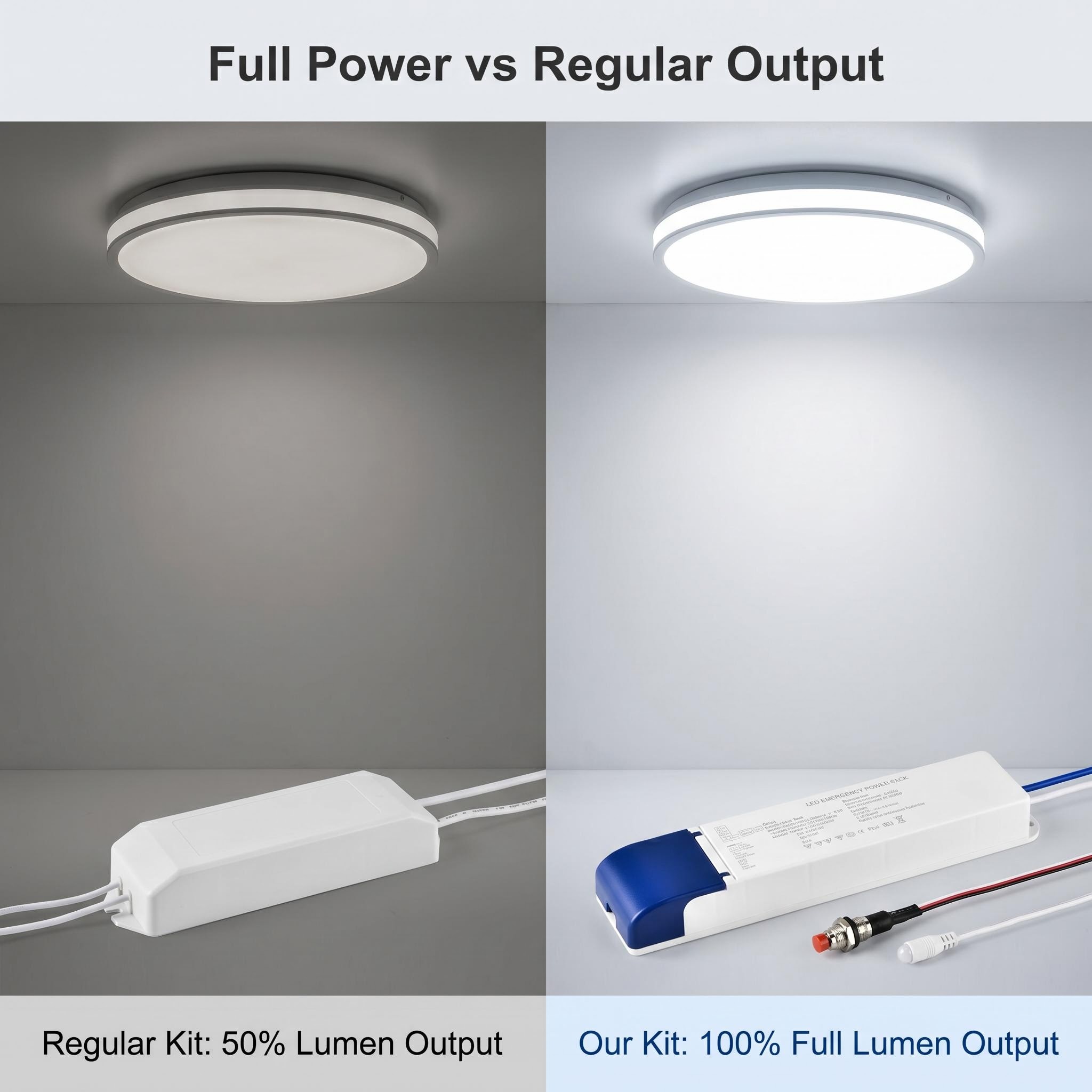
LED Emergency Driver Full Power Output Emergency Driver
Full power output drivers that keep the fixture at 100 percent light output during the emergency period instead of a reduced level.
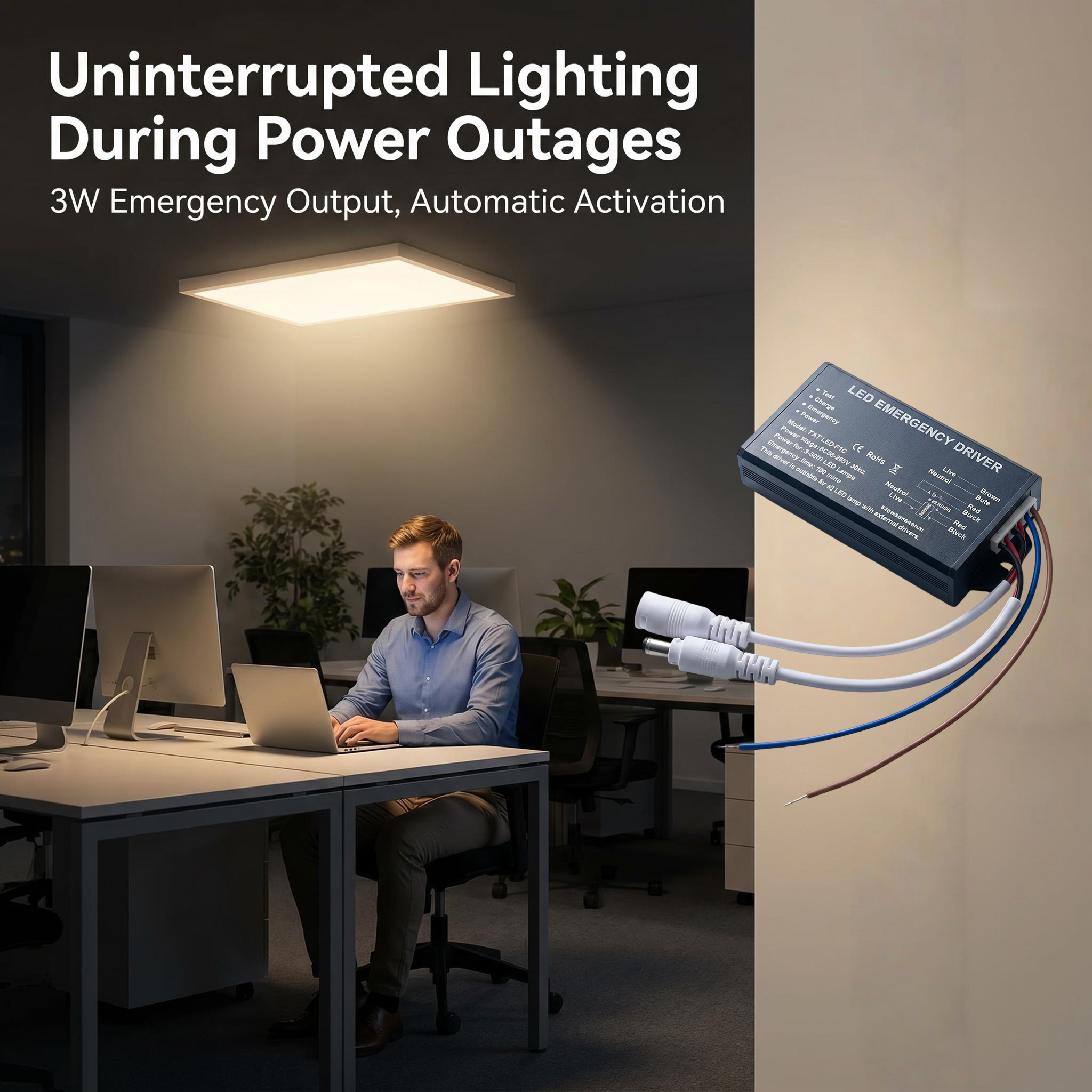
LED Emergency Driver For LED Panel Lights
Emergency drivers sized for 600×600 and 1200×300 LED panels with external drivers.
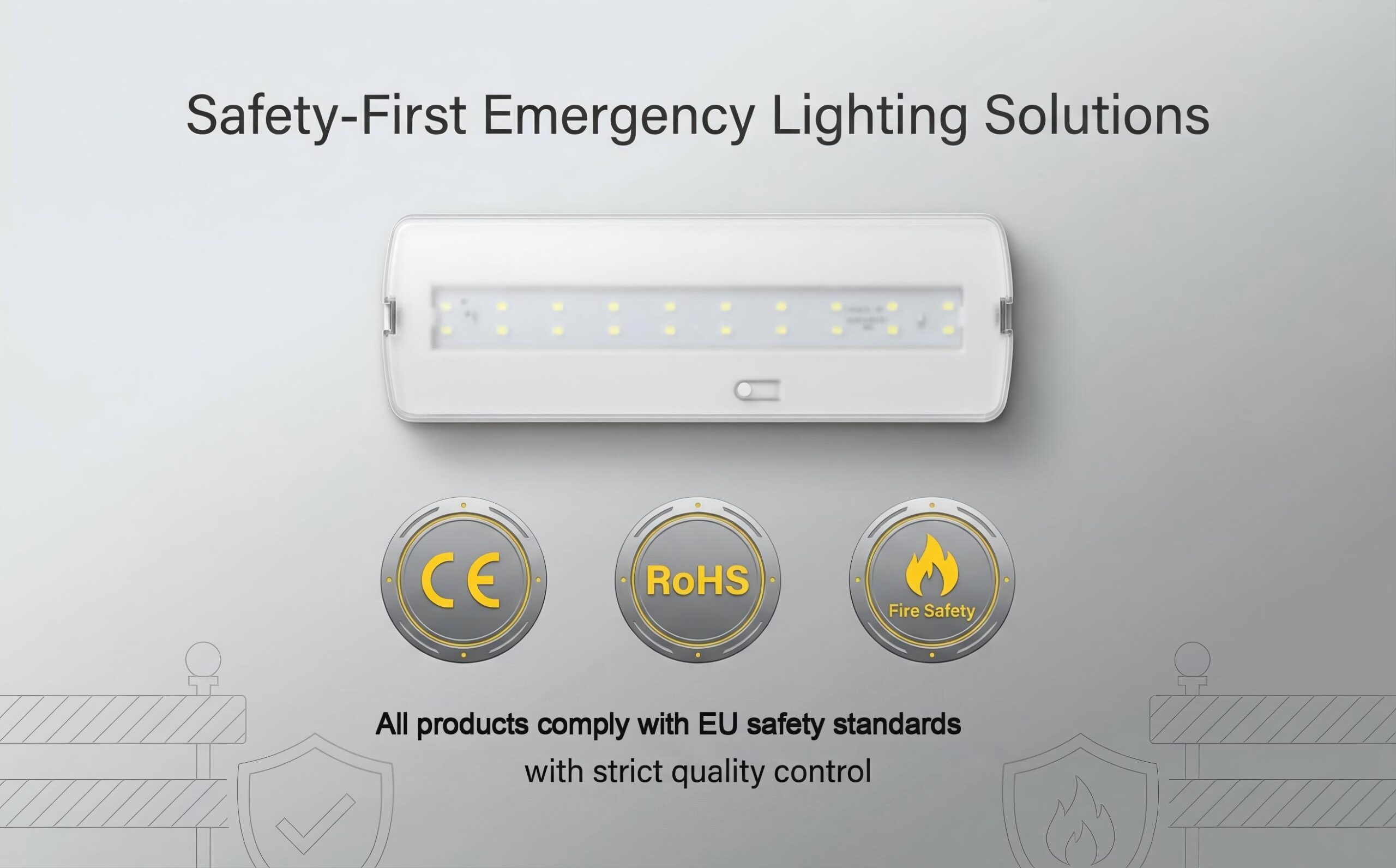
Hệ thống chiếu sáng khẩn cấp
Self-contained emergency lighting with selectable 90 minute to 3 hour duration and maintained or non-maintained wiring.
Frequently Asked Questions About Self-test Twin Spot Emergency Light
Minimum Order Quantity And Sample Policy
Q: What is the minimum order quantity and how quickly can I receive a sample?
MOQ is 100 units for standard SKUs, 300 units for OEM branding or custom colour temperature. Sample lead time is 5 to 7 working days from payment confirmation; bulk lead time is 25 to 35 days depending on battery chemistry and test firmware version. A single sample ships by air courier; bulk orders typically move sea freight FOB Shenzhen or CIF to named port.
Host Fixture Compatibility And Output Matching
Q: How do I confirm the twin spot suits my host fixture and what output options exist?
Check the emergency driver output window: typical units deliver DC 9-42V at 150-350mA constant current, driving 3W to 10W LED arrays per head. Emergency output is 120 to 350 lumens per head, roughly 10% to 30% of normal mains output depending on optic efficiency. Request the supplier’s load matching table and verify the total forward voltage of your LED module falls inside the driver’s DC output window.
Emergency Duration And Battery Chemistry
Q: What emergency durations are available and which battery chemistry should I specify?
Standard durations are 90 minutes, 2 hours and 3 hours. NiCd 3.6V 1500mAh packs suit 90-minute units at 3W; Li-ion 18650 3.7V 2200mAh or LiFePO4 3.2V 3000mAh packs suit 3-hour configurations at 4W to 6W. LiFePO4 offers 500 to 800 cycles versus 300 to 500 for standard Li-ion and 200 to 300 for NiCd. Charge time is 24 hours to full capacity per EN 62034. Replacement interval is 4 years for lithium chemistries, 3 years for NiCd in standard ambient conditions.
Maintained Versus Non-Maintained Wiring
Q: Can the unit operate maintained or non-maintained, and what wiring difference should my installer expect?
Non-maintained wiring uses switched live to the charging circuit only; the spotlight illuminates on mains failure. Maintained wiring requires permanent live plus switched live, with a changeover relay inside the unit that transfers the LED module to emergency inverter output when mains drops. Specify your requirement at order; the PCB population differs and field conversion is not recommended without factory reconfiguration.
Self-Test Facility Options
Q: What self-test options are available and how do they comply with EN 62034?
Options are manual test key, automatic self-test firmware, and DALI-2 emergency control gear interface. EN 62034 requires duration test at intervals not exceeding the rated duration, plus functional test at least monthly. Self-test units flash status via bi-colour LED: green for healthy, red for fault. DALI versions report test results to the central monitoring system with addressable fault codes. Confirm the firmware version supports your local variant of the standard.
Certification And Conformity Documentation
Q: Which test reports and conformity marks can be supplied for my destination market?
Ask the supplier to provide third-party test reports for the standards your market enforces: EN 60598-2-22 and EN 1838 for Europe; BS 5266-1 for UK projects; UL 924 for North America; AS/NZS 2293 for Australia and New Zealand. The supplier should show CB test certificates, EMC reports to EN 55015, and photometric data. Do not accept unverified mark artwork; request report numbers and issuing body names for customs verification.
Lithium Battery Shipping And Export Practicalities
Q: How do lithium batteries affect shipping mode and required documents?
Li-ion and LiFePO4 packs require UN 38.3 test summary, MSDS, and dangerous goods declaration for air freight (IATA PI 965 Section IB or II) and sea freight (IMDG Code). Single samples below 100Wh per pack travel by courier with simplified documentation. Bulk orders over 300 units typically move as Class 9 dangerous goods by sea to reduce freight cost. Confirm the supplier’s battery UN 38.3 test report covers the exact cell model and configuration in your unit.
Warranty Spare Parts And OEM Support
Q: What warranty, spare parts availability, and OEM branding options are offered?
Standard warranty is 3 years on electronics, 2 years on NiCd packs, 3 years on lithium packs. Spare battery modules and LED heads should be available for 5 years minimum post-production. OEM options include silk-screen logo, custom carton artwork, and neutral instruction manuals. Payment structure is typically 30% deposit, 70% against copy of bill of lading for established buyers; 100% advance for first orders under USD 10,000. Confirm the supplier maintains ageing test stations (minimum 2-hour burn-in at 40°C ambient) and hipot test records (1500VAC, 5mA leakage limit) for each production batch.
Important Notice
Specifications, output and duration figures and price ranges in this guide are indicative and are provided
for planning purposes only. Actual emergency output, duration, battery life, ingress protection and available conformity documentation
differ by model and by destination country, and emergency lighting design remains the responsibility of the project designer. Buyers
must confirm their own mains voltage and frequency, the emergency lighting standard enforced locally, the host fixture compatibility
and their import requirements before placing an order. All figures are subject to written confirmation in the final proforma invoice
issued by Hymark.
Sourcing Self-test Twin Spot Emergency Light from Hymark
What to Request Before You Place an Order
A qualified supplier should provide discharge duration records for the exact battery batch shipped with your units. Ask for the constant current inverter output window in DC volts and mA, the driven load in watts, and confirmation that the changeover relay switches within the time limits EN 60598-2-22 specifies. For self-test functionality, verify the automatic test interval aligns with EN 62034 and that the circuit can flag inverter, battery or lamp faults without manual intervention.
Battery traceability matters for air and sea freight. LiFePO4 packs at 3.2V or Li-ion 18650 cells require UN 38.3 test summaries for IATA and IMDG compliance; NiCd alternatives avoid lithium transport restrictions but add weight and reduce cycle life. Ask for the charge time in hours, the cycle life at rated depth of discharge, and whether the pack is replaceable without tools.
How Hymark Structures Production and Export
JIALINGHANG ELECTRONIC CO., LTD. was founded in 2013 as a global LED exporter in general illumination, shifted focus to LED emergency technology and high performance LED strips in 2017, and launched Hymark in 2026 as its premium brand. Product design and R&D are managed in house; manufacturing runs through partnered facilities that have operated since 2013, with SMT and final assembly lines producing emergency lighting, emergency exit signs, emergency luminaires, emergency twin spotlights, LED emergency drivers for LED high bays, panel lights, tubes and linear lights, full power output emergency driver, LED strip lights, COB LED strips and SMD LED strips.
This arrangement keeps engineering and global distribution under direct control while leveraging established assembly and ageing test capacity. Buyers receive selectable emergency duration—90 minutes, 2 hours or 3 hours—maintained or non-maintained wiring, OEM and ODM branding, export carton packing and FOB or CIF terms. Sample lead time is typically 7 to 10 working days for standard configurations.
Send Your Specification for a 24-Hour Quotation
Send the host fixture type and wattage, the emergency duration your code requires, your mains voltage, and your destination port. Hymark will return a quotation within 24 hours via WhatsApp or email with the matching inverter output window, battery specification, and packing configuration.
Get a Factory Direct Quote on Self-test Twin Spot Emergency Light
JIALINGHANG ELECTRONIC CO., LTD. has been in LED lighting since 2013 and has focused on
LED emergency technology and high performance LED strips since 2017. Hymark products are co-designed with our
dedicated manufacturing partners, built with selectable emergency duration and maintained or non-maintained wiring, and function
tested before packing. Send us the host fixture type and wattage, the emergency duration your local code requires, your mains
voltage and your destination port and we will return a quotation within 24 hours.

 English
  Spanish
  Arabic
  French
  German
  Russian
  Portuguese
  Italian
  Vietnamese