
LED Emergency Driver Buyer Guide
An LED emergency driver converts mains AC to DC battery charge during normal operation and, on power failure, inverts the stored DC back to a constant current DC output that keeps the host fixture alive. Typical entry-class units deliver 3W to 5W emergency output (roughly 10% to 20% of a 25W panel’s normal lumens) for 90 minutes from a 3.2V LiFePO4 2200mAh or 3.7V Li-ion 18650 2600mAh pack; mid-class drivers reach 8W to 15W (25% to 50% of normal output) for 2 hours via 7.4V or 11.1V Li-ion configurations; high-class full-power models match 100% of normal fixture output for 3 hours using 22.2V LiFePO4 packs from 6000mAh to 12000mAh, with charge cycles of 500 to 1500 depending on chemistry depth of discharge.
The rest of this page breaks down every line of an emergency driver datasheet across these three classes, explains what each parameter means for compliance and installation, and flags where a number on paper may not match what the inspector or local code actually requires.
Input Voltage And Frequency Range
Entry-class drivers typically accept AC 85V–265V at 50/60Hz, covering most global markets in one SKU. Mid and high-class drivers for European projects often narrow to AC 220V–240V or expand to AC 100V–277V for North American 277V branch circuits. The datasheet line to verify: does the unit tolerate the nominal plus 10% tolerance your local supply actually delivers? A driver rated 220V–240V but not 253V peak will fail prematurely on a stiff grid.
Emergency Output Window And Driven Load
The datasheet lists output voltage and current, not wattage directly. A typical entry driver shows DC 12V–40V at 150mA constant current, meaning the driver hunts for the voltage at which 150mA flows; if your LED module forward voltage sits at 30V, the delivered emergency power is 4.5W. Mid-class units may offer DC 20V–60V at 250mA to 350mA. High-class full-power drivers for LED high bays or panels specify DC 100V–200V at 500mA to 700mA, matching the original driver output so the fixture produces identical lumens in emergency mode. The critical check: the LED module’s total forward voltage must fall inside the driver’s output window, or the inverter cannot regulate.
Battery Chemistry Capacity And Cycle Life
Entry units commonly use single-cell LiFePO4 3.2V 2200mAh (7.04Wh) or Li-ion 18650 3.7V 2600mAh (9.62Wh), yielding 90 minutes at 3W to 5W with margin. Mid-class series strings of two to three 18650 cells deliver 7.4V 5200mAh (38.48Wh) or 11.1V 3500mAh (38.85Wh), supporting 2 hours at 10W to 12W. High-class LiFePO4 packs at 22.2V 6000mAh (133.2Wh) sustain 3 hours at 40W full output. Cycle life differs sharply: LiFePO4 typically achieves 1500 cycles at 80% depth of discharge; standard Li-ion 18650 around 500 to 800 cycles; NiCd, still found in legacy designs, offers 300 to 500 cycles but tolerates wider temperature swings. Ask the supplier for the IEC 62133 or UN 38.3 test report if lithium cells are involved, customs in most jurisdictions require this for battery shipments.
Emergency Duration And Lumen Percentage
EN 1838 and BS 5266-1 specify minimum illuminance on escape routes; the driver datasheet must show duration, not merely battery capacity. Entry 90-minute units suit UK and EU open-area applications where 1 lux minimum suffices. Two-hour duration meets deeper UK requirements and many Middle Eastern codes. Three-hour duration is mandatory for UK sleeping accommodation, healthcare, and assembly buildings per BS 5266-1, and for some Southeast Asian high-rise codes. The lumen percentage line on the datasheet—often 10%, 25%, 50%, or 100%—must be cross-checked against the host fixture’s normal output: a 4000lm panel at 10% delivers 400lm, which may or may not hit the required point lux depending on room geometry and mounting height.
Test Facility And Wiring Mode
Self-test per EN 62034 automates monthly function and annual duration tests, reporting fault status via LED indicator or volt-free contact. DALI emergency test integration adds addressable reporting to the building management system, but requires a DALI-2 input device certified bus. Manual test key is the minimum; the installer holds a switch for 30 seconds to simulate failure. Maintained wiring powers the emergency driver from a switched live so the fixture is lit during normal use; non-maintained wiring uses an unswitched permanent live, keeping the battery charged but the lamp off until power failure. The datasheet must state compatibility: some drivers are maintained-only, some switchable via DIP or wiring configuration.
Physical Ratings And Thermal Range
IP rating on the driver housing, not merely the completed luminaire, matters for recessed ceiling plenum installations where condensation occurs. Entry drivers are often IP20; mid and high-class units for industrial or outdoor host fixtures trend to IP65 with sealed cable glands. Ambient temperature range for lithium chemistries typically spans 0°C to 45°C charging, -20°C to 60°C discharge; NiCd extends charging to -10°C or lower. The datasheet line “ta” or “ambient” must cover your installed location, battery capacity derates sharply above 35°C.
What To Request Beyond The Datasheet
A specification sheet is a design intent document. Before shortlisting, request the factory test report showing actual output voltage regulation at 25% and 100% battery state, the battery cell manufacturer’s own cycle life data at the declared discharge depth, and the conformity assessment documentation for the target market—CE DoC referencing EN 60598-2-22 for Europe, UKCA for Great Britain, UL 924 file number for North America, or AS/NZS 2293 test reports for Australasia. Verify that the model number on the datasheet matches exactly the certification paperwork; OEMs often carry multiple variants under similar series names with different approvals.
Types and Configurations of LED Emergency Driver
Parameter Table Across Entry Mid and High Classes
| Parameter | Entry Class | Mid Class | High Class |
|---|---|---|---|
| Driven load | 3–10 W | 10–25 W | 25–60 W |
| Emergency output | 10–30 % of normal lumen output | 30–50 % of normal lumen output | 50–100 % (full power) |
| Emergency duration | 90 minutes | 90 minutes or 3 hours | 2 hours or 3 hours |
| Input voltage | AC 220–240 V 50 Hz | AC 85–265 V 50/60 Hz | AC 100–277 V 50/60 Hz |
| Output window | DC 9–42 V, 150–350 mA | DC 9–60 V, 200–700 mA | DC 24–250 V, 300–1500 mA |
| Battery chemistry | NiCd 3.6 V 600–1200 mAh | Li-ion 18650 3.7 V 2000–2600 mAh | LiFePO4 3.2 V 3000–6000 mAh |
| Charge time | 16–24 hours | 12–16 hours | 6–10 hours |
| Cycle life | 300–500 cycles | 500–800 cycles | 1500–2500 cycles |
| Test facility | Manual test key only | Self-test per EN 62034 | Self-test plus DALI-2 |
| Wiring mode | Không được bảo trì | Maintained or non-maintained | Maintained or non-maintained |
| IP rating | IP20 internal | IP20 or IP65 | IP65 or IP66 |
| Ambient temperature | 0 °C to +45 °C | -10 °C to +50 °C | -20 °C to +55 °C |
Reduced Power Output Drivers
These units deliver 10 % to 30 % of normal luminaire output in emergency mode, typically 150 to 400 lm for a panel or tube that normally produces 1500 to 3000 lm. Electrical contractors buy them for cost-sensitive retrofits where the priority is code compliance rather than task visibility. The battery pack is usually NiCd 3.6 V 600 mAh or small Li-ion 18650 3.7 V 1500 mAh, keeping the module compact for installation inside slim LED panel housings. What they cannot do: illuminate a workspace adequately for safe egress if the normal luminaire was already marginal on output; EN 1838 and BS 5266-1 set minimum lux levels on escape routes that a 10 % output may fail to meet in high-ceiling or wide-area applications. Buyers should verify the supplier’s photometric data for the complete luminaire-plus-driver combination, not the driver alone.
Full Power Output Drivers
Full power emergency drivers maintain 100 % of normal lumen output during mains failure, drawing from a LiFePO4 3.2 V 3000 mAh to 6000 mAh pack or a multi-cell Li-ion configuration. M&E consultants specify these for open-plan offices, retail floors, and industrial aisles where maintained operation is critical for business continuity or where safety regulations mandate full illumination. The constant-current inverter must match the LED module’s forward voltage and current precisely; a mismatch causes flicker or premature LED degradation. What they cannot do: fit into tight enclosures—the battery volume is roughly 3× to 5× that of a reduced-power equivalent, and the thermal management for sustained full-power discharge adds 20 mm to 40 mm to module depth. Luminaire OEMs need to redesign housing cavities rather than simply swapping in a full-power driver.
Maintained Versus Non-Maintained Configurations
Non-maintained drivers sit dormant during normal operation, charging the battery while the luminaire runs on mains power; on failure, the changeover relay switches the LED module to inverter output within 0.5 seconds per EN 60598-2-22. Maintained drivers keep the LED energised at all times from the inverter circuit, with the battery trickle-charging in parallel; this suits corridors and stairwells where the fitting must function as both normal and emergency luminaire. Lighting designers favour maintained wiring for aesthetic consistency—no visible difference between normal and emergency fittings. What it cannot do: reduce component count or cost. Maintained drivers require a changeover relay rated for continuous duty and generate more standby heat, shortening NiCd cycle life to 300–400 cycles versus 500+ in non-maintained use. Facility managers should confirm the wiring diagram on the emergency driver datasheet matches their existing switch lines before ordering.
Self-Test and DALI-Equipped Drivers
Self-test drivers automate the monthly functional test and annual duration test required by EN 62034 and BS 5266-1, reporting fault status via an LED indicator or volt-free contact. DALI-2 emergency drivers integrate into building management systems, transmitting test results, battery health, and remaining capacity to a central panel. Building managers responsible for life safety compliance in multi-tenant offices or hospitals buy these to eliminate manual test logs and reduce maintenance contractor callouts. What they cannot do: operate without a compatible DALI bus power supply and addressing scheme; a standalone DALI driver in a non-DALI installation is an expensive manual-test unit with unused pins. Procurement officers should specify whether they need DALI-209 (emergency) compatibility or basic DALI broadcast dimming, as firmware revisions vary by supplier.
Panel Tube and Linear Specific Drivers
These are form-factor variants optimised for the mechanical and electrical constraints of their target luminaire. Panel drivers (for 600×600 mm or 1200×300 mm edge-lit or backlit panels) spread the battery pack along the frame rail, using output windows of DC 36–42 V at 300–500 mA to match panel LED strings. Tube drivers fit inside 25 mm diameter T8 or T5 housings, requiring cylindrical battery packs of Li-ion 18650 cells in 2S or 3S configuration, with output at DC 18–36 V and 150–250 mA. Linear drivers for continuous-run trunking or pendant systems offer longer cut lengths and higher wattage, up to 40 W emergency output across 1200 mm or 1500 mm modules. What they cannot do: cross-compatibly swap between formats—a panel driver with 42 V output will overdrive a 18 V tube string, and a tube driver’s 150 mA current starves a panel designed for 500 mA. OEMs adding emergency versions to their fixtures must match the led emergency driver specifications to the original LED module’s I-V curve, not just the housing dimensions.
High-Bay and Industrial Drivers
Built for LED high bays from 50 W to 200 W normal rating, these drivers deliver 10 W to 40 W emergency output from LiFePO4 packs of 12.8 V 4000 mAh to 12.8 V 8000 mAh, achieving 3-hour duration at height. The inverter output runs DC 100–250 V to match the series-parallel LED arrays common in high-bay optics, with IP65 or IP66 enclosures to survive dust and moisture in warehouses and manufacturing plants. IK08 or IK09 impact resistance protects against forklift collisions. What they cannot do: provide full power at 15 m mounting height with a small battery—the lumen maintenance over 3 hours drops as cell voltage sags, and high-bay optics with narrow beam angles concentrate the reduced output into a pool that may miss peripheral aisles. Industrial procurement officers should request third-party photometric files for emergency mode, not rely on normal-mode IES files scaled by percentage.
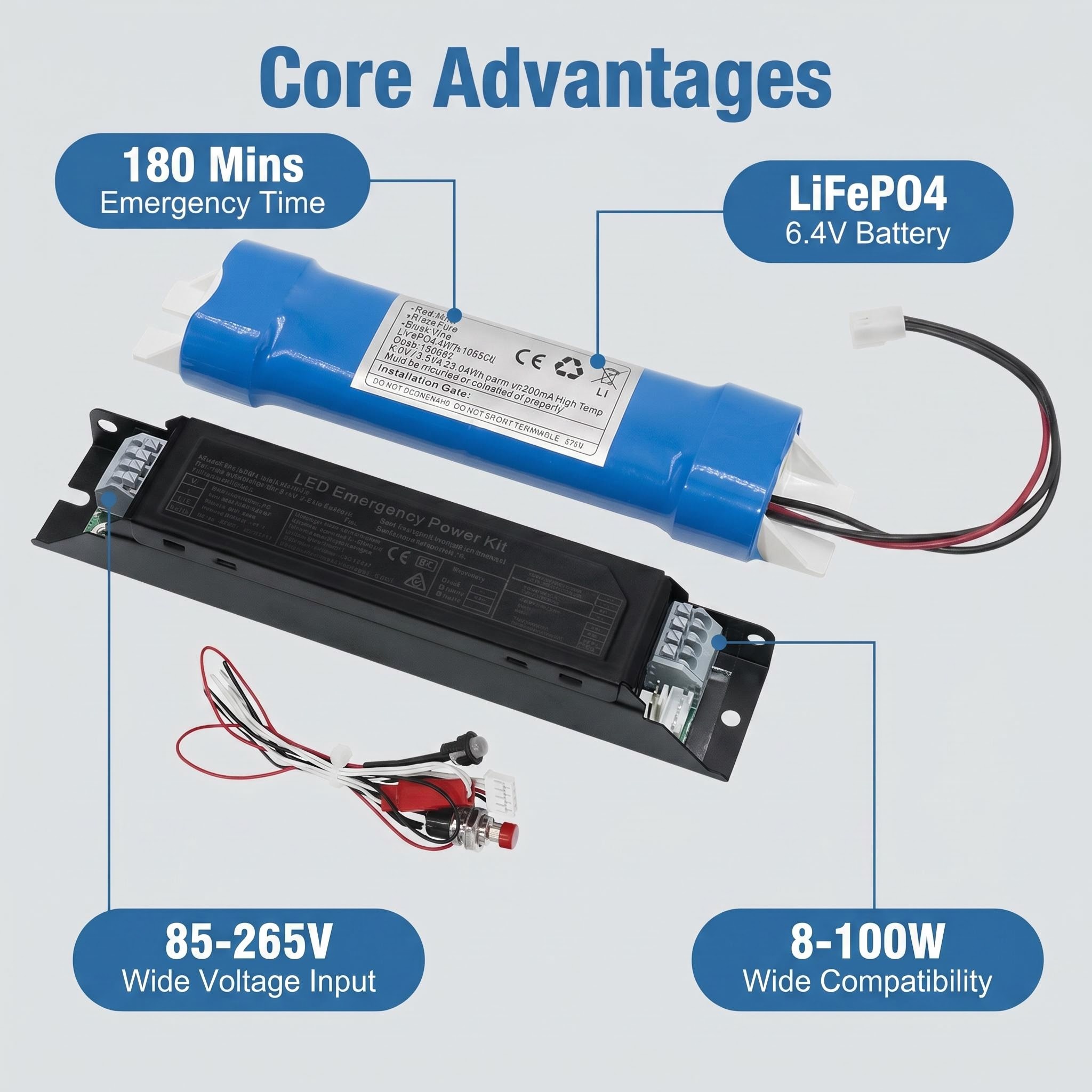
Specifications and How to Read Them
| Parameter | Entry Level | Mid Range | High Specification |
|---|---|---|---|
| Input Voltage / Frequency | AC 85-265V 50/60Hz | AC 100-277V 50/60Hz | AC 220-240V 50Hz or AC 120-277V 50/60Hz |
| Driven Load (Normal Mode) | 8-18W | 10-40W | 20-60W |
| DC Output Voltage Window | 25-80V | 30-120V | 40-250V |
| DC Output Current | 150-350mA constant current | 200-700mA constant current | 300-1400mA constant current |
| Đầu ra khẩn cấp | 3W, ~200-300lm, 25% of normal | 5W, ~400-550lm, 30% of normal | 10W, ~900-1200lm, 40% of normal |
| Thời gian khẩn cấp | 90 minutes | 120 minutes | 180 minutes |
| Battery Chemistry | NiCd 3.6V 1500mAh | Li-ion 18650 3.7V 2600mAh | LiFePO4 3.2V 3000mAh |
| Charge Time | 24 hours | 16 hours | 8 hours |
| Cycle Life | 300-500 cycles | 500-800 cycles | 1500-2000 cycles |
| Test Facility | Manual test key | Self-test per EN 62034 | Self-test + DALI-2 emergency |
| Wiring Mode | Non-maintained only | Non-maintained, maintained optional | Maintained / Non-maintained selectable |
| IP / IK Rating | IP20 / IK03 | IP30 / IK05 | IP65 / IK08 |
| Ambient Temperature | 0°C to +45°C | -10°C to +50°C | -20°C to +55°C |
| Dimensions (L×W×H) | 120×40×25mm | 160×50×30mm | 200×60×35mm |
| Mounting | Plastic clips | Metal brackets with screws | Steel tray with quick-release |
Input Voltage Range and Frequency
The first line of any emergency driver datasheet tells you where the product can be installed. AC 85-265V 50/60Hz covers virtually every mains supply worldwide: 120V in North America, 230V across Europe and the Middle East, 220V in Southeast Asia and Latin America. AC 100-277V is the North American commercial range that captures 277V branch circuits common in US factories and retail spaces. A driver marked AC 220-240V only will not start on 120V and will fail in a US retrofit.
Frequency matters for the changeover relay timing and the battery charger circuit. Most modern drivers accept 50Hz or 60Hz automatically, but verify this if your project spans Saudi Arabia (60Hz) and Nigeria (50Hz).
Driven Load in Watts
This figure defines the normal-mode LED load the driver can support. It is not the emergency output. An 18W entry-level driver runs an LED panel at full brightness during mains-present conditions and switches to emergency mode when power fails. The emergency inverter inside the driver is sized separately.
Oversizing the normal load creates no benefit and may shorten inverter life. Undersizing leaves lumens on the table. Match the driver to the LED module’s actual power draw, not the fixture’s marketing wattage.
DC Output Voltage Window and Current
LEDs need constant current, not constant voltage. The datasheet shows a DC voltage window (for example 30-120V) and a constant current (for example 350mA). The driver automatically adjusts its output voltage to maintain that current across the forward-voltage range of the LED string.
If your LED module’s forward voltage is 36V at 350mA, the driver sits at the bottom of its window. If the module is 108V, the driver sits near the top. Exceed the window and the driver cannot regulate; the emergency output will flicker or shut down.
Emergency Output in Lumens and Percentage of Normal
EN 1838 and BS 5266-1 do not mandate a specific wattage in emergency mode. They mandate minimum illuminance on the escape route: 1 lux minimum on the centre line for open areas, 0.5 lux minimum for anti-panic areas. The driver datasheet translates this into lumens at the source so you can verify photometric calculations.
Entry-level drivers typically deliver 25% of normal light output. Mid-range units reach 30-35%. High-specification drivers with LiFePO4 packs and efficient inverters may achieve 40% or higher. A 40W panel dropping to 10W emergency output (40%) gives roughly 900-1200 lumens depending on LED efficacy. This is easier to achieve with modern 180-200 lm/W panels than with legacy 100 lm/W modules.
Thời gian khẩn cấp
90 minutes satisfies EN 60598-2-22 and BS 5266-1 for most UK and European commercial buildings. 120 minutes is common in healthcare, assembly halls, and jurisdictions with extended egress requirements. 180 minutes (3 hours) appears in high-rise, tunnel, and critical infrastructure specifications in the Middle East and parts of Southeast Asia.
Duration is tested at the rated emergency load and at the bottom of the ambient temperature range. A driver rated for 90 minutes at +25°C may deliver only 70 minutes at 0°C if the battery chemistry is NiCd or standard Li-ion. LiFePO4 retains capacity better across temperature.
Battery Chemistry Voltage and Capacity
| Chemistry | Nominal Voltage | Typical Capacity | Energy Density | Temperature Resilience | Cycle Life |
|---|---|---|---|---|---|
| NiCd | 1.2V/cell, 3.6V pack | 1500-1800mAh | Low | Good to -20°C | 300-500 |
| Li-ion 18650 | 3.6-3.7V/cell | 2000-3500mAh | High | Poor below 0°C | 500-800 |
| LiFePO4 | 3.2V/cell | 2000-4000mAh | Medium | Excellent to -20°C | 1500-2000 |
Capacity in mAh alone is misleading. Multiply by voltage to compare energy: NiCd 3.6V × 1500mAh = 5.4Wh versus LiFePO4 3.2V × 3000mAh = 9.6Wh. The LiFePO4 pack stores nearly twice the energy in a similar volume, which directly extends duration or raises emergency wattage.
Ask suppliers for the UN 38.3 test report for lithium-based packs. This is mandatory for air freight and enforced by IATA and IMDG regulations. NiCd packs face fewer transport restrictions but contain cadmium, which triggers RoHS and WEEE obligations in the EU and UK.
Charge Time and Cycle Life
Trickle charge maintains the battery at full capacity during mains-present conditions. Fast charge restores a depleted battery after a discharge test. Entry-level NiCd systems need 20-24 hours to full charge. Li-ion and LiFePO4 systems with intelligent chargers achieve 8-16 hours.
Cycle life defines how many full discharge-charge cycles the battery completes before capacity drops to 80% of rated. Self-test systems that exercise the battery monthly consume cycles. A 500-cycle Li-ion pack in a monthly-test installation reaches end-of-life in roughly 20 years of calendar use, but calendar ageing (chemical degradation regardless of use) typically limits practical life to 8-10 years. LiFePO4 at 1500+ cycles outlasts the LED module in most fixtures.
Test Facility
Manual test key: A physical switch or fuse bypass that forces emergency mode. Requires a maintenance visit to operate and log results. Satisfies older versions of BS 5266-1 but creates compliance risk if tests are missed.
Self-test per EN 62034: The driver automatically exercises the battery at programmed intervals (typically monthly functional tests, annually for full-duration tests). Status LEDs on the driver or remote indicator report pass/fail. Reduces maintenance labour and creates auditable records.
DALI-2 emergency: Integrates with building management systems via the DALI bus. Reports individual device status, battery health, remaining capacity, and fault codes to a central panel. Specified in new-build offices and smart buildings in the UK, Germany, and the UAE.
Maintained or Non-Maintained Wiring
Không được bảo trì: The emergency driver is energised only when mains fails. The LED module is dark or fed by a separate normal driver during mains-present conditions. Simpler wiring, lower energy use, standard for standalone emergency luminaires.
Được duy trì: The emergency driver feeds the LED module continuously during normal operation, often through a changeover relay that switches to battery power on mains failure. Required in spaces where the luminaire is the normal working light and must stay illuminated during emergency operation. Common in LED panels and linear lights that serve as both general and emergency lighting.
The datasheet specifies whether the driver supports maintained mode, and whether a changeover relay is internal or requires external wiring.
IP and IK Rating
| Rating | Bảo vệ | Typical Application |
|---|---|---|
| IP20 | Fingers and solid objects >12mm | Indoor ceiling voids, office panels |
| IP30 | Tools and wires >2.5mm | Semi-protected plant rooms |
| IP65 | Dust-tight, low-pressure water jets | Carparks, tunnels, food production |
| IK03 | 0.35 joule impact | Domestic and light commercial |
| IK05 | 0.7 joule impact | Schools, public corridors |
| IK08 | 5 joule impact | Industrial, vandal-prone areas, prisons |
IP and IK are tested as a complete luminaire, not the driver alone. A driver marked IP65 must be installed in a matching IP65 housing to claim the rating.
Ambient Temperature Range
Battery capacity and charger efficiency collapse at temperature extremes. 0°C to +45°C is the safe harbour for NiCd and basic Li-ion. -10°C to +50°C suits unheated UK plant rooms and Middle East roof voids. -20°C to +55°C covers cold-storage warehouses and outdoor Gulf installations.
Check whether the duration rating is derated at the temperature extremes. Some datasheets quote 90 minutes at +25°C but only 60 minutes at 0°C.
Dimensions and Mounting
Entry-level drivers at 120×40×25mm fit inside slim LED panels with 25mm ceiling void clearance. Mid-range units at 160×50×30mm need deeper housings or external mounting in a ceiling rose. High-specification drivers at 200×60×35mm with steel trays suit high-bay fixtures and linear trunking systems.
Verify terminal orientation: end-entry versus side-entry affects wiring congestion in narrow housings. Check cable gland positions if the driver mounts in an IP65 enclosure.
Reading an Emergency Driver Datasheet as a Non-Engineer
Start with the application drawing usually found on page two or three. Identify your LED module’s forward voltage and current from its own datasheet. Confirm the driver’s DC output window envelopes this point. Check the emergency output percentage against your lux-point calculation: if the normal fixture delivers 500 lux on the task plane and you need 1 lux on the escape route, 25% output (125 lumens at source, perhaps 0.8 lux after optical losses and distance) may be marginal.
Cross-reference the battery chemistry against your project’s environmental temperature và maintenance regime. A self-test LiFePO4 driver costs more upfront than a manual-test NiCd unit, but eliminates quarterly maintenance visits and replaces less often.
Confirm the test facility against your client’s specification. A DALI-2 driver cannot deliver smart-building integration if the BMS only speaks BACnet. A manual-test driver in a hospital creates audit failure risk.
Trade Terms and Export Practicalities
| Term | Meaning | Risk Allocation |
|---|---|---|
| EXW | Ex Works: buyer collects from factory | Buyer bears all cost and risk from factory gate |
| FOB | Free On Board: seller loads vessel at named port | Risk transfers when goods cross ship’s rail |
| CFR | Cost and Freight: seller pays to destination port | Buyer bears risk at loading, pays unloading and onward |
| CIF | Cost Insurance Freight: seller pays freight and insurance to port | Buyer bears risk at loading; insurance claim is buyer’s problem if damage occurs |
| L/C | Letter of Credit: bank guarantees payment against documents | Seller protected if documents conform; buyer protected if documents describe goods correctly |
| T/T | Telegraphic Transfer / bank wire: direct payment | Fast, no document check; requires trust in supplier |
HS code 9405.40.90 covers “other electric lamps and lighting fittings” including emergency drivers in most customs tariff schedules. Verify with your freight forwarder whether the destination country classifies drivers as luminaire parts (9405) or electrical power supplies (8504).
CE marking indicates conformity with EU directives (EMC, LVD, RoHS). UKCA marking is required for Great Britain (England, Scotland, Wales) since Brexit. Northern Ireland retains CE under the Windsor Framework. A driver with CE but not UKCA cannot clear UK customs legally after 31 December 2024 for most product categories.
UN 38.3 is the lithium battery transport test: altitude simulation, thermal cycling, vibration, shock, external short circuit, crush, forced discharge. Request the UN 38.3 test summary (mandatory since 2020) before booking air freight. Sea freight under IMDG requires the same documentation plus proper dangerous goods labeling on cartons: Class 9 miscellaneous, UN 3480 or UN 3481 depending on whether batteries ship alone or with equipment.
Packing and Documentation
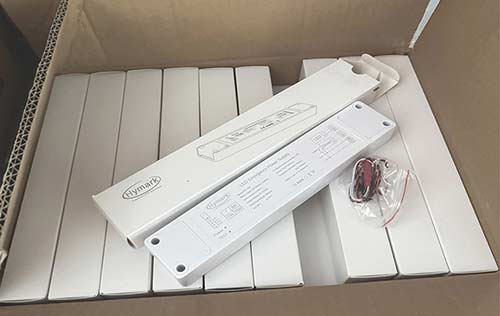
Standard carton packing: individual box with foam insert, 50-100 units per master carton, 10-12 master cartons per pallet. Request a packing list showing net weight, gross weight, and carton dimensions for freight calculation. A certificate of origin (often Chamber of Commerce stamped) may be required for preferential tariff treatment under trade agreements.
MOQ for branded emergency drivers typically runs 500-1000 units for factory orders. Sample policy: 1-5 units at 1.5×-2× production unit cost, air freight collect, refundable against first production order. Lead time from confirmed PO: 30-45 days for standard specifications, 60-75 days for custom output windows or DALI firmware variants.
Ask the supplier to confirm which standards the product is designed to meet, then request third-party test reports (not certificates) for EN 60598-2-22, EN 62034, or UL 924 as applicable. A test report from an accredited lab demonstrates due diligence even if full certification is not pursued for the specific model variant.
LED Emergency Driver Price and What Drives It
| Class | Typical Rating or Output | Duration or Runtime | Indicative FOB USD |
|---|---|---|---|
| Entry | 3W–5W emergency, 10%–30% of normal lumen output | 90 minutes | $4.50–$7.00 |
| Mid | 5W–10W emergency, 30%–50% of normal lumen output | 90 minutes or 3 hours | $8.00–$14.00 |
| High | 10W–20W emergency, 50%–100% of normal lumen output | 2 hours or 3 hours, self-test/DALI | $16.00–$28.00 |
Battery Cells and Chemistry
The battery pack is typically the single largest cost component. Entry-class units often use NiCd 3.6V 700mAh–1200mAh packs, costing less upfront but delivering 300–500 cycles and requiring replacement every 3–4 years under EN 62034 testing regimes. Mid-range products shift to Li-ion 18650 3.7V 2000mAh–2600mAh cells, offering 500–800 cycles and faster charge times of 12–16 hours versus 20–24 hours for NiCd. High-class drivers increasingly specify LiFePO4 3.2V 3000mAh–6000mAh configurations, achieving 1500–2500 cycles with 4–6 hour charge times and stable thermal performance across -20°C to +60°C ambient. LiFePO4 costs 40%–60% more per watt-hour than Li-ion 18650, but the cycle life difference reshapes five-year ownership math.
Driver and Inverter Electronics
The constant-current inverter stage converts battery DC to the output window required by the LED load—typically DC 9V–60V at 150mA–700mA for panel and linear applications, or DC 36V–240V for tube-compatible designs. The inverter must maintain output within ±10% across battery discharge curve and temperature extremes per EN 60598-2-22. A changeover relay for maintained/non-maintained switching adds $0.80–$1.50 in component cost. Higher-class units integrate dimming compatibility and wider input voltage ranges (AC 85-265V or 100-277V versus single-voltage AC 220-240V), requiring larger capacitors and wider-tolerance magnetics.
LED Package and Load Matching
Where the emergency driver includes its own LED package rather than driving existing luminaire LEDs, the LED efficacy and thermal design directly impact battery sizing. A 5W emergency output at 120 lm/W requires 42 LED lumens; at 90 lm/W, the same perceived light needs 5.6W and a 33% larger battery. Buyers should verify whether quoted emergency lumens assume the driver alone or the complete emergency luminaire.
Enclosure Hardware and Thermal Design
IP20 open-frame drivers occupy the entry tier. IP65 polycarbonate or die-cast aluminium enclosures with gasketed cable entries add $2.00–$4.50. IK08–IK10 impact ratings for public or industrial environments require additional metalwork or reinforced housings. Ambient temperature ratings of 0°C to +45°C versus -20°C to +60°C determine silicone potting compound selection and PCB copper weight—2oz copper minimum for sustained high-temperature operation.
Test and Certification Cost Amortisation
Third-party approval to EN 60598-2-22, EN 1838 and EN 62034 involves initial testing fees of $8,000–$25,000 per product family depending on laboratory and scope. For a 2,000-unit production batch, this contributes $4.00–$12.50 per unit. UL 924 approval for North American markets typically runs $15,000–$35,000. AS/NZS 2293 certification for Australia adds separate testing. These costs compress dramatically at volume: 10,000-unit batches spread the same overhead at $0.80–$3.50 per unit. A supplier offering prices 30% below market without demonstrated certificate ownership is likely either absorbing these costs unsustainably or operating without tested compliance.
Assembly Labour and Export Packing
Labour content is modest—$0.60–$1.20 per unit for PCB loading, battery welding, enclosure assembly and functional burn-in. Export packing adds $0.40–$0.80: individual carton with foam insert, master carton of 20–50 units, palletised to 500–800 units for sea freight. Lithium battery restrictions under UN 38.3, IATA and IMDG require hazardous goods documentation, lithium battery labels, and often limited quantities per carton for air freight—typically 35kg net lithium content per transport unit, pushing high-volume orders toward sea freight despite 25–35 day transit times.
Freight Insurance and Destination Charges
FOB Shenzhen pricing excludes sea freight ($300–$800 per cubic metre to Europe or UK), marine insurance at 0.15%–0.3% of CIF value, and destination charges: UK import duty at 2.7%–4% on emergency lighting, 20% VAT, plus customs clearance fees of £80–£150. Middle Eastern markets may add 5% duty plus local standards testing fees. African and Latin American destinations face higher freight costs and extended customs processing.
Why the Cheapest Quote Differs
The lowest-priced emergency driver datasheet normally reflects one or more of: a NiCd 600mAh cell delivering 90 minutes at 3W but only 200 cycles; a 10% emergency output ratio that may not meet EN 1838 minimum illuminance requirements for the specific application; absence of self-test circuitry requiring manual monthly key testing; or an untested design with no valid test report traceable to an accredited laboratory. These trade-offs are legitimate for price-sensitive markets with relaxed enforcement, but create compliance exposure in jurisdictions with active building control inspection.
Five-Year Running Cost Comparison
| Cost Element | Entry Class (NiCd 3.6V 1200mAh) | Mid Class (Li-ion 18650 3.7V 2600mAh) | High Class (LiFePO4 3.2V 5000mAh) |
|---|---|---|---|
| Initial FOB unit cost | $6.00 | $11.00 | $22.00 |
| Battery replacement cycle | Year 3 | Year 4–5 | Year 7–10 (none in 5yr) |
| Battery replacement cost (installed) | $8.00 | $12.00 | N/A within 5yr |
| Annual testing labour: manual 30min @ $45/hr | $22.50 | N/A (self-test) | N/A (self-test/DALI) |
| Annual testing labour: DALI automated | N/A | N/A | $3.00 system licence |
| Expected failure rate | 8%–12% | 3%–5% | 1%–2% |
| Replacement unit cost (Year 2–5 average) | $6.00 | $11.00 | $22.00 |
| 5-year total per installed unit | $55–$68 | $42–$50 | $37–$45 |
The entry-class hardware saves $5–$16 at purchase but accumulates higher lifecycle costs through battery replacement, manual testing burden, and earlier failure. The crossover point where LiFePO4 delivers lowest total cost typically occurs between 3.5 and 5 years depending on local labour rates and testing regime requirements under BS 5266-1 or equivalent national codes.
What to Request from the Supplier
When reviewing an emergency driver datasheet, ask for: the complete battery specification including chemistry, voltage, capacity and cycle life at 25°C; the output window in DC volts and mA with tolerance; the driven load wattage at beginning and end of emergency duration; charge time from deep discharge; self-test or DALI test interval programming; IP and IK ratings with test standard references; and ambient temperature operating range. Request a copy of the third-party test report (not a supplier declaration) showing compliance to the standards applicable in your destination market—EN 60598-2-22 and EN 1838 for Europe, UL 924 for North America, or AS/NZS 2293 for Australia and New Zealand. Verify that the report scope covers the exact model number and rating on the datasheet, not a similar product in the same family.
Industry Applications for LED Emergency Driver
A LED emergency driver is only useful when it matches the hazards and compliance rules of the space it serves. The table below maps six common sectors to the specification lines that matter on an emergency driver datasheet, followed by short case notes on each.
| Sector | Typical Installation | Recommended Specification | Why This Product Fits |
|---|---|---|---|
| Commercial Offices and Fit-Outs | Recessed LED panels, 600×600 mm or 1200×300 mm, suspended or ceiling-void mounted | Input AC 220–240V 50/60 Hz; emergency output 3–10W at 50–100% of normal lumen output; LiFePO4 3.2V 1500–3000 mAh; 90-minute duration; self-test or DALI-2 per EN 62034; maintained or non-maintained wiring | Open-plan floors need uniform escape-route lux levels; self-test reduces maintenance access to ceiling voids |
| Hospitals and Clinics | LED panels in corridors, treatment rooms, operating theatres; linear luminaires in plant rooms | Input AC 100–277V or 220–240V; emergency output 5–15W at 100% normal output where critical; LiFePO4 3.2V 3000–6000 mAh; 3-hour duration; changeover relay with <0.25 s transfer; IP44 minimum | BS 5266-1 and HTM 06-01 require maintained circuits and full output in critical care; longer duration covers delayed evacuation |
| Schools and Universities | LED tubes in corridors, stairwells, sports halls; linear battens in classrooms | Input AC 85–265V; emergency output 3–8W at 50–100% normal output; Li-ion 18650 3.7V 2000–2600 mAh; 90-minute or 2-hour duration; manual test key; IK08 for sports halls | Vandal resistance and simple manual testing suit estates teams with limited BMS access |
| Retail and Shopping Malls | LED downlights, linear cove lighting, high-bay luminaires in atria | Input AC 220–240V or 100–277V; emergency output 5–20W at 50–100% normal output; LiFePO4 or NiCd 3.6–6V 2000–4000 mAh; 2-hour duration; IP20–IP65 depending on location; maintained wiring for display lighting | Extended trading hours and public liability exposure demand reliable changeover and visible indicator LEDs |
| Warehouses and Logistics Centres | LED high bays, LED linear high-bay fixtures, emergency twin spots | Input AC 100–277V or 220–240V; emergency output 10–40W at 50–100% normal output; LiFePO4 6.4–12.8V 3000–6000 mAh; 3-hour duration; IP65; ambient −20 °C to +50 °C | High mounting heights and cold storage zones need wide temperature range and high-lumen emergency output to meet EN 1838 minimums at floor level |
| Car Parks and Stairwells | Bulkhead fittings, LED tubes, linear luminaires in covered and open-deck structures | Input AC 220–240V; emergency output 3–10W at 50–100% normal output; NiCd 3.6V 1500–2500 mAh or LiFePO4 3.2V 2000 mAh; 2-hour duration; IP65 minimum; IK10 where exposed to vehicle impact | Moisture, salt and mechanical abuse favour sealed housings and robust battery chemistry; non-maintained wiring is standard |
Commercial Offices and Fit-Outs
Open-plan offices in London, Dubai or Singapore typically install 600×600 mm LED panels driven at 36–40W normal load. The emergency driver must deliver 3–10W emergency output, which translates to roughly 50–100% of normal lumen output depending on panel efficacy. A LiFePO4 3.2V 3000 mAh pack achieves 90 minutes at 5W with margin. Self-test or DALI-2 test facilities per EN 62034 are worth specifying because ceiling-void access is disruptive in tenanted floors. The datasheet should show an input window of AC 220–240V and a constant-current output of DC 25–80V at 120–350 mA. Maintained wiring is common where the normal luminaire also serves as the escape light; non-maintained is acceptable if separate emergency fittings are installed.
Hospitals and Clinics
Corridor and critical-care lighting in NHS trusts or GCC health authorities must comply with BS 5266-1 or local equivalents referencing EN 1838. Operating-theatre supply rooms often demand 100% normal output in emergency mode to sustain surgical procedures, which pushes the driver to 10–15W and requires a LiFePO4 3.2V 6000 mAh or dual-cell pack for 3-hour duration. The changeover relay transfer time should be <0.25 seconds to avoid perceptible flicker. Datasheets should list AC 100–277V input to cover both 230V European and 120V Middle East plant-room supplies. Ask the supplier to confirm the driver output is compatible with your panel’s LED module voltage; mismatched DC output windows are a common cause of field failures.
Schools and Universities
UK academies and Southeast Asian universities often retrofit LED tubes or linear battens into existing trunking. An emergency driver rated 3–8W at DC 18–60V, 150–300 mA suits 18W and 24W LED tubes. Li-ion 18650 3.7V 2600 mAh packs are compact enough for 1500 mm tube housings and deliver 90 minutes at 4W. Sports halls need IK08 or IK10 mechanical protection on the battery enclosure; specify this on the datasheet impact-test line. Manual test keys remain common because many schools lack DALI infrastructure; if the driver offers self-test, check that the indicator LED is visible through the diffuser.
Retail and Shopping Malls
Luxury retail fit-outs in malls from Milan to Manila use maintained wiring so that display downlights stay live during a drill or mains failure, with the emergency driver taking over seamlessly. The datasheet should show a changeover relay rated for the normal driver load—often 20–40W for high-CRI downlights. Battery chemistry is a trade-off: LiFePO4 3.2V 4000 mAh gives 2-hour duration at 8W with 500–800 cycles, while NiCd 3.6V 2000 mAh is cheaper but heavier and requires more frequent replacement. IP65 is advisable in food-hall and atrium locations where steam or sprinkler testing occurs.
Warehouses and Logistics Centres
High-bay LED fixtures at 8–14 m mounting height need emergency drivers that can push 10–40W into LED modules at DC 30–80V, 300–700 mA to achieve the 1 lux minimum on the floor required by EN 1838. A LiFePO4 12.8V 3000 mAh pack (4S configuration) or 6.4V 6000 mAh (2S2P) delivers 3-hour duration at 15–20W. The critical line on the datasheet is ambient temperature: −20 °C to +50 °C is necessary for cold-store aisles and uninsulated roofs in continental Europe or high-altitude Latin America. Full-power-output emergency drivers that bypass the normal LED driver entirely avoid compatibility issues with dimmable high-bay control gear.
Car Parks and Stairwells
Multi-storey car parks expose luminaires to water ingress, salt spray and vehicle impact. Bulkhead fittings with IP65 và IK10 ratings are standard; the emergency driver inside must share that protection or be housed in a separate IP65 enclosure. NiCd 3.6V 2500 mAh packs tolerate temperature swings but weigh more than lithium alternatives; LiFePO4 3.2V 2000 mAh is lighter and ships under UN 38.3 lithium-battery transport rules if you are importing from Shenzhen to Europe or Africa. The 2-hour duration specified in many local building codes is met at 5W with either chemistry. Non-maintained wiring is normal: the fitting is dark until mains failure, then the emergency driver ignites the LED module at DC 12–36V, 150–250 mA. Check the datasheet for terminal block capacity—stairwell installers often need 2.5 mm² cable for long loop-in runs.
Ordering and Importing Step by Step
The three mistakes that most often leave a delivered batch of LED emergency drivers unusable are straightforward to prevent with five minutes of specification cross-checking before issuing a purchase order.
Mistake 1: Output window mismatch. The emergency driver outputs DC 50-180V at 150mA, but the host fixture’s normal LED driver is 36V. Result: the fixture never reaches emergency lumen target or fails to strike. Fix: Record the host fixture’s normal-mode forward voltage and current, then select an emergency driver whose output window overlaps that load curve.
Mistake 2: Duration or illuminance below code. A 90-minute driver ships to a site where BS 5266-1 requires 3-hour duration for sleeping accommodation, or the emergency output is 10% of normal when EN 1838 demands 50% for escape routes. Fix: Confirm the applicable standard and duration requirement before shortlisting models.
Mistake 3: Missing lithium battery or conformity documentation. Customs holds a container because the UN 38.3 test summary is absent, or the local inspector rejects installation because the CE DoC references the wrong harmonised standard. Fix: Request documentation templates at quotation stage, not after production.
Parameter Table Across Entry Mid High Classes
| Parameter | Entry Class | Mid Class | High Class |
|---|---|---|---|
| Emergency output | 3W, 10-15% of normal lumens | 5-8W, 25-35% of normal lumens | 10-15W, 50-100% of normal lumens |
| Thời lượng | 90 minutes | 90 or 180 minutes | 180 minutes or 3 hours |
| Input voltage | AC 220-240V 50Hz | AC 100-277V 50/60Hz | AC 85-265V 50/60Hz |
| Output window | DC 9-42V, 200mA | DC 50-180V, 150mA | DC 100-240V, 100mA or constant power |
| Driven load | 3-10W LED module | 8-25W LED panel/tube | 20-60W LED high bay/linear |
| Battery chemistry | NiCd 3.6V 1200mAh | Li-ion 18650 3.7V 2600mAh | LiFePO4 3.2V 3000mAh or 6.4V 6000mAh |
| Charge time | 24 hours | 16-20 hours | 12-16 hours |
| Cycle life | 300-500 cycles | 800-1000 cycles | 1500-2000 cycles |
| Test facility | Manual test key only | Manual test key, optional self-test | Self-test or DALI to EN 62034 |
| Wiring mode | Không được bảo trì | Non-maintained or maintained | Non-maintained, maintained, or switched maintained |
| IP rating | IP20 | IP20 or IP65 | IP65 or IP66 |
| Ambient temperature | 0°C to +25°C | -10°C to +40°C | -20°C to +50°C |
| Typical application | Office retrofit, residential | Commercial, retail, education | Industrial, tunnel, outdoor |
How to Read an Emergency Driver Datasheet Line by Line
Input Voltage and Frequency
“AC 220-240V 50Hz” means the unit is intended for the UK and Europe. “AC 100-277V 50/60Hz” covers North America, Japan and most of Southeast Asia. The wider range adds cost but reduces SKU count for multi-region projects. Check whether the normal-mode supply to the emergency driver is taken before or after the fixture’s own driver—this determines whether the emergency driver needs its own voltage tolerance or inherits it.
Output Window (DC Volts and mA)
This is the load curve the inverter presents to the LED module in emergency mode. A window of DC 50-180V at 150mA means the driver can support any LED array whose forward voltage at 150mA falls within 50-180V. If the host fixture’s normal driver is 36V constant current, this driver will not work—the emergency output voltage minimum exceeds the LED forward voltage. The fix is either a different LED module with higher series voltage or an emergency driver with a lower output window such as DC 9-42V.
Emergency Output in Watts and Percentage of Normal Lumens
EN 1838 requires 1 lux minimum on the centre line of escape routes for ceilings up to 4m, and 0.5 lux for wider areas. This translates to roughly 10% of normal output for open-plan offices with high-efficacy panels, or 50-100% for low-efficacy decorative luminaires or high mounting heights. The datasheet should state both the wattage in emergency mode and, ideally, the percentage of normal lumens achieved. If only wattage is given, divide by the LED module efficacy (lm/W) to estimate lumens, then compare to the normal-mode lumen figure.
Battery Voltage and Capacity
“LiFePO4 6.4V 6000mAh” means two 3.2V cells in series, each 3000mAh. Multiply nominal voltage by capacity for watt-hours: 6.4V × 6Ah = 38.4Wh. At 10W emergency output with inverter efficiency of 85%, this yields roughly 3.3 hours of duration. The datasheet should confirm the rated duration at the specified load, not just the raw battery capacity. Ask for the duration test record if it is not stated.
Charge Time
NiCd packs typically need 24 hours from flat to full. Li-ion 18650 and LiFePO4 chemistries charge in 12-20 hours depending on the charge management IC. A shorter charge time indicates active charge control, which also extends cycle life. For maintained systems where the battery is continuously floated, charge time matters less than for non-maintained systems that may be discharged during testing.
Cycle Life
“500 cycles” means 500 complete discharge-charge cycles to 80% of initial capacity. At one test discharge per month, 500 cycles equals roughly 40 years—far beyond the product’s mechanical life. More relevant is calendar life: LiFePO4 retains capacity for 8-10 years at 25°C ambient, while NiCd may fade after 5-7 years. High-temperature mounting positions above 35°C ambient accelerate calendar ageing for all chemistries.
Test Facility
Manual test key: a push-button or switch on the driver housing that disconnects mains and forces inverter operation. Self-test: automatic discharge test at intervals set by firmware, typically monthly brief tests and annual full-duration tests. DALI: digital addressable lighting interface per EN 62034, enabling centralised reporting of test results and fault flags. DALI adds cost and requires a DALI bus; self-test adds less cost but still needs physical access to read status LEDs. Manual test key is lowest cost but relies on building maintenance discipline.
Maintained versus Non-Maintained Wiring
Non-maintained: the LED module receives power from the emergency inverter only when mains fails. The normal driver and emergency driver are electrically separate. Maintained: the emergency driver contains a changeover relay that connects the LED module to the inverter output continuously, or switches between normal and emergency supply. Maintained wiring requires an additional switched live to the emergency driver. The datasheet wiring diagram must show terminal blocks for L, N, switched L, and earth.
IP and IK Rating
IP20 is adequate for recessed ceiling voids and interior luminaire housings. IP65 is required for surface mounting in car parks, kitchens, or anywhere dust and moisture are present. IK08 or IK10 is relevant for vandal-prone locations. The emergency driver itself may be IP20 inside an IP65 luminaire, or IP65 as a standalone module for retrofit into existing housings.
Ambient Temperature Range
Lithium-ion 18650 cells should not be charged below 0°C; LiFePO4 tolerates -10°C charging. Above +45°C ambient, cycle life degrades rapidly. The datasheet range is the manufacturer’s warranty limit, not necessarily the chemistry’s physical limit. For boiler rooms or Middle Eastern roof voids, specify drivers with +50°C or +55°C rating and confirm the duration test was conducted at that temperature.
Numbered Ordering and Import Checklist
- Record host fixture type, wattage and driver architecture. Note normal-mode forward voltage, current, and whether the driver is constant current or constant voltage. Photograph the existing driver label if retrofitting.
- Confirm required duration and emergency output level per local code. EN 1838 and BS 5266-1 specify 3 hours for sleeping accommodation in the UK; 90 minutes suffices for most other European escape routes. UL 924 and NFPA 101 govern North American projects. AS/NZS 2293 sets 90 minutes for Class C and D buildings in Australia. Request the supplier’s duration test record for the specific load wattage you intend to drive.
- Choose maintained or non-maintained wiring. Non-maintained is simpler and lower cost. Maintained is required where the luminaire must operate normally via the emergency supply during hours of darkness, or where switched circuits need emergency override. Verify the datasheet wiring diagram matches your ceiling rose or luminaire terminal block layout.
- Decide manual test key versus self-test or DALI. Manual test key suits small installations with dedicated maintenance staff. Self-test per EN 62034 suits commercial buildings where manual testing is unreliable. DALI suits large estates with building management systems. Self-test and DALI models carry a 15-25% premium over manual test equivalents.
- Confirm mains voltage and frequency at the mounting location. UK and Europe: 230V 50Hz. North America: 120V 60Hz or 277V 60Hz. Middle East: 230V 50Hz or 127V 60Hz depending on emirate. Southeast Asia: 220V 50Hz common, but 110V in parts of Japan and Taiwan. A driver rated only 220-240V will fail or be damaged on 120V or 277V.
- Confirm the conformity mark and test report the destination market requires. CE marking for Europe requires compliance with EN 60598-2-22 and EN 61347 series; the Declaration of Conformity should list these standards. UKCA for Great Britain post-Brexit. UL 924 for the United States and Canada. AS/NZS 2293 for Australia and New Zealand. Request the supplier’s test report number and the accredited laboratory that issued it; do not accept a generic certificate without test data.
- Check IP rating and ambient temperature for the mounting position. IP20 for interior housings, IP65 for surface or exterior. If ambient exceeds +40°C, request high-temperature variant or derate the load wattage by 20%. Ask for the temperature test report per EN 60598-2-22 clause 16.
- Agree MOQ and sample approval before mass production. Typical MOQ for LED emergency drivers is 500-1000 units for custom output windows, 100-200 units for standard models. Request two samples: one for electrical bench testing against the host fixture, one for environmental chamber testing if temperature is marginal. Allow 2-3 weeks for sample dispatch by air.
- Require batch duration test records for production units. EN 62034 and BS 5266-1 expect each batch to be duration-tested at rated load. Ask for a factory test certificate showing date, load, measured duration, and battery voltage at end of discharge. Spot-check 5% of delivered units on receipt.
- Arrange lithium battery shipping documents and select freight mode. Li-ion 18650 and LiFePO4 cells are Class 9 dangerous goods per UN 38.3, IATA and IMDG. Air freight requires UN 38.3 test summary, MSDS, and shipper’s declaration; maximum net quantity per package applies. Sea freight is less restrictive but slower; full container load (FCL) reduces handling risk. Avoid part-load consignments where batteries share containers with incompatible cargo. Request the supplier’s dangerous goods packaging certificate.
- Specify carton and pallet packing and labelling. Individual cartons should contain 20-50 units with foam or corrugated inserts preventing terminal damage. Carton label: product code, voltage, wattage, quantity, gross weight, UN 38.3 lithium battery handling label if applicable. Pallet: 10-20 cartons, shrink-wrapped, ISPM-15 marked wood for destinations requiring it. Mark pallet with destination, PO number, and handling instructions.
- Plan commissioning and first annual test on site. On installation, perform a functional test per BS 5266-1 clause 7 or local equivalent: verify charging indicator, trigger emergency mode, confirm full-duration output. Record battery voltage before and after test. Schedule the first annual full-duration test in 12 months; self-test systems still require annual physical inspection of indicators and wiring integrity. File test records for inspection by fire authority or building insurer.
What to Request at Quotation Stage
| Document | Purpose |
|---|---|
| Full datasheet with output window load curve | Verify host fixture compatibility |
| Duration test report for target load wattage | Confirm code compliance |
| UN 38.3 test summary and MSDS | Enable lithium battery shipping |
| CE/UKCA/UL test report with accredited lab name | Verify conformity mark validity |
| Wiring diagram for maintained and non-maintained variants | Plan installation labour |
| Factory quality plan and batch test record template | Pre-approve acceptance criteria |
Related Hymark Products
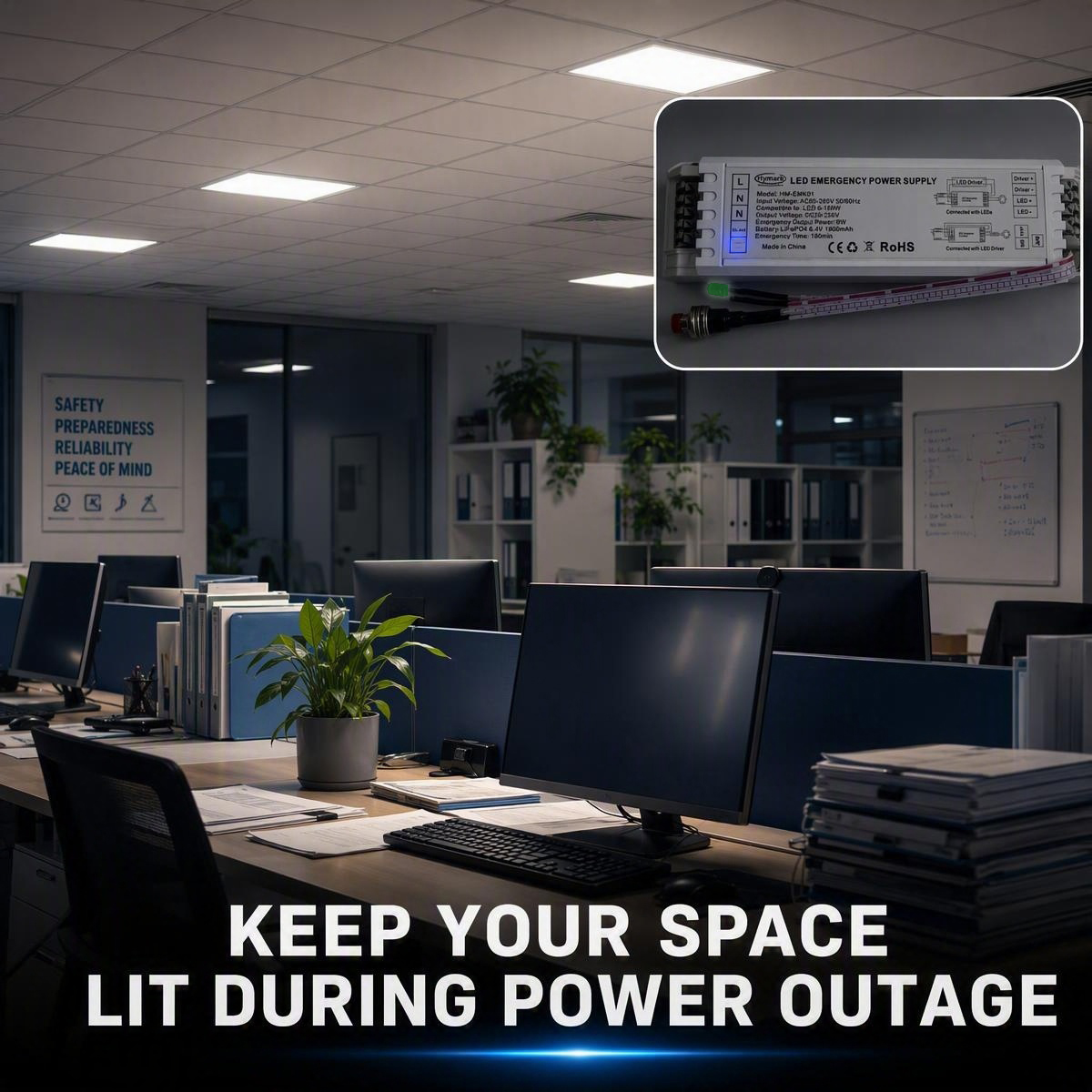
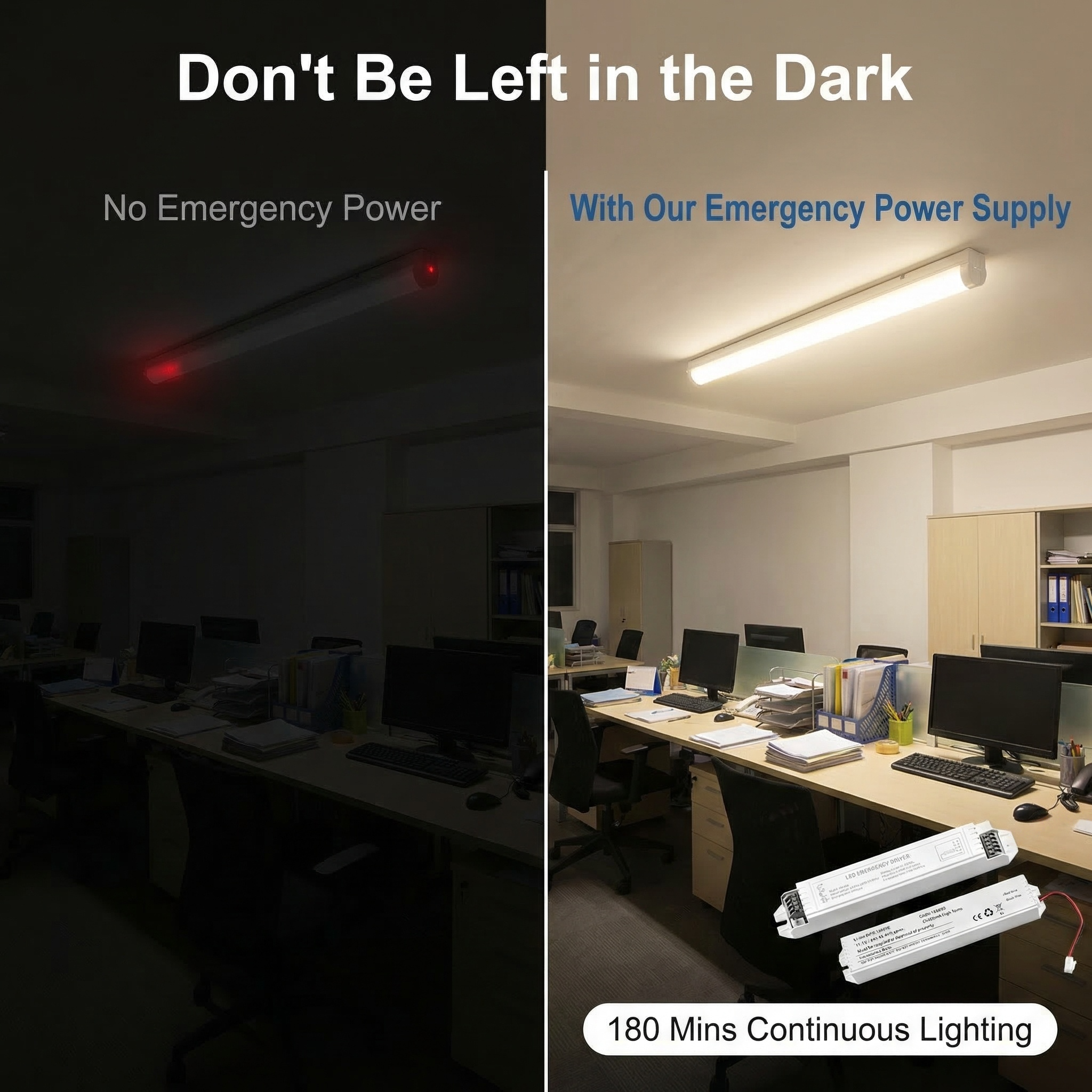
LED Emergency Driver For LED Panel Lights
Emergency drivers sized for 600×600 and 1200×300 LED panels with external drivers.
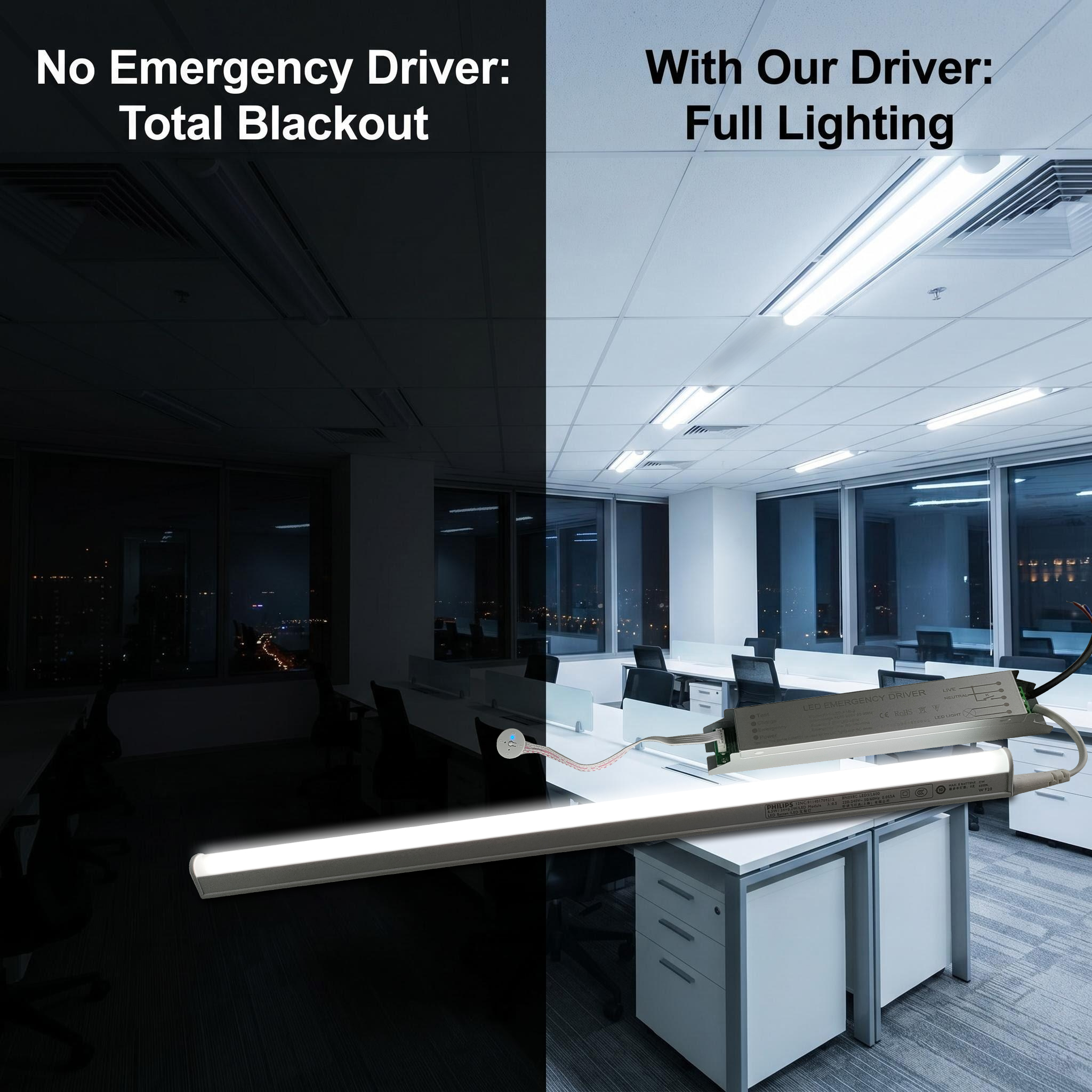
LED Emergency Driver For LED Tubes
Emergency conversion kits for T8 and T5 LED tubes and batten fittings.
LED Emergency Driver For Linear Lights
Slim emergency drivers that fit inside linear and trunking profiles without a separate battery box.
Frequently Asked Questions About LED Emergency Driver
Q: What is the minimum order quantity and lead time for LED emergency drivers?
MOQ is typically 500 units for standard models, 1000 units for custom output curves. Lead time runs 25 to 35 days after order confirmation for bulk orders. Samples ship within 5 to 7 working days against a nominal charge that is credited against the first production order. Pallet configuration is 40 cartons per pallet, each carton holding 50 to 100 units depending on driver wattage class.
Q: How do I confirm the emergency driver suits my host fixture?
Match three parameters: the driver’s output voltage window in DC volts must sit within the LED module’s forward voltage range; the emergency output in watts must reach at least 10% of normal luminaire wattage for EN 1838 compliance, or 25% to 100% depending on local code; and the physical dimensions must fit the fixture’s emergency compartment. Request the emergency driver datasheet to cross-check the constant current output curve against your LED module’s V-I characteristic.
Q: What emergency duration and output options are available?
Standard durations are 90 minutes, 2 hours, and 3 hours. Entry-class drivers deliver 3W to 5W emergency output, typically 10% to 20% of normal lumen output. Mid-class units span 5W to 10W, yielding 25% to 50% of normal output. High-class full-power-output models achieve 100% of normal lumens for the rated duration. LiFePO4 3.2V 3000mAh to 6000mAh packs and Li-ion 18650 configurations support the higher durations without excessive battery volume.
Q: What is the difference between maintained and non-maintained wiring?
Non-maintained wiring uses a two-pole changeover relay: the driver energises the LED module only when mains fails, drawing zero standby current from the battery. Maintained wiring keeps the emergency module live during normal operation, typically at reduced current, and switches to full battery output on mains failure. Maintained systems require a third switched live conductor; non-maintained suits fixtures with separate normal and emergency LED arrays. Check BS 5266-1 or AS/NZS 2293 for wiring method mandates in your market.
Q: What self-test and remote monitoring options are offered?
Manual test key is standard across all classes: a recessed switch or external key switch initiates a 30-second to full-duration functional test. Self-test models per EN 62034 run automatic monthly 30-second tests and annual 90-minute to 3-hour duration tests, with LED status indication. DALI test facility enables remote interrogation of battery health, lamp status, and test results over the lighting control bus. DALI versions require a DALI-2 compatible emergency controller on the network.
Q: What battery chemistry is used and how often must it be replaced?
NiCd 3.6V to 4.8V packs at 1200mAh to 2500mAh remain the entry option, offering 300 to 500 cycles and replacement every 3 to 4 years. Li-ion 18650 3.7V 2000mAh to 3500mAh packs achieve 500 to 800 cycles with 4 to 5 year replacement intervals. LiFePO4 3.2V 3000mAh to 6000mAh packs deliver 1500 to 2000 cycles, with 6 to 8 year service life and full charge in 16 to 24 hours. LiFePO4 carries lower thermal runaway risk but occupies 20% more volume per watt-hour than Li-ion.
Q: Which test reports and conformity marks should I request for my market?
For the UK and EU, ask for EN 60598-2-22 and EN 1838 test reports, plus EN 62034 for self-test models; the importer or authorised representative applies CE and UKCA marking. For the Middle East, request IEC 61347 and IEC 62471 reports for SASO or ECAS conformity. For Southeast Asia and Africa, CB test certificates to IEC 60598-2-22 streamline local acceptance. For the Americas, UL 924 or CSA C22.2 No. 141 reports are required; NFPA 101 governs installation. For Australia and New Zealand, demand AS/NZS 2293.2 compliance evidence. Always verify the report scope covers your exact model number and battery configuration.
Q: How do lithium batteries affect shipping mode and documentation?
Li-ion and LiFePO4 packs above 100Wh or in quantities triggering Section II of IATA PI 965 and IMDG Code SP 188 require UN 38.3 test summaries, MSDS, and shipper’s declaration for dangerous goods. Most LED emergency drivers with integrated batteries under 100Wh per pack ship as UN 3480 or UN 3481 under Section II, packed in UN 4G cartons with lithium battery handling labels. Sea freight is preferred for palletised orders to avoid passenger aircraft restrictions; air freight may require freighter-only routing. Confirm your freight forwarder accepts Class 9 lithium shipments before booking.
Warranty Spare Parts and OEM Support
Standard warranty is 3 years on the electronic module, 2 years on NiCd packs, 3 years on Li-ion, and 5 years on LiFePO4 configurations. Spare battery packs are available by part number for field replacement without discarding the inverter module. OEM branding options include laser-marked housings, customised carton labels, and multi-language installation sheets. MOQ for OEM packaging starts at 1000 units. Installation and commissioning support is provided via wiring diagrams, DALI commissioning guides, and video sequences for relay polarity and test switch location.
Important Notice
Specifications, output and duration figures and price ranges in this guide are indicative and are provided
for planning purposes only. Actual emergency output, duration, battery life, ingress protection and available conformity documentation
differ by model and by destination country, and emergency lighting design remains the responsibility of the project designer. Buyers
must confirm their own mains voltage and frequency, the emergency lighting standard enforced locally, the host fixture compatibility
and their import requirements before placing an order. All figures are subject to written confirmation in the final proforma invoice
issued by Hymark.
Sourcing LED Emergency Driver from Hymark
Once you have decoded the emergency driver datasheet, the next step is confirming that the supplier can build to those exact parameters and support the fixture through its installed life. Hymark, the premium brand of JIALINGHANG ELECTRONIC CO., LTD., operates from a model that keeps engineering and distribution in-house while co-designing with dedicated manufacturing facilities that have run since the company’s founding year of 2013. The 2017 strategic shift into LED emergency technology means the product architecture—constant current inverter blocks, changeover relay logic, LiFePO4 3.2V packs in 1500mAh to 5000mAh ranges, and self-test or DALI-automated test firmware—has been iterated specifically for emergency applications rather than adapted from general illumination drivers.
The Hymark range serving this category includes LED emergency drivers for LED panel lights, LED tubes, LED linear lights, and LED high bays, plus full-power-output emergency drivers that deliver 100 percent of normal lumen output in emergency mode rather than the typical 10 percent to 50 percent. Buyers can specify maintained or non-maintained wiring, 90-minute or 180-minute or 3-hour duration, and input voltage profiles such as AC 220-240V or AC 100-277V depending on destination market. OEM and ODM branding, export carton packing, and FOB or CIF terms are available. Hymark does not claim certificates on behalf of its manufacturing partners; buyers should request the supplier’s test reports for EN 60598-2-22, EN 1838, EN 62034, BS 5266-1, UL 924, or AS/NZS 2293 compliance as relevant to their project jurisdiction, plus UN 38.3 documentation for any lithium battery shipment.
Send the host fixture type and wattage, the emergency duration your code requires, your mains voltage, and your destination port. Hymark returns a quotation within 24 hours via WhatsApp or email.
Get a Factory Direct Quote on LED Emergency Driver
JIALINGHANG ELECTRONIC CO., LTD. has been in LED lighting since 2013 and has focused on
LED emergency technology and high performance LED strips since 2017. Hymark products are co-designed with our
dedicated manufacturing partners, built with selectable emergency duration and maintained or non-maintained wiring, and function
tested before packing. Send us the host fixture type and wattage, the emergency duration your local code requires, your mains
voltage and your destination port and we will return a quotation within 24 hours.


 English
  Spanish
  Arabic
  French
  German
  Russian
  Portuguese
  Italian
  Vietnamese