
LED Emergency Driver Buyer Guide
A real LED emergency driver manufacturer in China runs SMT lines, ageing stations and battery assembly in-house or under direct contract, not through a trading office that outsources every order. The right product for your fixture depends on three things: the host luminaire’s normal LED driver output (typically 25-55V DC at 300-700mA for panels, 80-240V DC at 100-250mA for tubes), the emergency duration your local code demands (90 minutes for NFPA 101 and UL 924 markets, 1 hour to 3 hours for EN 1838 and BS 5266-1), and the third-party test report the inspector or customs will ask to see (ENEC for Europe, UL 924 for North America, SAA for AS/NZS 2293 in Australia). This page covers how to verify actual manufacturing capability, read discharge test records, confirm battery traceability, and spot the documentation gaps that delay shipments by weeks.
In-House Assembly Capacity Versus Trading Office
Ask for photos with date stamps of SMT lines, reflow ovens and final assembly stations. A manufacturer handling LED emergency drivers at volume runs automatic pick-and-place for the inverter PCB, through-hole stations for the changeover relay and terminal block, and dedicated battery pack welding jigs. Trading offices show catalogues but cannot produce floor videos on demand. Request a live video call walking from raw component stores to finished goods; 48-hour compliance suggests real control, while excuses about “factory confidentiality” often mean no direct access.
Battery Sourcing and Cell Traceability
The battery pack dominates both cost and liability. LiFePO4 3.2V 1500mAh to 3000mAh cells suit 90-minute to 3-hour outputs at 3W to 10W emergency load, with 500-800 cycle life and stable thermal performance. Li-ion 18650 3.7V 2000mAh to 2600mAh offers higher energy density but stricter UN 38.3 transport rules and shorter 300-500 cycle life. NiCd 3.6V to 9.6V packs survive wider temperature ranges (-20°C to +50°C ambient) but carry cadmium RoHS restrictions in EU markets and lower energy density. Demand cell-level purchase invoices from tier-one suppliers (BYD, EVE, Lishen), lot codes matching the pack labels, and incoming inspection records for voltage consistency and internal resistance. Without this, you cannot verify cycle life claims or defend a product liability claim.
Discharge and Duration Test Records
Every batch must undergo full-duration discharge at rated load before shipment. For a 3-hour EN 1838 driver, that means 180 minutes at the claimed emergency output—typically 30% to 100% of normal lumens depending on model—with lumen maintenance recorded at 15-minute intervals. Ask for the last three months of test logs: date, batch number, battery lot code, ambient temperature, initial and final lumen readings, and pass/fail against the 50% minimum at duration end that EN 60598-2-22 requires. Random sampling is not enough; 100% discharge testing on finished units is the norm at factory level, though some manufacturers test only battery packs and trust inverter consistency.
Ageing and Hipot Test Stations
Reliability failures show up in the first 500 hours. A proper manufacturer runs 4-hour to 8-hour ageing at 40°C ambient on 100% of units, checking for thermal runaway, relay chatter or inverter oscillation. Hipot (dielectric strength) testing at 1500V AC or 3000V AC between mains and output circuits, depending on insulation class, catches winding faults and clearance violations. Request the station capacity—how many units simultaneously, test voltage applied and duration—and whether records link to serial numbers. Trading offices have no ageing room to show.
Third-Party Test Reports for Destination Markets
Do not accept “CE certificate” as an answer. Ask specifically for:
– ENEC or CB test reports to EN 60598-2-22 and EN 61347 for European markets
– UL 924 file number and test report for North America
– SAA approval to AS/NZS 2293 for Australia and New Zealand
– IEC 62471 photobiological safety assessment for LED sources
Verify the report covers the exact model number, voltage range and battery chemistry you are ordering. Report shopping—testing one configuration and selling another—is common. Check issue dates; reports more than five years old may predate standard revisions.
Sample Lead Time and Payment Structure
Functional samples with correct battery packs and destination-market labels ship in 7-12 working days from a real manufacturer with stock PCBs and cells. Trading offices quote 3-4 weeks because they must source from their factory network. First orders typically run 30% TT deposit, 70% against copy of BL, with LC only above $50,000 for established relationships. Samples below 5 pieces often cost $80-$150 each including express freight, credited against first bulk order. MOQ sits at 200-500 pieces for customised labels or specific output windows, 50-100 pieces for standard models.
After-Sales Engineering Capability
Emergency driver failures in the field usually trace to mismatch with the host fixture’s LED module forward voltage. A qualified manufacturer provides pre-sales voltage-current mapping: send your fixture’s normal driver output curve, receive a recommended emergency driver output window (for example, 50-80V DC at 350mA for a 40W panel, or 180-260V DC at 120mA for a 20W tube). Post-sales, they should analyse returned units for battery degradation versus inverter fault, advise on maintained versus non-maintained wiring configuration, and supply firmware updates for self-test or DALI-2 test facility versions. Trading offices forward complaints to their supplier and wait.
Types and Configurations of LED Emergency Driver
Reduced-Power Emergency Drivers for LED Panels Tubes and Linear Lights
| Type or Class | Typical Rating or Output | Duration or Runtime | Best Suited For | Notes |
|---|---|---|---|---|
| 10–20% Reduced-Power Driver | 3–10W emergency, 10–50W normal load | 90 min or 3 hr | LED panel lights, LED tubes, linear office fittings | Most common retrofit option; lumen output drops to 10–20% of normal but meets EN 1838 escape-route minimums |
| Full-Power Emergency Driver | 100% of normal wattage maintained | 90 min or 2 hr | High-bay warehouses, cleanrooms, surgical suites | Requires larger LiFePO4 or Li-ion 18650 pack; battery cost 3–4× higher than reduced-power equivalent |
| Self-Test/DALI-2 Emergency Driver | 10–20% or 100% selectable | 90 min or 3 hr | Smart buildings, BMS-integrated installations | EN 62034 compliant auto-test cycles; firmware and reporting hardware add 15–25% to unit cost |
| Maintained/Non-Maintained Switchable Driver | 10–20% or 100% via wiring change | 90 min | Retail, hospitality, mixed-use schemes | Single SKU reduces distributor stock; relay changeover rated for 100,000 operations at 250V AC |
| Strip-Specific Low-Voltage Emergency Driver | 12V or 24V DC output, 200–1500mA | 90 min or 2 hr | COB LED strips, SMD 2835/5050 strips in coves and signage | Constant-voltage inverter; must match strip working voltage exactly or risk colour shift |
| High-Temperature Emergency Driver | 10–20% output, 85°C ambient rated | 90 min | Industrial kitchens, boiler rooms, Middle East façades | NiCd or high-grade LiFePO4 required; standard Li-ion 18650 degrades above 60°C |
A 10–20% reduced-power emergency driver is the workhorse that luminaire OEMs and electrical contractors install in 80% of commercial ceiling grids. The inverter outputs 150–350V DC at 50–150mA, just enough to keep a 36W LED panel alive at roughly 500–700 lumens instead of its normal 3,600 lm. The battery pack is typically LiFePO4 3.2V 3000mAh or NiCd 3.6V 1800mAh, giving 90 minutes at 4–6W with a 6–8 hour recharge. Buyers in Southeast Asia and Africa favour this class because it ships air-freight under IATA PI 965 Section IB with minimal paperwork. What it cannot do is maintain task lighting: a warehouse aisle lit at 10% normal output is legal for egress under EN 1838 but unsafe for continued operations.
A full-power emergency driver restores 100% of the fitting’s lumen output during mains failure. The battery scales to LiFePO4 12.8V 6000mAh or four-cell Li-ion 18650 14.4V 5200mAh, driving the same LED module at identical current through a bypass relay. Procurement officers for UK distribution centres and Middle East logistics hubs specify these when BS 5266-1 or local codes demand “normal lighting level maintained.” The trade-off is weight: a 50W full-power kit weighs 1.8–2.4 kg versus 0.6–0.9 kg for reduced-power, complicating shallow ceiling voids and increasing freight cost by 30–40% on FOB Shenzhen terms.
A self-test or DALI-2 emergency driver automates the monthly and annual duration tests that EN 62034 and BS 5266-1 require. The microcontroller initiates a 30-second functional test every 28 days and a 90-minute duration test annually, logging results for DALI broadcast or local LED indication. M&E consultants in Europe specify these for Tier 1 office fit-outs because manual test keys get lost or ignored. The firmware and isolated DALI power supply add roughly 15–25% to the BOM; if the building has no DALI bus, that money is wasted. These units still need physical inspection of the indicator LED, so “maintenance-free” is a misnomer.
A maintained/non-maintained switchable driver uses a wiring bridge or DIP switch to select between modes. In maintained wiring, the emergency module feeds the LEDs continuously through the changeover relay during normal mains operation; in non-maintained, the module sits idle until power fails. Lighting wholesalers in Latin America stock this as a single SKU covering both local wiring conventions, reducing inventory by half. The relay is the wear item: verify the supplier quotes a 250V AC 2A rating with 100,000 mechanical cycles. Below that, a fluorescent retrofit with frequent switching will fail before the battery does.
A strip-specific low-voltage emergency driver inverts battery DC to 12V or 24V at constant voltage, not constant current, to match COB LED strips or SMD 2835 tape. Output window is typically 11.5–12.5V or 23–25V at 1–3A, with battery packs built from LiFePO4 3.2V cells in 4S or 8S configuration. Lighting designers specifying cove or retail display continuity need this, but must confirm the strip’s W/m and lm/m at emergency voltage: a 24V 14.4W/m 2835 strip may dim to 60% apparent output at 22V, which may still comply with EN 1838 if the designer’s spacing accounts for it. These drivers cannot drive constant-current LED modules; the voltage mismatch will trip protection or flicker.
A high-temperature emergency driver derates less aggressively than standard units, with electrolytic capacitors rated 105°C and batteries qualified for 75–85°C ambient. NiCd 3.6V 1200mAh packs tolerate heat but carry EU battery directive restrictions; high-grade LiFePO4 with ceramic separators is the emerging replacement. Facility managers in GCC countries and industrial kitchens should request the supplier’s actual discharge test records at 85°C ambient, not just component ratings, because EN 60598-2-22 duration tests are conducted at 25°C. What this class cannot do is match the cycle life of temperate-climate Li-ion: expect 300–400 equivalent full cycles rather than 800.
How to Verify a Real Manufacturer Versus a Trading Office
SMT and final assembly ownership. Ask for video of the pick-and-place line loading the constant-current inverter IC, the transformer winding station, and the battery pack welding operation. A trading office will show a generic warehouse or refuse. Hymark’s facility in Shenzhen runs two Yamaha SMT lines for PCB populations up to 450×350 mm, with in-house ICT and functional test jigs for each SKU. If the supplier names a “partner factory” without letting you audit it, you are buying through a middleman with opaque QC.
Battery sourcing and traceability. The cell market is fragmented: a “LiFePO4 3000mAh” label can hide Grade B rejects with 40% actual capacity. Demand cell-level purchase invoices from EVE, CATL, or Lishen, and lot-coded discharge test records showing each pack hit 100% rated duration at 25°C and 70% at 0°C. UN 38.3 test summaries must be available per lot for air freight; without them, your shipment stalls at Hong Kong or Dubai customs.
Discharge and duration test records. A real manufacturer ages 100% of production for 2–4 hours at full emergency load before packing, logging voltage sag and lumen maintenance. Ask for a random serial-numbered unit’s test graph: time on X-axis, output current and battery voltage on Y-axis. Trading offices have no such database. For EN 60598-2-22 compliance, the supplier should also show hipot test records at 1.5kV AC or 3kV DC for 60 seconds on each batch.
Third-party test reports for the destination market. Do not accept “CE certified” as a sentence. Ask for the EN 60598-2-22 and EN 61347-2-7 test report number, the issuing laboratory (SGS, TÜV, Intertek, DEKRA), and the scope: does it cover the exact wattage and battery chemistry you are ordering? For UL 924 entry to North America, the report must list the specific LED module part numbers the driver is approved to operate with; generic “LED load” language is invalid. For AS/NZS 2293 in Australia, ask for the Certificate of Conformity with the driver model on it.
Sample lead time and payment structure. A manufacturer with stocked bare PCBs and cell inventory ships samples in 5–7 working days; a trading office quoting 15–20 days is relaying to a factory with no priority. Payment structure reveals confidence: 30% T/T deposit, 70% against BL copy is standard for established buyers; 100% advance for samples is common but should drop to 50/50 after a first order. Escrow through Alibaba Trade Assurance or the supplier’s own STS arrangement protects both parties on initial deals under USD 50,000.
After-sales engineering capability. Ask the technical contact to explain why your 40W LED panel at 120mA forward current needs a 10W or a full 40W emergency kit, and how the changeover relay timing interacts with your DALI driver. A trading office forwards the question; a manufacturer answers in one call. Hymark provides wiring schematics for maintained, non-maintained, and switched configurations, plus DALI address mapping for self-test units, because the engineering team designed the firmware.
Price Drivers and Lead Time Reality
Battery chemistry dominates BOM cost. A reduced-power 10W kit with NiCd 3.6V 1800mAh costs USD 8.50–11.00 FOB Shenzhen at 500-unit MOQ; swapping to LiFePO4 3.2V 3000mAh adds USD 3.50–4.00 but extends cycle life from 200 to 600 equivalent full discharges. Full-power 40W kits with Li-ion 18650 14.4V 5200mAh run USD 28–36 at 500 units, with battery comprising 45–50% of that.
Self-test/DALI firmware and isolated communication hardware add USD 4.00–6.00 to any base unit. IP65 enclosure with gasket and stainless screws adds USD 2.50–3.50 over open-frame or IP20 plastic. High-temperature rating with 105°C capacitors and ceramic-separator LiFePO4 adds 20–25%.
Lead time is 15–20 days for 500–2,000 units of standard reduced-power SKUs with LiFePO4 cells in stock. Full-power or DALI-2 variants stretch to 25–30 days. Peak Q3 shipping ahead of European winter compliance audits adds 5–7 days. Samples ship in 5–7 working days against USD 80–120 including courier, refundable against first order above USD 5,000.
Carton packing is 20 units per carton, 12 cartons per pallet for sea freight; lithium shipments require UN 4.2-compliant fibreboard with Class 9 label, and IATA PI 965 Section IB documentation for air cargo under 35 kg net battery mass per package. FOB Shenzhen is standard; CIF Felixstowe or Jebel Ali adds 8–12% for current container rates. MOQ is 500 units for branded production, 100 units for neutral-label first orders to qualify the supplier.
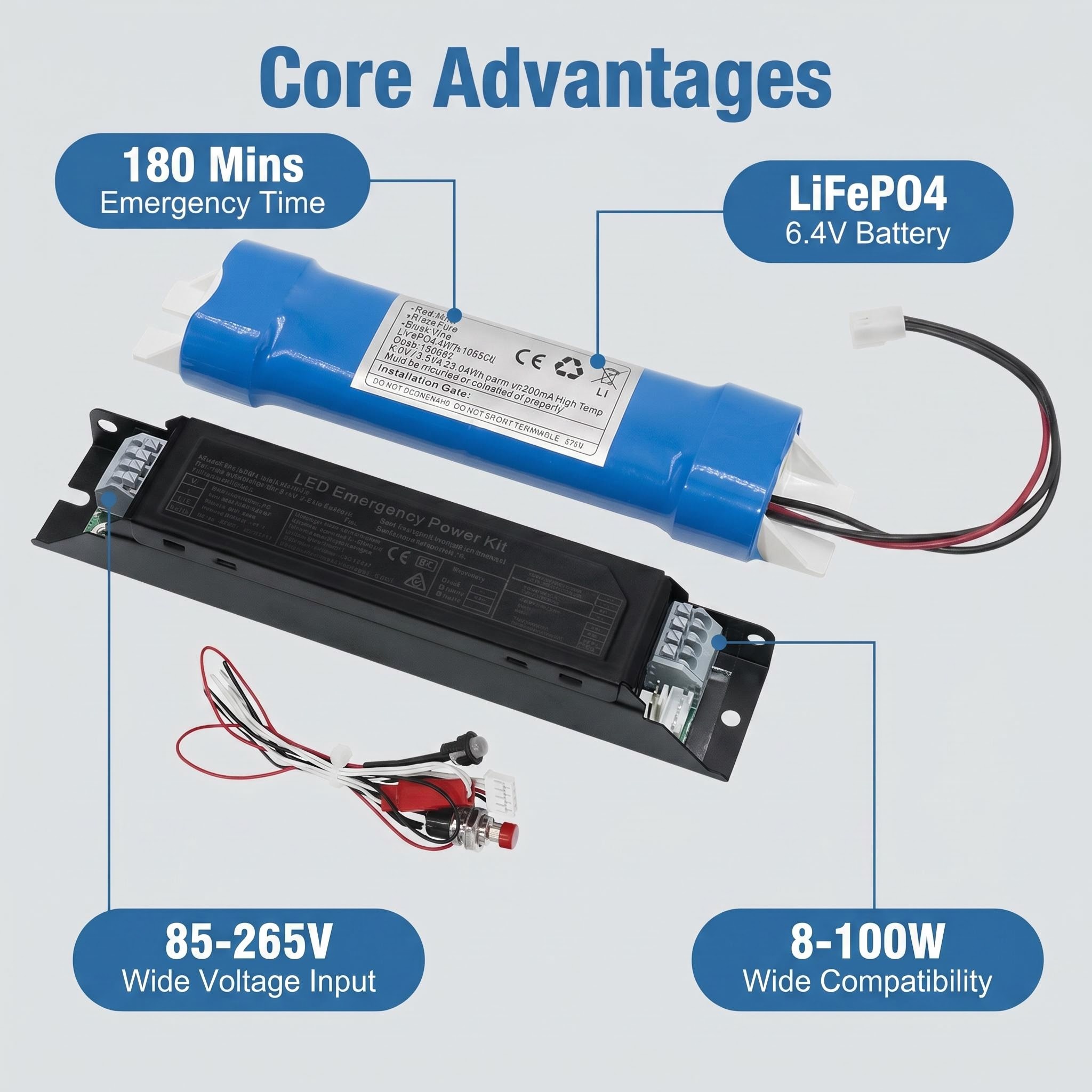
Specifications and How to Read Them
| Parameter | Entry Level | Mid Range | High Specification |
|---|---|---|---|
| Input voltage | AC 85-265V 50/60Hz | AC 100-277V 50/60Hz | AC 220-240V 50Hz or AC 120-277V 60Hz |
| Driven load | 3-10W | 8-20W | 15-60W |
| DC output window | 9-42V 150mA constant current | 20-80V 250mA constant current | 50-240V 350mA constant current |
| Emergency output | 300lm at 30% of normal | 800lm at 50% of normal | 2400lm at 100% of normal |
| Emergency duration | 90 minutes | 120 minutes | 180 minutes |
| Battery chemistry | NiCd 3.6V 700mAh | Li-ion 18650 3.7V 2200mAh | LiFePO4 3.2V 3000mAh |
| Charge time | 24 hours | 16 hours | 12 hours |
| Cycle life | 300-500 cycles | 800-1000 cycles | 1500-2000 cycles |
| Test facility | Manual test key | Auto self-test per EN 62034 | DALI-2 self-test + manual key |
| Wiring mode | Non-maintained only | Non-maintained or maintained | Maintained + non-maintained selectable |
| IP / IK rating | IP20 / IK02 | IP65 / IK06 | IP66 / IK08 |
| Ambient temperature | 0°C to +45°C | -10°C to +50°C | -20°C to +55°C |
| Dimensions (L×W×H) | 120×40×25mm | 160×50×30mm | 200×60×35mm |
| Mounting | Plastic clip | Steel bracket + screws | Magnetic + screw dual mount |
How to Read the Datasheet Line by Line
Input voltage range and frequency tells you which markets the driver ships to without modification. AC 85-265V covers 230V Europe and 120V North America in one SKU. AC 220-240V 50Hz is UK and EU only; 120-277V 60Hz is North American commercial. Check the label matches the site supply. A driver rated only 220-240V will fail on 120V or overheat at 277V.
Driven load in watts is the LED panel, tube or linear the driver must support in emergency mode. This is not the normal driver wattage. A 40W panel light might need only 10W emergency output to meet EN 1838 minimum illuminance. Match this figure to your luminaire’s emergency lumen target, not its normal rating.
DC output voltage window and current show the constant current inverter’s operating range. The driver delivers fixed milliamps and varies voltage to maintain that current. If your LED module wants 36V at 200mA, the driver’s 20-80V 250mA range fits, but 9-42V 150mA does not. The voltage window must sit above the LED forward voltage at end of battery discharge, with margin for temperature drift.
Emergency output in lumens and as percentage of normal determines compliance. EN 1838 requires minimum 1 lux on the floor for escape routes; BS 5266-1 adds 0.2 lux open area minimum. A 40W panel producing 4000lm normally might target 2000lm emergency (50%) for maintained mode, or 400lm (10%) for non-maintained if the space has other ambient light. Ask the luminaire maker for the lm/W of the LED module at the driver’s emergency current, then verify the percentage against your project spec.
Emergency duration is 90 minutes for most UK and EU escape lighting, 120 minutes for some Middle East authorities, 180 minutes for high-risk task areas per BS 5266-1. The battery must deliver this at end of nominal life, not when new. A 2200mAh Li-ion pack driving 10W at 3.7V nominal draws roughly 2.7A; theoretical runtime is 48 minutes. The actual 120-minute claim comes from lower emergency wattage, higher battery voltage under light load, and conservative rating. Demand the discharge curve at 25°C and at 0°C.
Battery chemistry voltage and capacity drives price and lifespan. NiCd 3.6V 700mAh is cheapest but carries memory effect, cadmium RoHS restrictions, and short cycle life. Li-ion 18650 3.7V 2200mAh offers better energy density but needs protection circuits against over-discharge; thermal runaway risk requires UN 38.3 test reports for air freight. LiFePO4 3.2V 3000mAh is safest, longest cycle life, heaviest, most expensive. For a 10-year building lease, LiFePO4 often beats Li-ion on total cost despite 40% higher unit price.
Charge time and cycle life indicate maintenance burden. A 24-hour charge time with 300-cycle NiCd means annual replacement in daily test regimes. A 12-hour charge with 1500-cycle LiFePO4 survives weekly functional tests for a decade. For projects with remote sites or difficult access, cycle life dominates purchase price.
Test facility determines compliance labour. Manual test key needs a technician monthly. Self-test per EN 62034 automates duration and functional tests, logging faults to a status LED. DALI-2 adds remote monitoring, addressable reporting, and integration with building management systems. DALI drivers cost 25-40% more; factor in saved technician hours across 500 fittings.
Maintained or non-maintained wiring changes the installation. Non-maintained: line switched to driver, neutral permanent, lamp off until mains failure. Maintained: separate permanent line and switched line, lamp live during normal operation via changeover relay. The relay switches to inverter on power loss. Some drivers accept both; others are non-maintained only. Check the terminal block legend: L, N, L(switched), L(permanent) or similar.
IP and IK rating must match the luminaire, not exceed it. IP20 driver in IP65 housing wastes the housing; moisture ingress at cable glands still risks failure. IP65 driver with IP20 panel is acceptable if mounted internally. IK08 suits sports halls and mental health facilities; IK02 suffices above suspended ceilings.
Ambient temperature range affects warranty. 0°C to +45°C ratings derate above 35°C in practice; battery capacity drops 20% at 0°C and 40% at -10°C. A -20°C to +55°C LiFePO4 driver uses heated battery packs or wider electrolyte tolerance; confirm with discharge test records at temperature extremes.
Dimensions and mounting determine retrofit feasibility. Emergency drivers for LED panel lights often fit 600×600mm ceiling voids with 25mm depth limits. LED emergency drivers for LED tubes need length under 300mm to fit within batten housings. LED emergency drivers for linear lights may mount in trunking; magnetic bases speed installation but vibrate loose in rail corridors.
Verifying a Real Manufacturer from a Trading Office
SMT and assembly capacity separates price from risk. Ask for photos of pick-and-place lines, reflow ovens, and AOI stations. A real LED emergency driver manufacturer runs at least two SMT shifts; a trading office shows rented factory photos from a partner who also serves competitors. Request a video call walking the line with today’s date visible. Hymark maintains in-house SMT for control boards and partners with certified assembly houses for high-volume battery pack welding; we disclose which facility builds each SKU.
Battery sourcing and traceability matters after the second fire. Demand cell manufacturer certificates (BAK, EVE, Lishen, CATL for LiFePO4; Samsung, LG, Panasonic for Li-ion 18650) and lot codes matching the pack labels. A trading office buys whatever cells the battery assembler offers this week. Traceability requires the driver maker to hold cell test reports (IEC 62133 or UL 1642) and pack assembly records by serial number.
Discharge and duration test records prove the datasheet is not aspirational. Every production batch should have 100% duration test or AQL sampling at minimum. Ask for a test report from last month: load watts, duration minutes, end-point voltage, ambient temperature, pass/fail. Records older than six months suggest batch testing has stopped or the factory changed suppliers.
Ageing and hipot test stations catch infant mortality. Hipot (high potential) testing at 1500V AC or 3000V DC verifies insulation between mains and output. Ageing runs drivers at 40°C ambient for 2-4 hours before packing. Missing either step means field failures in the first month. A manufacturer shows burnt-in units stacked on racks; a trading office cannot explain why their supplier skipped it.
Third party test reports for the destination market are what customs and inspectors accept. For UK and Europe: ENEC or CE test reports to EN 60598-2-22, EN 1838, EN 62034, IEC 61347. For UKCA: same standards, UK-recognized body. For UL 924 North America: complete test data, not just a manufacturer’s declaration. For AS/NZS 2293 Australia: RCM compliance evidence. Do not accept “we can get it” as equivalent to “we hold it.” Ask for report number, test house name, and date; verify with the test house if uncertain.
Sample lead time reveals inventory depth. A manufacturer with common chip stock ships samples of standard LED emergency drivers in 5-7 working days. Custom output voltages or DALI firmware add 2-3 weeks. A trading office quotes 4-6 weeks because they must negotiate with the real factory after your order. Hymark samples from Shenzhen finished-goods stock for standard models; custom builds from JIALINGHANG assembly in 15 working days.
Payment structure indicates confidence. 30% T/T deposit, 70% against B/L copy is standard for first orders. 100% L/C at sight protects the buyer but adds 2-3% cost and delays shipment by letter processing. A supplier demanding 100% advance for samples is either cash-starved or hiding behind no-recourse terms. Escrow through platform services or Secured Trading Service arrangements reduce risk for small first orders.
After-sales engineering capability survives the warranty. Ask how firmware updates reach installed DALI units, whether replacement drivers match obsolete output windows, and who answers technical questions in your time zone. A trading office forwards WhatsApp messages to a factory engineer who replies overnight in Mandarin. A manufacturer staffs application engineers who speak project specifications.
Trade Terms and Export Practicalities
FOB Shenzhen means the seller loads containers at Yantian or Shekou port; buyer arranges ocean freight and insurance. Typical for repeat buyers with freight forwarders. CIF adds sea freight and insurance to destination port; seller nominates the carrier, buyer handles unloading and inland. CFR is CIF without insurance; buyer covers marine risk. EXW is factory gate; buyer arranges everything including China export clearance. Lowest supplier price, highest buyer complexity. For LED emergency drivers containing lithium batteries, EXW often forces the buyer to manage UN 38.3 documentation and IATA/IMDG packing themselves.
L/C (letter of credit) suits high-value orders where buyer and seller lack trust history. Bank fees run $300-800 per document set; discrepancies in packing lists or certificates delay payment. T/T (telegraphic transfer) is faster and cheaper for established relationships. Many Chinese LED emergency driver suppliers accept combined terms: T/T deposit, balance by L/C for first order, pure T/T after six months of clean shipments.
HS code for LED emergency drivers is typically 8504.40 (static converters) or 8539.31 (parts of lamps). Correct classification affects duty rates and whether battery-containing units need dangerous goods declarations. The supplier’s export customs broker should confirm; do not guess.
CE marking is the supplier’s declaration that the product meets EU directives. The buyer must verify the technical file exists and covers the specific model shipped. UKCA replaces CE for Great Britain; Northern Ireland retains CE under the Windsor Framework. A driver with only CE cannot legally enter GB after the grace period ended.
UN 38.3 battery test report is mandatory for lithium cell and battery transport. Section 38.3 of the UN Manual of Tests and Criteria covers altitude simulation, thermal cycling, vibration, shock, external short circuit, crush, overcharge, and forced discharge. The report must name the cell manufacturer, model, and watt-hour rating. IATA limits standalone lithium ion batteries to 30% state of charge for air freight; IMDG has less restrictive rules for sea containers. NiCd and NiMH face less stringent transport rules but still require proper classification.
Packing list and certificate of origin complete customs entry. The packing list must match carton counts, gross and net weights, and battery declarations. Certificate of origin (Form A or CO) determines preferential duty rates under trade agreements. For UK-EU trade post-Brexit, rules of origin compliance requires evidence of substantial transformation in China; final assembly and testing of LED emergency drivers typically qualifies, but simple battery insertion may not.
What Price Differences Actually Buy
Entry level LED emergency drivers at $4-7 FOB use NiCd cells, 90-minute duration, IP20, manual test keys, and 300-cycle battery life. They suit price-sensitive wholesale in developing markets where replacement labour is cheap and regulations are enforced lightly.
Mid range units at $9-14 FOB move to Li-ion 18650, 120-minute duration, IP65, self-test per EN 62034, and 800-cycle life. The premium pays for reduced maintenance visits and broader market acceptance. Most UK and EU distributors stock this tier.
High specification drivers at $18-35 FOB add LiFePO4 packs, 180-minute duration, maintained/non-maintained changeover, DALI-2, IP66/IK08, and -20°C operation. The buyer gains 10-year service intervals, remote monitoring, and compliance in harsh environments. For a Dubai metro station or Nordic offshore platform, the premium eliminates access scaffolding and emergency lighting failure penalties.
Lead time stretches with battery chemistry and test facility complexity. Standard NiCd models: 15-20 days after deposit. LiFePO4 with custom voltage: 25-35 days. DALI-2 firmware certification adds 10 days for independent verification. Peak season (August-October before year-end project deadlines) extends all lead times by 1-2 weeks; order by June for November site handover.
MOQ typically runs 500 units for branded packaging, 100 units for neutral white-box. Sample orders of 1-5 units ship from stock at 15-25% premium over volume pricing. Tooling for custom mounting brackets or label languages: $300-800 amortised over first 2000 units.
The emergency driver supplier who answers every question above with documents, not promises, is the one worth the flight to Shenzhen.
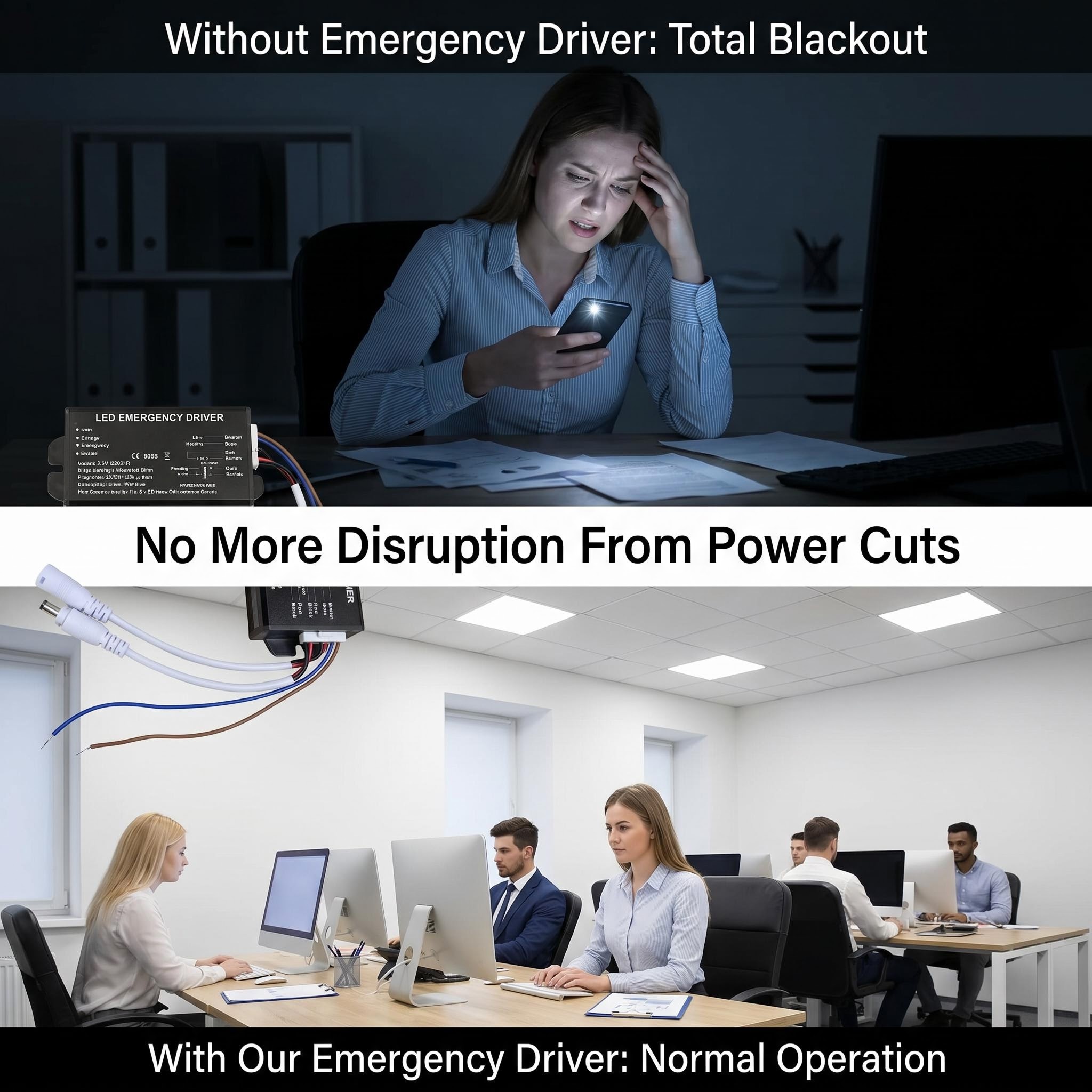
LED Emergency Driver Price and What Drives It
| Class | Typical Rating or Output | Duration or Runtime | Indicative FOB USD |
|---|---|---|---|
| Entry 3W LED strip / small panel | 3W DC 12-36V 250mA | 90 min | $4.50–$7.00 |
| Standard 5W tube / linear driver | 5W DC 25-42V 150mA | 90 min | $7.00–$11.00 |
| Mid-range 10W panel / high-bay | 10W DC 30-42V 280mA | 3 hr | $12.00–$18.00 |
| Full-power 20W+ high-bay driver | 20W DC 50-240V 100mA or matching normal output | 2–3 hr | $22.00–$35.00 |
| DALI self-test variant (add-on) | Same as base unit | Same | +$3.50–$6.00 |
These bands assume LiFePO4 3.2V 1500–3000mAh packs, IP20 plastic enclosures, and batch sizes of 500–1000 pieces. NiCd alternatives at 2.4V–4.8V 600–1200mAh sit roughly 15% below the entry band but carry shorter cycle life (300–400 versus 800–1500) and heavier shipping restrictions under IATA/IMDG. Prices below $4.00 FOB for any 90-minute unit normally signal a 14500 Li-ion cell under 800mAh, an untested inverter topology, or missing changeover relay.
What Actually Makes Up the FOB Price
The bill of materials for a 10W 3-hour emergency driver for LED panel light breaks down roughly as follows on a $14.50 FOB unit at 1000-piece volume:
- Battery pack: 35–42%. LiFePO4 3.2V 3000mAh prismatic or 26650 cylindrical cells dominate this line. A matched BMS with cell balancing adds $0.80–$1.20. This is the single largest line item.
- Driver and inverter electronics: 18–24%. Constant-current inverter stage, changeover relay, charging circuit, and protection. The inverter must hold output within ±10% across the discharge curve; cheaper designs drift to +25% as cell voltage sags, risking LED overcurrent.
- Enclosure and hardware: 8–12%. IP20 ABS for indoor recessed or surface mounting; IP65 metal with grommets for industrial applications roughly doubles this share.
- Test and certification cost amortised: 10–15% on first production run, dropping to 3–5% by run five. Third-party testing to EN 60598-2-22 (thermal, endurance, fault conditions), EN 1838 (illuminance distribution and duration), and EN 62034 (automatic test systems including DALI) typically runs $8,000–$25,000 per product family depending on notified body rates. Spread across 2,000 units, that is $4.00–$12.50 each. This is the second largest line item until volumes justify the amortisation.
- Assembly labour: 6–9%. SMT, through-hole, battery pack welding, final assembly, and 100% function test.
- Export packing and inland freight: 4–6%. Inner carton 20 units, master carton 100 units, palletised for Shenzhen or Ningbo port.
- Factory margin: 8–12% at contract manufacturer level; 15–22% at vertically integrated OEM.
Sea freight to Rotterdam or Felixstowe adds $0.40–$0.80 per unit depending on oil surcharge and congestion; air freight with UN 38.3 certified lithium cells runs $1.50–$3.00 and requires Class 9 dangerous goods documentation. Insurance at 110% CIF is typically 0.3–0.5%. UK import duty on LED emergency drivers sits at 2.7% under HS 8504.40; EU MFN rate is 2.5%; VAT at 20% (UK) or 19–27% (EU member states) applies on CIF plus duty. Middle Eastern and African markets often see 5% duty plus local handling fees of $150–$400 per container.
Why the Cheapest Quote Is Rarely Comparable
A $5.50 FOB emergency driver for LED tube and linear lights versus a $10.50 unit from the same search results usually differs in ways that matter for compliance and life cost:
| Cost reduction method | What the buyer loses |
|---|---|
| 14500 Li-ion 800mAh instead of 18650 2000mAh or LiFePO4 3000mAh | 60-minute real runtime instead of 90-minute certified; 200-cycle life versus 800+; higher thermal runaway risk in ceiling voids |
| Fixed resistor current limit instead of constant-current inverter | Emergency output drops 40% as battery depletes; may fall below EN 1838 minimum illuminance thresholds in final 30 minutes |
| No changeover relay; direct diode OR-ing | Maintained wiring only; non-maintained circuits fail to switch; relay contact rating not verified |
| Missing self-test MCU | Manual test key only; BS 5266-1 and many jurisdictions now require automatic monthly and annual functional tests |
| Untested enclosure plastic | No glow-wire 850°C or ball-pressure verification; thermal deformation in downlight cavities |
| Photometric data absent | Cannot prove compliance with EN 1838 spacing tables for the luminaire; specifier rejection |
The emergency driver supplier offering these reductions rarely documents the trade-off. Buyers should request the discharge curve at 25°C and at the ceiling void limit temperature (typically 45°C or 55°C for the product class), and the test house report number for the specific model variant, not a “family” certificate.
Supplier Qualification: Manufacturer Versus Trading Office
For buyers searching “led emergency driver manufacturer in China,” the real factory can be verified through several concrete checks:
In-house or partnered SMT and assembly capacity
– Ask for SMT line count, placement accuracy (±0.05mm for 0402 components), and whether battery pack welding is done on the same site or subcontracted 50km away. A trading office will deflect or provide a generic video.
– Request photos of the ageing burn-in room: 50–100 stations running 3-hour discharge cycles at 45°C ambient. Trading offices rarely maintain this capital equipment.
Battery sourcing and traceability
– Demand cell manufacturer and grade: EVE, Lishen, BAK, or Farasis for LiFePO4; Samsung 29E or LG MJ1 for Li-ion 18650. “A-grade” means nothing without lot codes.
– Traceability to UN 38.3 test summary for the exact cell model, not the pack assembler’s certificate. IATA and IMDG require this for every shipment.
Discharge and duration test records
– A qualified manufacturer keeps batch records showing every unit passed 90-minute or 3-hour discharge at rated load before packing. Ask for a sample test report with serial number, date, technician initials, and measured lumen maintenance percentage.
Ageing and hipot test stations
– Hipot (dielectric withstand) at 1500V AC or 2U+1000V per IEC 61347-2-7 for 60 seconds; insulation resistance >2MΩ. Ageing at 40°C for 4–8 hours catches infant mortality in capacitors and relays.
Third party test reports for the destination market
– For UK and EU: EN 60598-2-22, EN 1838, EN 62034 reports issued by a notified body or ILAC-accredited laboratory. Ask for the report number and scope: does it cover the exact wattage, duration, and battery configuration?
– For UL 924 or AS/NZS 2293 markets, the same principle applies. Do not accept “compliant to” without report review.
Sample lead time
– Genuine manufacturers with stocked cells and PCBs: 7–12 working days for 2–5 samples including configured output current and connector. Trading offices quoting 3–4 days often pull from trader stock with unknown cell age.
Payment structure
– Factory-direct terms typically 30% T/T deposit, 70% against B/L copy for first order; LC at sight for orders above $50,000. Trading offices often demand 100% advance or use escrow platforms that mask the actual source.
After-sales engineering capability
– Can the manufacturer adjust output voltage window from DC 25-42V to DC 50-240V for a high-bay retrofit? Can they implement DALI-2 self-test protocol per EN 62034? Trading offices forward questions with 48-hour delays; engineers answer directly.
Five-Year Running Cost Comparison
Assuming 100 units installed in a commercial facility, 3-hour maintained emergency drivers for LED high bays:
| Scenario | Entry 5W unit | Mid 10W unit | Full-spec 10W DALI self-test |
|---|---|---|---|
| Purchase price FOB per unit | $6.50 | $14.50 | $24.00 |
| Initial landed cost per unit (UK, 1000pc volume) | $9.20 | $19.80 | $31.50 |
| Battery replacement cycle | 3 years (Li-ion 18650, 500 cycles) | 5 years (LiFePO4 3000mAh, 1500 cycles) | 5 years (LiFePO4 3000mAh) |
| Battery replacement cost per unit at year 3 | $4.50 | $0 (not yet) | $0 |
| Annual testing labour: manual key 100 units × 15 min @ £35/hr | £875/year | £875/year | £175/year (DALI automated, 20% spot check) |
| 5-year testing labour | £4,375 | £4,375 | £875 |
| Expected failure rate (no-name cells, no ageing) | 8% | 3% | 1.5% |
| Replacement units for failures over 5 years | 8 | 3 | 1.5 |
| 5-year total cost per installed unit | ~$28.00 | ~$32.50 | ~$36.00 |
The gap narrows dramatically. The entry unit saves $22.00 upfront per unit but costs nearly the same over five years while carrying higher compliance risk: a single failure during a real emergency or a failed fire inspection carries liability far exceeding the hardware saving.
Lead Time and Ordering Practicalities
Standard LiFePO4 cell lead time from Chinese manufacturers is 15–25 days; 18650 availability fluctuates with electric vehicle demand. Total factory lead time for a validated emergency driver for LED panel light or LED tubes and linear lights:
- Samples (1–5 units, existing configuration): 7–12 working days
- MOQ 500 units, no customisation: 25–30 days
- MOQ 1000 units, customised output window or connector: 35–45 days
- First order with new certification testing: add 4–6 weeks for third-party testing before production release
Hymark’s sample policy for the LED emergency driver lines: 2–3 working units shipped ex-works Shenzhen within 10 days against confirmed specification, with discharge test data sheet included. MOQ is 500 units per model for standard configurations; 1000 units for DALI variants with customised DALI short addresses pre-programmed.
Payment: 30% deposit, 70% against copy of bill of lading. LC at sight acceptable for orders above $30,000. All lithium battery shipments comply with UN 38.3, IATA PI 965 Section IB or IMDG Code Special Provision 188 as applicable, with dangerous goods declaration and MSDS included.
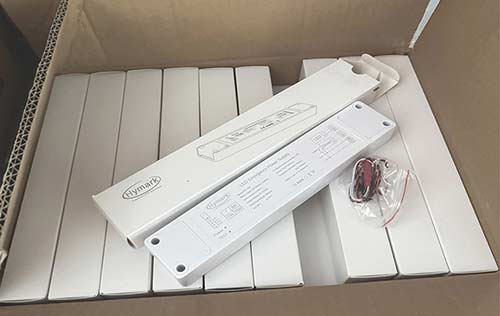
Industry Applications for LED Emergency Driver
A buyer searching for an LED emergency driver manufacturer in China needs to know whether the factory can deliver compliant product consistently, not just whether it lists the right keywords. The table below maps six sectors where Hymark LED emergency drivers are installed, followed by sector-specific notes on what procurement officers and specifiers should verify before placing volume orders.
| Sector | Typical Installation | Recommended Specification | Why This Product Fits |
|---|---|---|---|
| Commercial Offices and Fit-Outs | Recessed LED panel lights in suspended ceilings, linear pendant systems | 3W–10W emergency output, 90 min duration, maintained or non-maintained wiring, self-test or DALI test facility per EN 62034 | High bay count demands automated testing; changeover relay isolates normal driver cleanly |
| Hospitals and Clinics | LED panel lights in corridors, treatment rooms, operating theatre support areas | 3h duration, minimum 50% normal lumen output, IP44 minimum for cleaning regimes, LiFePO4 3.2V 3000mAh pack | Extended duration mandatory for patient evacuation; stable battery chemistry reduces maintenance call-outs |
| Schools and Universities | LED tubes in corridors, linear lights in lecture halls, stairwell bulkheads | 90 min–2h duration, 3W–8W emergency load, NiCd or Li-ion 18650 7.4V 2200mAh, manual test key | Budget pressure favours replaceable battery packs; vandal-resistant test switch needed in student areas |
| Warehouses and Logistics Centres | LED high bays (100W–200W normal), linear aisle lighting | Full power output emergency driver, 90 min duration, 100% lumen output maintained, wide AC 85–265V input | EN 1838 requires uniform illuminance across wide racking aisles; normal driver failure must not darken the space |
| Car Parks and Stairwells | Surface-mounted LED bulkheads, linear strip in ramps, twin spot emergency luminaires | IP65 minimum, IK08 impact rating, 90 min duration, constant current inverter output 150–350mA window | Moisture, salt and physical impact demand sealed housing; constant current prevents LED flicker at low battery voltage |
| Hotels and Residential Common Areas | LED downlights in corridors, cove strip in lobbies, exit sign integration | 90 min duration, 3W–6W emergency, maintained wiring for 24/7 corridor circuits, self-test per EN 62034 | Guest safety liability drives automated test compliance; maintained wiring avoids guest confusion from dark corridors |
Commercial Offices and Fit-Outs
Open-plan offices with 600×600 mm LED panel lights typically run 36W–40W normal load and require 200–400 lumens emergency output from the same LED array, roughly 10% of normal flux. A 3W LED emergency driver for LED panel lights with 150–200mA constant current output at 15–25V DC achieves this. The critical procurement check is whether the supplier’s changeover relay breaks both L and N poles to the normal driver, preventing backfeed that leaves panels dimly lit in emergency mode. Ask for discharge duration test records showing 90-minute output stability at 25°C ambient, and whether the self-test firmware cycles monthly brief tests and annual full-duration tests per EN 62034. Sample lead time from a real manufacturer with in-house SMT should be 5–7 working days, not 3–4 weeks.
Hospitals and Clinics
Healthcare procurement in the UK references BS 5266-1 và HTM 06-01, which often specify 3-hour duration for areas where patient movement is restricted. A full power output emergency driver maintaining 100% of normal LED flux is rarely needed; 50% output (e.g., 1500 lumens from a 3000-lumen LED panel) satisfies EN 1838 minimums for escape routes while conserving battery capacity. The LiFePO4 3.2V 3000mAh pack, roughly 9.6Wh nominal, delivers 3W for 3 hours with headroom for converter inefficiency and end-of-life capacity fade. Charge time to 90% capacity should be under 24 hours; ask for cycle life documentation—LiFePO4 typically achieves 800–1500 cycles to 80% capacity versus 300–500 for NiCd. Verify the battery pack has cell-level balancing; unbalanced series strings fail prematurely in 24-hour duty cycles.
Schools and Universities
Educational estates balance first-cost pressure against 10-year maintenance liability. A 7.4V 2200mAh Li-ion 18650 pack (two cells in series, 16.3Wh) driving 5W emergency load gives 90 minutes with margin, at lower pack cost than LiFePO4. The trade-off is cycle life: expect 500 cycles versus 1000+ for LiFePO4, and tighter ambient temperature limits—Li-ion 18650 performance degrades below 0°C, whereas LiFePO4 operates to −20°C. For northern European installations, specify LiFePO4 despite the 15–20% unit cost premium. Ask the emergency driver supplier for ageing test records: 48-hour 40°C ambient burn-in of assembled drivers catches early component failures that classroom downtime cannot tolerate.
Warehouses and Logistics Centres
High-bay LED fixtures at 8–12 metre mounting heights need full power output emergency drivers because EN 1838 requires 0.5 lux minimum on the floor—difficult to achieve from a 10% output derating at that distance. A driver delivering 100W emergency from 100–277V AC input, with DC output window 100–250V at 350–700mA, maintains the same LED current as the normal driver. Battery configuration scales accordingly: LiFePO4 25.6V 6000mAh (eight cells in series) or multiple parallel strings. The procurement risk is weight and shipping class: lithium batteries over 100Wh per pack fall under UN 38.3 Section IA requirements, requiring dangerous goods packaging, labelling and IATA/IMDG documentation. A manufacturer with in-house battery assembly can configure split packs under 100Wh each, shipping as Section IB or II depending on watt-hour rating, reducing freight cost and customs complexity.
Car Parks and Stairwells
Surface-mounted luminaires in exposed concrete structures face condensation, pressure washing and vehicle impact. Specify IP65 và IK08 minimum for the complete emergency luminaire, not merely the driver enclosure. The LED emergency driver itself contributes to sealing: potted inverter sections with silicone or epoxy prevent moisture ingress to the changeover relay contacts. Constant current output 150–350mA at 9–36V DC covers most linear LED modules and COB arrays used in bulkheads. For ramp lighting with LED strip retrofits, note that strip products at 24V DC require different inverter topology than mains LED panels—verify the driver output window matches the strip’s forward voltage range. Ask for IEC 61347 compliance documentation on the inverter section; this standard covers DC-supplied control gear safety.
Hotels and Residential Common Areas
Corridor lighting in hospitality runs maintained wiring: the emergency driver charges in parallel with normal illumination, and the changeover relay only activates on mains failure. This demands a driver designed for continuous energisation without overheating the battery pack. EN 60598-2-22 requires that maintained emergency luminaires do not exceed 50°C at any point contacting combustible material. Ask the manufacturer for thermal imaging records from type testing, or request a sample for your own hipot and thermal runaway verification. DALI test facility integration allows building management systems to poll emergency status across hundreds of rooms; verify the DALI interface is certified to IEC 62386-202 for emergency control gear, not merely generic DALI-2 dimming.
Supplier Qualification Checklist for Volume Buyers
When evaluating any LED emergency driver manufacturer in China, request evidence across these points before tooling payment or mould fees:
- SMT and assembly capacity: In-house Yamaha or Panasonic pick-and-place lines, or subcontracted to named partner? Ask for factory audit photos with date stamps.
- Battery sourcing and traceability: Cell manufacturer (e.g., EVE, Lishen, BYD), batch codes, incoming inspection records for capacity and internal resistance.
- Discharge and duration test records: Automated test rack logs showing 90-minute or 3-hour runs at rated load, with voltage and lumen output logged minute-by-minute.
- Ageing and hipot stations: 4-hour 1.5kV AC hipot on 100% production units? 48-hour ambient burn-in on sampled units?
- Third-party test reports for destination market: Intertek, SGS, TÜV or DEKRA reports for EN 60598-2-22, EN 1838, EN 62034—not merely in-house test declarations.
- Sample lead time: Under 10 days for standard models indicates stock components and active production; 4–6 weeks suggests trading office forwarding to undisclosed factory.
- Payment structure: 30% deposit, 70% against copy of B/L is standard for established manufacturers; 100% advance or escrow-only terms warrant scrutiny.
- After-sales engineering capability: Schematic and firmware revision access for fault diagnosis, or merely warranty replacement without root cause analysis?
Hymark maintains in-house SMT, battery pack assembly with cell-level traceability, and automated discharge test racks at its Zhongshan facility. Standard MOQ is 500 units per model with 15–20 day lead time for existing designs; custom output window or DALI firmware revisions add 4–6 weeks. Samples ship within 5–7 working days against pro-forma invoice.
Ordering and Importing Step by Step
Three mistakes leave more LED emergency driver batches unusable on arrival than any other. The fix for each is one line.
Mistake 1: Output window mismatch. The emergency driver delivers 50V DC to a fixture whose normal driver expects 25-35V, or 350mA constant current to a module wired for 700mA. The LEDs barely glow or the inverter shuts down on overload. Fix: Record the host fixture’s normal driver output—voltage and current mode—before selecting any emergency driver model.
Mistake 2: Duration or illuminance shortfall. The batch arrives rated for 90 minutes, but the local code for the corridor classification demands 3 hours, or the 10% emergency output produces 30 lux on the floor where 50 lux is required. Fix: Confirm the required duration in minutes and the minimum emergency illuminance in lux before requesting a quotation.
Mistake 3: Missing lithium documentation or wrong mark. Customs holds the container because the UN 38.3 test summary for the LiFePO4 packs is absent, or the CE DoC references the wrong standard version, or the carton lacks the lithium handling label for air freight. Fix: Request the complete conformity documentation and shipping classification for the battery chemistry before placing the order.
Host Fixture Specification Lock
Match the emergency driver to the fixture it will inhabit. Record these six parameters before contacting any emergency driver supplier:
| Parameter | What to Record | Typical Range |
|---|---|---|
| Fixture type | Panel, tube, linear, high bay | — |
| Normal LED module power | Watts | 9W to 60W |
| Normal driver output voltage | DC volts | 25-42V, 50-80V, 100-240V |
| Normal driver output current | mA, constant current | 350mA, 500mA, 700mA, 1050mA |
| Driver architecture | Constant voltage or constant current | CC preferred for emergency matching |
| Physical space for battery pack | Length × width × height inside housing | 150mm × 40mm × 30mm typical for small panels |
A 40W panel light with a 1200mA constant current normal driver needs an emergency driver with an output window covering roughly 25-40V at 1200mA, or a matched inverter with adjustable current straps. A 20W tube with 175V DC LED string needs a high-voltage emergency driver, not the standard low-voltage model. Hymark’s LED Emergency Driver For LED Panel Lights covers 25-45V and 45-80V windows; the LED Emergency Driver For LED Tubes và LED Emergency Driver For Linear Lights span higher voltage ranges for long LED strings.
Duration and Emergency Output Level
The emergency output is expressed as a percentage of normal lumen output and in absolute lumens. EN 1838 requires 50 lux minimum on escape routes for ceiling heights up to 4m; BS 5266-1 sets 1 lux minimum on the open floor for anti-panic areas. Achieving this depends on the fixture’s efficacy and the emergency driver’s output wattage.
| Application | Typical Emergency Output | Duration Required |
|---|---|---|
| Open plan office, UK | 10% of normal, 400-600 lm | 3 hours (BS 5266-1) |
| Corridor, EU | 10-20% of normal, 200-400 lm | 90 minutes or 3 hours per national annex |
| High bay warehouse | 100% of normal, 3000-5000 lm | 90 minutes (EN 60598-2-22) |
| Healthcare, Middle East | 10% maintained, 500 lm | 2 hours (local civil defence) |
Request the supplier’s duration test data at the exact wattage you will load. A driver rated “3 hours at 10W” may deliver only 90 minutes at 15W. The battery capacity in watt-hours must equal the load in watts multiplied by the duration in hours, divided by the inverter efficiency (typically 80-85%). A 10W load for 3 hours needs roughly 36Wh stored; a LiFePO4 6.4V 6000mAh pack provides 38.4Wh, leaving marginal headroom for ageing.
Maintained or Non-Maintained Wiring
Maintained: The emergency driver powers the LEDs continuously through a changeover relay; on mains failure, the battery takes over instantly. The relay must be rated for the switching current and lifetime. Wiring runs live and neutral to the emergency driver, plus switched live for normal control. Used where the luminaire is the only source in the space.
Non-maintained: The LEDs are off during normal operation; the emergency driver activates only on mains failure. Simpler wiring, lower energy consumption, but the fixture must be designated emergency-only or have a separate normal driver. Common in exit signs and twin spotlights.
Confirm which mode the local wiring practice expects. UK commercial installations often prefer maintained for open areas; non-maintained suffices for dedicated escape route fittings.
Test Facility Selection
| Type | Wiring Impact | Standard Reference | Best For |
|---|---|---|---|
| Manual test key | Two-pole test switch on driver housing | EN 62034 basic | Small installations, cost-sensitive |
| Self-test | Automatic monthly and annual cycle, status LED | EN 62034 full | Large estates, reduced maintenance labour |
| DALI | Addressable test commands, fault logging to central BMS | EN 62034 + DALI Part 252 | Smart buildings, remote monitoring |
Self-test drivers cost 15-25% more than manual key versions. DALI adds the DALI bus wiring and commissioning time. For a 500-unit warehouse, self-test pays back in reduced manual testing labour within two years. For a 20-unit retail fit-out, manual key is proportionate.
Mains Voltage and Frequency by Destination
| Market | Nominal Voltage | Frequency | Typical Conformity Mark |
|---|---|---|---|
| UK | 230V AC | 50Hz | UKCA or CE |
| Continental EU | 220-240V AC | 50Hz | CE |
| Middle East (GCC) | 230V AC | 50Hz | G-Mark + CE or SASO |
| Southeast Asia | 220V AC | 50Hz | CE accepted, local SNI for Indonesia |
| Africa (most) | 220-240V AC | 50Hz | CE or IEC test report |
| Latin America | 127V or 220V AC | 50/60Hz | INMETRO (Brazil), UL (Mexico) |
| North America | 120-277V AC | 60Hz | UL 924, cUL |
Specify the input voltage range on the order. A driver rated 220-240V only will fail on 127V Mexican circuits or sag on 277V US commercial lines. Hymark’s standard range is AC 85-265V for global coverage; 100-277V for North America.
Conformity Mark and Test Report Verification
Do not accept a supplier’s claim of certification. Request and verify:
- Test report number and issuing laboratory for the destination market’s required standard. For CE/UKCA: EN 60598-2-22, EN 1838, EN 62034, IEC 61347. For UL: UL 924. For AS/NZS: AS/NZS 2293.
- Scope of the test report: Does it cover the exact model, output window, and battery configuration you are ordering? A report for a 10W NiCd version does not cover a 15W LiFePO4 version.
- Date and standard version: EN 60598-2-22:2014+A11:2022 is current; older versions may not satisfy 2024 construction requirements.
- Battery UN 38.3 test summary: Required for lithium chemistries. Must list the cell manufacturer, model, and the tests passed (T1-T8).
A real manufacturer maintains these documents by model variant and revision. A trading office forwards whatever the factory sends, often outdated or for a different specification.
IP Rating and Ambient Temperature for Mounting Position
| Mounting Position | Minimum IP | Ambient Range | Driver Consideration |
|---|---|---|---|
| Indoor ceiling, clean | IP20 | 0°C to +50°C | Standard electronics |
| Car park soffit, dusty | IP54 | -10°C to +45°C | Sealed enclosure, gasketed cable entries |
| Tunnel, wet | IP65 | -20°C to +40°C | Potting compound, conformal coating |
| Cold store | IP54 | -25°C to +30°C | Low-temperature battery chemistry |
Lithium-ion 18650 cells lose 30-40% capacity below 0°C. LiFePO4 tolerates -20°C better but still derates. NiCd operates to -20°C but carries cadmium restrictions in the EU. Confirm the battery’s rated temperature range matches the mounting position.
Supplier Qualification: Manufacturer versus Trading Office
Verify these capabilities before sample order:
SMT and Assembly Capacity
– In-house SMT line or partnered facility under direct QC? Request photos of the SMT floor, reflow oven temperature profiles, and AOI records.
– Battery pack assembly: automated spot welding or hand-soldered? Hand-soldered lithium packs are a fire risk.
Battery Sourcing and Traceability
– Cell manufacturer and grade: A-grade LiFePO4 32700 cells from EVE or Lishen, or unbranded B-grade?
– Batch codes linking each driver to a battery production lot. Essential for recall management.
Discharge and Duration Test Records
– Every batch should have 100% duration test records at rated load, or at minimum AQL sampling per ISO 2859. Request a sample record showing load in watts, duration in minutes, and end-of-discharge voltage.
Ageing and Hipot Test Stations
– 4-hour minimum burn-in at full load? Hipot (dielectric withstand) at 1500V AC for basic insulation, 3000V AC for reinforced? Ask for the test protocol document.
Third Party Test Reports
– Current, unexpired, for the exact destination market. Cross-check the laboratory accreditation (UKAS, DAkkS, NVLAP, CNAS with ILAC MRA).
Sample Lead Time
– A real manufacturer ships samples in 5-10 working days from stock PCBs and cells. A trading office quotes 15-25 days because they wait for the factory.
Payment Structure
– Manufacturer: typically 30% T/T deposit, 70% before shipment, or L/C at sight for large orders. Trading office: often demands 50% deposit, less flexible.
After-Sales Engineering
– Can their engineer explain why your 42V LED module flickers at 350mA emergency output? Can they adjust the current sense resistor or recommend a different output window? Trading offices forward questions; manufacturers answer them.
Sample Approval Before Mass Production
- Order 2-3 samples of the exact configuration: output window, battery chemistry, test facility, input voltage.
- Run your own duration test: load with your LED module, discharge to the rated time, measure lumen output at 30-minute intervals.
- Check thermal imaging after 1 hour emergency operation: battery pack and inverter MOSFET temperatures.
- Verify the physical fit in your fixture housing: battery pack dimensions, terminal block access, mounting hole alignment.
- Confirm the label and carton markings match your destination requirements.
- Only then release the mass production PO.
Batch Duration Test Records Requirement
Include in the purchase order:
“Supplier shall provide discharge test record for each production batch, showing: date, batch number, test load in watts, output voltage at start and end, duration in minutes to 80% rated voltage, ambient temperature, and pass/fail determination per EN 60598-2-22 Clause 16. Records to be retained for 10 years and provided with shipment.”
Lithium Battery Shipping Documents and Freight Mode
| Freight Mode | Required Documentation | Bao bì |
|---|---|---|
| Air freight (IATA) | UN 38.3 test summary, Section II or Section IB shipper declaration, lithium handling label (Class 9) | UN 4G fibreboard box, 1.2m drop test, 24kg gross weight limit per package for Section IB |
| Sea freight (IMDG) | UN 38.3 test summary, dangerous goods declaration, lithium battery mark | UN 4G box or pallet with segregation from other dangerous goods |
| Courier (DHL/FedEx) | UN 38.3 summary, shipper declaration, limited quantity if applicable | Pre-approved packaging from courier |
LiFePO4 is classified as UN 3481 (lithium ion batteries contained in equipment) or UN 3480 (standalone), depending on whether shipped installed or separately. The energy density matters: ≤100Wh per cell, ≤300Wh per battery pack, determines packaging and quantity limits. Request the supplier’s freight forwarder’s classification opinion in writing before booking.
NiCd and sealed lead-acid have different UN numbers and less restrictive transport rules, but lower energy density and shorter cycle life.
Carton and Pallet Packing and Labelling
| Item | Specification |
|---|---|
| Inner carton | 20-50 units per carton, foam or corrugated insert preventing battery terminal contact |
| Carton label | Model number, quantity, gross weight, lithium battery handling mark if applicable, CE or destination mark, manufacturer name and address |
| Outer carton (master) | 4-6 inner cartons, double-wall corrugated, 200lb test minimum |
| Pallet | Euro pallet 1200×800mm or 1200×1000mm, stretch-wrapped, maximum 800kg for air freight, 1500kg for sea |
| Container loading | 20GP: 10-12 pallets; 40HQ: 22-24 pallets, depending on carton cube |
Request a packing list sample before shipment. Misdeclared weights trigger customs delays and carrier penalties.
Commissioning and First Annual Test Plan
The supplier’s responsibility ends at the factory gate. Plan for site-side verification:
| Activity | Timing | Standard Reference |
|---|---|---|
| Visual inspection, label verification | Day of installation | BS 5266-1 Clause 7 |
| Functional test: simulate mains failure, verify emergency output | Commissioning | EN 62034 |
| Duration test: full discharge to rated time | Within 30 days of handover | EN 60598-2-22 |
| Log results in building fire safety register | Immediate | Local regulatory requirement |
| First annual test | 12 months from commissioning | BS 5266-1 |
Self-test systems still require annual manual verification of the log and physical lamp check. DALI systems automate the logging but not the physical verification.
Ordering Checklist
- Record host fixture type, wattage, normal driver output voltage and current mode, and physical space for battery pack.
- Confirm required emergency duration in minutes and minimum emergency illuminance in lux for the application.
- Select maintained or non-maintained wiring configuration.
- Choose manual test key, self-test, or DALI test facility.
- Confirm nominal mains voltage and frequency for the destination; specify input voltage range on order.
- Identify the conformity mark and standard version required; request current third-party test report for exact model variant.
- Verify IP rating and ambient temperature range match the mounting position.
- Qualify supplier: SMT capacity, battery traceability, discharge test records, ageing and hipot protocols, sample lead time, payment terms, after-sales engineering access.
- Order samples; run duration and thermal tests with your LED module; approve before mass production PO.
- Specify batch duration test records in purchase order terms.
- Confirm lithium battery UN classification, required shipping documents, and freight mode with forwarder and supplier.
- Approve carton and pallet packing specification; verify labelling includes all destination marks and battery handling labels.
- Plan commissioning tests and first annual test; assign responsibility and register.
Related Hymark Products
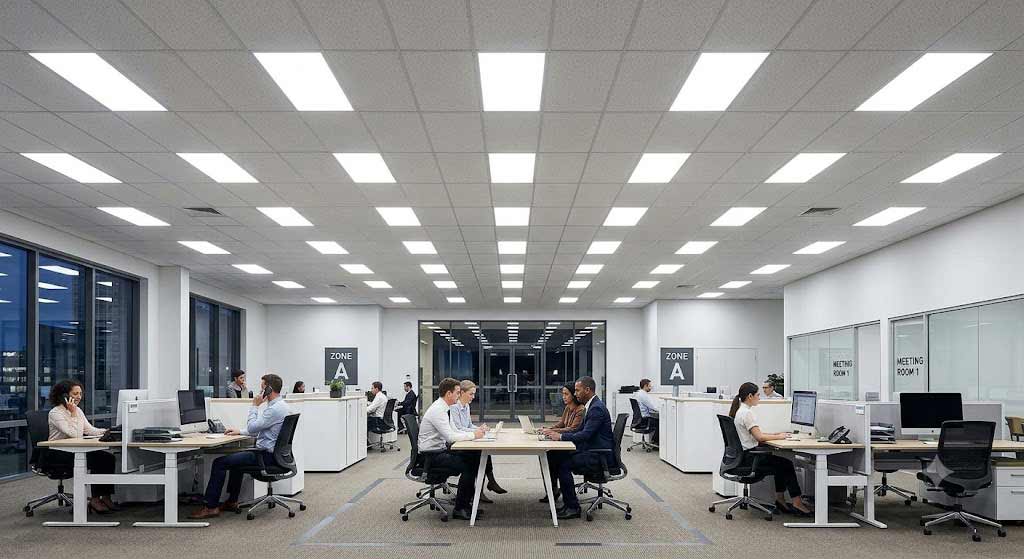
LED Emergency Driver For LED Panel Lights
Emergency drivers sized for 600×600 and 1200×300 LED panels with external drivers.
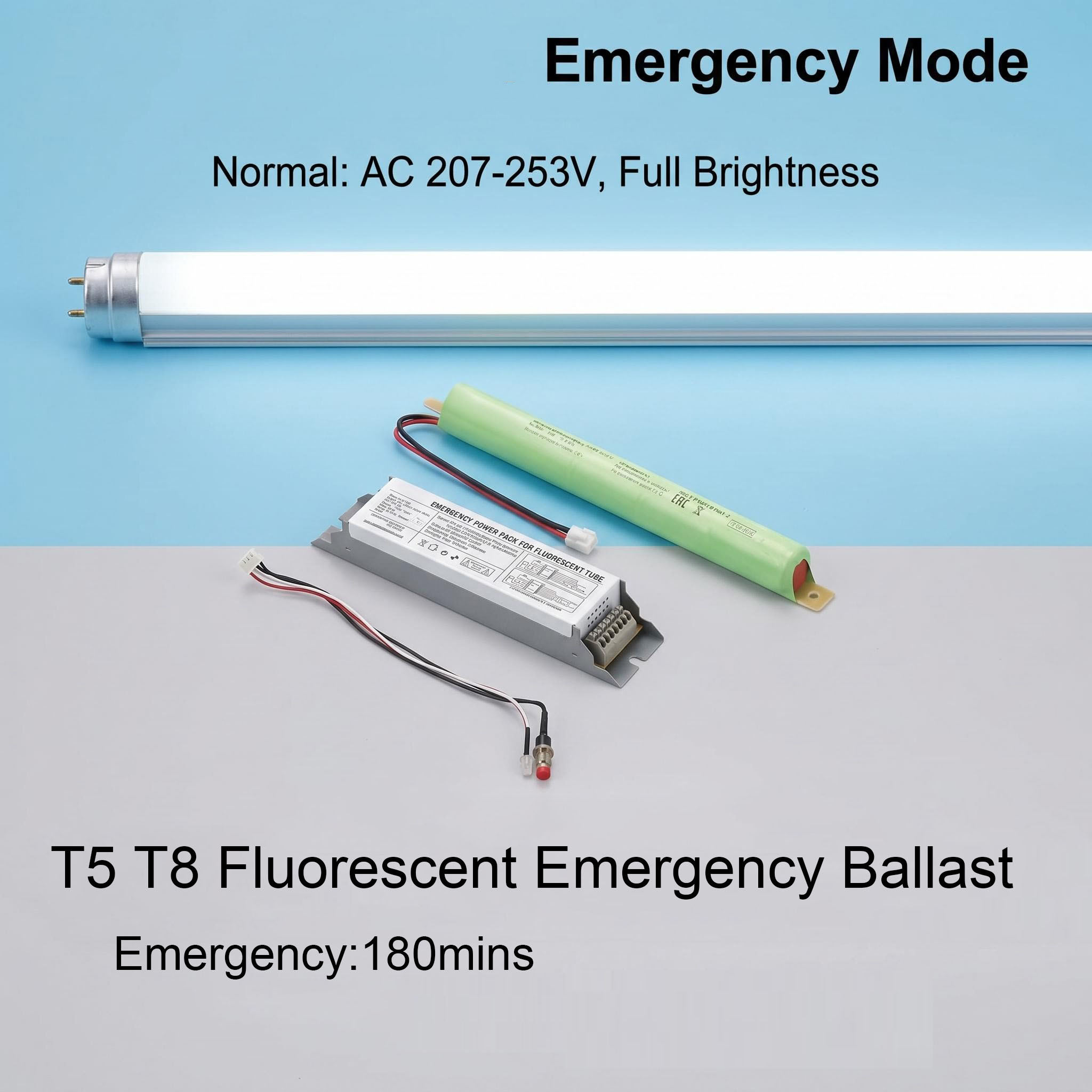
LED Emergency Driver For LED Tubes
Emergency conversion kits for T8 and T5 LED tubes and batten fittings.
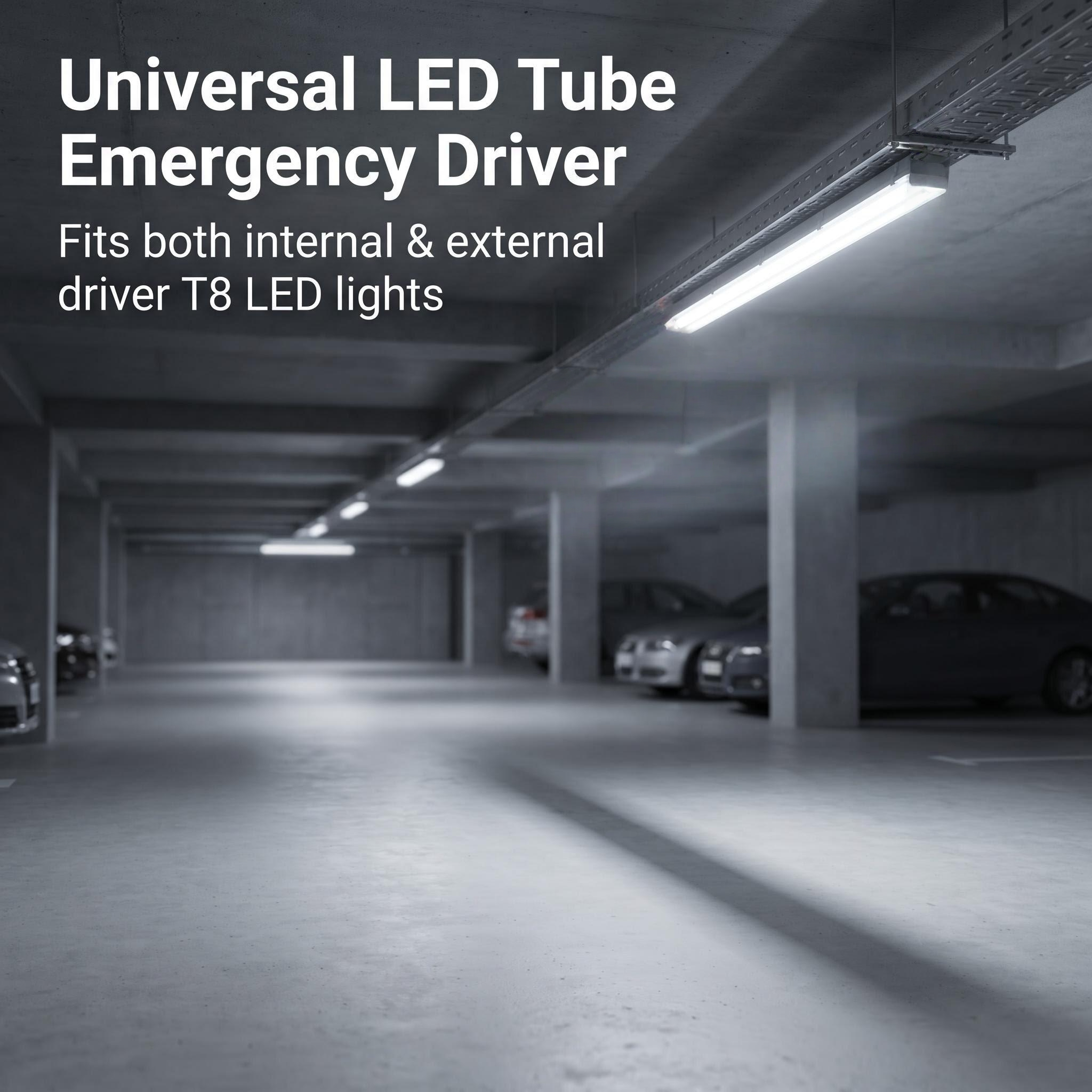
LED Emergency Driver For Linear Lights
Slim emergency drivers that fit inside linear and trunking profiles without a separate battery box.
Frequently Asked Questions About LED Emergency Driver
Supplier Qualification Checklist For LED Emergency Driver Buyers
Q: How do I know I am dealing with a real manufacturer and not a trading office?
Inspect the factory’s SMT lines, battery pack assembly stations, and burn-in racks in person or via video. Ask for photos with date stamps of ageing ovens, hipot testers, and duration test rigs. A genuine LED emergency driver manufacturer keeps raw battery cell certificates of origin and can show discharge curves for the exact batch. Trading offices deflect these requests or send generic brochures.
Q: What minimum order quantity and lead time should I expect?
Hymark’s standard MOQ is 500 units per model for OEM orders, 100 units for neutral-label stock. Sample lead time is 5-7 working days from confirmed specification; bulk production runs 15-25 days depending on battery chemistry and test-report generation. LiFePO4 packs extend lead time by 3-5 days versus NiCd because cell matching and BMS programming add steps. Air-freight samples of lithium-based drivers require UN 38.3 test summaries and MSDS, adding 2 days to documentation.
Q: Which emergency duration and output options are available, and how do they match my fixture?
Hymark’s LED emergency drivers for panels, tubes, and linear lights offer 90-minute, 2-hour, and 3-hour duration at 3W, 5W, 8W, or 10W emergency output. Output is typically 10-30% of normal luminaire lumens: a 40W panel at 4000 lm drops to 400-1200 lm in emergency mode. The inverter output window is DC 150-280V at 150-300 mA for panels, DC 90-180V at 200-350 mA for tubes, and DC 24-50V at 400-700 mA for linear systems. Confirm your LED module’s forward voltage and current draw sit inside this window.
Q: What battery chemistries are used, and how often must they be replaced?
NiCd 3.6V 1500-4000 mAh packs charge in 24 hours and last 3-4 years with 500 cycles. Li-ion 18650 3.7V 2200-5200 mAh packs charge in 16-20 hours and reach 800-1000 cycles. LiFePO4 3.2V 3000-6000 mAh packs charge in 12-16 hours, deliver 1500-2000 cycles, and tolerate -20°C to +60°C ambient. Replacement intervals: NiCd every 3 years, Li-ion every 5 years, LiFePO4 every 8-10 years under EN 62034 self-test regimes.
Q: What test reports and conformity marks should I request for my destination market?
For the UK and Europe, ask for third-party EN 60598-2-22, EN 1838, and EN 62034 test reports plus valid CE documentation. For BS 5266-1 compliance in Britain, the report must cover the specific duration and output you are ordering. Middle East and Africa typically accept CB reports derived from IEC 61347. For the US, UL 924 is required; for Australia, AS/NZS 2293. Verify the report references your exact model number, not a generic series. Hymark can supply test summaries for review; buyers should cross-check certificate validity with the issuing laboratory.
Q: How does lithium battery chemistry affect shipping mode and required documents?
UN 38.3 testing is mandatory for all lithium cell shipments by air (IATA PI 965-970) and sea (IMDG Code SP 188). LiFePO4 and Li-ion 18650 packs above 100 Wh require Class 9 dangerous goods labels, shipper’s declaration, and 1.2 metre drop-test packaging. Hymark packs single drivers in UN-certified cartons with fibreboard dividers; pallet loads use 4-ply export cartons and moisture-barrier wrapping. Sea freight to Europe runs 28-35 days FOB Shenzhen; air freight to Dubai or Lagos is 5-7 days CIF with DG handling surcharge. NiCd ships as general cargo with no DG surcharge.
Q: What warranty, spare parts, and after-sales engineering support are provided?
Hymark offers 3 years warranty on NiCd-based drivers and 5 years on Li-ion and LiFePO4 variants. Spare battery packs, replacement inverters, and changeover relays are stocked for 7 years post-discontinuation. After-sales support includes wiring diagram review for maintained versus non-maintained circuits, DALI addressing guidance, and remote troubleshooting via photo and video. For OEM luminaire builders, application engineers review thermal management and driver mounting position to prevent battery degradation from host fixture heat.
Q: Can I get OEM branding, custom packaging, and installation support for my market?
OEM branding adds 3-5 days for silkscreen and label plate production. Custom packaging with your logo, barcode, and local language manual is available at 500-unit MOQ. Hymark supplies maintained and non-maintained wiring schematics, DALI integration notes, and commissioning checklists aligned to BS 5266-1 or local variants. For large projects, factory technicians can conduct on-site or video-call training for installation contractors on duration test procedures and battery replacement protocols.
Important Notice
Specifications, output and duration figures and price ranges in this guide are indicative and are provided
for planning purposes only. Actual emergency output, duration, battery life, ingress protection and available conformity documentation
differ by model and by destination country, and emergency lighting design remains the responsibility of the project designer. Buyers
must confirm their own mains voltage and frequency, the emergency lighting standard enforced locally, the host fixture compatibility
and their import requirements before placing an order. All figures are subject to written confirmation in the final proforma invoice
issued by Hymark.
Sourcing LED Emergency Driver from Hymark
A qualified emergency driver supplier must demonstrate control over the four failure points that kill projects: output stability under load, battery consistency after 500+ cycles, EMC compliance at the destination port, and traceable after-sales support when a batch underperforms. Trading offices rarely own the test stations that prove these; manufacturers do.
What Hymark Brings to the Sourcing Decision
JIALINGHANG ELECTRONIC CO., LTD. was founded in 2013 as a global LED exporter in general illumination. A strategic shift in 2017 refocused the company on LED emergency technology and high performance LED strips. Hymark was launched in 2026 as the premium brand. Products are co-designed and engineered in-house through a strategic partnership with dedicated manufacturing facilities that have also been operating since 2013. The company manages R&D, product design and global distribution itself.
This structure matters because the engineering team specifies the inverter topology, the battery management IC thresholds, and the changeover relay contact rating for each driver family. For LED panel lights, tubes and linear lights, Hymark produces emergency drivers with input ranges of AC 85-265V or 100-277V, output windows typically 9-42V DC at constant current levels from 150mA to 700mA, and driven emergency loads from 3W to 25W. Emergency duration is selectable at 90 minutes, 2 hours, or 3 hours. Battery options span LiFePO4 3.2V packs (1500mAh to 5000mAh, roughly 800 to 1500 cycles), Li-ion 18650 configurations, and NiCd where local codes still permit. Charge time to 90% capacity is 24 hours maximum. Self-test and DALI test facility variants are available. Maintained and non-maintained wiring are both supported.
Documentation You Should Demand Before Placing an Order
For EN 60598-2-22, EN 1838, EN 62034 or BS 5266-1 markets, ask for third-party test reports covering the exact driver-and-battery combination you intend to buy, not a generic family certificate. For UL 924 or AS/NZS 2293 destinations, request the applicable test data for your specific input voltage and frequency. Verify that the supplier holds discharge and duration test records for the production batch, not just the prototype. Ask for UN 38.3 test summaries if lithium batteries are involved, and confirm IATA/IMDG-compliant inner packaging for air or sea freight.
Price Drivers and Lead Time
Unit price moves with battery chemistry (LiFePO4 commands 15-25% premium over NiCd for equivalent capacity), emergency duration (3-hour packs require 100% more cells than 90-minute versions), and output power. Self-test circuitry adds 8-12% to BOM cost. DALI adds another 10-15%. MOQ typically starts at 500 units for branded OEM orders, with 200-unit trial lots negotiable for first-time buyers. Sample lead time is 7-10 days from confirmed specification. Production lead time runs 25-35 days after deposit, depending on battery cell availability. Payment structure is 30% deposit, 70% against bill of lading. FOB Shenzhen or CIF to destination port.
Closing the Specification
Send the host fixture type and wattage, the emergency duration your code requires, your mains voltage, and your destination port. Hymark will return a matched driver specification, battery configuration, and firm quotation within 24 hours via WhatsApp or email.
Get a Factory Direct Quote on LED Emergency Driver
JIALINGHANG ELECTRONIC CO., LTD. has been in LED lighting since 2013 and has focused on
LED emergency technology and high performance LED strips since 2017. Hymark products are co-designed with our
dedicated manufacturing partners, built with selectable emergency duration and maintained or non-maintained wiring, and function
tested before packing. Send us the host fixture type and wattage, the emergency duration your local code requires, your mains
voltage and your destination port and we will return a quotation within 24 hours.


 English
  Spanish
  Arabic
  French
  German
  Russian
  Portuguese
  Italian
  Vietnamese