
LED Emergency Driver Buyer Guide
The right LED emergency driver family is determined by three things: the host fixture type (panel, tube, linear high bay or strip), the emergency duration your local code demands, and whether the inspector expects EN 60598-2-22, UL 924, AS/NZS 2293 or another approval. Below is a complete taxonomy of every real type and sub-type in production, with the numbers that separate them.
| Type | Sub-Type | Normal Input | Đầu ra khẩn cấp | Pin | Thời lượng | Best For | Key Limitation |
|---|---|---|---|---|---|---|---|
| Integral LED Panel Emergency Driver | Recessed panel kit | AC 220-240V or 100-277V | 10W-20W DC 25-40V 300-500mA | LiFePO4 6.4V 2600mAh or Li-ion 18650 7.4V 2200mAh | 90 min, 3 hr | 600x600mm or 1200x300mm panels in offices, healthcare | Fixed output window; panel LED voltage must fall inside driver Vf range |
| Slim panel mini driver | 85–265 V AC | 5W-10W DC 18-36V 250mA | Li-ion 3.7V 2600mAh | 90 min | Ultra-thin panels <25mm depth | Lower lumen fraction, typically 10-15% of normal output | |
| LED Tube Emergency Driver | T8 retro-fit internal | AC 220-240V | 9W-18W DC 36-72V 180-250mA | NiCd 3.6V 1500mAh or LiFePO4 6.4V 1500mAh | 90 min, 2 hr | Single or twin T8 battens, trunking systems | NiCd variants need 24 hr charge time; LiFePO4 cuts this to 6 hr |
| T5 linear internal | AC 100-277V | 7W-14W DC 28-54V 200mA | LiFePO4 6.4V 2000mAh | 90 min, 3 hr | T5 HO fittings in retail, schools | T5 tube voltage spread is narrow; verify Vf match | |
| LED Linear / Strip Emergency Driver | Constant voltage 12V/24V strip | AC 220-240V | 10W-60W DC 12V or 24V | Li-ion 18650 11.1V 4400mAh or LiFePO4 12.8V 3000mAh | 90 min, 2 hr, 3 hr | LED strip coves, signage, architectural accent | Output is CV not CC; lumen maintenance depends on strip efficiency (e.g. 14.4W/m SMD2835 at 120 LED/m, 1200 lm/m, CRI>80, 3000K or 4000K) |
| High-bay linear driver | AC 100-277V | 20W-50W DC 30-60V 350-700mA | LiFePO4 12.8V 6000mAh | 3 hr | Warehouse continuous lines, aisle lighting | Physical size; battery pack often remote-mounted | |
| Full Power Emergency Driver | 100% output maintained | AC 220-240V | Full fixture wattage mirrored | LiFePO4 25.6V 6000mAh or larger | 90 min, 2 hr | Escape routes needing full task light, BS 5266-1 corridors | Battery volume 3-4x standard; weight and cost increase proportionally |
| Reduced output non-maintained | 85–265 V AC | 30-50% of normal lumens | LiFePO4 12.8V 3000mAh | 90 min, 3 hr | Open areas where minimum 1 lux on floor per EN 1838 suffices | Lower battery cost but specifier must verify point-by-point lux | |
| Emergency Twin Spotlight Driver | Adjustable head kit | AC 220-240V | 2x3W DC 3-12V per head | NiCd 4.8V 1200mAh or Li-ion 7.4V 1500mAh | 90 min, 3 hr | Anti-panic lighting, high-risk task areas | EN 1838 requires 5 lux on escape routes; twin spots achieve this at distance only with narrow beam |
| DALI-2 Self-Test Emergency Driver | Addressable system module | AC 220-240V | 10W-40W DC 25-50V 200-800mA | LiFePO4 12.8V 3000-6000mAh | 90 min, 3 hr | Smart buildings, EN 62034 automated testing regimes | Requires DALI bus power; not backward compatible with DSI |
| Standalone auto-test | AC 100-277V | 5W-20W | Li-ion 7.4V 2200mAh | 90 min | Small projects without BMS integration | Test results via LED blink code; no remote monitoring |
Maintained Versus Non-Maintained Wiring
Maintained drivers keep the emergency LEDs energised during normal mains operation via a changeover relay; non-maintained units sit dark until mains failure triggers the inverter. Maintained wiring suits corridors and stairwells in public buildings under BS 5266-1. Non-maintained reduces battery cycling and extends LiFePO4 cycle life from roughly 500 to 800 cycles. Verify your local code: EN 1838 and AS/NZS 2293 treat maintained status differently for escape route versus open-area anti-panic lighting.
Battery Chemistry Trade-Offs
NiCd 3.6V or 4.8V packs remain the cheapest per piece but carry 24-hour charge times, memory-effect risk and restricted air-freight under IATA regulations. Li-ion 18650 cells (3.7V nominal, 2600-3500mAh) halve charge time to 8-12 hours and ship under UN 38.3 test documentation. LiFePO4 3.2V cells assembled to 6.4V or 12.8V packs offer 1500-2000 cycles, wider temperature tolerance (-20°C to +60°C ambient) and the safest thermal runaway profile, at roughly 15-25% higher cell cost. For tropical climates or unplant roof spaces, LiFePO4 is the defensible choice despite the premium.
Test Facility Hierarchy
Manual test key is lowest cost and satisfies minimum legal duty but relies on building staff logging monthly and annual tests. Self-test drivers with internal clocks automate duration and function tests per EN 62034; fault reporting is local LED or volt-free contact. DALI-2 emergency modules integrate into building management for remote logging, addressable fault location and automated compliance reporting. DALI adds $8-15 per driver and requires compatible luminaire wiring; specify it only where the maintenance contract justifies the infrastructure.
IP Rating and Ambient Range
Integral panel and tube drivers typically rate IP20 or IP30, sufficient for luminaire interior installation. Linear strip drivers for exterior coving or car parks need IP65 minimum; verify gasket integrity on cable entries. Standard drivers specify 0°C to +50°C ambient. Extended-range variants with LiFePO4 packs operate to -20°C but lose 20-30% emergency duration below 0°C; size battery capacity accordingly or accept shorter run time.
How a LED Emergency Driver Works
An LED emergency driver is a switch-mode power supply with a battery-backed DC inverter, a changeover relay, and a charge-management circuit. The sequence below is common to the emergency driver types used in LED panels, LED tubes, and linear luminaires. Strip products follow a different architecture and are covered separately.
Normal Operation Sequence
- Mains present: charging circuit conditions the battery
The input stage accepts AC 85-265V or 100-277V, rectifies and steps the voltage down to the battery float level. A LiFePO4 3.2V 3000mAh pack is held at 3.4–3.6V float; a NiCd 3.6V 1200mAh pack at 3.6V; a Li-ion 18650 3.7V 2600mAh cell at 4.2V with charge termination. The charge current tapers from 0.3C to trickle over 12–24 hours for a full depleted-to-full cycle. EN 62034 requires the indicator to show “healthy” only when the battery can deliver the rated duration. - Mains failure is detected
The detection circuit monitors the rectified DC bus. When it collapses below 70–80% of nominal, the comparator triggers. Detection time is typically 50–200 ms. Faster detection is possible but increases nuisance switching during brownouts. - Changeover relay transfers the load
A relay or solid-state switch disconnects the normal LED driver output and connects the battery to the inverter. Transfer time is under 0.5 seconds for self-contained emergency luminaires to comply with EN 1838 and BS 5266-1. The inverter is already primed; there is no warm-up delay. - Battery feeds constant-current inverter output
The boost or buck-boost inverter converts the battery DC to the LED forward-voltage window, typically 9–42V DC at 150–350 mA constant current, depending on the model and the matched fixture. The driver limits output to the programmed emergency wattage—commonly 3W, 5W, or 10W—which is 10–30% of the normal fixture output. EN 1838 requires minimum illuminance on escape routes; the lumen target is met by the combination of emergency output and optics, not by full-power operation. - Light output and duration are limited by battery energy and inverter cutoff
The inverter runs until the battery reaches its low-voltage disconnect: 2.5V for LiFePO4, 3.0V for Li-ion, 1.0V per cell for NiCd. A 3.2V 3000mAh LiFePO4 pack stores roughly 9.6Wh. At 5W inverter output with 85% efficiency, the theoretical maximum is 1.6 hours; in practice, with temperature derating and end-of-life margin, the rated duration is 90 minutes or 3 hours depending on the model. The inverter also folds back current if the LED load attempts to draw above the programmed level. - Status indicator and test facility report condition
A bicolour LED shows green for healthy/charging, red for fault or discharge. A manual test key simulates mains failure for 30 seconds or the full rated duration. Self-test models run automatic brief and full-duration tests per EN 62034 schedules; DALI-integrated versions report status to the building management system. The test facility does not increase reliability; it only reveals failure after it has occurred. - Mains restore: reversion and recharge
When the AC bus recovers, the relay drops back to normal mode within 0.5 seconds. The charge circuit restarts. A full recharge from deep discharge takes 12–24 hours for NiCd, 6–12 hours for LiFePO4. The indicator returns to green once the battery acceptance test is passed.
Where Cheap Products Lose Output or Duration
Three points in the sequence above separate compliant drivers from failures in the field:
- Slow or erratic changeover. Budget relays with welded contacts or weak coils can stick, leaving the fixture dark in emergency mode. The relay is a wear item; a 10A relay rated for 100,000 operations at 250V AC is preferable to a 5A signal relay repurposed for mains switching.
- Inverter current regulation drifts. A cheap inverter without true constant-current control will deliver higher current at full battery, then collapse below the minimum useful threshold before the battery is empty. The result is a driver that claims 3 hours but gives 90 minutes of useful light followed by dim glow. Check that the emergency output is specified in lumens or watts across the full discharge curve, not just at t=0.
- Charge management omits cell balancing or temperature compensation. A single-string LiFePO4 pack without balancing will develop overcharged and undercharged cells within 100–200 cycles. At 45°C ambient, an uncompensated charger overcharges; at 0°C, undercharges. Both reduce the achievable duration. A 500-cycle LiFePO4 pack becomes a 150-cycle pack in practice.
Maintained and Non-Maintained Wiring
The sequence above describes non-maintained operation: the emergency driver is inactive until mains fails. In maintained wiring, the emergency LEDs are energised continuously from the normal supply via a switched live, and the emergency driver only takes over on failure. The driver must therefore tolerate being back-fed at its output terminals during normal operation. Not all emergency driver types accept this; verify the terminal block is labelled for maintained use.
Strip Product Architecture
LED strip emergency drivers do not use the relay-and-inverter sequence above. The strip itself is a resistive current limiter: 12V or 24V DC feeds a repeating segment of 3 LEDs in series (for 12V) or 6–7 LEDs (for 24V), each segment with a 150–330 ohm SMD resistor. Cut length is every 50 mm or 25 mm depending on LED pitch. A strip emergency driver is therefore a DC UPS: a battery-backed 12V or 24V supply that switches from mains adapter to battery boost on failure. There is no constant-current inverter stage.
| Parameter | Typical Value | Notes |
|---|---|---|
| Working voltage | 12V DC or 24V DC | 24V allows longer runs before voltage drop |
| LEDs per metre | 60, 120, 240 | Higher density for COB strips, lower for SMD 2835 |
| Power | 4.8–14.4 W/m | 4.8W/m for 60 LED SMD 2835, 14.4W/m for 120 LED high-output |
| Lumens per metre | 400–1,500 lm/m | Depends on LED type and CRI |
| CRI | Ra 80 or Ra 90 | Ra 90 for retail and gallery applications |
| Colour temperature | 2700K, 3000K, 4000K, 6000K | 4000K most common for commercial emergency |
| PCB width | 8 mm, 10 mm, 12 mm | Wider copper (2 oz) reduces voltage drop |
| Copper weight | 1 oz or 2 oz | 2 oz recommended for 5m+ runs |
| Voltage drop | 0.5–2V over 5m | Limits practical run length; feed from both ends or use 24V |
Voltage drop is the critical limiter. At 12V, a 5m strip drawing 3A loses 1.5V in 1 oz copper, dimming the far end below useful output. The emergency driver does not correct for this; it merely maintains the supply voltage at the feed point. Designers should calculate drop per metre or specify 24V and 2 oz copper for runs over 3 metres.
Standards to Verify with the Supplier
| Tiêu chuẩn | What it governs | What to request |
|---|---|---|
| EN 60598-2-22 | Construction and marking of emergency luminaires | Test report for the specific driver model |
| EN 1838 | Escape route illuminance levels and uniformity | Photometric data for the complete luminaire, not the driver alone |
| EN 62034 | Automatic test systems | Self-test or DALI test schedule documentation |
| BS 5266-1 | UK emergency lighting design and installation | Compliance statement for the intended duration (1 hr, 2 hr, 3 hr) |
| UL 924 | North American emergency power equipment | UL file number if supplying to US or Canadian projects |
| AS/NZS 2293 | Australian emergency luminaire requirements | Certificate of conformity for the battery and driver combination |
A supplier should provide the battery chemistry, capacity, and cycle life in writing, not merely the duration. The cycle life of 500 for LiFePO4 or 300 for NiCd is achievable only with proper charge management; ask for the temperature range of the charge circuit, typically 0°C to 45°C for indoor products, wider for industrial versions.
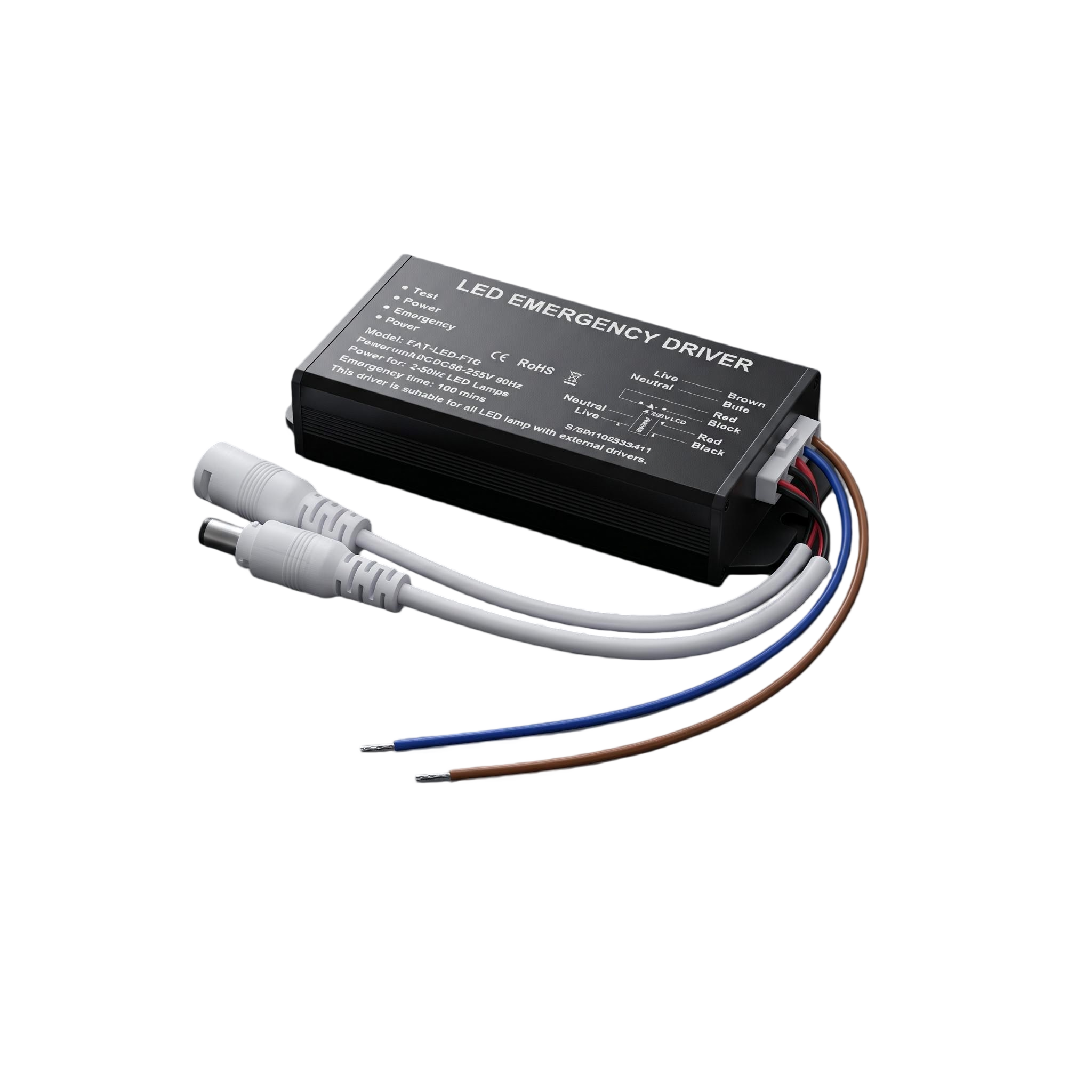
Types and Configurations of LED Emergency Driver
| Type or Class | Typical Rating or Output | Duration or Runtime | Best Suited For | Notes |
|---|---|---|---|---|
| Reduced-Power Emergency Driver (10–30% mode) | 3–10W emergency output, 10–30% of normal lumen package | 90 min or 3 hr | LED panels, LED tubes, linear office fixtures in escape routes | EN 1838 minimum 1 lux on floor often met at 10–20% of normal output; LiFePO4 3.2V 1500–3000mAh typical; constant current inverter output 25–80V DC at 100–350mA |
| Full-Power Emergency Driver (100% mode) | Matches normal driver wattage, 20–60W | 90 min or 2 hr | LED high bays, industrial linear, retail downlights where task visibility matters | Requires LiFePO4 6.4V 4000–6000mAh or Li-ion 18650 11.1V 2600mAh packs; larger enclosure; BS 5266-1 and NFPA 101 may mandate full power for high-risk task areas |
| Self-Test Emergency Driver (EN 62034) | 3–25W depending on model | 90 min or 3 hr | Schools, hospitals, shopping centres, any site with large lamp counts and limited maintenance staff | Programmed functional and duration test intervals; DALI or standalone reporting; adds 15–25% cost versus manual test key version; battery fault and LED fault relay output often included |
| Manual-Test Emergency Driver | 3–25W | 90 min or 3 hr | Small commercial, warehousing, residential blocks where a maintenance porter can walk the building | Push-button test key or remote test switch; no DALI wiring needed; EN 62034 compliance not claimed; NiCd 3.6V 1200mAh or LiFePO4 options |
| Maintained/Non-Maintained Switchable Driver | 3–15W emergency output | 90 min or 3 hr | Luminaire OEMs building one SKU for both wiring schemes; corridors with generator-backed normal lighting | Changeover relay switches to inverter on mains failure; maintained wiring requires live switched supply to driver at all times; non-maintained wiring isolates normal driver only |
| Strip-Specific Emergency Driver (low voltage DC input) | 10–30W at 24V or 48V DC input; 5–15W emergency output | 90 min or 2 hr | COB LED strips, SMD LED strips in coves, signage, architectural features | Input 24V DC or 48V DC from normal LED driver; boost inverter to strip voltage; LiFePO4 3.2V 3000mAh common; cut-to-length strip compatibility depends on strip working voltage and cut length |
Reduced-Power Emergency Driver
This is the volume product in commercial retrofit and new build. The driver runs the same LED module at 10–30% of normal luminous flux—typically 300–800 lumens from a 3000-lumen LED panel—powered by a LiFePO4 3.2V 1500–3000mAh pack through a constant current inverter stage at 25–80V DC, 100–350mA. Electrical contractors and installers specify these for office corridors and open-plan escape routes where EN 1838 only demands 1 lux minimum on the centre line. The trade-off is real: occupants get enough light to evacuate but not enough to continue working, and the luminaire OEM must verify that their LED module efficacy and lumen maintenance at 10% drive current still meets the required output. These drivers cannot serve high-risk task areas under BS 5266-1 or NFPA 101 where full normal output is mandated during emergency operation.
Full-Power Emergency Driver
Facility managers in manufacturing, cold storage, and data halls buy these because reduced output would leave hazardous machinery or racking aisles dangerously dim. The driver must match the normal LED driver wattage—20W, 40W, 60W—so the battery pack scales to LiFePO4 6.4V 4000mAh or Li-ion 18650 11.1V 2600mAh configurations, with charge times extending to 12–24 hours and cycle life dropping to 500–800 cycles for Li-ion versus 1500+ for LiFePO4. The enclosure grows to IP65 or larger to house the pack and heat sink. What it cannot do is fit inside a slim 600×600 mm LED panel ceiling void; these are external box or wire-in-canopy formats for high bays and linear trunking. Procurement officers should ask suppliers for the battery pack UN 38.3 test summary before air freight, as lithium capacities above 100Wh trigger IATA Section IA packaging rules.
Self-Test Emergency Driver
M&E consultants specify these for projects where EN 62034 automatic test systems are tendered as standard—typically education, healthcare, and retail portfolios with hundreds of luminaires. The driver firmware triggers a 1–5 minute functional test monthly and a 90-minute duration test annually, reporting battery health and LED circuit integrity via DALI broadcast or a local fault relay to the building management system. The hardware premium is 15–25% over manual test, and the installation requires DALI bus wiring or at least a two-wire fault signalling loop. What it cannot do is eliminate the need for annual physical inspection of exit sign legibility and obstruction under BS 5266-1; the standard treats automatic testing as a complement, not a replacement, to human verification.
Manual-Test Emergency Driver
Lighting wholesalers stock these for price-sensitive projects and small commercial jobs where a maintenance porter can press test keys during weekly fire checks. Battery options range from legacy NiCd 3.6V 1200mAh (shorter cycle life, 300–500 cycles, but tolerant of 0°C to +45°C) to LiFePO4 3.2V 1500mAh (longer life, lighter, but ambient below -10°C degrades performance). Input voltage is typically AC 85–265V universal. The limitation is compliance risk: if the porter misses a test or records it falsely, the first indication of battery failure is a black luminaire during a real mains failure. These drivers do not satisfy EN 62034; buyers in jurisdictions where that standard is cited in building regulations should confirm local inspector expectations.
Maintained/Non-Maintained Switchable Driver
Luminaire OEMs adding emergency versions to their standard LED panel or tube lines buy these to reduce SKU proliferation. A changeover relay inside the driver selects between maintained wiring—emergency LED live whenever the luminaire is switched on, inverter taking over on mains failure—and non-maintained wiring—emergency LED only energised on mains failure. The same driver hardware covers both schemes with a wiring strap or DIP switch. The complexity is in the maintained supply: the switched live must reach the driver even when wall switches are off, requiring three-core plus earth cabling that some retrofit sites lack. These drivers cannot convert a non-maintained wired building to maintained operation without re-cabling.
Strip-Specific Emergency Driver
Lighting designers and architectural specifiers use these for LED strip coves, backlit signage, and feature lighting where a mains-input emergency driver would be physically impossible to conceal. The unit takes 24V DC or 48V DC from the normal LED driver, stores energy in a LiFePO4 3.2V 3000mAh pack, and boosts to the strip working voltage—typically 24V DC—at reduced current for emergency duration. Match is critical: a 14.4W/m SMD LED strip at 3000K, 120 LEDs/m, 24V, cut every 100mm, will run at roughly 5W/m in emergency mode, so a 5-metre cove needs 25W emergency output and a driver rated accordingly. These drivers cannot drive 230V AC direct-input LED strips or COB strips with built-in rectifiers; the strip must be pure DC-fed with defined polarity. IP rating of the driver housing must also match the strip location—IP20 for dry coves, IP65 for bathroom mirror installations referencing IEC 60598-2-22.
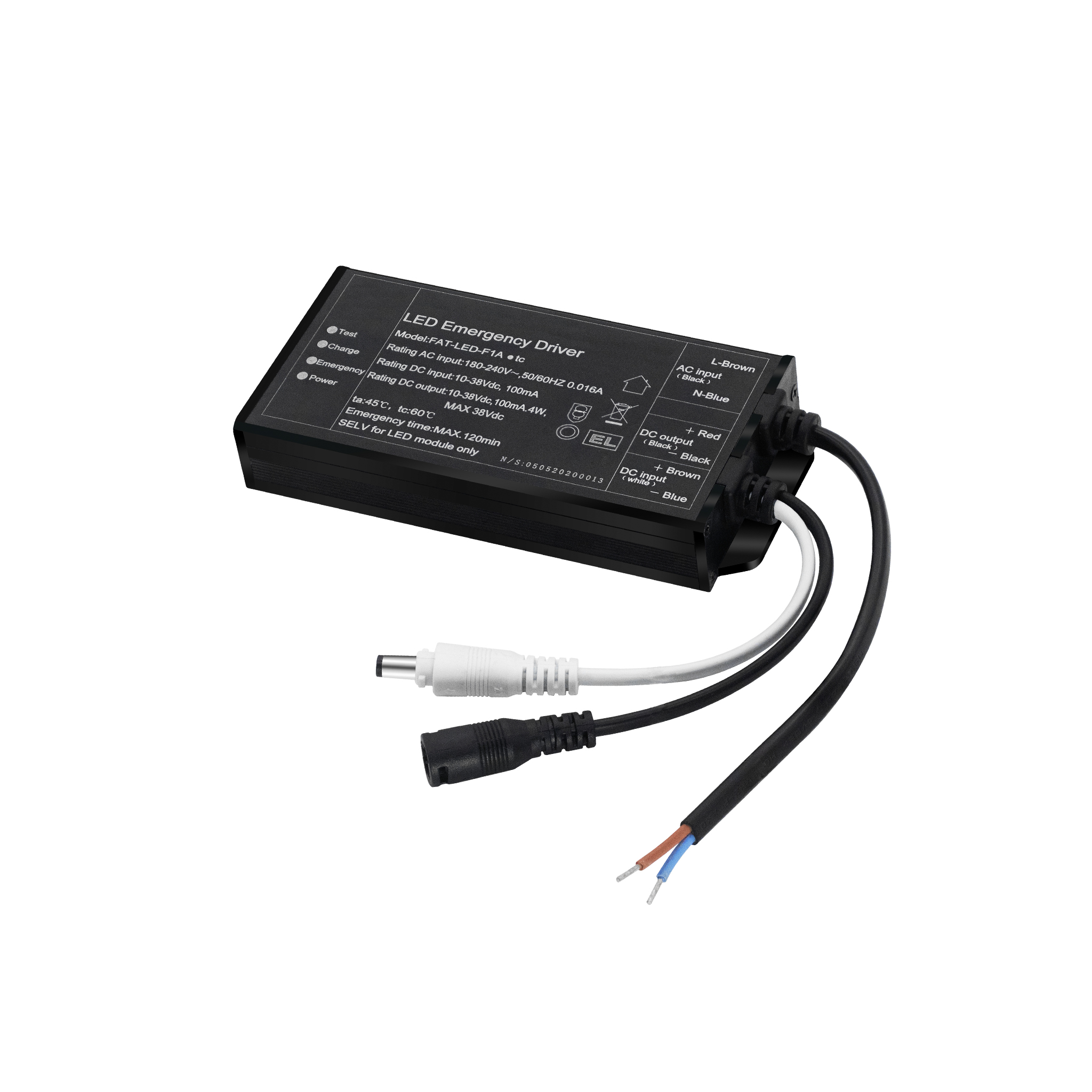
Main Components of a LED Emergency Driver
An LED emergency driver is a modular system. Buyers who understand the sub-assemblies can spot where a cheap unit cuts corners and where a premium unit earns its price. The table below breaks down every major assembly, compares typical entry-level and upgraded implementations, and identifies the weakest link in each chain.
| Assembly | Function | Typical Entry Level Version | Typical Upgraded Version | What Fails First |
|---|---|---|---|---|
| Enclosure and Mounting | Houses electronics, provides strain relief, thermal management, IP/IK protection | ABS plastic box, clip-on lid, IP20, 60°C max ambient | Steel or flame-retardant polycarbonate, gasketed IP65, 70°C ambient, sliding bracket for LED panel gear trays | Lid clips crack after thermal cycling; gasket hardens if not silicone |
| Charging Circuit | Maintains battery at float voltage, prevents overcharge, monitors temperature | Simple resistor-limited trickle charge, fixed 7.2V or 14.4V for NiCd, no thermal compensation | Switch-mode charger with CC/CV profile, 3.65V per cell for LiFePO4, NTC thermistor foldback, charge status to MCU | Electrolytic capacitor dries out at 85°C; trickle charger cooks NiCd in hot ceilings |
| Battery Pack and Cell Chemistry | Stores energy for emergency output | NiCd 3.6V 600mAh or 7.2V 1200mAh, 500 cycles, memory effect, 24h charge time | LiFePO4 6.4V 3000mAh or 12.8V 1500mAh, 1500–2000 cycles, 4–6h charge, UN 38.3 tested for air freight | NiCd cell shorts from cadmium dendrites; LiFePO4 BMS fails from vibration |
| Constant Current Inverter Output Stage | Converts battery DC to regulated current for LED load during emergency | Linear regulator or simple boost, 150mA fixed, 70% efficiency, no dimming | Buck-boost topology, 200–350mA selectable, 90% efficiency, matches normal driver current to hit 10% or 50% emergency output per EN 1838 | MOSFET overheats if heatsinking is inadequate; inductor saturates |
| Changeover and Mains Sensing Circuit | Detects AC loss, switches LED load from normal driver to emergency inverter, restores on return | Relay with 220–240V coil only, 10ms break, no maintained wiring support | Wide-range AC 85–265V sensing, solid-state or latching relay, <5ms transfer, maintained/non-maintained selectable via dip switch | Relay contacts arc and weld if inrush current exceeds rating; sensing resistor drifts |
| Status Indicator and Test Facility | Shows charge/ fault state, enables compliance testing | Bicolor LED only (red=charging, green=ok), manual test key | Same LED plus DALI-2 interface per EN 62034, automatic self-test every 30 days, 10% annual duration test, fault log | LED itself rarely fails; test key switch corrodes; DALI bus needs termination resistor |
| Output Leads and Connectors | Distributes power to LED board, connects battery, mains input | 0.5mm² PVC wire, push-fit Wago clones, no polarity keying | 0.75mm² silicone-insulated, JST or Molex latching, color-coded for battery+/– and LED+/– | PVC hardens and cracks in 60°C+ ceilings; push-fit springs lose tension |
| LED Board Diffuser or Legend Panel (luminaires/exit signs) | Produces visible light or pictogram during emergency | SMD 2835 on FR4, 80 lm/W, no emergency lumen reserve, polycarbonate diffuser yellows | SMD 2835 on aluminum MCPCB, 120 lm/W, optical design maintains 10% emergency output uniformly, UV-stabilized diffuser | Solder joints crack on FR4; diffuser haze reduces output below EN 1838 minimums |
| PCB LED Package Resistors and IP Coating (strip products) | Flexible linear light source, often retrofit into coves or signage | SMD 3528 60 LEDs/m, 4.8W/m, 400 lm/m, CRI 70, 3000K, no coating, 12V | COB or SMD 2835 120–240 LEDs/m, 14.4–19.2W/m, 1500–2000 lm/m, CRI 90+, 2700–6500K selectable, polyurethane conformal coat, IP67, 24V | Resistor overheats at strip cut points; coating traps moisture if applied over flux residue |
Battery Pack Chemistry and Capacity
The battery determines whether the unit survives three years or twelve. NiCd 3.6V 600mAh packs deliver roughly 90 minutes at 3W emergency output, but their 500-cycle life and 24-hour charge time make them obsolete for most new builds except where local regulations still mandate them. LiFePO4 6.4V 3000mAh packs run 3 hours at 4W with 1500–2000 cycles and charge in 4–6 hours, but they require a battery management system (BMS) to prevent over-discharge below 2.5V per cell. Li-ion 18650 3.7V 2600mAh cells offer higher energy density but thermal runaway risk above 60°C, so they are rarely used in enclosed ceiling luminaires unless the fixture has explicit thermal management. Buyers should ask suppliers for UN 38.3 test reports for lithium chemistries; without this, air freight and some sea freight consolidators will refuse the shipment.
Charging Circuit Topology
The charging circuit is where entry-level and upgraded units diverge most sharply. A resistor-limited trickle charger applies continuous current to a NiCd pack, which overcharges and dries electrolyte if the ambient exceeds 45°C—a common condition in roof voids. A switch-mode CC/CV charger with NTC compensation reduces charge current when the pack temperature rises, extending LiFePO4 cycle life from 800 to 2000 cycles. The electrolytic capacitor on the charger output is the dominant failure mode: 85°C-rated parts last 3,000–5,000 hours, while 105°C-rated parts reach 8,000–10,000 hours. At 50°C ambient with internal heating, that difference is three years versus seven years. Specifiers should ask for capacitor temperature rating and charger MTBF data at 50°C, not 25°C.
Changeover Relay and Mains Sensing
The changeover assembly must transfer the LED load from normal driver to emergency inverter fast enough that occupants do not perceive darkness. EN 1838 allows 0.5 seconds for escape routes; a relay with 10ms break and 15ms make comfortably meets this, but contact arcing during inrush from discharged capacitors in the normal driver welds contacts closed. The result is a fixture that never enters emergency mode, or one that flickers between sources. Upgraded units use latching relays or back-to-back MOSFETs with current limiting, and they sense mains over AC 85–265V so a 277V North American circuit or a 220–240V Middle East installation uses the same SKU. The sensing resistor divider drifts 1–2% per 1,000 hours at 70°C; after five years, the threshold may shift enough to trigger false transfers during brownouts. Self-test modules per EN 62034 catch this drift by comparing transfer voltage against a reference, but only if the facility manager reads the fault log.
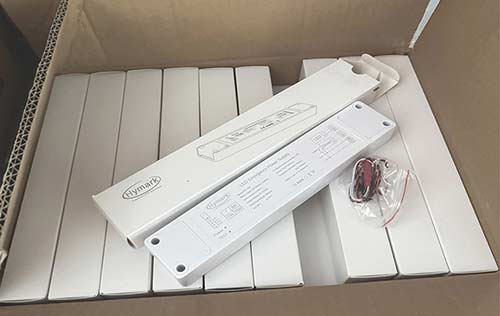
Specifications and How to Read Them
LED emergency drivers are not a single product family. The emergency driver types on the market differ by output stage topology, battery chemistry, test intelligence, and how they interface with the host luminaire. The table below classifies the three builds most commonly quoted by Hymark for panel, tube, and linear projects.
| Parameter | Entry Level | Mid Range | High Specification |
|---|---|---|---|
| Input voltage | AC 220–240V 50/60Hz | AC 100–277V 50/60Hz | AC 85–265V 50/60Hz |
| Driven load (normal mode) | 8–18W | 10–40W | 20–60W |
| DC output window | 24–40Vdc, 200mA | 25–50Vdc, 350mA | 30–60Vdc, 500mA |
| Emergency output | 300 lm, 30% of normal | 600 lm, 50% of normal | 1200 lm, 100% of normal |
| Emergency duration | 90 minutes | 2 hours | 3 giờ |
| Battery chemistry | NiCd 3.6V 1500mAh | Li-ion 18650 7.4V 2600mAh | LiFePO4 12.8V 3000mAh |
| Charge time | 24 hours | 16 hours | 8 hours |
| Cycle life | 300–400 cycles | 500–700 cycles | 800–1200 cycles |
| Test facility | Manual test key | Self-test per EN 62034 | Self-test + DALI-2 |
| Wiring mode | Không được bảo trì | Không được bảo trì | Maintained or non-maintained |
| IP / IK rating | IP20 / IK02 | IP65 / IK07 | IP66 / IK08 |
| Ambient temperature | 0°C to +45°C | –10°C to +55°C | –20°C to +60°C |
| Dimensions (L×W×H) | 150×40×28 mm | 200×50×32 mm | 260×60×35 mm |
| Mounting | Plastic clips | Metal bracket + screws | Magnetic + screw dual |
How to Read the Datasheet Line by Line
Input Voltage Range and Frequency
The line marked “AC Input” tells you where the driver can be installed without a step-down transformer. AC 220–240V covers the UK and EU; AC 100–277V adds Japan, North America, and parts of the Middle East; AC 85–265V is true universal voltage. Frequency is almost always 50/60Hz. A driver rated only 220–240V will trip or fail on 277V North American circuits.
Driven Load in Watts
This is the normal-mode LED load the driver can switch and, in maintained wiring, continue to feed during mains presence. Do not confuse it with emergency output. A 40W driver can carry a 36W panel in normal mode but may only deliver 20W in emergency mode. The emergency wattage is what the battery and inverter must sustain.
DC Output Voltage Window and Current
The inverter stage delivers DC at a fixed current (constant current) or fixed voltage (constant voltage). Constant current is standard for LED panels, tubes, and linear modules because it stabilises lumen depreciation. The window—e.g., 25–50Vdc at 350mA—means the driver auto-matches any LED forward voltage within that range. If your LED module is 54V, the driver will not start.
Emergency Output in Lumens and Percentage of Normal
EN 1838 requires minimum illuminance on escape routes; it does not mandate a percentage. However, specifiers and OEMs need to know what the fixture will look like in emergency mode. A 30% output driver keeps the space dimly lit; a 100% output driver gives full normal brightness from the same LEDs. The lumen figure depends on the host luminaire’s efficacy, so the datasheet usually states “up to X lm at Y% of nominal load.”
Thời gian khẩn cấp
90 minutes satisfies EN 60598-2-22 and BS 5266-1 for most UK and EU buildings. Three hours is common for Middle East specs, battery-backed stairwells, and some healthcare applications. The duration is tested at the rated emergency load; if you under-load the driver, the battery lasts longer but the light output drops below the design point.
Battery Chemistry Voltage and Capacity
NiCd 3.6V packs are cheap, tolerate temperature extremes, but carry cadmium RoHS restrictions and suffer memory effect. Li-ion 18650 7.4V 2600mAh packs offer higher energy density but need protection circuits against over-discharge. LiFePO4 12.8V 3000mAh packs run cooler, cycle 800–1200 times, and meet stricter fire-safety clauses, but they cost more and weigh more per watt-hour. Capacity in mAh multiplied by voltage gives watt-hours; divide by emergency load in watts to estimate duration before inverter losses.
Charge Time and Cycle Life
Charge time is mains-restoration to 80% capacity. NiCd takes 20–24 hours; LiFePO4 with active balancing takes 6–8 hours. Cycle life is the number of full discharge-recharge cycles before capacity falls to 80% of rated. For a self-tested driver cycling monthly, 500 cycles equals roughly 40 years; in practice, calendar ageing limits life to 8–12 years.
Test Facility
Manual test key: the installer or maintenance technician inserts a key or presses a button to force mains failure. Self-test per EN 62034: the driver runs automatic functional tests at intervals (usually monthly) and duration tests (annually). DALI-2: the driver reports status, battery health, and fault flags to the building management system. DALI requires a DALI bus power supply and compatible luminaire wiring; it adds cost but removes the need for physical access.
Maintained or Non-Maintained Wiring
Non-maintained: the emergency LEDs only energise when mains fails. Maintained: the same LEDs are live during normal operation via a changeover relay, so the fitting looks identical in both modes. Maintained wiring needs an extra switched live and is mandatory in some cinema, theatre, and high-risk task-lighting applications.
IP and IK Rating
IP20 is indoor electrical enclosure only. IP65 is jet-proof for car parks and plant rooms. IP66 is powerful jet-proof for external soffits and tunnels. IK02 withstands 0.2 joule impact; IK08 withstands 5 joule, equivalent to a 1.7kg mass dropped from 300mm.
Ambient Temperature Range
Battery chemistry sets the limit. NiCd works below 0°C; Li-ion and LiFePO4 need derating or low-temperature cut-offs below –10°C to avoid lithium plating. Above +45°C, NiCd charge acceptance drops; LiFePO4 tolerates up to +60°C but cycle life halves for every 10°C above 25°C.
Dimensions and Mounting
Check the driver fits the luminaire’s wiring compartment. Entry-level plastic clips suit shallow troffers. Magnetic mounting suits steel high-bay housings but must include a tether for seismic or IK-rated installations.
Export Practicalities and Trade Terms
FOB, CIF, CFR, EXW
EXW means the buyer collects from the factory and handles all export clearance and freight. FOB Shenzhen means Hymark loads the container and clears export customs; the buyer pays ocean freight and insurance. CFR adds freight to the destination port but not marine insurance. CIF adds insurance to CFR. For LED emergency drivers, FOB and CIF are the most common quotations. L/C (letter of credit) payment terms are accepted for orders above USD 30,000; T/T with 30% deposit, 70% before shipment is standard below that threshold.
HS Code and Marking
The harmonised code for LED emergency drivers is 8504.40 (static converters). CE marking is required for EU customs entry; UKCA for Great Britain. The buyer should request a Declaration of Conformity citing EN 60598-2-22 and EN 61347-2-7, plus test reports from an accredited lab. Hymark does not claim third-party certification on behalf of the buyer; the OEM or importer holds responsibility for the finished luminaire’s compliance.
UN 38.3 Battery Transport
Lithium-ion and LiFePO4 battery packs must pass UN 38.3 tests (T1–T8) before air or sea freight. The supplier should provide the UN 38.3 test summary report, MSDS, and 1.2m drop-test certificate. IATA limits lithium batteries to 35kg net per package for passenger aircraft; IMDG requires Class 9 dangerous goods labelling and a shipper’s declaration. NiCd packs are not lithium-classified but are environmentally hazardous; they need recycling labels and may be restricted by individual carriers.
Packing List and Certificate of Origin
Standard carton: 50 drivers per carton, 10 cartons per plywood pallet, total 500 units. Gross weight approximately 18kg per carton. Certificate of Origin is issued by China Council for the Promotion of International Trade (CCPIT) or customs-approved chambers; buyers in GCC countries and parts of Africa require it for preferential tariff treatment.
Matching Emergency Driver Types to Fixtures
Panel Lights
Flat ceiling panels need slim drivers, usually under 30mm height. Output is 25–40Vdc at 300–500mA. Non-maintained is standard; maintained is rare unless the panel is the only light source in a small room. IP20 suffices for office ceilings; IP65 for kitchen and hospital canopy panels.
LED Tubes
T8 and T5 replacement tubes run at lower voltage, 18–36Vdc, and need drivers that match the tube’s internal LED string. Some tube emergency kits are external battery packs with a micro-inverter; others replace the non-emergency driver entirely. The cut-off voltage of the tube must sit inside the driver’s output window.
Linear Lights
Suspended or surface-mounted linear extrusions often run 24V or 48V constant-voltage strips or 350mA–700mA constant-current modules. The emergency driver must match the linear’s total forward voltage. Linear projects frequently specify DALI self-test because the fittings are inaccessible above production lines or in retail ceilings.
High Bays
High-bay emergency drivers are the exception to the slim rule: they need higher wattage, 40–60W emergency output, and LiFePO4 packs to deliver 100% light for 90 minutes at 8–10m mounting height. Magnetic mounting is preferred for round UFO housings. IK08 is advisable in warehousing with forklift traffic.
Industry Applications for LED Emergency Driver
| Sector | Typical Installation | Recommended Specification | Why This Product Fits |
|---|---|---|---|
| Commercial Offices and Fit-Outs | Recessed LED panels, LED tubes in suspended ceilings | 3W–10W emergency output, 10%–30% of normal lumen output, 90 min or 3 hr duration, AC 220–240V input, DC 180–260V/150–300mA output, LiFePO4 3.2V 3000mAh, self-test or DALI test facility | Maintained wiring with changeover relay preserves clean ceiling aesthetics; automatic testing reduces facilities management labour |
| Hospitals and Clinics | LED panels in corridors, LED linear lights in treatment rooms, emergency twin spots in plant rooms | 5W–15W emergency output, minimum 50% of normal output for escape routes per EN 1838, 3 hr duration mandatory in many jurisdictions, AC 85–265V input for UPS compatibility, DC 200–280V/200–350mA, LiFePO4 3.2V 6000mAh, DALI-2 self-test to EN 62034 | Critical care continuity demands highest reliability; battery chemistry with 500–800 cycles tolerates frequent functional tests |
| Warehouses and Logistics Centres | LED high bays (100W–200W normal), LED linear aisle lighting | 10W–20W emergency output, 10%–20% of normal high-bay output (sufficient at mounting heights), 3 hr duration, AC 100–277V input, DC 250–300V/80–150mA, Li-ion 18650 11.1V 2600mAh pack, IP65 driver enclosure | High mounting heights reduce required lux; wide input voltage covers North American and European installations from same SKU |
| Car Parks and Stairwells | Surface-mounted LED batten fittings, LED tubes in weatherproof enclosures | 3W–8W emergency output, 100% of fitting output if single-lamp maintained circuit, 90 min or 2 hr duration, AC 220–240V input, DC 120–200V/120–250mA, NiCd 3.6V 1500mAh or LiFePO4 6.4V 1500mAh, IP65 minimum, IK08 | Aggressive environments punish nickel-cadmium; lithium iron phosphate withstands temperature cycling without memory effect |
| Retail and Shopping Malls | LED downlights in circulation ceilings, LED linear cove lighting, LED strips in display cases | 5W–12W for downlines, 2W–5W for strip emergency packs, 10%–25% of normal output, 90 min duration, AC 220–240V input, DC 24V/200–500mA for strip variants, LiFePO4 3.2V 1500–3000mAh, maintained wiring with silent changeover | Display continuity protects trading hours; low-voltage strip emergency drivers avoid rewiring 24V architectural circuits |
| Hotels and Residential Common Areas | LED panels in lift lobbies, LED tubes in stairwells, decorative linear in corridors | 5W–10W emergency output, 50% of normal output in escape routes per local codes, 90 min or 2 hr duration, AC 220–240V input, DC 180–240V/180–300mA, LiFePO4 3.2V 3000mAh, manual test key plus automatic periodic test | Guest safety compliance with minimal disruption; maintained circuits allow normal dimming via building management system |
Commercial Offices and Fit-Outs
Open-plan offices typically mount 600x600mm LED panels at 2.5m–3.5m height. Emergency output of 3W–10W delivers 300–800 lumens, roughly 10%–30% of a 30W–40W panel’s normal output, which satisfies EN 1838 minimum 1 lux at floor level for open areas. A 90-minute duration covers most European evacuation codes; UK projects under BS 5266-1 increasingly specify 3 hours for phased evacuation or high-rise buildings. The changeover relay in maintained wiring switches the panel from mains driver to emergency inverter without visible interruption. Self-test circuitry, meeting EN 62034, runs 30-second functional and 3-hour duration tests automatically; DALI integration reports failures to the facilities dashboard. LiFePO4 3.2V 3000mAh packs reach full charge in 24 hours and tolerate the 5°C–45°C ambient range common in ceiling voids.
Hospitals and Clinics
Healthcare escape routes demand higher emergency illuminance than commercial spaces: EN 1838 specifies minimum 50% of normal lighting in critical care corridors and 100% in operating department escape routes. This drives emergency drivers to 5W–15W output, delivering 500–1500 lumens from LED panels or linear fittings. Three-hour duration is mandatory in NHS estates and many Middle Eastern hospital codes to cover delayed evacuation of bed-bound patients. LiFePO4 chemistry at 3.2V 6000mAh provides the capacity without the thermal runaway risk of cobalt-based lithium-ion in continuously occupied buildings. DALI-2 self-test to EN 62034 generates audit trails for infection-control teams who cannot access ceiling voids freely. Input range of AC 85–265V ensures compatibility with hospital UPS and generator transfer sequences.
Warehouses and Logistics Centres
LED high bays at 8m–14m mounting height present a specific calculation: EN 1838 requires 0.5 lux minimum at floor level, which a 10W–20W emergency output achieves even at 10%–20% of a 150W high bay’s normal 18,000-lumen output. The wide AC 100–277V input covers 120V North American and 230V European warehouse installations from the same driver platform. Output window of DC 250–300V at 80–150mA matches the forward-voltage profile of 70–100 series-connected LEDs in high-bay COB arrays. Li-ion 18650 11.1V 2600mAh packs in 3S1P configuration deliver the watt-hour density needed for 3-hour duration at 15W, though cycle life of 300–500 is shorter than LiFePO4 alternatives. IP65 on the driver enclosure protects against dust and pressure-wash cleaning regimes.
Car Parks and Stairwells
These environments punish electronics. Ambient temperatures in enclosed car parks swing from sub-zero to 40°C; moisture and salt accelerate corrosion. A specification of IP65 and IK08 on the emergency driver housing is the practical minimum. Nickel-cadmium 3.6V 1500mAh packs remain common in legacy specifications due to low capital cost and proven performance to -20°C, but the 500-cycle life and cadmium disposal burden drive specification toward LiFePO4 6.4V 1500mAh alternatives. Output of 3W–8W from DC 120–200V/120–250mA suits single-lamp LED battens; maintained wiring at 100% output avoids the complexity of dual-circuit fittings in small enclosures. Charge time of 16–24 hours must be factored into commissioning schedules after deep discharge.
Retail and Shopping Malls
Trading continuity shapes retail emergency lighting design. Maintained circuits with silent changeover keep displays illuminated during brief mains dips, avoiding customer alarm and revenue loss. Downlight emergency drivers at 5W–12W preserve brand-critical spotlighting on merchandise. Architectural cove and display-case LED strips introduce a distinct sub-category: emergency drivers outputting DC 24V at 200–500mA directly replace or parallel the normal 24V driver, maintaining 2W–5W emergency output across 5m–10m of SMD strip without rewiring low-voltage circuits. Colour temperature consistency at 3000K or 4000K matters for fabric and food rendering; the emergency driver must not shift CRI below 80 when operating at reduced current. Ninety-minute duration suffices for most mall evacuation codes; extended 2-hour specifications appear in Middle Eastern mall projects referencing NFPA 101 alongside local civil defence requirements.
Hotels and Residential Common Areas
Guest safety compliance competes with aesthetic concealment. Lift lobbies and corridors use recessed LED panels and decorative linear fittings where visible emergency gear is unacceptable. Emergency drivers at 5W–10W with maintained changeover preserve the fitting’s normal appearance. UK hotels under BS 5266-1 require 50% of normal lighting in escape routes; this typically means the emergency driver must sustain half the LED array, not a separate low-wattage emergency lamp. LiFePO4 3.2V 3000mAh packs fit within the 25mm–35mm ceiling void depth common in hotel refurbishments. Manual test keys satisfy the weekly functional test that duty holders must perform; automatic periodic testing to EN 62034 covers the monthly and annual duration tests that staff forget. Battery cycle life of 500–800 charges matches the 4–6 year replacement interval typical in hospitality maintenance budgets.
Related Hymark Products

LED Emergency Driver For LED Panel Lights
Emergency drivers sized for 600×600 and 1200×300 LED panels with external drivers.
LED Emergency Driver For LED Tubes
Emergency conversion kits for T8 and T5 LED tubes and batten fittings.
LED Emergency Driver For Linear Lights
Slim emergency drivers that fit inside linear and trunking profiles without a separate battery box.
Frequently Asked Questions About LED Emergency Driver
By Wiring Topology
Q: What is the difference between maintained and non-maintained emergency drivers?
A maintained emergency driver keeps the LED load energised during normal mains operation via a changeover relay, so the fixture functions as both everyday and emergency luminaire. A non-maintained driver sits idle until mains failure; the battery and inverter activate only when AC drops. Maintained wiring suits circulation routes and open-plan offices where the fitting must contribute to normal illumination. Non-maintained costs less per unit and draws no standby power from the battery during normal hours, but the fixture is dark until emergency mode triggers. Both configurations must meet EN 60598-2-22 and EN 1838 for minimum illuminance on escape routes.
Q: Which wiring method works for retrofitting existing LED panels or linear fixtures?
A Non-maintained drivers retrofit more easily because they need only switched live, neutral and earth to the driver, plus DC output to the LED module. The original driver remains untouched for normal operation. Maintained retrofitting requires access to unswitched live and switched live, plus a relay contact rated for the normal driver’s output current. Many LED panels with integrated 0-10V or DALI dimming need maintained drivers with dimming-compatible relays to avoid flicker or glow during normal hours. Check the host fixture’s terminal block layout before specifying; space inside the housing often limits driver size to 150mm x 45mm x 30mm or smaller.
By Emergency Duration and Output Level
Q: What emergency duration and output options are available, and how do they relate to battery size?
A Standard durations are 90 minutes, 2 hours and 3 hours per EN 1838 and BS 5266-1. Output levels typically range from 3W to 15W emergency mode, expressed as a percentage of normal output—commonly 10%, 20%, 30% or 100% full power. A 10W LED panel normally delivering 1000 lm might drop to 200 lm (20%) in emergency, powered by a LiFePO4 3.2V 3000mAh pack for 90 minutes. Three-hour duration at full 10W output demands roughly LiFePO4 12.8V 4500mAh or multiple Li-ion 18650 cells in series-parallel, increasing driver volume by 40-60%. Lower percentage outputs extend duration without enlarging the battery, but verify the resulting luminaire meets minimum 1 lux on the floor centreline for escape routes.
By Test and Monitoring Facility
Q: What self-test options exist, and which buildings require them?
A Manual test key is the baseline: a push-button or switch simulates mains failure for the required duration. Self-test drivers automate this monthly and annually per EN 62034, cycling the battery and reporting via an LED status indicator. DALI self-test integrates with building management systems, transmitting fault codes for battery, inverter or lamp failures over the DALI bus. Buildings with sleeping risks, high occupancy or remote unmanned sites—hotels, hospitals, warehousing—typically specify self-test or DALI to reduce maintenance labour. Manual test suffices for small retail or office fit-outs where a facilities manager can walk the building monthly. DALI drivers cost 25-35% more than basic self-test units.
By Battery Chemistry and Replacement Cycle
Q: Which battery chemistry should I specify, and what replacement interval applies?
A NiCd 3.6V or 4.8V packs remain available for legacy compatibility and wide temperature tolerance (-20°C to +50°C), but cadmium content triggers RoHS and battery directive restrictions in EU markets. Li-ion 18650 3.7V cells offer 2000-2600mAh in compact formats with 500-700 cycle life, though thermal runaway risk demands protection circuits. LiFePO4 3.2V packs deliver 1500-3000mAh, tolerate 800-1500 cycles, charge in 12-16 hours, and operate from 0°C to +45°C with lower fire risk. NiCd replacement is typically 4 years; Li-ion and LiFePO4 5-8 years depending on ambient temperature and annual test cycles. Ask suppliers for cycle life data at your project’s maximum ambient, not ambient room temperature.
By Physical Form Factor and Host Fixture Compatibility
Q: How do I confirm an emergency driver suits my host fixture?
A Match five parameters: input voltage range (AC 85-265V or 100-277V covers most markets; 220-240V for UK/EU-only), output window in DC volts and mA (example: 50-180V DC at 150mA constant current for 8-24W LED panels), physical dimensions versus available housing space, IP rating equal to or higher than the fixture (IP20 driver inside IP65 housing is acceptable; IP65 driver required for exposed locations), and ambient temperature range (ta 25°C standard; ta 45°C for industrial or luminaire housings with poor ventilation). For LED tubes and linear lights, verify the driver fits the trunking or end-cap compartment; many 600mm and 1200mm battens accept only drivers under 35mm wide.
By Certification and Market Access
Q: Which test reports and conformity marks should I request for my destination market?
A For UK and EU, ask for EN 60598-2-22 and EN 1838 test evidence plus CE or UKCA marking documentation. The Middle East generally accepts CB test certificates based on IEC 61347 plus in-country registration; GCC members need G-Mark. Southeast Asia varies: Singapore requires SS 563, Malaysia MS IEC 60598-2-22, Thailand TISI. Africa often accepts IEC-based test reports with local import inspection. Latin America: Mexico NOM, Brazil INMETRO. UL 924 applies to US and Canadian projects; AS/NZS 2293 for Australia and New Zealand. Never assume a supplier holds current marks; request test report numbers and issuing body names, then verify scope covers the exact driver model and output rating you are ordering.
By Logistics and Commercial Terms
Q: How do lithium batteries affect shipping, and what are typical MOQ, lead time and sample terms?
A Lithium batteries require UN 38.3 test summary reports for air freight (IATA PI 965-970) and sea freight (IMDG Code Section 3.3). UN 38.3 covers altitude simulation, thermal cycling, vibration, shock, external short circuit, impact and forced discharge. Without this documentation, forwarders reject cargo. Sea freight is preferred for bulk orders; air freight limited to 35kg lithium content per package or requires dangerous goods declaration. Typical MOQ for Hymark LED emergency drivers is 500-1000 units, with lead time 25-35 days after order confirmation. Samples of 2-5 units ship within 5-7 days ex-works Shenzhen; sample cost credited against first production order. Payment terms are 30% deposit, 70% against copy of bill of lading for orders under $50,000; letter of credit negotiable above.
Important Notice
Specifications, output and duration figures and price ranges in this guide are indicative and are provided
for planning purposes only. Actual emergency output, duration, battery life, ingress protection and available conformity documentation
differ by model and by destination country, and emergency lighting design remains the responsibility of the project designer. Buyers
must confirm their own mains voltage and frequency, the emergency lighting standard enforced locally, the host fixture compatibility
and their import requirements before placing an order. All figures are subject to written confirmation in the final proforma invoice
issued by Hymark.
Sourcing LED Emergency Driver from Hymark
Matching the Driver to Your Fixture and Code
Start with the host luminaire’s normal LED driver: note its forward-voltage window and rated current. An emergency driver must sit electrically between that driver and the LED module, or replace it entirely during mains failure. For panel lights and linear systems running 40–60V DC LED chains, Hymark’s panel- and tube-specific emergency drivers deliver 3W to 10W emergency output at 50–100 percent of normal flux, depending on the model and duration selected. For high-bay fixtures with 100–200V DC LED loads, the high-bay range drives 10W to 25W emergency output, again with selectable 90-minute, 2-hour or 3-hour duration.
Battery chemistry shapes the trade-offs. LiFePO4 packs at 3.2V 3000mAh or 6.4V 1500mAh achieve 500–800 cycles, charge in 16–24 hours, and suit 3-hour durations at moderate wattage. Li-ion 18650 cells at 3.7V 2600mAh offer higher energy density but 300–500 cycles; they fit 90-minute or 2-hour kits where space is tight. NiCd remains available for legacy specifications but carries heavier weight and shorter cycle life.
Wiring configuration matters for maintained versus non-maintained operation. Maintained units need a permanent live plus switched live, running the LED at reduced current during normal hours and switching to full battery drive on power loss. Non-maintained units use a single permanent live, drawing only charge current until mains failure. Self-test and DALI test facilities automate the monthly and annual functional checks required by EN 62034 and BS 5266-1; specify these for multi-tenancy buildings where manual testing is impractical.
What to Request in Your Shortlist
When comparing suppliers, ask for the inverter output curve: constant current in mA across the DC voltage window, not just a nominal wattage. Verify the changeover relay rating and whether the kit includes a remote indicator if your installation needs one. For export orders, confirm lithium battery transport documentation: UN 38.3 test summary, IATA Section II or Section IB packing instructions, and IMDG Code compliance for sea freight. Hymark ships on FOB Shenzhen or CIF terms to UK, European, Middle Eastern, Southeast Asian, African and Latin American ports, with export carton packing standard and pallet loading on request. MOQ is typically 500 units for branded emergency drivers, with 2–3 week lead time for standard configurations and samples available within 5–7 days.
Why Hymark for LED Emergency Drivers
JIALINGHANG ELECTRONIC CO., LTD. was founded in 2013 as a global LED exporter in general illumination; a strategic shift in 2017 refocused the company on LED emergency technology and high performance LED strips. Hymark was launched in 2026 as the premium brand. Products are co-designed and engineered in house through a strategic partnership with dedicated manufacturing facilities that have also been operating since 2013, and the company manages R&D, product design and global distribution itself. The range covers LED emergency drivers for LED high bays, panel lights, tubes and linear lights, plus full power output emergency drivers, alongside emergency luminaires, exit signs and twin spotlights. Orders are supplied with selectable emergency duration, maintained or non-maintained wiring, OEM and ODM branding, export carton packing and FOB or CIF terms.
Send your host fixture type and wattage, the emergency duration your code requires, your mains voltage and your destination port to receive a quotation within 24 hours via WhatsApp or email.
Get a Factory Direct Quote on LED Emergency Driver
JIALINGHANG ELECTRONIC CO., LTD. has been in LED lighting since 2013 and has focused on
LED emergency technology and high performance LED strips since 2017. Hymark products are co-designed with our
dedicated manufacturing partners, built with selectable emergency duration and maintained or non-maintained wiring, and function
tested before packing. Send us the host fixture type and wattage, the emergency duration your local code requires, your mains
voltage and your destination port and we will return a quotation within 24 hours.

 English
  Spanish
  Arabic
  French
  German
  Russian
  Portuguese
  Italian
  Vietnamese