
LED Emergency Driver Buyer Guide
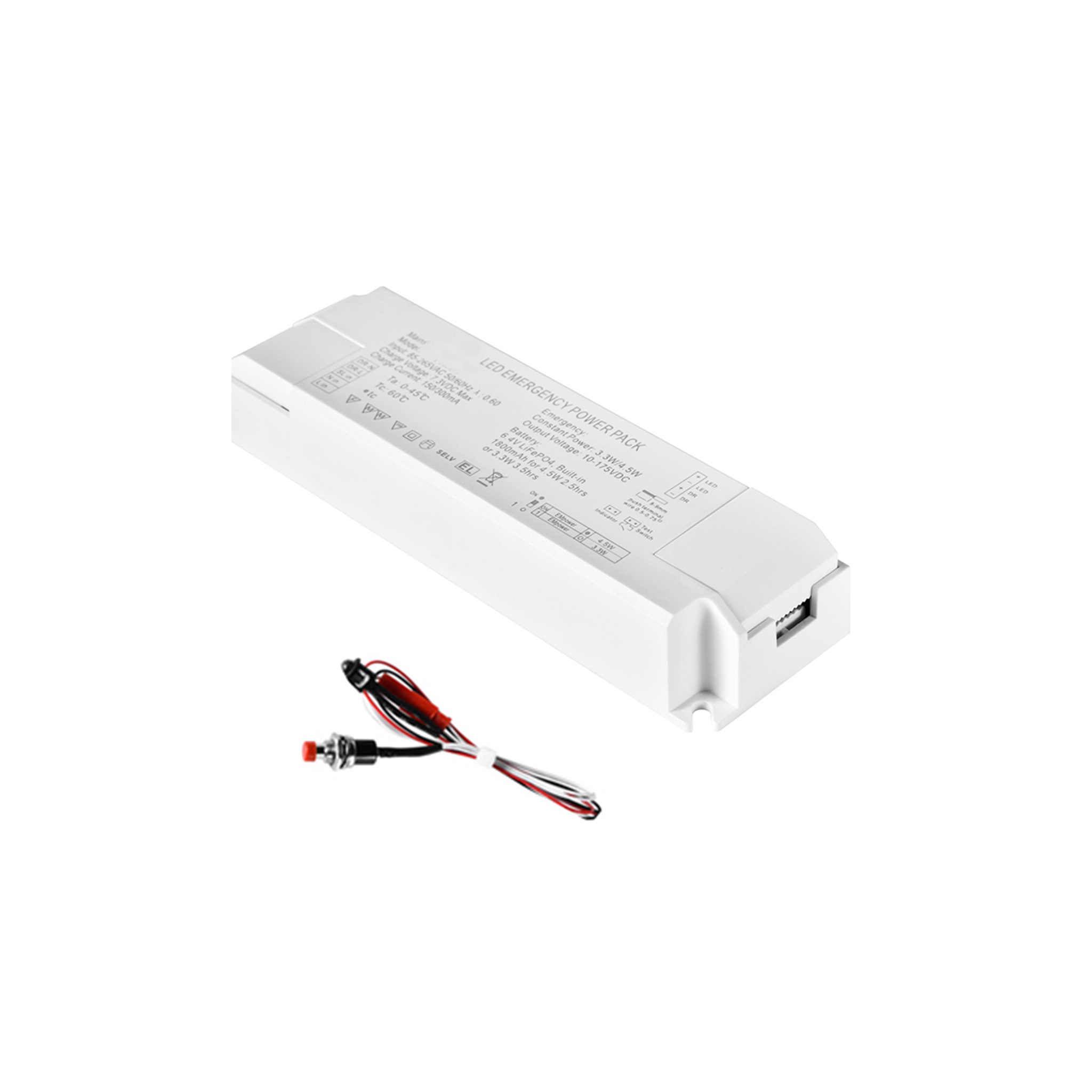
An emergency conversion kit for LED panel lights is a self-contained module that adds battery-backed emergency operation to a standard LED panel, typically comprising a switched-mode charging circuit, a LiFePO4 or Li-ion 18650 battery pack, and a constant current inverter that overrides the normal driver when mains power fails. The right kit depends on three things: the host fixture’s normal LED load in watts and its driver output window in DC volts and milliamps, the emergency duration your local code mandates (90 minutes for UL 924 and NFPA 101 in North America, 1 to 3 hours for EN 1838 and BS 5266-1 in the UK and Europe), and whether the inspector expects a CE mark, UKCA, UL listing, or AS/NZS 2293 compliance evidence.
This page covers the configurations Hymark builds for panel light OEMs and contractors, the technical match points that prevent field failures, and the documentation to request from any Chinese manufacturer before placing an order.
Matching the Kit to the Host Fixture
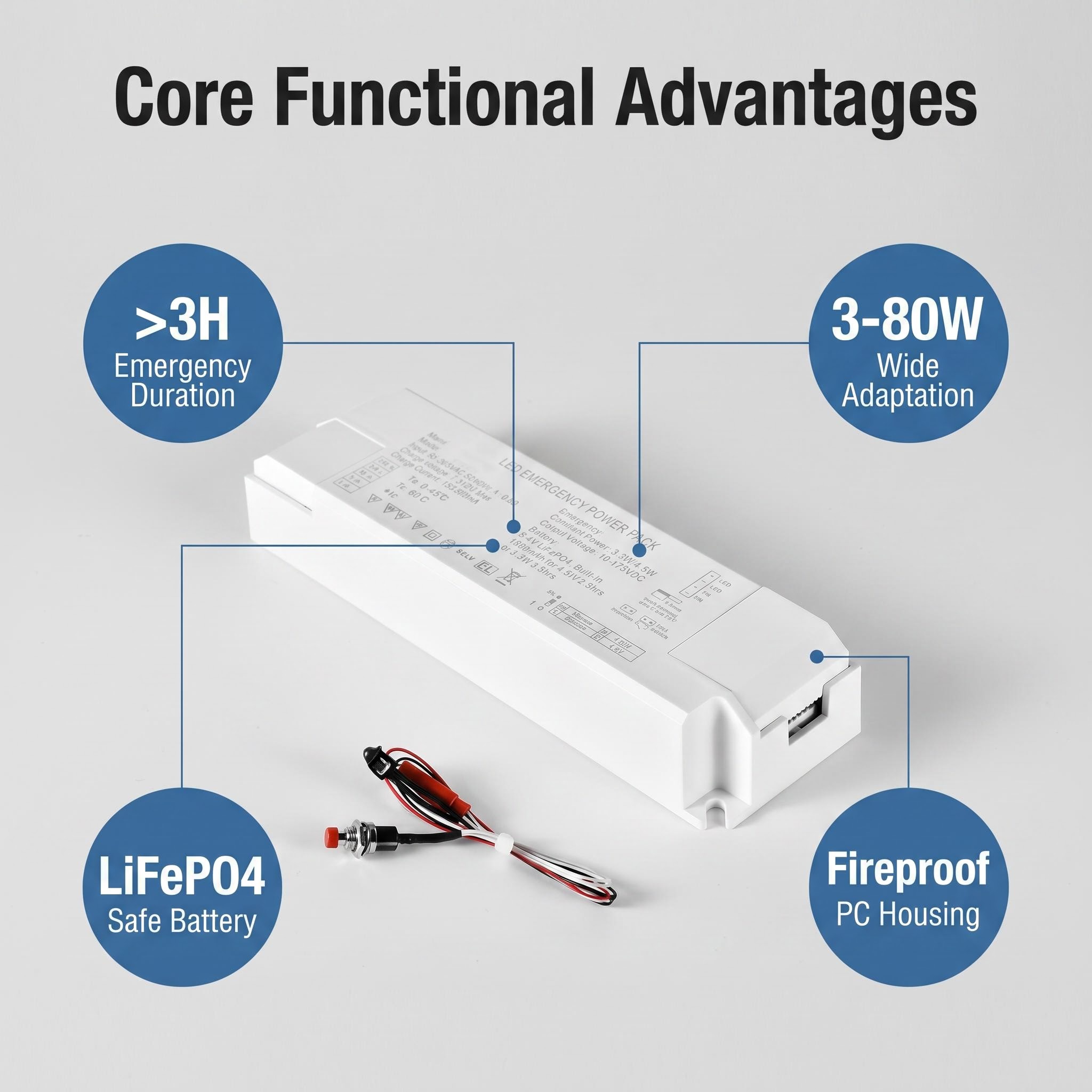
LED panel lights typically run 36W to 48W in normal mode from a driver output of 25–42V DC at 600–1200mA. The emergency kit must not try to replicate that full output. EN 1838 requires only 10% of normal luminous flux for escape routes, though 50% is common for open areas. A 40W panel might therefore need 4W to 20W emergency output, depending on application class. Hymark’s panel-specific kits cover 10W to 50W normal load with emergency outputs of 3W, 5W, 8W, or 10W at 50–180V DC or 25–80V DC constant current, matched to the LED string voltage.
Check these points against the host fixture:
| Parameter | Typical Panel Light | Emergency Kit Must Cover |
|---|---|---|
| Normal load | 36–48W | ≤ rated kit wattage |
| Driver output | 25–42V DC, 600–1200mA | Inverter output window overlaps LED Vf at emergency current |
| LED configuration | Single string or 2S2P | Verify total forward voltage at reduced current |
| Housing depth | 25–40mm typical | Battery pack physical dimensions |
| Ambient at ceiling | 25–45°C | Kit rated to Tₐ max, typically +45°C to +55°C |
A kit rated 10W emergency output driving 50–180V DC at 55mA suits a 60-LED string panel where Vf ≈ 3.0V × 60 = 180V. A 24V panel string needs the 25–80V output variant. Mismatch here means the inverter cannot strike the LEDs or runs them below the 1 lux minimum EN 1838 requires at floor level.
Battery Chemistry and Duration Trade-Offs
| Chemistry | Nominal V | Typical Capacity | Cycle Life | Charge Time | Notes |
|---|---|---|---|---|---|
| NiCd 3S | 3.6V | 1500–2500mAh | 300–500 | 24h | Legacy, wide temperature, memory effect, cadmium content |
| Li-ion 18650 1S2P | 3.7V | 4400–5200mAh | 500–800 | 16–24h | Higher energy density, UN 38.3 required for air freight |
| LiFePO4 1S | 3.2V | 3000–6000mAh | 1500–2000 | 12–16h | Safer chemistry, flat discharge curve, heavier per Wh |
For a 10W emergency output at 180V DC and 55mA, the inverter draws roughly 10W ÷ 0.85 efficiency ≈ 11.8W from the battery. A 3.2V 6000mAh LiFePO4 pack holds 19.2Wh; at 80% depth of discharge that yields 15.4Wh, giving 78 minutes. To reach 180 minutes with margin, the same chemistry needs 11,000mAh or a higher voltage pack (6.4V 6000mAh). Buyers specifying 3-hour duration must verify the supplier has sized the battery for actual output watts, not just nominal wattage.
Cheaper NiCd kits save 15–25% upfront but lose 40% capacity at 0°C and require replacement every 3–4 years in self-test cycling. LiFePO4 costs more but maintains >80% capacity at -10°C and typically lasts 8–10 years in maintained ceiling installations.
Wiring Configuration: Maintained or Non-Maintained
Non-maintained wiring is simpler: the kit senses mains loss via its own connection and energises the inverter. The panel light has no live feed in emergency mode unless the normal switch is bypassed. Maintained operation requires a permanent live to the kit, a switched live from the wall switch, and internal relay logic that keeps the inverter off while mains is present and the switch is closed, then activates when either condition fails. Confirm the kit includes a changeover relay rated for the panel’s normal operating current, not just the emergency load.
DALI self-test per EN 62034 adds two wires and requires the host fixture’s normal driver to support DALI dimming or at least not conflict on the bus. Manual test key is the fallback where DALI infrastructure is absent.
What to Request from the Manufacturer
Any supplier claiming compliance should provide, at minimum:
- Test reports to EN 60598-2-22 or UL 924, with the specific kit model and output rating listed, not a generic family certificate
- Battery UN 38.3 test summary for lithium chemistries, plus IATA/IMDG shipping classification (UN 3481 for Li-ion, UN 3090 for Li metal)
- Photometric data showing emergency lumen output and, for panel applications, the distribution with the kit mounted in the host housing
- Declaration of conformity with the relevant mark (CE, UKCA, RCM for Australia) and the standards referenced
Hymark’s panel-specific emergency drivers are built to order with 85–265V AC or 220–240V AC input, 90-minute or 3-hour duration, and LiFePO4 or Li-ion battery packs. Lead time is 25–35 days for standard configurations, 40–50 days for custom output windows. Samples ship within 5–7 days against confirmed specifications.
Types and Configurations of LED Emergency Driver
| Type or Class | Typical Rating or Output | Duration or Runtime | Best Suited For | Notes |
|---|---|---|---|---|
| Reduced-Power Emergency Driver (3W–10W) | 3W–10W DC output, 10%–50% of normal luminaire output | 90 min or 3 hr | LED panel lights, LED tubes, linear fixtures in offices and corridors | Maintains egress visibility per EN 1838; not suitable for task lighting during emergency |
| Full-Power Emergency Driver | Matches normal driver wattage (18W–60W+), 100% lumen output | 90 min or 2 hr | LED high bays, industrial battens, surgical luminaires, retail | Requires larger battery pack; heavier, more costly; check luminaire heat dissipation in emergency mode |
| Self-Test / DALI-Compatible Emergency Driver | 3W–50W range, configurable output percentage | 90 min or 3 hr per EN 62034 schedule | Commercial buildings, hospitals, schools with maintenance contracts | Automates EN 62034 functional duration tests; adds £15–£40 unit cost versus manual-test equivalent |
| Maintained / Non-Maintained Switchable Driver | 3W–25W, changeover relay for maintained wiring | 90 min or 3 hr | Public buildings requiring illuminated standby (maintained) or pure backup (non-maintained) | One SKU reduces inventory; wiring configuration determines mode; relay contact rating limits switching current |
| External-Battery Emergency Driver Kit | 3W–15W, remote LiFePO4 or NiCd pack (3.2V–12V, 1500mAh–6000mAh) | 90 min or 3 hr | Slim LED panels, linear fixtures with shallow ceiling voids | Battery mounted remotely up to 2m; IP rating of battery enclosure must match installation zone |
| LED Strip Emergency Driver (Constant Voltage) | 12V or 24V DC, 2W–10W per metre strip load, 60–120 LEDs/m | 90 min or 2 hr | Cove lighting, stair nosing, wayfinding strips in commercial interiors | Matches 12V/24V strip architecture; verify strip lumen output at reduced emergency voltage |
Reduced-Power Emergency Driver
This is the volume configuration for LED panel lights and LED tubes in commercial retrofit. Output is typically 3W to 10W DC, which translates to roughly 10% to 50% of the luminaire’s normal lumen output depending on LED efficacy and driver efficiency. Input voltage is AC 85-265V or 220-240V depending on target market. The constant-current output window is commonly DC 9-42V at 150mA to 350mA, driving a 3W to 10W LED load. Battery chemistry is usually LiFePO4 3.2V 1500mAh to 3000mAh or NiCd 3.6V 1200mAh to 2400mAh, giving 90 minutes or 3 hours runtime. Charge time is 16 to 24 hours to full capacity. Cycle life is 500 to 800 cycles for LiFePO4, 300 to 500 for NiCd. Electrical contractors and lighting wholesalers buy this type in bulk for office and corridor installations. What it cannot do: it will not preserve task-lighting levels. EN 1838 requires minimum illuminance on the floor centreline, not full working-plane lux, so a 10W panel dropping to 3W emergency output may feel dim to occupants even if code-compliant.
Full-Power Emergency Driver
Full-power emergency drivers are specified when the application demands identical lumen output in normal and emergency modes. Typical ratings run 18W to 60W or higher, with DC output windows such as 25-80V at 350mA to 900mA to match the original LED driver specification. Battery packs scale accordingly: LiFePO4 12.8V 4000mAh to 9000mAh or multiple Li-ion 18650 cells in 3S2P or 3S3P configurations. Runtime is 90 minutes or 2 hours; 3 hours is rare above 40W due to battery mass. These units are bought by luminaire OEMs building emergency versions of LED high bays for warehouses, or by M&E consultants specifying surgical luminaires and retail environments where darkness disrupts operations. The trade-off is physical: a 60W full-power kit with 3-hour duration can exceed 2.5kg and require dedicated mounting lugs. Heat dissipation in emergency mode also needs verification—the luminaire was thermal-tested with the normal driver, not necessarily with the emergency inverter located in the same housing.
Self-Test and DALI-Compatible Emergency Driver
This class adds automatic test circuitry to any of the power classes above. EN 62034 defines the functional test (monthly, brief) and duration test (annually, full discharge) schedules. Self-test units perform these without building management intervention; DALI-compatible versions report status to the central lighting management system. Output ratings mirror reduced-power or full-power ranges. The incremental cost is £15–£40 per unit versus manual-test equivalents. Facility managers and building owners with maintenance contracts across multi-site portfolios are the primary buyers—self-test reduces technician callouts. What it cannot do: eliminate the need for annual visual inspection of luminaire condition and cleanliness. A passing DALI status bit does not confirm that the diffuser is not occluded by dust or that the LED array has not degraded.
Maintained and Non-Maintained Switchable Driver
A single driver SKU with a changeover relay allows the installer to wire for maintained operation (emergency LED live during normal supply, often at reduced output as a beacon) or non-maintained (emergency LED only energised on mains failure). Typical ratings are 3W to 25W. The relay contact rating—often 2A at 250V AC—must not be exceeded by any switched normal-mode load. Input voltage is typically AC 220-240V for UK/Europe or AC 100-277V for Middle East and Southeast Asia markets. These are bought by electrical contractors who want inventory flexibility and by OEMs exporting to multiple territories with differing wiring conventions. BS 5266-1 and EN 60598-2-22 set the requirements for maintained circuits; the supplier should provide evidence that the relay meets the switching endurance specified in the standard. What it cannot do: operate in both modes simultaneously. The wiring configuration at commissioning locks in one behaviour.
External-Battery Emergency Driver Kit
When the LED panel or linear fixture has insufficient depth for an integrated battery—common with 8mm to 12mm edge-lit panels—the driver electronics mount inside the luminaire or junction box while the battery pack mounts remotely in the ceiling void, on cable tray, or in a separate enclosure. Typical output is 3W to 15W DC. Battery packs are LiFePO4 3.2V 3000mAh to 6.6V 6000mAh or NiCd 3.6V to 12V configurations, with cable lengths of 1m to 2m between driver and battery. IP rating of the battery enclosure becomes critical: IP20 is acceptable in dry ceiling voids; IP65 is needed for car parks or external soffits. LED panel OEMs and installers working with shallow ceiling systems are the main buyers. What it cannot do: tolerate excessive voltage drop. The interconnect cable must be sized for the battery voltage and peak inverter current; a 3.2V LiFePO4 pack at 3A peak is far more sensitive to 0.5V drop than a 12V pack at 0.8A.
LED Strip Emergency Driver
This niche class provides emergency backup for 12V or 24V constant-voltage LED strip installations used in cove lighting, stair nosing, and wayfinding. Output is regulated 12V DC or 24V DC at 2W to 10W total strip load, covering typically 1m to 5m of strip at 4.8W/m to 14.4W/m depending on LED density (60 LEDs/m to 120 LEDs/m SMD2835 or SMD5050). Battery is commonly Li-ion 18650 3.7V 2200mAh to 2600mAh in 3S or 4S configuration for 12V output, or LiFePO4 for longer cycle life. Runtime is 90 minutes or 2 hours. The critical specification is lumen maintenance at reduced strip voltage: some 24V strips drop to 50% luminous flux at 20V, so the driver must hold regulation tight. Lighting designers and architects specifying decorative emergency lighting buy these. What it cannot do: drive high-wattage strip runs. A 10W emergency driver cannot back up 20m of 14.4W/m strip—that requires segmenting the installation or accepting partial coverage.
Specifications and How to Read Them
| Parameter | Entry Level | Mid Range | High Specification |
|---|---|---|---|
| Input voltage | AC 220-240V 50Hz | AC 85-265V 50/60Hz | AC 100-277V 50/60Hz |
| Driven load (normal mode) | 18-40W panel | 20-60W panel | 30-80W panel |
| Emergency output | 3W (8-10% of normal) | 5W (15-20% of normal) | 8W (20-25% of normal) |
| Emergency lumens | 300-400 lm | 600-800 lm | 1000-1200 lm |
| Emergency duration | 90 minutes | 120 minutes | 180 minutes |
| Battery chemistry | NiCd 3.6V 1500mAh | Li-ion 18650 3.7V 2600mAh | LiFePO4 3.2V 3000mAh |
| Charge time | 24 hours | 16 hours | 12 hours |
| Cycle life | 300-500 cycles | 800-1000 cycles | 1500-2000 cycles |
| Test facility | Manual test key | Self-test per EN 62034 | Self-test + DALI |
| Wiring mode | Non-maintained | Non-maintained or maintained | Maintained or non-maintained |
| IP rating | IP20 | IP20 | IP65 |
| Ambient temperature | 0°C to +45°C | -10°C to +50°C | -20°C to +55°C |
| Dimensions (L×W×H) | 150×40×30 mm | 180×45×35 mm | 200×50×40 mm |
Input Voltage Range and Frequency
The first line to check is the AC input window. A driver rated 220-240V 50Hz suits the UK, Europe, Middle East and most of Africa. For Southeast Asia, Latin America and projects with generator or unstable grid supply, specify AC 85-265V 50/60Hz to avoid brown-out failure. The 100-277V variant covers North American commercial 277V circuits and mining or industrial sites in Canada and the US. Frequency tolerance matters: 50/60Hz dual rating lets one SKU serve global distribution stock. Check whether the driver accepts switched live dimming inputs from DALI or 1-10V systems without dropping emergency charge.
Driven Load in Watts
This figure is the maximum panel wattage the driver can support in normal mode, not the emergency output. A 40W-rated driver feeding a 36W panel leaves headroom for LED efficacy degradation over 50,000 hours. Oversizing by 10-15% also reduces thermal stress on the changeover relay and inverter. The emergency output in watts is fixed by the inverter stage—typically 3W, 5W or 8W—so a higher normal-load rating does not mean brighter emergency light. Match the driver to the panel’s actual LED module voltage and current, not just the nominal system wattage.
DC Output Voltage Window and Current
Emergency drivers output constant current, not constant voltage. The datasheet shows a DC voltage range such as 9-42V at 350mA, or 18-80V at 240mA. The panel’s LED string must fall inside this window. If the panel runs 120V DC in normal mode, a driver with 9-42V output will not light it in emergency. Some drivers auto-match; others need DIP switches or resistor selection at installation. Current tolerance of ±5% is typical; wider variation shifts colour temperature and lumen maintenance.
Emergency Output in Lumens and Percentage of Normal
EN 1838 requires minimum illuminance on the floor, not a percentage of normal output, but buyers still compare lumens. A 600mm × 600mm panel at 3600lm normal output dropping to 600lm in emergency gives 17%. For open areas this may comply; for escape routes with reflective surfaces, 10% can suffice. Higher percentage output (20-25%) uses larger batteries and costs more. The trade-off is battery size versus enclosure space and weight. Ask the supplier for the lumen maintenance curve at 25°C and at the maximum rated ambient temperature.
Durata dell'emergenza
90 minutes satisfies EN 60598-2-22 and BS 5266-1 for most commercial buildings. Three-hour duration is mandatory for UK sleeping accommodation, hospitals and assembly buildings over 300 persons. Two hours is common in Middle East specifications referencing NFPA 101 indirectly. Duration testing must use the actual driven load, not a resistor bank. Battery capacity derates with age: a 2600mAh cell delivering 5W for 120 minutes when new may deliver only 90 minutes after 500 cycles at 45°C.
Battery Chemistry Voltage and Capacity
NiCd 3.6V packs at 1500-1800mAh are the entry point. They tolerate deep discharge and high temperature but carry cadmium content restrictions under EU Battery Directive 2006/66/EC and require recycling infrastructure. Li-ion 18650 3.7V 2600-3500mAh offers higher energy density and lighter weight but needs PCB protection against overcharge and thermal runaway. LiFePO4 3.2V 3000mAh gives the longest cycle life and safest thermal profile, with nominal discharge to 80% depth, but the 3.2V nominal voltage needs boost circuitry for higher LED string voltages. Capacity alone does not determine duration; inverter efficiency at low load matters equally. A supplier claiming 3 hours should show test data at end-of-life battery condition, not fresh cell.
Charge Time and Cycle Life
NiCd charges in 20-24 hours from flat. Li-ion and LiFePO4 reach 80% in 8-10 hours and full charge in 12-16 hours. Fast charge below 12 hours is possible but reduces cycle life by 30-40%. Cycle life definitions vary: 500 cycles to 80% initial capacity is standard for Li-ion; LiFePO4 often specifies 2000 cycles to 70%. Temperature accelerates ageing. Ask for cycle life at 25°C and at the maximum ambient the driver will see in the ceiling void.
Test Facility
Manual test key is the minimum: a switch or fuse bypass that simulates mains failure. Self-test per EN 62034 runs automatic duration and function tests at programmable intervals—typically monthly function and annual duration. DALI-2 emergency (IEC 62386-202) reports status to the building management system, logs failures, and allows addressed testing of individual luminaires. DALI drivers cost 40-60% more than self-test and need compatible control gear. Non-DALI self-test is sufficient for most retail and office projects; DALI becomes cost-effective above 200 luminaires or where maintenance access is difficult.
Maintained or Non-Maintained Wiring
Non-maintained: the emergency driver only energises when mains fails. Two-wire supply: permanent live and neutral. Maintained: the emergency LEDs also operate during normal hours, either from a separate switched live or from the same supply via internal relay. Three-wire or four-wire installation: permanent live, switched live, neutral, earth. Some drivers accept either configuration with jumper setting. Maintained wiring is essential for exit signs that must be visible continuously and for corridors where normal lighting is switched locally. Non-maintained reduces standby consumption and component operating hours.
IP and IK Rating
IP20 is standard for ceiling void mounting behind diffuser panels. IP65 with sealed cable glands suits car parks, tunnels, food preparation areas and external soffits. IK08 or IK09 impact resistance is relevant for sports halls, custody suites and industrial corridors where maintenance equipment or ball games may strike the luminaire. Emergency drivers mounted remotely from the panel in a separate enclosure need matching IP rating if the cable run passes through damp zones.
Ambient Temperature Range
0°C to +45°C covers standard UK and European interiors. -10°C to +50°C suits unheated warehouses and Middle East plant rooms. -20°C to +55°C is needed for cold stores, loading bays and exposed parking in continental climates. Battery capacity halves approximately every 10°C below 0°C for Li-ion; LiFePO4 retains 60-70% at -20°C. High temperature above 45°C accelerates electrolyte decomposition and permanently reduces capacity. Specify the driver’s maximum ambient with the battery at end of cycle life, not fresh.
Dimensions and Mounting
Entry-level drivers at 150mm × 40mm × 30mm fit standard ceiling void depth. High-specification units with LiFePO4 packs and IP65 potting reach 200mm × 50mm × 40mm and may not fit shallow 25mm ceiling systems. Check mounting: steel clip for DIN rail or direct screw to tray? Cable entry positions? Removable battery for separate replacement without replacing inverter? These affect maintenance cost over ten-year service life.
Trade Terms and Export Practicalities
FOB (Free On Board): supplier delivers to named port, clears export customs, buyer pays ocean freight and insurance. Standard for container loads from Shenzhen or Guangzhou to UK/Europe. CIF (Cost Insurance Freight): supplier arranges sea freight and marine insurance to destination port; buyer handles import clearance and inland haulage. CFR (Cost and Freight): same as CIF without insurance—risk transfers at loading port, so buyer should arrange cover. EXW (Ex Works): buyer collects from factory, handles all export documentation. Only viable if buyer has China logistics capability. L/C (Letter of Credit): bank guarantees payment against compliant documents; adds 1-3% cost and 5-10 days document checking. T/T (Telegraphic Transfer): 30% deposit, 70% against copy of bill of lading is common for established relationships; 100% advance for first orders under USD 10,000.
HS code 9405.40 covers emergency lighting equipment; 8504.40 covers static converters including LED drivers. Correct classification affects duty rate and whether CE/UKCA technical file requirements apply.
Conformity Marks and Documentation
CE marking for EU and EEA access requires Declaration of Conformity to EN 60598-2-22, EN 1838, EN 62034 where applicable, and EMC directive 2014/30/EU. The manufacturer or authorised representative must hold test reports from accredited laboratory. UKCA marking replaces CE for Great Britain (England, Scotland, Wales) from 1 January 2023; Northern Ireland accepts CE or UKNI. Ask the supplier for the test report number, laboratory accreditation (UKAS, DAkkS, CNAS with ILAC MRA), and whether the report covers the exact battery and LED load configuration you will order.
UN 38.3 is mandatory for lithium battery transport: altitude simulation, thermal test, vibration, shock, external short circuit, impact/crush, overcharge, forced discharge. The test report must reference the cell type (e.g., INR18650-26M) and the completed battery pack with protection PCB. IATA limits standalone lithium batteries to 30% state of charge for air freight; IMDG allows higher charge for sea freight. The supplier should provide MSDS, UN 38.3 summary, and 1.2m drop test packaging certificate. NiCd batteries are classified as dangerous goods Class 9 but face fewer transport restrictions.
Packing and Sample Policy
Individual carton typically 20-50 units with inner foam or cardboard dividers. Outer carton to 12-15kg gross for manual handling. Pallet: 40 cartons per 1100mm × 1100mm IPPC-treated wood pallet, stretch-wrapped, maximum 800kg for standard sea freight. MOQ for customised output voltage or private labelling typically 500-1000 units; stock configurations from 100 units. Sample lead time 3-5 days ex-factory; production lead time 15-25 days for orders under 5000 units. Sample cost USD 30-80 per unit depending on specification, credited against first production order above MOQ.
Supplier Qualification Checklist
Request: accredited test report for EN 60598-2-22 and EN 1838; UN 38.3 summary for lithium variants; ISO 9001 certificate for manufacturing quality system; factory audit report or third-party inspection (SGS, Bureau Veritas) within 24 months; bill of materials showing battery cell manufacturer (Samsung, LG, BAK, domestic tier-one); and warranty terms covering battery capacity to 80% at end of declared cycle life. Cross-check test report model numbers against the product code on the quotation. Mismatches indicate the supplier may be quoting a tested prototype and shipping a revised, untested production version.
LED Emergency Driver Price and What Drives It
| Class | Typical Rating or Output | Duration or Runtime | Indicative FOB USD |
|---|---|---|---|
| Entry-level 3-4W panel kit | 180-250 lm at 10% of normal output | 90 minutes | 4.50-7.00 |
| Mid-range 5-8W panel kit | 350-550 lm at 15-20% of normal output | 90 minutes | 8.00-14.00 |
| Full-power 10-15W kit | 800-1200 lm at 100% normal output | 90 minutes | 18.00-28.00 |
| Extended duration 3-4W | 180-250 lm at 10% output | 3 ore | 9.00-13.00 |
| DALI self-test 5-8W | 350-550 lm at 15-20% output | 90 minutes | 16.00-24.00 |
| High-temperature rated 5-8W | 350-550 lm at 15-20% output | 90 minutes | 14.00-22.00 |
Prices are indicative FOB Shenzhen or Jiangmen for batch quantities of 500-1000 pieces. Samples typically carry a 30-50% premium. MOQ for custom battery configurations or private-label enclosures usually starts at 500-1000 units. Lead time for standard SKUs runs 15-25 days; first orders with new certifications or custom tooling extend to 45-60 days.
What Makes Up the Unit Cost
Battery pack e third-party approval are normally the two largest line items on any emergency driver. Everything else is negotiable; these two dictate whether the product survives its first compliance inspection or its third year in service.
| Cost Component | Typical Share of FOB | What Drives Variation |
|---|---|---|
| Battery cells | 22-35% | Chemistry (LiFePO4 3.2V vs. Li-ion 18650 3.7V vs. NiCd 1.2V), capacity in mAh, cell grade (automotive surplus vs. new A-grade), UN 38.3 test status |
| Driver and inverter electronics | 15-22% | Constant-current output stability, changeover relay rating, surge protection, operating temperature range |
| LED package (where kit includes emergency lamp) | 8-15% | SMD 2835 or 5730 package, CRI 80 vs. 90, colour temperature 3000K/4000K/6000K |
| Enclosure and hardware | 8-12% | Steel vs. aluminium, IP20 vs. IP65, custom mounting bracket for panel recess |
| Test and certification amortised | 10-18% | EN 60598-2-22, EN 1838, EN 62034, BS 5266-1, UL 924, AS/NZS 2293; spread over batch size |
| Assembly labour | 6-10% | Semi-automatic vs. manual cell welding, functional burn-in duration |
| Export packing | 2-4% | Individual carton vs. bulk, lithium-label UN carton, pallet configuration |
| Inland freight to port | 1-3% | Distance from factory to Shenzhen/Yantian, lithium transport routing restrictions |
| Freight and insurance | 5-12% | Sea FCL vs. LCL vs. air; IATA/IMDG lithium restrictions often force sea for large orders |
| Margin and overhead | 8-15% | R&D recovery, warranty reserve, currency hedge |
Why the Cheapest Quote Costs Less
A 4.50 USD kit against an 8.00 USD competitor is not the same product with better negotiation. The gap comes from specific, traceable reductions:
- Smaller cell: 3.2V 1500mAh LiFePO4 instead of 3.2V 3000mAh. Runtime shrinks from 90 minutes to 60 minutes at rated load, or the emergency output drops to 5% of normal instead of 10%. EN 1838 mandates minimum illuminance on escape routes; a 5% output may not achieve this on a large panel mounted at 2.5m height.
- Reduced emergency output level: 10% of normal luminous flux instead of 15% or 100%. The driver inverter is sized for 3W instead of 8W. Electronics cost drops, but the host fixture may deliver insufficient lumens for the space.
- Untested or self-certified design: No third-party test house report for EN 60598-2-22 thermal abuse, no photometric data to EN 1838 spacing tables, no DALI protocol verification to EN 62034. The supplier ships with a CE mark based on internal assessment. Customs in the EU may accept it; a building control officer or insurer’s inspector may not.
Li-ion 18650 cells cost less per watt-hour than LiFePO4 but carry shorter cycle life (300-500 vs. 500-800 full cycles) and stricter shipping constraints. NiCd remains available for legacy specifications and wide-temperature sites (-20°C to +50°C ambient) but carries cadmium RoHS restrictions in EU markets and lower energy density.
Five Year Running Cost Comparison
| Scenario | Entry-Level 3-4W Kit | Mid-Range 5-8W Kit | Full-Power 10-15W Kit |
|---|---|---|---|
| Initial unit cost (FOB) | 5.50 | 10.00 | 22.00 |
| Battery replacement at year 3 | 2.50 (Li-ion 18650, 1 cycle) | 4.00 (LiFePO4, 1 cycle) | 6.50 (LiFePO4 dual pack, 1 cycle) |
| Annual testing labour (manual key or self-test) | 15 min @ 25/hr = 6.25/yr; or 0 for DALI auto-test | Same | Same |
| Expected failure rate years 1-5 | 8-12% (cell degradation, solder joint) | 3-5% | 2-4% |
| Replacement units in 5 years (pro-rata) | 0.50 | 0.25 | 0.15 |
| 5-year cost per installed unit | ~43-48 USD | ~43-48 USD | ~55-62 USD |
The entry-level and mid-range converge in total cost because the cheaper battery fails sooner and demands more intervention. The full-power kit costs more upfront but suits applications where maintained normal lighting is critical—hospitals, clean rooms, high-bay industrial—or where the authority having jurisdiction interprets EN 1838 strictly on minimum illuminance levels.
Matching Configuration to Host Fixture and Local Code
For LED panel lights specifically, the emergency driver must resolve three interface questions:
- Input voltage: Panel drivers are typically 220-240V single-phase in UK/EU, 120-277V in North American commercial, 100-240V universal in Middle East and Southeast Asia projects. The emergency driver input range must cover the panel’s supply. A 220-240V-only emergency unit will fail in a 277V installation.
- Output window: Constant-current emergency drivers deliver DC 9-42V or DC 25-80V at 150mA, 200mA, 350mA or 700mA. The panel’s LED string voltage must fall within this window. A 600x600mm panel with 40V LED forward voltage needs a driver with 25-50V range, not a 9-24V unit.
- Maintained vs. non-maintained wiring: Non-maintained (switching only to emergency on mains failure) needs two wires plus earth to the panel. Maintained (emergency LED also lit during normal operation, or switched maintained with a local control) needs additional switching logic and often a changeover relay rated for the normal driver current. Confirm the panel’s normal driver is dimmable or switched separately; some emergency drivers back-feed through the same wires and conflict with 0-10V or DALI dimming circuits.
Code-specific minimums to verify with the supplier:
| Market | Key Requirement | What to Request from Supplier |
|---|---|---|
| UK | BS 5266-1, EN 1838 1 lux minimum on escape route, EN 62034 for self-test | Test report number, photometric data for spacing tables, self-test interval programming |
| EU general | EN 60598-2-22, CPR compliance for cable if included | Declaration of Performance for fixed cabling, battery disconnect test evidence |
| North America | UL 924, NFPA 101 90-minute minimum, 10.8V battery cutoff | UL file number (verify on ul.com), 90-minute duration at rated temperature |
| Middle East | Often BS or IEC base with local civil defence addendum | Certificate of conformity for specific emirate, Arabic labelling |
| Australia/NZ | AS/NZS 2293, 90-minute duration, specific exit sign colours | JAS-ANZ or equivalent accredited test report |
| Southeast Asia | Mix of IEC adoption and local ministerial regulation | In-country type test acceptance, SNI where applicable |
Supplier Qualification Checklist
A manufacturer of emergency conversion kits for LED panel lights should demonstrate:
- Cell sourcing traceability: Batch codes on cylindrical cells, MSDS and UN 38.3 test summary available per shipment. IATA and IMDG compliance for air or sea freight; lithium batteries over 100Wh often require dangerous goods declaration and restricted to cargo aircraft only.
- Inverter output stability: Constant-current regulation within ±5% across battery discharge curve, not just at nominal voltage. Ask for the DC output waveform at 80% and 20% battery state.
- Thermal design: Operating ambient range. A driver rated 0°C to +45°C will fail in a Gulf summer ceiling plenum or an unheated UK warehouse. High-temperature variants to +55°C or +65°C exist but carry premium.
- Test facility integration: Manual test key (standard), automatic self-test (EN 62034, 30-second functional monthly, 90-minute duration annually), or DALI Type A emergency with addressable status reporting. DALI adds 6-10 USD to unit cost but eliminates manual testing labour.
- Changeover relay life: Mechanical relay rated for 50,000 operations minimum; solid-state alternatives for silent switching in healthcare or education.
- Warranty structure: Battery typically 2-3 years, electronics 3-5 years. Pro-rata battery replacement terms.
Export Practicalities Affecting Landed Cost
| Factor | Detail |
|---|---|
| Mains voltage by market | 220-240V 50Hz (UK/EU/Middle East/Africa/Asia); 120V 60Hz or 277V 60Hz (North America); 100V or 200V (Japan, Taiwan) |
| Conformity mark | CE for EU customs; UKCA for Great Britain; UL mark for US; RCM for Australia; SASO/SABER for Saudi Arabia; EAC for Russia/CIS |
| Lithium transport | UN 38.3 required per cell model; IATA PI 965 Section IA/IB or II depending on watt-hour; IMDG Code Class 9 for sea freight. Many forwarders refuse lithium entirely; those that accept charge 15-40% premium |
| Packing | 50-100 units per carton, 10-20 cartons per pallet; lithium label, Class 9 label, emergency response telephone. Pallet dimensions 1200x1000mm or 1200x800mm per destination preference |
| Incoterms | FOB Shenzhen/Yantian standard; CIF to port adds 5-12% depending on destination and fuel surcharge volatility |
| Sample policy | 1-5 units at 30-50% premium, air freight with lithium documentation, 5-10 days |
Battery replacement and testing labour dominate the five-year picture more than the purchase price. A buyer comparing two suppliers at 6.00 USD and 10.00 USD should model the full period, not the invoice.
Industry Applications for LED Emergency Driver
| Sector | Typical Installation | Recommended Specification | Why This Product Fits |
|---|---|---|---|
| Commercial Offices and Fit-Outs | Recessed LED panel lights in suspended ceilings, linear lights in corridors | 3W–10W emergency output, 50% of normal lumen output, 90-minute duration, AC 220–240V input, DC 150–280V / 200–350mA output, LiFePO4 3.2V 2600mAh, self-test to EN 62034 | Maintained wiring matches open-plan occupancy sensors; slim driver fits 600×600 mm panel housings |
| Hospitals and Clinics | Cleanroom LED panels, surgical corridor linear luminaires | 10W–15W emergency output, 100% maintained output for critical paths, 3-hour duration, AC 100–277V input, DC 200–280V / 400–500mA, LiFePO4 6.4V 3000mAh, DALI test facility | IEC 61347-1 plus local health facility codes demand full illumination for patient evacuation and procedure completion |
| Retail and Shopping Malls | Backlit LED panels in shopfronts, cove and linear accent strips | 5W–8W emergency output, 30–50% of normal output, 90-minute duration, AC 85–265V input, DC 24V / 350mA for strip compatibility, Li-ion 18650 7.4V 2200mAh | Non-maintained wiring avoids energy waste during trading hours; strip drivers handle 10W/m COB at 3000K CRI 90+ |
| Warehouses and Logistics Centres | High-bay LED fixtures over aisles, emergency twin spots at exits | 15W–40W emergency output, 25–50% of normal high-bay output, 2-hour duration, AC 220–240V or 100–277V input, DC 200–280V / 500–700mA, LiFePO4 12.8V 4500mAh, IP65 enclosure | High ambient to +45°C; LiFePO4 cycle life 800–1500 cycles outperforms NiCd in temperature cycling |
| Car Parks and Stairwells | Surface-mounted LED panels, bulkheads, linear strip in ramps | 3W–6W emergency output, 10–25% of normal output (low-level escape route), 2-hour duration, AC 220–240V input, DC 120–200V / 150–250mA, LiFePO4 3.2V 3000mAh, IP65, IK08 | EN 1838 requires 1 lux minimum on centre line; vandal resistance and moisture protection non-negotiable |
| Hotels and Residential Common Areas | Decorative LED panels in lobbies, cove strip in corridors | 5W–10W emergency output, 50% maintained output for guest safety perception, 90-minute to 2-hour duration, AC 220–240V input, DC 24V / 250mA for 14.4W/m SMD strip at 2700K CRI 85, Li-ion 18650 7.4V 2600mAh | Maintained wiring keeps corridors lit during power dips; warm colour temperature preserves hospitality ambience |
Commercial Offices and Fit-Outs
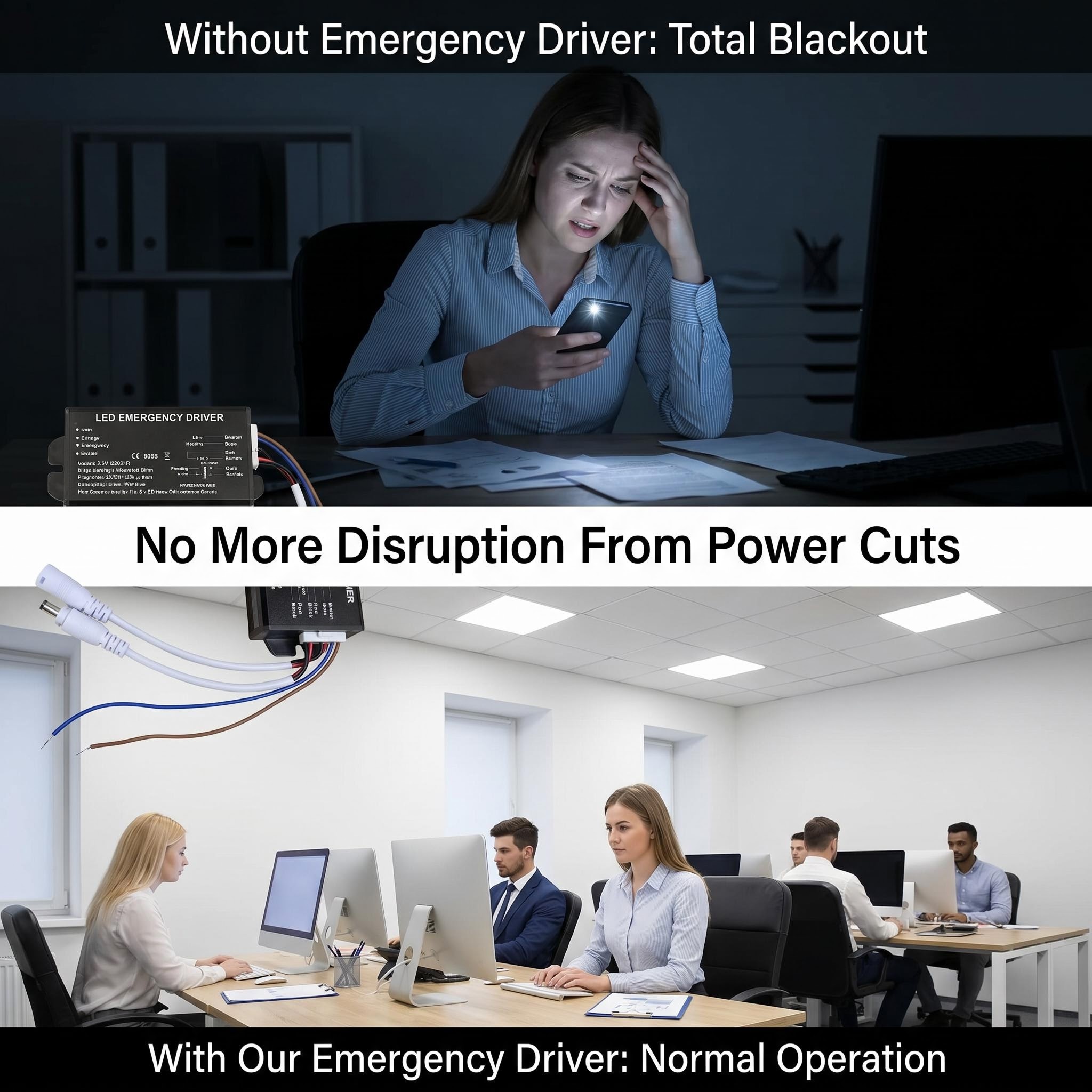
A typical 600×600 mm LED panel in a London office draws 36W at 4000 lm. The emergency driver must fit inside the same housing without visible modification. Specify a unit delivering 3W to 10W emergency output, roughly 50% of normal lumen output, for 90 minutes per BS 5266-1. Input voltage AC 220–240V at 50 Hz matches UK and European mains. The output window sits at DC 150–280V and 200–350 mA to drive the existing LED array through a changeover relay. Battery chemistry matters for ceiling access costs: LiFePO4 3.2V 2600mAh packs reach full charge in 24 hours and offer 500 to 800 cycles, reducing maintenance visits versus NiCd alternatives that need replacement every 3 to 4 years. Self-test circuitry to EN 62034 is standard fit in multi-tenant buildings where manual test keys are impractical. Ask the supplier for third-party test reports against EN 60598-2-22, not just a CE mark on the carton.
Hospitals and Clinics
Critical care corridors and A&E routes cannot tolerate partial illumination. The specification normally demands 100% maintained output for the full emergency duration, typically 3 hours to cover generator sequencing or extended grid failure. A 10W to 15W emergency driver fed from AC 100–277V suits international projects where Middle Eastern or Southeast Asian sites run 230V or 277V distribution. Output at DC 200–280V and 400–500 mA preserves the original luminaire’s lumen package. LiFePO4 6.4V 3000mAh packs in parallel configuration sustain the higher wattage without voltage sag. DALI test facility is preferred for building management system integration, allowing automated monthly function tests and annual duration tests per EN 62034. Buyers should verify the supplier’s inverter maintains constant current regulation below 10% ripple to avoid LED flicker that disturbs medical imaging or patient recovery environments.
Retail and Shopping Malls
Shopfront LED panels and architectural cove lighting using 24V COB strip at 10W/m, 1000 lm/m, 3000K, CRI 90+ present a compatibility challenge: the emergency driver must switch the strip supply without rewiring the entire run. Specify a 5W to 8W emergency output at 30% to 50% of normal output for 90 minutes, with DC 24V / 350 mA output matching the strip’s nominal voltage. Li-ion 18650 7.4V 2200mAh packs with boost converter achieve this in compact form. Non-maintained wiring is standard in retail—emergency only activates on mains failure, avoiding energy penalty during 14-hour trading days. EN 1838 still requires 50% of normal illuminance on escape routes within 5 seconds of switchover. Confirm the supplier’s changeover relay rating exceeds the strip’s inrush current, which can spike to 1.5× nominal at cold start.
Warehouses and Logistics Centres
LED high bays at 150W to 200W normal output need emergency drivers that can scale without custom engineering. A 15W to 40W emergency output at 25% to 50% of normal output provides adequate aisle visibility for 2 hours, meeting most European and Middle Eastern codes. Input at AC 220–240V or 100–277V covers both 50 Hz and 60 Hz regions. Output window DC 200–280V at 500–700 mA drives high-voltage LED chains efficiently. LiFePO4 12.8V 4500mAh packs operate reliably at ambient temperatures to +45°C common under metal roofs; cycle life of 800 to 1500 cycles outlasts NiCd, which suffers memory effect and cadmium disposal restrictions under EU Battery Regulation 2023/1542. IP65 enclosure rating is minimum for dusty environments. Ask for UN 38.3 test summary documents before shipping lithium batteries by air or sea freight.
Car Parks and Stairwells
Escape route lighting in multi-storey car parks demands low-level, uniform illumination rather than full task lighting. EN 1838 specifies 1 lux minimum on the centre line of escape routes; 3W to 6W emergency output at 10% to 25% of normal output achieves this economically over 2 hours. Input AC 220–240V feeds surface-mounted bulkheads and linear fittings in ramps. Output DC 120–200V at 150–250 mA suits small LED arrays. LiFePO4 3.2V 3000mAh packs in IP65, IK08 housings withstand moisture, salt spray in coastal sites, and accidental impact from vehicles or trolleys. Non-maintained wiring is universal in unmanned structures. The buyer should confirm the supplier’s luminaire-level test data against EN 60598-2-22, as project inspectors often reject standalone driver certificates without whole-fitting validation.
Hotels and Residential Common Areas
Guest perception of safety in hotel lobbies and residential corridors drives specification toward maintained output at 50% of normal levels, avoiding the jarring darkness-to-full-brightness transition of non-maintained systems. A 5W to 10W emergency driver with DC 24V / 250 mA output feeds 14.4W/m SMD strip at 2700K, CRI 85, preserving warm ambience. Duration of 90 minutes to 2 hours satisfies BS 5266-1 and most local derivatives. Li-ion 18650 7.4V 2600mAh packs fit into slim aluminium extrusions behind cove profiles. Maintained wiring requires the driver to accept permanent live, switched live, and neutral connections correctly; incorrect terminal identification is a common site fault. Buyers should request terminal diagrams and ask whether the supplier provides wiring configurations for both maintained and non-maintained modes on the same SKU, simplifying inventory for mixed projects.
Ordering and Importing Step by Step
Three mistakes regularly leave an emergency driver batch unusable on arrival. Mismatched output window: the driver’s DC output range does not align with the host fixture’s LED module forward voltage and current draw. Fix by recording the fixture’s nominal and maximum LED voltage before selecting a driver with overlapping output. Insufficient duration or illuminance: the unit delivers 90 minutes when the local code demands 3 hours, or 10% emergency output when 25% is required. Fix by mapping the installation’s occupancy category and escape route width to the applicable standard’s minimum lux and duration table. Missing lithium battery or conformity documentation: customs holds or rejects shipments lacking UN 38.3 test summaries, MSDS/SDS, or the conformity mark the destination inspector expects. Fix by requesting copies of these documents before placing the deposit and confirming the freight forwarder handles Class 9 dangerous goods if required.
Record Host Fixture Parameters
Order the emergency driver around the host fixture, not the other way around.
| Parameter | What to Record | Why It Matters |
|---|---|---|
| Fixture type | LED panel 600x600mm, 1200x300mm, linear, high bay, tube | Determines physical mounting space and thermal environment |
| Normal wattage | 36W, 40W, 50W typical for panels | Sets the emergency output fraction the code requires |
| LED driver architecture | Constant current external driver, integrated linear IC, 0-10V dimmable, DALI | Dictates whether the emergency driver needs a changeover relay or direct LED module connection |
| LED module forward voltage | 25-42V DC, 36-48V DC, or 54-80V DC common ranges | Must fall inside the emergency driver’s constant current output window |
| LED module current | 350mA, 500mA, 700mA, 1050mA typical | The emergency driver output current must match or be adjustable to this value |
For LED panel lights, Hymark emergency drivers typically cover output windows such as DC 25-42V at 350mA or 500mA for 36-40W panels, or DC 50-80V at 350mA for higher voltage modules. The emergency output is commonly 3W to 10W depending on the model, translating to roughly 8% to 25% of normal lumen output depending on LED efficacy and the percentage required by code.
Confirm Duration and Emergency Output Level
| Market | Standard | Typical Minimum Duration | Typical Emergency Output Requirement |
|---|---|---|---|
| UK | BS 5266-1, EN 1838 | 3 hours for escape routes, 1 hour for anti-panic open areas | 10% of normal or 1 lux minimum on escape route centre line, whichever gives higher practical result |
| Europe | EN 60598-2-22, EN 1838 | 1 hour or 3 hours depending on building class | Same as UK; some jurisdictions specify 25% of normal for high-risk task areas |
| USA | UL 924, NFPA 101 | 90 minutes | 1 footcandle (10.8 lux) minimum on escape route |
| Australia/NZ | AS/NZS 2293 | 90 minutes for Class C, 2 hours for Class D, 3 hours for Class E | 0.2 lux minimum on escape route floor |
Specify 90 minutes, 2 hours, or 3 hours at order. A 3-hour unit requires a larger battery pack than 90 minutes—typically LiFePO4 3.2V 3000-6000mAh or Li-ion 18650 3.7V 2200-5200mAh configurations versus smaller NiCd packs for 90-minute versions. The charge time to 90% capacity is commonly 16 to 24 hours for lithium systems.
Choose Maintained or Non-Mained Wiring
Non-maintained: the emergency driver sits dormant until mains failure. One set of supply wires, simpler installation, lower energy use. Standard for most commercial and industrial LED panels where normal illumination runs during occupied hours.
Maintained: the emergency LED circuit runs continuously via a changeover relay that switches to battery on mains failure. Requires separate switched live wiring. Used where the fixture is the only light source in an escape route and must be visibly lit at all times.
Confirm with the M&E consultant which wiring method the fire certificate specifies. Ordering the wrong configuration means rewiring or replacing the driver.
Decide Test Facility Type
| Type | Function | Wiring Complexity | Cost Position |
|---|---|---|---|
| Manual test key | Installer or facilities manager inserts key to interrupt mains and observe function | Low | Base |
| Automatic self-test | Microprocessor initiates brief functional test monthly and duration test annually; status LED indicates fault | Medium | Mid |
| DALI self-test | Same as self-test but reports status over DALI bus to central building management system; complies with EN 62034 | Higher; requires DALI line | Premium |
For projects with hundreds of panels, DALI self-test reduces labour for annual compliance verification. For small installations, manual test key is sufficient if the maintenance contract includes regular manual testing.
Confirm Mains Voltage and Frequency
| Region | Nominal Voltage | Frequency | Typical Input Range on Driver Label |
|---|---|---|---|
| UK, Europe | 230V AC | 50Hz | 220-240V AC |
| Middle East | 230V AC | 50Hz or 60Hz | 220-240V AC |
| Southeast Asia | 220V AC or 230V AC | 50Hz | 220-240V AC or 85-265V AC |
| Africa | 220V AC or 230V AC | 50Hz | 220-240V AC or 85-265V AC |
| Latin America | 127V AC or 220V AC | 60Hz | 100-277V AC or 85-265V AC |
| USA, Canada | 120V AC or 277V AC | 60Hz | 100-277V AC |
A driver labelled AC 220-240V will not survive on 127V. A 100-277V or 85-265V wide-range unit covers most global markets but costs 10-15% more. Record the actual measured voltage at the distribution board, not just the nominal national figure.
Verify Conformity Mark and Test Report
The inspector or customs officer at destination looks for specific marks. Do not assume CE covers all scenarios.
| Market | Mark | What to Request from Supplier |
|---|---|---|
| European Economic Area | CE + EN 60598-2-22 | Declaration of Conformity citing EN 60598-2-22 and EN 1838; test report number and issuing laboratory |
| UK (post-Brexit) | UKCA + BS EN 60598-2-22 | UKCA Declaration of Conformity; note BS 5266-1 for system design |
| USA | UL listed or UL recognized | UL 924 test report; for OEM luminaire integration, UL recognized component status may suffice |
| Australia | RCM (Regulatory Compliance Mark) | AS/NZS 60598.2.22 test evidence |
| Middle East | SASO (Saudi), ESMA (UAE), or equivalent | In-country conformity certificate in addition to CE base documentation |
Request copies of the relevant test report and Declaration of Conformity before issuing the purchase order. Verify the report covers the exact model number, battery chemistry, and duration you are ordering. A report for a NiCd 90-minute variant does not cover a LiFePO4 3-hour variant.
Check IP Rating and Ambient Temperature for Mounting Position
| Mounting Position | Typical Exposure | Minimum IP | Ambient Range to Specify |
|---|---|---|---|
| Recessed in ceiling void, driver in plenum | Dust, occasional condensation | IP20 | -10°C to +45°C |
| Surface mounted on ceiling, driver external | Dust, cleaning moisture | IP54 | -10°C to +45°C |
| Outdoor soffit or canopy | Rain, hose-directed water | IP65 | -20°C to +50°C |
| Industrial high bay with heat accumulation | Dust, elevated temperature | IP54 | -10°C to +55°C |
Lithium battery cycle life degrades rapidly above +45°C ambient. A driver mounted in a warm factory roof void in summer may need a high-temperature battery variant or remote battery placement. Hymark LiFePO4 packs are typically rated for 500 to 800 cycles at standard temperature, dropping to 300 to 400 cycles at sustained +55°C.
Agree MOQ Sample Approval and Production Lead Time
| Item | Typical Range | Action |
|---|---|---|
| MOQ | 100 to 500 units for standard models; 1000+ for custom output window or private label | Negotiate mixed-SKU pallet if buying multiple wattages |
| Sample lead time | 7 to 14 days ex-works | Order samples of each output window and duration variant you need |
| Mass production lead time | 25 to 40 days after sample approval and deposit | Lock in before Chinese New Year or Q4 peak season |
| Sample cost | 1.5x to 2.5x unit price, often credited against first bulk order | Budget for 2-3 samples: one for electrical testing, one for thermal evaluation, one for archive |
Test the sample connected to your actual host fixture panel. Measure emergency output in lumens at 1 minute and at end of rated duration. Verify the changeover relay operates cleanly without LED flicker.
Require Batch Duration Test Records
For every production batch, request a duration test record showing:
- Batch serial number range
- Test date and ambient temperature
- Battery voltage at start and end of discharge
- Measured emergency output in watts or percentage of nominal
- Duration achieved versus rated duration
EN 60598-2-22 requires each unit to be functionally tested before shipment. Batch records demonstrate systematic compliance. For lithium battery variants, also request cell voltage consistency data—cells matched to ±0.05V improve pack longevity.
Arrange Lithium Battery Shipping Documents and Freight Mode
Lithium batteries are UN 3481 (packed with equipment) or UN 3480 (standalone) under IATA and IMDG regulations.
| Freight Mode | Requirement | Practical Note |
|---|---|---|
| Air freight (IATA) | UN 38.3 test summary per battery model; MSDS/SDS; limited quantity per package; often 35kg net lithium content limit per aircraft | Fastest but most restrictive; suitable for urgent samples or small batches under MOQ |
| Sea freight (IMDG) | Same UN 38.3 and MSDS; Class 9 dangerous goods declaration; proper shipping name on bill of lading | Standard for bulk orders; no lithium content limit per vessel |
| Express courier (DHL/FedEx/UPS) | UN 38.3 mandatory; shipper’s declaration required; some destinations require pre-approval | Convenient for samples; prohibitively expensive for >50kg |
Confirm the supplier holds valid UN 38.3 test summaries for the exact battery cell model and pack configuration. UN 38.3 expires if the cell manufacturer changes chemistry or form factor. Request copies with 12 months validity remaining.
Confirm Carton and Pallet Packing and Labelling
| Element | Specification to Agree |
|---|---|
| Inner carton | Corrugated double-wall, driver in anti-static bag with foam insert; 10 to 20 units per carton typical |
| Carton label | Model number, quantity, batch code, lithium battery handling label if applicable, gross weight |
| Outer pallet | ISPM-15 treated wood or plastic pallet for EU/UK; maximum 300-400kg per pallet for manual handling |
| Pallet label | Same carton data plus total units, total gross/net weight, destination address, shipping marks |
| Container loading | 20GP or 40HQ depending on volume; confirm stackability if double-stacking in warehouse |
Photograph the first production carton and pallet for your records before shipment. Discrepancies in carton markings are a common customs delay trigger.
Plan Commissioning and First Annual Test
Schedule these activities before the driver shipment arrives.
| Activity | Timing | Responsible Party |
|---|---|---|
| Receipt inspection: verify model numbers, quantities, physical damage | Day of delivery | Electrical contractor or procurement |
| Installation and wiring: normal supply, maintained live if applicable, earth | During fit-out | Electrical contractor |
| Functional test: manual test key or observe self-test initiation | At handover | Commissioning engineer |
| Illuminance measurement on escape route: compare to 1 lux (EN) or 1 fc (UL) | At handover | Lighting designer or fire officer |
| First annual duration test: full 3-hour or 90-minute discharge and recharge cycle | 12 months after installation | Facilities manager or maintenance contractor |
Record all test results in the building’s fire safety logbook. EN 62034-compliant DALI self-test systems automate the record-keeping but still require annual physical verification that the luminaire has not been damaged or obscured.
A delivered batch is only usable when every parameter above aligns with the host fixture, the local code, and the customs requirements at destination. Work through this checklist in sequence with your supplier before releasing the deposit.
Related Hymark Products
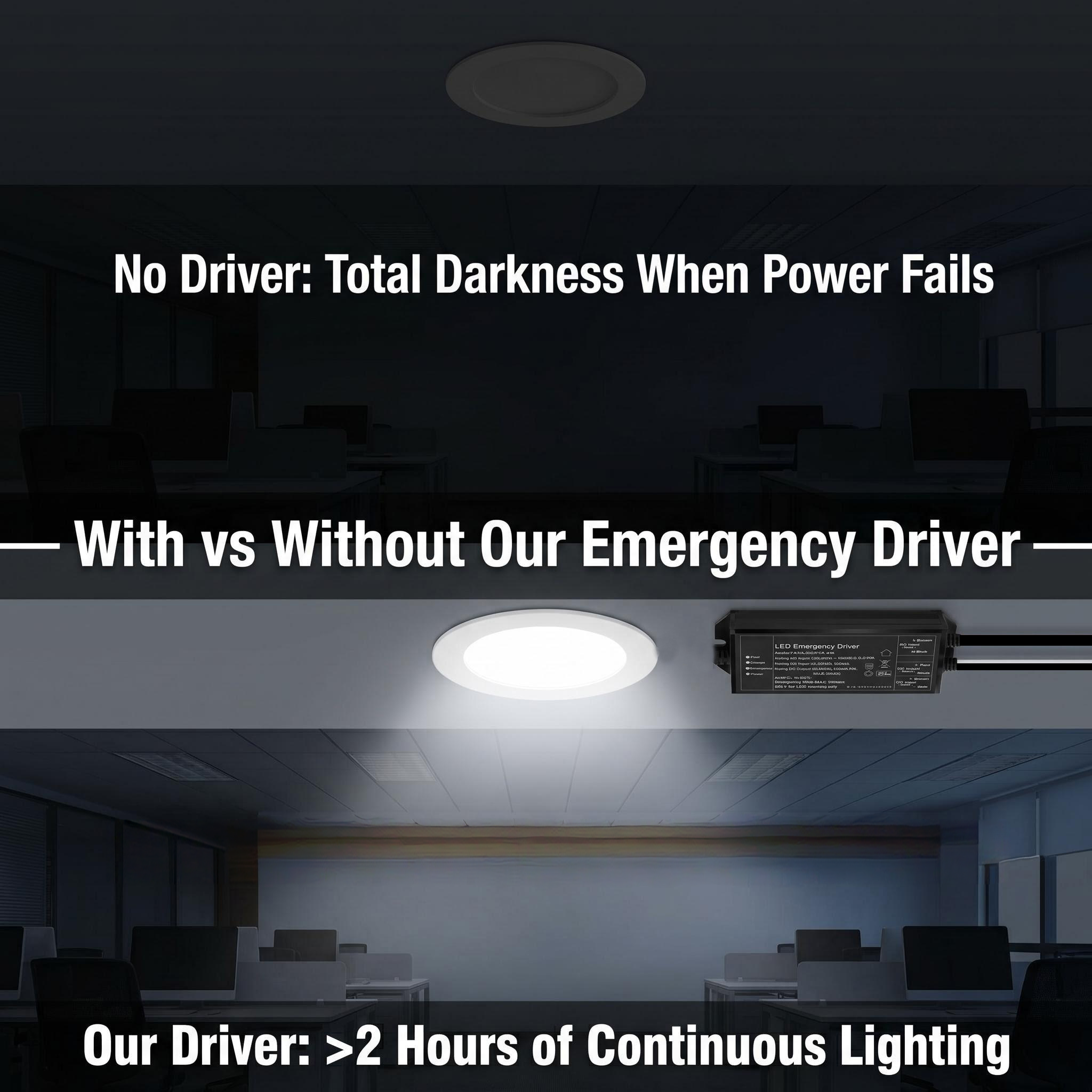
LED Emergency Driver For LED Panel Lights
Emergency drivers sized for 600×600 and 1200×300 LED panels with external drivers.
Frequently Asked Questions About LED Emergency Driver
Matching The Driver To The Fixture And Code
Q: How do I confirm your emergency driver fits my LED panel light?
Match three parameters: input voltage range, output window, and driven load. Hymark panel-light emergency drivers accept AC 85-265V or 220-240V mains and deliver constant-current DC output in bands such as 25-42V at 240mA or 50-85V at 120mA. The emergency output must reach the lumen level your local code demands—typically 10% of normal output minimum under EN 1838, though many buyers specify 30-50% for open areas. Request the inverter’s output curve and the changeover relay rating to verify compatibility with your fixture’s LED module and driver.
Q: What emergency duration and output levels are available?
Standard durations are 90 minutes, 2 hours, and 3 hours. A 3W emergency output for 3 hours from a LiFePO4 3.2V 3000mAh pack is common for 600x600mm panels; 5W for 3 hours suits larger 1200x300mm units. Output as a percentage of normal luminous flux depends on the host fixture’s efficacy—expect 300-500 lumens emergency from a 4000lm panel, roughly 8-12%. Higher emergency percentages require larger battery packs and reduce the number of units per carton due to lithium shipping limits.
Wiring And Control Options
Q: Do you supply maintained or non-maintained versions?
Both. Non-maintained wiring uses a single switched live to the emergency driver, which activates only when mains fails. Maintained wiring requires a permanent live plus switched live; the changeover relay keeps the LED module illuminated during normal operation and transfers to battery on failure. Maintained circuits comply with BS 5266-1 for spaces requiring continuous illumination. Specify your wiring topology before ordering—PCB layouts differ, and maintained versions carry a small standby load that affects battery sizing calculations.
Q: What test facility options exist—manual, self-test, or DALI?
Three tiers: manual test key for monthly and annual functional tests; automatic self-test per EN 62034 with status LED indication; and DALI-2 emergency compatibility for central monitoring and reporting. Self-test drivers add roughly 15-20% to the unit cost but eliminate manual testing labour. DALI versions require a DALI bus power supply and compatible control gear. Confirm whether your project specification calls for addressable monitoring or if local codes mandate automatic testing—AS/NZS 2293.1 requires periodic testing, for example.
Battery And Supplier Qualification
Q: What battery chemistry do you use and when must it be replaced?
LiFePO4 3.2V 1500-6000mAh packs dominate current production, offering 500-800 cycles to 80% capacity versus 300-500 cycles for Li-ion 18650 and 200-300 for legacy NiCd 3.6V packs. Charge time from deep discharge is 24 hours to full capacity. Replacement interval depends on cycle count and ambient temperature—at 25°C, LiFePO4 typically lasts 5-7 years; above 35°C, derate by 30-40%. Ask suppliers for cycle-life test data at your operating temperature, not room-temperature figures. Battery packs must be user-replaceable without tools to comply with EN 60598-2-22 maintenance requirements.
Q: What conformity marks and test reports can you supply for my market?
Buyers should request third-party test reports against the standards their market enforces: EN 60598-2-22 and EN 1838 for the UK and EU; BS 5266-1 for UK fire authority acceptance; UL 924 for North America; AS/NZS 2293 for Australia and New Zealand. Hymark can supply CB test certificates and associated factory inspection reports. Verify that reports cover the exact model number and battery configuration you intend to order—variant listings on a single certificate are common but must be explicit. Customs in the Middle East and Africa frequently require SASO or SONCAP conformity based on IEC 61347 derivations; confirm which certificate the local inspector will accept.
Logistics And Commercial Terms
Q: How do lithium batteries affect shipping and what are your MOQ and lead times?
LiFePO4 and Li-ion packs require UN 38.3 test summary documents for air freight (IATA PI 965 Section IB or II) and IMDG Code compliance for sea freight. Single-carton air samples are feasible; bulk orders above 300-500 units typically ship sea freight to avoid the 35kg net lithium content limit per aircraft. MOQ is 500 units for standard configurations, 1000 for OEM branding. Lead time is 25-30 days after confirmed order for standard products; 40-45 days for custom output windows or private-label packaging. Samples ship within 5-7 days against pro-forma invoice.
Q: What warranty, spare parts availability, and installation support do you offer?
Standard warranty is 3 years on the driver electronics, 2 years on the battery pack. Extended 5-year terms are negotiable on volume orders with annual factory inspection. Spare battery packs and changeover relays are stocked for 7 years from model discontinuation. Installation support includes wiring diagrams for maintained and non-maintained configurations, commissioning checklists for self-test and DALI variants, and remote troubleshooting via photographs of LED indicator patterns. On-site commissioning support is available in the UK, UAE, and Southeast Asia against a day-rate fee; elsewhere, we train your electrical contractor via video conference with the actual fixture model.
Important Notice
Specifications, output and duration figures and price ranges in this guide are indicative and are provided
for planning purposes only. Actual emergency output, duration, battery life, ingress protection and available conformity documentation
differ by model and by destination country, and emergency lighting design remains the responsibility of the project designer. Buyers
must confirm their own mains voltage and frequency, the emergency lighting standard enforced locally, the host fixture compatibility
and their import requirements before placing an order. All figures are subject to written confirmation in the final proforma invoice
issued by Hymark.
Sourcing LED Emergency Driver from Hymark
A well-specified LED emergency driver must match three things: the electrical signature of the host fixture, the duration and output level demanded by local life-safety code, and the physical space inside the luminaire housing. Hymark’s range for LED panel lights and linear fixtures covers maintained and non-maintained wiring, with selectable emergency duration of 90 minutes, 2 hours or 3 hours, and emergency output typically at 10%, 20%, 30% or 100% of normal lumen packages depending on the inverter model. Input accepts AC 85-265V or 100-277V depending on SKU; output windows span DC 50-240V at constant-current bands from 150 mA to 700 mA, driving LED loads from 3W to 60W in standard configuration and up to full-power output on dedicated high-lumen variants. Battery packs use LiFePO4 3.2V cells in 3000 mAh to 6000 mAh configurations, or Li-ion 18650 where space is constrained, with charge cycles of 500 to 800 for LiFePO4 versus 300 to 500 for standard Li-ion. NiCd options remain available for legacy specifications requiring -20°C to +50°C ambient tolerance, though at higher weight and lower cycle life.
What to Verify Before Placing an Order
Buyers should confirm that the supplier can produce test reports for the specific standard their market enforces: EN 60598-2-22 and EN 1838 for Europe, BS 5266-1 for the United Kingdom, UL 924 for North America, AS/NZS 2293 for Australia and New Zealand. EN 62034 covers automatic test systems including self-test and DALI-integrated monitoring. Ask for UN 38.3 test summaries on lithium battery shipments; IATA and IMDG compliance is mandatory for air and sea freight respectively. Request the battery charge time—typically 16 to 24 hours for full recovery—and whether the changeover relay is rated for the host fixture’s inrush current. IP20 is standard for internal drivers; specify IP65 only if the driver mounts in a wet-location canopy.
Perché Hymark
JIALINGHANG ELECTRONIC CO., LTD. was founded in 2013 as a global LED exporter in general illumination. A strategic shift in 2017 refocused the company on LED emergency technology and high performance LED strips. Hymark was launched in 2026 as the premium brand. Products are co-designed and engineered in house through a strategic partnership with dedicated manufacturing facilities that have also been operating since 2013, and the company manages R&D, product design and global distribution itself. The range covers emergency lighting, emergency exit signs, emergency luminaires, emergency twin spotlights, LED emergency drivers for LED high bays, panel lights, tubes and linear lights, full power output emergency drivers, LED strip lights, COB LED strips and SMD LED strips. Orders are supplied with selectable emergency duration, maintained or non-maintained wiring, OEM and ODM branding, export carton packing and FOB or CIF terms.
Send the host fixture type and wattage, the emergency duration your code requires, your mains voltage and your destination port to get a quotation within 24 hours via WhatsApp or email.
Get a Factory Direct Quote on LED Emergency Driver
JIALINGHANG ELECTRONIC CO., LTD. has been in LED lighting since 2013 and has focused on
LED emergency technology and high performance LED strips since 2017. Hymark products are co-designed with our
dedicated manufacturing partners, built with selectable emergency duration and maintained or non-maintained wiring, and function
tested before packing. Send us the host fixture type and wattage, the emergency duration your local code requires, your mains
voltage and your destination port and we will return a quotation within 24 hours.


 English
  Spanish
  Arabic
  French
  German
  Russian
  Portuguese
  Italian
  Vietnamese