
LED Emergency Driver Buyer Guide
A real emergency LED driver supplier in China ships units matched to your host fixture’s normal driver output, the local code’s required emergency duration—90 minutes for EN 60598-2-22 markets, 2 hours for many Middle Eastern specifications, 3 hours for some UK BS 5266-1 applications—and carries third-party test reports that customs and the electrical inspector in your destination country actually recognise. The right product is not a generic box; it is a constant-current inverter outputting 9-42V DC at 150-700mA to hold 10% to 100% of normal lumen output depending on the maintained or non-maintained wiring configuration, powered by a LiFePO4 3.2V 3000mAh pack or Li-ion 18650 3.7V 2600mAh cluster for 500-800 cycle life versus 300-500 for legacy NiCd 3.6V 1500mAh options that still appear in price-driven tenders.
The remainder of this page examines supplier qualification: how to verify in-house SMT and assembly capacity, battery cell traceability, discharge and duration test records, ageing and hipot stations, and after-sales engineering support before you commit to an MOQ.
What Separates a Manufacturer from a Trading Office
SMT and final assembly. Ask for photos with date stamps of the reflow line, AOI station, and functional test bench. A trading office will show you a catalogue; a manufacturer can describe PCB copper weight—typically 1oz to 2oz for emergency drivers carrying 5W to 25W sustained inverter load—and explain why their 1.6mm FR4 board specification matters for thermal cycling during the 500-hour ageing run.
Battery sourcing and traceability. LiFePO4 cells from tier-one Chinese suppliers currently trade at roughly USD 0.08-0.12 per Wh at cell level; Li-ion 18650 varies wider at USD 0.06-0.15 per Wh depending on 2000mAh, 2600mAh or 3000mAh capacity and whether the cell carries its own UN 38.3 test summary. Request cell-level UN 38.3 reports, lot numbers, and the supplier’s incoming inspection records for internal resistance and capacity. A manufacturer with battery assembly in-house can produce this; a trader forwards you their vendor’s documents with the vendor name redacted.
Discharge and duration test records. EN 62034 and BS 5266-1 both require verification that the unit delivers rated emergency output for the full duration at the declared temperature range, typically -10°C to +55°C for indoor drivers, -20°C to +55°C for IP65-rated variants. Ask for raw data from the last six months: battery voltage at 0, 30, 60, 90, 120 and 180 minutes, lumens or mA maintained, and whether the test was run with the actual LED load or a resistive dummy. A real factory generates this daily; a trader has none.
Test Equipment and Third-Party Documentation
Ageing and hipot. A qualified supplier runs 100% of units through 3.75kV AC hipot for 60 seconds, then ages assembled drivers at 40°C ambient for at least 4 hours before final function test. Some add a 24-hour burn-in at 1.2x nominal load. Ask for the station count: fewer than four ageing ovens for a supplier claiming 50,000 units monthly output is a mismatch.
Third-party reports. Do not accept “CE certified” as a sentence. Ask for the EN 60598-2-22 test report number, the laboratory name, and the specific model variants covered. For UL 924 or AS/NZS 2293 markets, the same applies—verify the report scope matches your import tariff code and the inspector’s checklist. A manufacturer has these on file; a trader may have never seen the original PDF.
Sample Lead Time and Payment Structure
Standard sample lead time from a real manufacturer with in-house SMT is 5-7 working days for existing models, 15-20 days for custom output voltage or connector specifications. Payment structures vary: 30% deposit, 70% against copy of B/L is common for first orders under USD 10,000; 100% advance for samples under USD 500. A trading office often demands 50% deposit and stretches sample lead time to 15 days because they are routing through a factory they do not control.
After-Sales Engineering Capability
Emergency driver failures in the field are rarely the inverter; they are mismatch between the driver’s output window and the host fixture’s LED forward voltage, or a battery management system that over-discharges in high-temperature installations. A qualified supplier staffs application engineers who can read your normal driver’s 0-10V dimming curve and specify whether the emergency driver needs a changeover relay or can use switched live wiring. Ask for a technical contact name, direct email, and timezone coverage. A trading office routes through a salesperson who forwards to a WeChat group.
Types and Configurations of LED Emergency Driver
| Type or Class | Typical Rating or Output | Duration or Runtime | Best Suited For | Notes |
|---|---|---|---|---|
| Reduced-Power Emergency Driver (Half-Power) | 3–4W emergency output, 25–50% of normal luminaire output | 90 min or 3 hours | LED panel lights, LED tubes, linear office luminaires | Most common OEM retrofit option; requires luminaire designed to provide adequate spacing and reflector efficiency at reduced output |
| Full-Power Emergency Driver | Matches normal driver watt-for-watt: 10W, 20W, 40W, up to 60W+ | 90 min or 2 hours | LED high bays, warehouse linear trunking, corridors with high lux requirements | Demands larger battery pack and heatsink; cost premium 40–60% over half-power equivalent |
| Self-Test / DALI-Compatible Emergency Driver | 3–20W depending on configured output | 90 min or 3 hours | Commercial buildings under EN 62034 or BS 5266-1 maintenance regimes | Adds MCU and real-time clock; firmware must match regional test cycle requirements (monthly functional, annual duration) |
| Maintained / Switched Emergency Driver | Same output options as above, with changeover relay | 90 min or 3 hours | Corridors, stairwells, escape routes requiring normal and emergency from same fitting | Dual wiring topology; relay rated for 100,000+ operations at 250V 2A typical |
| External-Battery Emergency Driver Kit | 3–10W inverter module; battery in separate IP20 or IP65 enclosure | 90 min to 3 hours | Luminaires with space constraints, high-temperature locations, or field retrofit | Battery remote placement allows Ta > 45°C at driver; cable length 0.5–2.0m typical |
| High-Temperature Industrial Emergency Driver | 5–15W output; constant current 150–350mA | 90 min or 2 hours | LED high bays in foundries, boiler rooms, glass plants | Ambient rated to Ta 65°C; NiCd or LiFePO4 selected over Li-ion 18650 for thermal stability |
Reduced-Power Emergency Driver
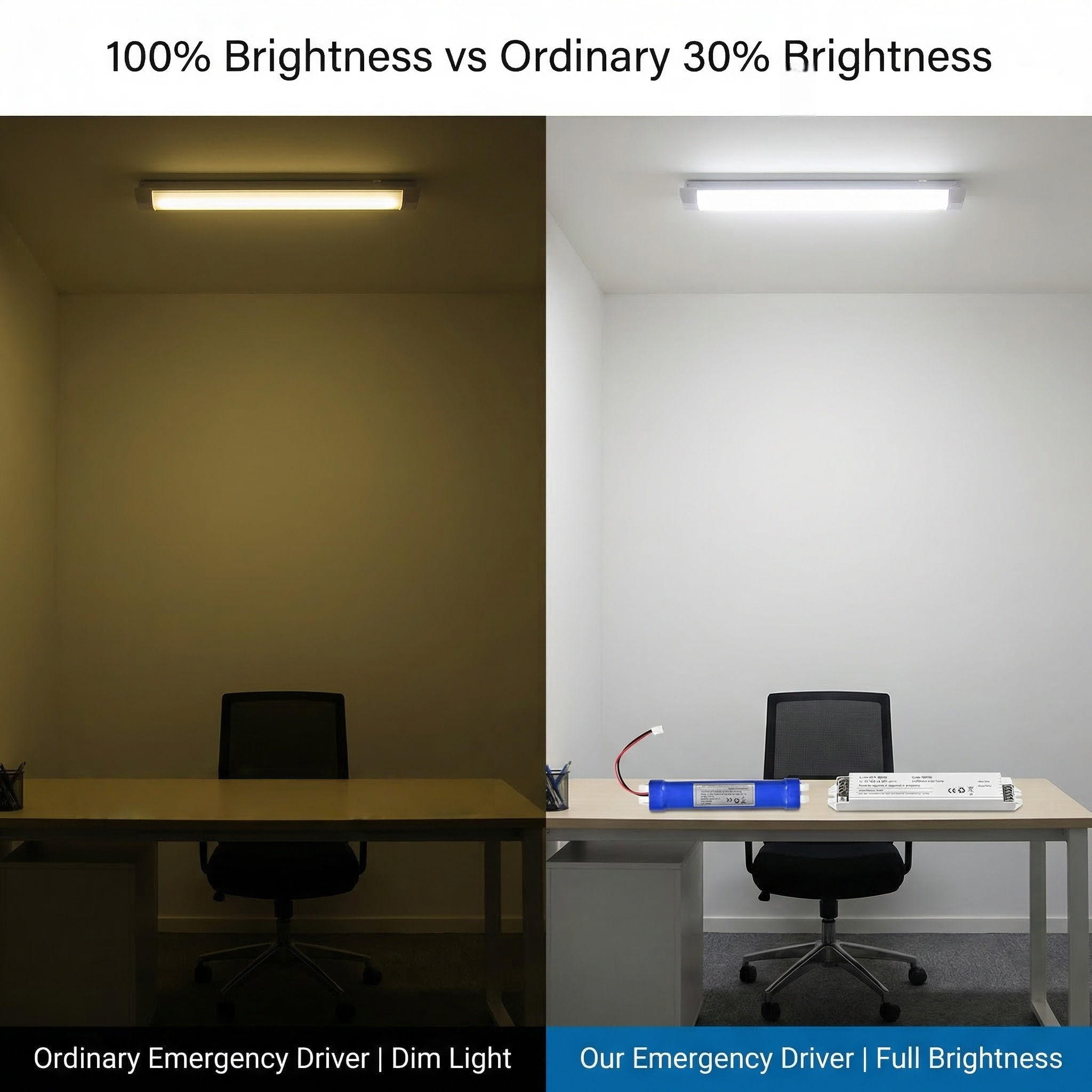
The reduced-power or half-power emergency driver is the default choice for luminaire OEMs adding emergency functionality to LED panels, LED tubes, and linear office fittings. Typical configurations deliver 3W to 4W at the emergency LED module, which translates to roughly 25% to 50% of the luminaire’s normal luminous output depending on LED efficacy and optical efficiency. Input voltage is universal AC 85–265V or 220–240V region-specific; the inverter output window is usually DC 12–60V at constant current 150mA to 350mA. Battery chemistry is most commonly Li-ion 18650 in 3.7V 2200mAh or 2600mAh single-cell or 2S2P configurations, giving 90 minutes at 3W or 180 minutes at reduced load. Charge time from deep discharge runs 20–24 hours. Electrical contractors and wholesale distributors buy this class in volume for office and retail fit-outs because it avoids relamping the entire installation. What it cannot do: it will not deliver the maintained illuminance levels EN 1838 requires for open areas or high-risk task zones if the host luminaire’s normal output was already marginal. Buyers should request discharge duration test records showing actual lumen maintenance at 90 minutes, not just battery voltage under no load.
Full-Power Emergency Driver
Full-power emergency drivers replicate the normal driver’s entire wattage output—10W, 20W, 40W, and above—so that emergency lux levels equal normal operation. This matters for LED high bays over 4m mounting height, warehouse linear systems, and corridors where the normal design lux already sits close to the EN 1838 escape route minimum. The battery pack scales accordingly: a 20W full-power unit for 90 minutes needs LiFePO4 6.4V 6000mAh or Li-ion 2S4P 7.4V 5200mAh, with cycle life 500–800 for LiFePO4 versus 300–500 for standard Li-ion. Charge time extends to 24–36 hours; the inverter stage requires larger magnetics and a heatsink that may not fit inside a slim panel housing. Luminaire OEMs and M&E consultants specify this class for new-build industrial projects. The trade-off is cost: the battery and inverter components add 40–60% to the driver BOM, and the physical envelope may force a remote battery box. It cannot be retrofitted into every existing fitting without mechanical redesign.
Self-Test and DALI-Compatible Emergency Driver
Self-test emergency drivers incorporate a microcontroller and real-time clock to execute automatic functional tests (typically monthly, 1–5 minutes) and annual duration tests (full 90 minutes or 3 hours) per EN 62034 and BS 5266-1 without manual intervention. DALI-compatible variants report status, fault flags, and remaining battery capacity to the building management system. Output ratings span 3W to 20W depending on firmware configuration; the test schedule itself varies by destination—UK installations often expect BS 5266-1 aligned intervals, while continental European projects reference EN 62034. Facility managers and building owners responsible for life safety compliance buy this class to eliminate the labour cost of manual test key operation across large estates. The limitation: the MCU adds a continuous standby draw (0.3–1W typical) and a firmware dependency; if the supplier cannot demonstrate firmware version control and field update capability, the driver may become non-compliant when standards revise test protocols. Buyers should ask for the DALI device type implementation table and confirmation that the self-test logic has been third-party witnessed, not merely asserted.
Maintained and Switched Emergency Driver
Maintained emergency drivers include a changeover relay that energises the LED module from normal mains via the driver in everyday operation, then switches to inverter/battery output on mains failure. Non-maintained variants only activate in emergency mode. The relay is typically rated for 100,000+ mechanical operations at 250V 2A; maintained wiring requires a permanent live, switched live, and neutral to the luminaire, versus just permanent live and neutral for non-maintained. Output ratings mirror the other classes. Electrical contractors and lighting designers specify maintained for corridors and stairwells where the fitting serves as both normal and escape lighting, avoiding the need for twin luminaires. The constraint: the relay is a wear component, and a failed relay can leave the fitting dark in normal mode or failed to switch in emergency. Buyers should verify the supplier has relay life-test data and that the changeover time meets EN 60598-2-22 (typically <0.5s for maintained circuits). This class cannot be used in simple two-wire retrofit installations without pulling an additional switched live conductor.
External-Battery Emergency Driver Kit
External-battery kits separate the inverter/driver PCB from the battery pack, linked by a 0.5m to 2.0m cable assembly. The battery enclosure may be IP20 for ceiling void mounting or IP65 for exposed industrial locations. This format suits LED panels with shallow recesses, linear trunking with no end-cap space, or retrofits where the existing luminaire housing cannot accommodate a 60mm-diameter battery cylinder. Typical ratings are 3W to 10W; battery configurations include Li-ion 18650 3.7V 4400mAh 2P (90 min at 6W) or LiFePO4 6.4V 3000mAh. Procurement officers and retrofit contractors favour this class for upgrade projects where luminaire replacement is avoided. The limitation: the interconnect cable is a failure point, and IP ratings must be maintained at both gland entries. Battery traceability becomes harder when the pack is sourced separately from the inverter; buyers should demand cell-level UN 38.3 test summaries and confirm the assembler’s incoming inspection records for voltage matching and internal resistance pairing.
High-Temperature Industrial Emergency Driver
High-temperature emergency drivers are specified for ambient temperatures above 45°C, common in foundries, boiler rooms, glass manufacturing, and Middle Eastern unconditioned plant rooms. These units typically deliver 5W to 15W at constant current 150mA to 350mA, with Ta ratings to 65°C. Battery chemistry shifts from Li-ion 18650 to LiFePO4 or NiCd: LiFePO4 3.2V 3000mAh cells tolerate 60°C ambient with reduced cycle life penalty, while NiCd 3.6V 1500mAh to 4000mAh packs remain serviceable to 70°C but carry heavier weight and cadmium content restrictions under EU Battery Regulation. The inverter stage uses higher-temperature capacitors (105°C rated, 5,000-hour life minimum) and potted magnetics. Industrial procurement officers and M&E consultants in GCC and Southeast Asian markets specify this class. What it cannot do: it will not match the energy density of standard Li-ion, so runtimes above 90 minutes at 15W demand physically large battery assemblies. Buyers should request ageing test records showing 1,000-hour thermal soak at maximum rated Ta, and verify the supplier’s battery cell procurement channel—reclaimed or B-grade cells are a known failure mode in high-temperature applications.
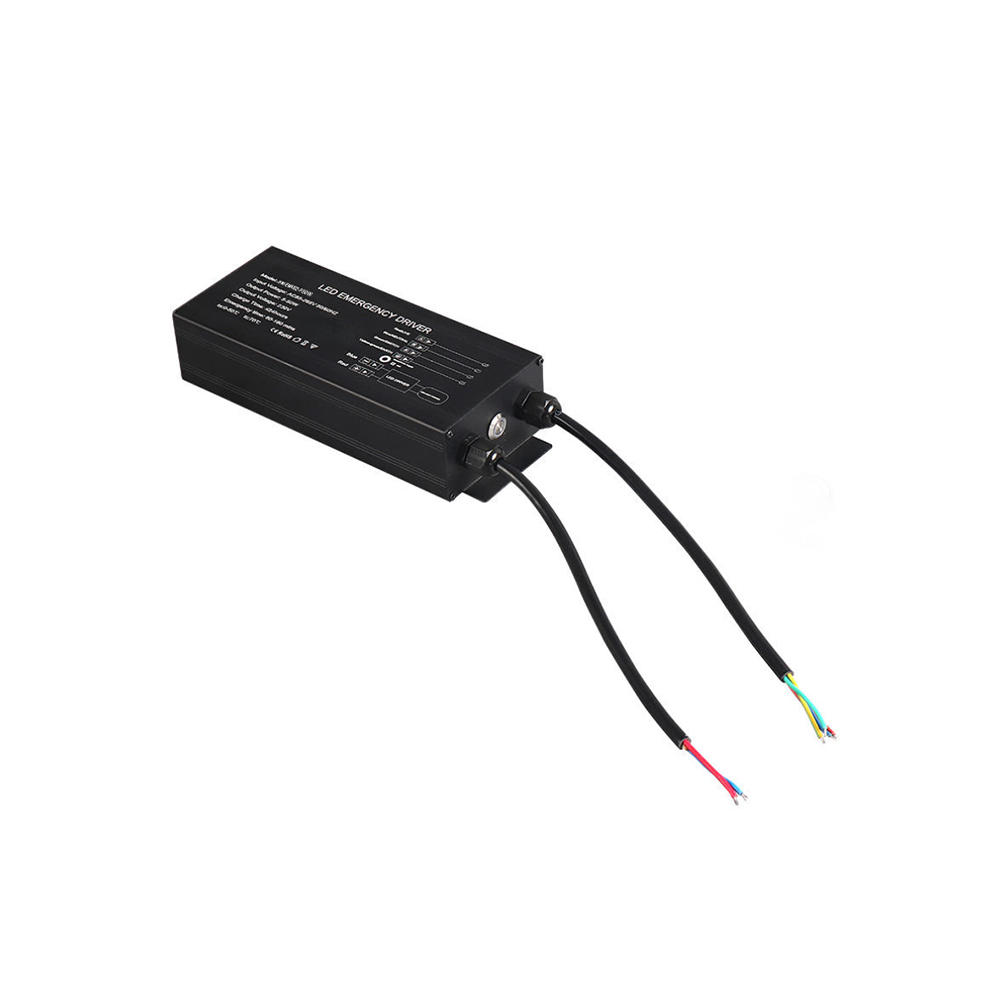
Specifications and How to Read Them
| Parameter | Entry Level | Mid Range | High Specification |
|---|---|---|---|
| Input Voltage / Frequency | AC 85-265V, 50/60Hz | AC 100-277V, 50/60Hz | AC 220-240V ±10%, 50/60Hz |
| Driven Load (Normal Mode) | 15-40W | 20-60W | 30-100W |
| DC Output Window | 50-150V @ 120mA | 100-240V @ 180mA | 150-280V @ 250mA |
| Uscita di emergenza | 3W, 15-20% of normal | 6W, 25-30% of normal | 10W, 50-100% of normal |
| Emergency Light Output | 300-400lm | 600-900lm | 1000-2000lm |
| Durata dell'emergenza | 90 minutes | 120 minutes | 180 minutes |
| Battery Chemistry | NiCd 3.6V 1500mAh | Li-ion 18650 3.7V 2600mAh | LiFePO4 3.2V 3000mAh |
| Charge Time | 24 hours | 16-20 hours | 8-12 hours |
| Cycle Life | 300-500 cycles | 500-800 cycles | 800-1500 cycles |
| Test Facility | Manual test key | Self-test per EN 62034 | Self-test + DALI-2 |
| Wiring Mode | Non-maintained | Non-maintained or Maintained | Maintained + Switchable |
| IP / IK Rating | IP20 / IK05 | IP65 / IK07 | IP66 / IK08 |
| Ambient Temperature | 0°C to +45°C | -10°C to +55°C | -20°C to +60°C |
| Dimensions (L×W×H) | 120×40×25mm | 160×50×30mm | 200×60×35mm |
| Mounting | Internal clip | Internal clip + screw lugs | Internal + external bracket |
How to Read an LED Emergency Driver Datasheet
Input voltage range and frequency. Look for “AC 85-265V 50/60Hz” for universal input, or “AC 220-240V” for UK/European mains only. The wider the range, the more tolerant the driver is to grid fluctuations common in Southeast Asia and Africa. Frequency tolerance matters for generators: 50Hz and 60Hz must both be accepted if you ship to the Americas and Asia from one SKU.
Driven load in watts. This is the normal-mode LED load the driver supports, not the emergency output. A 40W driver means your panel or tube must draw 40W or less in normal operation. Exceed this and the driver overheats; undershoot by too much and the constant-current output becomes unstable. Match within ±10% for reliable operation.
DC output voltage window and current. Expressed as “DC 100-240V @ 180mA” or similar. The voltage window must bracket your LED module’s forward voltage at operating temperature. The current figure is fixed by the driver’s constant-current design. If your LED strip needs 200mA and the driver delivers 180mA, you get 90% light output in emergency; if it needs 150mA, the driver may not start or may overdrive the LEDs depending on circuit design. Verify this with the supplier’s load compatibility list.
Emergency output in lumens and as percentage of normal. EN 1838 requires minimum 1 lux on escape routes; BS 5266-1 adds 0.5 lux for open areas. The datasheet should state emergency lumens and the percentage of normal output: “600lm, 25% of normal” tells you the driver reduces to quarter power in emergency. For high-bay applications, 50-100% maintained output may be needed to meet the same absolute lux levels from greater mounting heights. Ask for the lumen figure at your specific LED module’s efficacy, not generic claims.
Emergency duration. 90 minutes is the baseline for most jurisdictions. 120 minutes appears in some Middle Eastern specifications and large UK complexes. 180 minutes is specified for high-risk task areas and some industrial insurance requirements. The battery must be sized for the full duration including degradation margin; a 3000mAh LiFePO4 pack at 10W output with inverter losses gives roughly 3 hours with headroom for end-of-life capacity fade.
Battery chemistry voltage and capacity. NiCd 3.6V packs are cheapest but carry memory effect and cadmium disposal restrictions in the EU. Li-ion 18650 3.7V 2600mAh offers better energy density but requires UN 38.3 testing for air freight and stricter thermal management. LiFePO4 3.2V 3000mAh costs 30-40% more, delivers 500-800 cycles to 80% capacity, and tolerates +60°C ambient without thermal runaway risk. The voltage determines inverter topology: 3.2V LiFePO4 needs a boost stage to reach 150V+ LED strings, adding cost and efficiency loss.
Charge time and cycle life. Charge time ranges from 8 hours for LiFePO4 with dedicated CC-CV chargers to 24 hours for trickle-charged NiCd. Cycle life matters for total cost of ownership: 300 cycles at daily test discharge equals roughly one replacement per year; 800 cycles stretches to three years. Ask for the test protocol—cycles to 80% capacity at what depth of discharge and at what temperature.
Test facility. Manual test key: operator presses a button or inserts a key switch, cheapest, relies on human discipline. Self-test per EN 62034: automatic monthly function test and annual duration test, with LED status indication; adds £8-15 to BOM cost. DALI-2 test facility: communicates test results and faults to the building management system, requires DALI bus wiring and compatible luminaire; adds £15-25 plus integration complexity.
Maintained or non-maintained wiring. Non-maintained: driver sits idle until mains failure, simplest wiring, one switched live input. Maintained: driver powers LED continuously via changeover relay, requires permanent live, switched live, and neutral; relay must handle normal-mode current without contact welding. Maintained/non-maintained switchable: jumper or DIP switch selection, one SKU covers both applications but adds terminal complexity.
IP and IK rating. IP20 suits internal luminaire mounting only. IP65 with sealed cable glands allows external mounting in dusty or wet locations. IP66 withstood temporary immersion testing. IK05 resists 0.7J impact; IK07 resists 2J, sufficient for most public buildings; IK08 at 5J is specified for sports facilities and correctional environments. Verify the rating applies to the complete installed assembly, not the bare PCB.
Ambient temperature range. 0°C to +45°C is standard indoor. -20°C to +60°C with LiFePO4 supports unventilated luminaires in GCC climates and Nordic winters. Lithium-ion performance degrades below 0°C; NiCd tolerates cold but suffers faster self-discharge above +35°C. Check the datasheet specifies emergency duration at the temperature extreme, not at 25°C laboratory conditions.
Dimensions and mounting. Measure your luminaire cavity against the driver’s L×W×H including terminal block clearance. Internal clip mounting suits shallow ceiling panels; screw lugs with anti-rotation tabs prevent loosening from thermal cycling; external bracket mounting allows retrofit to existing fixtures without disassembly.
Strip-Specific Parameters Where Applicable
For LED strip emergency drivers, the datasheet adds: working voltage (typically DC 12V, 24V, or 48V for the strip itself, with the emergency driver providing matching output); W/m (watts per metre, 4.8W/m for low-density SMD2835 up to 14.4W/m for COB strips); lm/m (lumens per metre, 400lm/m at 4.8W/m with 83lm/W efficacy, up to 1500lm/m for high-efficacy COB); LEDs per metre (60, 120, 240, or 480 for COB continuous appearance); CRI (80+ for general, 90+ for retail and healthcare); colour temperature (2700K, 3000K, 4000K, 5000K, 6500K); cut length (every 50mm for 12V, 100mm for 24V, determined by LED grouping); reel length (5m standard, 10m on request); PCB width (8mm, 10mm, 12mm, 15mm with 2oz or 3oz copper weight for thermal management and voltage drop reduction).
Supplier Qualification: Separating Manufacturer from Trading Office
SMT and assembly capacity. A real manufacturer owns or has exclusive partnership with SMT lines placing driver ICs, MOSFETs, and battery management chips. Ask for photos with date stamps, or request video call verification. Trading offices show generic factory photos from multiple sources. Hymark operates in-house SMT for PCBA and final assembly with partnered cell injection moulding; buyers may request virtual or physical audit.
Battery sourcing and traceability. The 18650 or 18650-equivalent cells must carry a recognised brand (BAK, EVE, Lishen, or equivalent) with batch codes traceable to the cell manufacturer’s COA. Generic “A-grade” claims without documentation indicate rewrapped or B-grade cells. Ask for the cell specification sheet and the battery pack’s UN 38.3 test summary number, which must match the cell supplier’s report.
Discharge and duration test records. Every production batch must undergo full-duration discharge at rated load and temperature. Ask for a sample test report showing: initial battery voltage, load voltage at 30/60/90 minute marks, lumen output at each interval, and pass/fail against declared duration. Trading offices produce reports on request from unknown third parties; manufacturers show dated records with serial number traceability.
Ageing and hipot test stations. Driver PCBs require 4-8 hours burn-in at +45°C ambient before final test. Hipot (dielectric withstand) testing at 1500V AC or 3750V DC verifies isolation between mains and output. Ask for test voltage, duration, and acceptance leakage current. A manufacturer has dedicated racks; a trading office outsources this inconsistently.
Third party test reports for the destination market. Do not accept “CE certified” as a statement. Request the test report number, testing laboratory name (SGS, TÜV, Intertek, DEKRA, or accredited Chinese labs), and standard tested to: EN 60598-2-22 for luminaire safety, EN 62034 for automatic test systems, EN 61347 for controlgear, plus LVD and EMC directives. For UKCA, the same standards apply with UK-recognised body involvement post-Brexit. For UL 924 entry to North America, a file number searchable on UL’s database is required. AS/NZS 2293 for Australia requires RCM marking with evidence of compliance. The buyer should verify the report covers the exact model number and battery configuration being purchased, not a similar product.
Sample lead time. A manufacturer with stock components ships samples in 5-7 working days. Longer suggests component procurement from distant suppliers or assembly scheduling at a contracted factory. Hymark samples ship from Jiangmen within 5 working days for standard configurations; custom output windows or DALI programming add 3-5 days.
Payment structure. Trading offices often demand 100% advance or large deposits due to cash flow constraints. Manufacturers with production control accept 30% T/T deposit, 70% against B/L copy for established buyers, or L/C at sight for orders above $50,000. New relationships may start with 50/50 terms until credit is established.
After-sales engineering capability. Can the supplier’s engineer explain why your 240V LED module flickers at 120mA emergency output? Do they have load compatibility matrices or can they test your specific LED module against their driver? Trading offices forward questions to factories with 48-hour delays. Manufacturers have application engineers with oscilloscopes and integrating spheres.
Trade Terms and Export Practicalities
FOB (Free On Board). Seller delivers goods onto the vessel at named port; buyer pays ocean freight and insurance. Common for Shenzhen or Guangzhou port shipment. Risk transfers when goods cross the ship’s rail. Buyer controls freight forwarder choice and insurance coverage.
CIF (Cost Insurance Freight). Seller pays freight and marine insurance to destination port. Insurance typically covers 110% of CIF value. Buyer assumes risk on loading but does not pay until arrival. Verify insurance covers lithium battery cargo; some underwriters exclude or surcharge UN 3480/3481 shipments.
CFR (Cost and Freight). Seller pays freight; buyer arranges insurance. Rare for battery shipments since insurers demand known-good packing and UN certification from the seller.
EXW (Ex Works). Buyer collects from factory. Useful if you have existing China logistics infrastructure; otherwise exposes you to export clearance, VAT rebate complexities, and battery transport documentation you may lack.
L/C (Letter of Credit). Bank guarantees payment against compliant documents. Adds 0.15-0.3% cost and 3-5 days document checking. Protects both parties for large first orders. Requires precise consistency between invoice, packing list, B/L, and certificate of origin.
T/T (Telegraphic Transfer). Direct bank transfer. Faster, cheaper, but requires trust. 30/70 structure is standard; negotiate 10/90 only with long-established suppliers.
HS code. 9405.40 for emergency lighting equipment; 8504.40 for static converters (LED drivers). Battery packs may ship separately under 8507.60 for lithium. Correct classification affects duty rate and whether lithium transport restrictions apply to the complete shipment or separable components.
CE and UKCA marking. CE requires EU declaration of conformity with technical file; UKCA requires UK-recognised body for products under regulations requiring third-party intervention. The manufacturer or authorised representative must hold the technical file, not the trading office. Ask for the DoC and verify the signatory’s company name matches the invoice.
UN 38.3 battery test report. Mandatory for lithium battery air and sea transport. Covers T1-T8 tests: altitude simulation, thermal cycling, vibration, shock, external short circuit, impact, overcharge, forced discharge. Each battery chemistry and capacity combination needs separate testing. The report must list the cell manufacturer and model, the battery pack assembler, and the watt-hour rating. Without this, freight forwarders will reject the booking.
Packing list and certificate of origin. Packing list must match carton markings with net/gross weight and battery UN marking. Certificate of origin (Form A or CO) may be required for preferential duty under trade agreements; China-origin goods face anti-dumping scrutiny in some markets, so accuracy matters.
Carton and pallet packing. Drivers typically pack 50-100 units per carton with individual PE bags and foam separators. Battery packs ship separately or installed with insulating tabs to prevent activation. UN 3481 Section II for lithium batteries in equipment allows consolidated packing with specific gross weight limits per carton. Full UN 3480 for standalone batteries requires hazard labels and limited quantity per package. Pallet: 20-24 cartons per 1.2m×1.0m Euro pallet or 1.1m×1.1m Asian pallet, max 800kg for air freight, 1000kg+ for sea.
MOQ and lead time. Standard MOQ for LED emergency drivers is 500-1000 units per model, negotiable to 200 units for first trial with surcharge. Lead time: 15-20 days for repeat orders with component stock; 30-35 days for new configurations requiring PCB revision or custom battery packs. LiFePO4 cell availability fluctuates; confirm cell allocation before placing deposit.
Sample policy. 1-5 units at 1.5×-2× production unit price, refundable against first order above MOQ. Custom output voltage or DALI address programming may incur NRE charge £200-500, amortised across production order.
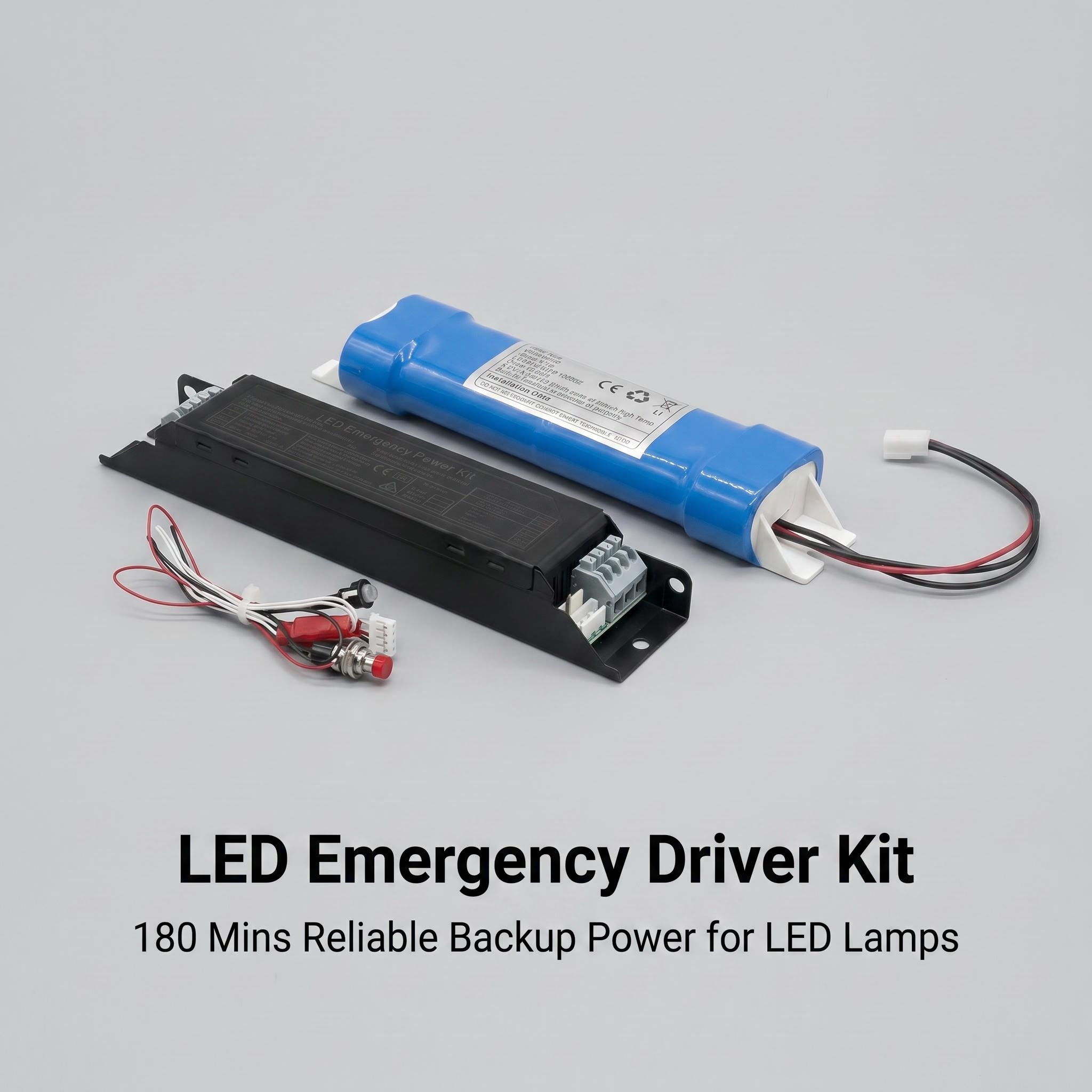
LED Emergency Driver Price and What Drives It
| Class | Typical Rating or Output | Duration or Runtime | Indicative FOB USD |
|---|---|---|---|
| Economy 3-10W | 3-10W emergency, 10-30% of normal lumen output | 90 minutes | $4.50 – $8.00 |
| Standard 10-20W | 10-20W emergency, 20-50% of normal lumen output | 90 minutes to 2 hours | $8.00 – $16.00 |
| High Output 20-40W | 20-40W emergency, 50-100% of normal lumen output | 2 hours to 3 hours | $16.00 – $32.00 |
| Full Power 40-60W | 40-60W emergency, 100% maintained output | 90 minutes to 3 hours | $28.00 – $55.00 |
| DALI/Self-Test Intelligent | 10-40W with EN 62034 automated testing | 90 minutes to 3 hours | $22.00 – $48.00 |
These bands assume single-unit FOB Shenzhen/Guangzhou for batches of 500–2,000 pieces. Samples at 1–10 units typically carry a 40–80% premium. Prices below $4.00 for any unit with a genuine lithium battery pack usually signal a smaller cell than rated, a NiCd substitute, or incomplete third-party testing documentation.
What Actually Drives The Factory Gate Price
Battery cells and pack assembly typically absorb 25–35% of the BOM cost for lithium-based emergency drivers. A 3.2V LiFePO4 18650 1500mAh cell runs higher than a 3.7V Li-ion 18650 2000mAh cell, but delivers 500–800 cycles versus 300–500 cycles and passes UN 38.3 thermal abuse thresholds more reliably. A 7.2V NiCd 900mAh pack costs 30–40% less upfront but requires replacement every 2–3 years and faces cadmium disposal restrictions across the EU and several Southeast Asian markets. Buyers should ask for cell supplier invoices or COOs; trading offices rarely have direct battery procurement relationships.
Driver and inverter electronics account for 20–28%. The constant-current inverter stage, changeover relay, and charging IC determine whether the unit maintains stable DC output (typically 9–42V, 100–350mA depending on model) across the 85–265VAC or 100–277VAC input range. A discrete MOSFET inverter design costs more than an integrated IC solution but handles inductive LED load transients better during the 0.3–2 second changeover window required by EN 60598-2-22.
Enclosure and thermal hardware runs 8–15%. IP20 plastic housings suffice for internal panel or tube driver compartments; IP65 metal enclosures with grommeted cable entries add $2.50–$4.00 for high-bay or outdoor linear applications. IK08 rating for public areas adds another $1.00–$2.00 in reinforced housing or potting compound.
Test and certification cost amortisation typically represents 10–18% per unit across the first production batch. A complete EN 60598-2-22, EN 1838, and EN 62034 test sequence at a Notified Body runs €8,000–€18,000. UL 924 testing for North American markets costs $12,000–$25,000. AS/NZS 2293 compliance adds AUD $6,000–$12,000. Spread across 3,000 units, this is $3.00–$8.00 per driver. A factory without in-house hipot, discharge duration, and thermal ageing stations ships untested product and quotes lower because the certification risk sits with the buyer.
Assembly labour, inland freight, and export packing combine for 6–10%. LED emergency drivers pack at 40–80 units per carton, 20–28 cartons per 1200×1000mm pallet. Lithium-cell units require UN 38.3 Section 38.3.5 test summaries, Class 9 hazardous material labels, and often IATA/IMDG restricted air or sea freight—adding $0.30–$0.80 per unit in documentation and specialised packing versus NiCd or non-battery goods.
Why The Cheapest Quote Usually Costs More
A $3.80 FOB quote for a “10W 90-minute emergency driver” normally means one of three things: a 3.7V 1200mAh Li-ion cell substituting for a rated 2000mAh pack (yielding 55–65 minutes at actual 10W load before voltage collapse); emergency output capped at 15–20% of normal lumens rather than the 50% implied; or a design that has not completed full-duration discharge testing against EN 1838 minimum illuminance curves. The buyer discovers this only during commissioning or first annual test.
Conversely, a $14.00 unit with LiFePO4 3.2V 3000mAh, 2-hour duration at 50% output, and documented 500-cycle ageing data carries predictable replacement intervals and passes inspector scrutiny under BS 5266-1 or local derivatives.
Five-Year Running Cost Comparison
| Cost Element | Economy Li-ion 18650 1500mAh | Standard LiFePO4 3000mAh 2H | DALI Self-Test LiFePO4 3000mAh |
|---|---|---|---|
| Unit FOB | $6.00 | $14.00 | $26.00 |
| Battery replacement cycle | 2.5 years | 5+ years | 5+ years |
| Battery replacement cost (installed) | $8.00 | $12.00 | $14.00 |
| Manual test labour (30 min × 2/year × 5 yr at $35/hr) | $175.00 | $175.00 | $35.00 (automated) |
| Expected failure rate | 8–12% | 3–5% | 2–4% |
| Failure replacement (parts + labour) | $45.00 | $55.00 | $65.00 |
| 5-Year Total per Unit | $240–$260 | $260–$280 | $140–$160 |
The intelligent unit breaks even against the economy option by year three and halves ongoing compliance labour. For portfolios above 500 luminaires, this dominates purchase price.
Supplier Qualification Checklist
Manufacturing depth. Ask for SMT line ownership or a binding partnership letter with the actual PCBA house. In-house SMT with Yamaha or Panasonic placement capacity and AOI inspection indicates traceability; a trading office will deflect or provide a generic facility photo.
Battery sourcing and traceability. Request the cell manufacturer’s UN 38.3 test report number and the pack assembler’s IEC 62133 or UL 2054 documentation. Legitimate factories can produce cell incoming inspection records with voltage, internal resistance, and capacity sampling data.
Discharge and duration test records. Every design iteration should have dated 90-minute or 3-hour discharge logs at rated load and temperature (typically 0°C to +55°C ambient). Ask for a random serial-numbered unit’s test printout from the ageing station.
Third-party test reports for the destination market. Do not accept “CE certified” as a statement; request the test report reference number, applicable standard list (EN 60598-2-22, EN 1838, EN 62034 for European markets; UL 924 for US; AS/NZS 2293 for Australia/New Zealand), and the body that issued it. Verify the report covers the exact model name and battery configuration you intend to order.
Sample lead time and engineering response. A real manufacturer ships electrically representative samples in 5–10 working days from stock PCBA and configured battery packs. A trading office quotes 15–25 days because they are relaying your request. Technical questions about maintained versus non-maintained wiring configurations, DALI address programming, or custom output voltage windows should receive schematic-level answers within 24–48 hours, not generic brochure text.
Payment structure. 30% TT deposit, 70% against B/L copy is standard for first orders. Demands for 100% advance on samples, or refusal of documentary collection, suggest cash-flow stress or absence of factory leverage.
After-sales engineering capability. Confirm whether the supplier can issue revised firmware for DALI test intervals, provide wiring diagrams for local maintained-switching requirements, or analyse returned field failures at component level. Trading offices route these to the factory with 2–3 week delays and garbled technical context.
Freight and Compliance Reality for Lithium Cells
Li-ion and LiFePO4 packs above 100Wh per unit require IATA Dangerous Goods Declaration for air freight and IMDG Code compliance for sea freight. Many forwarders refuse mixed DG/non-DG pallets; dedicated lithium shipments add 15–30% to freight cost and extend booking lead times by 5–10 days. UN 38.3 Section 38.3.5 summary documents must accompany every shipment; missing paperwork triggers customs detention at destination, particularly in the UK post-EU exit, Saudi Arabia SASO clearance, and Brazil ANVISA-influenced ports.
NiCd packs avoid lithium transport restrictions but face REACH and RoHS limitations across Europe and increasing Middle East environmental scrutiny. Buyers specifying NiCd for freight simplicity should confirm destination market acceptance in writing.
Minimum Order and Lead Time Benchmarks
| Order Type | Quantity | Tempi di consegna | Notes |
|---|---|---|---|
| Sample with existing battery config | 1–5 units | 5–10 days | May carry 50–100% sample surcharge |
| Sample with custom output/voltage | 1–5 units | 15–20 days | Requires PCBA revision |
| First production | 500–1,000 units | 25–35 days | Includes incoming cell inspection and ageing |
| Repeat production | 2,000–5,000 units | 20–30 days | Steadies once cell pipeline confirmed |
| Large project | 10,000+ units | 35–50 days | Staggered shipment or VMI possible |
MOQ flexibility varies by factory depth. A pure manufacturer with owned SMT lines often accepts 500-unit first orders; trading offices quoting below this usually aggregate across multiple buyers and sacrifice configuration control.
What To Request In Your First RFQ
Specify: normal LED load in watts and nominal lumen output; required emergency output as percentage of normal and absolute lumens; maintained or non-maintained wiring topology; input voltage (220–240V 50Hz for UK/EU/Middle East/Africa; 100–277V 60Hz for Americas; 220V 50Hz for Southeast Asia); target duration (90 min, 2 hr, 3 hr); test facility (manual key switch, self-test per EN 62034, or DALI-2 emergency); IP and IK rating; ambient temperature range at mounting height; and destination market certification requirement. A supplier who returns a matched specification sheet with cell chemistry, capacity, cycle life, and discharge curve within two business days is demonstrating manufacturing competence. One who returns only a price list and “we can do anything” is not.
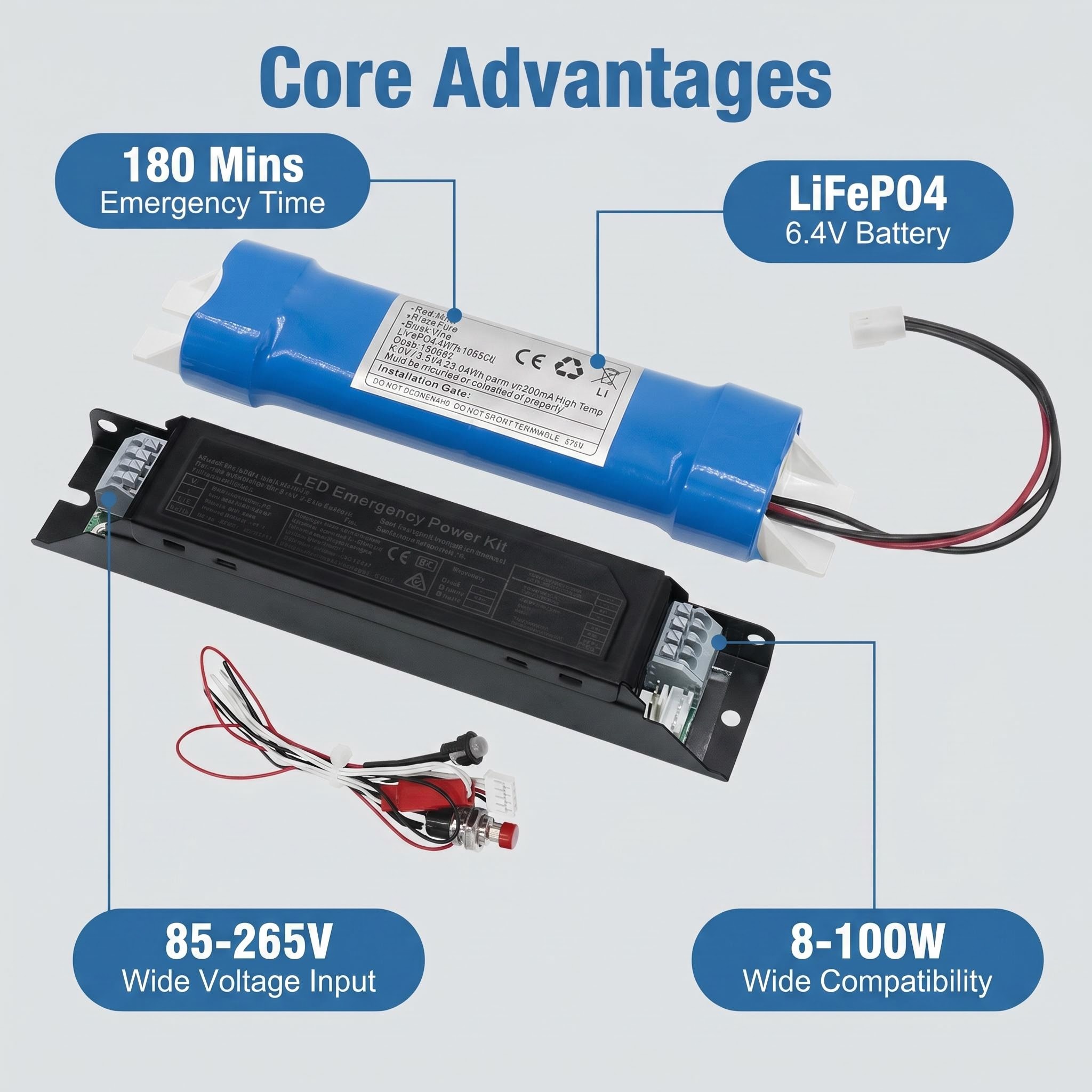
Industry Applications for LED Emergency Driver
| Sector | Typical Installation | Recommended Specification | Why This Product Fits |
|---|---|---|---|
| Commercial Offices and Fit-Outs | Recessed LED panels in suspended ceilings, linear pendant runs in open plan floors | 3W to 8W emergency output, 50% of normal lumen package, 90 min duration, AC 220-240V input, DC 150-260V / 200mA output, LiFePO4 3.2V 3000mAh, self-test to EN 62034 | Modular retrofit without ceiling disruption; maintained or non-maintained wiring matches tenant fit-out flexibility |
| Hospitals and Clinics | Cleanroom LED panels, corridor linear battens, treatment room downlights | 100% maintained output, 3 hour duration, AC 85-265V input, DC 200-240V / 300mA, LiFePO4 3.2V 6000mAh, IP65 driver enclosure, DALI self-test | Critical care spaces require full illumination continuity; 3 hour backup covers delayed evacuation and generator sequencing |
| Warehouses and Logistics Centres | LED high bays at 8-15m mounting, aisle linear runs | 10W to 20W emergency output, 10-20% of high bay normal output (sufficient for safe egress at height), 2 hour duration, AC 100-277V input, DC 280-300V / 100mA, Li-ion 18650 7.4V 5200mAh | High mounting demands higher DC output window to overcome voltage drop; wide input range suits three-phase industrial feeds |
| Car Parks and Stairwells | Surface-mounted LED bulkheads, recessed stairwell luminaires | 3W to 5W emergency output, IP65 driver, IK08 impact resistance, 90 min duration, AC 220-240V, DC 12-48V / 500mA for low voltage bulkhead compatibility, NiCd 3.6V 4000mAh option for cold ambient | EN 1838 requires 1 lux minimum on escape route centreline; damp and vandal-prone locations need mechanical protection |
| Hotels and Residential Common Areas | Decorative LED panels in lobbies, linear coves in corridors, LED tubes in service areas | 50% maintained output for lobbies (guest safety perception), 10% non-maintained for back-of-house, 90 min duration, AC 220-240V, DC 180-220V / 250mA, LiFePO4 3.2V 3000mAh, manual test key | Mixed maintained/non-maintained strategy across zones; changeover relay must be silent for occupied guest floors |
| Retail and Shopping Malls | Track-mounted LED spots, display case LED strips, large format LED panels | 5W to 10W emergency output, 20% of normal for accent lighting (sufficient to identify exit signage), 90 min duration, AC 220-240V, DC 24V / 400mA for LED strip compatibility, Li-ion 7.4V 2600mAh, 6 hour charge time | Low voltage DC output window drives 24V LED strip directly without separate converter; fast charge minimises downtime after discharge test |
Commercial Offices and Fit-Outs
Office refits in London, Frankfurt or Dubai typically specify 50% emergency output for 90 minutes to BS 5266-1 or EN 1838. A 600×600 LED panel drawing 36W normal load needs roughly 18W emergency output to maintain perceived brightness; practical LED emergency drivers for this segment deliver 3W to 8W actual driven load, which at LED efficacy of 120-150 lm/W yields 360-600 lumens—sufficient for open plan egress when multiplied across multiple fittings. The input voltage range of AC 220-240V suits European and Middle Eastern mains; for Southeast Asian contracts at AC 230V nominal, the same driver operates without derating. LiFePO4 3.2V 3000mAh packs reach full charge in 24 hours and offer 500-800 cycles to 80% capacity. Buyers should request discharge duration test records showing the actual minutes achieved at 25°C and at the rated end-of-life voltage, not just the datasheet claim. Self-test to EN 62034 reduces maintenance callouts in multi-tenant buildings where facilities managers lack daily walk-through capacity.
Hospitals and Clinics
Healthcare procurement in the UK requires compliance with Health Technical Memorandum 05-02, which references BS 5266-1 for escape lighting and adds 3 hour duration for areas where patients may be bed-bound. The LED emergency driver must deliver 100% maintained output through the changeover relay so that switching is imperceptible to staff monitoring vital equipment. A typical LED panel driver specification: AC 85-265V input for compatibility with isolated medical transformer supplies, DC 200-240V / 300mA constant current output, driving a 40W panel at full flux. The LiFePO4 3.2V 6000mAh pack—two cells in parallel—provides the stored energy for 180 minutes with margin for battery ageing to 80% capacity. DALI self-test integration allows centralised reporting to the building management system, with fault flags for lamp failure, battery fault and duration test failure. IP65 on the driver enclosure is necessary for ceiling voids with pressurised ventilation and potential condensation. Buyers should verify the supplier has hipot test records at 1500V AC for 60 seconds on each production batch, as earth leakage limits in medical locations are stringent.
Warehouses and Logistics Centres
High bay LED emergency drivers face a voltage-window challenge: a 150W LED high bay at 280-300V DC forward voltage needs an emergency driver output window of DC 280-300V at 100mA to deliver 10W, which at 150 lm/W efficacy gives 1500 lumens—roughly 10% of normal output but adequate for aisle egress in high-rack storage. The AC 100-277V input range covers North American 277V branch circuits and European 230V without separate SKUs. Li-ion 18650 7.4V 5200mAh packs (two series, two parallel) achieve 2 hour duration at 10W with inverter efficiency of 85%. Cold storage warehouses below 0°C require NiCd 3.6V packs instead; lithium-ion discharge capacity falls to 50% at -20°C where NiCd retains 70%. The supplier should provide temperature-derated duration curves, not room-temperature figures. Third party test reports for UL 924 or EN 60598-2-22 must cover the actual LED load model the buyer intends to use, not a generic resistive substitute.
Car Parks and Stairwells
BS 5266-1 and EN 1838 specify 1 lux minimum average on the centreline of escape routes; in a 2.5m wide car park drive aisle, a 3W LED bulkhead at 120 lm/W spaced at 8-10m achieves this with overlap. The LED emergency driver output of DC 12-48V / 500mA suits the low voltage LED modules common in bulkhead fittings, with the wide output window accommodating both 12V and 48V nominal loads without adjustment. IP65 and IK08 are mandatory for surface mounting at 2-3m height where vehicle impact and pressure washing occur. NiCd 3.6V 4000mAh packs tolerate -10°C to +45°C ambient without capacity loss, though cycle life is 300-500 versus 800 for LiFePO4. The 90 minute duration standard in most jurisdictions leaves margin for smoke clearance or fire service intervention. Buyers should ask for vibration test records per EN 60598-2-22 Annex L, as car park ceiling fixings transmit structural vibration from traffic.
Hotels and Residential Common Areas
Guest experience drives specification in hotel lobbies: maintained 50% output preserves architectural lighting intent during mains failure, avoiding the “blackout then emergency” impression that triggers complaints. The LED emergency driver changeover relay must switch silently—mechanical relays audible in quiet lobbies are unacceptable; solid-state switching adds cost but eliminates acoustic disturbance. Corridors and back-of-house shift to non-maintained 10% output for battery conservation. AC 220-240V input, DC 180-220V / 250mA output matches standard LED panel and linear loads. LiFePO4 3.2V 3000mAh, 24 hour charge, manual test key for monthly functional verification where DALI infrastructure is absent. Fire-rated ceiling systems (30, 60, 90 minute integrity) require the emergency driver to be mounted within the fire-resistant zone or in a tested enclosure; buyers should request the specific ceiling system approval letter, not assume generic compliance.
Retail and Shopping Malls
Display case LED strips at 24V DC nominal present a compatibility opportunity: an LED emergency driver with DC 24V / 400mA output window drives the strip directly during emergency, without the normal 24V switch-mode supply. This simplifies wiring and eliminates a failure point. The 5W to 10W emergency output at 20% of normal accent lighting is sufficient for exit identification without preserving merchandise display quality. Li-ion 7.4V 2600mAh reaches 6 hour charge time after full discharge, minimising overnight recovery in 24-hour retail environments. AS/NZS 2293 for Australian mall contracts requires 90 minute duration and specific colour temperature constraints on emergency lighting—not colder than 4000K to avoid harsh appearance. The supplier should provide photometric test reports with the actual LED strip CCT and CRI, not generic module data. Carton packing for lithium battery shipments must display the UN 38.3 test summary and comply with IATA Section II or IMDG Special Provision 188 for sea freight; buyers should confirm the supplier’s freight forwarder has current dangerous goods certification, as port detention for incorrect documentation adds 2-3 weeks to lead time.
Ordering and Importing Step by Step
The three mistakes that most often leave a delivered batch unusable are:
- Mismatched output window. The emergency driver delivers 50-200V DC at 150mA constant current, but the host LED module needs 24-40V DC at 500mA. Fix: record the host fixture’s forward voltage and current before contacting any supplier.
- Duration or illuminance below local code. A 90-minute driver ships to a site requiring 3 hours per BS 5266-1, or the emergency output is 30% of normal when the space needs 10 lux minimum on the floor per EN 1838. Fix: confirm the required duration and minimum emergency percentage against the standard cited in the specification.
- Missing lithium battery or conformity documentation at customs. UN 38.3 test summaries absent, or CE DoC unavailable when the EU border inspection requests it. Fix: require copies of battery transport papers and the conformity documents before the cargo leaves the factory.
Three Mistakes That Kill Deliveries
| Mistake | Typical Scenario | The Fix |
|---|---|---|
| Output window mismatch | 200V driver ordered for a 36V LED panel; module will not strike or burns out | Record host Vf and If; demand the supplier’s output window in writing |
| Duration too short | 90-minute driver installed where 180 minutes is mandatory | State the required duration and standard clause in the PO |
| Missing conformity docs | Shipment held at Rotterdam for CE DoC or UN 38.3 summary | Request document checklist before production; reject goods without them |
Step By Step Ordering And Import Checklist
1. Record Host Fixture Architecture
Document the normal LED driver type (isolated constant current, non-isolated, 0-10V dimmable, DALI), output parameters (typical ranges: 24-42V DC at 300-700mA for panels; 100-200V DC at 100-200mA for linear; 120-240V DC at 50-100mA for tubes), and rated wattage. The emergency driver must present a compatible output window: for example, 50-200V DC at 150mA for a 30W linear, or 24-40V DC at 500mA for a 20W panel. Note whether the fixture has internal switch wiring for maintained operation or requires the emergency driver to carry the changeover relay.
2. Confirm Duration and Emergency Output Level
Identify the minimum emergency duration from the applicable standard: 90 minutes for EN 60598-2-22 and most UL 924 applications; 120 minutes for some Middle East civil defence codes; 180 minutes for specific UK healthcare or high-risk task areas under BS 5266-1. Confirm the required emergency output as a percentage of normal luminous flux: common levels are 10% (minimum for escape routes under EN 1838), 30%, 50%, or 100% full-power output. A 40W panel at 50% emergency output needs roughly 20W from the inverter; at 10% it needs 4W. The battery capacity scales accordingly: a 3.2V LiFePO4 pack at 3000mAh delivers approximately 9.6Wh; with inverter losses of 15-20%, this supports roughly 2.5 hours at 3W or 90 minutes at 5W.
3. Choose Maintained or Non-Maintained Wiring
Non-maintained: the emergency driver sits idle during mains presence, activates on failure. Wiring is simpler, one switched live to the driver. Maintained: the emergency driver powers the LED module continuously or via a changeover relay, requiring a permanent unswitched live plus a switched live. Maintained units cost 10-15% more and need additional terminal blocks. Specify which mode; do not assume the supplier will default correctly.
4. Decide Test Facility Type
Manual test key: a physical switch or fuse holder for monthly function tests and annual duration tests. Lowest cost, requires site personnel discipline. Self-test: automatic 10-second function test every 30 days and 90-minute duration test annually per EN 62034; adds 8-12% to unit cost but reduces compliance labour. DALI self-test: reports status to a central BMS; requires DALI bus wiring and compatible infrastructure. Specify the test type in the PO; a self-test driver will not retrofit into a manual-only installation without rewiring.
5. Confirm Mains Voltage and Frequency
| Market | Typical Input | Notes |
|---|---|---|
| UK, EU | 220-240V AC 50Hz | CE marking expected |
| North America | 120V AC 60Hz or 277V AC 60Hz | UL 924 or cUL; 100-277V wide-range drivers cover both |
| Middle East | 220-240V AC 50Hz | SASO or local conformity mark |
| Southeast Asia | 220V AC 50Hz | PSE, SIRIM, or others by country |
| Africa | 220-240V AC 50Hz | Often accepts CE with local verification |
| Latin America | 127V or 220V AC 60Hz | INMETRO or local mark |
A driver rated 85-265V AC 50/60Hz covers most markets except dedicated 277V North American circuits. Do not assume; record the actual site voltage.
6. Confirm Conformity Mark and Test Report
For each destination, identify the mark customs and the inspector expect: CE for the European Economic Area; UKCA for Great Britain post-Brexit; UL for the United States; cUL for Canada; RCM for Australia under AS/NZS 2293. Request the supplier provide:
- Third-party test report to the relevant standard (EN 60598-2-22, UL 924, AS/NZS 2293)
- Battery cell or pack UN 38.3 test summary for lithium chemistries
- Declaration of Conformity or supplier’s equivalent
Do not accept “the driver is CE certified” as a verbal assurance. The report number, test laboratory, and date must be traceable.
7. Check IP and Ambient Temperature for Mounting Position
Drivers mounted inside weatherproof luminaires may need only IP20. Drivers in car parks, tunnels, or exterior soffits may need IP65 or IP67. Ambient temperature range: standard drivers are rated 0°C to +55°C; extended range -20°C to +60°C adds cost. Battery chemistry affects low-temperature performance: LiFePO4 maintains capacity to -20°C; Li-ion 18650 degrades below 0°C; NiCd tolerates -20°C but carries lower energy density and cadmium restrictions. Specify the mounting position and expected temperature range.
8. Agree MOQ Sample Approval and Production Lead Time
| Item | Typical Range | Notes |
|---|---|---|
| Sample lead time | 7-15 days | For configured output window and duration |
| Sample cost | $30-80 per unit plus freight | Often credited against first production order |
| MOQ | 100-500 units | Lower for standard configurations |
| Production lead time | 25-40 days | After sample approval and deposit |
| Payment structure | 30% T/T deposit, 70% against B/L copy or before shipment | Or L/C at sight for larger first orders |
Insist on sample approval before mass production. Test the sample on an actual host fixture: measure emergency output in lumens, verify duration with a timer, confirm changeover time under 5 seconds for maintained units.
9. Require Batch Duration Test Records
A real manufacturer or tightly partnered factory records 100% duration tests or statistical sampling per batch. Request:
- Discharge test log showing actual minutes achieved against rated duration
- Battery voltage at end of discharge
- Inverter output voltage and current under load
For LiFePO4 packs, verify the cell balancing and protection circuit (PCM) was tested. Reject goods with no batch test documentation.
10. Arrange Lithium Battery Shipping Documents and Freight Mode
Lithium batteries ship as Class 9 dangerous goods. Requirements:
| Chemistry | UN Number | Packing Instruction | Notes |
|---|---|---|---|
| LiFePO4 | UN 3480 or UN 3481 (packed with equipment) | PI 965 Section IB or PI 966 | Lower energy density than Li-ion; some carriers accept more freely |
| Li-ion 18650 | UN 3480/3481 | PI 965/966 | Stricter quantity limits per carton |
| NiCd | Not regulated as dangerous goods | Standard freight | Heavier, lower capacity, restricted in EU |
Required documents: UN 38.3 test summary for the cell or pack; MSDS or SDS; dangerous goods declaration; correctly marked carton labels (Class 9 lithium battery label, handling label, cargo-only aircraft label if applicable). Air freight from China to Europe or North America: 5-8 days but higher cost and stricter quantity limits. Sea freight: 25-35 days, lower cost, fewer restrictions on lithium quantities. For urgent samples, use courier with pre-approved dangerous goods arrangements.
11. Agree Carton and Pallet Packing and Labelling
Standard export carton: double-wall corrugated, 5-10 units per carton with individual polybag and foam insert. Pallet: fumigated ISPM 15 wood or plastic, 10-20 cartons per pallet depending on unit weight. Marking: destination address, carton number, gross/net weight, “Lithium Ion Batteries” or “Lithium Metal Batteries” as applicable, Class 9 labels on outer cartons if not overpacked. Photograph the loaded pallet before container sealing.
12. Plan Commissioning and First Annual Test
Upon delivery, the installer or commissioning engineer must:
- Record the installation date and location against each driver serial number
- Perform the first function test (manual key or trigger self-test)
- Measure and record emergency illuminance at designated points; compare to minimum required (e.g., 1 lux on centre line of escape route, 0.5 lux on anti-panic open area per EN 1838)
- For DALI systems, verify communication and fault reporting
- Schedule the first annual duration test before the anniversary of installation
File the commissioning record with the building’s fire safety log book. The emergency driver is only compliant when the full system including battery, lamp, and wiring performs to the installed standard.
Related Hymark Products
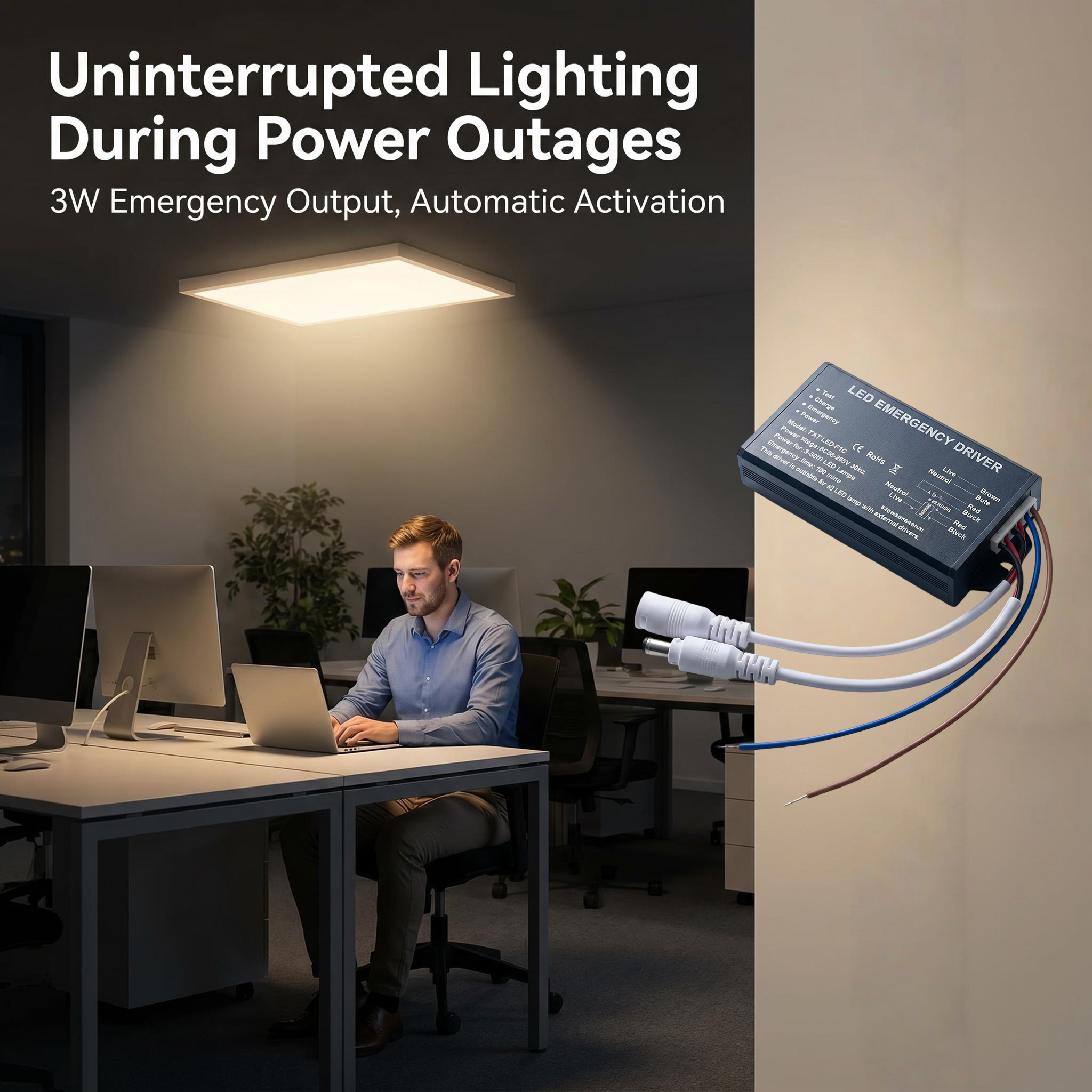
LED Emergency Driver For LED Panel Lights
Emergency drivers sized for 600×600 and 1200×300 LED panels with external drivers.
LED Emergency Driver For LED Tubes
Emergency conversion kits for T8 and T5 LED tubes and batten fittings.
LED Emergency Driver For Linear Lights
Slim emergency drivers that fit inside linear and trunking profiles without a separate battery box.
Frequently Asked Questions About LED Emergency Driver
Q: What is the minimum order quantity and how does it affect unit price?
MOQ is 500 pieces for standard emergency drivers and 1000 pieces for OEM-customised versions. At 500 units, a 3W panel driver with LiFePO4 3.2V 1500mAh pack typically lands at $4.20–$4.80 FOB Shenzhen. Scaling to 2000 units drops this 12–15%. Below MOQ, factory reprogramming and material waste push per-piece cost up 25–35%. Trading offices often quote lower MOQ but add 18–22% margin with no direct engineering access.
Q: How do I confirm the driver matches my host fixture’s electrical characteristics?
Match three parameters: input voltage range (AC 85–265V or 100–277V for wide-market units), emergency output window (DC 9–42V at 150–350mA for panel drivers; DC 18–60V at 200–500mA for high-bay drivers), and driven load in watts (typically 3W, 5W, 8W or 10W emergency output, translating to 30–100% of normal lumen output depending on fixture efficacy). Request the supplier’s compatibility matrix showing tested host luminaires, driver part numbers, and achieved lumen percentages under EN 1838 minimum illuminance requirements.
Q: What emergency duration and output options are available?
Standard durations are 90 minutes, 2 hours, and 3 hours. A 5W emergency driver for LED tube delivers roughly 375–500 lumens (50–70% of a 1200mm 18W tube normal output) for 90 minutes from a LiFePO4 6.4V 1500mAh pack. Three-hour versions require 6.4V 3000mAh or 11.1V 2200mAh Li-ion 18650 configurations, adding 40% to battery cost. Higher emergency output percentages need larger battery packs and often exceed standard enclosure dimensions—verify mechanical fit before specifying.
Q: What is the difference between maintained and non-maintained wiring?
Non-maintained wiring powers the LED only during mains failure via the changeover relay; normal mains feeds the luminaire’s own driver. Maintained wiring runs the LED through the emergency driver continuously, switching to battery inverter output on failure. Maintained systems suit always-on escape route lighting and require drivers rated for continuous thermal operation at 45°C ambient. Non-maintained units run cooler, extending LiFePO4 cycle life from 500 to 800 cycles. Specify wiring method at order—internal PCB layouts differ, and field conversion is not always possible.
Q: What battery chemistry should I specify and what is the realistic replacement interval?
LiFePO4 3.2V cells offer 500–800 cycles at 80% depth of discharge, translating to 6–8 years in typical service with annual testing per EN 62034. Li-ion 18650 3.7V packs provide higher energy density for compact high-bay drivers but degrade to 70% capacity after 300–500 cycles, suggesting 4–5 year replacement. NiCd 3.6V packs tolerate 0°C to 45°C ambient and cost 30% less, yet carry 150–200 cycle life and require annual capacity verification under BS 5266-1. Replacement interval depends on self-test frequency: monthly DALI-automated testing accelerates cycle consumption versus annual manual testing.
Q: What self-test and monitoring options are available?
Manual test key remains standard for cost-sensitive projects. Self-test variants with 30-second functional and annual duration tests per EN 62034 add $0.80–$1.20. DALI-2 emergency test interfaces enabling remote monitoring and automated logging to building management systems add $2.50–$3.50 and require DALI bus wiring during luminaire installation. Verify whether the DALI module carries independent addressability or shares the host luminaire’s DALI address—this affects commissioning complexity and fault isolation.
Q: What lead time and sample policy applies for first-time buyers?
Standard driver samples ship within 7–10 working days from confirmed specification; customised output window or connector configurations take 15–18 days. Sample cost is 100% prepaid, refundable against first production order above MOQ. Production lead time is 25–30 days for 500–2000 units, extending to 40–45 days for 5000+ units or during LiFePO4 cell allocation constraints. Confirm whether the supplier holds buffer stock of critical cells or orders per-project—this exposes lead time to 18650 supply volatility, particularly for UN 38.3-certified transport-grade cells.
Q: What conformity documentation should I request for my destination market?
For UK and EU markets, ask for third-party test reports against EN 60598-2-22, EN 1838, and EN 62034—not declarations alone. Reports should cover the exact driver model, battery configuration, and output window you will import. For UL 924 or NFPA 101 markets, North American recognised component testing is required; verify the test lab’s OSHA NRTL status. Middle East and Southeast Asian projects often require CB scheme reports or in-country re-certification. AS/NZS 2293 compliance needs specific duration and spacing calculations. Request discharge duration test records for your specific battery batch, not generic family data.
Q: How do lithium batteries affect shipping and what documents must accompany cargo?
LiFePO4 and Li-ion 18650 packs ship as UN 3480 or UN 3481 depending on standalone or equipment-integrated configuration. IATA limits standalone lithium cells to 30% state of charge for air freight; sea freight under IMDG allows higher charge but requires dangerous goods declarations and Class 9 labeling. Each battery batch needs UN 38.3 test summary reports covering T1–T8 tests. FOB Shenzhen terms place customs clearance and freight booking on the buyer; CIF to destination port includes ocean freight but not unloading or inland transport. Carton packing is 50–100 units per carton, 16–20 cartons per pallet; request pallet dimensions and gross weight for container loading calculations.
Q: What warranty terms and spare parts availability should I negotiate?
Standard warranty is 3 years on the driver electronics, 2 years on Li-ion or 3 years on LiFePO4 battery packs. Extendable to 5 years on drivers at 8% price premium. Spare parts commitment matters: confirm the supplier guarantees component availability for 5 years post-production and stocks replacement battery packs with identical cell specification. Battery pack part numbers should reference cell manufacturer and batch—substitution without notification voids warranty claims and risks EN 60598-2-22 compliance gaps.
Q: Can I request OEM branding and customised packaging?
OEM silkscreen on driver housings and customised carton labels require 1000-unit MOQ and add $0.15–$0.25 per unit. Packaging can be adapted to retail blister, individual box, or bulk contractor packs; specify whether multilingual installation sheets are required—EN 1838-compliant projects need local-language emergency duration and test instructions. Verify the supplier’s artwork approval cycle; 3–5 revision rounds are typical before production. Trading offices often outsource this, adding 10–14 days to lead time versus direct factory coordination.
Q: What installation and commissioning support is available post-purchase?
Request wiring diagrams showing maintained versus non-maintained connection to the host luminaire’s LED module and separate switched live feed. Commissioning support varies: standard supply includes English installation sheet; remote video call support during first installation is negotiable for orders above 2000 units. For DALI-equipped drivers, confirm whether the supplier provides DALI address allocation files and emergency test schedule templates compatible with your BMS platform. After-sales engineering capability is a key manufacturer differentiator—trading offices typically forward technical queries with 48–72 hour delay versus same-day response from factory application engineers with access to hipot and ageing test records.
Important Notice
Specifications, output and duration figures and price ranges in this guide are indicative and are provided
for planning purposes only. Actual emergency output, duration, battery life, ingress protection and available conformity documentation
differ by model and by destination country, and emergency lighting design remains the responsibility of the project designer. Buyers
must confirm their own mains voltage and frequency, the emergency lighting standard enforced locally, the host fixture compatibility
and their import requirements before placing an order. All figures are subject to written confirmation in the final proforma invoice
issued by Hymark.
Sourcing LED Emergency Driver from Hymark
When you source an LED emergency driver from China, the gap between a trading office and a real manufacturer shows up in three places: the battery traceability paperwork, the discharge test data that matches your specific LED module, and the engineering response when your host fixture runs at 75 °C in a Saudi summer.
What Hymark Brings to the Table
JIALINGHANG ELECTRONIC CO., LTD. was founded in 2013 as a global LED exporter in general illumination. A strategic shift in 2017 refocused the company on LED emergency technology and high performance LED strips. Hymark was launched in 2026 as the premium brand. Products are co-designed and engineered in house through a strategic partnership with dedicated manufacturing facilities that have also been operating since 2013, and the company manages R&D, product design and global distribution itself.
This matters for your project because the emergency driver range is built around matched systems, not catalogue parts. The LED emergency driver for panel lights delivers 3W to 15W emergency output at 120–280V DC constant current with a changeover relay for maintained or non-maintained wiring. The tube and linear variants cover 9–18W and 18–36W host loads respectively, with LiFePO4 3.2V 3000mAh or 6.4V 1500mAh packs giving 90 minutes or 3 hours duration. Self-test and DALI test facility options are available across the range. Full power output emergency drivers for high bays run 40W to 150W normal load with 100% lumen maintenance in emergency mode, using Li-ion 18650 7.4V 2600mAh packs with 500–800 cycle life and 24-hour charge time from flat.
What to Verify Before You Order
Ask any supplier for the discharge test records at your required duration and ambient temperature. EN 1838 requires minimum illuminance on the escape route; BS 5266-1 and AS/NZS 2293 add specific mounting height and uniformity ratios. A trading office will forward your request. Hymark’s engineering team runs ageing and hipot test stations in the partnered facility and can provide discharge curves for the specific LED module you are pairing with, not generic resistor-load data.
Battery chemistry traceability is equally critical. LiFePO4 cells ship under UN 38.3, IATA and IMDG rules. Hymark packs carry cell-level batch codes and UN 38.3 test summaries for the lithium battery transport documentation your freight forwarder needs. NiCd alternatives remain available for markets with restricted lithium import procedures, though charge time extends to 24 hours and cycle life drops to 300–400.
Pricing and Lead Time Reality
Emergency driver pricing moves on three drivers: battery chemistry and capacity, test facility complexity, and output power. A 3W non-maintained unit with NiCd and manual test key lands at roughly one-third the price of a 15W maintained DALI self-test variant with LiFePO4. MOQ starts at 500 units for branded drivers, 100 units for sample orders with OEM labelling. Sample lead time is 7–10 days. Production lead time runs 25–30 days for orders under 2,000 units, 35–45 days above that threshold. Payment structure is 30% deposit, 70% against copy of bill of lading for FOB Shenzhen or CIF terms to your destination port.
How to Move Forward
Send the host fixture type and wattage, the emergency duration your code requires, your mains voltage, and your destination port. Hymark will return a specification match and quotation within 24 hours via WhatsApp or email.
Get a Factory Direct Quote on LED Emergency Driver
JIALINGHANG ELECTRONIC CO., LTD. has been in LED lighting since 2013 and has focused on
LED emergency technology and high performance LED strips since 2017. Hymark products are co-designed with our
dedicated manufacturing partners, built with selectable emergency duration and maintained or non-maintained wiring, and function
tested before packing. Send us the host fixture type and wattage, the emergency duration your local code requires, your mains
voltage and your destination port and we will return a quotation within 24 hours.


 English
  Spanish
  Arabic
  French
  German
  Russian
  Portuguese
  Italian
  Vietnamese