
Twin Spot Emergency Light Buyer Guide
A twin spot emergency light is a self-contained, battery-backed luminaire with two independently adjustable lamp heads that direct emergency egress illumination onto specific escape routes or safety points. Manufacturers in China supply these units across two dominant architectures: a complete fitting with integrated battery and inverter, or a remote head assembly driven by a central battery system or an emergency driver housed in the host high-bay or industrial fixture.
The right configuration depends on three variables that precede any price discussion. First, the host fixture’s normal wattage and driver topology determine whether the twin spot operates in maintained mode, sharing the same circuit and switching to emergency on mains failure, or non-maintained mode, energising only when normal lighting fails. Second, the local code sets the emergency duration: EN 1838 and BS 5266-1 in the UK require 90 minutes minimum; AS/NZS 2293 in Australia and New Zealand specifies 90 minutes for most occupancies; UL 924 in North America permits 90 minutes; and some Gulf and African project specifications demand 2 or 3 hours. Third, the inspector’s expected conformity mark—CE for Europe, UKCA for post-Brexit Britain, UL for the United States, SASO for Saudi Arabia, or CB for mutual-recognition markets—dictates which test reports the supplier must present. Ask for EN 60598-2-22 or IEC 61347-2-7 compliance documentation, not a vague assurance.
Typical technical parameters for China-sourced twin spots span input voltage AC 85-265V or 100-277V, emergency output from 2 x 3W heads (roughly 400-600 lumens total, 100% of rated output in emergency) to 2 x 9W heads (1,200-1,800 lumens), with LiFePO4 3.2V 1500-3000mAh or NiCd 3.6V 1200-2500mAh battery packs. Charge time ranges 16-24 hours to full capacity; LiFePO4 cycle life reaches 800-1,500 cycles versus 300-500 for NiCd. Self-test and DALI test facilities per EN 62034 add cost but eliminate manual monthly key-switch testing. IP ratings run IP20 for indoor commercial to IP65 for dusty or damp industrial applications; IK08 or IK09 applies where mechanical impact is probable.
The remainder of this page examines how to qualify a Chinese manufacturer beyond the product data sheet: factory audit checkpoints, battery UN 38.3 transport certification for lithium chemistries, and sample evaluation protocols that reveal whether the lumen maintenance and duration claims survive a full discharge test.
Types and Configurations of Twin Spot Emergency Light
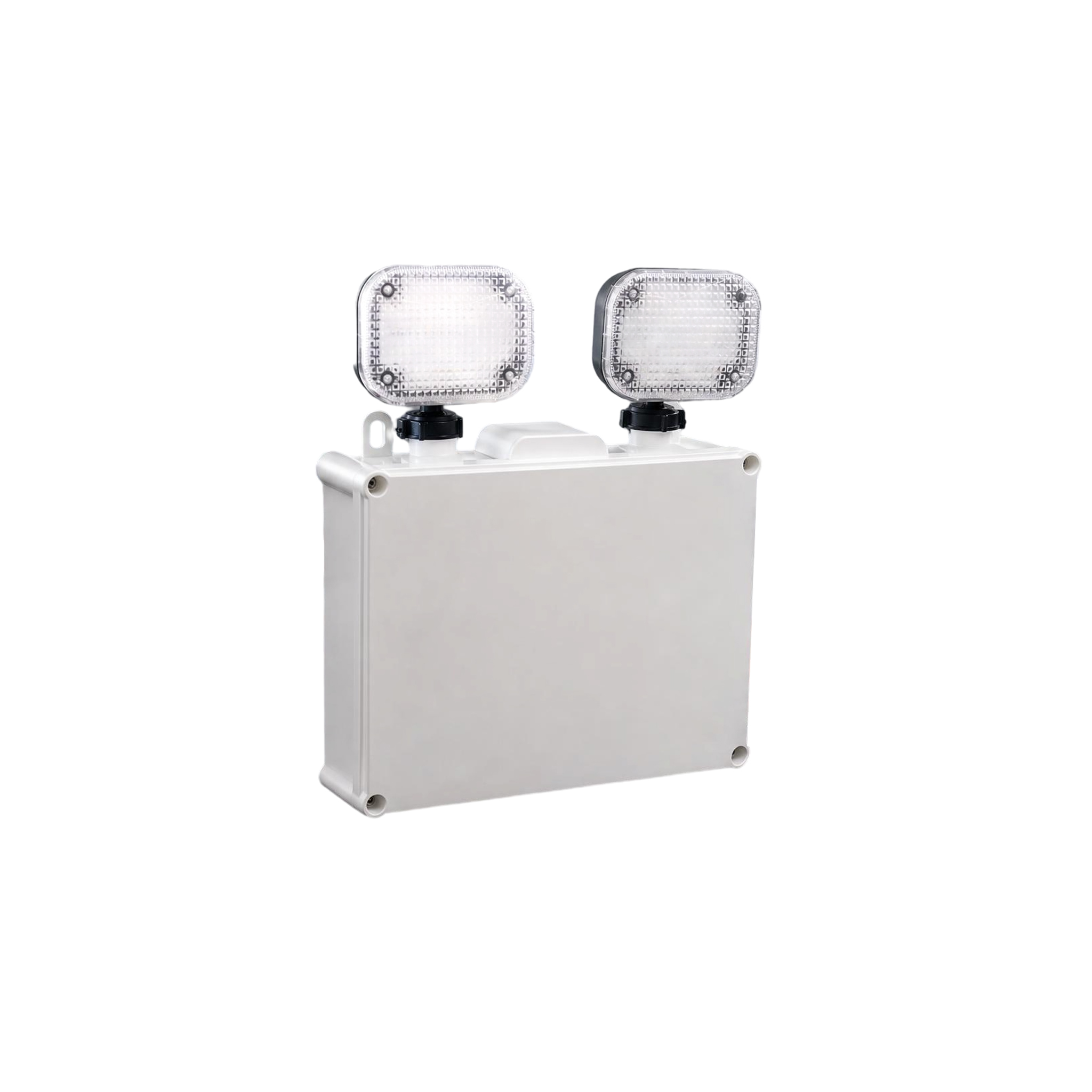
Twin spot emergency light are classified by output mode, battery chemistry, control protocol and enclosure rating. The table below maps six real configurations to their typical ratings and intended applications.
| Type or Class | Typical Rating or Output | Duration or Runtime | Best Suited For | Notes |
|---|---|---|---|---|
| Reduced-output self-contained non-maintained | 2 × 3W LED heads, 300–400 lm each at 10–15% of normal load | 90 min or 3 hr | Warehouses, retail, small offices | Lowest cost; manual test key only |
| Full-output self-contained maintained | 2 × 5W LED heads, 500–650 lm each at 100% of normal load | 90 min or 3 hr | Corridors, open areas, high-risk task zones | Requires changeover relay; higher battery demand |
| DALI-addressable self-test | 2 × 3W to 2 × 5W, 300–650 lm per head | 90 min or 3 hr | Large facilities, smart buildings, BMS integration | EN 62034 automated test schedule; needs DALI bus wiring |
| NiCd entry-level export | 2 × 3W, ~300 lm per head | 90 min | Price-sensitive markets, Africa, Latin America | 3.6V 1200–1800mAh NiCd; shorter cycle life 300–400 cycles; higher self-discharge |
| LiFePO4 premium export | 2 × 5W, 500–650 lm per head | 2 hr or 3 hr | UK, Europe, Middle East, high-temperature environments | 6.4V 1500–3000mAh; 500–800 cycles; UN 38.3 required for air freight |
| Weatherproof high-bay remote head | 2 × 5W to 2 × 10W remote heads, 500–1200 lm | 90 min or 3 hr | Industrial halls, cold storage, IP65/IK08 zones | Driver housed separately; heads mounted up to 3m cable run |
Reduced-Output Non-Maintained Units
These units draw from a 3.6V NiCd or 3.2V LiFePO4 pack, typically 1500–2500mAh, to feed two 3W LED heads at reduced luminous flux. The inverter outputs constant current in the 150–350mA range at 6–12V DC. Electrical contractors and installers buy this type for budget warehouse fit-outs where EN 1838 minimum illuminance on the floor plate is easily met without full normal-mode replication. The trade-off is clear: the fixture cannot serve as working illumination during normal mains operation, and if the space requires maintained lighting for safety-critical tasks, this configuration fails compliance under BS 5266-1 clause 6.2. Charge time from flat is 24 hours for NiCd, 16–20 hours for LiFePO4.
Full-Output Maintained Units
A changeover relay switches the LED heads from mains-driven normal operation to battery-driven emergency operation, maintaining 100% output. The battery pack must be sized for the full wattage—commonly 6.4V LiFePO4 3000mAh or 11.1V Li-ion 18650 2200mAh—delivering 90 minutes at 10W total load or 3 hours at 5W per head. Luminaire OEMs adding emergency versions to their own high-bay or linear fixtures specify this type because the same LED module serves both functions. Facility managers in the UK and Europe should verify that the supplier’s relay contact rating and switching logic meet EN 60598-2-22 clause 22.16; a weak relay causes flicker or welding closed, defeating the emergency function. Price range is 40–70% higher than reduced-output equivalents.
DALI-Addressable Self-Test Units
These incorporate a microcontroller that executes the EN 62034 test schedule—monthly functional tests and annual duration tests—reporting status over the DALI bus to a central monitoring system. The inverter still outputs 6–24V DC at 200–500mA depending on head wattage, but the intelligence layer adds cost. M&E consultants specifying smart office or hospital projects in the Middle East and Southeast Asia favour this type because manual test records are eliminated. The limitation is wiring infrastructure: the DALI bus requires separate two-core cabling, and if the building has no DALI backbone, the test function reverts to local self-test with LED status indication only. Buyers should ask suppliers to provide DALI compatibility declarations, not assume interoperability.
NiCd Entry-Level Export Configuration
NiCd 3.6V 1200–1800mAh packs remain common in African, Latin American and some Southeast Asian markets where first-cost dominates and environmental disposal rules are less stringent. The chemistry tolerates deep discharge but delivers only 300–400 cycles at 50% depth of discharge, with monthly self-discharge of 10–15% necessitating more frequent functional checks. Input voltage is typically AC 85–265V 50/60Hz to cover unstable grid conditions. Lighting wholesalers buying for price-sensitive tenders should note: NiCd contains cadmium, and the EU Battery Regulation 2023/1542 restricts placement on the European market. This configuration cannot be sold into EU member states without compliance documentation.
LiFePO4 Premium Export Configuration
LiFePO4 6.4V 1500–3000mAh packs dominate UK, European and Middle Eastern specifications due to thermal stability, 500–800 cycle life, and compatibility with IEC 62471 photobiological safety assessments for high-power LED heads. The flat discharge curve holds inverter output voltage stable through the 90-minute or 3-hour duration. Input range is commonly AC 220–240V or 100–277V for Middle East dual-voltage sites. Procurement officers must confirm UN 38.3 test summary availability before shipment—lithium batteries are classed as dangerous goods under IATA and IMDG, and air freight requires proper packaging, state-of-charge below 30%, and hazard labels. Sea freight in properly declared DG containers is less restrictive. Lead time is typically 25–35 days FOB Shenzhen; MOQ 100 units.
Weatherproof Remote-Head Units
Industrial applications separate the emergency driver and battery pack—housed in an IP65 enclosure with IK08 impact resistance—from the LED heads, connected by 1.5mm² flexible cable up to 3 metres. This allows mounting the heads at optimal angle while protecting electronics from wash-down or freezer environments. Output window is 12–24V DC at 350–700mA, driving 5W to 10W heads that deliver 500–1200 lm each. The configuration suits food processing and cold storage in Europe and Australia under AS/NZS 2293. What it cannot do: the voltage drop over cable runs beyond 3 metres at these currents degrades head output below EN 1838 minimums, so longer runs require heavier cable or a distributed driver architecture. IP rating applies to the driver enclosure only; buyers must specify head IP rating separately if wash-down jets are directed upward.
Specifications and How to Read Them
| Parameter | Entry Level | Mid Range | High Specification |
|---|---|---|---|
| Normal LED load | 2 × 3W spot heads | 2 × 5W spot heads | 2 × 9W spot heads |
| Emergency output per head | 200 lm | 350 lm | 600 lm |
| Emergency output as % of normal | 33% | 35% | 33% |
| Emergency duration | 90 minutes | 180 minutes | 180 minutes |
| Input voltage | AC 220-240V 50Hz | AC 100-277V 50/60Hz | AC 100-277V 50/60Hz |
| DC output window | 12-24V, 350mA constant current | 12-36V, 500mA constant current | 12-48V, 700mA constant current |
| Battery chemistry | NiCd 3.6V 1500mAh | Li-ion 18650 7.4V 2600mAh | LiFePO4 6.4V 3000mAh |
| Charge time to 80% | 24 hours | 16 hours | 8 hours |
| Cycle life | 300-500 cycles | 500-800 cycles | 1500-2500 cycles |
| Test facility | Manual test key | Auto self-test | Self-test + DALI-2 |
| Wiring mode | Non entretenu | Non entretenu | Maintained or non-maintained |
| IP rating | IP20 | IP65 | IP65 |
| IK rating | IK02 | IK07 | IK08 |
| Ambient temperature | 0°C to +35°C | -10°C to +45°C | -20°C to +55°C |
| Housing | ABS plastic | Die-cast aluminium | Die-cast aluminium + polycarbonate lens |
| Typical unit price (FOB Shenzhen) | $8-12 | $18-28 | $35-50 |
How to Read the Input Voltage and Frequency Line
The input range tells you where the gear will survive on local mains. A label reading “AC 220-240V 50Hz” means the unit is built for the UK, Europe, Middle East and most of Africa. “AC 100-277V 50/60Hz” covers Japan at 100V, North America at 120V, and commercial 277V circuits in the United States. If you are shipping to Saudi Arabia or Chile, confirm the local nominal is inside the stated range. Frequency tolerance is usually ±3%; 50Hz gear will run on 60Hz but the charger may run warmer. Ask the supplier for a declaration of frequency compatibility if the project specification demands it.
Decoding Driven Load and DC Output
“Driven load 2 × 5W” means the emergency module is sized to power two spot heads at five watts each during normal operation. The DC output window—typically 12-36V at 500mA constant current—describes what the inverter delivers to the LEDs when mains fails. Constant current is the critical phrase: LED forward voltage drifts with temperature, so a voltage-source inverter would deliver unstable light. The constant-current inverter holds 500mA regardless of whether the LED string presents 18V or 30V. Check that your spot head’s forward-voltage curve falls inside the window. A head rated 32V nominal will not run on a 12-24V inverter.
Emergency Output in Lumens and Percentage
EN 1838 requires escape-route lighting to deliver minimum 1 lux on the centre line; open-area anti-panic lighting needs 0.5 lux minimum. Twin spots are usually anti-panic or high-risk task lighting, not escape-route luminaires, so the lumen figure matters more than the percentage. A 350 lm emergency output from a 1000 lm normal-output head is 35%. That 35% is typical because emergency runs from a battery, and battery watt-hours are expensive. Higher percentages exist but need larger battery packs and longer charge times. If your client wants 50% or 100% emergency output, the battery capacity and physical size of the unit will roughly double.
Battery Chemistry Voltage and Capacity
NiCd 3.6V 1500mAh delivers 5.4 watt-hours. At 80% inverter efficiency, that is 4.3Wh usable. A 2 × 3W load draws 6W; 4.3Wh ÷ 6W = 43 minutes. The entry-level unit therefore needs a larger NiCd pack or lower load to reach 90 minutes. Ask the supplier to show the calculated duration at end-of-life, not fresh-cell.
Li-ion 18650 7.4V 2600mAh (two cells in series) gives 19.2Wh nominal. At 85% efficiency and 10W load, that is 1.6 hours. This is the sweet spot for mid-range builds: lighter than NiCd, no memory effect, but requires UN 38.3 testing for air freight.
LiFePO4 6.4V 3000mAh gives 19.2Wh with superior thermal stability and 1500-2500 cycles. The downside is higher cost and lower nominal voltage, which may not suit some LED drivers without a boost stage. For installations in Qatar or Singapore where ambient hits 50°C, LiFePO4 is the safer chemistry.
Charge Time and Cycle Life Trade-Offs
A 24-hour charge time for NiCd is standard; the chemistry accepts slow charge without damage. Li-ion 16-hour charge implies a 0.2C rate, gentle on the cells. LiFePO4 at 8 hours is charging near 0.4C, acceptable because the phosphate cathode tolerates higher rates. Faster charge means shorter cycle life. If the specification demands daily functional testing, cycle life becomes more important than charge speed. A 500-cycle Li-ion pack tested weekly will last ten years; tested daily it lasts eighteen months.
Test Facility: Manual Self-Test and DALI
Manual test key: A switch or removable fuse that simulates mains failure. Required by BS 5266-1 for small installations without central monitoring. The installer tests monthly; the logbook is paper.
Auto self-test: An internal timer runs a 30-second functional test monthly and a full-duration test annually. A visible LED changes from green to red if failure is detected. EN 62034 defines the test intervals and failure criteria. Ask the supplier whether the timer is mains-synchronised (tests at fixed calendar dates) or power-on-counted (drifts if the building loses supply).
DALI-2 test facility: The emergency module speaks DALI protocol Part 252 (emergency). The building management system polls status, records test results, and flags failures to the facilities manager. The module needs a DALI bus address and a separate DALI power supply at 16V typical. Not all “DALI-ready” labels mean Part 252 compliant; ask for the DALI test certificate number.
Maintained Versus Non-Maintained Wiring
Non entretenu: The spot heads are off during normal mains presence. On power failure, the changeover relay switches the battery inverter to the LEDs. Wiring needs permanent live, neutral, and switched live to trigger the relay. Simpler, lower energy use, but the heads give no indication of health until tested.
Mis à jour: The spot heads run from mains during normal operation and switch to battery on failure. Requires a permanent live, switched live, and neutral, plus a changeover relay rated for continuous duty. The relay is the weak point; ask for contact rating and expected mechanical life. Maintained wiring suits spaces that need continuous illumination for security or process reasons, but adds cost and complexity.
IP and IK Ratings for Installation Environment
IP20 suits dry indoor plant rooms and corridors. IP65 with sealed cable glands is needed for car parks, loading bays, and anywhere pressure hosing occurs. IK02 (0.2 joule impact) is vulnerable to vandalism; IK07 (2 joule, equivalent to a 0.5kg mass dropped 400mm) resists casual impact in public areas; IK08 (5 joule) is specified for prisons, psychiatric facilities, and heavy industrial aisles. The polycarbonate lens on the high-spec build absorbs impact better than glass; confirm the supplier uses UV-stabilised grade or it will craze within two years of outdoor exposure.
Ambient Temperature Range
0°C to +35°C is warehouse specification in temperate climates. -10°C to +45°C covers unheated UK stairwells and Dubai summer plant rooms. -20°C to +55°C is for cold-storage facilities and rooftop plant in Riyadh. Below 0°C, NiCd retains capacity better than Li-ion; below -10°C, LiFePO4 outperforms both. High temperatures accelerate calendar ageing: every 10°C above 25°C roughly halves Li-ion life. If the installation is in a boiler room or Middle East rooftop, derate the expected cycle life by 40% or specify LiFePO4.
Dimensions and Mounting
Entry-level ABS housings measure approximately 180 × 90 × 60mm and surface-mount with two M6 slots on 150mm centres. Mid-range aluminium units run 220 × 110 × 80mm with a swivel bracket allowing ±90° horizontal and ±30° vertical adjustment per head. High-specification builds at 260 × 140 × 95mm include a separate junction box for maintained wiring terminations and a stainless-steel tamper-proof fixing kit. Confirm the bracket material: die-cast zinc corrodes in coastal UAE within three years; aluminium or 316 stainless survives.
Export Terms and Compliance Marks
FOB Shenzhen: Seller loads container at Yantian or Shekou port; buyer pays ocean freight, insurance, and destination charges. Typical for orders above 500 units.
CIF: Seller pays freight to destination port; buyer clears customs and hauls to site. Adds $800-1500 per 20GP container to Europe depending on shipping line and bunker adjustment factor.
CFR: As CIF but buyer arranges marine insurance. Rare in lighting; most buyers prefer CIF or FOB.
EXW: Buyer collects from factory. Only practical if you have a Shenzhen logistics agent and export licence.
Payment: T/T 30% deposit, 70% against copy of bill of lading is standard for first orders. L/C at sight adds $300-500 bank charges and 5-7 days to documentation. For orders below $10,000, L/C cost often exceeds the security benefit.
HS code: 9405.10 for battery-powered emergency lighting. Confirm the supplier declares this correctly; some factories erroneously use 9405.40 (other electric lamps) which triggers customs examination in the UK and Germany.
CE and UKCA marking: EN 60598-2-22 is the harmonised standard for emergency luminaires under the EU Construction Products Regulation and UKCA. The manufacturer or authorised representative must hold test reports from a notified or UK-approved body. Do not accept a CE mark based solely on self-certification; ask for the test report number and the body that issued it. UKCA became mandatory for GB market on 1 January 2023; Northern Ireland continues under CE under the Windsor Framework.
UN 38.3 battery test report: Mandatory for lithium batteries in air freight (IATA PI 965 Section IB or II) and sea freight (IMDG Code Special Provision 188). The report must cover the exact cell model and configuration in the product. A report for bare 18650 cells does not cover the assembled pack with protection PCB. Ask for the UN 38.3 test summary with the Watt-hour rating and the packaging instruction reference.
Packing list and certificate of origin: The packing list must match the commercial invoice line by line: model, quantity, net and gross weight, carton dimensions. Certificate of origin (Form EUR.1 or REX-registered exporter statement) is needed for EU preferential tariff if the factory has cumulation-compliant components. For UK-EU trade, the REX system or UK-specific origin declaration applies post-Brexit.
Supplier Qualification Checklist
Before placing the deposit, verify:
- Test report for EN 60598-2-22 covering the exact model and battery configuration you will receive. A report for a 3.6V NiCd variant does not cover a 7.4V Li-ion variant even if the housing is identical.
- UN 38.3 test summary with the supplier’s name as the shipper or manufacturer, not a third-party cell brand.
- Photographs of the production line’s battery assembly area: lithium cells should be welded, not soldered; soldered lithium packs are a fire risk and fail most insurer audits.
- Sample with your local voltage and frequency for a 30-day burn-in before bulk order. The sample cost of $80-150 is recoverable against a 1000-unit order.
- Warranty terms in writing: 2 years is minimum for the electronics, 1 year for NiCd, 3 years for LiFePO4. Who pays freight for warranty returns? Most Chinese suppliers expect you to ship the failed unit back at your cost.
Final Selection Guidance
Match the battery chemistry to the climate and test regime, not to the lowest price. Match the IP and IK rating to the installer environment, not to the catalogue default. Match the test facility to the maintenance contract: manual test for unmetered small buildings, DALI-2 for anything with a BMS. Request the specific test report numbers before shortlisting; a supplier who delays or deflects this request is either uncertified or reselling another factory’s product.
Twin Spot Emergency Light Price and What Drives It
| Class | Typical Rating or Output | Duration or Runtime | Indicative FOB USD |
|---|---|---|---|
| Economy 2 x 1W LED | 200–250 lm total emergency | 90 min | 8–14 |
| Standard 2 x 3W LED | 500–700 lm total emergency | 90 min | 14–22 |
| High-output 2 x 5W LED | 800–1200 lm total emergency | 90 min or 3 hr | 22–35 |
| High-output 2 x 5W LED with 3 hr duration | 800–1200 lm total emergency | 3 hr | 28–45 |
| Weatherproof IP65 variant (any output class) | Same as base class | Same as base class | +15–25% premium |
| Self-test or DALI-2 test variant (any output class) | Same as base class | Same as base class | +20–35% premium |
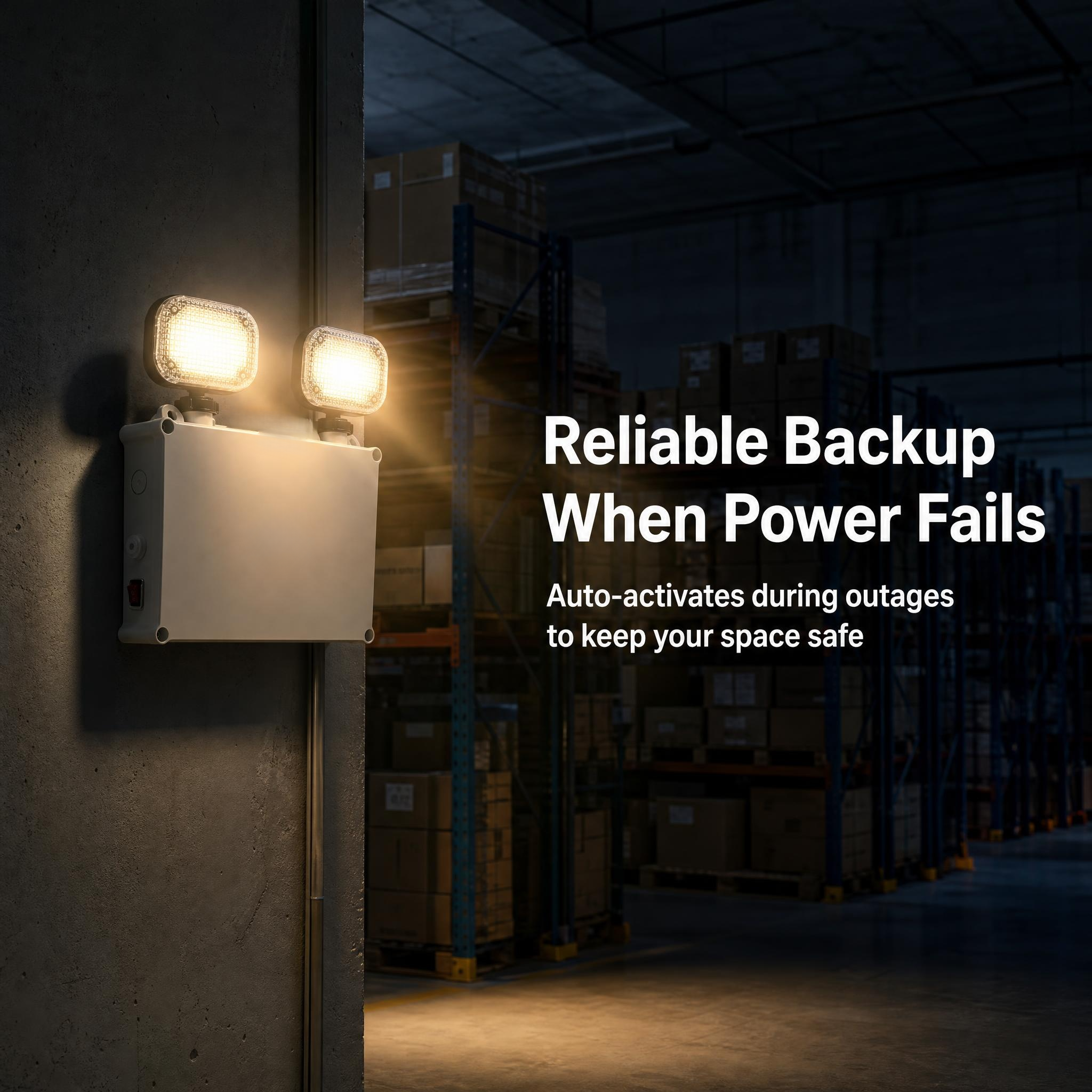
These bands assume AC 220–240V or 100–277V input, non-maintained wiring, and lithium-based battery packs shipped under standard export terms. NiCd options run 10–15% lower at FOB but face heavier freight surcharges and shorter cycle life.
What Drives the Factory Gate Price
The bill of materials for a twin spot emergency light breaks down into seven weighted categories. Battery and approval costs dominate.
Battery pack — typically 30–40% of ex-works cost. A 3.2V LiFePO4 3000mAh pack delivering 4W for 90 minutes costs more than a 3.7V Li-ion 18650 2200mAh pack, but offers 800–1500 cycles versus 500–800 and passes UN 38.3 thermal abuse testing more reliably. NiCd 3.6V 4000mAh still appears in budget builds; 300–500 cycles, 24-hour charge time, and cadmium content that complicates EU WEEE and battery directive compliance. Buyers specifying 3-hour duration need roughly 2.5× the watt-hour capacity of a 90-minute build, which scales non-linearly in cell count and enclosure volume.
Driver and inverter electronics — 15–22%. The constant-current inverter stage must hold output within ±10% from full charge down to battery end-of-life voltage. A changeover relay for maintained wiring adds 2–4% and a failure point; most twin spots are non-maintained for this reason. Self-test circuitry (EN 62034) or DALI-2 emergency test interfaces add a dedicated microcontroller and clock circuit, pushing this category toward the upper bound.
LED package — 8–15%. Twin spots use discrete high-power LEDs or small COB arrays. CRI 80+ at 4000K or 6500K is standard; 90 CRI adds 20–30% to LED cost with limited payback in escape-route lighting where EN 1838 prioritises luminance over colour rendering.
Enclosure and hardware — 10–18%. IK07 or IK08 polycarbonate for indoor, die-cast aluminium with IK10 and IP65 gasket for industrial or external stairwell applications. Swivel joints with detent positions at 90° increments wear faster than continuous-adjustment brass pivots; this is a common warranty failure.
Test and certification cost amortised — 5–12% depending on batch size. EN 60598-2-22 and EN 1838 testing for CE marking, plus CB scheme or in-country approval (UKCA for Great Britain, UL 924 for North America, AS/NZS 2293 for Australia/New Zealand). A full test programme for a new twin spot platform runs $15,000–40,000. Spread across 2,000 pieces, that is $7.50–20.00 per unit; across 10,000 pieces, $1.50–4.00. Buyers should ask for the test report scope—whether it covers the exact LED and battery combination in the quoted build, or a “family” approval with looser tolerances.
Assembly labour — 6–10%. Twin spots require hand wiring of the battery harness, inverter board, and lamp heads. Automated SMT handles the PCB, but final assembly remains manual.
Export packing — 2–4%. Individual colour boxes, master cartons of 6 or 12, palletised for sea freight. Lithium shipments need UN 38.3 compliant packaging, hazard labels, and often a 30% freight surcharge versus NiCd or lead-acid equivalents.
Landed Cost Beyond FOB
Inland freight to Shenzhen or Ningbo port adds $0.30–0.80 per unit. Sea freight to UK/EU ports runs $0.50–1.50 per unit at full container load; air freight for lithium cells is restricted to cargo-only aircraft and costs 6–10× sea, so most buyers plan 45–60 day sea lanes. Insurance at 110% CIF value is standard. Destination duty for emergency lighting luminaires is typically 2.5–6.5% into the EU, 6% into the UK under current tariffs, plus 20% VAT on CIF+duty. Customs clearance and broker fees add $150–400 per consignment regardless of size.
Why the Cheapest Quote Is Cheaper
A $8–10 FOB twin spot normally means one of three things: a 1500mAh lithium cell rated for 90 minutes but delivering 60–70% of nominal capacity within 12 months; an emergency output of 150 lm total rather than 250+ lm, which may not meet EN 1838 minimums for open-area anti-panic lighting; or a design that has not undergone third-party testing to EN 60598-2-22, leaving the buyer responsible for CE due diligence and local market liability. Some suppliers quote on “test-for-certification” builds where the prototype passes but production units use alternate LEDs or cells without re-validation.
Five-Year Running Cost Comparison
Assume 50 units installed, 3-hour duration required, weekly testing under BS 5266-1 or local equivalent.
| Cost Element | Economy Build (Li-ion 18650 2200mAh) | Standard Build (LiFePO4 3000mAh) | Premium Build (LiFePO4 5000mAh with Self-Test) |
|---|---|---|---|
| Unit FOB at purchase | 12 | 24 | 38 |
| Initial landed cost (50 units) | 750 | 1,500 | 2,375 |
| Battery replacement cycle | Year 2 and Year 4 | Year 4 | Year 5 (projected) |
| Battery replacement cost per unit (cells + labour) | 6 | 8 | 10 |
| Total battery replacement (50 units, 5 yr) | 600 | 400 | 500 |
| Manual testing labour (30 min/week, $35/hr loaded) | 4,550 | 4,550 | 2,275 (self-test halves burden) |
| Expected failure rate (failed unit replacement) | 8 units | 3 units | 1 unit |
| Failure replacement cost | 96 | 72 | 38 |
| Five-year total | 5,996 | 6,522 | 5,188 |
The economy build saves at procurement but costs more over five years through accelerated battery degradation, higher failure rates from thermal cycling in the inverter, and unrelenting manual testing labour. The self-test premium build breaks even around month 36 and pulls ahead if labour rates rise or if failed units trigger out-of-hours callout charges. Facility managers with limited maintenance access—remote sites, offshore platforms, high-bay warehouses—should weight the self-test option heavily even at higher capital cost.
Matching Configuration to Application
Host fixture compatibility: Twin spots are standalone luminaires, but the mounting surface matters. Plasterboard ceilings need toggle anchors or threaded rod; steel trunking or cable tray accepts magnetic or clamp brackets. The 2×5W high-output units draw 10W in maintained mode if wired that way; confirm the final circuit capacity.
Local code alignment: UK and EU projects need EN 1838 compliance for escape route luminance (1 lux minimum on centre line, 0.5 lux on perimeter) and EN 60598-2-22 construction. Middle East projects often reference BS 5266-1 directly. Southeast Asian markets may accept IEC 60598-2-22 with local endorsement; Africa varies by former colonial standards. Always request the test report number and issuing body, then cross-check accreditation on the body’s website—do not accept a supplier’s internal test declaration as equivalent.
Supplier qualification questions: What is the exact cell model and manufacturer in the battery pack? Is the inverter output current constant within ±10% across the 90-minute or 3-hour discharge? Does the quoted IP rating cover the full unit including lamp head seals, or only the base enclosure? What is the batch size for the last production run, and can they provide a dated factory test record for that batch? For lithium shipments, do they hold current UN 38.3 test summaries for the exact cell model, and do they book cargo-only aircraft or vessel-deck stowage as required by IATA and IMDG?
Industry Applications for Twin Spot Emergency Light
Matching Twin Spot Configuration to Application Need
| Sector | Typical Installation | Recommended Specification | Why This Product Fits |
|---|---|---|---|
| Commercial Offices and Fit-Outs | Suspended or surface mounted above open plan areas and corridors | 2 × 3W LED spots, 200–300 lm each at 100% output, 90 min duration, self-test, non-maintained | High mounting demands directional throw; discrete units avoid ceiling clutter |
| Hospitals and Clinics | Corridor intersections, above doorways in wards, stairwell landings | 2 × 3W or 2 × 5W, 300–500 lm, 3 hour duration, maintained wiring option, DALI test | BS 5266-1 and HTM 06-01 require maintained illumination in escape routes; staff need 24 hr visibility of test status |
| Warehouses and Logistics Centres | Racking aisles, loading bay soffits, high-bay companion mounting | 2 × 5W or 2 × 10W, 500–900 lm, 90 min or 2 hour, IP65, IK08, wide beam optics | Dust, forklift impact and 8–12 m mounting heights demand robust housing and narrow-beam intensity |
| Retail and Shopping Malls | Void edges, escalator pits, back-of-house corridors | 2 × 3W, 200–350 lm, 90 min, non-maintained, clean aesthetic finish | Public areas prioritise architectural blending; emergency lighting must not compete with display luminaires |
| Car Parks and Stairwells | Soffit or wall bracket at ramp turns, stair half-landings | 2 × 5W, 400–600 lm, 90 min or 2 hour, IP65, microwave or PIR option | EN 1838 requires 1 lux minimum on centre line; damp, salt and vehicle collision risk drive IP and IK ratings |
| Industrial Plants | Perimeter walkways around process equipment, control room externals | 2 × 5W or 2 × 10W, 500–1000 lm, 2 hour or 3 hour, IP65, wide temperature range −20 °C to +40 °C | Chemical vapour, vibration and extended egress routes need sealed construction and longer battery autonomy |
Commercial Offices and Fit-Outs
Open-plan offices and speculative fit-outs typically mount twin spots at 2.5–4 m ceiling height above circulation routes. The product configuration here is 2 × 3W LED spots drawing from a 3.6V NiCd 1500mAh or 3.2V LiFePO4 2000mAh pack, delivering roughly 200–300 lm per head at 100% of rated emergency output for 90 minutes. Input is standard AC 220–240V 50Hz for UK and EU markets, or AC 120V 60Hz where North American wiring intrudes on multinational rollouts. The inverter output window is typically DC 6–12V at 350–700mA constant current. Self-test to EN 62034 reduces maintenance access in leased spaces where facilities management is contracted quarterly. Non-maintained wiring keeps cost down; the changeover relay energises only on mains failure. Buyers should ask suppliers for evidence of EN 60598-2-22 thermal testing on the specific LED module paired with the emergency kit, because lumen maintenance and battery cycle life are interdependent.
Hospitals and Clinics
Healthcare estates operate under BS 5266-1 in the UK or equivalent national derivations of EN 1838, with many corridors classified as “areas of special risk” requiring 3 hour duration. The twin spot in this sector is often specified at 2 × 5W, producing 300–500 lm per head from a 7.4V Li-ion 18650 2600mAh or 11.1V 2200mAh pack, or a 6.4V LiFePO4 3000mAh pack where thermal runaway mitigation is prioritised. Maintained wiring is common: the LED spots run at reduced output during normal hours and switch to full battery output on failure, satisfying the need for continuous corridor illumination without separate switched luminaires. DALI test facility is increasingly specified so building management systems can log monthly function tests and annual duration tests automatically. Charge time from flat is typically 24 hours for NiCd-based packs, 16–20 hours for Li-ion. Cycle life ranges from 500 cycles (NiCd) to 800–1500 cycles (LiFePO4). Buyers should verify that the supplier’s DALI implementation covers test result reporting, not merely trigger commands.
Warehouses and Logistics Centres
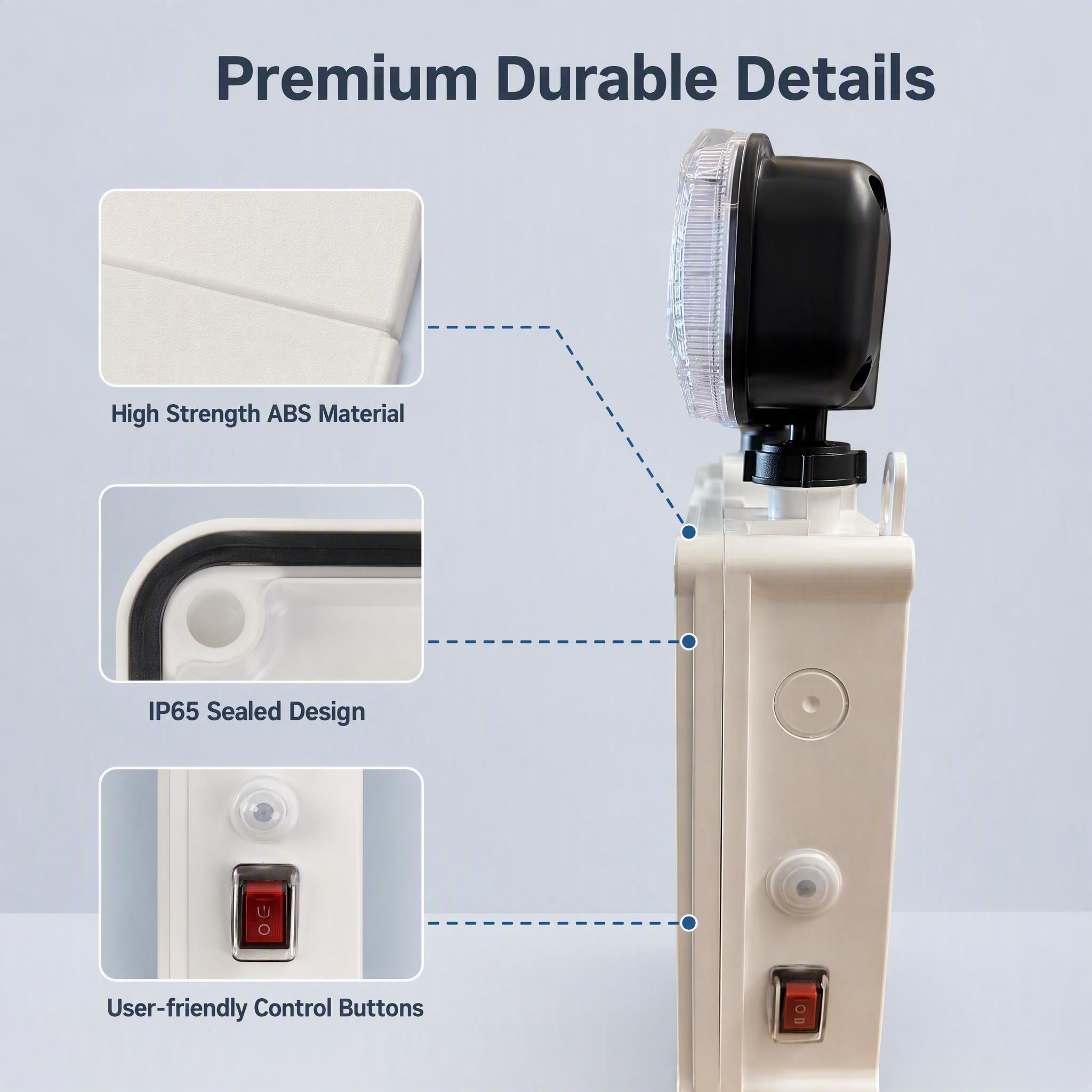
High-rack warehouses present a distinct photometric challenge: the emergency luminaire may sit at 8–12 m above floor level, illuminating narrow aisles between 10 m racking. Twin spots with 10°–25° beam angles et 2 × 5W or 2 × 10W output—500–900 lm per head—project sufficient intensity to meet EN 1838’s 1 lux horizontal minimum at ground level. The battery pack is typically 11.1V Li-ion 4400mAh or 12.8V LiFePO4 4000mAh, supporting 90 minute or 2 hour duration at full output. Input voltage tolerance of AC 85–265V accommodates sites with unstable rural distribution or generator-backed supplies. IP65 and IK08 housings withstand dust ingress and forklift impact. Ambient range −10 °C to +40 °C is standard; below −10 °C lithium-ion discharge rate degrades, so buyers in cold-store adjacencies should ask for LiFePO4 with low-temperature electrolyte formulation or specify NiCd where temperature extremes exceed lithium comfort zones. The trade-off is weight and cycle life: NiCd delivers 300–500 cycles versus 800+ for lithium chemistries.
Retail and Shopping Malls
Retail environments balance life safety compliance with visual merchandising. Twin spots here are typically 2 × 3W, 200–350 lm, 90 minute duration, in non-maintained configuration. The driver accepts AC 220–240V and outputs DC 6–9V at 300–600mA. Battery packs are compact: 3.6V NiCd 1200mAh or 3.2V LiFePO4 1500mAh, keeping unit depth below 80 mm for flush soffit mounting. Finish is typically white or silver to match ceiling services. The critical specification point is glare control: EN 1838 limits disability glare via maximum luminous intensity tables, but in retail the aesthetic constraint is tighter. Buyers should request IES photometric files or at least polar intensity diagrams to confirm the spot does not throw stray light onto display surfaces during test operation. Self-test is preferred over manual test key in malls with limited out-of-hours access.
Car Parks and Stairwells
Multi-storey car parks combine moisture, salt aerosol, vehicle exhaust particulates and physical impact risk. The twin spot specification rises to IP65 minimum, IK08 or IK09, with 2 × 5W output at 400–600 lm for 90 minute or 2 hour duration. Battery options split by climate: 7.4V Li-ion 2600mAh where temperature is moderated, 6.4V LiFePO4 3000mAh where summer soffit temperatures exceed 35 °C or winter drops below 0 °C. Some suppliers integrate microwave presence detection to switch spots to full output only during occupancy, extending battery calendar life; this is not an emergency function but a maintenance economy. Stairwells demand attention to vertical illuminance: EN 1838 requires 0.5 lux on stair treads, which twin spots achieve through downward beam angle and mounting position at half-landings rather than floor levels. Buyers should confirm the supplier’s luminaire classification under EN 60598-2-22 covers the intended mounting orientation—some housings are certified only for horizontal soffit, not wall bracket.
Industrial Plants
Process industries—food, pharmaceuticals, chemicals, energy—impose the widest range of constraints. Twin spots may need 3 hour duration where egress routes are long or complex, drawing from 12.8V LiFePO4 6000mAh or 11.1V Li-ion 5200mAh packs to drive 2 × 10W spots at 800–1000 lm. The constant current inverter operates at DC 12–24V, 700–900mA. Ambient temperature range is critical: standard lithium-ion performance degrades above 45 °C, so boiler houses or furnace galleries may require NiCd 9.6V 4000mAh despite its heavier weight and shorter cycle life. IP65 is baseline; IP66 may be specified where hose-down cleaning occurs. Vibration resistance—often claimed but rarely certified—should be questioned for mounting on process pipework or conveyor structures. Buyers should ask for IEC 61347-2-7 compliance evidence on the emergency inverter module, and for UN 38.3 test summaries if lithium batteries are shipped as loose spares for field replacement. The supplier’s ability to provide AS/NZS 2293-compatible variants matters for Australasian projects run by the same multinational owner.
Ordering and Importing Step by Step
Three mistakes leave a delivered batch of twin spot emergency lights unusable. Each has a one-line fix.
Mistake 1: Ordering an output window that does not match the host fixture’s LED driver. Fix: Record the host fixture’s normal-mode output voltage and current before requesting a twin spot module.
Mistake 2: Specifying duration or emergency illuminance below local code minimums. Fix: Confirm the required emergency duration and minimum lux on the escape path before signing the purchase order.
Mistake 3: Missing lithium battery or conformity documentation at customs. Fix: Require UN 38.3 test summaries and the correct conformity mark test reports in the shipping file before cargo departs.
Step 1 Record Host Fixture Parameters
A twin spot emergency module is not a standalone luminaire. It is an emergency engine that piggybacks onto a host fixture. The supplier needs:
| Parameter | What to Record | Typical Twin Spot Match |
|---|---|---|
| Host fixture type | LED high bay, linear trunking, floodlight, canopy | Determines bracket and beam angle |
| Normal output power | W | Twin spot emergency output often 3W–10W per head |
| Driver architecture | Constant current (CC) or constant voltage (CV) | CC inverter output 250mA–700mA, or CV 12V/24V/36V |
| Normal output window | DC V and mA | Must fall within twin spot inverter range, e.g., 24–42V at 350mA |
| Physical space | Driver cavity dimensions | Battery pack 3.2V LiFePO4 3000mAh–6000mAh or 3.7V Li-ion 18650 2600mAh–5200mAh |
If the host uses a 1–10V or DALI dimmable driver, confirm whether the twin spot module bypasses or respects the dimming signal in emergency mode. A changeover relay is standard for maintained wiring; non-maintained wiring uses the relay to isolate the normal supply.
Step 2 Confirm Duration and Emergency Output Level
Local codes set the minimum emergency duration and the minimum illuminance on the escape route.
| Market | Duration Standard | Typical Requirement | Emergency Output to Specify |
|---|---|---|---|
| UK | BS 5266-1 | 3 hours minimum | 10% of normal output minimum, often 300lm–800lm per head |
| Europe | EN 1838 + EN 60598-2-22 | 1 hour or 3 hours | 1 lux minimum on escape path; open area 0.5 lux |
| USA | UL 924 + NFPA 101 | 90 minutes | Path of egress 1.0 footcandle, 0.1 at any point |
| Australia / NZ | AS/NZS 2293 | 90 minutes | Class E1, E2, E3 per area classification |
| Middle East / Africa / SE Asia | Often EN-based or local derivative | 90 minutes or 3 hours | Varies; specify 3 hours for safety margin |
Hymark twin spot modules typically deliver 3W–10W emergency output per head. At 120lm/W LED efficacy, 5W gives roughly 600lm. Specify whether this is sufficient for the mounting height and spacing of the host fixture. A 15m-high warehouse with 10m spacing needs more lumens per head than a 4m corridor.
Step 3 Choose Maintained or Non-Maintained
| Wiring Mode | Use Case | Component Implication |
|---|---|---|
| Mis à jour | Emergency lamp also operates in normal mode; required in some escape routes | Changeover relay switches to battery on mains failure; lamp runs from normal supply when healthy |
| Non entretenu | Lamp off in normal mode; illuminates only on mains failure | Simpler wiring; no relay heat load in normal operation |
Maintained wiring requires a live neutral and switched line at the twin spot module. Non-maintained needs only permanent live and neutral. Confirm the host fixture terminal block capacity.
Step 4 Decide Test Facility
| Test Type | Wiring Complexity | Cost Impact | Standard Reference |
|---|---|---|---|
| Manual test key | Simple two-wire; key switch on fascia | Lowest | EN 60598-2-22 |
| Automatic self-test | Extra control wire or built-in timer | Medium; reduces labour for annual testing | EN 62034 |
| DALI self-test | DALI bus to central panel | Highest; full monitoring and logging | EN 62386-202 |
For a warehouse with 200 fittings, DALI self-test saves annual labour but needs DALI infrastructure. For a small retail unit, manual test key is adequate. Specify the test facility in the purchase order; it is not retrofittable without module replacement.
Step 5 Confirm Mains Voltage and Frequency
| Market | Nominal Voltage | Frequency | Tolerance to Specify |
|---|---|---|---|
| UK / Europe | 230V AC | 50Hz | 220–240V |
| USA / Canada | 120V AC / 277V AC | 60Hz | 100–277V |
| Middle East | 230V AC | 50Hz or 60Hz | 220–240V or 100–277V |
| Southeast Asia | 220V AC / 230V AC | 50Hz | 220–240V |
| Africa | 220V AC / 230V AC | 50Hz | 220–240V or 85–265V |
| Latin America | 127V AC / 220V AC | 60Hz | 100–277V preferred for coverage |
A twin spot module with 85–265V input covers most markets without SKU duplication. Confirm the actual local nominal; running a 230V-rated module at 127V long-term stresses the charger.
Step 6 Confirm Conformity Mark and Test Reports
Do not assume a supplier holds the certificate you need. Ask for:
| Market | Conformity Mark | Document to Request |
|---|---|---|
| UK | UKCA | Test report to BS EN 60598-2-22 and BS 5266-1 |
| Europe | CE | Test report to EN 60598-2-22, EN 1838, EN 62034 if self-test |
| USA | UL or ETL | UL 924 test report |
| Australia / NZ | RCM | Test report to AS/NZS 2293.3 |
| Middle East / Africa / SE Asia / Latin America | Varies; often CB certificate accepted | IEC 60598-2-22 CB test report |
Request the test report number, issue date, and testing laboratory name. Verify the report covers the exact model number on your purchase order, including battery variant.
Step 7 Check IP and Ambient Temperature for Mounting Position
| Mounting Environment | Minimum IP | Ambient Range to Specify | Typical Hymark Specification |
|---|---|---|---|
| Indoor clean | IP20 | 0°C to +25°C | Standard |
| Indoor dusty / damp | IP54 | -10°C to +40°C | Gasketed battery compartment |
| Outdoor / canopy | IP65 | -20°C to +50°C | Sealed cable glands, LiFePO4 preferred for high temperature |
| Industrial / high impact | IP65 + IK08 | -20°C to +55°C | Metal die-cast housing |
Li-ion 18650 cells degrade faster above +45°C. LiFePO4 3.2V cells tolerate +55°C with reduced cycle life. NiCd 1.2V cells handle -20°C well but carry environmental restrictions in the EU. Match battery chemistry to the mounting position.
Step 8 Agree MOQ and Sample Approval
| Item | Typical Range | Action |
|---|---|---|
| Sample | 1–2 units | Order with exact host fixture for fit and output verification |
| Sample lead time | 7–15 days | Confirm if custom output window or bracket |
| MOQ | 100–500 units | Negotiable for first order; 300 units typical for custom laser-marked fascia |
| Mass production lead time | 25–35 days | Confirm after sample approval and deposit |
Require the sample to be built from the same BOM as mass production, including battery cell manufacturer and PCB revision. A sample with Samsung 18650 cells and production with unbranded cells is a common mismatch.
Step 9 Require Batch Duration Test Records
Every production batch should have duration test records. Ask for:
- Random sample size for duration test (typically 5% or minimum 5 units)
- Test load in watts and actual duration in minutes
- Battery voltage at start and end of discharge
- Charger output voltage and current verification
EN 60598-2-22 requires 3-hour duration if rated for 3 hours. A batch record showing 185 minutes at 25°C is acceptable; 175 minutes is not.
Step 10 Arrange Lithium Battery Shipping Documents
| Requirement | Detail |
|---|---|
| UN 38.3 | Mandatory for Li-ion and LiFePO4 cells >100Wh, or batteries >20Wh. Twin spot packs are typically 3.2V × 3000mAh = 9.6Wh or 3.7V × 2600mAh = 9.62Wh, below threshold but cells may need separate documentation |
| IATA / IMDG | Air freight requires Section II or Section IB labeling; sea freight less restrictive |
| MSDS | Required by most forwarders |
| Dangerous goods declaration | Shipper’s declaration for air; bill of lading endorsement for sea |
If the battery pack is below 100Wh, UN 38.3 test summaries for the cell are usually sufficient. Confirm the freight mode before ordering; air freight from China to Europe with lithium batteries adds 3–5 days for DG processing and costs 15–25% more than sea freight.
Step 11 Confirm Carton and Pallet Packing and Labelling
| Item | Caractéristiques techniques |
|---|---|
| Inner carton | Individual box with model label, serial number, manufacturing date |
| Master carton | 10–20 units, gross weight under 15kg for manual handling |
| Pallet | ISO 1200mm × 1000mm or 1200mm × 800mm, plastic preferred for humidity |
| Pallet count | 200–400 units depending on housing size |
| Labeling | Conformity mark, battery warning label, “This way up”, handling instructions |
| FOB / CIF | FOB Shenzhen for buyer’s forwarder control; CIF port for supplier arrangement |
Require photos of the first production pallet for approval before vessel loading. Mislabelled pallets are held at destination port.
Step 12 Plan Commissioning and First Annual Test
| Activity | Timing | Responsibility |
|---|---|---|
| Visual inspection and mounting torque check | Day of installation | Installer |
| Duration test at full discharge | Within 30 days of energisation | Commissioning engineer |
| Log test results with fitting location | Same day | Facility manager |
| First annual test | 12 months from commissioning | Maintenance contractor |
EN 62034 self-test modules still require annual physical inspection of indicators and cleaning. Manual test key systems require full duration discharge annually per BS 5266-1. Build this into the maintenance contract at procurement stage; the cheapest module with manual test key is not cheapest if annual labour is unbudgeted.
Ordering Checklist Summary
- Record host fixture type, wattage, driver architecture, and normal output voltage/current window
- Confirm required emergency duration and minimum illuminance on the escape path per local code
- Specify maintained or non-maintained wiring and confirm terminal capacity
- Select manual test key, automatic self-test, or DALI self-test facility
- Confirm nominal mains voltage and frequency for the destination
- Identify required conformity mark and request dated test report with laboratory name
- Specify IP rating and ambient temperature range for the mounting position
- Order sample with production-equivalent BOM; approve before mass production
- Agree MOQ, lead time, and deposit terms
- Require batch duration test records with actual discharge minutes and battery voltages
- Obtain UN 38.3 summaries, MSDS, and dangerous goods declaration for lithium battery shipment
- Confirm freight mode and approve pallet packing photos before loading
- Book commissioning duration test and first annual test in the facility maintenance plan
Related Hymark Products
Projecteurs jumeaux de secours
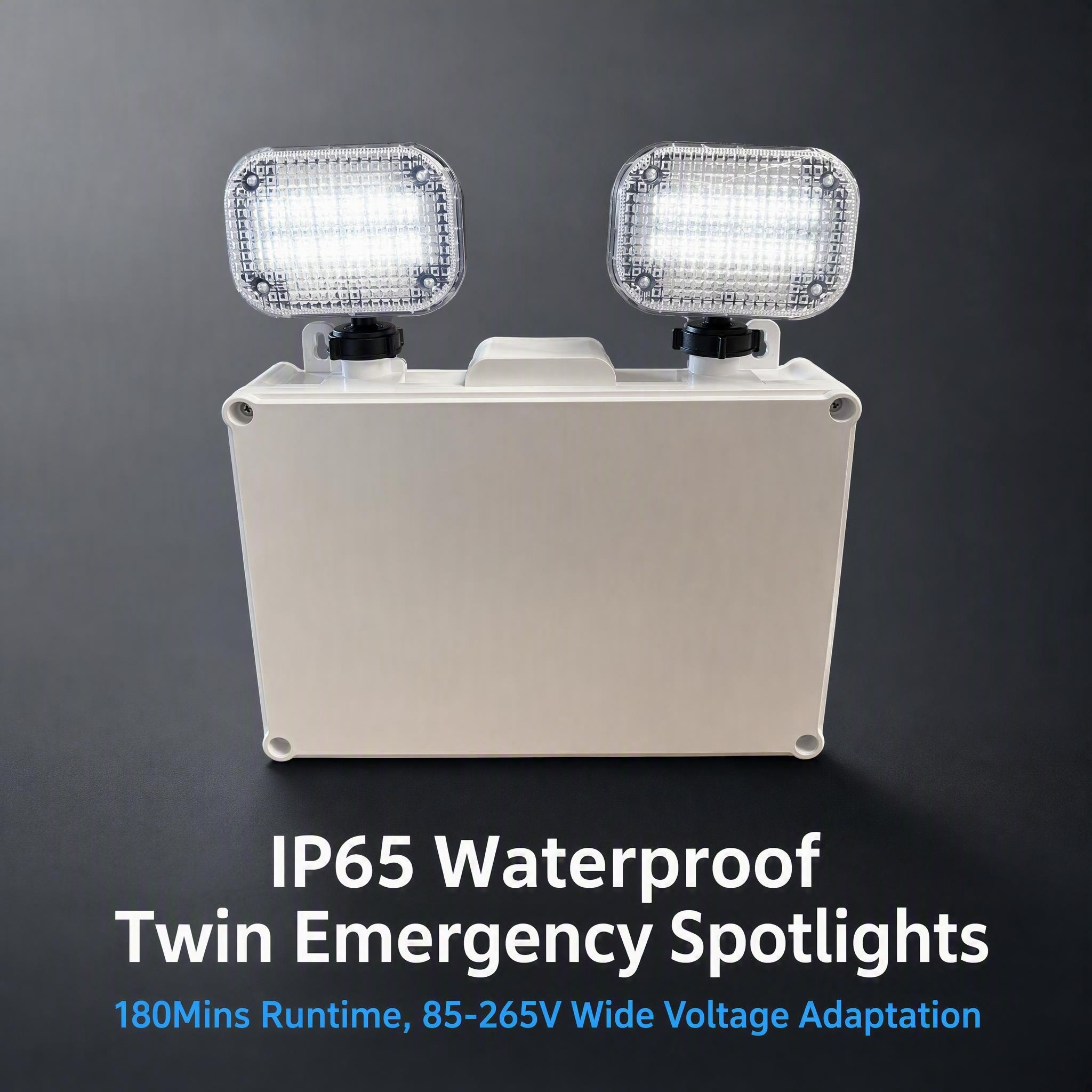
Twin head emergency spotlights with adjustable heads for stairwells, plant rooms and high risk task areas.
Frequently Asked Questions About Twin Spot Emergency Light
Twin Spot Configuration and Supplier Selection
Q: What is the minimum order quantity and can I order samples before committing to a bulk shipment?
MOQ is 100 units for standard twin spots, 500 units for OEM branded versions. Samples ship within 5 working days at unit price plus air freight. Hymark recommends ordering two sample variants—one maintained, one non-maintained—to verify mechanical fit and lumen output against your host fixture before placing the bulk order.
Q: How do I confirm the twin spot emergency module suits my existing high-bay or industrial fixture?
Check three parameters: input voltage range (Hymark units accept AC 85-265V or 100-277V depending on SKU), total driven load in watts (twin spots typically support 2W to 25W LED emergency output), and physical mounting—bracket spacing, head adjustability, and whether the changeover relay fits inside the host housing. Request the dimensional drawing and photometric file before sampling.
Q: What emergency duration and output options are available, and how do they relate to battery size?
Standard durations are 90 minutes, 2 hours, and 3 hours. A 3-hour kit at 100 percent emergency output demands roughly 3.2V 6000mAh LiFePO4 or 7.4V 2600mAh Li-ion 18650 configuration; 90 minutes at 50 percent output uses 3.2V 1500mAh LiFePO4. Output window is typically DC 12-80V at constant current, 150mA to 700mA depending on driver SKU. Match the emergency lumen target to EN 1838 minimums for your ceiling height.
Q: What is the difference between maintained and non-maintained wiring, and which should I specify?
Non-maintained: twin spots energise only on mains failure, wired directly to unswitched permanent live. Maintained: emergency heads run at reduced output during normal operation via a changeover relay, requiring a switched live plus permanent live. Maintained costs more and draws standby power; non-maintained is simpler but provides no visual reassurance during normal hours. BS 5266-1 and EN 60598-2-22 govern both configurations.
Q: What self-test and remote monitoring options are available, and do they add to unit cost?
Manual test key is standard. Automatic self-test per EN 62034 adds roughly 8-12 percent to BOM cost; DALI-2 emergency test interface adds 15-20 percent. Self-test performs monthly function and annual duration checks, reporting via LED status indicator. DALI enables centralised monitoring. Specify which protocol your building management system expects before the supplier programmes the inverter PCB.
Q: Which battery chemistry should I choose, and what is the realistic replacement interval?
NiCd packs last 3-4 years, tolerate -20°C to +50°C ambient, but contain cadmium and face disposal restrictions in the EU. LiFePO4 delivers 500-800 cycles, 5-6 year service life, 2-4 hour charge time, and operates at -10°C to +60°C. Li-ion 18650 offers higher energy density but requires stricter thermal management. Ask the supplier for cycle life data at your ambient temperature range; derate 20 percent above 45°C.
Q: What lead time applies for standard and customised twin spot orders, and what payment terms are typical?
Standard SKUs: 15-20 days after deposit. OEM branding, custom bracket geometry, or non-standard lumen packages: 35-45 days. Payment is 30 percent deposit, 70 percent against copy of bill of lading for FOB Shenzhen; LC at sight available for orders above USD 50,000. CIF quotes add 3-5 percent depending on destination port and current container rates.
Q: Which conformity marks and test reports should I request for my destination market, and how does lithium battery chemistry affect shipping?
For the UK and EU: ask for EN 60598-2-22 and EN 62034 test reports, plus CE construction file. The Middle East typically requires IEC-based CB test certificates plus national deviation. UL 924 applies for North American projects; AS/NZS 2293 for Australia. Hymark can supply third-party test reports on request; verify the report reference matches the exact SKU and firmware version ordered. Lithium batteries ship as UN 38.3 Class 9 dangerous goods, limiting air freight to cargo-only aircraft and requiring MSDS, UN 38.3 test summary, and 1.2 metre drop test documentation. Sea freight accepts lithium in properly labelled inner cartons, 20 units per carton, 10 cartons per pallet. Lead time extends 3-5 days for DG packing and customs declaration.
Q: What warranty coverage and spare parts availability should I negotiate?
Standard warranty is 3 years on the inverter and LED heads, 2 years on battery packs. Extend to 5 years on electronics for orders above 1000 units. Spare battery packs and LED modules should be available for purchase separately for minimum 7 years after shipment. Confirm the supplier stocks replacement heads with identical lumen output and beam angle to avoid re-commissioning the installation.
Q: Can I receive OEM branding, custom packaging, and installation support for large projects?
OEM branding on the housing and carton adds USD 0.80-1.20 per unit for silk-screen or laser marking. Custom carton with your project logo: MOQ 500 units. Hymark provides wiring diagrams in PDF and commissioning checklists; on-site support is available for projects above 2000 units in Southeast Asia and the Middle East, travel cost billed separately. Remote video support is standard for all orders.
Important Notice
Specifications, output and duration figures and price ranges in this guide are indicative and are provided
for planning purposes only. Actual emergency output, duration, battery life, ingress protection and available conformity documentation
differ by model and by destination country, and emergency lighting design remains the responsibility of the project designer. Buyers
must confirm their own mains voltage and frequency, the emergency lighting standard enforced locally, the host fixture compatibility
and their import requirements before placing an order. All figures are subject to written confirmation in the final proforma invoice
issued by Hymark.
Sourcing Twin Spot Emergency Light from Hymark
What to Request Before You Order
Send the supplier these five items and you will receive a configuration that matches your project instead of a generic catalogue unit:
- Host fixture type and normal-mode wattage
- Required emergency duration: 90 minutes, 2 hours or 3 hours
- Mains voltage and frequency at the installation site
- Maintained or non-maintained wiring scheme
- Destination port and Incoterm preference: FOB Shenzhen or CIF
Why Hymark Fits This Procurement
JIALINGHANG ELECTRONIC CO., LTD. was founded in 2013 as a global LED exporter in general illumination. A strategic shift in 2017 concentrated development on LED emergency technology and high-performance LED strips. Hymark launched in 2026 as the premium brand.
The twin spotlight range is co-designed and engineered in-house through a strategic partnership with dedicated manufacturing facilities that have also operated since 2013. JIALINGHANG manages R&D, product design and global distribution directly.
For twin spot emergency lights, Hymark offers selectable emergency duration, maintained or non-maintained wiring, and OEM or ODM branding. Export carton packing and FOB or CIF terms are standard.
Technical Specifications to Confirm
| Parameter | Typical Range to Specify |
|---|---|
| Emergency output | 200–800 lm per head, 5–10 % of normal output |
| Emergency duration | 90 min, 2 hr or 3 hr |
| Input voltage | AC 85–265V or 100–277V |
| Output window | DC 12–60 V, constant current 150–700 mA |
| Driven load | 3–10 W per head |
| Batterie | LiFePO4 3.2 V 1500–3000 mAh, or NiCd 3.6 V 1200–2500 mAh |
| Charge time | 16–24 hours to full capacity |
| Cycle life | LiFePO4 500–800 cycles; NiCd 300–500 cycles |
| Test facility | Manual test key, self-test, or DALI |
| Enclosure | IP20 to IP65, IK07 to IK10 |
| Ambient | -10 °C to +45 °C |
Standards Compliance to Verify with Documentation
Buyers should request test reports or certificates from the supplier for the standards their market enforces. EN 60598-2-22 covers construction and performance of emergency luminaires. EN 1838 defines emergency lighting illuminance on escape routes. EN 62034 addresses automatic test systems including self-test and DALI. BS 5266-1 provides UK application guidance. UL 924 applies in North American markets. AS/NZS 2293 governs Australian and New Zealand installations. IEC 61347 covers controlgear safety. For lithium battery shipments, UN 38.3, IATA and IMDG transport rules apply.
Next Step
Send your host fixture type and wattage, the emergency duration your code requires, your mains voltage and your destination port to Hymark. You will receive a quotation within 24 hours via WhatsApp or email.
Get a Factory Direct Quote on Twin Spot Emergency Light
JIALINGHANG ELECTRONIC CO., LTD. has been in LED lighting since 2013 and has focused on
LED emergency technology and high performance LED strips since 2017. Hymark products are co-designed with our
dedicated manufacturing partners, built with selectable emergency duration and maintained or non-maintained wiring, and function
tested before packing. Send us the host fixture type and wattage, the emergency duration your local code requires, your mains
voltage and your destination port and we will return a quotation within 24 hours.

 English
  Spanish
  Arabic
  French
  German
  Russian
  Portuguese
  Italian
  Vietnamese