
Emergency Lighting Buyer Guide
A genuine emergency light conversion modules supplier in China ships product that carries traceable battery cell certificates, inverter discharge records matched to EN 1838 duration tables, and third-party test reports for the destination market—not just a generic CE image on a website. The module you need depends on three hard variables: the host fixture’s normal LED driver output (typically 20W to 200W), whether your local code demands 90 minutes or 3 hours of emergency duration, and whether the inspector expects EN 60598-2-22, UL 924, or AS/NZS 2293 documentation.
This page covers how to qualify a real manufacturer against a trading office. We walk through in-house SMT and battery assembly capacity, the test records that prove duration claims, and the payment and sample structures that separate committed factories from intermediaries.
In-House or Partnered SMT and Assembly Capacity
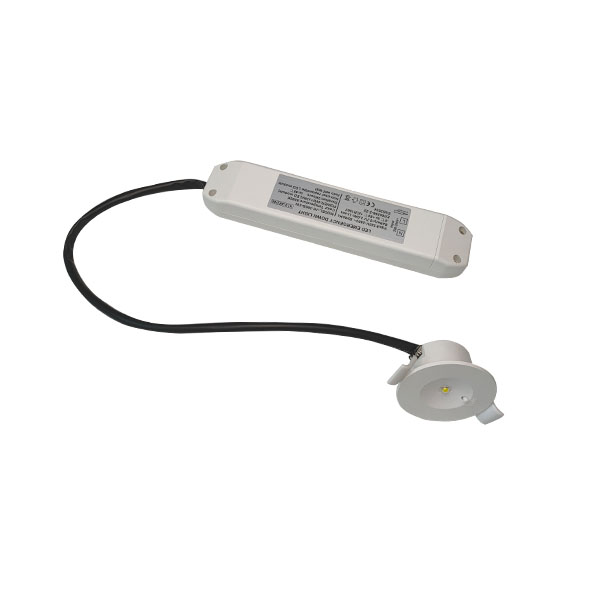
A conversion module is an inverter PCB, a changeover relay or electronic switch, and a battery pack in an enclosure. Ask for photos of the SMT line, the AOI station, and the final assembly jig. Real factories run 0402 and 0805 passive reels, constant-current ICs in SOIC or QFN packages, and through-hole relays rated for 250V AC switching. A trading office will deflect to “we have a partner” without naming the city or showing capacity. Request the inverter output window in DC volts and mA: typical ranges are 9-42V at 150-700mA for 10W to 60W emergency loads. The PCB should be FR-4, 1.6mm, with 2oz copper for thermal spread on the relay and MOSFET sections.
Battery Sourcing and Traceability
The battery is the cost driver and the failure point. Ask for the cell manufacturer’s name, the cell model, and the batch code system. LiFePO4 3.2V 1500mAh to 3000mAh packs dominate 90-minute modules at 5W to 10W emergency output; Li-ion 18650 3.7V 2000mAh to 2600mAh packs appear where higher energy density matters for compact modules. NiCd 3.6V to 4.8V 600mAh to 1000mAh packs still ship to markets with price pressure but carry shorter cycle life (300 to 500 cycles versus 800 to 1500 for LiFePO4) and higher self-discharge. Demand the UN 38.3 test summary for lithium cells, the MSDS, and the inbound cell inspection record. A factory with nothing to hide sends these within 24 hours.
Discharge and Duration Test Records
EN 1838 requires emergency illuminance on the task plane, not just inverter function. A real supplier keeps discharge logs: battery voltage every 15 minutes, lumen output at 60 seconds, at 90 minutes, and at end of discharge. Ask for a test record matched to your target module—say, 8W emergency output from a 40W normal panel, 90 minutes duration, with lumen maintenance above 50% of normal output at the 90-minute mark. The record should show ambient temperature during test (typically 20°C to 25°C reference, with derating data for 0°C to 40°C operation). Trading offices offer “yes, 3 hours” without data; factories show the ageing room logs.
Ageing and Hipot Test Stations
Modules must survive years of standby charge. Ask about the burn-in protocol: 48 hours at 40°C ambient with charge cycling is common for LiFePO4 packs. Hipot test stations apply 1500V AC or 3000V DC between mains and SELV output for 60 seconds to prove isolation; ask for the daily calibration sticker on the station. A factory serious about export runs 100% hipot, not batch sampling.
Third-Party Test Reports for the Destination Market
Do not accept “certified” as an answer. Ask for the test report number, the laboratory name, and the standard edition tested: EN 60598-2-22:2014 for Europe, BS 5266-1 for UK projects, UL 924 for North America, AS/NZS 2293 for Australia and New Zealand. Verify the report covers the exact model number, not a “family” that excludes your module. For DALI self-test modules, EN 62034 compliance should appear in the report scope. If the supplier cannot produce the report within two business days, they likely do not have it.
Sample Lead Time and Payment Structure
A real manufacturer ships samples in 5 to 10 working days from stock PCBs and battery packs. Custom enclosures or bespoke output windows extend to 15 to 20 days. Payment structures reveal commitment: 30% deposit, 70% against copy of B/L is standard for first orders under USD 10,000; LC at sight becomes negotiable above USD 50,000. Trading offices often demand 100% advance or offer no factory visit. Ask for the FOB port—Shenzhen or Ningbo for most Guangdong and Zhejiang factories—and whether carton packing is 20 or 50 modules per carton, with pallet height limits for lithium battery IMDG shipments.
After-Sales Engineering Capability
Emergency modules fail in the field because of wiring errors—maintained versus non-maintained loops—or because the host fixture’s LED driver does not tolerate the module’s switching topology. A qualified supplier provides wiring diagrams for both maintained (permanent live, switched live, neutral) and non-maintained (switched live, neutral only) configurations, with explicit relay contact ratings. Ask for the name and contact of the application engineer who will handle your technical questions post-shipment. A trading office has no such person; a factory puts you through to the design department.
The right supplier is the one that shows you the test data before you ask for the price. Start with the battery traceability and the discharge record; everything else follows.
Types and Configurations of Emergency Lighting
Full Power Emergency Drivers for LED High Bays and Industrial Luminaires
| Type or Class | Typical Rating or Output | Duration or Runtime | Best Suited For | Notes |
|---|---|---|---|---|
| Full power emergency driver 50-100W normal load | Emergency output 100% of normal lumens (e.g., 5000-10000 lm maintained) | 90 minutes or 3 hours per EN 1838 | Warehouses, manufacturing halls, high-bay retail | Requires LiFePO4 12.8V 6000mAh or 25.6V 3000mAh pack; constant current output 250-700mA DC; input AC 100-277V |
| Reduced power emergency driver 10-50W normal load | Emergency output 10-50% of normal lumens (e.g., 500-2500 lm) | 90 minutes or 2 hours | Corridors, stairwells, storage rooms | Li-ion 18650 7.4V 2200mAh or NiCd 3.6V 4000mAh; output 150-350mA DC; lower battery cost but visibly dimmer |
| Maintained/non-maintained convertible exit sign module | 120-400 lm face illumination | 90 minutes minimum, 3 hours common | Public buildings, offices, healthcare | Changeover relay switches between mains and emergency mode; AC 85-265V input; self-test or DALI per EN 62034 |
| Self-test emergency twin spotlight | 2 × 500-800 lm adjustable heads | 90 minutes or 3 hours | Open areas, loading bays, external canopies | IP65 enclosure typical; NiCd 6V 4000mAh or LiFePO4 6.4V 3000mAh; manual test key override |
| Emergency LED strip module COB high density | 480-720 lm/m at 5W/m emergency (typically 20-30% of normal 24W/m) | 90 minutes or 2 hours | Architectural coves, retail displays, wayfinding | 24V DC input; 480 LEDs/m COB; CRI 90+; 3000K or 4000K; cut length 50mm; 10mm PCB, 2oz copper |
| DALI-addressable emergency driver with central monitoring | 10-60W normal load, programmable 10-100% emergency output | 90 minutes to 3 hours configurable | Smart buildings, campuses, facilities with BMS | Requires DALI bus power; EN 62034 automated function test; LiFePO4 11.1V 4500mAh typical |
Full power emergency drivers for LED high bays represent the most demanding conversion module category. These units must deliver the full lumen output of the host luminaire—often 5000 to 10000 lumens—from a battery pack sized for 90 minutes or 3 hours of runtime. The battery configuration is typically LiFePO4 at 12.8V 6000mAh or 25.6V 3000mAh, chosen for thermal stability in luminaire housings that may reach 65°C during normal operation. The constant current inverter stage outputs 250-700mA DC with a voltage window matched to the LED module’s forward voltage curve. Electrical contractors and industrial procurement officers specify these for warehouse and manufacturing applications where maintained illumination at full level is critical for safe evacuation. What they cannot do is retrofit into luminaires with incompatible LED module voltages or insufficient internal space for the battery pack and inverter assembly; the physical envelope often exceeds 200mm × 60mm × 35mm.
Reduced power emergency drivers sacrifice lumen output for battery cost and size reduction, typically operating at 10-50% of normal light output during emergency mode. A 40W LED panel might deliver only 2000 lumens in emergency, sufficient for escape route illumination per EN 1838 but clearly dimmer than normal operation. Battery options include NiCd 3.6V 4000mAh packs for cost-sensitive projects or Li-ion 18650 7.4V 2200mAh configurations where weight and cycle life matter. These drivers suit corridors, stairwells, and storage areas where M&E consultants specify minimum illuminance rather than full task lighting. Facility managers should recognise that reduced output models cannot maintain safe working conditions during prolonged outages; they provide escape route visibility only.
Maintained and non-maintained convertible exit sign modules incorporate a changeover relay that either switches the LED face illumination to battery supply during mains failure (non-maintained) or keeps it energised continuously with battery backup (maintained). The input accepts AC 85-265V for global compatibility, and the output stage drives 120-400 lumens across the sign face depending on pictogram size and viewing distance requirements. Self-test functionality per EN 62034 automates the monthly function test and annual duration test, or DALI integration enables centralised reporting to building management systems. Lighting designers and specifiers select these for public buildings and healthcare facilities where maintained operation is mandated. These modules cannot operate without a compatible legend face and housing; the module alone does not constitute a complete exit sign assembly.
Self-test emergency twin spotlights package two adjustable heads—each 500-800 lumens—with an internal battery and inverter in an IP65 enclosure for open area and external applications. The NiCd 6V 4000mAh option offers lower unit cost but shorter cycle life (300-500 cycles) and requires replacement every 3-4 years under typical test cycling; LiFePO4 6.4V 3000mAh alternatives achieve 800-1500 cycles with slower capacity fade. A manual test key provides override for immediate verification during commissioning and inspection. Electrical contractors install these for loading bays, canopies, and large open plan areas where a single luminaire must cover broad floor zones. The limitation is directional coverage; these are not suitable for linear escape routes requiring uniform illuminance.
Emergency LED strip modules for architectural integration use COB LED strips at high density—480 LEDs per metre on 10mm PCB with 2oz copper—to achieve 480-720 lumens per metre at emergency power levels of 5W/m, roughly 20-30% of normal 24W/m operation. The 24V DC input interfaces with standard LED drivers, and 50mm cut length allows precise length matching to cove details. Colour temperature options at 3000K or 4000K with CRI 90+ meet retail and hospitality specifications. Lighting designers specify these for cove lighting, display cases, and wayfinding strips where continuous luminous lines must remain visible during evacuation. These modules cannot replace primary escape lighting; their output is too low and too diffuse to meet point illuminance requirements on the floor plane.
DALI-addressable emergency drivers add network intelligence to any of the above load classes, enabling programmable emergency output levels and automated test scheduling per EN 62034. The DALI bus carries commands and status reporting; the driver maintains local battery and inverter operation independent of network faults. Battery configurations typically use LiFePO4 11.1V 4500mAh for 3-hour duration at moderate loads. Facility managers and building operators with central BMS infrastructure specify these for campuses and multi-building estates where manual inspection of hundreds of emergency luminaires is impractical. The constraint is infrastructure dependency; without DALI wiring and a functioning application controller, the enhanced functionality is unavailable, though the local emergency operation remains intact.
Supplier Qualification for Emergency Conversion Modules
Buyers searching for emergency light conversion module suppliers in China face a market segmented between integrated manufacturers with in-house assembly and trading offices that source finished units from third-tier factories. The distinction matters for specification integrity, traceability, and after-sales support.
In-House SMT and Assembly Capacity. A genuine manufacturer operates surface mount technology lines for PCB assembly, including the constant current inverter boards, battery management circuits, and DALI communication modules. Ask for video documentation of the SMT line, reflow oven profile records, and AOI (automated optical inspection) station capability. Trading offices cannot provide this; they will offer factory visit arrangements at arm’s length. Hymark maintains partnered SMT capacity with controlled reflow profiles for thermal-sensitive LiFePO4 battery management ICs, with first-article inspection records available for review.
Battery Sourcing and Traceability. The battery pack represents 30-45% of module cost and the dominant failure mode. Request cell manufacturer certificates of origin—common sources include EVE Energy, Lishen, and BAK for LiFePO4 cylindrical cells—and incoming inspection records for cell voltage, internal resistance, and capacity matching. A supplier with genuine manufacturing control will have lot traceability linking each finished module to cell batch and weld station. Ask specifically for UN 38.3 test summary documentation for the cell and completed battery pack; without this, air freight and many sea freight channels are unavailable. NiCd packs face transport restrictions under IATA and IMDG regulations that add documentation burden and cost.
Discharge and Duration Test Records. EN 60598-2-22 and EN 1838 require verification that emergency duration meets declared runtime at rated temperature. A qualified supplier maintains discharge test stations with programmable DC loads, temperature chambers, and data logging for each production batch. Request sample test reports showing actual discharge curves at 0°C, 20°C, and 55°C ambient; the capacity at temperature extremes reveals cell quality and thermal design adequacy. Trading offices typically have no access to these records.
Ageing and Hipot Test Stations. Production-level reliability testing includes burn-in of assembled modules under cyclic load and high-potential insulation testing at 1500V AC or 3000V DC between mains and output circuits. Ask for ageing rack capacity—number of units under simultaneous test—and hipot test fixture calibration certificates. These capital investments separate manufacturers from assemblers.
Third Party Test Reports for Destination Markets. Do not accept unverified claims of certification. For UK and EU markets, request test reports against EN 60598-2-22 and EN 1838 from accredited laboratories; the report number should be verifiable with the issuing body. For UL 924 entry to North American markets, the supplier must have completed testing at a UL-witnessed facility or submitted through a CB scheme with national differences. For AS/NZS 2293 in Australasia, specific duration and colour requirements apply. Hymark can discuss testing pathways for target markets without claiming held approvals; buyers should budget 8-12 weeks for initial type testing and report issuance.
Sample Lead Time and Payment Structure. Genuine manufacturers with component stock offer sample lead times of 5-10 working days for standard modules; custom output currents or battery configurations extend to 15-20 days. Trading offices often quote similar timelines but with hidden factory queuing that stretches delivery. Payment structures vary: 30% deposit with 70% against copy of bill of lading is standard for initial orders; letter of credit becomes viable above USD 50,000 for buyers with established banking relationships. Samples typically command 100% payment in advance, refundable against first production order.
After-Sales Engineering Capability. Emergency module failures in the field require diagnostic support: distinguishing inverter faults from battery degradation, advising on compatible LED module replacements, and interpreting self-test fault codes. A supplier with in-house firmware and hardware engineers provides schematic-level guidance and field-return analysis. Trading offices route enquiries back to opaque factory contacts with 48-hour response delays. Hymark assigns application engineering contact for technical post-sale issues, with typical response within one working day for DALI programming and fault interpretation.
Price Drivers and Lead Time Planning
Emergency conversion module pricing correlates directly with battery chemistry and capacity, output power class, and test facility complexity. At 2025 market levels, indicative ranges for qualified manufacture are: reduced power modules with NiCd packs at USD 8-15 unit for 10-25W normal load; full power drivers with LiFePO4 at USD 35-65 for 50-100W applications; DALI-addressable variants adding 20-30% premium for communication hardware and firmware licensing. Exit sign modules with integrated battery and inverter fall USD 12-25 depending on legend complexity and IP rating.
Lead time from confirmed order to FOB shipment runs 25-35 days for MOQ of 500-1000 units, extending to 45-55 days for orders above 5000 units where cell procurement and ageing scheduling create bottlenecks. Lithium battery transport documentation adds 3-5 days for UN 38.3 test summary verification and IATA/IMDG shipper’s declaration preparation. Carton packing typically 20-40 units per carton, 20-25 cartons per pallet; CIF quotes to major ports add 8-15% to FOB value depending on destination and current freight indices.
Buyers should plan specification freeze 60 days before required on-site date, allowing two weeks for sample evaluation, four weeks for production, and two weeks for shipping and customs clearance. For project procurement officers in the Middle East and Africa, where local inspection upon arrival is common, ensure third party test reports accompany shipment documentation to avoid port detention.
Specifications and How to Read Them
| Parameter | Entry Level | Mid Range | High Specification |
|---|---|---|---|
| Input voltage / frequency | AC 85-265V 50/60Hz | AC 100-277V 50/60Hz | AC 220-240V 50Hz or AC 120-277V 50/60Hz |
| Driven load (normal mode) | 3-15W LED | 10-40W LED | 40-100W LED high bay or panel |
| DC output voltage window | 12-36V | 25-50V | 50-250V |
| DC output current | 150-350mA | 300-700mA | 500-1500mA |
| Emergency output | 300lm, 10% of normal | 800lm, 30% of normal | 3000lm, 50% of normal |
| Emergency duration | 90 minutes | 120 minutes | 180 minutes |
| Battery chemistry / voltage / capacity | NiCd 3.6V 600mAh | Li-ion 18650 3.7V 2600mAh | LiFePO4 3.2V 3000mAh |
| Charge time | 24 hours | 16 hours | 12 hours |
| Cycle life | 300-500 cycles | 500-800 cycles | 1500-2500 cycles |
| Test facility | Manual test key | Auto self-test 30s/30min/annual | DALI-2 self-test per EN 62034 |
| Wiring mode | Non entretenu | Non-maintained or maintained | Maintained or non-maintained with changeover relay |
| IP / IK rating | IP20 / IK02 | IP65 / IK07 | IP66 / IK08 |
| Ambient temperature | 0°C to +40°C | -10°C to +45°C | -20°C to +55°C |
| Dimensions (L×W×H) | 120×40×30mm | 180×55×35mm | 220×70×45mm |
| Mounting | Internal clip to LED module | Internal or remote steel enclosure | Remote weatherproof enclosure with gland entries |
How to Read an Emergency Conversion Module Datasheet
Input voltage range and frequency tells you which mains networks the module accepts without damage. A module rated AC 85-265V 50/60Hz works on 120V 60Hz in North America and 230V 50Hz in Europe without rewiring. A narrower 220-240V rating saves component cost but fails in 110V markets. Check that the upper limit includes your local nominal voltage plus 10% tolerance.
Driven load in watts is the LED power the module can switch in normal mode. The entry-level 3-15W range suits downlights and small bulkheads. The 40-100W high-specification range matches LED high bays and large panels. Exceeding this rating overheats the inverter and voids any warranty. Undersizing wastes money if you never use the headroom.
DC output voltage window and current define the LED string the module can drive. A 25-50V window at 300-700mA means the module outputs constant current within that voltage range. Your LED load must fall inside both limits: a 36V COB array at 500mA works; a 12V strip at 1A does not. The inverter is a constant-current device, not a fixed-voltage supply.
Emergency output in lumens and as a percentage of normal determines whether occupants can evacuate safely. EN 1838 requires minimum 1 lux on the escape route centre line; the module must produce enough lumens from the installed luminaire to achieve this. A 10% output ratio from a 3000lm normal luminaire gives 300lm emergency—adequate for a small office but marginal for a warehouse with high mounting. A 50% ratio from the same luminaire yields 1500lm, which covers larger spaces or higher mounting heights. The percentage is fixed by the inverter design and battery capacity, not adjustable in the field.
Emergency duration is the time the battery sustains output at rated load. Ninety minutes satisfies most jurisdictions; 120 or 180 minutes covers healthcare, high-rise, or jurisdictions with extended requirements. Duration tests use the rated load at 25°C ambient; cold batteries deliver less. Ask for discharge test records at your minimum ambient temperature.
Battery chemistry voltage and capacity drives cost, weight, cycle life, and transport classification. NiCd 3.6V 600mAh packs are cheap, tolerate temperature extremes, but contain cadmium with RoHS and waste restrictions in the EU. Li-ion 18650 3.7V 2600mAh packs triple the energy density but need UN 38.3 testing for air freight and degrade faster above 45°C. LiFePO4 3.2V 3000mAh packs offer the longest cycle life (1500-2500 cycles), thermal stability, and no heavy-metal restrictions, at 20-30% higher cell cost. Capacity in mAh multiplied by voltage gives watt-hours: 3.2V × 3000mAh = 9.6Wh, which determines how long the inverter runs at a given load.
Charge time matters for first commissioning and after deep discharge. A 24-hour NiCd charge reflects trickle-rate chemistry to avoid memory effect. Twelve-hour LiFePO4 charging uses higher current with battery management system cutoff. Faster charge claims usually mean partial recovery to 80%; full charge still takes the stated time.
Cycle life is the number of full discharge-charge cycles before capacity drops below 80% of rated. At one monthly test cycle, 500 cycles lasts 40 years in theory but calendar ageing limits actual life to 8-12 years for Li-ion, 15-20 for LiFePO4, 5-8 for NiCd. Ask for cycle test data to IEC 61960 or IEC 62620, not just cell manufacturer claims.
Test facility determines compliance labour. Manual test key requires a technician visit monthly or per local code. Self-test automates 30-second functional, 30-minute duration, and annual full-duration tests per EN 62034, logging results for inspection. DALI-2 self-test integrates into building management systems with addressable fault reporting. The hardware cost difference is 15-25% between manual and self-test, 30-40% for DALI, but labour savings recover this in 2-4 years for large portfolios.
Maintained or non-maintained wiring describes normal-mode operation. Non-maintained: the LED runs from mains via the driver; emergency only activates on power failure. Maintained: the LED runs from the module continuously or via a changeover relay, so the same luminaire serves normal and emergency lighting. Maintained wiring needs a relay rated for the normal-mode current and voltage; check the datasheet relay specification matches your driver output.
IP and IK rating defines where the module lives. IP20 is indoor electrical panel only. IP65 allows dusty or wet industrial locations. IP66 with IK08 survives hose-directed water and 5 joule impact, suitable for parking garages and tunnels. The module rating must match or exceed the luminaire rating; a IP20 module inside an IP65 luminaire is acceptable if the enclosure seals.
Ambient temperature range affects battery chemistry selection and lumen maintenance. Lithium-ion capacity drops 20% at 0°C and charging below freezing damages cells. LiFePO4 performs better below 0°C but still derates. Specify the actual minimum and maximum temperatures at the installation location, not the building interior design temperature.
Dimensions and mounting determine whether the module fits your luminaire housing or needs a remote enclosure. Remote mounting adds wiring between module and LED, which must be fire-rated and protected from mechanical damage per BS 5266-1 clause 13.5.
Trade Terms and Export Practicalities
FOB (Free On Board) means the supplier delivers goods to the port of shipment cleared for export. You pay ocean freight, insurance, and destination charges. Typical for container loads where you have freight forwarder relationships.
CIF (Cost Insurance Freight) includes ocean freight and insurance to your port. You still pay destination unloading, customs clearance, and inland delivery. Insurance covers total loss, not partial damage; inspect containers before signing clean bills of lading.
CFR (Cost and Freight) is CIF without insurance. You arrange marine insurance separately. Rare in lighting exports; most buyers prefer CIF or FOB.
EXW (Ex Works) means you collect from the factory, bearing all export clearance, freight, and risk. Lowest supplier price but highest buyer logistics burden. Only practical if you have import infrastructure in China.
Payment structures shape risk allocation. T/T (Telegraphic Transfer) with 30% deposit, 70% before shipment is standard for first orders. L/C (Letter of Credit) at sight or 30-60 days protects the buyer if documents fail to match, but adds 0.5-1.5% bank charges and ties up credit lines. Some suppliers accept L/C for orders above $50,000; others refuse due to document discrepancy risks.
HS code 9405.10 covers emergency lighting in most customs tariffs. Verify with your broker whether your destination splits by battery type or application. Incorrect classification delays clearance and triggers penalties.
CE and UKCA marking are declarations of conformity, not certificates issued by authorities. For emergency lighting, the relevant directives are LVD (2014/35/EU), EMC (2014/30/EU), and RoHS (2011/65/EU). The supplier must hold test reports to EN 60598-2-22 and EN 1838, plus EN 62034 for self-test modules, from a notified or accredited laboratory. Ask for the report number, test lab accreditation, and date; reports over five years may not cover design changes. UKCA applies to Great Britain; Northern Ireland still accepts CE under the Windsor Framework.
UN 38.3 battery test report is mandatory for lithium battery air or sea transport. The report covers altitude simulation, thermal cycling, vibration, shock, external short circuit, impact, overcharge, and forced discharge on the cell and completed battery pack. Ask for the UN 38.3 test summary with the battery manufacturer’s UN number and proper shipping name. Without this, freight forwarders refuse booking.
Packing list and certificate of origin complete customs documentation. The packing list must match carton labels with quantity, weight, and dimensions per carton. A certificate of origin (Form A or RCEP depending on destination) may reduce tariff under trade agreements. China-origin goods face anti-dumping scrutiny in some markets; accurate origin declaration prevents seizure.
Supplier Qualification: Manufacturing Capacity and Traceability
In-house or partnered SMT and assembly capacity separates factories from trading offices. Ask for SMT line specifications: pick-and-place accuracy (±0.05mm for 0402 components), reflow oven zone count (eight zones minimum for lead-free profiles), and AOI coverage. If assembly is partnered, request the partner’s name, address, and ISO 9001 scope certificate. A trading office will deflect or provide vague answers.
Battery sourcing and traceability is critical because cells dominate failure modes and transport compliance. Ask for the cell manufacturer’s name (BAK, EVE, Lishen, CATL for lithium; Sanyo or FDK for NiCd), batch codes, and incoming inspection records. Cell-level test data should show capacity variance within ±3% per batch. Random cell substitution between orders breaks UN 38.3 validity.
Discharge and duration test records should exist for every production batch, not just type testing. A factory with ageing stations runs 100% of modules for 90 minutes at 25°C load before packing. Ask to see the test log format: date, serial number, battery voltage before and after, duration achieved, pass/fail. Missing or manual-only records suggest spot-check sampling, which misses intermittent faults.
Ageing and hipot test stations verify long-term reliability and electrical safety. Ageing runs modules at 40°C ambient for 4-8 hours to accelerate early failures. Hipot (dielectric withstand) tests apply 1500V AC or 3000V DC between mains and output for 60 seconds per IEC 61347-2-7. Ask for hipot test voltage, ramp rate, and failure criteria. A factory without automated hipot logging cannot prove 100% testing.
Third party test reports for the destination market must be current and cover the exact model variant. EN 60598-2-22 reports should list the module as tested, the LED load used, and the battery type. Cross-check the report model number against the quotation; suffixes like “-A” or “-B” may denote untested variants. For UL 924 or AS/NZS 2293 markets, confirm the report is from an OSHA NRTL or JAS-ANZ accredited body, not an internal lab.
Sample lead time indicates production reality. Two to three weeks for a first sample suggests in-house assembly with existing materials. Six to eight weeks suggests ordering materials for your sample, which is normal for custom builds but suspicious for catalogue items. Ask what changes between sample and production: if the sample uses premium cells and production switches to cheaper alternatives, the sample is meaningless.
Payment structure reveals financial health. Factories accepting 100% T/T in advance may be undercapitalized or have been burned by bad debt. Standard 30/70 T/T or L/C at sight from established factories indicates normal cash flow. Refusal of any deposit reduction for repeat orders suggests rigid working capital or intermediary markup.
After-sales engineering capability matters when your installation fails commissioning. Ask for schematic and wiring diagram availability, Mean Time Between Failure data, and whether firmware updates are field-applicable or factory-only. A supplier who cannot explain why a module trips RCD protection or flickers in maintained mode will cost you return visits and reputation.
What Cheaper Alternatives Omit
A module priced 30% below market typically saves on: battery capacity (2000mAh labelled versus 2600mAh actual, detected only by discharge test); inverter efficiency (65% versus 85%, requiring larger battery for same duration); omission of self-test circuitry; or IP20 plastic enclosure versus IP65 metal. These trade-offs are valid for cost-sensitive residential markets but fail commercial inspections for duration, lumen output, or ingress protection. Match specification to application requirement, not initial price.
Emergency Lighting Price and What Drives It
| Class | Typical Rating or Output | Duration or Runtime | Indicative FOB USD |
|---|---|---|---|
| Basic exit sign (single-sided, non-maintained) | 80–120 lm, 8–12 m viewing distance | 90 min | 4.50–7.00 |
| Premium exit sign (double-sided, self-test, DALI) | 120–200 lm, 20–30 m viewing distance | 2–3 hr | 12.00–22.00 |
| Emergency bulkhead (3 W LED, non-maintained) | 180–250 lm at 100% normal output | 90 min | 8.00–14.00 |
| Emergency bulkhead (5 W LED, self-test) | 300–450 lm at 100% normal output | 2 hr | 15.00–25.00 |
| Emergency twin spotlight (2 × 3 W LED heads) | 400–600 lm combined | 90 min–3 hr | 18.00–35.00 |
| Emergency driver module (for OEM luminaire, 10–50 W normal load) | 10–50% of normal output (e.g., 500–2500 lm equivalent) | 90 min–3 hr | 14.00–45.00 |
| Full-power emergency driver (maintains 100% normal output) | 100% of normal luminaire output | 90 min–2 hr | 35.00–90.00 |
| High-bay emergency driver (100–200 W normal, 10–20% emergency) | 1000–4000 lm emergency | 90 min–3 hr | 55.00–150.00 |
These bands assume standard MOQ of 500–1000 pieces, EN 60598-2-22 or UL 924 oriented design, and lithium-based battery packs. NiCd versions sit 15–25% lower on FOB but carry shorter cycle life and heavier freight cost per unit of stored energy.
What Actually Drives the Price
The bill of materials for a mid-range 5 W LED emergency bulkhead with 2-hour duration and self-test typically breaks down as follows, expressed as percentage of factory gate cost before margin:
| Cost Element | Typical % of Factory Cost | Technical Notes |
|---|---|---|
| Battery pack (LiFePO4 3.2V 2200–3000mAh or Li-ion 18650 3.7V 2000–2600mAh) | 22–32% | Single largest line item. LiFePO4 offers 1500–3000 cycles versus 500–800 for standard Li-ion 18650, but costs 40–60% more per Wh. NiCd 2.4V–4.8V 1500–4000mAh is cheaper upfront, 300–500 cycles, declining availability due to environmental restrictions |
| Driver/inverter PCB with changeover relay | 18–25% | Constant current output 150–350 mA at 6–40 VDC depending on LED configuration. Must survive 85–265 VAC input and switch to battery inverter within 0.5 seconds per EN 60598-2-22 |
| LED package (SMD 2835 or 3030) | 8–14% | Emergency output 300–450 lm from 1–5 W LED array. CRI >80, 4000K or 6000K typical |
| ABS or polycarbonate enclosure + diffuser + hardware | 12–18% | IP20 for indoor, IP65 for corridors and damp locations. IK07–IK08 for public areas |
| Test and certification amortised over batch | 6–12% | Third-party testing to EN 60598-2-22, EN 1838, EN 62034 or UL 924. CB report, SAA for Australia, SASO for Saudi Arabia. Spread across first production run of 2000–5000 units |
| Assembly labour | 6–10% | SMT for PCBA, manual for battery pack termination and final assembly |
| Export carton and pallet packing | 2–4% | Inner carton with foam insert, outer carton 5-layer corrugated, 12–24 units per carton, 48–72 cartons per 20′ container |
| Inland freight to port | 1–2% | Shenzhen or Ningbo to Yantian/Ningbo port |
| Sea freight (non-lithium) or air/sea restricted freight (lithium) | 3–8% | UN 38.3 certified cells required for air freight; IATA PI 965 Section IA/IB or Section II packing. Sea freight under IMDG Code Class 9. Lithium restrictions add 20–40% to freight cost and limit carrier choice |
| Insurance | 0.5–1% | 110% CIF value |
| Destination duty and VAT | Variable by market | 0–14% duty for emergency lighting in most markets; VAT 5–20% |
| Clearance and handling | 1–3% | Broker fees, port charges, inspection where applicable |
The battery pack and third-party approval together account for 30–45% of factory cost. A supplier quoting 30% below market on a like-for-like specification is almost certainly cutting one of these two: substituting an unbranded 18650 cell rated at 1500mAh actual versus 2600mAh labelled, or shipping with an internal test report rather than accredited laboratory documentation.
Why the Cheapest Quote Costs More
Low-price emergency conversion modules and luminaires typically achieve their figure through three reductions that buyers discover only after installation:
Reduced cell capacity or chemistry downgrade. A 3.7V 1500mAh Li-ion pack stores roughly 5.5 Wh. At 80% inverter efficiency this delivers 4.4 Wh to the LED. A 3 W emergency load draws 3 W × 2 hr = 6 Wh required. The maths does not work. The supplier either overstates duration or the module fails at 70 minutes. LiFePO4 3.2V 3000mAh stores 9.6 Wh, providing genuine 2-hour margin at 3 W with cycle life to spare.
Lower emergency output percentage. EN 1838 requires minimum 1 lux on escape route centreline; BS 5266-1 adds 0.5 lux minimum for open areas. A cheap module may output 5% of normal luminaire lumens versus 10% or 100% for full-power designs. The installer must verify spacing calculations; a 5% module in a high-bay with 15,000 normal lumens gives 750 lm emergency, possibly insufficient for 8-metre mounting height over a wide aisle.
Untested or partial test coverage. A supplier with no in-house ageing station ships product that has never completed a full charge-discharge-charge cycle. Capacitor failures, relay contact welding, and battery management IC faults appear in the first 10–50 cycles. Without EN 62034 automatic test function or even manual test key verification, these faults remain hidden until mains failure.
Five-Year Running Cost Comparison
| Cost Element | Budget Module (USD) | Mid-Range Module (USD) | Premium Module (USD) |
|---|---|---|---|
| Initial FOB unit cost | 6.00 | 14.00 | 28.00 |
| First battery replacement at year 3 (Li-ion 18650 2000mAh, 500-cycle life) | 4.50 | — | — |
| First battery replacement at year 5 (LiFePO4 3000mAh, 2000-cycle life) | — | — | — |
| Annual testing labour: manual test 12 × 15 min at USD 35/hr | 105.00 | — | — |
| Annual testing labour: automatic self-test, 1 × 30 min review annually | — | 17.50 | — |
| Annual testing labour: DALI monitored network, 1 × 15 min review annually | — | — | 8.75 |
| Expected failure rate: 8% per year (cheap relay, no cell balancing) | 3.20/year | — | — |
| Expected failure rate: 2% per year (standard build) | — | 1.40/year | — |
| Expected failure rate: 0.5% per year (LiFePO4, conformal coated PCB, sealed relay) | — | — | 0.70/year |
| 5-year total per unit | 76.50 | 21.50 | 33.45 |
The comparison assumes 100 units installed. The budget module’s hidden cost in labour and replacement exceeds its purchase price by factor of twelve over five years. Facility managers specifying for hospitals, data centres, or high-rise residential should model this explicitly; procurement officers evaluated on first-cost alone create this liability.
Supplier Qualification: Factory or Trading Office
Buyers searching for “emergency light conversion modules supplier in China” receive quotations from both manufacturers and intermediaries. The following checks separate the two and predict delivery reliability.
SMT and assembly capacity. Ask for photos with date stamp of SMT lines, reflow ovens, and battery pack welding stations. A real factory runs 2–4 SMT lines for emergency driver PCBs, with daily capacity of 2000–5000 driver boards. Trading offices show generic workshop images from other facilities. Request the PCB gerber and bill of materials for your specific model; a manufacturer delivers this in 24 hours, a trader forwards the request and adds 48–72 hours.
Battery sourcing and traceability. Demand cell manufacturer certificates: EVE, Lishen, BAK, or Farasis for LiFePO4; Samsung, LG, or domestic Tier-1 for Li-ion 18650. The supplier should provide lot numbers linking to UN 38.3 test summaries for that cell batch. Random spot-check: ask for the MSDS and UN 38.3 test report number, then verify with the cell maker’s export department. Trading offices often cannot produce batch-level documentation.
Discharge and duration test records. A qualified factory maintains 50–100 station ageing racks running continuous charge-discharge cycles. Request test records for your specific model showing 10 units × full 90-minute or 3-hour discharge at rated load, ambient 25°C and at temperature extremes if required. Records should include initial voltage, voltage at 30/60/90 minutes, and recovery voltage post-test. Absence of these records means the design is unproven at volume.
Ageing and hipot test stations. Hipot (dielectric withstand) testing to 1500 VAC or 3000 VAC per IEC 61347-2-7 is mandatory for emergency drivers. Ageing chambers at 45°C–55°C for 4–8 hours reveal early component failures. Factory visit or third-party audit should confirm these stations are operational, not dormant equipment for showroom tours.
Third-party test reports for destination market. Do not accept “CE certificate” as sufficient. Request the test report number, accredited laboratory name (SGS, TÜV Rheinland, Intertek, DEKRA, BSI), and standard scope: EN 60598-2-22 for luminaires, EN 62034 for automatic test systems, EN 1838 for photometric performance, BS 5266-1 for UK application. For UL 924 entry to North America, the report must show the specific model and battery combination. Verify the report covers your exact configuration; a report for a 90-minute NiCd bulkhead does not cover a 3-hour LiFePO4 version.
Sample lead time. Genuine manufacturers deliver tooled samples in 7–14 days for existing platforms, 21–28 days for modified enclosures or custom battery packs. Trading offices quote 3–5 days then source from stockists with generic product; your specification modifications become impossible.
Payment structure. Manufacturers accept 30% T/T deposit, 70% against copy of B/L or L/C at sight for first orders. Demands for 100% advance payment or Western Union only indicate cash-flow stress or intermediary risk. Escrow through Alibaba or similar is acceptable for samples under USD 2000.
After-sales engineering capability. Ask for the email address and direct phone of the application engineer who will support your project. A manufacturer assigns a named engineer with access to firmware source, PCB layout, and battery management parameters. A trading office routes queries through a sales agent with 24-hour delay and no technical authority. Test this before order: send a wiring diagram query on maintained versus non-maintained switching with DALI interface, and measure response time and accuracy.
Lead Time and Order Structure
Standard production lead time from confirmed PO to FOB shipment:
| Quantity | Existing model, no modification | Modified label, colour temperature or duration | New housing or custom driver output |
|---|---|---|---|
| Sample 1–10 pieces | 7–10 days | 14–21 days | 21–30 days |
| 500–1000 pieces | 21–28 days | 28–35 days | 45–60 days |
| 2000–5000 pieces | 28–35 days | 35–45 days | 60–90 days |
| 10,000+ pieces | 35–45 days | 45–55 days | 90–120 days |
LiFePO4 cell availability fluctuates with electric vehicle demand; confirm battery allocation at PO confirmation or add 10–15 days buffer. Peak season (September–November ahead of Middle East construction season) extends all lead times by 20%.
MOQ varies by product class: exit signs 500 pieces, bulkheads 300 pieces, emergency drivers 200 pieces, twin spotlights 200 pieces. Mixed container loading to 20′ FCL or 40′ HQ reduces per-unit freight cost by 40–60% versus LCL.
What to Request in Your First Enquiry
Structure your RFQ to eliminate ambiguity and receive comparable quotations:
- Normal luminaire wattage and LED array voltage (e.g., 36 W, 28–40 VDC)
- Required emergency output: percentage of normal (10%, 50%, 100%) or absolute lumens
- Duration: 90 minutes, 120 minutes, 180 minutes
- Wiring configuration: maintained (permanent live plus switched line) or non-maintained (mains fail only)
- Test facility: manual test key, self-test to EN 62034, or DALI-2 Type A (Device Type 0 and 1)
- Input voltage: 220–240 VAC 50 Hz for Europe/Middle East/Africa, 100–277 VAC 60 Hz for Americas, 85–265 VAC for universal
- Ambient temperature range: standard 0°C to +45°C, or extended -10°C to +55°C for Middle East rooftop plant rooms
- IP rating: IP20, IP44, IP65
- Destination market and required conformity marks: CE (EU/UKCA pending), UKCA (GB), UL (US/Canada), SAA (Australia), SASO (Saudi Arabia), EAC (Russia/CIS)
- Battery chemistry preference if any: LiFePO4, Li-ion 18650, NiCd
- Annual volume and project timeline
A supplier responding with detailed technical confirmation within 48 hours, including battery calculation sheet and photometric estimate, demonstrates engineering engagement. A supplier returning only a price list without technical interrogation is likely positioning traded stock.
Final Note on Price Validation
The indicative FOB bands in the opening table move with cell commodity pricing, RMB exchange rate, and ocean freight indices. Use them for budgetary planning only. Lock pricing with formal pro forma invoice valid 30–60 days, and specify that battery cells will be sourced from named Tier-1 manufacturer with UN 38.3 certification for the shipment date. The extra clause costs nothing to include and protects against silent substitution to cheaper, untested cells when lithium carbonate prices spike.
Industry Applications for Emergency Lighting
| Sector | Typical Installation | Recommended Specification | Why This Product Fits |
|---|---|---|---|
| Commercial Offices and Fit-Outs | Recessed LED panels, suspended linear luminaires | 3-hour duration, 10% normal output minimum, self-test per EN 62034, maintained or non-maintained wiring | High occupancy density requires guaranteed egress path illumination without maintenance burden |
| Hospitals and Clinics | Corridor bulkheads, operating theatre downlights, stairwell fittings | 3-hour duration, 50–100% maintained output, changeover relay, DALI test facility | Critical care areas cannot tolerate dark intervals; maintained circuits ensure continuous visibility |
| Warehouses and Logistics Centres | LED high bays, twin spotlights, aisle linear lights | 90-minute or 3-hour duration, 10–25% output, IP65 minimum, LiFePO4 battery pack | High mounting heights and dusty environments demand robust ingress protection and thermal stability |
| Retail and Shopping Malls | Downlights, track spotlights, cove strip lighting | 90-minute duration, 10% output, constant current inverter 150–350mA, CRI >80 strips | Merchandise visibility and crowd safety must balance; strips at 4000K maintain colour consistency |
| Car Parks and Stairwells | Bulkhead luminaires, recessed wall lights, bollards | 3-hour duration, 5–10 lux minimum on escape route, IP65, IK08, NiCd or Li-ion 18650 | Vandal-prone, damp locations need mechanical and environmental resilience with predictable battery replacement |
| Industrial Plants | High bay drivers, floodlights, emergency twin spots | 3-hour duration, 100% full power output, AC 100–277V input, DC 36–48V inverter output | Process areas with hazardous machinery require no reduction in illumination during evacuation |
Commercial Offices and Fit-Outs
Open-plan offices with 500–1000 lux normal task lighting typically specify emergency outputs of 50–150 lumens per fitting, representing 10% of normal LED panel output. A 600x600mm LED panel drawing 36W normally might carry an emergency driver delivering 3.6W at 150–300mA DC into the same LED string. BS 5266-1 requires 1 lux minimum on the centre line of escape routes; in practice, spacing calculations at 10% output achieve this with 3–4 metre mounting heights. Self-test circuitry per EN 62034 reduces manual testing costs in multi-tenant buildings. Buyers should verify the supplier holds discharge duration test records for the exact LED load and temperature combination, not just a generic module test.
Hospitals and Clinics
Healthcare corridors and critical care zones normally demand maintained emergency systems where the luminaire remains illuminated via changeover relay during both normal and emergency states. A typical specification calls for 3-hour duration with output at 50–100% of normal, often 500–1000 lumens from a 20W LED downlight. The battery pack may be LiFePO4 3.2V 6000mAh configured 2S2P for 6.4V nominal, supporting higher discharge rates without voltage sag. EN 1838 requires 5 lux minimum in corridors and 15 lux in operating areas. DALI test facility enables integration with building management systems for automated monthly function tests and annual duration tests. Ask suppliers for evidence that their changeover relay contacts are rated for the inductive load of LED drivers and will survive 50,000 operations.
Warehouses and Logistics Centres
High-bay installations at 8–12 metres require emergency twin spotlights or integrated emergency drivers delivering 25–50% of normal 150W–200W LED high bay output, typically 2000–4000 lumens for 90 minutes or 3 hours. LiFePO4 battery packs at 12.8V 9000mAh provide stable thermal performance in unconditioned spaces where ambient reaches 35–45°C. IP65 rating prevents dust ingress from forklift traffic; IK08 protects against accidental impact from pallet movements. The constant current inverter output window of 25–50V at 700–1400mA must match the LED module voltage-current curve precisely. Buyers should request hipot test records at 1500V AC for 60 seconds and ageing test data showing 100% charge-discharge cycles at 45°C ambient.
Retail and Shopping Malls
Retail environments balance aesthetic continuity with safety compliance. Downlights and track spotlights typically use emergency drivers with 90-minute duration at 10% output, 200–400 lumens from a 20W fitting. Architectural cove lighting with COB LED strips at 14.4W/m, 1200 lm/m, 4000K, CRI 90+ requires dedicated 24V DC emergency inverters or separate miniature bulkheads. The strip product itself runs at 24V DC with 10mm cut length on 10mm PCB with 2oz copper; emergency conversion demands careful voltage matching or separate emergency circuits. EN 60598-2-22 requires that decorative luminaires used as emergency lights must not compromise escape route illumination patterns. Verify strip suppliers state actual lumen maintenance at 3-hour discharge, not just initial output.
Car Parks and Stairwells
These transitional spaces see moisture, temperature cycling, and physical abuse. Bulkhead luminaires with IP65 and IK08 ratings are standard, using NiCd 3.6V 4000mAh or Li-ion 18650 3.7V 2600mAh packs depending on procurement policy regarding cadmium content. A typical 15W LED bulkhead delivers 150 lumens emergency output for 3 hours, meeting the 5 lux minimum on stair treads per BS 5266-1. Charge time from deep discharge should not exceed 24 hours to restore full duration capability. Battery traceability matters: request cell manufacturer, batch codes, and UN 38.3 test summaries for lithium variants if air freight is contemplated. The supplier should demonstrate discharge duration tests at 5°C, the temperature at which NiCd outperforms lithium chemistries.
Industrial Plants
Manufacturing and process environments with rotating machinery, chemicals, or elevated platforms require full-power emergency output to maintain safe working illumination during evacuation. Full power output emergency drivers deliver 100% of normal LED load—50W to 200W—through boosted inverter output at 36–48V DC, 1000–4000mA. Input voltage range AC 100–277V covers both European 230V and North American 120V/277V supplies. LiFePO4 12.8V 18000mAh packs support 200W for 90 minutes with margin. UL 924 and NFPA 101 govern North American installations; European sites reference EN 60598-2-22 and EN 1838. The procurement officer should request third-party test reports showing the exact wattage and duration combination, not extrapolations from lower load tests. Lead time for custom output windows typically extends 4–6 weeks beyond standard 2-week sample lead times.
Ordering and Importing Step by Step
The three mistakes that most often leave a delivered batch unusable are:
Mistake 1: Output window mismatch. The emergency module’s DC output window (for example 9-42V at 350mA or 200-240V at 50Hz) does not match the host fixture’s LED driver architecture or voltage range. Fix: Record the fixture’s normal mode forward voltage and current before ordering, then match the module’s constant-current inverter output to that exact window.
Mistake 2: Duration or illuminance shortfall. The module delivers 90 minutes when the local code requires 3 hours, or the emergency output percentage yields lux on the floor below EN 1838 minimums. Fix: Confirm the required duration in minutes (90, 120, 180) and the percentage of normal output (typically 10% for open areas, up to 100% for full-power maintained systems) against the destination standard before specifying.
Mistake 3: Missing lithium documentation at customs. UN 38.3 test summaries, MSDS, or conformity marks absent or incorrect. Fix: Require the supplier to pre-ship all battery transport documents and verify the CE mark or UKCA, UL, or SAA file number matches the actual product label.
Step By Step Ordering And Import Checklist
1. Record Host Fixture Parameters
- Normal LED module wattage: ___ W
- Forward voltage range: ___ V DC
- Operating current: ___ mA
- Driver architecture: integrated linear, switching constant-current, or 0-10V dimmable
- Fixture internal space for module and battery pack: ___ mm (L × W × H)
- Terminal block access for changeover relay wiring
The emergency module must fit physically and electrically. A 50W panel with 120-200V LED string needs a 200-240V output window; a 20W high-bay with 36V COB array needs 9-42V at 500mA or higher. Mismatched windows force return or rework.
2. Confirm Duration And Emergency Output Level
| Application | Typical Duration | Sortie d'urgence | Standard Reference |
|---|---|---|---|
| General escape route | 90 min | 10% of normal, minimum 1 lux on floor centre line | EN 1838, BS 5266-1 |
| High-risk task area | 3 heures | 100% maintained | BS 5266-1 |
| Anti-panic open area | 90 min | 0.5 lux minimum | EN 1838 |
| North America exit sign | 90 min | 5 foot-candles on path | UL 924 |
| Australia/New Zealand | 90 min | As per AS/NZS 2293.1 Table E1 | AS/NZS 2293 |
Specify the duration in your purchase order: 90 minutes, 2 hours, or 3 hours. The battery capacity scales directly. A 3-hour module at 10W emergency output needs approximately triple the watt-hours of a 90-minute version.
3. Choose Maintained Or Non-Maintained Wiring
- Non-maintained: Module sits idle during normal operation; battery charges. On mains failure, changeover relay switches to inverter output. Wiring: live/neutral to module, switched output to LED array. Lower cost, simpler, but no indication of lamp health during normal use.
- Maintained: Module powers LED array continuously via inverter circuit; battery supplements on failure. Wiring requires additional switched live for test switching. Higher component stress, typically 20-30% price premium, but lamp integrity proven daily.
For maintained systems, confirm the module supports continuous inverter operation without overheating. Ambient temperature rating must accommodate sustained internal rise.
4. Decide Test Facility Type
| Type | Function | Wiring Complexity | Cost Impact |
|---|---|---|---|
| Manual test key | Installer or facilities manager initiates 30-second or full-duration test via external switch | Low: single pole switch or key switch | Baseline |
| Self-test (EN 62034) | Module auto-initiates brief functional test monthly, full duration annually; fault indicator LED | Medium: indicator LED wiring to accessible position | +15-25% |
| DALI self-test | Same intervals, reports status over DALI bus to central system | High: DALI bus wiring, addressing, commissioning software | +30-40% |
Self-test and DALI modules reduce labour for facility managers but require commissioning. Confirm your project has DALI infrastructure before specifying DALI test facility.
5. Confirm Mains Voltage And Frequency
| Market | Nominal Voltage | Frequency | Tolerance |
|---|---|---|---|
| UK, EU | 230V AC | 50Hz | 220-240V |
| Middle East | 230V AC | 50Hz | 220-240V |
| Southeast Asia | 220V AC | 50Hz | 200-240V |
| North America | 120V or 277V AC | 60Hz | 100-277V |
| Latin America | 220V AC | 50/60Hz | 200-240V |
| Africa | 220V or 230V AC | 50Hz | 200-240V |
Modules with 85-265V or 100-277V input cover most markets. For dedicated 220-240V regions, narrower input range modules cost 5-10% less but fail in 120V markets. Specify the input range explicitly; do not assume “universal” without verification.
6. Verify Conformity Marks And Test Reports
Ask the supplier to provide, for your records:
- Test report to EN 60598-2-22 for the complete emergency luminaire or conversion kit
- Photometric data or lumen output verification for the emergency mode
- Battery cell UN 38.3 test summary (for lithium chemistries)
- EMC test report to EN 55015 or local equivalent
Do not accept “CE compliant” as a statement without supporting documentation. For UK import post-Brexit, confirm UKCA marking and UK-recognised body involvement if required by the product category. For UAE or Saudi Arabia, confirm G-Mark or SASO requirements separately; these are not CE equivalents.
7. Check IP Rating And Ambient Temperature
| Mounting Position | Minimum IP | Typical Ambient Range | Module Requirement |
|---|---|---|---|
| Indoor office ceiling | IP20 | 0°C to +25°C | Standard 0°C to +50°C rating |
| Car park soffit | IP54 | -5°C to +35°C | 0°C to +50°C with battery derating below +5°C |
| Exterior canopy | IP65 | -20°C to +40°C | Extended range -20°C to +60°C, LiFePO4 preferred |
| Tunnel or industrial | IP66/67 | -10°C to +50°C | Sealed module, thermal management verification |
| Vulnerable to impact | IK08 or IK10 | — | Polycarbonate housing or metal enclosure |
Battery chemistry selection follows temperature. LiFePO4 3.2V cells retain 60-70% capacity at -20°C; standard Li-ion 18650 (3.6V/3.7V) falls below 40% and risks lithium plating. NiCd tolerates -20°C but carries environmental restrictions in EU markets. For cold climates, specify LiFePO4 and confirm duration test records include low-temperature verification if required.
8. Agree MOQ Sample Approval And Production Lead Time
| Item | Typical Parameter | Negotiation Point |
|---|---|---|
| Sample lead time | 7-14 days | Faster for stocked modules; 3-4 weeks for custom output window |
| Sample cost | $50-200 per unit | Often credited against first production order |
| MOQ | 200-500 units | Lower for standard modules; 1000+ for custom battery configuration |
| Production lead time | 25-40 days | Depends on battery cell procurement; LiFePO4 cells currently 4-6 weeks |
| Payment structure | 30% T/T deposit, 70% against B/L copy | LC at sight for orders above $50,000; discuss at quotation stage |
Require pre-production samples wired into your actual host fixture for duration and lumen verification. Approve sample with signed test record before authorising mass production.
9. Require Batch Duration Test Records
Every production batch should carry:
- Date and batch code of manufacture
- Battery voltage and capacity verification (for example 3.2V LiFePO4 3000mAh, 6.4V 1500mAh pack, or 11.1V 2200mAh Li-ion)
- Charge time to full capacity: typically 16-24 hours for initial charge
- Discharge duration at rated load: 90, 120, or 180 minutes minimum
- End-of-discharge voltage
- Hipot test record: typically 1500V AC or 2U+1000V for 60 seconds per IEC 61347
- Ageing test: 4-8 hours at +40°C ambient or rated maximum
Request these records in your purchase order terms. Spot-check on receipt: run one unit from each carton through a full discharge cycle to confirm duration.
10. Arrange Lithium Battery Shipping Documents
Lithium batteries (LiFePO4, Li-ion 18650, Li-polymer) ship as Class 9 dangerous goods.
- UN 38.3: Required for all lithium cells and batteries. Ask for the test summary document with UN number, test dates, and testing laboratory.
- IATA (air freight): PI 965 Section IA/IB or Section II depending on watt-hours per cell and per package. Limits: 100Wh per cell, 300Wh per battery pack for passenger aircraft; higher limits for cargo-only aircraft. Most emergency modules fall under 100Wh per pack.
- IMDG (sea freight): Less restrictive; UN 3481 or UN 3480 depending on equipment containment. FCL container typically simplest for bulk orders.
- MSDS/SDS: Required for customs clearance in most jurisdictions.
Freight mode trade-off: air freight 7-10 days door-to-door but 40-60% higher cost and stricter packaging; sea freight 30-45 days, lower cost, UN-certified fibreboard cartons usually sufficient. For urgent samples, air courier with Section II documentation; for production, sea freight with proper dangerous goods declaration.
11. Specify Carton And Pallet Packing
| Element | Caractéristiques techniques |
|---|---|
| Individual carton | Corrugated fibreboard, UN 4G certified if containing lithium batteries; module in anti-static bag, battery with terminal protection |
| Inner pack | 10-20 modules per inner carton with separator |
| Master carton | Weight limit 12-15 kg for manual handling; gross weight marked |
| Pallet | IPPC ISPM 15 treated wood or plastic; 800-1000 kg maximum for sea freight |
| Labelling | Battery handling label (Class 9), UN number, proper shipping name, consignee address, batch code, CE/UKCA mark if required by destination |
Require packing photos before shipment for first order. Carton dimensions affect freight cost significantly: optimise for standard pallet footprint (1200 × 1000mm Euro pallet or 1200 × 800mm).
12. Plan Commissioning And First Annual Test
On-site requirements often overlooked in procurement:
- Commissioning test: full 90-minute or 3-hour discharge within 24 hours of installation per BS 5266-1 or local equivalent
- Record initial lux levels at designated escape route points; compare to design minimums
- Set annual test calendar; self-test modules reduce but do not eliminate need for annual full-duration verification
- Maintain log of test results for inspector or insurer review; 3-6 year retention typical
Include commissioning test protocol in handover documentation. Specify language: English for UK/EU/Middle East/Africa, Spanish for Latin America, or local language as required.
Red Flags In Supplier Qualification
| Indicator | What To Ask | Why It Matters |
|---|---|---|
| No SMT line visit or video | Request footage of pick-and-place, reflow, and AOI stations | Trading offices outsource unpredictably; in-house SMT controls component traceability |
| Battery supplier unnamed or unverifiable | Demand cell manufacturer name, model, and lot traceability | Counterfeit 18650 cells are common; capacity and cycle life claims unenforceable without source verification |
| No discharge test station visible | Ask for photo of ageing rack with temperature logging | Duration claims untested; thermal runaway risk in poorly screened packs |
| Test reports with mismatched model numbers | Cross-check report model against quoted model | Common practice: show report for similar but not identical product |
| Sample lead time over 4 weeks with “stock” claimed | Question why stocked standard product needs extended lead time | May indicate procurement from third factory upon order |
| No engineering contact for after-sales | Request direct technical escalation path | Installers need wiring clarification; facilities managers need fault diagnosis |
A manufacturer with in-house SMT, battery pack assembly, and automated discharge testing will show these capabilities without hesitation. Request virtual factory tour or third-party audit report (SGS, Bureau Veritas, TÜV Rheinland facility audit) if site visit impractical.
Price Drivers Summary
| Factor | Cost Impact | Trade-Off |
|---|---|---|
| 3-hour vs 90-minute duration | +40-60% battery cost | Larger battery, longer charge time, heavier module |
| LiFePO4 vs NiCd vs Li-ion | LiFePO4 +15-25% vs Li-ion; NiCd declining availability | Cycle life 500-800 vs 300-500; thermal stability; environmental compliance |
| Self-test vs manual test | +15-25% module cost | Labour saving over 5-10 year life typically exceeds premium |
| DALI test facility | +30-40% module cost | Requires DALI infrastructure; wasted without central system |
| Extended temperature range | +10-20% | Necessary for cold climates; standard module fails below 0°C |
| Custom output window | +20-30% MOQ impact | Standard 9-42V or 200-240V modules cheaper at lower volume |
The cheapest quoted module is rarely the lowest total cost of ownership. Factor in failed customs clearance, replacement shipment, site re-visit labour, and non-compliance liability when comparing quotations.
Related Hymark Products
Éclairage de secours
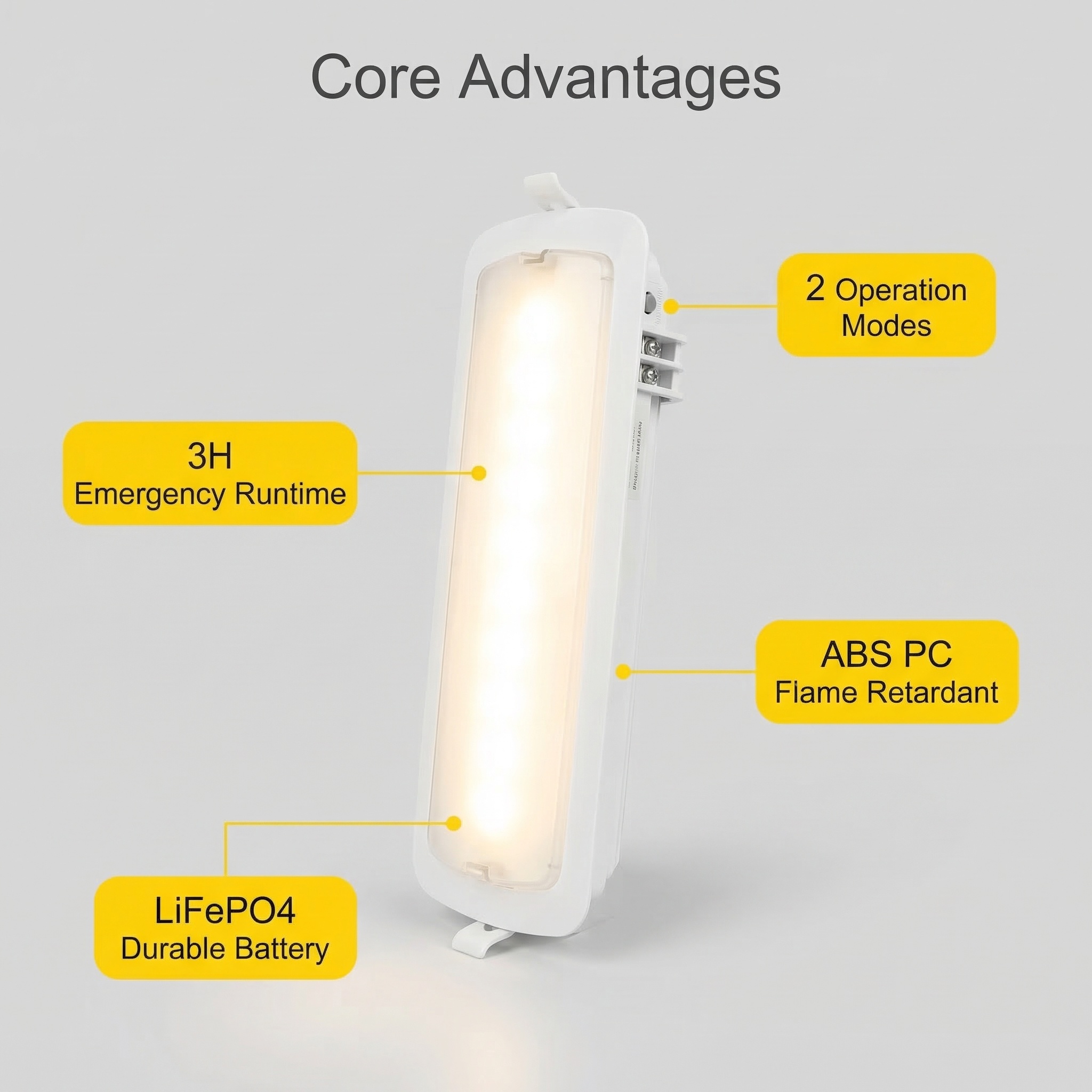
Self-contained emergency lighting with selectable 90 minute to 3 hour duration and maintained or non-maintained wiring.
Frequently Asked Questions About Emergency Lighting
Minimum Order Quantity And Price Drivers
Q: What is your MOQ and what drives price per unit?
MOQ is 500 pieces for standard emergency drivers, 300 for emergency exit signs, and 1000 metres for LED strip orders. Price steps occur at 1,000, 3,000 and 10,000 units. The three largest cost drivers are battery chemistry (LiFePO4 costs 15-20% more than Li-ion 18650, NiCd is cheaper but heavier), whether the output is full-power (100% of normal lumens) versus reduced emergency output (10-30% of normal lumens), and the inclusion of automatic self-test firmware versus manual test key only.
Matching The Module To The Host Fixture
Q: How do I confirm your emergency driver will work with my existing luminaire?
Check four parameters: the driver’s AC input range (typically 85-265V or 100-277V) must match your mains supply; the DC output window (for example 20-42V at 350mA or 700mA) must fall within your LED module’s forward voltage and current rating; the driver’s maximum driven load in watts must equal or exceed your fixture’s LED wattage; and the physical dimensions must fit inside your housing. Request a photometric report showing emergency light output in lumens and as a percentage of normal output, tested to EN 1838 or UL 924 minimums for the intended mounting height.
Emergency Duration And Output Options
Q: What emergency durations and light outputs are available?
Standard durations are 90 minutes, 2 hours and 3 hours. Output options divide into reduced output (10-30% of normal lumens, typical for open-area escape lighting) and full-power output (100% of normal lumens, required for high-risk task areas and anti-panic lighting under BS 5266-1 and EN 1838). A 10W LED panel on full-power emergency output needs roughly a LiFePO4 6.4V 3000mAh pack for 90 minutes, or 6.4V 6000mAh for 3 hours. Reduced-output versions use smaller batteries and cost less.
Maintained Versus Non-Maintained Wiring
Q: Can your modules do maintained, non-maintained, or switched maintained operation?
All three wiring modes are available. Non-maintained uses two wires (line and neutral) to the driver; the battery charges in standby and the inverter activates only on mains failure. Maintained requires a permanent live, a switched live, and neutral; the changeover relay selects between mains-powered normal operation and battery-powered emergency mode. Switched maintained is identical but the switched live comes from a local control switch. Specify your requirement before ordering; the PCB layout and relay specification differ.
Self-Test And Remote Monitoring Options
Q: What test facilities do your emergency drivers include?
Options are manual test key only, automatic self-test to EN 62034, and DALI-2 self-test with emergency data reporting. Manual test requires a physical pushbutton or key switch. Self-test firmware performs a brief functional test every 28 days and a full duration test annually, with status indicated by a bi-colour LED. DALI self-test adds addressable reporting of battery health, lamp failure, and test results to a central monitoring system. DALI versions cost 25-30% more and require compatible infrastructure.
Battery Chemistry Replacement And Cycle Life
Q: What battery chemistries do you offer and how often must they be replaced?
LiFePO4 3.2V cells in series configurations (3.2V, 6.4V, 12.8V) deliver 800-1,500 cycles to 80% capacity with charge times of 12-16 hours; replacement interval is typically 5-7 years. Li-ion 18650 3.7V packs achieve 500-800 cycles, charge in 8-12 hours, and last 3-5 years; higher energy density suits compact modules. NiCd 1.2V cells offer 300-500 cycles, tolerate -20°C to +50°C ambient, but contain cadmium with disposal restrictions under EU Battery Directive 2006/66/EC. All chemistries require annual testing to EN 62034 or BS 5266-1.
Lead Time Samples And Production Scheduling
Q: What is your lead time and sample policy?
Standard lead time is 25-30 days after order confirmation and deposit. Samples ship in 5-7 days for existing models, 12-15 days for customised output voltage or connector configurations. Sample cost is 1.5-2 times the unit price, credited against the first production order. For orders above 5,000 pieces, confirm whether raw materials are in stock; battery cells and changeover relays are the longest-lead components at 4-6 weeks if not held in inventory.
Payment Terms And Export Documentation
Q: What payment structure do you accept and what documents accompany shipment?
Standard terms are 30% deposit, 70% against copy of bill of lading for FOB Shenzhen or CIF destination port. Letters of credit are accepted for orders above USD 50,000 with confirmation charges borne by the buyer. Documents include commercial invoice, packing list, bill of lading or airway bill, and certificate of origin. For CE-marked goods, the supplier should provide a Declaration of Conformity and technical construction file upon request; for UL-listed destinations, ask for the supplier’s UL file number and authorisation letter.
Conformity Marks And Third-Party Test Reports
Q: Which test reports and conformity marks can you supply for my market?
For the UK and EU, ask for test reports to EN 60598-2-22, EN 1838, EN 62034 and IEC 61347 from an accredited laboratory; the CE mark must be supported by a technical file. For the US, UL 924 test reports are required; verify the laboratory is OSHA NRTL-accredited. For Australia and New Zealand, request AS/NZS 2293.2 test reports. The supplier should provide battery UN 38.3 test summaries for lithium chemistries. Do not accept a supplier’s claim of certification without viewing the actual report number and scope.
Lithium Battery Shipping And Transport Documents
Q: How do lithium batteries affect shipping mode and required documents?
LiFePO4 and Li-ion 18650 packs are Class 9 dangerous goods under UN 3480 or UN 3481. Air freight requires IATA PI 965-970 compliant packaging, a UN 38.3 test summary for each cell and battery model, and a shipper’s declaration; many carriers limit lithium content to 35kg per package. Sea freight follows IMDG Code SP 188 or full dangerous goods declaration depending on watt-hour rating. Road freight within China to port requires a road transport dangerous goods declaration. These rules add 3-5 days to documentation lead time and USD 200-400 per shipment in handling fees.
Warranty Spare Parts And After-Sales Engineering
Q: What warranty do you offer and can you support field replacements?
Standard warranty is 3 years for the electronic module, 2 years for Li-ion batteries, 3 years for LiFePO4, and 1 year for NiCd. The warranty covers manufacturing defects, not improper installation or ambient temperature exceedance. Ask whether the supplier stocks replacement battery packs, inverter boards, and changeover relays as spare parts with part numbers traceable to your order. After-sales engineering support means the supplier can diagnose flicker, premature battery failure, or compatibility issues via video call and provide revised firmware or output current settings remotely.
OEM Branding Packaging And Private Labelling
Q: Can I order private-labelled products with my branding and manual?
OEM branding is available at 1,000 pieces minimum for standard models, 3,000 for custom silkscreen or carton print. The supplier should provide template files for the product label, carton mark, and multi-language manual covering wiring diagrams for maintained and non-maintained circuits, battery replacement procedure, and the test interval schedule required by EN 62034 or local regulations. Verify that your brand name appears on the Declaration of Conformity if you are the legal manufacturer under EU or UK market surveillance requirements.
Installation Support And Commissioning
Q: Do you provide installation guidance and commissioning documentation?
The supplier should furnish wiring diagrams showing connection of the permanent live, switched live, neutral and earth for maintained circuits; the line and neutral only for non-maintained; and DALI bus wiring if applicable. Commissioning requires a recorded functional test of full duration, measured emergency light output in lux at floor level compared to the design minimum from EN 1838, and verification of the test schedule programming. Ask for a commissioning certificate template and whether the supplier’s engineering team is available for video support during first installations in a new market.
Important Notice
Specifications, output and duration figures and price ranges in this guide are indicative and are provided
for planning purposes only. Actual emergency output, duration, battery life, ingress protection and available conformity documentation
differ by model and by destination country, and emergency lighting design remains the responsibility of the project designer. Buyers
must confirm their own mains voltage and frequency, the emergency lighting standard enforced locally, the host fixture compatibility
and their import requirements before placing an order. All figures are subject to written confirmation in the final proforma invoice
issued by Hymark.
Sourcing Emergency Lighting from Hymark
What to Request in Your First Enquiry
Send the host fixture type and wattage, the emergency duration your code requires, your mains voltage and your destination port. Hymark returns a quotation within 24 hours via WhatsApp or email.
Get a Factory Direct Quote on Emergency Lighting
JIALINGHANG ELECTRONIC CO., LTD. has been in LED lighting since 2013 and has focused on
LED emergency technology and high performance LED strips since 2017. Hymark products are co-designed with our
dedicated manufacturing partners, built with selectable emergency duration and maintained or non-maintained wiring, and function
tested before packing. Send us the host fixture type and wattage, the emergency duration your local code requires, your mains
voltage and your destination port and we will return a quotation within 24 hours.


 English
  Spanish
  Arabic
  French
  German
  Russian
  Portuguese
  Italian
  Vietnamese