
Emergency Lighting Buyer Guide
The right auto-test emergency light supplier depends on whether your project needs self-test per EN 62034, DALI-2 emergency integration, or both, and whether the factory can prove discharge records for the exact duration your code requires—90 minutes for EN 1838 and BS 5266-1, 90 minutes for UL 924, or 2 hours for AS/NZS 2293. A genuine manufacturer ships emergency drivers with constant current output windows of 9-42V DC at 150-500mA, driving 3W to 25W emergency loads from LiFePO4 3.2V 1500mAh to 6000mAh packs or NiCd 3.6V 1200mAh to 4000mAh packs, with charge times of 16-24 hours and cycle lives of 300 cycles for NiCd versus 500-800 for LiFePO4.
This page covers how to audit a factory’s actual manufacturing depth versus trading-office packaging: SMT lines, battery traceability, ageing and hipot stations, third-party test report scope, sample lead times, and payment structures that protect buyers.
In-House SMT and Assembly Capacity
Ask for photos with timestamps of pick-and-place lines handling emergency driver PCBs, not just finished luminaires. A real factory runs surface-mount for the inverter board, battery management IC, and changeover relay in the same facility or under direct subcontract with weekly audits. Trading offices show you generic assembly benches and cannot specify the copper weight—typically 1oz to 2oz—or PCB width for the driver module. Request the bill of materials for the auto-test firmware chip; if they cannot name the supplier of the microcontroller running the EN 62034 self-test algorithm, they are not designing the product.
Battery Sourcing and Traceability
LiFePO4 cells for аварийное освещение must ship with UN 38.3 test summaries for air freight and IMDG compliance for sea containers. Demand cell-level lot numbers linking to discharge test records at 0.2C rate for the full rated duration—90 minutes, 120 minutes, or 180 minutes—at the declared emergency wattage. A 3.2V 3000mAh LiFePO4 pack delivers roughly 9.6Wh; at 80% inverter efficiency, that supports 4W for 115 minutes, not the 180 minutes some suppliers claim. Traceability means the factory can show you the cell manufacturer’s datasheet, not just a printed label they applied.
Discharge and Duration Test Records
Every production batch of emergency drivers needs sampled discharge testing at 25°C ambient and at the lower limit of the rated temperature range, often 0°C or -10°C for IP65 outdoor units. Ask for the last three months of records: date, batch number, test duration, lumen output at 60 seconds and at the end of the emergency period as percentage of normal output—typically 10% for escape route lighting per EN 1838, higher for high-risk task areas. If the factory has no climate chamber and relies on supplier certificates, they are not controlling output.
Ageing and Hipot Test Stations
Ageing racks run emergency drivers at 85-265V AC input for 2-4 hours at full load before final test. Hipot stations apply 1500V AC or 3000V DC between primary and secondary for 60 seconds per IEC 61347-2-7. Count the stations: ten ageing sockets and one hipot unit cannot support claimed monthly output. Photograph the calibration stickers; expired calibration means invalid test results.
Third-Party Test Reports for the Destination Market
Do not accept a generic CE document. For the UK, ask for a test report to BS EN 60598-2-22 with the SAA or BSI mark scope listed. For the Middle East, request SASO or ECAS conformity evidence. For Southeast Asia, check whether the report covers the specific mains voltage—220-240V at 50Hz for Singapore, 220V at 60Hz for Philippines. The report must match the exact model number on your purchase order, not a “family” covering twenty variants.
Sample Lead Time and Production Lead Time
A factory with in-house SMT delivers auto-test emergency driver samples in 7-12 days, complete emergency luminaires in 14-21 days. Trading offices quote 25-35 days because they relay to a distant factory. Production lead time for 500-2000 units runs 25-35 days after deposit; for 5000+ units, 40-55 days. LiFePO4 battery packs extend lead time by 5-10 days versus NiCd due to cell procurement cycles.
Payment Structure and Risk Allocation
First orders with a new supplier should use 30% deposit, 70% against copy of bill of lading, or letter of credit at sight for orders above USD 30,000. Avoid 100% advance for untested factories. For OEM luminaire projects where Hymark supplies emergency drivers for your housing, tooling costs for custom firmware or connector configurations run USD 800-2500, amortized across the first 10,000 units.
After-Sales Engineering Capability
Auto-test firmware occasionally needs field updates for DALI-2 compatibility or local utility demand-response integration. Confirm the supplier has firmware engineers, not just sales staff forwarding WeChat messages to a distant programmer. Ask for a written commitment on firmware revision documentation and whether they can remotely diagnose test-failure logs from the driver memory.
Types and Configurations of Emergency Lighting
Full-Power Emergency Drivers for LED High Bays and Linear Fixtures
| Type or Class | Typical Rating or Output | Duration or Runtime | Best Suited For | Notes |
|---|---|---|---|---|
| Full-power emergency driver (LED high bay) | 100W–200W normal, 100% output in emergency | 90 min or 180 min | Warehouses, manufacturing halls, sports facilities | Requires dedicated battery pack and heatsink compatibility |
| Reduced-power emergency driver (LED panel/tube) | 40W–60W normal, 10%–30% output in emergency | 90 min or 180 min | Offices, corridors, retail | Lower battery cost, longer duration possible |
| Self-test emergency driver with DALI | 20W–100W normal, configurable 10%–100% emergency | 90 min to 3 hours | Smart buildings, BMS-integrated sites | EN 62034 automated test scheduling |
| Non-maintained exit sign luminaire | 3W–8W LED, 50–200 cd/m² face brightness | 90 min or 180 min | All escape routes | BS 5266-1 / EN 1838 viewing distance compliance |
| Maintained recessed emergency downlight | 10W–25W normal, 100% or 10% emergency | 90 min | Hotels, healthcare, circulation areas | Changeover relay switches to battery on mains failure |
| COB LED emergency strip (IP65) | 14.4W/m, 1200 lm/m, 420 LEDs/m, CRI 90, 3000K–6000K | 90 min to 3 hours (with driver) | Cove lighting, stair nosing, architectural accent | 24V DC working, 50mm cut length, 10mm PCB, 2oz copper |
Full-power emergency drivers deliver identical lumen output in emergency mode as during normal operation, typically 100W to 200W for LED high bays in warehouses and manufacturing halls. These units draw from a LiFePO₄ battery pack, commonly 12.8V 6000mAh or 25.6V 3000mAh configurations, with a constant current inverter output of 36V–80V DC at 700mA–1400mA depending on the LED load. Procurement officers for industrial projects specify these when operational continuity is critical, such as in production lines where safe shutdown requires full illumination. The trade-off is battery bulk: a 200W full-power system needs roughly 25.6V 12000mAh LiFePO₄, weighing 8–12 kg and occupying 300mm × 200mm × 80mm in the luminaire housing. A trading office will often quote this specification without verifying the driver can sustain thermal management for 90 minutes at full load; ask for discharge test records at 25°C and 45°C ambient.
Reduced-Power Emergency Drivers for LED Panels and Tubes
Reduced-power emergency drivers, also called partial-output or standby-lumen units, typically provide 10% to 30% of normal output in emergency mode—so a 40W LED panel producing 4000 lumens normally yields 400–1200 lumens for 90 minutes. The battery pack scales accordingly: a 3.2V 6000mAh LiFePO₄ cell in series-parallel configuration (12.8V nominal) supports a 10W emergency load for 180 minutes. Electrical contractors favour these for corridor and office retrofits because the battery fits within standard ceiling void depths of 60mm–80mm. What this class cannot do: illuminate task areas for continued work during prolonged outages. EN 1838 mandates minimum 1 lux on the centre line of escape routes; reduced-power drivers meet this but do not preserve working plane illumination. When a supplier quotes “90 minutes at 10%,” verify whether the percentage refers to lumen output or wattage—lumen maintenance varies by LED bin and driver efficiency.
Self-Test and DALI-Enabled Emergency Systems
Self-test emergency drivers incorporate EN 62034-compliant automatic test circuitry, performing brief functional tests every 4 weeks and full duration tests annually without manual intervention. DALI-2 emergency extensions add network reporting to building management systems. A typical specification: 20W–100W normal load, emergency output configurable from 10% to 100% via DIP switch or DALI command, with a Li-ion 18650 11.1V 5200mAh pack and 3-hour charge time from depleted state. Facility managers in UK and European commercial buildings specify these to eliminate the labour cost of manual test key operations across 500+ luminaire installations. The limitation is commissioning complexity: DALI emergency devices require unique short addresses, and a trading office often ships generic drivers without pre-configuration, leaving site electricians to address and group devices. Ask suppliers whether they provide DALI application files (.DAF) and whether the self-test firmware supports 90-minute, 120-minute, or 180-minute duration variants selectable in software.
Non-Maintained Exit Sign Luminaires
Non-maintained exit signs illuminate only upon mains failure, drawing zero standby power from the battery during normal operation. Typical ratings: 3W to 8W LED face illumination, 50 to 200 cd/m² luminance depending on viewing distance per EN 1838 and BS 5266-1, with a 3.6V 1800mAh NiCd or 3.2V 1500mAh LiFePO₄ battery providing 90 or 180 minutes. The changeover relay or solid-state switch must activate within 5 seconds of mains failure per EN 60598-2-22. Wholesalers and distributors stock these in bulk for new-build residential and commercial projects in the Middle East and Southeast Asia, where maintained wiring is not standard practice. What they cannot do: serve as normal illumination—the face is unlit during everyday operation, so they do not contribute to ambient lighting calculations. Battery chemistry choice matters for export: NiCd packs face transport restrictions and environmental regulations in the EU, while LiFePO₄ requires UN 38.3 test summary documentation for air freight.
Maintained Recessed Emergency Downlights
Maintained emergency downlights operate as normal luminaires powered by mains, switching to battery via changeover relay during power failure. Common specifications: 10W–25W normal LED load, 100% maintained output or selectable 10% emergency output, with 12.8V 3000mAh LiFePO₄ providing 90 minutes. Input voltage range is typically AC 220–240V 50Hz for UK/European markets or AC 85–265V 50/60Hz for universal export. Lighting designers specify these in hotels and healthcare where ceiling aesthetics must remain consistent—no separate emergency fitting is visible. The constraint is wiring complexity: maintained circuits require a switched live for normal control plus permanent live for charging, and the luminaire OEM must ensure the changeover relay is rated for the inrush current of the LED driver. A real manufacturer will show relay contact ratings (typically 2A at 250V AC resistive) and hipot test records at 1500V AC for 60 seconds; a trading office often omits these details.
COB and SMD LED Emergency Strip Systems
Emergency LED strip systems combine architectural flexibility with life safety compliance. COB strips at 14.4W/m, 1200 lm/m, 420 LEDs/m with CRI 90 and colour temperature 3000K–6000K operate at 24V DC with 50mm cut length on 10mm PCB with 2oz copper weight. For emergency function, a dedicated 24V DC emergency driver with 11.1V 5200mAh Li-ion 18650 pack provides 90 minutes at 50% output (600 lm/m) or 180 minutes at 25% output. IP65 silicone-coated variants suit stair nosing and exterior cove applications. Luminaire OEMs adding emergency versions to their fixtures buy these as modular sub-assemblies. The limitation is voltage drop: at 24V, 5-metre runs exceed 3% loss without supplementary power feed, and emergency drivers rarely exceed 60W total output. Verify the supplier’s PCB copper weight—1oz copper cannot sustain 14.4W/m over 5 metres without excessive temperature rise, whereas 2oz copper maintains Tj below 85°C.
Supplier Qualification: Verifying Manufacturer Capability
Distinguishing a real emergency lighting manufacturer from a trading office requires direct evidence of production control, not catalogue claims. SMT and assembly capacity: ask for photos of pick-and-place lines with date stamps, or request a video call showing your specific PCB in reflow. A factory with in-house SMT runs 2–4 lines for emergency driver PCBs, typically 0402 and 0805 passive components plus SOIC microcontroller packages for self-test firmware. Battery sourcing and traceability: legitimate manufacturers hold cell-level UN 38.3 reports for each lithium battery SKU, with supplier batch codes traceable to incoming inspection records. Demand the cell manufacturer’s name (e.g., EVE Energy, Lishen, CATL for LiFePO₄) and the pack assembly date code.
Discharge and duration test records: every emergency driver batch must undergo 100% discharge duration testing at rated load. A real factory maintains ageing racks with automated cut-off logging; ask for a sample test report showing 90-minute discharge curves at 25°C and 55°C ambient. Ageing and hipot stations: hipot testing at 1500V AC or 3000V DC for 60 seconds verifies insulation between mains and output circuits; ageing runs for 2–4 hours at 40°C ambient catch infant mortality in electrolytic capacitors. Third-party test reports: while this article does not claim specific certificates for Hymark, buyers should request CB test reports to IEC 61347-2-7 for emergency lighting units, or ENEC test reports for European markets. Verify the report covers the exact model number on your purchase order, not a “family” certificate.
Sample lead time: a genuine manufacturer with in-house SMT produces first-off samples in 7–10 working days for existing platforms, or 15–20 days for modified firmware or custom battery configurations. Trading offices quote 3–5 days because they ship from stock, but cannot modify firmware or retest duration. Payment structure: factories typically accept 30% T/T deposit, 70% against copy of B/L for FOB Shenzhen; trading offices often demand 100% advance for small orders. After-sales engineering: real manufacturers assign application engineers who can explain why a 200W full-power driver trips thermal protection at 50°C ambient, or how to configure DALI test schedules. Request a technical contact for video troubleshooting before placing volume orders.
Export Practicalities and Price Drivers
Mains voltage and frequency vary by destination: UK and UAE require 220–240V 50Hz, North America 120–277V 60Hz, Southeast Asia mixed 220V 50Hz and 127V 60Hz. Drivers with 100–277V input cover most markets but cost 15–20% more than 220–240V single-voltage units. Conformity marks: UKCA for Great Britain, CE for EU, RCM for Australia (AS/NZS 2293), UL mark for North America (UL 924). Customs in Saudi Arabia and UAE increasingly require SASO IECEE recognition for CB reports.
Lithium battery transport rules dominate logistics cost: UN 38.3 testing is mandatory for air freight (IATA DGR Section II or PI 965–967), with state-of-charge limited to 30% for standalone shipments. Sea freight (IMDG Code) is less restrictive but requires dangerous goods declaration. Carton packing: typically 20–40 units per carton, 10–12 cartons per pallet for exit signs; battery packs ship separately in UN-certified fibreboard boxes (4G/X) with lithium handling labels. FOB Shenzhen port versus CIF destination: CIF adds 8–15% for sea freight insurance and handling, with transit 25–35 days to UK/Europe, 14–18 days to Middle East.
MOQ and lead time: standard emergency drivers run 500–1000 pieces MOQ with 25–30 day production lead time; customised battery capacities or firmware extend to 45–50 days. Sample policy: 1–5 units at 1.5×–2× volume unit price, refundable against first order of 1000+ pieces. Price drivers in 2025: LiFePO₄ cell costs declined 20% from 2022 peaks but remain 40% above NiCd equivalent capacity; aluminium enclosure prices fluctuate with LME rates; EN 62034 self-test firmware adds $3–$5 BOM cost over manual-test variants. Buyers evaluating “best auto-test function emergency light supplier” should weigh whether the premium for self-test and DALI is recovered in reduced maintenance labour over a 10-year building lease.

Specifications and How to Read Them
| Parameter | Entry Level | Mid Range | High Specification |
|---|---|---|---|
| Input voltage | AC 85-265V 50/60Hz | AC 100-277V 50/60Hz | AC 220-240V 50Hz |
| Driven load | 3W LED module | 10W LED panel | 50W LED high bay |
| DC output window | 9-12V DC 350mA | 25-40V DC 500mA | 180-260V DC 240mA |
| Emergency output | 180lm (60% of normal) | 600lm (60% of normal) | 3000lm (60% of normal) |
| Emergency duration | 90 minutes | 3 часа | 3 часа |
| Battery chemistry | NiCd 3.6V 1500mAh | Li-ion 18650 7.4V 2600mAh | LiFePO4 12.8V 3000mAh |
| Charge time | 24 hours | 6 hours | 4 hours |
| Cycle life | 300-500 cycles | 800-1000 cycles | 1500-2000 cycles |
| Test facility | Manual test key | Self-test to EN 62034 | DALI-2 self-test |
| Wiring mode | Не обслуживается | Не обслуживается | Maintained or non-maintained |
| IP/IK rating | IP20 / IK04 | IP65 / IK07 | IP66 / IK08 |
| Ambient temperature | 0°C to +40°C | -10°C to +45°C | -20°C to +55°C |
| Размеры | 280×80×45mm surface | 600×600×50mm recessed | 200×150×80mm bulkhead |
| Sample lead time | 7 days | 10-12 days | 14-18 days |
| MOQ | 500 units | 200 units | 50 units |
How to Read an Emergency Lighting Datasheet Line by Line
Input voltage range and frequency. This tells you whether the driver will survive your local grid. AC 85-265V covers most of the world except Japan’s 100V nominal; AC 220-240V is UK and EU specific. Frequency 50/60Hz means the unit works in both regions. Ask for test records at the voltage extremes—some entry-level units overheat at 265V after 30 minutes.
Driven load in watts. This is the LED luminaire’s normal-mode consumption, not the emergency output. A 50W high bay needs a driver rated for at least 50W normal plus the inverter overhead. Overrating by 20% is standard practice. The datasheet must state whether this is LED load only or includes driver losses.
DC output voltage window and current. The inverter outputs DC to match the LED module’s forward voltage. Constant current output—350mA, 500mA or 700mA—is preferred because it prevents thermal runaway. The voltage window must overlap your LED module’s Vf curve. If your LED panel needs 30-36V and the emergency driver outputs 25-40V, it works. If the driver tops out at 28V, it does not.
Emergency output in lumens and as percentage of normal. EN 1838 requires minimum illuminance on the escape route, not a fixed percentage. Most manufacturers design for 60% of normal output because that hits the lumen target with typical LED efficacy. A 1000lm normal downlight giving 600lm in emergency mode is standard. Higher percentages exist but drain the battery faster or require larger packs.
Emergency duration. Ninety minutes satisfies UK BS 5266-1 and most of Asia. Three hours is standard for healthcare, high-risk task areas, and some Middle East specifications. The duration test must be at the end of battery life, not on a fresh cell. Ask for discharge curves at year 3 and year 4.
Battery chemistry voltage and capacity. NiCd 3.6V packs are cheap, tolerate heat poorly, and carry memory-effect risk. Li-ion 18650 7.4V 2600mAh doubles energy density but needs protection circuits and UN 38.3 transport documentation. LiFePO4 12.8V 3000mAh costs most upfront, delivers 1500-2000 cycles, and operates to -20°C. Capacity in mAh alone is meaningless without voltage—multiply V × Ah for watt-hours, then divide by emergency load for real duration.
Charge time and cycle life. Twenty-four hours for NiCd reflects trickle-charge limitations. Six hours for Li-ion needs a CC-CV charger IC. Four hours for LiFePO4 demands active cell balancing. Cycle life claims assume shallow discharges to 80% depth; full discharges every cycle halve the number. Ask for the test protocol: IEC 61960 for Li-ion, IEC 60622 for NiCd.
Test facility. Manual test key is a switch you press monthly. Self-test to EN 62034 automates duration and function tests with LED status indicators. DALI-2 self-test reports over the lighting network to a central BMS. DALI adds £15-25 to unit cost and requires a DALI bus. Self-test is mandatory for many UK NHS and school contracts.
Maintained or non-maintained wiring. Non-maintained: lamp off in normal power, on in emergency. One switched live plus neutral. Maintained: lamp on whenever the local switch is on, and stays on via battery when power fails. Needs permanent live, switched live, and neutral. Maintained emergency drivers contain a changeover relay rated for the normal-mode current—typically 2A at 250V AC. Check relay contact material; silver-nickel is standard, silver-cadmium-oxide for inductive loads.
IP and IK rating. IP20 suits dry interior corridors. IP65 with sealed gasket for car parks and plant rooms. IP66 with breather valve for external bulkheads in driving rain. IK04 resists a 0.25kg mass dropped 200mm. IK08 survives 5kg from 400mm—specify for prisons, sports halls, and railway applications. Ask for third-party IP test reports; self-declaration is common and often optimistic.
Ambient temperature range. 0°C to +40°C is warehouse standard. -20°C to +55°C covers uninsulated plant rooms in the Gulf summer and Nordic winter. Lithium-ion charging below 0°C risks plating and short-circuit; the driver must inhibit charge or the battery needs a heating pad. LiFePO4 charges to -10°C typically.
Dimensions and mounting. Surface boxes need 35mm minimum depth for 90-minute NiCd, 50mm for 3-hour LiFePO4. Recessed modules fit standard ceiling grids. Bulkheads with hinged gear trays allow battery replacement without tools. Check mounting centres against your fixing pattern—European 60mm centres do not match UK 50.8mm (2 inch) legacy boxes.
Strip Product Specifics
For LED strip emergency drivers, the datasheet adds: working voltage 12V DC or 24V DC or 48V DC; strip power in W/m from 4.8W/m (low-density SMD2835) to 19.2W/m (high-density COB); lumens per metre from 400lm/m to 2000lm/m depending on efficacy and density; LEDs per metre at 60, 120, 240, or 480 for COB continuous; CRI 80 for general escape lighting, 90+ for retail and healthcare where colour discrimination matters; colour temperature 3000K, 4000K, or 6000K with 4000K most common for emergency because it maximises perceived brightness at low output; cut length every 50mm at 12V, every 100mm at 24V, every 200mm at 48V; PCB width 8mm, 10mm, or 12mm with 2oz or 3oz copper for thermal management; reel length 5 metres standard, 10 metres on request. IP20 strip in aluminium extrusion with diffuser achieves IP44; silicone-encapsulated strip to IP65; full extruded jacket to IP67.
Supplier Qualification: Factory Versus Trading Office
SMT and assembly capacity. A real manufacturer owns or directly controls surface-mount lines for LED driver PCBs. Ask for photos with date stamps, or better, video call the factory floor. Minimum viable capacity: two SMT lines, one for driver boards, one for LED modules. Trading offices rent factory space for your visit and disappear when quality issues arise. Check whether the same address handles both SMT and final assembly—some suppliers subcontract SMT 200km away and lose traceability.
Battery sourcing and traceability. The battery is the failure point in most emergency luminaires. Ask for cell manufacturer: BAK, EVE, Lishen for Li-ion; BYD or CATL sub-brands for LiFePO4. The supplier should provide cell lot numbers, weld inspection records, and BMS firmware version. UN 38.3 test summary documents must name the exact cell model inside your pack, not a generic family. Trading offices often switch cells without notice when their broker finds cheaper stock.
Discharge and duration test records. Every production batch should have 100% duration test or at least AQL sampling at ISO 2859-1 General I level. Ask for a test record from last month: serial number, battery voltage before and after discharge, lumen output at 30 minutes, 60 minutes, and end point, ambient temperature during test. Records should be machine-printed with timestamps, not handwritten on demand.
Ageing and hipot test stations. Hipot (dielectric withstand) at 1500V AC or 3000V AC depending on insulation class checks for creeping faults in transformer windings. Ageing runs the assembled driver at 40°C ambient for 4-8 hours before final test. A factory with 50+ ageing racks has volume; one with two racks and excuses has capacity constraints.
Third party test reports for the destination market. EN 60598-2-22 and EN 1838 reports from accredited labs—SGS, TÜV, Intertek, DEKRA—are standard for EU and UK. BS 5266-1 compliance is design-based, not certificated, but a UKCA or CE declaration should reference it. UL 924 for North America requires factory follow-up service; a one-off test report is insufficient. AS/NZS 2293 needs Australian electrical approval and local representative. Ask for the report number and check it on the lab’s database; some suppliers Photoshop old reports.
Sample lead time. Seven days implies stock components and no customisation. Ten to twelve days suggests scheduled production with minor PCB changes. Fourteen to eighteen days for high-spec units with custom lithium packs and DALI firmware. Shorter than seven days for a claimed factory usually means they are buying from stock at the market and relabelling.
Payment structure. Trading offices demand 30% deposit, 70% against copy of B/L because they lack cash flow. Established manufacturers accept 30% T/T, 70% L/C at sight or 60 days open account for repeat buyers. L/C adds $300-500 bank charges and is standard for Middle East and African government tenders. T/T in advance is highest risk for buyer; insist on at least documentary collection or escrow for first orders above $10,000.
After-sales engineering capability. Ask who answers when a 3-hour duration unit fails at 2 hours in a Dubai hotel. A trading office forwards your complaint to the factory WeChat group and waits. A real manufacturer has application engineers who can read inverter oscilloscope traces, adjust CC-CV curves remotely, and fly to site with replacement packs and firmware cables. Check whether they stock replacement batteries with the same cell model three years after original shipment—cell obsolescence is common.
Trade Terms and Export Practicalities
FOB (Free On Board). Seller delivers goods onto the vessel at named port of loading—Shenzhen, Ningbo, Shanghai. Buyer pays ocean freight, insurance, and destination charges. FOB is standard for containerised emergency lighting. Clarify whether FOB includes export customs clearance; in China it should, but some suppliers add ¥800-1500 as a surprise.
CIF (Cost Insurance Freight). Seller pays to destination port. Insurance covers total loss, not partial water damage unless you inspect at port and claim immediately. CIF adds 3-5% to FOB for freight and 0.3% for insurance. For lithium battery shipments, CIF is simpler because the seller handles IMDG documentation, but verify they use freight forwarders certified for Class 9 dangerous goods.
CFR (Cost and Freight). Like CIF but buyer arranges insurance. Rare in practice because marine insurers prefer seller-arranged coverage for consistency.
EXW (Ex Works). Buyer collects from factory door. You handle China export clearance, trucking to port, and all documentation. Only use EXW if you have a China freight agent; otherwise customs delays and demurrage erase any savings.
L/C (Letter of Credit). Bank guarantees payment against compliant documents. Discrepancies in packing list weights, certificate of origin dates, or BL notify party names trigger rejection and $100-300 amendment fees. Emergency lighting with lithium batteries needs the UN 38.3 test report referenced in the L/C documents or the bank may refuse payment.
T/T (Telegraphic Transfer). Direct bank wire. 30% deposit confirms order, 70% before shipment is standard for new relationships. For repeat orders, negotiate 70% against copy of BL. T/T is fastest but offers no documentary protection.
HS code. 9405.40 for electric lamps and lighting fittings including emergency lighting. Some customs authorities classify emergency drivers under 8504.40 (static converters) if sold separately. Confirm with your customs broker; wrong classification delays clearance and attracts penalties.
CE and UKCA marking. CE requires EU declaration of conformity and technical file held in Europe. UKCA replaces CE for Great Britain; Northern Ireland accepts CE under Windsor Framework. The supplier must provide the DoC with their name and address, product model, and standards referenced. You as importer or distributor hold legal responsibility if the DoC is fabricated.
UN 38.3 battery test report. Mandatory for lithium battery air and sea transport. Tests T.1 through T.8 cover altitude simulation, thermal cycling, vibration, shock, external short circuit, crush, overcharge, and forced discharge. The report must name the cell manufacturer, model, and watt-hour rating. IATA limits standalone lithium-ion cells to 30% state of charge for air freight; assembled packs in equipment may ship at higher SOC with carrier approval. IMDG Code Section 3.4 for sea freight is less restrictive but needs proper shipping name “LITHIUM METAL BATTERIES” or “LITHIUM ION BATTERIES” and Class 9 label.
Packing list and certificate of origin. Packing list must match BL carton counts and weights exactly. Certificate of origin Form E for ASEAN, Form A for GSP countries, or ordinary CO from China Council for International Trade. Some Middle East buyers require legalised CO with chamber of commerce and embassy stamp—add 5-7 days and $50-150 per document. Battery shipments need the UN 38.3 test summary as a separate document, not embedded in the packing list.
Carton and pallet packing. Individual carton 0.03-0.05 CBM for bulkhead units, 10-12 units per carton. Pallet to 1.2m × 1.0m Euro or Asia standard, 500-800kg maximum for floor loading. Double-wall corrugated for ocean freight; single-wall acceptable for air. Lithium battery cartons need the UN 4G/X specification mark or the inner packaging must pass the 1.2m drop test.
MOQ and lead time. Entry-level maintained/non-maintained bulkheads: 500 units, 21-28 days. Mid-range self-test panels: 200 units, 35-42 days including driver PCB procurement. High-specification DALI high bay emergency drivers: 50 units, 45-55 days for LiFePO4 pack qualification and firmware validation. Sample policy: one unit free for established distributors, chargeable at 1.5× unit cost for new enquiries, refunded against first order.

Emergency Lighting Price and What Drives It
| Class | Typical Rating or Output | Duration or Runtime | Indicative FOB USD |
|---|---|---|---|
| Basic LED exit sign, non-maintained | 8-15 lm face illumination, single-sided | 90 min | $4.50 – $8.00 |
| Mid-range LED exit sign, self-test | 20-35 lm face illumination, double-sided | 90 min | $9.00 – $16.00 |
| Economy emergency bulkhead, non-maintained | 150-250 lm at 3W LED | 90 min | $7.00 – $12.00 |
| Performance emergency bulkhead, maintained | 300-500 lm at 5W LED, 10-20% normal output | 3 h | $14.00 – $24.00 |
| Emergency twin spotlight, non-maintained | 2 × 150 lm at 3W each | 90 min | $11.00 – $19.00 |
| LED emergency driver for high bay/panel | 10W at 25-40% normal output, DC 24-42V 250mA | 90 min – 3 h | $18.00 – $35.00 |
| Full power emergency driver | 100% normal output, DC 36-55V 350mA | 90 min – 2 h | $32.00 – $58.00 |
| DALI-addressable emergency driver with monitoring | 10-20W, programmable output, DC 24-50V 200-400mA | 3 h | $45.00 – $78.00 |
These bands assume factory-direct FOB Shenzhen or FOB Ningbo for minimum order quantities of 500-1000 pieces, single-model runs, and standard white or black ABS/polycarbonate housings. Custom colours, laser-etched legends, or mixed MOQs shift pricing toward the upper bound.
What Actually Drives the Factory Gate Price
The bill of materials for a typical 3-hour maintained emergency bulkhead selling at $18-22 FOB breaks down roughly as follows, based on April 2025 component pricing for a 1000-piece batch:
Battery pack: 35-45% of ex-works cost. A LiFePO4 3.2V 3000mAh pack (9.6Wh, roughly 500-800 cycles) costs more than a NiCd 3.6V 1800mAh pack (6.5Wh, 300-400 cycles) but delivers stable voltage through discharge and avoids the EU battery directive restrictions on cadmium. Li-ion 18650 3.7V 2600mAh cells (9.6Wh) sit between the two on unit cost but trigger UN 38.3 transport testing and IATA/IMDG shipping surcharges that add $0.80-1.50 per unit to landed cost.
Driver/inverter PCB with changeover relay: 18-25%. The constant-current inverter stage must hold output within ±10% from full battery to end-of-discharge. EN 60598-2-22 requires the changeover relay or solid-state switch to transfer within 0.25 seconds. Self-test firmware adds $2.50-4.00; DALI-2 emergency compliance per EN 62034 adds $6.00-9.00 for the control IC and protocol stack.
LED package: 8-12% for integrated luminaires; negligible for emergency drivers where the customer supplies the load. SMD 2835 at 120 lm/W is standard; COB arrays at 150 lm/W appear in premium bulkheads but cost 40% more per kilolumen.
Enclosure and optics: 10-15%. IP65 polycarbonate with UV stabiliser costs 2.3× ABS. IK08 rating (5 joule impact) requires 3mm wall thickness versus 2mm for IK07.
Test and certification amortisation: 8-15% depending on batch size. A full EN 60598-2-22 test sequence including thermal, photometric and endurance cycling runs $4,000-7,000 at a notified body. Spread across 1,000 units this is $4-7; across 5,000 units, $0.80-1.40. Third-party CB test reports for IEC 61347 on the driver module are separate and run $3,000-5,000.
Assembly labour: 6-10%. Shenzhen hourly rates for semi-skilled assembly are now ¥22-28 ($3.00-3.90). A bulkhead takes 8-12 minutes; a driver with wire harness takes 15-20 minutes.
Packing and inland freight: 4-6%. Inner cartons of 20-24 units, outer carton to 0.08-0.12 m³, palletised for container loading. Inland truck to Yantian or Ningbo port is ¥1,200-1,800 per cubic metre.
Sea freight and insurance: 3-5% to European main ports; 5-8% to UK or Latin America Pacific coast. Air freight is 8-12× sea cost and requires lithium cell MSDS, UN 38.3 test summary, and often IATA Section II or Section IB packaging.
Supplier margin: 10-18% at factory gate for established manufacturers with in-house SMT; 25-40% for trading offices that outsource assembly.
The battery pack and the third-party approval are the two largest line items. A buyer who squeezes the battery specification from 3 hours to 90 minutes, or from LiFePO4 to NiCd, can see a 15-22% reduction in unit cost—but loses runtime margin, cycle life, or market access in cadmium-regulated jurisdictions.
Why the Cheapest Quote Is Not the Same Product
A $6.50 FOB exit sign versus a $12.00 sign from the same port typically reflects one or more of the following:
- Smaller cell: 600mAh NiCd substituting for 1800mAh, achieving 90 minutes only at 25°C and failing at 0°C when EN 1838 requires compliance across the declared ambient range.
- Reduced emergency output: 5 lm face brightness instead of 15-20 lm, below the minimum for BS 5266-1 viewing distances in smoke-filled corridors.
- Untested design: No witnessed thermal cycling, no 24-hour hipot at 2kV+500V, no photometric file. The supplier may hold a generic CB for a similar product but not for the SKU being quoted.
- No self-test circuit: Manual test key only, eliminating EN 62034 compliance and requiring monthly physical inspection labour.
- Single-layer PCB with 1oz copper: Thermal runaway risk at 3-hour duration; reputable factories use 2oz copper with thermal vias for 10W+ drivers.
Five-Year Running Cost Comparison
| Cost Element | Budget Unit ($6.50 FOB) | Mid-Range Unit ($14.00 FOB) | Premium Unit ($28.00 FOB) |
|---|---|---|---|
| Initial landed cost (est. CIF UK) | $9.20 | $19.80 | $39.50 |
| Battery replacement at Year 3 | $4.50 (NiCd 600mAh, 2×) | $6.00 (LiFePO4 3000mAh, 1×) | $0 (LiFePO4, still >80% capacity) |
| Annual testing labour (manual vs auto-test) | $18/year × 5 = $90 | $4/year × 5 = $20 (self-test) | $2/year × 5 = $10 (DALI automated) |
| Expected failure rate / replacement | 15% in Year 2-3 = $1.38/unit | 4% in Year 4-5 = $0.79/unit | 2% in Year 5 = $0.79/unit |
| 5-year total per installed point | $105.08 | $46.59 | $50.29 |
The budget unit appears cheapest at procurement but costs 2.1-2.3× over the installed life. The crossover point where self-test and LiFePO4 recover the premium is typically 18-24 months in commercial buildings with 50+ emergency points.
Factory Verification: Separating Manufacturer from Trading Office
Buyers qualifying a “Best Auto-test Function Emergency Light Supplier” should verify the following before placing deposit:
In-house or partnered SMT capacity: Ask for PCB assembly line photos with date stamps, or request a video call showing the solder paste printer, pick-and-place, and reflow oven. A factory with in-house SMT controls firmware revision and can implement DALI address programming without subcontractor delays. Trading offices show assembly benches with hand-soldered samples.
Battery sourcing and traceability: Demand cell manufacturer certificates (EVE, Lishen, BAK for Li-ion; BYD, CATL sub-brands for LiFePO4) and incoming inspection records showing voltage variance ≤±0.05V within a batch. Untraceable cells are the single largest cause of emergency duration failure in third-party market surveillance.
Discharge and duration test records: Every production batch should have 100% functional test and sampled duration test records. Ask for a redacted report showing actual lumen maintenance at 90 minutes, 180 minutes, and end-of-discharge cut-off voltage. A factory without automated ageing racks cannot perform this economically.
Ageing and hipot test stations: Hipot (dielectric withstand) at 2kV AC + 500V for Class II products, or 1.5kV for SELV circuits, with leakage current <5mA. Ageing racks run 4-8 hours at 40°C ambient to catch infant mortality in capacitors and relays.
Third-party test reports for the destination market: Do not accept “we have CE” as sufficient. Request the test report number, the notified body (for EU), the standard edition (EN 60598-2-22:2014+A11:2022 is current), and the exact model designation covered. Cross-check on the body’s online database. For UKCA, verify the approved body and that the report references UK-adopted standards.
Sample lead time: Genuine manufacturers with standard enclosures ship tooled samples in 5-8 working days. Trading offices quoting 12-15 days are likely subcontracting and adding margin.
Payment structure: Manufacturers typically accept 30% deposit, 70% against copy of B/L. Requests for 100% advance or insistence on unrelated third-party escrow platforms are warning signals.
After-sales engineering capability: Can the supplier explain the maintained versus non-maintained wiring diagram for your specific luminaire? Can they provide a DALI application controller test file or explain the EN 62034 functional test sequence? Engineering contact with the firmware developer, not just the sales agent, indicates real manufacturing depth.
Lead Time and Ordering Practicalities
Standard production lead time from confirmed PO and deposit receipt is 25-35 days for 1,000-5,000 units of an existing model. New tooling for custom legends or enclosure colour adds 10-15 days. DALI-programmed drivers require firmware load and burn-in, adding 3-5 days.
Lithium battery orders face additional constraints: UN 38.3 test summaries must be current (valid indefinitely for the cell design, but shipping lines request copies less than 12 months old). IATA Section IB packing for air freight limits net lithium content to 2.5kg per package and requires dangerous goods declaration; many buyers switch to sea freight for orders over 200kg gross weight to avoid $3.50-5.00/kg air surcharge.
MOQ is typically 500 pieces per model for factory-direct pricing. Mixed-container loads of 2-3 models at 300 pieces each are negotiable at 8-12% price premium. Sample policy: 1-2 units at 1.5× FOB unit cost, refundable against first production order.
Payment terms for established relationships extend to 60 days B/L with credit insurance; first orders are strictly documentary collection or T/T against documents.

Industry Applications for Emergency Lighting
| Sector | Typical Installation | Recommended Specification | Why This Product Fits |
|---|---|---|---|
| Commercial Offices and Fit-outs | Recessed LED panels, surface-mounted bulkheads, suspended linear luminaires | 3-hour duration, 10% to 100% maintained output, self-test or DALI, 220-240V 50Hz input | High occupancy, extended working hours, BS 5266-1 compliance for escape routes |
| Hospitals and Clinics | Corridor bulkheads, operating theatre ante-rooms, stairwell wall packs | 3-hour duration, 100% maintained output, changeover relay, IP44 minimum | Critical care continuity, EN 1838 uniformity for patient evacuation |
| Warehouses and Logistics Centres | LED high-bay emergency drivers, twin spotlights, low-level way-guidance | 90-minute or 3-hour duration, 10% to 50% output, IP65, -10°C to +45°C ambient | Large open spaces, high mounting heights, EN 60598-2-22 for industrial ambient |
| Retail and Shopping Malls | Recessed downlights with emergency drivers, exit signs, cove strip accents | 90-minute duration, 10% maintained output, 3.2V LiFePO4 3000mAh, DALI addressable | Public assembly, after-hours security patrol, maintained display lighting |
| Car Parks and Stairwells | Bulkhead luminaires, recessed canopies, wall-mounted twin spots | 3-hour duration, IP65 minimum, IK08 impact resistance, 100-277V input | Vandal exposure, moisture, EN 1838 1 lux minimum on escape route centreline |
| Hotels and Residential Common Areas | Decorative bulkheads, exit signs, corridor linear strips | 3-hour duration, maintained or non-maintained, self-test, 220-240V 50Hz | Guest safety, 24-hour occupancy, reduced maintenance access |
Commercial Offices and Fit-outs
Office fit-outs in London, Dubai and Singapore typically specify 3-hour emergency duration to match insurance and building control requirements under BS 5266-1. A 600x600mm LED panel running 40W normal output will carry an emergency driver delivering 4W to 10W emergency load, which at 10% maintained output gives roughly 400 lumens—sufficient for open-plan escape routes where EN 1838 demands 1 lux minimum on the centreline. The driver input is 220-240V 50Hz, output window 25-80V DC at 120-350mA constant current, with a 3.2V LiFePO4 3000mAh pack providing the 3-hour reserve. Charge time from flat is 24 hours. Self-test circuitry with 30-day function and annual duration tests reduces facility management labour; DALI-2 emergency variants add addressable monitoring for estates with 500-plus luminaires. Buyers should request third-party test reports showing the specific panel model paired with the driver, not generic driver data alone.
Hospitals and Clinics
Healthcare procurement in the UK and Middle East almost always demands 100% maintained output so that failure of normal mains does not drop corridor lighting below clinical task levels. A typical corridor bulkhead runs 20W normal and 20W emergency through a changeover relay, with the inverter delivering the full 25-80V DC window at 250-700mA to match the LED module exactly. Battery chemistry shifts to Li-ion 18650 7.4V 2600mAh or 11.1V 2200mAh packs for higher watt-hour density in compact housings; cycle life 500 to 800 full discharges. EN 62034 automatic test function is mandatory for hospital estates, with local indicator LEDs and remote fault signalling to the building management system. IP44 is the practical minimum for clean corridor environments; operating theatre support areas may specify IP65 for wash-down protocols. Ask the supplier for discharge records showing actual 180-minute runtime at 25°C ambient, not calculated figures.
Warehouses and Logistics Centres
High-bay spaces at 8m to 15m mounting height need either dedicated twin spotlights or emergency drivers fitted inside 100W to 200W LED high bays. The emergency driver input of 100-277V 50/60Hz covers European and Middle East mains as well as North American 277V branch circuits. Output is 100-240V DC at 300-700mA for high-voltage LED chains, with driven emergency load 15W to 50W yielding 10% to 25% of normal high-bay output—at height this still achieves the 0.5 lux minimum for open areas under EN 1838. Battery packs are often NiCd 9.6V 4000mAh for cold tolerance to -10°C, though LiFePO4 12.8V 3000mAh packs are replacing them where temperature stays above 0°C. NiCd offers 300 to 500 cycles and must be declared for WEEE compliance in EU markets. Twin spot alternatives mount separately at 3m to 4m on walls or columns, IP65 rated, with 90-minute or 3-hour duration selectable by dip switch. Buyers should verify the supplier runs duration tests at +45°C ambient, the upper limit of declared operation, as warehouse roof zones exceed 35°C in Gulf summers.
Retail and Shopping Malls
Retail specifications vary sharply by market tier. Budget mall fit-outs in Southeast Asia and Africa accept 90-minute duration, 10% maintained output from self-contained emergency drivers inside standard downlights, with 3.2V LiFePO4 3000mAh packs and manual test key only. Premium mall operators in the UAE and UK specify DALI addressable emergency with 3-hour duration, central monitoring, and maintained output to preserve display ambience during brownouts. A typical 25W downlight emergency driver delivers 2.5W to 5W at 25-40V DC, 120-200mA, with the battery pack sized for 180 minutes at that load. Cove accent strips in retail are a separate circuit: 24V DC SMD strip at 14.4W/m, 120 LEDs/m, 3000K or 4000K, CRI 80+, do not carry emergency function themselves but may be fed from a central UPS or inverter system. Where emergency cove is required, the specification shifts to dedicated 24V DC emergency inverter modules with 12V or 24V battery rails. Charge time for self-contained retail drivers is 24 hours; cycle life for LiFePO4 in partial-discharge retail use exceeds 1000 cycles.
Car Parks and Stairwells
These are the most physically abused emergency installations. IK08 impact resistance and IP65 moisture protection are baseline specifications across UK, European and Middle East projects. A standard surface bulkhead runs 8W to 15W normal, 3W to 8W emergency, with the inverter output 12-50V DC at 150-400mA constant current. Battery is 3.2V LiFePO4 6000mAh for 3-hour duration at higher loads, or 3.2V 3000mAh for 90-minute economy specifications. Stairwells require 1 lux minimum on the centreline of each tread under EN 1838, which at narrow stair geometry often needs luminaires every 3m to 4m rather than the 8m spacing acceptable in corridors. Self-test with 30-second function, 30-minute partial and annual full-duration cycles per EN 62034 is standard; DALI is rare below premium commercial schemes. Buyers should request IK test reports to IEC 62262, not merely IP data, and should ask whether the supplier’s ageing test station runs 1000-hour thermal cycling on complete luminaires or only on bare drivers.
Hotels and Residential Common Areas
Hotel specifications cluster around 3-hour duration for guest evacuation confidence, with maintained output in lobbies and non-maintained in back-of-house corridors where staff know the building. A typical decorative bulkhead at 12W normal takes an emergency driver delivering 3W at 12-24V DC, 250mA, from a 7.4V Li-ion 18650 2600mAh pack. The maintained/non-maintained wiring is selectable at terminal block during installation—buyers should confirm the driver supports both modes without hardware variant changes, reducing SKU count for the contractor. Self-test with local LED indicator is standard; DALI appears only in branded hotel chains with central BMS integration. Residential common areas in multi-occupancy buildings under UK Building Regulations require compliance with BS 5266-1 and often specify 3-hour duration throughout, with photoluminescent exit signs supplemented by electrical exit signs for visibility in smoke. Strip lighting in hotel coves is normally non-emergency architectural accent; where emergency cove is specified, use dedicated 24V DC emergency inverter modules with 12.8V LiFePO4 6000mAh battery, not standard LED driver battery packs. Charge time 24 hours, cycle life 500 to 800 full discharges.
Ordering and Importing Step by Step
The three mistakes that most often leave a delivered batch unusable are easy to prevent with one extra line of verification each. Mistake one: ordering an emergency module with a 50-140V DC output window for a fixture whose normal driver runs 180-250V DC. Fix: record the host fixture’s nominal wattage, forward voltage and driver architecture before you request a quote. Mistake two: assuming 90 minutes covers every market when the project specifies 3 hours or a minimum 1 lux on the floor path. Fix: confirm duration and emergency illuminance against the local code edition, not the supplier’s default catalogue. Mistake three: shipping lithium cells by sea without UN 38.3 test summaries or attempting air freight on a Friday with a Monday installation. Fix: request battery documentation and freight mode approval before you confirm the purchase order.
Three Mistakes That Kill a Batch
| Mistake | What Goes Wrong | One-Line Fix |
|---|---|---|
| Output window mismatch | Module cannot strike the LED load; fixture stays dark in emergency | Record host driver Vf range and request matching DC output window |
| Duration or illuminance shortfall | Fails commissioning test or annual inspection; replacement cost equals full re-order | Confirm local code duration (90 min, 2 hr or 3 hr) and minimum lux level before quoting |
| Missing lithium or conformity docs | Customs seizure, port storage charges, missed project handover | Request UN 38.3 summary and destination-market test report before payment release |
Host Fixture Specification Record
A real manufacturer asks for this data before quoting. A trading office guesses.
- Normal LED module: wattage, nominal forward voltage (Vf), typical current (mA)
- Driver architecture: isolated versus non-isolated, constant voltage or constant current output, whether the emergency module must carry the full load or only a reduced emergency fraction
- Desired emergency output: as lumens or as percentage of normal output (common ratios: 10%, 20%, 50%, 100%)
- Physical space: maximum module dimensions inside the fixture body, battery compartment volume, cable entry positions
Hymark builds emergency drivers with output windows from 9-42V DC at 150-700mA for low-voltage LED boards, 50-140V DC at 100-450mA for mid-power panels and linear fixtures, and 180-250V DC at 50-180mA for high-bay arrays. The wrong window means the inverter cannot reach strike voltage or runs at excessive current.
Duration and Emergency Output Level
Match the module to the code, not to the cheapest catalogue line.
| Market / Application | Typical Duration | Minimum Emergency Output Reference |
|---|---|---|
| UK, Europe general escape | 3 часа | EN 1838: 1 lux minimum on centre line, 0.5 lux over full width; anti-panic area 0.5 lux |
| UK high-risk task area | 3 часа | 15 lux minimum where hazardous process continues |
| North America | 90 minutes | UL 924: path of egress illumination per NFPA 101 |
| Australia / New Zealand | 90 minutes | AS/NZS 2293.1: 0.2 lux minimum at floor on centre line |
| Middle East, Africa, Southeast Asia, Latin America | 90 min or 3 hr per local adoption | Often EN or IEC based; verify with M&E consultant |
A 3-hour duration at 100% emergency output requires roughly triple the battery capacity of a 90-minute unit at 10% output. For a 20W LED panel at 50% emergency output (10W), a LiFePO4 6.4V 6000mAh pack delivers approximately 38Wh usable; at 10W for 3 hours you need 30Wh plus inverter efficiency loss, so that pack is adequate with margin. At 100% output for 3 hours you would need 60Wh plus loss, pushing to LiFePO4 12.8V 6000mAh or larger.
Maintained or Non-Maintained Wiring
- Maintained: emergency lamp operates during normal mains via a changeover relay; lives on permanent and switched live plus neutral. Use where the fitting must show light at all times, or where the local code requires it for certain escape routes.
- Non-maintained: lamp only operates on battery; two-wire or three-wire with switched live for testing. Lower component count, lower cost, but the fitting is dark until mains failure.
Confirm which the specifier has drawn. A module wired non-maintained into a maintained circuit will not illuminate in normal hours. A maintained module wired as non-maintained may cycle the relay unnecessarily or fail to charge correctly.
Test Facility Selection
| Type | Wiring | Hardware Cost | Engineering Trade-Off |
|---|---|---|---|
| Manual test key | Two-wire or three-wire | Lowest | Requires site visit monthly or per local interval; human failure mode is common |
| Self-test (EN 62034) | Two-wire or three-wire | Mid | Module runs automatic duration and function tests; reports fault by LED indicator or volt-free contact |
| DALI self-test | DALI bus plus mains | Higher | Centralised reporting, addressable fault logging, integrates with building management system |
A real manufacturer programmes self-test intervals and records firmware version against batch. Ask for the test algorithm: does it run a 30-second function test monthly and a full duration test annually, or some other pattern? Does the DALI version implement Part 251 (emergency) or only Part 102 (general lighting)?
Mains Voltage and Frequency by Destination
| Region | Nominal Voltage | Frequency | Typical Input Range on Module |
|---|---|---|---|
| UK, Europe | 220-240V AC | 50Hz | AC 85-265V or 220-240V |
| North America | 120V AC or 277V AC | 60Hz | AC 100-277V |
| Middle East | 220-230V AC | 50Hz | 85–265 В переменного тока |
| Southeast Asia | 220V AC | 50Hz | 85–265 В переменного тока |
| Africa | 220-240V AC | 50Hz | 85–265 В переменного тока |
| Latin America | 110-220V AC varies by country | 50/60Hz | AC 85-265V preferred for coverage |
A module rated only 220-240V will fail or degrade on a 277V North American circuit. A wide-range 85-265V unit costs more in input stage components but covers all markets from one SKU.
Conformity Marks and Test Reports
Do not accept a supplier’s claim of certification. Request the specific document.
| Market | Mark or Standard | What to Request from Supplier |
|---|---|---|
| UK | UKCA, BS 5266-1, EN 60598-2-22 | Third-party test report to BS EN 60598-2-22; EN 1838 photometric data for the complete luminaire if module is sold separately |
| EU | CE, EN 60598-2-22, EN 62034 if self-test | Test report from accredited lab; EMC to EN 55015 and EN 61547; LVD to EN 60598-2-22 |
| North America | UL 924, cUL | UL test report or file number for the exact model; verify on UL database |
| Australia / New Zealand | RCM, AS/NZS 2293.1 | Test report to AS/NZS 2293.1 including temperature rise and duration |
| Middle East, Africa, Southeast Asia, Latin America | Often CB scheme or in-country approval | CB test certificate and report if available; otherwise in-country third-party report |
A trading office forwards documents from a factory they do not control. A real manufacturer holds the original report with their name as applicant and can explain the test conditions.
IP Rating and Ambient Temperature for Mounting Position
| Location | Typical Requirement | Battery Chemistry Consideration |
|---|---|---|
| Indoor office, corridor | IP20, IK07 | Li-ion or NiCd acceptable |
| Car park, plant room, canopy | IP65, IK08 | LiFePO4 preferred for wider temperature range |
| Tunnel, platform, cold store | IP66, IK10, -20°C to +45°C ambient | LiFePO4 3.2V cells; NiCd performs at low temperature but carries cadmium restriction |
| External soffit, coastal | IP66, salt spray tested | Sealed LiFePO4 pack with conformal coating on PCB |
Standard Li-ion 18650 cells derate below 0°C. LiFePO4 cells maintain usable capacity to -10°C or lower depending on cell specification. Confirm the ambient range on the datasheet, not in the marketing summary.
Supplier Qualification: Manufacturer versus Trading Office
Verify these points before placing a deposit.
- SMT and assembly: in-house pick-and-place for LED driver boards, or partnered with a captive factory under long-term contract? Ask for line photos or video call. A trading office deflects.
- Battery sourcing: cell supplier name, grade (automotive, energy storage, consumer), batch traceability by barcode. Request the cell datasheet: a 18650 2600mAh cell from a tier-one supplier versus an unbranded 2000mAh cell affects cycle life from 500 to 1500 cycles.
- Test stations: discharge test at rated load for full duration on every batch, not spot-check; ageing burn-in at 40°C ambient for 4-8 hours; hipot (dielectric strength) at 1500V AC or 2U+1000V per EN 61347-2-7. Ask for the test record template.
- Third-party reports: original PDF with lab letterhead, test date within last 3-5 years, model number matching your order exactly. A “family report” covering similar products is not valid for your customs clearance.
- Sample lead time: 7-15 days for a configured module from a real factory; 25-40 days often indicates re-selling. Hymark typically ships samples within 10 days against confirmed host fixture data.
- Payment structure: 30% deposit, 70% against copy of bill of lading is standard for first orders. A demand for 100% advance or payment to a personal account is a red flag.
- After-sales engineering: can they explain why your fitting flickers in emergency mode? Do they have firmware update capability for self-test modules? A trading office cannot answer.
Numbered Ordering and Import Checklist
- Record host fixture type, wattage, LED forward voltage range, driver architecture and physical space for module and battery.
- Confirm required duration (90 minutes, 2 hours or 3 hours) and emergency output level (lumens or percentage of normal) against the applicable code edition.
- Choose maintained or non-maintained wiring and confirm with the electrical designer.
- Decide manual test key, self-test (EN 62034) or DALI self-test; verify compatibility with site BMS if DALI.
- Confirm nominal mains voltage and frequency for the destination; specify input voltage range on the module.
- Identify the conformity mark and test report the destination market customs and inspector expect; request document copy before order.
- Check IP rating and ambient temperature range for the mounting position; select battery chemistry accordingly.
- Agree MOQ (typically 100-500 units for configured modules, 1000+ for custom battery packs), unit price and price validity date.
- Order samples first; run duration test on sample with your exact LED load and measure actual lumen output, not just inverter voltage.
- Approve sample in writing; specify approved sample serial number as reference for mass production.
- Require batch duration test records: every unit or sampling plan per ISO 2859-1; discharge load in watts, actual duration in minutes, battery voltage at end of discharge.
- Request battery shipping documents: UN 38.3 test summary for lithium cells, MSDS, shipper’s declaration if applicable; confirm freight mode (sea freight for lithium over 100Wh typically; air freight restricted by IATA PI 965 Section IA/IB).
- Agree carton and pallet packing: individual carton dimensions and weight, units per carton, cartons per pallet, pallet gross weight, container loading quantity; require “UN 3481 LITHIUM ION BATTERIES CONTAINED IN EQUIPMENT” label if applicable.
- Confirm Incoterms: FOB Shenzhen or CIF destination port; clarify who arranges destination customs clearance and inland haulage.
- Plan commissioning and first annual test on site: record initial function test date, set calendar reminder for annual duration test, assign responsible person, keep log per BS 5266-1 clause 7 or local equivalent.
Final Verification Before Payment Release
Cross-check the proforma invoice against your checklist. The output window in V DC and mA must match item 1. The duration in hours must match item 2. The battery chemistry and capacity in mAh must be stated. The conformity reference must match item 6. If any line is missing or vague, request clarification before you pay.
Related Hymark Products
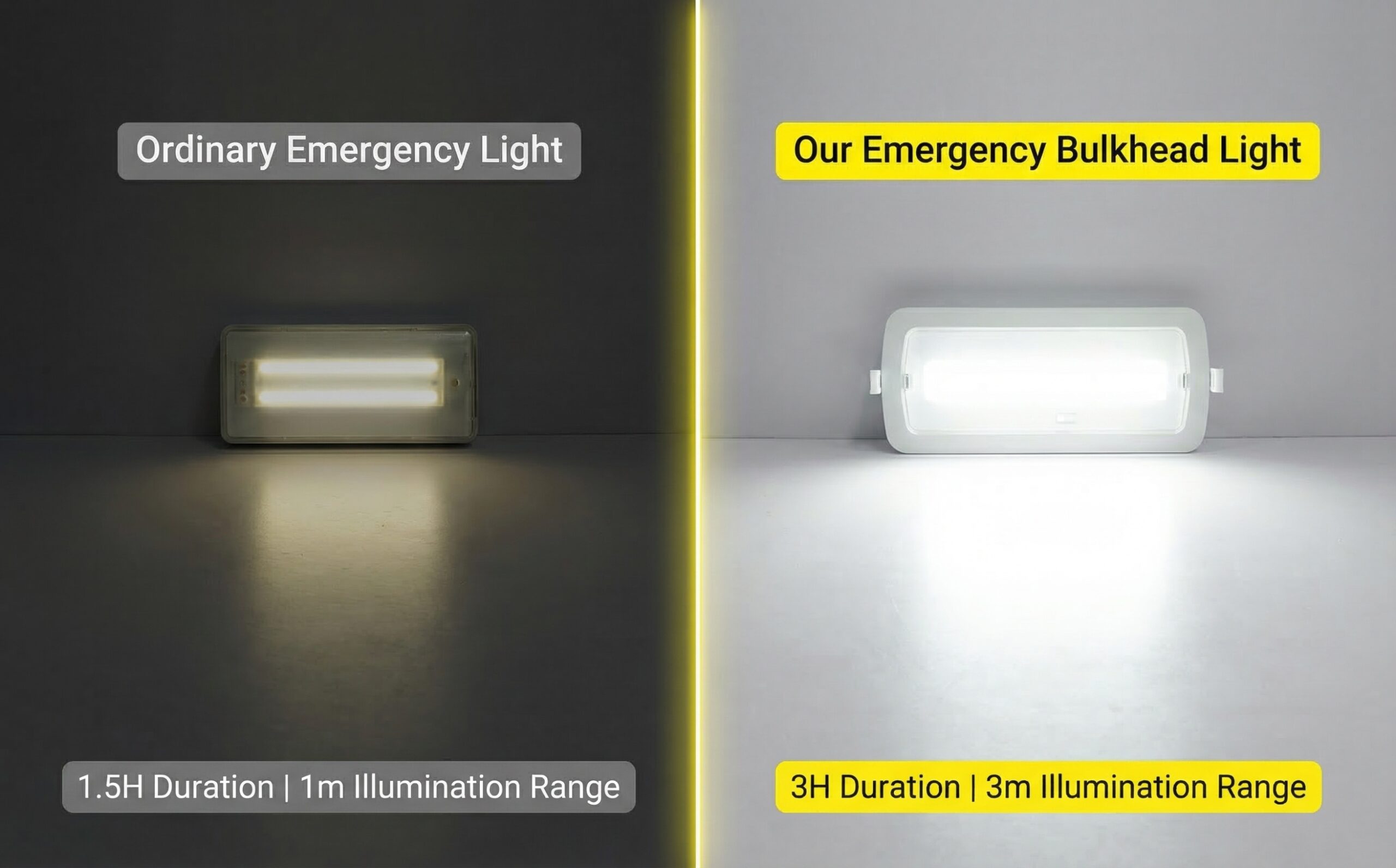
Аварийное освещение
Self-contained emergency lighting with selectable 90 minute to 3 hour duration and maintained or non-maintained wiring.
Frequently Asked Questions About Emergency Lighting
How To Qualify A Real Emergency Lighting Manufacturer
Q: What is the minimum order quantity and how does it change with custom emergency duration or output?
MOQ for standard emergency drivers with 90-minute duration and 3W emergency output is 500 units. Custom durations of 2 hours or 3 hours, or higher emergency outputs of 5W to 10W, raise MOQ to 1000 units because battery pack capacity must shift from LiFePO4 3.2V 1500mAh to 3000mAh or 6000mAh, requiring separate cell sourcing and BMS programming. OEM packaging with your carton artwork adds 300 units to any MOQ.
Q: How do I confirm your emergency driver fits my host fixture’s LED module and thermal design?
Send the normal driver output spec: constant current in mA and voltage window in DC V, plus LED forward voltage range. Hymark emergency drivers cover 9-42V DC or 20-80V DC output windows at 150mA to 700mA. The emergency output must match or sit within the LED module’s Vf curve at reduced current. For high-bay fixtures above 80W normal load, we size the inverter stage and confirm the changeover relay rating; thermal modelling at 25°C ambient with emergency output at 10-30% of normal lumens prevents overdriving LEDs in emergency mode.
Q: What emergency duration and output options are available, and what do they cost?
Standard is 90 minutes at 3W emergency output, roughly 300-400 lumens depending on LED efficacy. Upgrading to 2 hours at 5W adds LiFePO4 3.2V 3000mAh versus 1500mAh, increasing unit cost 18-22%. Three hours at 10W for high-bay applications needs LiFePO4 6000mAh or dual 18650 Li-ion 7.4V 2600mAh packs, adding 35-40%. EN 1838 requires minimum 1 lux on escape routes; verify your lumen target against ceiling height and spacing, not just wattage.
Q: What is the difference between maintained and non-maintained wiring, and which do you supply?
Non-maintained: emergency circuit energises only on mains failure, wiring runs switched live to the changeover relay. Maintained: emergency lamp runs continuously via the normal supply, with seamless transfer to battery on failure. Hymark supplies both; maintained versions include a charging circuit that floats the battery while the lamp operates. Specify at order; maintained drivers cost 8-12% more due to dual-path circuitry and higher relay duty rating.
Q: What self-test and DALI options are available, and do they meet EN 62034?
Manual test key is standard. Auto-test versions run a 30-second functional test monthly and a full duration test annually, with LED status indication. DALI-2 emergency test facility versions add addressable monitoring per EN 62034; ask the supplier to provide third-party test evidence that the DALI interface passes the command set for duration test, inhibit, and fault reporting. DALI versions add 15% to unit cost and require a compatible DALI bus power supply.
Q: What battery chemistry do you use, what is the replacement interval, and how do I verify cell traceability?
Standard is LiFePO4 3.2V for cycle stability, 500-800 cycles to 80% capacity, with charge time 16-24 hours from flat. NiCd 3.6V or 4.8V packs are available for cold ambient below -10°C where lithium performance drops; NiCd offers 300-500 cycles but contains cadmium with disposal restrictions. Li-ion 18650 3.7V is used for compact twin-spot units. Request cell supplier certificates and UN 38.3 test summaries for the exact cell model; genuine manufacturers hold batch records linking cell barcode to pack assembly date.
Q: What is sample lead time, production lead time, and what payment structure do you use?
Standard samples with 90-minute LiFePO4 configuration ship in 7-10 days. Custom duration or DALI samples take 14-18 days. Production lead time is 25-35 days for 500-2000 units, 40-50 days for 5000+ or peak Q4. Payment is 30% deposit, 70% against copy of B/L for established buyers; first orders or custom OEM may require 50% deposit, 50% CAD. Letters of credit accepted above USD 30,000 with 2% surcharge.
Q: Which test reports and conformity marks can you supply for my destination market, and what should I verify?
For UK and EU: ask for EN 60598-2-22 and EN 1838 test reports, plus EMC to EN 55015; CE marking is supplier-declared, so verify the test lab is ISO 17025 accredited. For UL 924 in North America, confirm the report covers the exact model with your battery capacity, as UL requires case-by-case listing. For AS/NZS 2293 in Australia, demand independent laboratory reports for duration and photometric performance. Hymark provides copies of existing third-party reports; we do not claim certificates we cannot produce on request.
Q: How do lithium batteries affect shipping mode, documents, and landed cost?
LiFePO4 and Li-ion packs above 100Wh per pack require UN 38.3 test summaries, MSDS, and dangerous goods declarations for air freight (IATA PI 965 Section IB or II). Sea freight follows IMDG Code SP 188 for smaller cells. This adds USD 150-400 per shipment for DG handling and restricts some carrier options. Below 100Wh per pack, documentation is lighter but still required. NiCd ships under separate UN classification with cadmium labelling. FOB Shenzhen or CIF destination; CIF adds 8-15% for freight and marine insurance.
Q: What warranty, spare parts, and after-sales engineering support do you provide?
Standard warranty is 3 years on electronics, 2 years on battery packs, limited to defects in manufacture. Extended 5-year warranty available with MOQ commitment. Spare battery packs and driver PCBs stocked for 5 years post-model discontinuation. After-sales support includes wiring diagram review, DALI commissioning guidance, and fault-code interpretation. For OEM luminaire partners, we provide emergency lumen calculation spreadsheets and spacing tables against BS 5266-1 and EN 1838 minimum illuminance requirements.
Q: Can you OEM brand the product, customise packaging, and support my luminaire integration?
OEM branding on driver label and carton artwork available at 1000 units. Custom PCB shape or connector position for your fixture housing requires 2000 units and 4-6 week NPI cycle. We supply 3D step files and photometric emergency output data in IES format for your lighting design software. Integration support includes review of your normal driver spec to ensure compatibility with our changeover relay contact rating and inverter output window, preventing mismatched emergency current that overdrives or underdrives your LED module.
Important Notice
Specifications, output and duration figures and price ranges in this guide are indicative and are provided
for planning purposes only. Actual emergency output, duration, battery life, ingress protection and available conformity documentation
differ by model and by destination country, and emergency lighting design remains the responsibility of the project designer. Buyers
must confirm their own mains voltage and frequency, the emergency lighting standard enforced locally, the host fixture compatibility
and their import requirements before placing an order. All figures are subject to written confirmation in the final proforma invoice
issued by Hymark.
Sourcing Emergency Lighting from Hymark
Why Verification Beats Claims on Paper
A supplier’s willingness to show process evidence matters more than any catalogue promise. Ask for the discharge log from the last batch test: it should record cell-level voltage at 0, 30, 60 and 90 minutes, or at 1-hour intervals for a 3-hour rated pack. Request the ageing station photo—thermal runaway screening at 45°C ambient for 72 hours is standard practice for LiFePO4 packs bound for tropical markets. For NiCd alternatives, the same station should show a 16-hour trickle charge followed by a full discharge to 1.0V per cell. If the supplier cannot produce these records, the “manufacturer” is likely routing your order through a third-party assembly shop with no traceability.
What Hymark’s Structure Delivers
JIALINGHANG ELECTRONIC CO., LTD. was founded in 2013 as a global LED exporter in general illumination. A strategic shift in 2017 refocused the company on LED emergency technology and high performance LED strips. Hymark was launched in 2026 as the premium brand. Products are co-designed and engineered in-house through a strategic partnership with dedicated manufacturing facilities that have also been operating since 2013. The company manages R&D, product design and global distribution itself.
This structure means the engineering team specifies the inverter output window—typically DC 9-42V at 150-350mA for linear and panel applications, or DC 24-80V at 100-250mA for high-bay drivers—rather than accepting whatever an unrelated factory offers. Battery packs are sourced with cell-level traceability: LiFePO4 3.2V 1500mAh to 6000mAh configurations for cycle life between 800 and 1500 cycles, or Li-ion 18650 3.7V 2000mAh to 3500mAh where energy density matters more than cycle count. NiCd 3.6V to 9.6V packs remain available for cold-ambient specifications where lithium chemistry struggles below -10°C.
Range and Configuration Flexibility
The Hymark range covers emergency lighting, emergency exit signs, emergency luminaires, emergency twin spotlights, LED emergency drivers for LED high bays, panel lights, tubes and linear lights, full power output emergency drivers, LED strip lights, COB LED strips and SMD LED strips. Configuration options include selectable emergency duration—90 minutes, 2 hours or 3 hours—maintained or non-maintained wiring, and self-test or DALI test facility integration. Emergency output is specified as both lumens and percentage of normal output: typically 10% to 50% depending on the EN 1838 or BS 5266-1 compliance path selected. Input voltage ranges cover AC 85-265V, 100-277V and 220-240V by destination market. IP ratings from IP20 to IP65 and IK ratings to IK08 are available for the fixture housing, with the emergency module itself typically rated IP20 to IP40.
Export Practicalities and Lead Time
Orders are supplied with export carton packing and FOB or CIF terms. Sample lead time is 7 to 10 days for standard configurations. Production lead time runs 25 to 35 days for first orders, 20 to 28 days for repeat orders with confirmed specifications. MOQ varies by product: 100 units for emergency drivers and modules, 500 metres for LED strip products. Payment structure is typically 30% deposit, 70% against bill of lading copy.
For lithium battery shipments, the supplier should provide UN 38.3 test summary reports and package the goods for IATA Section II or IMDG compliance as appropriate. Hymark’s logistics team handles this documentation as standard.
Request Your Specification Review
Send the host fixture type and wattage, the emergency duration your code requires—90 minutes, 2 hours or 3 hours—your mains voltage, and your destination port. Hymark will return a quotation within 24 hours via WhatsApp or email.
Get a Factory Direct Quote on Emergency Lighting
JIALINGHANG ELECTRONIC CO., LTD. has been in LED lighting since 2013 and has focused on
LED emergency technology and high performance LED strips since 2017. Hymark products are co-designed with our
dedicated manufacturing partners, built with selectable emergency duration and maintained or non-maintained wiring, and function
tested before packing. Send us the host fixture type and wattage, the emergency duration your local code requires, your mains
voltage and your destination port and we will return a quotation within 24 hours.


 English
  Spanish
  Arabic
  French
  German
  Russian
  Portuguese
  Italian
  Vietnamese