
LED Downlight Buyer Guide
The right LED downlight with emergency backup from a Chinese supplier depends on three things: the host fixture’s normal wattage and ceiling cut-out, whether your local code demands 90 minutes or 3 hours of maintained output, and whether the inspector will accept EN 60598-2-22 test reports or requires in-country certification like UL 924 or AS/NZS 2293. Most buyers source 5W to 15W recessed units with integrated NiCd 3.6V 1200mAh packs for cost-sensitive projects, or LiFePO4 3.2V 3000mAh packs where 500+ cycle life and stable thermal performance matter.
This page focuses on supplier qualification: how to verify the factory actually builds the emergency module rather than relabeling traded goods. The remaining sections cover in-house versus partnered SMT capacity, battery traceability and discharge records, ageing and hipot infrastructure, third-party test report validity, sample lead times, and what after-sales engineering capability looks like when a site fails commissioning.
In-House SMT and Assembly Capacity
A real manufacturer either runs SMT lines for the LED emergency driver PCB or holds a documented partnership with a captive facility under the same quality system. Ask to see the reflow oven profile for the constant-current inverter board, the pnp placement accuracy spec (typically ±0.05mm for 0402 components), and whether the changeover relay is wave-soldered or hand-soldered. Hand soldering on mains-voltage relay pins creates cold-joint risk under thermal cycling. The supplier should state PCB copper weight (1oz or 2oz) and whether the emergency driver output window—typically DC 9-42V at 150-350mA for small downlights—is calibrated to the specific LED forward voltage of the host fixture. A trading office will describe these parameters vaguely or defer to a “partner factory” they cannot name.
Battery Sourcing and Traceability
The battery chemistry determines price and compliance risk. NiCd 3.6V 1200mAh packs cost less upfront but carry RoHS and transport restrictions in the EU; LiFePO4 3.2V 3000mAh packs run 30-40% higher in BOM cost but deliver 3 hours at 4W emergency output with 500-800 cycles to 80% capacity; Li-ion 18650 3.7V 2600mAh cells sit between the two on energy density but require stricter cell balancing. Demand cell-level purchase invoices or UN 38.3 test summaries for the exact cell model in your pack, not a generic family certificate. The supplier should log batch codes against discharge test records so you can trace a failed cell back to its production lot.
Discharge and Duration Test Records
EN 1838 requires emergency output at a defined lux level on the escape route, but the factory must prove duration at the actual driven load. Ask for discharge curves at 25°C and at the ambient temperature limit of the product—often 0°C to 45°C for residential downlights, -10°C to 55°C for commercial. A 90-minute rated unit should show 108 minutes minimum at end of battery life with a safety margin; a 3-hour unit should show 195 minutes. The records should include initial lumen output in emergency mode as a percentage of normal output, typically 10% for non-maintained units, 100% for maintained if the inverter is sized to match the full LED load.
Ageing and Hipot Test Stations
Every unit should undergo 100% functional ageing: at least 24 hours charge followed by a full discharge cycle before final assembly. Hipot testing at 1500V AC or 2kV DC for 60 seconds verifies isolation between mains and the emergency output circuit. Ask for the daily station count versus claimed monthly output—if a factory ships 50,000 emergency drivers monthly but owns two ageing racks handling 200 units per day, the math does not close. Photographs with timestamps are weaker evidence than a live video walkthrough with random serial number checks.
Third-Party Test Reports for the Destination Market
Do not accept a report that covers “LED iluminação de emergência” generically. The test report must list your exact model number, the battery chemistry and capacity, the inverter output voltage and current range, and the standard edition (e.g., EN 60598-2-22:2014+A1:2020). For UK projects, BS 5266-1 commissioning requires evidence of EN 62034 automatic test function if self-test is claimed; for North America, UL 924 covers the emergency power supply, not the luminaire itself unless tested as a system. Middle Eastern projects often demand IEC 61347-2-7 for emergency inverter modules plus local energy efficiency registration. Ask who holds the report—the factory, the trading office, or a third brand—and whether it is transferable to your import entity.
Sample Lead Time and Payment Structure
A factory with in-house SMT and battery assembly typically ships configured samples in 7-12 working days; a trading office quoting 3-5 days is usually pulling from stock that may not match your final specification. First orders should run 30% TT deposit, 70% against BL copy or LC at sight for orders above $30,000. Samples below $200 are usually pre-paid by wire; avoid suppliers who demand Western Union for sample fees. MOQ for OEM configurations starts at 500-1000 units for integrated downlights, 2000-3000 for emergency driver modules alone.
After-Sales Engineering Capability
The supplier should assign an application engineer who can recalculate the emergency output window if you switch from a 10W COB downlight to a 15W SMD array, who understands whether your project needs maintained wiring (live mains to the unit at all times) or non-maintained (switched normal supply, permanent live to the emergency module), and who can explain why a self-test facility per EN 62034 adds $2-3 in BOM cost versus a manual test key. Ask for a written response to a technical change request within 48 hours; silence after sample payment is a warning signal.
Types and Configurations of LED Downlight
Full-Power Maintained Emergency LED Downlight
| Type or Class | Typical Rating or Output | Duration or Runtime | Best Suited For | Notes |
|---|---|---|---|---|
| Full-power maintained 90 min | 100% of normal lumens, 800–1500 lm from 10–18W LED | 90 minutes | Offices, retail, healthcare corridors | Requires 3-wire permanent/switched/neutral plus maintained live; battery pack sized at full 10–18W load |
| Full-power maintained 3 hour | 100% of normal lumens, 600–1200 lm from 8–15W LED | 3 horas | Schools, care homes, UK escape routes per BS 5266-1 | LiFePO4 12.8V 4500mAh or NiCd 9.6V 4000mAh typical; battery volume doubles versus 90-minute variant |
| Reduced-power maintained 90 min | 30–50% of normal lumens, 300–600 lm from 3–6W LED | 90 minutes | Warehouses, back-of-house, cost-sensitive projects | Constant current inverter output 180–350mA at 9–24V DC; smaller battery, lower material cost |
Full-power maintained units deliver identical light output in emergency mode as in normal operation because the emergency driver feeds the same LED module at full current through a changeover relay. A buyer should verify the supplier runs discharge duration tests at 25°C ambient on 100% of production lots, not spot-checks only, and records actual lumen maintenance at minute 90 against the EN 1838 minimum of 1 lux on the floor for escape routes. The battery pack must be traceable to cell level: LiFePO4 3.2V cells in 4S configuration or NiCd 1.2V cells in 8S or 10S arrangement, with capacity matched to the driven load in watts divided by inverter efficiency (typically 80–85%). Electrical contractors and M&E consultants specify these for projects where occupants are unfamiliar with the building layout. The limitation is wiring cost—three cores plus earth to every point—and the physical volume of the battery pack, which often forces a remote battery box for recessed downlights under 100mm ceiling void depth. Sample lead time from real manufacturers with in-house SMT lines is 10–15 days; trading offices quoting 3–5 days usually forward your order.
Non-Maintained Emergency LED Downlight
| Type or Class | Typical Rating or Output | Duration or Runtime | Best Suited For | Notes |
|---|---|---|---|---|
| Non-maintained 90 min | 100% of normal lumens when activated, 500–1000 lm from 5–10W LED | 90 minutes | Storage areas, plant rooms, intermittently occupied spaces | 2-wire permanent/neutral only; no maintained live needed |
| Non-maintained 3 hour | 100% of normal lumens when activated, 400–800 lm from 4–8W LED | 3 horas | UK industrial, Middle East spec-built facilities | Self-test or manual test key per EN 62034; Li-ion 18650 7.4V 2600mAh 2S1P common |
Non-maintained downlights remain dark during normal mains presence and switch to battery output only on power failure. The wiring saves one switched live conductor, reducing cable cost by roughly 15–20% on multi-point circuits. Facility managers and industrial procurement officers favour these for areas where continuous emergency illumination is not legally required under BS 5266-1 or local variants. The critical verification point is the changeover relay: a stuck relay renders the fitting dead in emergency, so ask for hipot test records at 1500V AC for 60 seconds on the relay coil-to-contact isolation. The battery in a non-maintained unit sees shallower cycling because it discharges only during tests and genuine failures, so a Li-ion 18650 pack with 300–500 cycle life is often acceptable versus the 800–1500 cycles expected from LiFePO4 in maintained duty. These units cannot serve as normal working luminaires; if your space needs working light daily, specify maintained.
Self-Test and DALI-Addressable Emergency Downlight
| Type or Class | Typical Rating or Output | Duration or Runtime | Best Suited For | Notes |
|---|---|---|---|---|
| Auto self-test 90 min | 30–100% of normal lumens per programmed profile | 90 minutes | Large retail chains, multi-site facility portfolios | EN 62034 compliant; monthly function and annual duration tests automatic |
| DALI-2 emergency 90 min | 30–100% of normal lumens, addressable 0–63 or 0–127 | 90 minutes | Smart buildings, BMS-integrated projects, UK PFI contracts | DALI Part 252 for emergency; reports luminaire status to central monitoring |
Self-test and DALI-addressable downlights eliminate the labour cost of manual monthly key-switch tests and provide audit trails for building control inspectors. A real manufacturer programs the test schedule at firmware level and validates it against EN 62034, not merely wiring a generic inverter with a timer chip. The DALI-2 variant adds Part 252 emergency commands to standard 254 dimming, requiring a DALI bus power supply at 16V typical with 250mA capacity. Lighting designers and specifiers for premium commercial projects demand these, as do facility managers with 500+ luminaire estates. The price driver is the microcontroller and isolated DALI power supply circuit, adding 15–25% to BOM cost versus manual-test equivalents. What they cannot do is operate reliably on a noisy DALI bus with non-compliant third-party gear; insist on test reports showing interoperability with at least two other suppliers’ DALI controllers. Trading offices rarely stock these because firmware customisation requires direct engineering contact.
Recessed Versus Surface and Trimless Enclosure Formats
| Type or Class | Typical Rating or Output | Duration or Runtime | Best Suited For | Notes |
|---|---|---|---|---|
| Recessed integrated emergency 90 min | 600–1200 lm from 8–15W LED module | 90 minutes | New build ceilings with 100mm+ void | Die-cast aluminium heatsink with separate battery compartment; IP20 to IP44 |
| Surface-mounted emergency downlight 90 min | 500–1000 lm from 7–12W LED | 90 minutes | Concrete soffits, retrofit where void unavailable | Visible cable entry; IK08 typical for impact resistance |
| Trimless plaster-in 90 min | 400–800 lm from 6–10W LED | 90 minutes | High-end residential, gallery, architectural schemes | 2–3mm plaster reveal; battery access from rear only |
The enclosure format determines whether the emergency battery and inverter fit within the luminaire body or require a remote pack. Recessed integrated units with 100mm ceiling void depth accommodate LiFePO4 12.8V 3000mAh packs in a thermally isolated compartment below the LED heatsink; surface-mounted units expose the battery to higher ambient temperatures, accelerating calendar ageing and requiring derated capacity or forced ventilation. Trimless plaster-in fittings prioritise aesthetics over serviceability: battery replacement requires ceiling access from above, which is often impossible in finished interiors. Luminaire OEMs adding emergency versions to their own downlight chassis should ask whether the supplier provides mechanical CAD files for the battery compartment or insists on using their own stamped-steel enclosure, which may clash with your thermal design. Real manufacturers with in-house assembly stations keep 0.5mm and 0.8mm PCB copper weights in stock and can adjust LED pitch for thermal reasons; trading offices cannot.
Price Drivers Sample Policy and Lead Time Reality
| Cost Component | Typical Range | What Cheaper Alternatives Omit |
|---|---|---|
| Battery pack LiFePO4 12.8V 3000mAh | $8–14 at 1k units | Li-ion 18650 without cell balancing; 200-cycle life versus 800+ |
| Constant current inverter 10W | $4–7 | Open-frame PCB without conformal coating; no thermal foldback at 70°C |
| Changeover relay 5A | $1.50–3 | Reed relay rated 1A; contact welding risk at inrush |
| Self-test microcontroller | $2–4 | Discrete RC timer; drift ±20% over temperature |
| EN 60598-2-22 third-party test report | $3,000–6,000 per series | No report; supplier copies another product’s documentation |
FOB Shenzhen pricing for a complete 10W maintained emergency downlight with LiFePO4 battery and self-test runs $22–35 at 500-unit MOQ for real manufacturers with SMT and assembly in-house; trading office quotes at $18–28 often substitute 18650 packs without UN 38.3 transport certification, risking customs seizure. Genuine sample lead time is 12–18 days including cell procurement, PCB fabrication, and 48-hour ageing burn-in; anyone promising 5-day samples ships from trader stock with unknown battery batch age. Payment structures split at 30% T/T deposit, 70% against copy of bill of lading for first orders; established buyers with six-month trading history may negotiate 60-day LC for orders above $50,000. After-sales engineering capability means the supplier can recalibrate inverter output current via firmware when you change LED module suppliers mid-contract; ask for a written commitment to retain source code for your SKU for minimum five years.
Specifications and How to Read Them
| Parameter | Entry Level | Mid Range | High Specification |
|---|---|---|---|
| Normal LED module power | 9W COB | 15W COB | 25W COB |
| Normal luminous flux | 720 lm @ 3000K | 1350 lm @ 4000K | 2500 lm @ 4000K |
| Emergency output | 180 lm (25%) | 450 lm (30%) | 750 lm (30%) |
| Emergency duration | 90 minutes | 2 hours | 3 horas |
| Input voltage / frequency | AC 220-240V 50Hz | AC 100-277V 50/60Hz | AC 85-265V 50/60Hz |
| DC output to LED (emergency) | 9-12V 350mA | 15-24V 350mA | 24-36V 350mA |
| Battery chemistry | NiCd 3.6V 1500mAh | Li-ion 18650 3.7V 2600mAh | LiFePO4 3.2V 3000mAh |
| Charge time to 80% | 16 hours | 6 hours | 4 hours |
| Cycle life (to 80% capacity) | 300-400 cycles | 500-700 cycles | 800-1200 cycles |
| Test facility | Manual test key | Self-test per EN 62034 | Self-test + DALI-2 |
| Wiring mode | Non-maintained | Non-maintained | Maintained or non-maintained |
| IP / IK rating | IP20 / IK02 | IP44 / IK04 | IP65 / IK08 |
| Ambient temperature | 0°C to +40°C | -10°C to +45°C | -20°C to +55°C |
| Cutout / overall diameter | 75mm / 90mm | 90mm / 105mm | 125mm / 145mm |
| Recessed depth | 55mm | 65mm | 85mm |
| Emergency driver dimensions | 85 × 40 × 22mm | 120 × 45 × 28mm | 160 × 55 × 32mm |
| Unit EXW price band (500 pcs) | $8.50 – $11.00 | $14.50 – $19.00 | $28.00 – $38.00 |
How to Read the Input Voltage and Frequency Line
The input range tells you where the driver will survive without premature failure. A 220-240V 50Hz label means the unit is built for the UK and European mains and will struggle in the Gulf or Southeast Asia where 277V or voltage spikes are common. The 100-277V 50/60Hz mid-range option covers UK, Europe, Middle East and most of Asia from one SKU. The 85-265V wide-range driver adds margin for rural grids in Africa and Latin America where sustained undervoltage is routine. Ask the supplier to confirm the driver holds IEC 61347-2-7 or UL 924 input tolerance testing; do not accept a generic LED driver datasheet relabelled as emergency.
How to Read the DC Output Window and Driven Load
Emergency drivers do not feed the mains LED module directly; they switch to a constant-current DC output through a changeover relay. The voltage window (for example 15-24V) must sit within the forward-voltage range of your normal LED module at its emergency current. The current (350mA is standard for downlights) multiplied by the voltage at the LED gives the emergency wattage: 20V × 0.35A = 7W. If your normal module is 15W, that 7W equals roughly 30-35% lumen output depending on LED efficacy. Verify the supplier has paired the driver to the specific COB or SMD module in the downlight; mismatched voltage windows cause flicker or shutdown in emergency mode.
How to Read Emergency Output in Lumens and Percentage
EN 1838 and BS 5266-1 specify minimum illuminance on the floor, not the fitting output, but buyers still need the fitting’s emergency lumens to calculate spacing. A 450 lm emergency output from a 1350 lm normal downlight is 33%, but after optic losses and ceiling height the useful floor lux may be 15-20% of normal. For escape routes the standard demands 1 lux minimum; open areas need 0.5 lux. A high-specification 750 lm unit in a 3m ceiling with 90° beam achieves roughly 35 lux directly beneath, decaying to 1 lux at 5.5m radius. Demand photometric files in IES or LDT format, not just a lumen number on the datasheet.
How to Read Emergency Duration
Ninety minutes satisfies UK Building Regulations and BS 5266-1 for most premises. Two hours appears in healthcare and assembly buildings under NFPA 101 or when the escape route is complex. Three hours is specified for high-risk task areas, some Middle East civil defence codes, and UK premises where phased evacuation is practised. Duration depends on battery capacity and discharge efficiency, not the label alone. A 3.2V 3000mAh LiFePO4 pack stores 9.6Wh; at 80% inverter efficiency and 7W load that yields 1.1 hours. To reach 3 hours the supplier must either reduce load to 2.5W or increase battery capacity to 9000mAh. Cross-check the maths on every datasheet.
How to Read Battery Chemistry Voltage and Capacity
NiCd 3.6V packs are the entry-level legacy option. They tolerate temperature extremes but carry cadmium RoHS restrictions in Europe and suffer memory effect if shallow-cycled. Li-ion 18650 3.7V cells offer higher energy density and lighter weight but need precise battery management systems to avoid thermal runaway; UN 38.3 testing is mandatory for air freight. LiFePO4 3.2V cells trade some energy density for thermal stability and longer cycle life; they are the preference for maintained installations where daily cycling occurs. Capacity in mAh is meaningless without voltage: 3.7V 2600mAh is 9.6Wh, nearly identical to 3.2V 3000mAh at 9.6Wh. Always compare watt-hours.
How to Read Charge Time and Cycle Life
Charge time from deep discharge to 80% capacity matters for maintained systems that cycle daily. NiCd needs 14-16 hours trickle charge; Li-ion reaches 80% in 4-6 hours with CC-CV charging; LiFePO4 with dedicated chargers can reach 80% in 3-4 hours. Cycle life definitions vary: 300 cycles to 80% capacity for NiCd versus 800-1200 for LiFePO4 under IEC 61951 or IEC 62133 test conditions. Ask for discharge cycle test records at 0.2C rate, 25°C ambient, with capacity fade curves. A trading office will show you a cell manufacturer’s brochure; a real manufacturer shows in-house ageing station logs with batch numbers.
How to Read Test Facility
Manual test key is a push-button or switch that simulates mains failure; it satisfies older installations but places compliance burden on the facilities manager. Self-test per EN 62034 automates monthly functional tests and annual duration tests, reporting via LED status indicator; it is now expected in UK and European commercial projects. DALI-2 test facility integrates with building management systems, transmits fault codes to central monitoring, and satisfies BS 5266-1:2016 for complex buildings. DALI requires correct addressing and a compatible bus power supply; confirm the supplier provides commissioning support, not just a DALI logo on the box.
How to Read Maintained Versus Non-Maintained Wiring
Non-maintained wiring powers the LED module from the switched mains in normal mode and from the battery only when mains fails. The emergency driver sits in parallel with the normal driver; wiring is simpler but the emergency light is off during normal hours. Maintained wiring runs the emergency module continuously from the normal supply via the emergency driver, which contains the changeover relay and charging circuit; the battery only supplies upon failure. Maintained is essential for spaces that must stay lit during normal operation and where the downlight serves as both general and emergency luminaire. The driver is larger, runs warmer, and costs 40-60% more. Verify the supplier’s maintained drivers are rated for continuous operation at maximum ambient, not just intermittent emergency duty.
How to Read IP and IK Rating
IP20 in the entry build suits dry interior ceilings only. IP44 adds splash protection for bathrooms or kitchen canopies with occasional moisture. IP65 is dust-tight and jet-proof, required for external soffits, car parks, and food preparation areas where pressure washing occurs. IK02 withstands 0.2 joule impact; IK04 reaches 0.5 joule for public corridors; IK08 at 5 joule is specified for sports facilities, warehouses, and mental health premises. The IK rating applies to the bezel and lens, not just the housing; polycarbonate diffusers achieve IK08 where glass fails.
How to Read Ambient Temperature Range
0°C to +40°C is adequate for heated UK commercial space. -10°C to +45°C covers Middle East winter nights and Southeast Asian plant rooms. -20°C to +55°C is required for cold storage, unheated stairwells in Nordic markets, and Gulf summer roof voids where ambient reaches 55°C and the driver internal temperature exceeds 70°C. Battery chemistry is the limiting factor: NiCd performs at -20°C but fades above 45°C; Li-ion capacity collapses below 0°C and risks plating below -10°C unless the cell is specifically low-temperature rated; LiFePO4 operates across the widest span but still needs derating above 50°C. Demand temperature-compensated charging curves if the installation spans this range.
How to Read Dimensions and Mounting
Recessed downlight dimensions are given as cutout diameter, overall diameter, and recessed depth. A 90mm cutout with 105mm overall gives 7.5mm bezel overlap; verify ceiling thickness tolerance. Recessed depth of 65mm assumes a 20mm ceiling void plus driver clearance; shallow ceilings need remote driver mounting in an adjacent ceiling void or junction box. Remote mounting adds 1.0-1.5m of cabling between driver and LED module; voltage drop in the DC cable reduces emergency output unless the supplier has sized conductors accordingly. Ask for maximum remote mounting distance in the specification, not just in a footnote.
Supplier Qualification: Separating Manufacturer from Trading Office
In-House or Partnered SMT and Assembly Capacity
A real emergency downlight manufacturer either runs SMT lines for LED modules and driver PCBs in-house or owns a partnered facility under long-term contract, not spot-market outsourcing. Ask for factory audit photos showing Yamaha or Juki pick-and-place machines, reflow ovens with thermal profiling, and AOI stations. A trading office shows you stock photos or refuses video walkthrough. Hymark maintains SMT capacity for emergency driver PCBs and LED module assembly; the specific lines and throughput are available under NDA during supplier qualification.
Battery Sourcing and Traceability
The battery is the life-limited component and the highest fire risk. Demand cell-level traceability: manufacturer (for example EVE, Lishen, BAK for LiFePO4; Samsung, LG, Molicel for Li-ion 18650), batch codes, and incoming inspection records. A manufacturer holds cell certificates of conformity and performs incoming capacity sampling at 5% AQL minimum. A trading office buys finished battery packs from an anonymous pack builder and cannot trace cell origin. Ask for the battery pack assembly factory’s UN 38.3 test report number and verify it against the cell manufacturer’s report.
Discharge and Duration Test Records
Every production batch of emergency drivers must undergo 100% functional test and sampled duration test. Ask for a test record showing: batch number, test date, ambient temperature, initial charge time, discharge load in watts, duration to 80% rated output, and pass/fail. The record should span at least six months of production. Hymark generates these records automatically from ageing stations; sample reports are available during factory audit.
Ageing and Hipot Test Stations
Ageing stations run emergency drivers under full load at 40-45°C ambient for 2-4 hours to catch infant mortality. Hipot (dielectric withstand) testing applies 1500V AC or 3750V DC between mains and accessible metal for 60 seconds per IEC 61347-1. A manufacturer has dedicated stations with automatic cutoff and logging; a trading office relies on the upstream factory and may skip sampling. Ask for calibration certificates on hipot equipment; out-of-calibration hipot testers give false pass results that fail in the field.
Third Party Test Reports for the Destination Market
Do not accept “CE certificate” as a document; CE is a self-declaration. Ask for the test report underlying the declaration: EN 60598-2-22 for luminaire safety in emergency mode, EN 62034 for automatic test systems, EN 1838 for photometric performance, and IEC 61347 for driver safety. For UK export post-Brexit, UKCA marking requires UK-recognised approved body assessment for certain regulations; the supplier should show UKCA technical files and, where required, approved body certificate numbers. For UL 924 entry to North America, the report must be from a UL-listed or OSHA-recognised NRTL; UL file numbers are publicly verifiable on UL’s database. For AS/NZS 2293 to Australia and New Zealand, the supplier needs JAS-ANZ accredited certification body reports with Australian electrical safety approval. Hymark does not claim to hold these certificates for all builds; buyers should verify current status against their specific project requirements.
Sample Lead Time
A manufacturer with in-house driver assembly and standard COB modules delivers samples in 7-12 working days for existing designs, including battery formation charge. A trading office quoting 3-5 days is shipping from trader stock or diverting another customer’s shipment; the sample may not match production. Custom CCT, bespoke bezel finish, or modified output percentage extends sample lead time to 15-20 days. Hymark’s standard emergency downlight samples ship within 10 working days from confirmed specification and payment.
Payment Structure
First orders from unverified buyers typically run 30% T/T deposit, 70% against copy of bill of lading. Established relationships or orders under letter of credit move to 15% deposit, 85% CAD or L/C at sight. Small sample orders below $500 are often 100% advance. Trading offices sometimes demand 50% deposit because they lack credit terms with their upstream factory. A manufacturer with cash flow discipline can offer more flexible structures; Hymark operates on 30/70 for first orders with qualified buyers.
After-Sales Engineering Capability
Emergency downlights fail in the field due to driver-battery mismatch, incorrect maintained wiring, or DALI addressing errors. A trading office forwards complaints to the factory with 48-hour language-barrier delay. A manufacturer has application engineers who read wiring diagrams, interpret DALI fault codes, and can remotely diagnose via photo or video. Ask how the supplier handles warranty claims: replacement parts only, labour contribution, or on-site technician dispatch. Hymark maintains engineering contact during UK and European business hours and provides wiring schematics with batch-specific driver variants.
Trade Terms and Export Practicalities
FOB Shenzhen or FOB Hong Kong
Free On Board means the supplier delivers goods cleared for export onto the vessel at the named port. Risk transfers when goods cross the ship’s rail. FOB Shenzhen suits sea freight to UK/Europe via Yantian or Shekou; FOB Hong Kong adds inland haulage cost but may simplify booking for buyers with Hong Kong freight agents. The supplier’s price includes carton packing, palletising, and export customs declaration. Buyer pays ocean freight, insurance, and destination charges.
CIF and CFR
Cost and Freight (CFR) adds ocean freight to the supplier’s obligation; buyer arranges insurance. Cost Insurance and Freight (CIF) adds marine insurance minimum cover. CIF to Felixstowe or Rotterdam is common for European distributors who want single-invoice simplicity. The supplier chooses the shipping line; specify if you require premium carriers for lithium battery cargo, as some lines restrict UN 38.3 goods to designated vessels. CIF does not include destination THC, customs clearance, or inland delivery.
EXW
Ex Works places maximum obligation on the buyer: collect from factory gate, arrange all export clearance, freight, and insurance. Useful if you operate your own China export licence and consolidation warehouse. Most buyers avoid EXW for first orders unless they have established China logistics.
L/C and T/T
Telegraphic transfer is standard for established relationships. Letter of credit adds bank fees ($200-400 per issuance) and requires meticulous document compliance; any discrepancy between packing list, certificate of origin, and bill of lading becomes a rejection point. For lithium battery shipments, the L/C must not expire before UN 38.3 test report validity or MSDS renewal dates. Hymark accepts confirmed irrevocable L/C for orders above $30,000; below this T/T is more cost-effective for both parties.
HS Code
Emergency LED downlights with integral battery fall under 9405.10 (chandeliers and other electric ceiling or wall lighting fittings) or 9405.40 (other electric lamps and lighting fittings) depending on customs interpretation. The emergency driver alone is 8504.40 (static converters). Incorrect classification delays clearance and triggers duty reassessment. Provide your freight forwarder with the supplier’s detailed component breakdown to confirm classification before shipment.
CE and UKCA Marking
CE marking on emergency downlights relies on compliance with the Low Voltage Directive (2014/35/EU), EMC Directive (2014/30/EU), and Radio Equipment Directive where DALI wireless is present. The supplier must hold technical files and declaration of conformity; the CE mark itself is not a certificate. UKCA marking replaces CE for Great Britain (England, Scotland, Wales); Northern Ireland operates under UKNI with CE alignment. Since 2023, UKCA requires UK-recognised standards; verify the supplier’s test reports reference current BS EN editions, not outdated EN versions.
UN 38.3 Battery Test Report
Lithium batteries (Li-ion 18650, LiFePO4) require UN 38.3 testing before air or sea transport: altitude simulation, thermal test, vibration, shock, external short circuit, impact/crush, overcharge, and forced discharge. The report must reference the specific cell model and, for assembled packs, the pack configuration. Validity is typically indefinite for the tested design unless cell chemistry or construction changes. IATA Dangerous Goods Regulations and IMDG Code govern packaging: lithium-ion requires Class 9 hazard label, Watt-hour marking on each battery, and strong outer packaging to 1.2m drop test. NiCd contains no lithium and ships as environmentally hazardous substance under UN 3028 with different packing requirements. A trading office often lacks the expertise to package correctly; customs rejection and airline refusal are common.
Packing List and Certificate of Origin
The packing list must reconcile with the bill of lading: carton count, gross/net weight, dimensions, and itemised contents including battery location per carton. For Middle East and African markets, certificate of origin (Form A or EUR.1 for EU preferential origin, or China Chamber of International Commerce non-preferential) supports customs valuation and duty claims. Some Latin American countries require legalised certificates; confirm apostille or consular authentication needs before shipment.
MOQ and Lead Time
Standard emergency downlight MOQ is 500 units for single CCT and finish, 1000 units for mixed CCT within one order. Entry-level builds with standard NiCd batteries and white finish reach 2000-3000 units per month; customised LiFePO4 maintained units with DALI and black bezel run 800-1200 units per month. Production lead time from confirmed deposit: 25-30 days for standard builds, 40-45 days for customised optics or special voltage variants. Peak season (September-November ahead of Chinese New Year) extends lead times by 10-15 days; plan buffer stock accordingly.
LED Downlight Price and What Drives It
| Class | Typical Rating or Output | Duration or Runtime | Indicative FOB USD |
|---|---|---|---|
| Standard fixed LED downlight non-emergency | 10W–12W, 800–1000 lm | N/A | $2.80–$5.50 |
| Standard fixed LED downlight with emergency kit | 10W–12W normal; 3W–5W emergency, 25–40% lumen maintenance | 90 min | $14.50–$22.00 |
| High-lumen commercial downlight emergency | 20W–30W normal; 6W–10W emergency, 30–50% lumen maintenance | 90 min to 3 hr | $24.00–$38.00 |
| Premium DALI/self-test emergency downlight | 15W–25W normal; 5W–8W emergency, 35–50% lumen maintenance | 2 hr to 3 hr, EN 62034 automatic test | $32.00–$52.00 |
| Explosion-proof or high-IP emergency downlight | 15W–20W; 5W–7W emergency | 90 min to 3 hr, IP65–IP66, IK08 | $45.00–$75.00 |
Prices assume single-colour 3000K–4000K SMD LED packages, steel or die-cast aluminium reflector, and Li-ion 18650 or LiFePO4 battery packs. MOQ typically 500–1000 units for factory-direct FOB Shenzhen or Ningbo. Sample lead time 7–12 working days; production lead time 25–40 days depending on battery cell availability and whether third-party testing reports must be refreshed.
Real Cost Structure of an Emergency LED Downlight from China
Battery pack and cell traceability — typically 25–35% of total factory cost. A 3-cell Li-ion 18650 pack at 11.1V 2200mAh runs $3.50–$5.20 at cell level; LiFePO4 3.2V 3000mAh cells in 4S or 6S configuration run 20–40% higher but deliver 800–1500 cycles versus 500–800 for standard Li-ion. The cheapest quotes often substitute unbranded 18650 cells with actual capacity 1500–1800mAh rather than rated 2200mAh, or use NiCd 3.6V 1200mAh packs at half the cell cost but with 60% shorter cycle life and 24-hour charge recovery. Ask for cell manufacturer, batch code, and UN 38.3 test summary for the exact cell model — not the finished battery pack, but the cell itself.
Driver and inverter electronics — 15–22% of factory cost. The emergency driver must switch from mains AC 85–265V or 220–240V normal operation to DC inverter output, typically 9–42V at constant current 150mA–350mA depending on LED module voltage. The changeover relay or electronic switch adds $0.80–$1.40. Self-test circuitry per EN 62034 adds $1.50–$2.80; DALI emergency interface adds $3.50–$6.00. A non-maintained wiring design is simpler; maintained wiring requires live neutral and switched line terminals with additional relay logic.
LED package — 8–15% for standard SMD 2835 arrays; 12–20% for COB downlights. Normal output 800–1500 lm at 10W–15W; emergency output 200–600 lm at 3W–8W. CRI 80+ standard, 90+ available at 15% premium. Colour temperature 2700K–6500K, with 3000K and 4000K most stocked.
Enclosure and thermal hardware — 10–18%. Die-cast aluminium reflector and heatsink at $1.80–$3.50 versus pressed steel with powder coat at $0.90–$1.60. IP44 standard for indoor; IP65 gasket and sealing adds $0.70–$1.20. IK07–IK08 impact rating for public areas adds mechanical thickness.
Test and certification amortisation — 5–12% depending on batch size. EN 60598-2-22 and EN 1838 testing for European markets typically costs $4000–$8000 per product family; BS 5266-1 adds UK-specific assessment. UL 924 for North America runs $8000–$15000. AS/NZS 2293 for Australia requires local accredited laboratory. Amortised over 2000 units, this is $2–$7.50 per fitting; over 500 units, $8–$30. A supplier quoting “tested to” without showing a dated, product-specific test report from an ILAC-MRA signatory laboratory is quoting an untested design.
Assembly labour — 4–8% at current Guangdong/Dongguan rates. Emergency units require more handling: battery insertion, discharge test, charge verification.
Export packing and logistics — 3–6% factory side. Individual white box with installation manual, 10–20 units per carton, 50–80 cartons per pallet. Lithium battery shipments require UN 38.3 certification, Class 9 dangerous goods labelling, and IATA/IMDG restrictions that often force sea freight rather than air for full container loads. Air freight for samples or small batches runs 4–8x sea freight cost and requires airline-specific dangerous goods acceptance.
Sea freight, insurance, duty, VAT, clearance — destination-variable, typically 15–30% of FOB for European delivery, 20–35% for UK post-Brexit with customs complexity, 10–20% for Middle East or Southeast Asia. UK import duty on LED luminaires: 0–3.7% depending on HS classification; VAT 20% on CIF plus duty.
Why the Cheapest Quote Is Not the Same Product
A $9.50 FOB emergency downlight versus a $16.00 unit from the same region normally reflects one or more of these:
- Smaller or lower-grade cell: 1500mAh actual versus 2200mAh rated, giving 60–70 minutes real runtime instead of 90 minutes at declared output, or same duration at 60% lumen maintenance instead of 30–50%
- Reduced emergency output level: 2W inverter instead of 3W–5W, producing 100–150 lm emergency versus 250–400 lm required for open area compliance under EN 1838
- Untested or generic inverter: no EN 60598-2-22 thermal or endurance testing, no documented changeover time under 5 seconds, no verification of 24-hour recharge from full discharge
- No self-test or manual test key only: EN 62034 compliance absent, meaning the installer must provide external test switches and log results manually for building control
Five-Year Running Cost Comparison
| Cost Element | Budget Unit ($9.50 FOB typical) | Spec-Compliant Unit ($16.00 FOB typical) |
|---|---|---|
| Initial landed cost (UK example, CIF+20% VAT) | $14.50 | $24.00 |
| Battery replacement cycle | Every 18–24 months (NiCd or low-grade Li-ion) | Every 4–5 years (LiFePO4 or branded Li-ion 18650) |
| Battery replacement cost (cells + labour, 5 yr) | $18–$28 (3 replacements) | $6–$10 (1 replacement) |
| Routine testing labour (manual test, 12x/yr, 10 min) | $120–$180 over 5 years | $30–$50 (self-test/DALI, 2x annual physical verification) |
| Expected failure rate / warranty claim rate | 8–15% in years 2–4 | 2–5% in years 3–5 |
| Estimated rectification cost (callout + replacement) | $80–$150 per incident | $80–$150 per incident |
| 5-year total cost of ownership | $180–$320 per fitting | $140–$210 per fitting |
The budget unit costs less to buy and more to keep compliant. For facilities with 200+ emergency downlights, the labour saving from EN 62034 automatic test functionality alone typically recovers the unit premium within 18–24 months.
Supplier Qualification: Manufacturer versus Trading Office
SMT and assembly capacity — Ask for video or live virtual walkthrough of SMT lines for LED PCB population, reflow profile records, and battery pack assembly station. A trading office will describe “partner factory” relationships without direct access to production records. Hymark maintains in-house SMT for emergency driver PCBs and LED module assembly; battery pack welding and cell matching are performed at partnered cell-grade facilities with batch traceability.
Battery sourcing and traceability — Request the cell manufacturer’s certificate of conformity, UN 38.3 test report number, and batch code linkage to your specific purchase order. Genuine manufacturers can provide this within 48 hours; traders typically need 5–10 days to obtain it from upstream.
Discharge and duration test records — Every emergency downlight should have a factory discharge log: date, ambient temperature 20°C ±5°C, initial charge 24 hours, measured emergency duration in minutes, lumen output at 60 seconds and at end of duration, and pass/fail against declared specification. Ask for a random sample of serial-numbered records from your production batch.
Ageing and hipot test stations — Ageing burn-in at full load for 1–2 hours detects early driver failures; hipot (dielectric withstand) at 1500V AC or 2x rated voltage plus 1000V verifies insulation integrity. Photographs of test racks with date stamps are reasonable requests.
Third-party test reports for the destination market — Not “we can get CE” but “here is the EN 60598-2-22 test report for model XYZ, issued by [named ILAC-MRA laboratory], dated [within 2–3 years], covering clause [specific clause numbers].” For UK: BS 5266-1 compliance statement linked to the same test data. For Australia: AS/NZS 2293.2 test report from an accredited local lab.
Sample lead time and payment structure — Genuine manufacturers with stock cells and PCBs deliver samples in 7–12 working days against 30% T/T advance, 70% before shipment or L/C at sight. Traders often quote 3–5 days because they pull from existing factory stock with no customisation; this is fine for standard products but impossible for emergency variants with specific duration or output requirements.
After-sales engineering capability — Request a wiring diagram for maintained versus non-maintained installation, DALI integration notes, or a failure mode analysis for the specific inverter design. A manufacturer answers with schematic excerpts and application notes; a trader forwards a generic catalogue page. For luminaire OEMs integrating emergency drivers into their own downlight housings, engineering support on thermal interface, LED load matching, and driver physical fitment determines whether the project succeeds or stalls at prototype.
What to Request in Your First Enquiry
- Exact normal and emergency wattage, lumen output, and percentage maintenance
- Battery chemistry, voltage, capacity in mAh, and cycle life at 80% depth of discharge
- Input voltage range and output window (V DC, mA) for the emergency driver
- IP and IK rating with test standard reference
- Intended market and required conformity assessment: CE+UKCA, RCM, UL, or others
- Existing third-party test reports available for review, with laboratory name and report date
- UN 38.3 status for battery cell and whether air freight is possible for samples
- Sample lead time, production lead time at MOQ, and payment terms
This information, requested consistently across three potential suppliers, quickly separates quotation compilers from production-capable emergency lighting manufacturers.
Industry Applications for LED Downlight
| Sector | Typical Installation | Recommended Specification | Why This Product Fits |
|---|---|---|---|
| Commercial Offices and Fit-Outs | Recessed ceiling grid, 600×600 mm modules or plasterboard | 10W normal, 3W emergency (30%), 90 min, 3.7V Li-ion 2600mAh, self-test, IP20 | Maintained wiring suits open-plan spaces with mixed occupancy hours |
| Hospitals and Clinics | Cleanroom ceilings, corridor soffits, patient room downlights | 15W normal, 5W emergency (33%), 3 hours, LiFePO4 6.4V 1500mAh, DALI-2, IP44 | Extended duration mandatory for patient evacuation and critical care routes |
| Retail and Shopping Malls | Shop front ceilings, mall concourses, back-of-house corridors | 12W normal, 3.6W emergency (30%), 90 min, 3.7V Li-ion 18650 2200mAh, IP20 | High CRI 90+ normal mode preserves merchandise appearance; compact emergency driver fits shallow ceiling voids |
| Warehouses and Logistics Centres | High-bay racking aisles, loading dock canopies, mezzanine floors | 20W normal, 6W emergency (30%), 2 hours, LiFePO4 12.8V 2000mAh, IP65, -20°C to +50°C | Wide input 100-277V covers three-phase distribution; lithium chemistry performs at low ambient temperatures |
| Car Parks and Stairwells | Concrete soffit, steel deck, external ramp ceilings | 8W normal, 2.4W emergency (30%), 90 min, NiCd 3.6V 1200mAh or LiFePO4, IP65, IK08 | Impact resistance and moisture protection exceed minimum for vandal-prone areas |
| Hotels and Residential Common Areas | Lobbies, corridors, lift waiting areas, service risers | 10W normal, 3W emergency (30%), 90 min, 3.7V Li-ion 2600mAh, maintained/non-maintained selectable, IP44 | Dual wiring option allows single inventory for maintained public spaces and non-maintained back-of-house |
Commercial Offices and Fit-Outs
Open-plan offices in London or Dubai typically specify 90-minute duration to BS 5266-1 with emergency output at 30% of normal mode, yielding roughly 300 lm from a 10W downlight. The ceiling void depth in modern fit-outs is often 80–100 mm, so the emergency driver must measure under 35 mm in height to clear ductwork. Buyers should request discharge test records showing the 3.7V Li-ion 2600mAh pack sustains the 3W inverter load for the full 90 minutes without voltage collapse below 2.8V. Self-test functionality to EN 62034 reduces facility management costs in multi-tenant buildings where manual testing is impractical across 500+ luminaires.
Hospitals and Clinics
Healthcare projects in the UK and Middle East routinely demand 3-hour emergency duration for horizontal escape routes and final exits. A 15W downlight stepping back to 5W emergency (approximately 500 lm) requires a LiFePO4 6.4V 1500mAh pack or larger to avoid excessive depth; the 3.2V nominal per cell and flat discharge curve suit the long runtime better than Li-ion cobalt chemistry. DALI-2 test reporting integrates with building management systems for fault logging. IP44 rating handles ceiling-mounted disinfection spray protocols. Buyers should verify the supplier holds discharge curves at 25°C and 45°C ambient, as plant rooms and sterilisation zones operate at temperature extremes.
Retail and Shopping Malls
Luxury retail fit-outs specify CRI 90+ at 3000K or 4000K normal mode to render fabric and skin tones accurately; the emergency mode drops to 30% output but must remain above the 1 lux minimum on the floor plane per EN 1838. The 3.7V Li-ion 18650 2200mAh pack charges in 24 hours from flat and delivers 500–800 cycles at 80% depth of discharge. Shallow plenum depths in mall tenant units—often 60 mm—drive demand for split-type emergency drivers mounted remotely in adjacent ceiling voids. Ask for photometric files in IES format for both normal and emergency modes to verify spacing ratios in narrow shop units.
Warehouses and Logistics Centres
High-bay downlights in racking aisles face voltage fluctuations from forklift charger loads and photovoltaic export; the 100-277V input range covers 230V European and 277V North American distribution without separate SKUs. A 20W normal, 6W emergency configuration with LiFePO4 12.8V 2000mAh pack runs 2 hours, satisfying most jurisdictions outside the UK. The constant current inverter output at 240 mA into 25–40V LED strings avoids colour shift during emergency operation. Cold-storage warehouses below 0°C eliminate NiCd and standard Li-ion; LiFePO4 retains 70% capacity at -20°C where cobalt chemistry falls below 40%. Request cycle life data at 0.5C discharge rate, as logistics sites rarely permit luminaire access for battery replacement.
Car Parks and Stairwells
BS 5266-1 and NFPA 101 both treat enclosed car parks as high-risk areas requiring 1 lux minimum on escape routes; moisture, exhaust fumes and physical impact demand IP65 and IK08 ratings. An 8W downlight with 2.4W emergency output (approximately 240 lm) using NiCd 3.6V 1200mAh offers the lowest first cost and widest temperature tolerance, though the 300-cycle life and 15-hour charge time impose higher replacement labour over ten years. LiFePO4 alternatives at 3.2V 3000mAh reduce weight by 60% for ceiling-mounted installations where structural loading is marginal. Buyers should request IK test video evidence and salt spray records if coastal sites are in scope.
Hotels and Residential Common Areas
Hotel corridors operate extended hours with intermittent occupancy; maintained wiring keeps emergency luminaires illuminated continuously, while non-maintained suits back-of-house stores and plant rooms where normal lighting runs only during staff presence. A 10W downlight with selectable wiring via DIP switch or terminal block reduces inventory complexity. The 3.7V Li-ion 2600mAh pack in a 30% emergency configuration yields 90 minutes at roughly 3W. Fire-rated enclosures to 30, 60 or 90 minutes integrity are often mandatory in multi-residential towers; verify the supplier holds test reports from an accredited fire laboratory for the specific ceiling substrate—plasterboard, concrete or composite deck—rather than generic claims.
Ordering and Importing Step by Step
Three mistakes most often leave a delivered batch of LED downlights with emergency backup unusable:
Mistake 1: Output window mismatch. The emergency driver’s DC output window (for example 9-42V at 250mA or 50-240V at 150mA) does not match the host fixture’s LED module voltage and current draw. Fix: Record the fixture’s normal-mode forward voltage and current before ordering any emergency driver.
Mistake 2: Duration or illuminance below code. The emergency output delivers 200 lumens for 90 minutes when the project specification or local code requires 300 lumens for 3 hours. Fix: Confirm the required duration and minimum emergency lux level on the escape route before finalising the battery capacity.
Mistake 3: Missing documentation at customs. Lithium battery shipments arrive without UN 38.3 test summary, MSDS, or the conformity mark documentation the destination country requires. Fix: Request shipping documents and test report references before paying the deposit, not after dispatch.
Checklist Before Contacting Suppliers
- Record the host fixture architecture. Note the normal LED driver output: constant current in mA (350mA, 500mA, 700mA, 1050mA) or constant voltage in VDC (12V, 24V, 36V), the fixture wattage (10W, 15W, 20W, 30W typical for downlights), and the LED module’s forward voltage range. The emergency driver must sit electrically between the mains input and the LED module, with an output window that overlaps the module’s operating voltage. For mains-voltage LED arrays, a high-voltage emergency driver (50-240V DC output window) is required; for low-voltage COB or SMD arrays, a 9-42V or 12-60V window is typical.
- Confirm required emergency duration and output level. EN 1838 and BS 5266-1 typically require 3 hours at a defined minimum illuminance on the escape route, with the emergency output expressed either as a percentage of normal output (commonly 10%, 20%, 50%, or 100%) or as a minimum lumen figure. A 15W downlight at 100% emergency output needs roughly 15W emergency drive; at 20% output, 3W emergency drive may suffice if the resulting 300-400 lumens meets the escape-route lux requirement. Match the battery capacity to this: a LiFePO4 6.4V 3000mAh pack stores approximately 19.2Wh, enough for roughly 3 hours at 4-5W with inverter losses; a Li-ion 18650 7.4V 2600mAh pack stores 19.2Wh with similar practical output; NiCd 3.6V 4000mAh offers 14.4Wh but with higher self-discharge and shorter cycle life (300-500 cycles versus 500-800 for LiFePO4).
- Choose maintained or non-maintained wiring. Non-maintained: the emergency driver charges in standby and switches on only when mains fails. Maintained: the emergency module powers the LED continuously during normal operation via a changeover relay, switching to battery on mains failure. Maintained requires a switched live plus permanent live; non-maintained needs only permanent live. Record which wiring method the ceiling void and switch arrangement support.
- Decide the test facility. Manual test key: a small switch on the driver or remote plate initiates a simulated mains failure; suitable for small installations where a maintenance technician performs monthly and annual tests. Self-test: the driver automatically performs brief functional tests and longer duration tests, reporting status via LED indicator; EN 62034 defines the test intervals. DALI self-test: integrates with building management systems for remote monitoring and logging. DALI adds cost and requires DALI wiring; self-test adds roughly 15-20% to driver cost versus manual test; manual test is cheapest but carries compliance risk if tests are missed.
Supplier Qualification and Manufacturing Verification
- Verify in-house or partnered SMT and assembly capacity. Ask for photos or video of the SMT line, battery pack welding station, and final assembly line. A real manufacturer can show ageing racks with dozens of drivers running simultaneous discharge tests. A trading office will defer or send generic images. Ask specifically: do you assemble the emergency driver PCBA in-house or through a partnered factory? Do you build battery packs on site or purchase completed packs? Battery pack assembly in-house indicates traceability; outsourced packs obscure cell source and batch consistency.
- Demand battery sourcing and traceability documentation. For lithium cells, request the cell manufacturer’s name and model (for example, EVE 18650 2600mAh or Lishen 26650 3000mAh), the cell batch code format, and whether UN 38.3 test summaries are available per batch. LiFePO4 cells are generally safer for high-temperature ceiling voids (ambient up to 55°C) than Li-ion cobalt-oxide 18650 cells; NiCd tolerates wider temperature but carries cadmium RoHS restrictions in the EU and UK. The supplier should state cell origin and provide a battery pack specification sheet with nominal voltage, capacity in mAh, charge current, charge time (typically 16-24 hours for full charge from deep discharge), and cycle life at 80% depth of discharge.
- Request discharge and duration test records. A qualified supplier maintains ageing stations where every batch or a defined sample rate undergoes full-duration discharge at rated load. Ask for a sample test report format: it should show test date, batch number, ambient temperature, load in watts, output current in mA, output voltage at start and end of discharge, and duration in minutes. For a 3-hour rated driver, the record must show ≥180 minutes. Hipot (dielectric strength) test records should show 1500V AC or 2U+1000V per EN 61347-1 applied between input and output, and between live parts and earth, with leakage current limit and test duration.
- Confirm third-party test reports for the destination market. Do not accept “CE certified” as a complete answer. Ask: which notified body issued the EN 60598-2-22 test report? What is the report number and date? For the UK, is there a UKCA marking assessment? For the Middle East, is there a GCC conformity certificate or SASO IECEE recognition? For Southeast Asia, does the supplier have SIRIM (Malaysia), PSB (Singapore), or TISI (Thailand) test reports? For Australia and New Zealand, AS/NZS 2293.3 compliance is required. For the US, UL 924. The supplier should provide the standard number, test report reference, and scope of models covered. You are verifying that the supplier has organised testing; you are not assuming any particular certificate exists.
- Test sample lead time and payment structure. Sample lead time for a custom emergency driver or downlight assembly should be 2-4 weeks if the supplier has active moulds and PCBA designs; 6-8 weeks if mechanical modifications are needed. Payment structures vary: 30% deposit, 70% against copy of bill of lading is common for first orders; letter of credit at sight for orders above $50,000; PayPal or wire transfer for samples. Be cautious of suppliers demanding 100% advance for first orders.
- Assess after-sales engineering capability. Ask whether the supplier has an application engineer who can review your fixture’s LED driver specification and confirm output window compatibility. Ask for a sample technical question: “My fixture uses a 40W normal driver, 700mA constant current, forward voltage 36-54V. Which emergency driver do you recommend for 3 hours at 10% output?” The response should come with a specific model, output window, and battery specification within 24-48 hours. Vague answers indicate trading-office product sourcing, not engineering depth.
Specification Confirmation Before Order
- Confirm mains voltage and frequency. Match the emergency driver’s input range to the installation: AC 220-240V 50Hz for UK and Europe; AC 100-277V 50/60Hz for Middle East and parts of Africa where voltage stability is poor; AC 120V 60Hz for North America if UL 924 scope is relevant. A wide-range 100-277V driver costs 10-15% more than a 220-240V single-voltage unit but eliminates voltage-surge failures in markets with unstable grids.
- Confirm the conformity mark and test report the destination market needs. Customs and electrical inspectors in each market expect specific marks:
| Market | Typical Mark | Relevant Standard | What to Request from Supplier |
|---|---|---|---|
| UK | UKCA | BS EN 60598-2-22, BS 5266-1 | Test report with UK-issued certification reference |
| EU | CE (EN) | EN 60598-2-22, EN 1838, EN 62034 | EN test report, DoC under EU CPR if relevant |
| Middle East GCC | G-Mark / GCC | IEC 60598-2-22 | GCC certificate with product model listed |
| Saudi Arabia | SASO IECEE | IEC 60598-2-22 | IECEE CB test certificate with national difference |
| UAE | ECAS / EQM | IEC 60598-2-22 | ECAS certificate of conformity |
| Australia / NZ | RCM | AS/NZS 2293.3 | Test report to AS/NZS 2293.3, electrical safety |
| Southeast Asia varies | SIRIM, PSB, TISI | National adoptions of IEC | In-country test report or CB with national differences |
| US | UL | UL 924 | UL file number and category (FWTO) |
| Africa varies | CE often accepted | EN 60598-2-22 | EN test report, verifier accepts per country |
Request the supplier’s current test report list and cross-check against your destination.
- Check IP rating and ambient temperature for the mounting position. Ceiling voids in kitchens, bathrooms, or external soffits need IP44 minimum; IP65 if directly exposed to dust or water jets. Typical LED downlight emergency modules are IP20 or IP30 for internal ceiling void mounting. If the void ambient exceeds 45°C, specify a high-temperature battery variant: LiFePO4 tolerates 60°C ambient better than standard Li-ion 18650 (typically 45°C limit). IK rating matters only for accessible luminaires: IK07 or IK08 for public spaces.
Order Execution and Shipment
- Agree MOQ and sample approval before mass production. MOQ for custom emergency downlight assemblies typically ranges 500-1000 units for existing designs, 2000-3000 units for new tooling or custom battery capacities. Sample approval should include: photometric confirmation (emergency lumen output measured), duration test witness or video, colour temperature match if the emergency LED source differs from the normal source, and mechanical fit in the host fixture. Sign a sample approval document before releasing mass production deposit.
- Require batch duration test records with shipment. For every production batch, request a summary ageing test record showing: date, quantity tested, sample size if not 100%, ambient temperature, load in watts, duration achieved, minimum output voltage. This is your evidence if an installation fails commissioning.
- Arrange lithium battery shipping documents and the right freight mode. Lithium batteries UN 3480 (standalone) or UN 3481 (packed with equipment) ship under IATA Dangerous Goods Regulations for air freight and IMDG Code for sea freight. Requirements include: UN 38.3 test summary per cell and per battery pack, MSDS or SDS, shipper’s declaration, proper UN packaging with Class 9 lithium battery label, and for air freight, a maximum 30% state of charge if cells exceed 100Wh. Sea freight is cheaper and less restrictive on charge state; allow 3-5 extra days for dangerous goods documentation. Ask the supplier: who prepares the shipper’s declaration, your freight forwarder or ours? Confirm before order.
- Confirm carton and pallet packing and labelling. Standard export carton: 5-ply corrugated, individual polybag or foam wrap per downlight, carton weight not exceeding 15kg for manual handling, carton marked with SKU, quantity, gross/net weight, country of origin, and lithium battery handling label if applicable. Pallet: ISPM 15 treated wood or plastic pallet, maximum height 1.6m for container loading, stretch-wrapped with corner boards. For downlights with glass or delicate reflectors, require inner cardboard dividers. Photograph the packing before shipment approval.
Commissioning and First Annual Test Plan on Site
- Plan commissioning tests on arrival. Every emergency downlight requires a functional test at installation: simulate mains failure, verify emergency output for minimum 5 minutes, check indicator LED shows charging status, record date and result in the building logbook. For self-test units, verify the test cycle initiates and reports correctly.
- Schedule the first annual duration test. EN 62034 and BS 5266-1 require a full duration test (3 hours for 3-hour rated units) within the first 12 months of operation, then annually thereafter. Self-test units perform this automatically; manual test units require a maintenance visit. Record the result: pass (full duration achieved, output maintained above minimum) or fail (premature shutdown, battery replacement required). Build this first test date into the handover documentation you provide to the facility manager.
- Retain supplier documentation for the product lifetime. Keep: sample approval record, batch test summaries, battery specification sheets with cell origin, conformity test report references, shipping documents, and commissioning records. This supports warranty claims and regulatory inspection for the design life of the product, typically 4-5 years for lithium battery emergency systems, 10 years for the LED module itself.
Related Hymark Products
Fitas LED COB
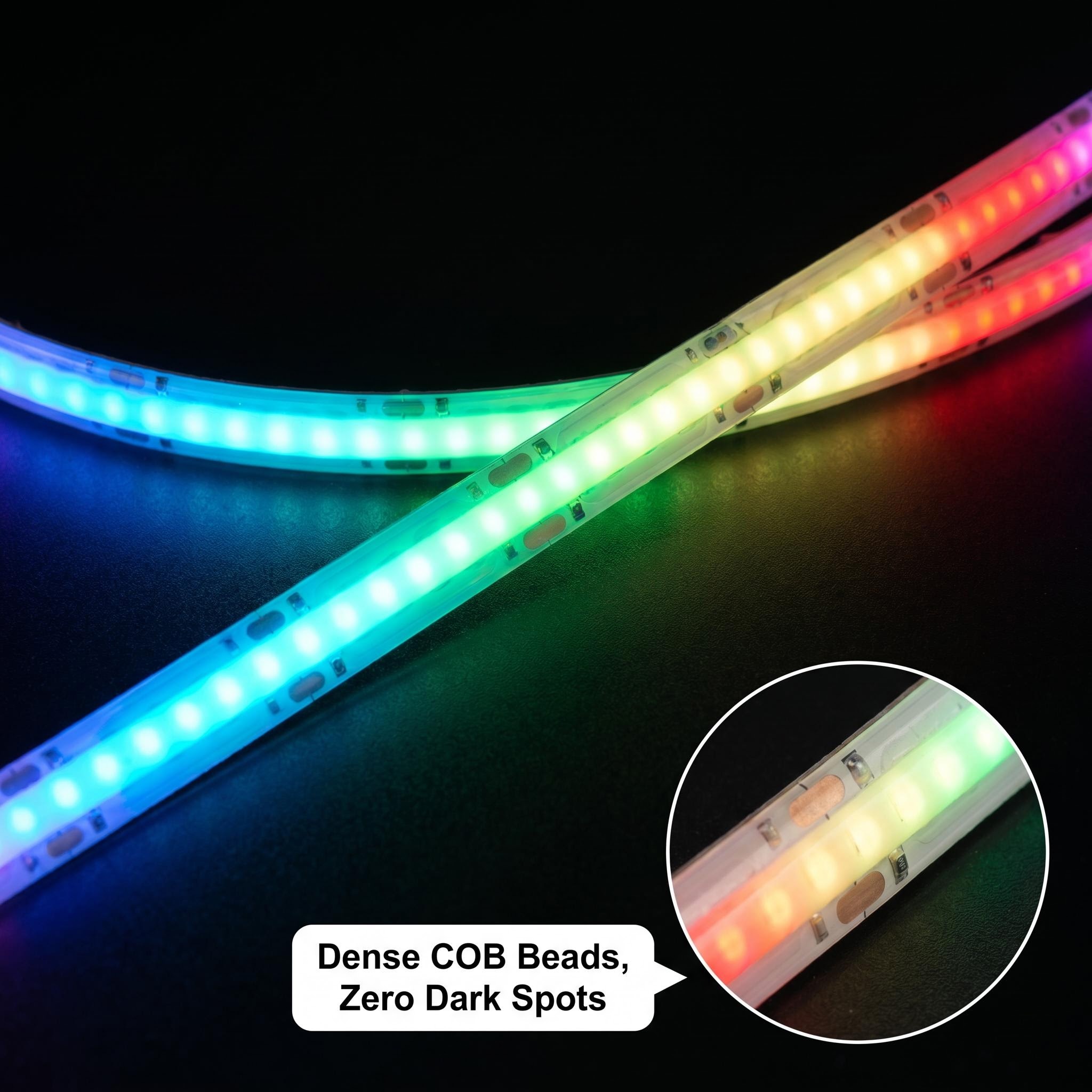
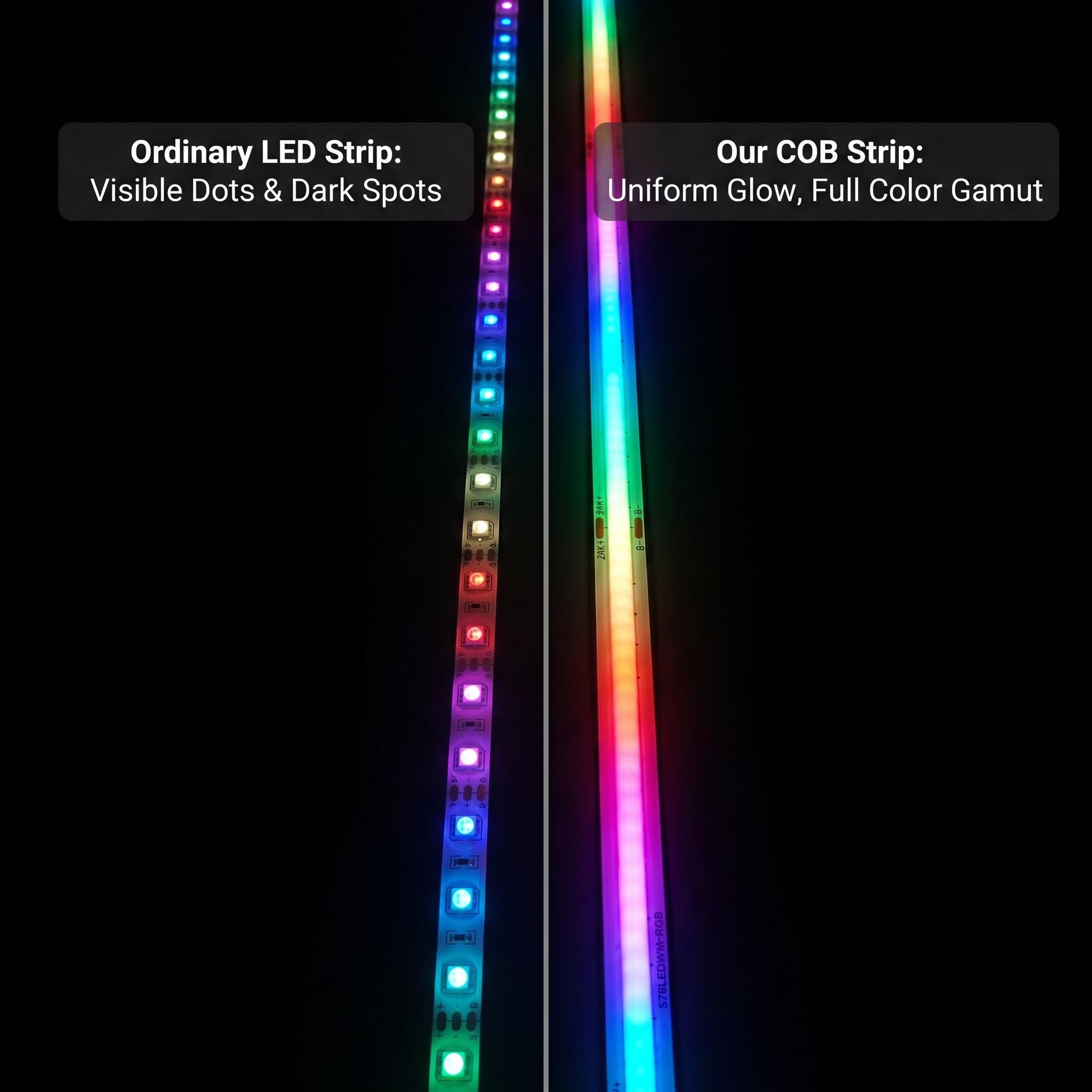
Dotless COB strip with continuous light lines for cove, profile and architectural detailing.
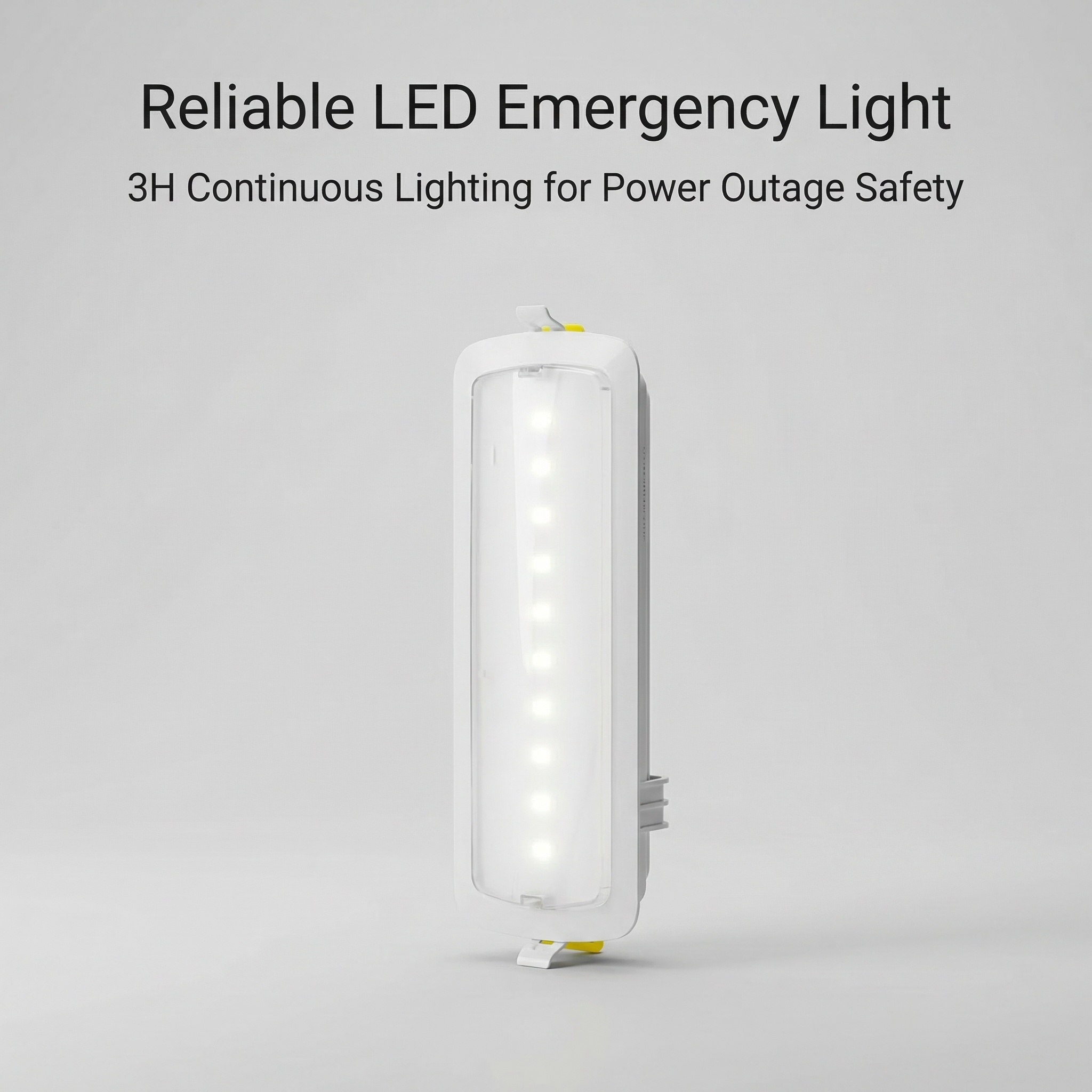
Iluminação de emergência
Self-contained emergency lighting with selectable 90 minute to 3 hour duration and maintained or non-maintained wiring.
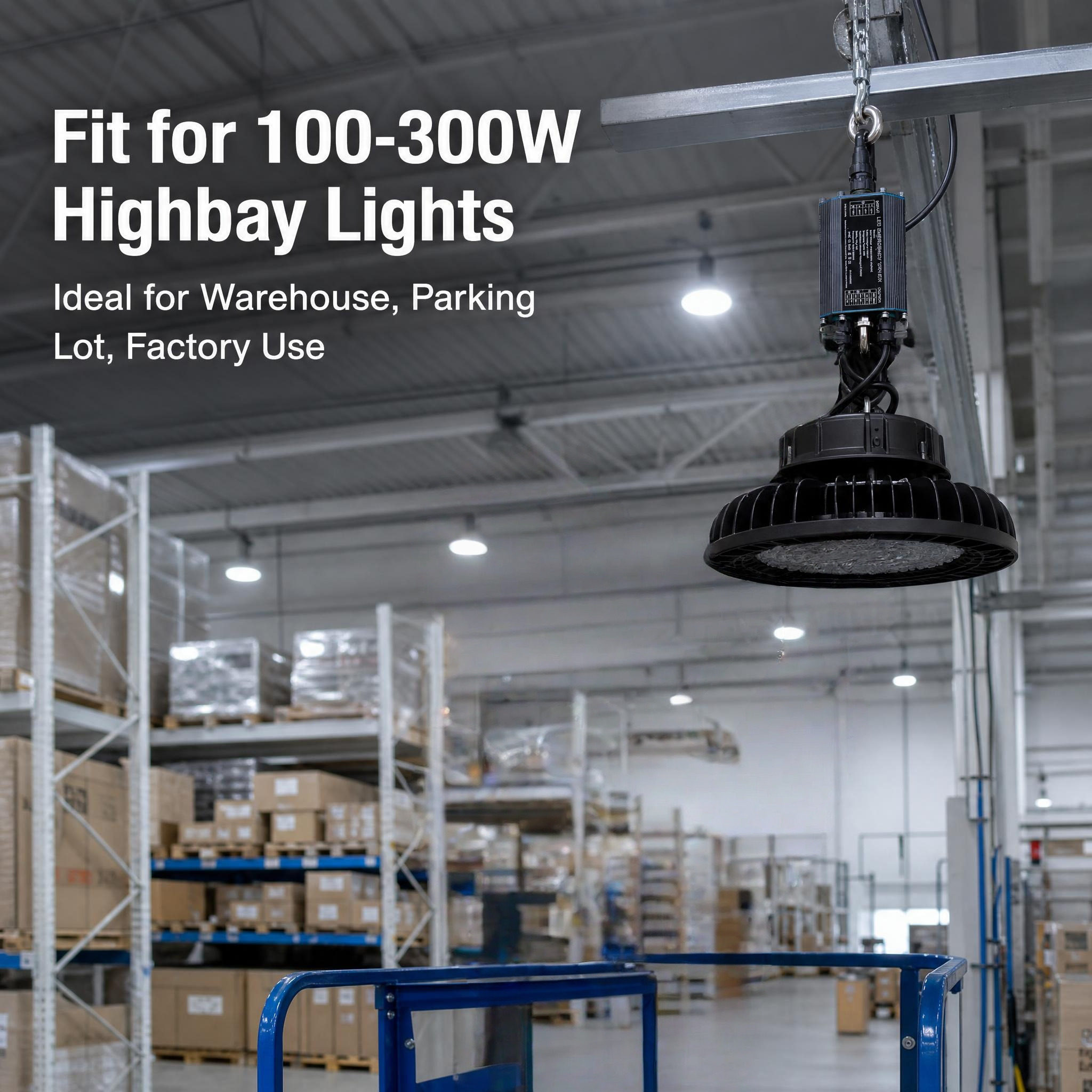
LED Emergency Driver For LED High Bays
High wattage emergency drivers for UFO and linear high bays in warehouses, plants and logistics centres.
Frequently Asked Questions About LED Downlight
How To Verify Real Manufacturing Capacity
Q: How can I tell if a supplier actually builds LED downlight emergency modules or just resells them?
Ask for photos of SMT lines, reflow ovens and battery pack welding stations with date stamps. A real factory holds cell-level procurement records showing 18650 or LiFePO4 batch codes, plus discharge test logs traced to individual serial numbers. Request a video call from the ageing room: modules should run 90-minute or 180-minute discharge cycles at 25°C ± 2°C ambient, with hipot testing at 500V DC or 1500V AC per IEC 61347. A trading office deflects; a manufacturer sends test records within 24 hours.
Q: What minimum order quantity and lead time should I expect for a first order of LED downlight emergency kits?
MOQ typically runs 500 to 1000 units for standard 3W to 12W emergency drivers, or 100 to 300 units if you commit to a fixed specification for 90 days. Sample lead time is 7 to 10 working days for existing models, 15 to 20 days for modified output current or custom connector wiring. Bulk production lead time ranges 25 to 35 days after deposit, extending to 45 days if you require destination-market third-party testing concurrent with production.
Matching The Module To Your Fixture
Q: How do I confirm your emergency driver fits my existing LED downlight housing and LED module?
Measure the downlight’s normal LED driver output: constant current in mA (300mA, 500mA, 700mA, 1050mA) and voltage window in DC V. The emergency driver must match or exceed this current with its inverter output, typically 3V to 80V DC adjustable. Check physical dimensions: emergency modules for recessed downlights usually need to fit within 120mm diameter and 35mm depth. Request a dimensional drawing and a functioning sample wired to your exact LED board before placing bulk order.
Q: What emergency duration and light output options are available, and how do they affect battery size and price?
Standard durations are 90 minutes, 120 minutes and 180 minutes per EN 1838 and BS 5266-1. Emergency output is typically 10% to 100% of normal lumen output; 10% to 30% is common for escape-route compliance, 50% to 100% for open-area anti-panic lighting. A 3-hour kit at 100% output needs LiFePO4 3.2V 6000mAh or Li-ion 18650 7.4V 5200mAh, adding 40% to 60% to battery cost versus a 90-minute 10% output pack using NiCd 3.6V 1500mAh.
Wiring Test And Control Options
Q: What is the difference between maintained and non-maintained wiring for LED downlight emergency units?
Non-maintained: the emergency module charges in standby and switches on only when mains fails, wired via a changeover relay. Maintained: the emergency lamp runs from the module during normal operation too, or from a separate switched live circuit, so the fitting illuminates whenever the area is occupied. Maintained wiring requires a latching relay and adds 15% to 25% to module cost. Check your local regulations: BS 5266-1 permits both; some Middle East specifications mandate maintained for stairwells.
Q: What self-test and DALI options are available, and do they change the module price?
Manual test key is standard. Automatic self-test per EN 62034 adds a microcontroller and clock circuit, increasing unit cost by 20% to 30%. DALI-2 emergency test facility adds a DALI bus interface and requires DALI-compatible LED driver compatibility; budget 35% to 50% above base price. Self-test modules run duration and functional tests at programmed intervals, storing fault codes. Confirm your site’s DALI address availability: each emergency module consumes one short address.
Battery Chemistry Shipping And Compliance
Q: What battery chemistry do you use, what is the replacement interval, and how does lithium affect shipping?
NiCd packs last 3 to 4 years, tolerate 0°C to 45°C ambient, but face environmental restrictions in EU markets. Li-ion 18650 and LiFePO4 packs offer 500 to 800 cycles, 5 to 8 year service life, and 3 to 4 hour recharge from flat. Lithium batteries require UN 38.3 test summary, IATA Section II or Section IB labeling, and IMDG Code documentation for sea freight. This restricts air freight to cargo-only aircraft for quantities over 35kg net lithium content, often pushing shipping mode to FCL sea freight with 25 to 30 day transit to Europe.
Documentation Payment And Support
Q: What test reports and conformity marks can you supply for my market, and what should I request before paying?
Ask for third-party test reports covering EN 60598-2-22, EN 1838 and EN 62034 for UK and EU; UL 924 for North America; AS/NZS 2293 for Australia and New Zealand. The supplier should provide CB test certificates as a base for national deviations. Verify the report scope matches your exact model number and battery configuration. Do not accept generic family reports with different wattages or battery chemistries substituted. Request EMC test data to EN 55015 and EN 61547 if your project specification includes electromagnetic compatibility clauses.
Q: What payment terms warranty coverage and after-sales engineering support do you offer?
Standard terms are 30% TT deposit, 70% against copy of BL for FOB Shenzhen or CIF port. LC at sight accepted above USD 50,000 with 2% surcharge. Warranty is typically 3 years on electronics, 2 years on NiCd or 3 years on lithium battery packs, conditional on annual discharge test records. Spare parts availability is 5 years from last production date. Engineering support includes wiring diagrams for maintained and non-maintained configurations, lux calculation guidance for EN 1838 compliance distances, and commissioning checklists for self-test and DALI address programming.
Important Notice
Specifications, output and duration figures and price ranges in this guide are indicative and are provided
for planning purposes only. Actual emergency output, duration, battery life, ingress protection and available conformity documentation
differ by model and by destination country, and emergency lighting design remains the responsibility of the project designer. Buyers
must confirm their own mains voltage and frequency, the emergency lighting standard enforced locally, the host fixture compatibility
and their import requirements before placing an order. All figures are subject to written confirmation in the final proforma invoice
issued by Hymark.
Sourcing LED Downlight from Hymark
What to Verify Before Placing an Order
A supplier claiming factory status should show you SMT and final assembly lines, not just a sales office. Ask for video walkthroughs of battery pack welding stations and ageing racks where emergency drivers run discharge cycles at 25°C ambient and at the thermal extremes of your destination market. Hymark’s partnered facilities have operated since 2013, the same year JIALINGHANG ELECTRONIC CO., LTD. was founded, and the company manages R&D, product design and global distribution directly while co-designing hardware with those dedicated manufacturing lines.
Battery traceability matters for customs clearance and for warranty claims. Request cell-level purchase records and UN 38.3 test summaries for lithium shipments—LiFePO4 3.2V packs and Li-ion 18650 3.7V packs both fall under IATA and IMDG restrictions for air and sea freight. NiCd 3.6V or 4.8V alternatives avoid lithium transport paperwork but carry heavier weight and shorter cycle life, typically 300 to 400 cycles versus 500 to 800 for LiFePO4 at 80 percent depth of discharge.
Demand discharge and duration test records for the specific combination you need: 90 minutes, 2 hours or 3 hours at your target emergency output, whether that is 10 percent, 20 percent or 100 percent of normal lumen output. EN 60598-2-22 and EN 1838 set minimum illuminance levels; BS 5266-1 and AS/NZS 2293 add duration and spacing rules for UK and Australasian projects. A valid report should list input voltage range—commonly AC 85-265V or 100-277V—inverter output window in DC volts and mA, driven load in watts, and the changeover relay response time between mains failure and emergency strike-in.
Check for hipot and ground continuity test stations, not just functional checks. Ask whether self-test or DALI test facility firmware is programmed and calibrated in-house. Sample lead time from Hymark runs 5 to 7 working days for standard emergency drivers; custom firmware or maintained versus non-maintained wiring variants add 3 to 5 days. Payment structures are typically 30 percent deposit, 70 percent against copy of bill of lading, with FOB Shenzhen or CIF destination port terms. MOQ starts at 100 units for branded emergency drivers, 500 units for OEM packaging.
How Hymark Supports Your Specification
Hymark was launched in 2026 as the premium brand of JIALINGHANG ELECTRONIC CO., LTD., reflecting the company’s 2017 strategic shift into LED emergency technology and high-performance LED strips. The range covers emergency lighting, emergency exit signs, emergency luminaires, emergency twin spotlights, LED emergency drivers for LED high bays, panel lights, tubes and linear lights, full power output emergency drivers, LED strip lights, COB LED strips and SMD LED strips. Orders ship with selectable emergency duration, maintained or non-maintained wiring, OEM and ODM branding, and export carton packing.
Send your host fixture type and wattage, the emergency duration your code requires, your mains voltage and your destination port. Hymark will return a quotation within 24 hours via WhatsApp or email.
Get a Factory Direct Quote on LED Downlight
JIALINGHANG ELECTRONIC CO., LTD. has been in LED lighting since 2013 and has focused on
LED emergency technology and high performance LED strips since 2017. Hymark products are co-designed with our
dedicated manufacturing partners, built with selectable emergency duration and maintained or non-maintained wiring, and function
tested before packing. Send us the host fixture type and wattage, the emergency duration your local code requires, your mains
voltage and your destination port and we will return a quotation within 24 hours.


 English
  Spanish
  Arabic
  French
  German
  Russian
  Portuguese
  Italian
  Vietnamese