
LED Emergency Driver Buyer Guide
FOB Shenzhen prices for Hymark LED emergency drivers run from $4.20 to $6.80 per unit for 3W to 10W open-frame modules with NiCd 3.6V 700mAh packs, $7.50 to $12.00 for 10W to 25W enclosed units with Li-ion 18650 7.4V 2200mAh or LiFePO4 6.4V 1500mAh packs, and $14.00 to $22.00 for 25W to 60W high-output drivers with LiFePO4 12.8V 3000mAh packs driving LED high bays or linear systems at 100% maintained output for 3 hours. MOQ is 500 pieces for customised firmware or DALI self-test variants, 200 pieces for standard SKUs; sample orders of 2 to 5 units ship within 5 working days at sample pricing 1.5× FOB.
The rest of this page breaks down where that money goes, what five-year ownership costs, and how specification choices move the number.
Cost Split By Component Class
| Component | Share of FOB (typical) | What Moves the Needle |
|---|---|---|
| Battery pack | 22% to 35% | LiFePO4 3.2V 3000mAh costs 40% more than Li-ion 18650 7.4V 2200mAh but delivers 500 to 800 cycles versus 300 to 500; NiCd 3.6V 700mAh is cheapest at 150 to 200 cycles |
| Inverter / driver PCB | 18% to 25% | Constant-current output 150mA to 700mA, wide-input 85-265V AC designs need larger inductors than 220-240V-only |
| Changeover relay | 5% to 8% | Mechanical relay for maintained wiring adds cost over solid-state non-maintained |
| Enclosure and thermal | 12% to 18% | IP20 plastic versus IP65 die-cast for humid markets |
| Testing and certification documentation | 8% to 15% | EN 60598-2-22 and EN 62034 test reports, UN 38.3 for lithium cells |
| Assembly and labour | 8% to 12% | |
| Packing and pallet prep | 3% to 5% | Individual carton 20 units, pallet 40 cartons, 800 units per pallet |
Five Year Running Cost
Battery replacement dominates. A LiFePO4 pack cycled monthly by EN 62034 automatic test function degrades to 80% capacity in roughly 6 years; Li-ion in 3 to 4 years; NiCd in 2 to 3 years. At technician labour rates of £45 to £65 per hour in the UK or €40 to €55 in Germany, a site visit to swap a failed NiCd pack every 2.5 years adds £18 to £26 annualised labour plus £4 to £6 cell cost, versus £9 to £13 labour plus £9 to £14 cell cost for LiFePO4 over 6 years. Self-test and DALI test facility reduce labour further by automating the 30-second functional test that BS 5266-1 and AS/NZS 2293 require monthly or quarterly.
What Drives Emergency Driver Cost From China
Freight and duty structure matters as much as unit price. A 40ft container holding 18,000 to 22,000 units at 0.4kg each ships FOB Shenzhen at roughly $0.18 to $0.25 per unit ocean to Rotterdam or Felixstowe; CIF adds 12% to 18%. Lithium cells need UN 38.3 test summaries and IATA/IMDG Section II or IB labelling; non-compliant shipments face customs detention at 3% to 5% incident rate in EU ports. Buyers should request the supplier’s MSDS and UN 38.3 test report numbers before confirming Incoterms.
Types and Configurations of LED Emergency Driver
FOB Price Bands by Product Class
| Product Class | Typical Driven Load | Sortie d'urgence | Duration | FOB Shenzhen USD (500 pcs) | FOB Shenzhen USD (2000 pcs) |
|---|---|---|---|---|---|
| Economy 3–10 W panel/tube driver | 3–10 W | 30–50 % of nominal | 90 min | 4.80–6.20 | 4.20–5.40 |
| Standard 10–20 W panel/linear driver | 10–20 W | 50–100 % of nominal | 90 min–3 hr | 7.50–10.50 | 6.50–9.00 |
| Full-power 20–60 W high-bay driver | 20–60 W | 100 % of nominal | 90 min–3 hr | 14.00–22.00 | 12.00–19.00 |
| Self-test/DALI intelligent driver | 10–40 W | 50–100 % of nominal | 90 min–3 hr | 18.00–28.00 | 15.00–24.00 |
| Compact strip emergency module | 5–15 W | 30–70 % of nominal | 90 min | 5.50–8.00 | 4.80–7.00 |
MOQ is 500 units for standard specifications, 2000 units for custom labels or firmware. Sample lead time is 5–7 working days; bulk lead time is 25–35 days after confirmed artwork and deposit. Payment terms are 30 % T/T deposit, 70 % against copy of B/L for first orders; L/C at sight negotiable above USD 50,000 per shipment.
Cost Split for a Standard 15 W 90-Minute Driver
| Cost Element | % of FOB | Typical USD at 500 pcs | Notes |
|---|---|---|---|
| Battery pack (LiFePO4 3.2 V 3000 mAh or Li-ion 18650 3.7 V 2600 mAh) | 22–28 % | 1.90–2.60 | LiFePO4 adds 15–20 % cell cost vs Li-ion 18650 but delivers 800–1200 cycles vs 500–700 |
| Driver electronics (inverter PCB, changeover relay, charge circuit) | 18–24 % | 1.60–2.20 | Constant-current output stage and EMI filtering dominate here |
| Enclosure and mounting hardware | 12–16 % | 1.00–1.40 | IP20 steel or aluminium; IP65 polycarbonate adds 0.40–0.70 |
| Testing and certification documentation | 8–12 % | 0.70–1.10 | EN 60598-2-22 and EN 62034 test reports; third-party CB or SAA adds 0.50–0.90 if ordered |
| Assembly and labour | 10–14 % | 0.90–1.20 | |
| Packing (inner box, carton, pallet) | 6–9 % | 0.50–0.80 | UN 38.3 lithium battery labels and documentation included where required |
| Freight to port and export formalities | 5–8 % | 0.40–0.70 | |
| Margin | 10–15 % | 0.90–1.40 |
Five-Year Total Cost of Ownership
| Cost Item | Standard Li-ion 18650 Driver | LiFePO4 Driver | Notes |
|---|---|---|---|
| Initial unit FOB | 7.50 | 9.20 | At 500 pcs |
| Battery replacement at year 3–4 | 2.80–3.40 | 0 (cycles typically exceed 5 years at 90 min monthly test) | Li-ion 18650 capacity drops below 80 % after 500–700 cycles; LiFePO4 retains 80 % after 1000–1500 cycles |
| Annual testing labour (manual test key) | 15–25 min per fitting at local electrician rates | Same | Self-test or DALI-automated test reduces this to 5 min visual inspection; labour saving pays back in 18–24 months on larger sites |
| Downtime/risk of non-compliance | Higher with manual test missed intervals | Lower | EN 62034 and BS 5266-1 require monthly function tests and annual duration tests |
| Five-year TCO per unit | 12.50–16.50 | 11.50–13.50 | LiFePO4 breaks even despite higher first cost on sites with disciplined test regimes |
What Drives Emergency Driver Cost From China
Battery chemistry and capacity account for the largest single variance. A NiCd 3.6 V 1500 mAh pack costs 30–40 % less than LiFePO4 3.2 V 3000 mAh but carries shorter cycle life (300–400 cycles), heavier weight, and tightening RoHS and transport restrictions. Buyers specifying EN 60598-2-22 and EN 1838 for European projects increasingly face end-customer preference for lithium-based systems despite the UN 38.3 testing surcharge (USD 800–1200 per battery model for air freight).
Output power and duration scale non-linearly. A 90-minute 10 W driver needs roughly 1800 mAh at 3.2 V; the same fitting at 3 hours needs 5400 mAh, more than tripling battery volume and cost. Full-power output (100 % of nominal lumens in emergency) requires a larger inverter stage and often a separate constant-current profile, adding 25–35 % to electronics cost versus reduced-power 30–50 % output.
Test facility complexity separates commodity and premium tiers. Manual test key wiring is simplest: two terminals, momentary contact to simulate mains failure. Self-test adds a microcontroller, real-time clock, and status LED; DALI-2 emergency compliance per EN 62034 adds isolated DALI bus interface, firmware certification, and addressable reporting. The BOM delta is USD 3.50–5.50 but eliminates site visit labour for monthly tests.
Enclosure rating is often underestimated. IP20 open-frame drivers suit luminaire OEMs integrating emergency modules inside sealed fittings. Standalone IP65 drivers for surface mounting in car parks or plant rooms need gasketed polycarbonate housings, cable glands, and corrosion-resistant hardware. The IP65 premium is 25–35 % but avoids field failures from dust ingress or condensation on inverter PCBs.
Certification documentation varies by target market. For the UK and EU, buyers should request EN 60598-2-22 and EN 1838 test reports plus EN 62034 for self-test units; CB test certificates speed local marking but are not mandatory for CE self-certification. For the Middle East, SASO or ECAS may be required. For Southeast Asia, Thailand TISI and Singapore BC1 add separate testing. Hymark prepares base EN test reports as standard; market-specific certifications are quoted per project.
Export Practicalities Affecting Landed Price
Mains voltage and frequency by destination: UK and EU expect 220–240 V 50 Hz; the Middle East uses 220–230 V 50 Hz (Saudi Arabia 60 Hz in some zones); Southeast Asia is mixed (Philippines 220 V 60 Hz, Singapore 230 V 50 Hz); Africa is predominantly 220–240 V 50 Hz; Latin America is largely 127 V or 220 V 60 Hz. Drivers with 85–265 V input cover all markets without SKU fragmentation; 220–240 V only saves USD 0.30–0.50 but limits resale flexibility.
Conformity marks customs expect: CE for EU, UKCA for Great Britain, UL or ETL for North America, RCM for Australia (AS/NZS 2293). Middle East customs increasingly scan for CB certificates linked to national deviations. African ports vary: Kenya PVoC, Nigeria SONCAP, Egypt GOEIC. Buyers should confirm with their freight forwarder which mark is inspected at destination; incorrect or missing documentation triggers demurrage averaging USD 150–400 per day.
Lithium battery transport rules: UN 38.3 test summary is mandatory for air freight (IATA DGR Section IA or IB) and sea freight (IMDG Code). Hymark batteries are tested to UN 38.3; copies accompany each shipment. For air freight, Li-ion 18650 packs over 100 Wh or LiFePO4 over 100 Wh need dangerous goods declaration and often cargo-only aircraft routing, adding 15–25 % to freight cost. Sea freight is unrestricted for tested batteries below 100 Wh per cell, 300 Wh per pack.
Carton and pallet packing: 50 units per carton, 20 cartons per plywood pallet (1000 units). Carton dimensions 48 × 38 × 32 cm, gross weight 14 kg. Palletised stack to 1.6 m for 20 ft container (approx. 20 pallets, 20 000 units) or 2.3 m for 40 ft HQ (approx. 32 pallets, 32 000 units). FOB Shenzhen covers loading; CIF adds sea freight and basic marine insurance. Typical CIF premium to UK/EU ports is USD 0.35–0.55 per unit at 20 ft container volumes; to Middle East USD 0.25–0.40; to Africa USD 0.45–0.70 depending on line and congestion.
Trade-Offs Buyers Should Weigh
| Lower-Cost Choice | What You Lose | When It Still Makes Sense |
|---|---|---|
| NiCd battery | Cycle life, RoHS compliance, weight | Legacy specifications in markets without lithium transport infrastructure |
| Reduced-power 30 % output | Visibility and task safety in large spaces | Corridors, store rooms, non-critical egress where EN 1838 minimum is met |
| Manual test only | Labour cost, test record traceability | Small installations with single-point responsibility and low labour rates |
| IP20 open frame | Standalone mounting flexibility, moisture protection | OEM integration into sealed luminaires with own IP rating |
Lead Time and Sample Policy
Standard configurations from Hymark’s LED Emergency Driver For LED Panel Lights, LED Emergency Driver For LED Tubes, and LED Emergency Driver For Linear Lights lines carry 25–35 day lead times from confirmed PO and deposit. Custom output currents (e.g. 350 mA instead of 500 mA), non-standard duration (2 hours for Middle East malls, 3 hours for UK healthcare), or private-label firmware (DALI short addresses pre-programmed) extend to 40–50 days and require 2000-unit MOQ.
Samples of standard 10 W and 20 W self-test drivers are held in Shenzhen stock; 1–2 units ship within 5–7 working days against courier collect account or prepaid freight. Sample credit of USD 50–80 applies to first bulk order above 500 units. Custom samples (non-standard current or duration) are built to order in 15–20 working days at prototype pricing 2×–2.5× bulk FOB.
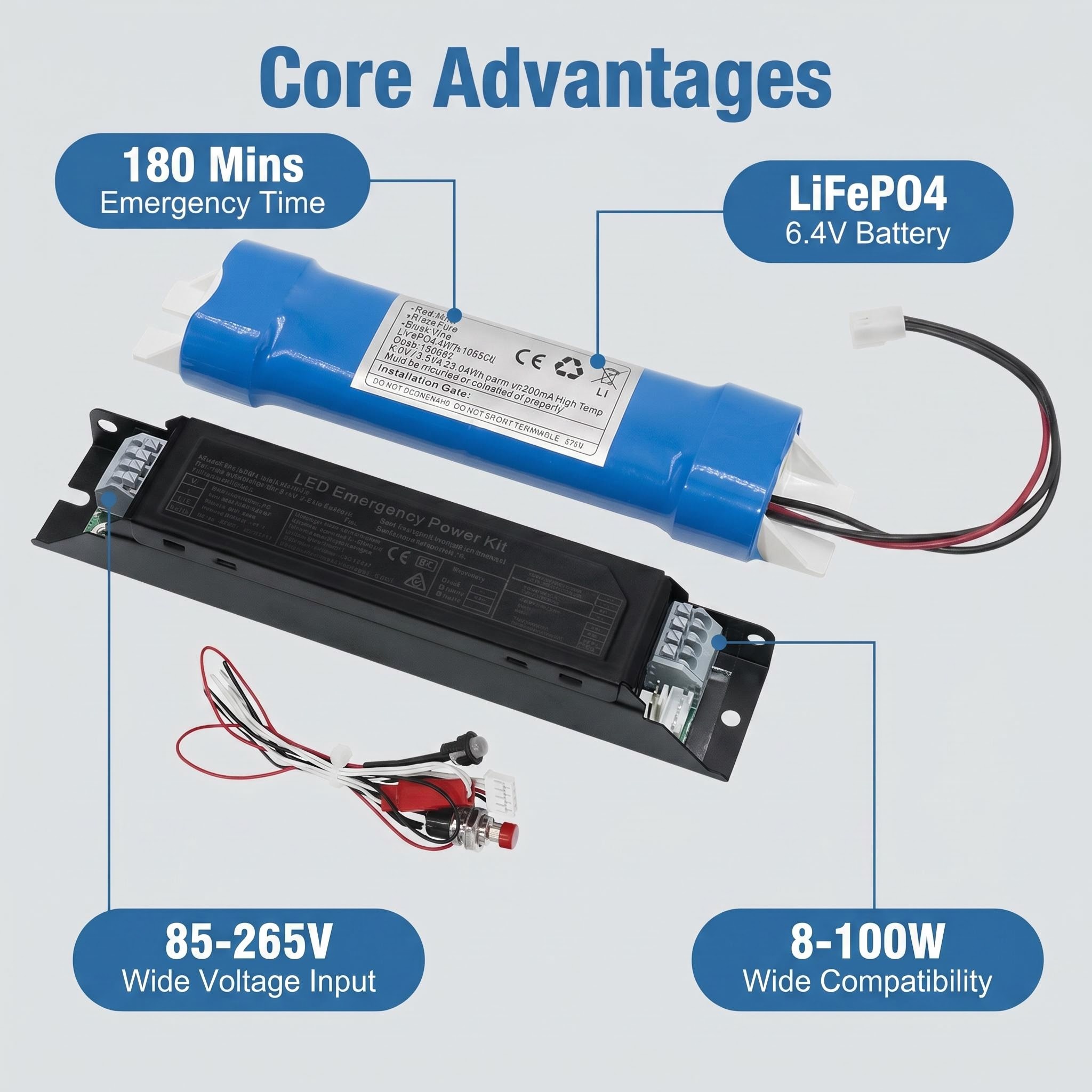
Specifications and How to Read Them
Representative Build Specifications
| Parameter | Entry Level | Mid Range | High Specification |
|---|---|---|---|
| Normal Input | AC 85-265V, 50/60Hz | AC 100-277V, 50/60Hz | AC 220-240V, 50Hz or AC 120-277V, 60Hz |
| Driven Load | 3-10W | 10-20W | 20-60W |
| DC Output Window | 9-42V, 150-350mA | 18-55V, 200-700mA | 36-80V, 350-1500mA |
| Sortie d'urgence | 300-600lm, 30% of normal | 800-1500lm, 50% of normal | 2000-4000lm, 100% of normal |
| Durée de la situation d'urgence | 90 minutes | 90 minutes or 3 hours | 3 heures |
| Battery Chemistry | NiCd 3.6V 1200mAh | Li-ion 18650 7.4V 2200mAh | LiFePO4 12.8V 3000mAh |
| Charge Time | 24 hours | 16 hours | 12 hours |
| Cycle Life | 300-500 cycles | 500-800 cycles | 1500-2000 cycles |
| Test Facility | Manual test key | Self-test per EN 62034 | Self-test + DALI-2 |
| Wiring Mode | Non entretenu | Non-maintained or maintained | Maintained or non-maintained |
| IP / IK Rating | IP20 / IK02 | IP65 / IK07 | IP66 / IK08 |
| Ambient Temperature | 0°C to +45°C | -10°C to +55°C | -20°C to +60°C |
| Dimensions | 120×35×22mm | 160×42×28mm | 200×60×35mm |
| Mounting | Plastic clips, internal to luminaire | Metal bracket, internal or remote | Steel enclosure, remote 3m cable |
| FOB Shenzhen (1000 pcs) | $4.20-6.50/unit | $8.50-14.00/unit | $22.00-38.00/unit |
Reading the Datasheet Line by Line
Input voltage range and frequency tells you where the driver can be installed without a step-down transformer. A range of AC 85-265V covers 120V North American and 230V European mains in one SKU. AC 100-277V suits 277V commercial distribution common in the US and Canada. The frequency marking 50/60Hz means the power factor correction and EMI filter are tuned for both grids. Check that your local nominal voltage sits comfortably inside the range, not at the edge. Brownout performance below 85V varies by design; some units cut out to protect the battery, others ride through brief dips.
Driven load in watts is the LED power the driver supports in normal mode. The emergency driver does not power the full fixture— it bypasses or replaces the normal LED driver during mains failure. Match this figure to your luminaire’s LED module consumption, not the total fixture wattage including normal driver losses. A 40W panel light might draw 36W at the LED module; specify a driver rated for 36W minimum, 40W preferred for headroom.
DC output voltage window and current define the LED string the emergency inverter can drive. Constant current output is standard; the driver adjusts voltage to maintain set current. If your LED module wants 36V at 500mA, verify the driver’s voltage window includes 36V and its current range includes 500mA. Exceeding the voltage window causes shutdown or flicker; exceeding current reduces LED life.
Emergency output in lumens and percentage of normal determines whether occupants can egress safely. EN 1838 requires minimum 1 lux on the centre line of escape routes; the driver must produce enough lumens through the fixture optics to achieve this. A driver rated at 50% of normal output on a 2000lm luminaire gives 1000lm emergency. For open areas, 10% of normal may suffice; for stairwells, 100% maintained output is often specified. The percentage figure is not a quality metric— it is a design choice. Higher percentage demands larger battery and higher inverter capacity.
Emergency duration is 90 minutes for most jurisdictions, 3 hours for UK healthcare (HTM 06-01), some industrial applications, and markets following BS 5266-1 strictly. The same hardware often supports both durations via battery capacity selection; verify which configuration you are pricing.
Battery chemistry voltage and capacity drives both cost and longevity. NiCd at 3.6V 1200mAh is cheapest but carries memory effect and cadmium disposal restrictions in EU and UK. Li-ion 18650 at 7.4V 2200mAh offers better energy density but requires UN 38.3 transport certification and thermal protection. LiFePO4 at 12.8V 3000mAh delivers longest cycle life, stable voltage through discharge, and safer thermal runaway profile, at 40-60% cost premium over Li-ion. Capacity in mAh directly determines duration: a 10W LED load at 36V draws 278mA; 2200mAh theoretical capacity yields 7.9 hours, but inverter efficiency (typically 82-88%) and end-of-life degradation (80% remaining capacity) reduce this to roughly 90 minutes practical.
Charge time matters for installation commissioning and after deep discharge. Sixteen hours is typical for Li-ion; LiFePO4 accepts faster charge rates. Ask whether the driver supports automatic trickle recovery after mains restoration or requires manual reset.
Cycle life at full depth of discharge: NiCd 300-500, Li-ion 18650 500-800, LiFePO4 1500-2000. Partial discharge extends all chemistries. For maintained systems with frequent brief outages, LiFePO4 pays back within 3-4 years against Li-ion replacement.
Test facility determines labour cost. Manual test key requires quarterly site visits, 15 minutes per unit. Self-test per EN 62034 automates monthly function and annual duration tests, reducing labour to annual log review. DALI-2 integration reports status to building management systems, adds $3-5 per unit in hardware, suits large facilities with DALI infrastructure. Self-test units still need physical inspection of indicator LEDs; the automation covers electrical function, not lens cleanliness.
Maintained versus non-maintained wiring changes the switchgear. Non-maintained: driver sits idle until mains fails, wired in parallel with normal supply. Maintained: driver powers LEDs continuously via changeover relay, switching to battery on mains loss; requires separate maintained supply circuit and relay rated for make-before-break or break-before-make as appropriate. Maintained wiring adds $2-4 in relay cost and complicates switching compatibility with dimming systems.
IP and IK rating selects enclosure. IP20 for internal luminaire mounting, dry locations. IP65 for damp or dusty environments, remote mounting in industrial bays. IP66 for hose-down areas. IK02 adequate for ceiling-recessed; IK07 minimum for public areas with vandalism risk; IK08 for sports facilities and prisons. Higher ratings add $1.50-4.00 in sealing and glass-reinforced polycarbonate or die-cast housing.
Ambient temperature range affects battery chemistry selection. Standard 0°C to +45°C suits office environments. -20°C to +60°C requires LiFePO4 or special NiCd; Li-ion 18650 discharges poorly below -10°C and risks lithium plating during charge. High-temperature locations above 55°C halve Li-ion cycle life; specify LiFePO4 or accept 2-year replacement intervals.
Dimensions and mounting determine whether the driver fits your luminaire housing or requires remote mounting. Entry-level 120×35×22mm fits most 600×600mm panel light cavities. High-specification 200×60×35mm with steel enclosure typically mounts externally with 3m fire-rated cable to the LED module. Remote mounting adds cable cost and voltage drop calculation: 1.5mm² cable loses 0.025V per metre at 1A; at 36V output, 3m run with return is acceptable; at 9V output, same run loses 5% and may trigger undervoltage protection.
Cost Structure and Five-Year Ownership
| Cost Component | Entry Level Share | Mid Range Share | High Specification Share |
|---|---|---|---|
| Battery cells | 22% | 28% | 35% |
| Driver electronics (inverter, charger, protection) | 25% | 24% | 22% |
| Enclosure and hardware | 12% | 15% | 18% |
| Testing and certification (internal, not claimed external) | 8% | 10% | 12% |
| Assembly and labour | 15% | 12% | 8% |
| Packing and marking | 6% | 5% | 3% |
| Freight to port (FOB basis) | 12% | 6% | 2% |
Five-year running cost varies by test regime and battery chemistry. Assume 100 units, quarterly manual test for entry-level, automated self-test for mid and high:
| Item | Entry Level | Mid Range | High Specification |
|---|---|---|---|
| Initial FOB 1000-unit price per unit | $5.20 | $11.00 | $28.00 |
| Battery replacement, year 3-4 | $1.80/unit (NiCd) | $3.50/unit (Li-ion) | $0 (LiFePO4, cycles remaining) |
| Testing labour, 5 years | $12.50/unit (quarterly manual, 15 min at $50/hr) | $2.10/unit (annual log review, 2.5 hr at $50/hr spread across 100 units) | $2.10/unit |
| Disposal/recycling (EU WEEE) | $0.40/unit NiCd premium | $0.20/unit Li-ion | $0.15/unit LiFePO4, no hazardous classification |
| 5-year total per unit | $19.90 | $16.80 | $30.25 |
The mid-range self-test Li-ion unit undercuts entry-level manual-test NiCd on lifetime cost despite 2× purchase price. High-specification LiFePO4 with DALI carries highest capital cost but lowest failure risk in critical applications and avoids mid-life battery replacement. For projects with 10-year horizon, LiFePO4 total cost drops below Li-ion.
Trade Terms and Export Practicalities
FOB Shenzhen means Hymark loads container at Yantian or Shekou port; buyer arranges ocean freight, insurance, and destination clearance. Typical addition: $800-1200 per 20GP container to UK/EU base ports, $1400-2200 to Middle East Gulf, $900-1500 to Southeast Asia. CIF adds freight and insurance to FOB; buyer still handles import clearance and duty. CFR (CNF) includes freight without insurance; buyer bears total loss risk at sea. EXW factory leaves all logistics to buyer; rarely used except for consolidated shipments. L/C payment suits first transactions over $30,000; adds $300-500 bank charges and 2-4 days document processing. T/T 30% deposit, 70% against copy of B/L is standard for established relationships; some buyers negotiate 100% against BL copy for repeat orders under $10,000.
HS code 9405.40 for emergency lighting equipment; 8504.40 for LED drivers without battery. Correct classification affects duty rate: 0-3.7% into EU under 9405.40, 0% for 8504.40. Some customs authorities challenge classification based on battery inclusion; prepare technical description showing integrated versus separate battery pack.
CE and UKCA marking are buyer’s responsibility for placing product on market, though supplier provides test reports to support declaration. Ask for EN 60598-2-22 and EN 62034 test documentation; verify test lab accreditation (ILAC-MRA signatory). Hymark can apply CE mark at factory; UKCA requires UK-recognized body for battery safety assessment post-Brexit. For UAE and Saudi markets, ECAS/EQM conformity uses same EN test base with additional national deviations on Arabic labeling.
UN 38.3 battery test report is mandatory for lithium chemistry air or sea transport. Report covers T1-T8 tests: altitude simulation, thermal cycling, vibration, shock, external short circuit, impact/crush, overcharge, forced discharge. Valid for battery design and cell manufacturer combination; ask whether report covers assembled pack or requires separate validation. IATA PI 966 Section II (lithium ion, packed with equipment) or PI 965 (standalone) determines packaging: lithium metal and ion cells over 20Wh or batteries over 100Wh need Class 9 hazard labeling, 1.2m drop test on package, and shipper’s declaration. Most emergency drivers fall under 100Wh pack limit; confirm watt-hour calculation (nominal voltage × rated capacity in Ah).
Packing list should itemize units per carton, battery chemistry and UN number (UN 3481 for lithium ion packed with equipment), gross weight, and HS code per line. Certificate of origin Form E for ASEAN preferential duty, EUR.1 for EU, or ordinary CO via China Council for Promotion of International Trade. For Chile, Peru, Australia under bilateral FTAs, certificate adds zero-duty access beyond standard MFN rate.
MOQ and lead time: 500 units standard MOQ for branded packaging; 100 units acceptable at $0.30/unit surcharge for neutral box. Sample lead time 5-7 days from payment; production lead time 25-30 days for orders under 2000 units, 35-40 days for 5000+ units or custom output configurations. Peak season (August-October pre-Christmas, March-May pre-Ramadan) extends by 10-15 days; book container space 2 weeks ahead of completion.
Emergency driver cost from China sits 15-30% below EU or US-manufactured equivalents at FOB level, narrowing to 5-15% after duty and freight for small orders under 500 units. The gap widens for LiFePO4 products where Chinese cell supply chain integration (CATL, EVE, BYD sub-suppliers) outperforms Western assembly of imported cells. Buyers lose local warranty enforcement and same-day technical support; gain direct factory specification flexibility on output voltage windows and duration settings not stocked by regional distributors.
What to Request in Your RFQ
- Confirm battery chemistry, nominal voltage, and capacity in mAh with cycle life at 80% depth of discharge
- Specify inverter efficiency at rated load and minimum voltage
- Request output current regulation curve: constant current region, start-up voltage, shutdown voltage
- Define test facility: manual key, auto self-test interval (monthly function, annual duration per EN 62034), DALI device type 0 or type 1 compliance
- State wiring requirement: non-maintained only, or maintained with changeover relay contact rating
- Clarify IP rating test method: IEC 60529 jet nozzle or hose nozzle for IP65/66
- Ask for UN 38.3 report number and issuing lab for lithium packs
- Confirm carton packing: units per carton, cartons per pallet, pallet dimensions and weight for freight calculation
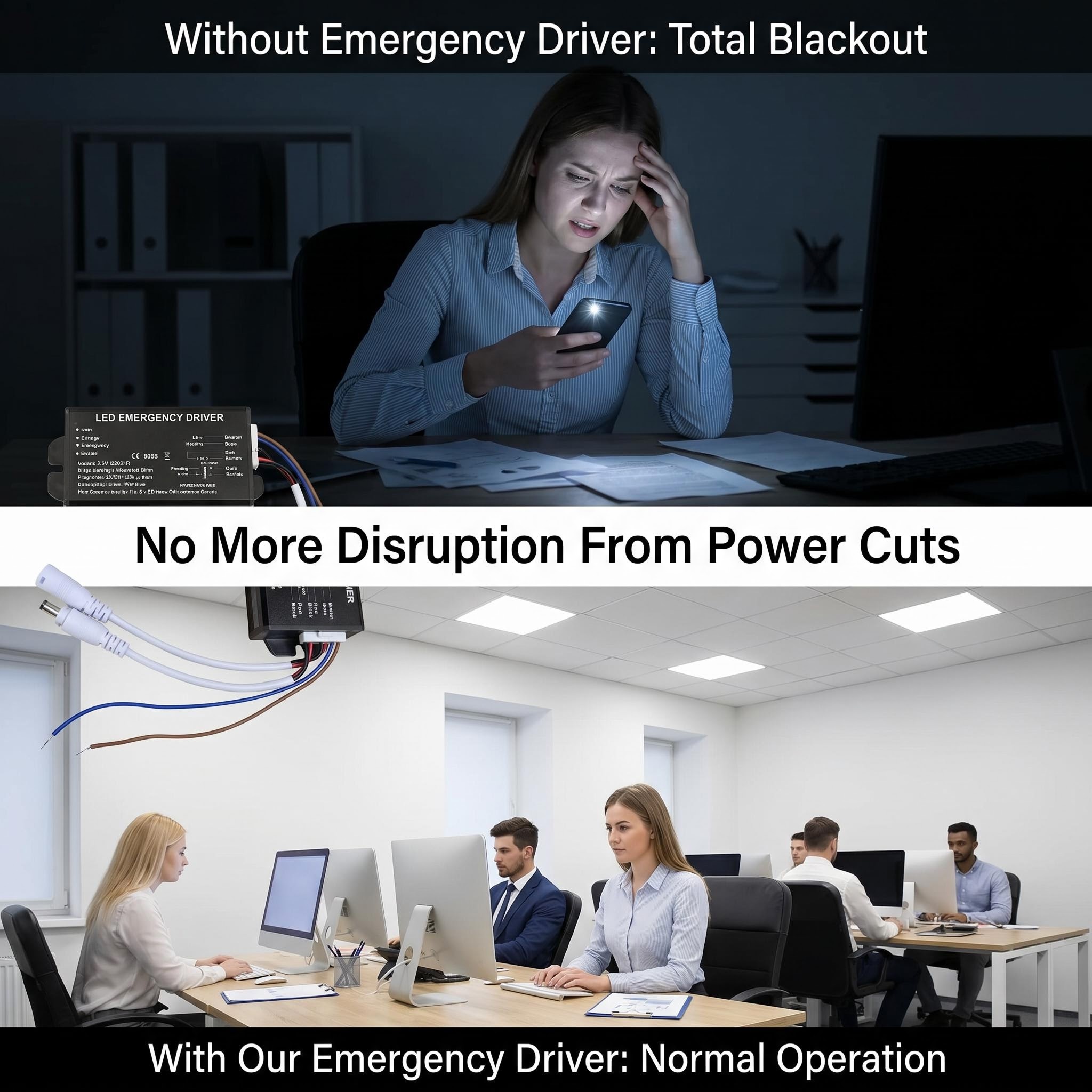
LED Emergency Driver Price and What Drives It
| Class | Typical Rating or Output | Duration or Runtime | Indicative FOB USD |
|---|---|---|---|
| Basic 3W LED panel/tube driver, NiCd 3.6V 1200mAh, non-maintained, manual test key | 3W DC 9-42V 350mA, 30-50% of normal output | 90 minutes | 4.50 – 7.20 |
| Mid-range 5W LED panel/tube/linear driver, Li-ion 18650 7.4V 2200mAh, self-test | 5W DC 9-60V 350mA, 50-100% of normal output | 2 hours | 8.50 – 14.00 |
| High-output 10W LED high bay driver, LiFePO4 12.8V 3000mAh, self-test | 10W DC 24-80V 500mA, 100% of normal output | 3 heures | 16.00 – 26.00 |
| Full-power emergency driver, LiFePO4 25.6V 6000mAh, DALI-2 self-test | 20-40W DC 100-240V, 100% of normal output | 3 heures | 32.00 – 55.00 |
| Custom OEM module with changeover relay, maintained wiring, DALI | 5-15W configurable, 50-100% output | 90 min to 3 hours | 18.00 – 42.00 |
These bands assume factory-direct FOB Shenzhen pricing for minimum order quantities of 500-1000 pieces. Smaller trial orders or samples typically carry 25-40% premium. Prices move with lithium cell commodity pricing and currency fluctuation; treat the table as a planning benchmark, not a binding quotation.
Battery Cells and Chemistry
The battery pack is normally the single largest material cost in an LED emergency driver. A NiCd 3.6V 1200mAh pack costs roughly 1.80-2.60 USD at cell level but carries weight and memory-effect penalties, with 300-500 cycle life. A Li-ion 18650 7.4V 2200mAh pack runs 3.50-5.50 USD, delivers 500-800 cycles, and requires UN 38.3 testing for air freight. LiFePO4 12.8V 3000mAh packs range 8.00-14.00 USD, achieve 1500-2500 cycles, and tolerate -20°C to +60°C ambient, but the higher voltage platform needs a more expensive inverter stage. Buyers specifying EN 60598-2-22 or BS 5266-1 compliance should confirm the supplier’s cell supplier holds IEC 62133 or UL 1642 test reports; without this, customs and local inspectors may reject the shipment.
Driver Electronics and Inverter Stage
The constant-current inverter, changeover relay, and charging circuit represent 15-22% of factory cost. A basic 350mA non-isolated buck-boost inverter for 3-7W loads uses a single IC and discrete MOSFET, costing 1.20-2.00 USD in components. Higher-power designs with isolated topology, PFC front end, or wide-input 85-265V AC capability push to 4.00-7.00 USD. Full-power emergency drivers that maintain 100% lumen output need synchronous rectification and larger magnetics; the electronics alone can reach 12.00-18.00 USD before the battery.
Enclosure Hardware and Thermal Design
Plastic ABS or polycarbonate enclosures with IP20 rating add 0.80-1.50 USD. IP65-rated die-cast aluminium housings with gasketed cable glands run 3.50-6.00 USD. The five-year running cost difference matters here: an IP20 driver mounted in a damp warehouse may fail at 18-24 months, while the IP65 unit survives. IK08 or IK10 impact ratings for industrial sites add another 1.00-2.50 USD in thicker housing and lens material.
Testing Certification and Amortisation
Third-party approval to EN 60598-2-22, EN 1838, EN 62034, or UL 924 typically costs 8,000-25,000 USD per product family depending on test lab and scope. Spread across a 5,000-piece production batch, this adds 1.60-5.00 USD per unit. Self-test and DALI-2 functionality requires additional EN 62034 protocol testing, adding 3,000-7,000 USD. A supplier quoting 3.50 USD for a “CE marked” driver without showing a test report number has likely self-declared or omitted the emergency-specific clauses; buyers should request the EU-type examination certificate or CB report with IEC 61347-2-7 annex coverage.
Assembly Labour and Overhead
Shenzhen and Dongguan assembly labour for emergency drivers runs 0.60-1.20 USD per unit at 500+ MOQ, higher for complex wiring harnesses or maintained/non-maintained dual-circuit configurations. Automated SMT reduces variance but requires 50,000+ annual volume to justify NRE.
Export Logistics and Lithium Restrictions
UN 38.3-tested lithium cells permit sea freight (IMDG Code Section II or Section IB) at 180-400 USD per cubic metre to European or Middle Eastern ports. Air freight (IATA PI 965 Section IA or IB) costs 4.50-8.00 USD per kilogram but demands more documentation and often faces airline embargoes during peak periods. NiCd and sealed lead-acid face fewer restrictions but heavier weight: a 500-piece carton of NiCd drivers weighs 28-35kg versus 18-24kg for Li-ion equivalents. Inland freight to Shenzhen port adds 0.15-0.30 USD per unit. Marine insurance at 110% CIF value runs 0.20-0.40 USD.
Destination Duty VAT and Clearance
EU MFN duty on LED emergency drivers (HS 9405.40) is 2.7-3.7%; UK Global Tariff post-Brexit aligns closely. Middle Eastern GCC states levy 5% VAT with zero customs duty for many LED products. African markets vary: Nigeria charges 5-10% duty plus 7.5% VAT; Kenya applies 25% duty and 16% VAT. Local clearance agent fees range 150-400 USD per consignment. Buyers comparing emergency driver cost from China should model total landed cost, not FOB alone.
Why the Cheapest Quote Differs
A 4.50 USD FOB driver typically uses: NiCd 3.6V 800mAh (not 1200mAh), giving 60-75 minutes actual runtime not 90 minutes; reduced emergency output at 20-30% of normal lumens rather than 50%; no changeover relay (the LED runs dimly in mains mode via resistor bleed); no self-test facility; and a self-certified CE mark without EN 60598-2-22 testing. The buyer saves 3.00-4.00 USD upfront but gains a non-compliant installation, higher failure rate, and manual testing labour every month under BS 5266-1 or local equivalent.
Five Year Total Cost of Ownership
| Cost Element | Basic 3W NiCd Manual Test | Mid-Range 5W Li-ion Self-Test | High-Output 10W LiFePO4 DALI |
|---|---|---|---|
| Unit FOB (500 pcs) | 5.50 USD | 11.00 USD | 21.00 USD |
| Freight duty VAT landed | 2.20 USD | 3.80 USD | 6.50 USD |
| Installation labour (assumed equal) | 3.00 USD | 3.00 USD | 3.00 USD |
| Year 0 capital | 10.70 USD | 17.80 USD | 30.50 USD |
| Annual testing labour: manual 30 min × 12 × 25 USD/hr | 150.00 USD | 15.00 USD (automated self-test) | 8.00 USD (DALI automated) |
| Battery replacement Year 3-4 | 8.00 USD (NiCd degraded) | 12.00 USD (Li-ion 18650) | 0 USD (LiFePO4 still >80% capacity) |
| Expected failure/replacement rate 5% | 0.54 USD | 0.89 USD | 1.53 USD |
| 5-year operating | 158.54 USD | 27.89 USD | 9.53 USD |
| 5-year total | 169.24 USD | 45.69 USD | 40.03 USD |
The table assumes a single installed unit; scale to project quantity. Labour rates vary by market: UK electrical contractor labour at 45-65 GBP/hour makes automated self-test or DALI essential. Southeast Asian markets at 8-15 USD/hour soften the gap, but compliance failure penalties do not. Facility managers under BS 5266-1 or NFPA 101 still bear legal liability for maintained escape lighting, regardless of local wage levels.
LiFePO4’s higher upfront cost pays back fastest in high-labour markets and where 3-hour duration is mandatory for high-occupancy or healthcare buildings under EN 1838. NiCd remains viable only where first-cost dominates and runtime requirements are minimal, though environmental disposal regulations increasingly restrict its use.
Industry Applications for LED Emergency Driver
LED Emergency Driver Price Points by Product Class
| Product Class | Typical FOB Shenzhen (USD) | MOQ | Délai de livraison |
|---|---|---|---|
| Basic 3W panel/tube driver, NiCd 3.6V 1500mAh, 90 min | $4.20 – $5.80 | 500 pcs | 18 – 22 days |
| Mid-range 5W linear driver, Li-ion 18650 7.4V 2200mAh, 3 hr | $7.50 – $9.80 | 300 pcs | 22 – 28 days |
| Full-power 15W high-bay driver, LiFePO4 12.8V 3000mAh, 2 hr | $14.00 – $18.50 | 200 pcs | 28 – 35 days |
| DALI self-test 10W panel driver, LiFePO4 6.4V 4500mAh, 3 hr | $16.50 – $21.00 | 200 pcs | 30 – 38 days |
Prices assume AC 85-265V input, DC 50-250V output window, constant current inverter topology. Add 8-12% for UL 924 variant with 100-277V input. Emergency driver cost from China moves ±15% with battery chemistry spot pricing and quarterly IC availability.
Cost Split for a Representative 5W Mid-Range Unit
| Cost Element | % of FOB | Notes |
|---|---|---|
| Battery cells (Li-ion 18650 or LiFePO4) | 22 – 28% | Largest single variable; LiFePO4 premium 18-25% over Li-ion |
| Driver electronics (IC, transformer, relay) | 20 – 24% | Constant current inverter ICs from TI, Onsemi, Silergy |
| Metal enclosure and hardware | 12 – 15% | Steel with epoxy powder coat; aluminium adds 40% |
| Testing and certification documentation | 8 – 12% | EN 60598-2-22 and EN 62034 witness testing; EMC pre-scan |
| Assembly and labour | 10 – 13% | Semi-automated SMT, manual battery pack welding |
| Packing (carton, pallet, desiccant) | 4 – 6% | UN 38.3 lithium labels and IATA documentation when applicable |
| Freight and duty to destination | 12 – 18% | Sea LCL to UK/EU; air for Middle East urgent orders |
Five-Year Total Cost of Ownership
| Cost Item | Annual or One-Off | Typical Range |
|---|---|---|
| Initial purchase (500 pcs) | One-off | $3,750 – $4,900 at mid-range FOB |
| Battery replacement, year 5 (Li-ion) | One-off | 35-45% of unit price; LiFePO4 often defers to year 7-8 |
| Battery replacement, year 8 (LiFePO4) | One-off | 40-50% of unit price |
| Routine testing labour | Annual | 15-20 min per fitting at £25-35/hr UK rate; self-test/DALI cuts to 5 min |
| Failed unit replacement (2-4% annual failure) | Annual | Spare stock held at 3% of installed base |
Self-test and DALI test facility adds $3.50-5.00 to unit price but reduces annual labour cost by 60-70%. For a 500-fitting installation, payback on self-test hardware occurs by year three.
Commercial Offices and Fit-Outs
Open-plan offices with LED panel lights 600x600mm typically specify maintained wiring with changeover relay, 90-minute duration, and 50% emergency output of normal lumen package. A 36W panel at 3600 lm normal drops to 1800 lm emergency via a 5W driver drawing from a 7.4V 2200mAh Li-ion 18650 pack. Charge time 24 hours, cycle life 500-600 to 80% capacity. Installers favour shallow 35mm depth drivers for ceiling void constraints. EN 1838 requires minimum 1 lux on escape routes; BS 5266-1 mandates monthly flick tests and annual full-duration tests.
Hospitals and Clinics
Healthcare corridors and treatment rooms require 3-hour duration under BS 5266-1 for patient evacuation with limited mobility. Drivers here run 10W emergency output from LiFePO4 12.8V 3000mAh packs, delivering 100% of normal LED tube output for critical task areas, 50% for circulation. Input AC 220-240V 50Hz; output DC 180-260V at 45mA constant current. IP44 minimum for clean utility areas; IP65 for isolation wards with hose-down protocols. Charge time 20-22 hours. Cycle life 800-1200 cycles. DALI self-test is standard specification to reduce disruption in 24/7 operations.
Schools and Universities
Classroom and corridor retrofit programmes favour non-maintained wiring to minimise circuit complexity. Typical specification: 3W driver, NiCd 3.6V 1500mAh or budget Li-ion 18650 3.7V 2000mAh, 90-minute duration, 30% emergency output of 18W LED tube normal load. Output DC 120-180V at 25mA. Charge time 16-20 hours. Cycle life 400-500 for NiCd, 500-700 for Li-ion. Budget pressure is acute; buyers accepting NiCd trade shorter cycle life and higher weight against 15-20% lower unit price. IK08 rating resists impact in sports hall and locker room applications.
Retail and Shopping Malls
Department stores and mall concourses use maintained wiring to preserve ambient lighting aesthetics during normal operation, with seamless changeover relay transfer. Linear LED trunking systems 1200-1500mm specify 5W-8W drivers, LiFePO4 6.4V 4500mAh, 2-hour duration, 100% emergency output to avoid dark zones at merchandise displays. Input AC 100-277V for Middle East and Southeast Asia voltage tolerance. Output DC 200-240V at 35mA. Charge time 22-24 hours. Colour temperature consistency 4000K ±200K maintained between normal and emergency modes per EN 1838 uniformity requirements.
Warehouses and Logistics Centres
High-bay racking aisles 8-12m mounting height demand full-power emergency drivers: 15W output from LiFePO4 12.8V 6000mAh, 2-hour duration, 100% of 150W LED high bay normal output to maintain aisle clearance visibility. Input AC 85-265V; output DC 250-300V at 50mA. Ambient -10°C to +45°C; LiFePO4 chemistry mandatory for low-temperature discharge performance versus Li-ion capacity collapse below 0°C. IP65 enclosure with IK10 lens for forklift impact zones. Annual testing via manual test key or DALI integration to building management system.
Car Parks and Stairwells
Multi-storey car parks combine moisture, vehicle exhaust, and vandal exposure. Specification: non-maintained, 3W-5W driver, Li-ion 18650 7.4V 2200mAh or LiFePO4 6.4V 3000mAh, 90-minute duration, 50% output of 20W LED batten. IP66 enclosure mandatory; IK09 for stairwells, IK10 for open deck levels. Output DC 150-200V at 30mA. Charge time 20 hours. AS/NZS 2293 in Australian markets adds 90-minute duration with 0.2 lux minimum at ground level for covered decks. Stainless steel bracket options add $1.20-1.80 per unit.
Hotels and Residential Common Areas
Corridor and lobby cove lighting with LED strips introduces specific driver constraints. Constant voltage emergency drivers 12V or 24V DC output replace normal driver during outage; 3.6W-7.2W emergency load from Li-ion 18650 11.1V 2200mAh pack, 90-minute duration. Strip specification: 120 LEDs/m, 14.4W/m normal, 4.8W/m emergency (33%), 400 lm/m at 4000K, CRI 80+, PCB width 10mm, 25mm cut length. Maintained wiring with changeover relay preserves hospitality ambience. EN 62034 automatic test function preferred to avoid guest disruption.
Industrial Plants
Process areas with metal halide replacement LED high bays need 100% emergency output for safe shut-down walkways. Full-power drivers 15W-25W, LiFePO4 25.6V 5000mAh, 3-hour duration for chemical and petrochemical sites. Output DC 280-320V at 55mA. Input AC 220-240V or 380-415V 3-phase derived single-phase. Ambient +55°C ceiling in foundries; battery thermal cutout at +60°C. ATEX-rated luminaire enclosure separate from driver; driver itself housed in IP66 external box with 2m heat-resistant cable. IEC 61347-2-7 compliance for emergency lighting inverter modules. Manual test key with 6-hourly test interval logbook for insurance audit.
Architectural Cove and Display Lighting
Retail display and cabinet work with COB LED strips 480 LEDs/m, 11W/m, 1100 lm/m, CRI 90+, 2700K-3000K warm white, requires miniature emergency drivers 12V 2A output, 3.7V 4000mAh Li-ion flat-polymer pack, 90-minute duration. Driver dimensions 120x35x18mm for aluminium channel concealment. Non-maintained wiring; automatic switchover via relay. Cut length 50mm, PCB width 8mm, 2oz copper for thermal management in continuous run applications. UL 924 recognition required for North American department store rollouts; CE and ENEC for European retail fit-out tenders.
Ordering and Importing Step by Step
The three mistakes that most often leave a delivered batch of LED emergency drivers unusable are easy to prevent with one extra line in the purchase order. Mistake one: ordering a driver with an output window of 50–150V DC when the host fixture needs 20–40V DC or 180–240V DC. The fix is to record the existing driver’s output voltage and current before selecting the emergency module. Mistake two: assuming 90 minutes covers every market, when the Middle East, parts of Southeast Asia and many African projects require 120 or 180 minutes, and EN 1838 sets minimum illuminance levels that may need more than the driver’s nominal 10% emergency output. The fix is to quote the exact duration and percentage required by the local enforcing standard in the enquiry. Mistake three: shipping lithium battery packs by sea or air without UN 38.3 test summary sheets, MSDS and the correct lithium handling label, or failing to include the IEC/EN test report the customs broker needs to clear electrical goods. The fix is to request the document checklist from the supplier before payment and to book freight only after confirmation.
FOB Price Table by Product Class
| Product Class | Typical FOB Shenzhen USD | Sortie d'urgence | Duration | Battery Chemistry | Driven Load |
|---|---|---|---|---|---|
| Economy LED emergency driver, NiCd 2.4V 1500mAh, manual test | $4.20–$5.80 | 3W, ~10–15% of normal | 90 min | NiCd 2.4V 1500mAh | 3–10W |
| Standard LED emergency driver, Li-ion 18650 3.7V 2200mAh, self-test | $6.50–$9.00 | 5W, ~15–20% of normal | 90 min | Li-ion 18650 3.7V 2200mAh | 5–15W |
| Full-power LED emergency driver, LiFePO4 3.2V 3000mAh, self-test | $11.00–$15.50 | 10–40W, 100% of normal | 90 min | LiFePO4 3.2V 3000mAh | 10–40W |
| Full-power LED emergency driver, LiFePO4 6.4V 6000mAh, 3-hour | $18.00–$24.00 | 10–40W, 100% of normal | 180 min | LiFePO4 6,4 V 6 000 mAh | 10–40W |
| DALI-2 self-test model, LiFePO4 3.2V 3000mAh | $14.50–$19.00 | 10–25W, 100% of normal | 90–180 min | LiFePO4 3.2V 3000mAh | 10–25W |
MOQ for standard configurations is 500 units. Sample orders of 1–5 units ship within 5–7 working days. Mass production lead time is 25–35 days after sample approval and deposit.
Cost Split for a Standard Self-Test LED Emergency Driver
| Component or Activity | Share of FOB Price | Notes |
|---|---|---|
| Battery cells (Li-ion 18650 or LiFePO4) | 22–28% | LiFePO4 costs 40–60% more than Li-ion 18650; NiCd is 15–20% cheaper but heavier and shorter cycle life |
| Driver electronics (inverter PCB, changeover relay, charging circuit) | 18–24% | Constant current output stage with 85–265V AC input range adds cost versus narrow-range input |
| Enclosure and thermal parts | 8–12% | IP65 polycarbonate versus open PCB in host fixture |
| Testing and certification documentation | 5–8% | Photometric testing, duration verification, EMC; third-party test report fees if buyer requests specific lab |
| Assembly and labour | 10–14% | |
| Packing (inner carton, master carton, pallet) | 3–5% | UN 4G box required for lithium battery air freight |
| Factory overhead and margin | 15–22% |
Freight adds $0.80–$2.20 per unit depending on volume and mode. Sea freight to UK/Europe ports runs 28–35 days; air freight 5–8 days but doubles the per-unit logistics cost. Import duty for emergency lighting drivers into the EU is typically 2.7–3.5% under HS 9405.40; UK tariff post-Brexit is similar but verify the commodity code with your broker. Middle East GCC states levy 5% duty plus handling fees.
Five-Year Running Cost Comparison
| Cost Item | NiCd Economy | Li-ion 18650 Standard | LiFePO4 Full-Power |
|---|---|---|---|
| Initial unit cost (FOB + freight + duty, landed) | $6.00 | $9.50 | $17.00 |
| Battery replacement at year 3–4 | $2.50 (NiCd 2.4V 1500mAh) | $4.00 (Li-ion 18650 3.7V 2200mAh) | $6.50 (LiFePO4 3.2V 3000mAh) |
| Battery cycle life | 300–400 cycles | 500–700 cycles | 1500–2500 cycles |
| Annual functional test labour (10 min/unit, 2 visits/year) | $4.00/year | $2.00/year (self-test reduces labour) | $2.00/year |
| Five-year total ownership cost per unit | $28.50 | $26.50 | $31.50 |
The Li-ion 18650 standard unit wins on five-year cost despite higher upfront price because self-test eliminates one site visit per year. The LiFePO4 full-power unit costs more but suits applications where 100% output is mandatory and battery replacement intervals must be minimised in inaccessible fittings.
The Ordering and Import Checklist
1. Record host fixture type, wattage and driver architecture
Note the existing LED driver output: constant current at 300mA, 350mA, 500mA or 700mA, or constant voltage at 24V, 36V or 48V DC. The emergency driver must match this output window. For LED panel lights, typical ranges are 25–42V DC at 300–500mA. For LED tubes and linear lights, 18–36V DC at 100–200mA or 120–240V DC direct-drive units are common. Request the inverter output window in writing: “Output: 18–36V DC, 200mA constant current” or similar.
2. Confirm required duration and emergency output level
Specify 90 minutes, 120 minutes or 180 minutes. Quote the percentage of normal output: 10% for basic escape route compliance under EN 1838, or 100% for full-power maintained operation where task lighting must continue. The battery capacity scales directly: a 10W LED load for 90 minutes needs roughly 3.2V 3000mAh LiFePO4; the same load for 180 minutes needs 6.4V 6000mAh or parallel 3.2V 6000mAh.
3. Choose maintained or non-maintained wiring
Non-maintained: emergency driver sits dormant until mains failure; no power to the LED module in normal operation. Maintained: emergency driver powers the LED module continuously or via a changeover relay, switching to battery on mains failure. Maintained units need an extra switched live wire and cost 15–20% more. Ensure the luminaire wiring compartment has terminal capacity for the additional conductors.
4. Decide manual test key versus self-test versus DALI
Manual test key: press button for 30-second functional test, full duration test by holding or using a separate switch. Self-test per EN 62034: automatic monthly functional test (30–60 seconds) and annual duration test, with status LED indication. DALI self-test: reports pass/fail/ fault to the building management system. Self-test adds $2.50–$4.00 to unit cost and reduces annual labour by $2.00–$4.00 per fitting.
5. Confirm mains voltage and frequency
| Market | Nominal Voltage | Frequency | Typical Input Range on Driver |
|---|---|---|---|
| UK, Europe | 230V AC | 50Hz | 220–240V AC or 85–265V AC |
| Middle East (GCC) | 230V AC | 50Hz | 220–240V AC or 85–265V AC |
| Southeast Asia (varies) | 220V AC | 50Hz | 220–240V AC |
| Africa (varies) | 220–240V AC | 50Hz | 220–240V AC or 85–265V AC |
| Americas | 120–277V AC | 60Hz | 100–277V AC |
A driver rated 220–240V AC only will fail or overheat on 120V or 277V. The 85–265V AC universal input costs 8–12% more but eliminates regional SKU duplication.
6. Confirm conformity mark and test report for destination market
| Market | Mark or Standard Expected | What to Request from Supplier |
|---|---|---|
| UK | UKCA, BS 5266-1, EN 60598-2-22 | Test report to BS EN 60598-2-22 and EN 1838 |
| EU | CE, EN 60598-2-22, EN 1838, EN 62034 (if self-test) | EU-type examination documentation, EMC and LVD compliance |
| Middle East | SASO, IEC 60598-2-22, or CB with national deviation | CB test certificate and report with IEC 60598-2-22 scope |
| Southeast Asia | varies: SIRIM (Malaysia), PSB (Singapore), others | In-country test report or CB with acceptance letter |
| Africa | varies: SONCAP (Nigeria), others; often accepts CE or CB | Specific import permit requirements from broker |
| Australia/NZ | RCM, AS/NZS 2293 | Electrical safety and EMC compliance evidence |
Do not accept a generic “CE certificate.” Ask for the test report number, test lab name, and standard editions covered.
7. Check IP rating and ambient temperature for mounting position
IP20 open PCB suits inside a host luminaire enclosure. IP65 standalone driver for exterior or washdown areas. Ambient temperature range: standard drivers are rated –10°C to +50°C; request –20°C to +60°C for cold stores or industrial roofs with solar gain. Battery capacity drops 20–30% below 0°C for Li-ion; LiFePO4 performs better at low temperature but still derates.
8. Agree MOQ and sample approval before mass production
Request one fully assembled sample with battery for duration verification, and one bare PCB sample for dimensional check inside your fixture housing. Test the sample for: output voltage window match, emergency duration at stated load, changeover time (under 5 seconds for non-maintained, per EN 60598-2-22), and charge time from flat (typically 16–24 hours for Li-ion, 12–16 hours for LiFePO4). Document approval in writing with photos of the sample label and PCB layout. Mass production lead time starts from this approval, not from PO date.
9. Require batch duration test records
Every production batch should have random-sample duration test data: 100% functional test and at least 10% duration test, or as agreed in QC protocol. Request the test report with batch number, test date, load wattage, actual duration achieved, and pass/fail result. This is your evidence if a field failure triggers warranty dispute or regulatory inspection.
10. Arrange lithium battery shipping documents and correct freight mode
UN 38.3 test summary: required for all lithium battery shipments by air (IATA PI 965–970) and sea (IMDG Code). MSDS (or SDS) with UN number UN3481 (lithium ion) or UN3480 (lithium metal). Shipper’s declaration for dangerous goods if standalone batteries or high capacity per package. For air freight, state of charge must not exceed 30% for standalone cells. Sea freight is cheaper and less restrictive on state of charge but slower. Pack in UN 4G fibreboard boxes with lithium battery handling label, Class 9 hazard label, and phone number for emergency response.
11. Confirm carton and pallet packing and labelling
Inner carton: 20–50 units with individual polybag and foam insert. Master carton: gross weight under 15kg for manual handling compliance in EU/UK. Pallet: standard 1200×1000mm Euro pallet or 1100×1100mm Asia pallet, 500–800 units per pallet depending on driver size. Marking: product code, quantity, gross/net weight, battery chemistry and watt-hour rating, UN 38.3 reference, handling instructions, country of origin. Include packing list and commercial invoice in waterproof document pouch on pallet exterior.
12. Plan commissioning and first annual test on site
On arrival, verify: carton count matches shipping documents; no physical damage; labels match ordered specification. Commissioning: install one sample per batch and run full 90-minute or 180-minute duration test before bulk installation. Record luminaire number, test date, duration achieved, and illuminance at floor level in lux. First annual test: repeat duration test and compare to commissioning results; degradation over 15% from initial indicates battery or inverter fault. Self-test systems still need annual visual inspection of the indicator LED and log download if DALI-connected.
Related Hymark Products
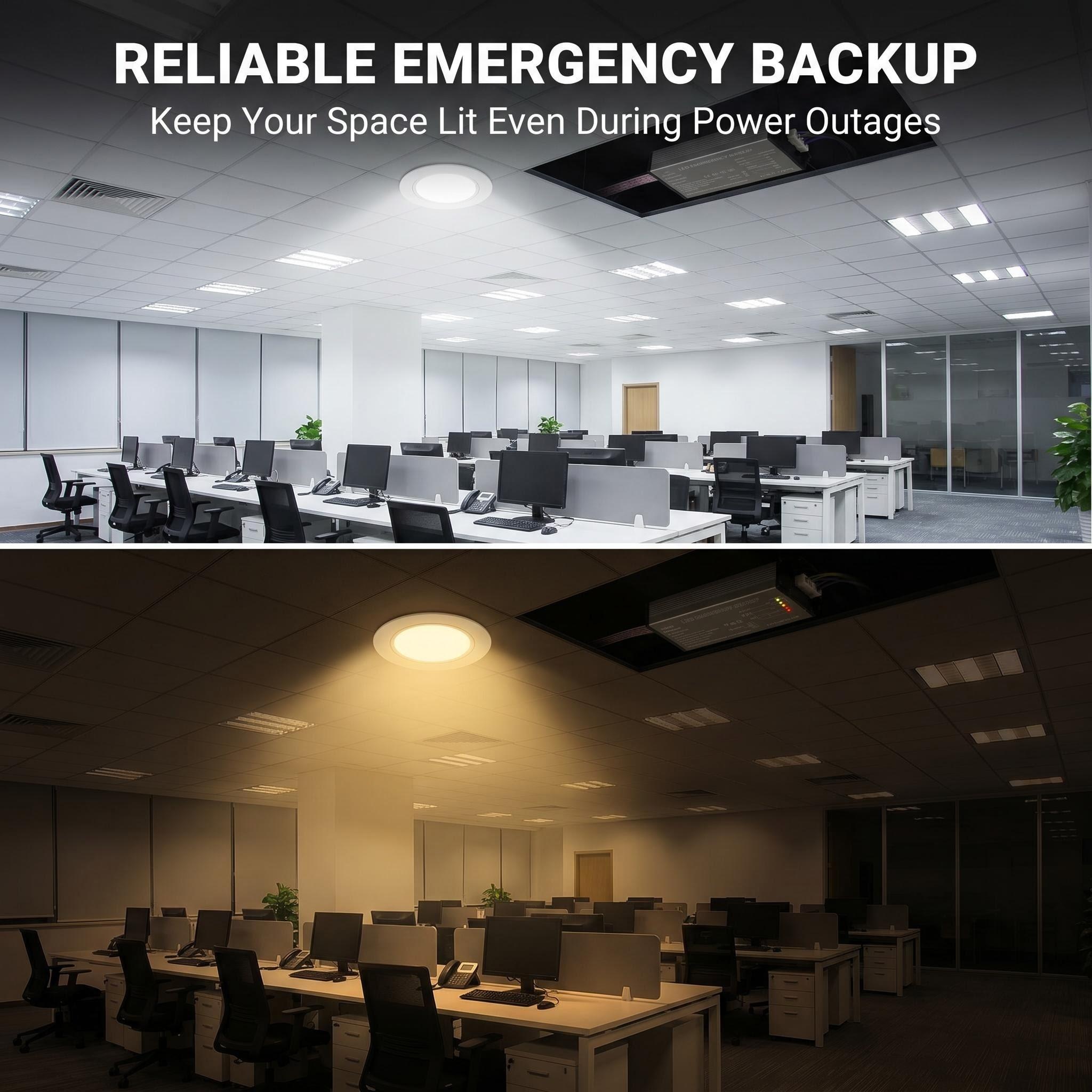
LED Emergency Driver For LED Panel Lights
Emergency drivers sized for 600×600 and 1200×300 LED panels with external drivers.
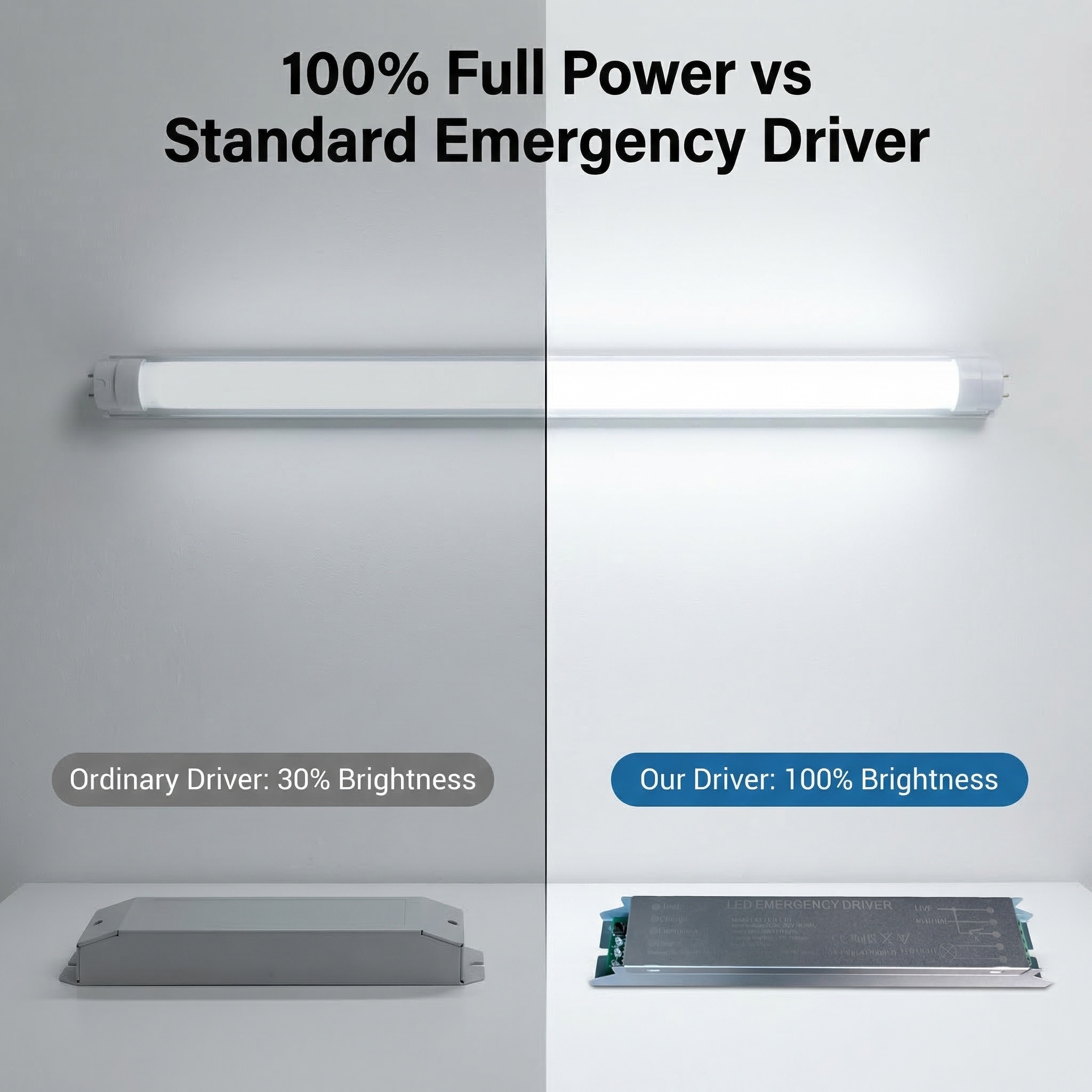
LED Emergency Driver For LED Tubes
Emergency conversion kits for T8 and T5 LED tubes and batten fittings.
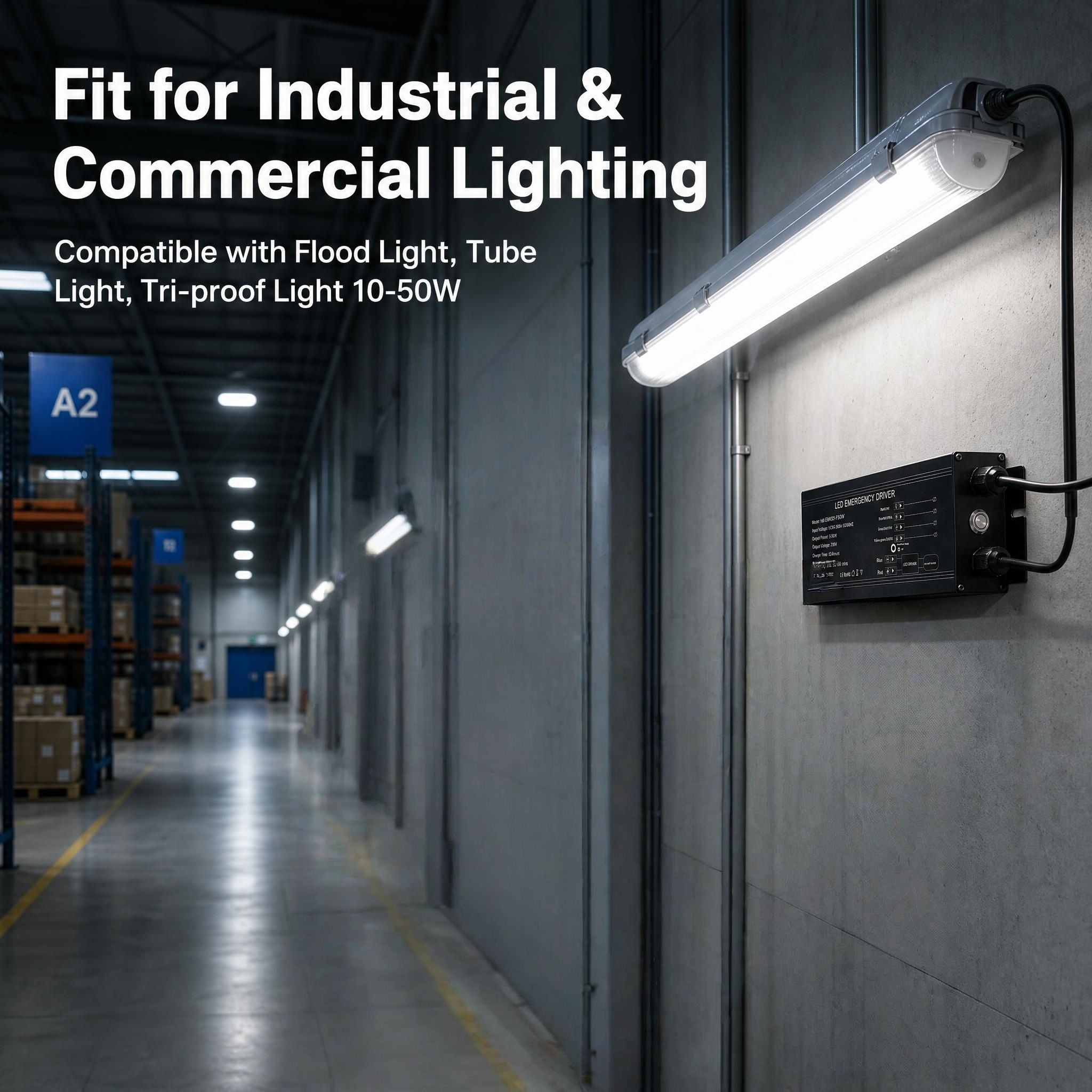
LED Emergency Driver For Linear Lights
Slim emergency drivers that fit inside linear and trunking profiles without a separate battery box.
Frequently Asked Questions About LED Emergency Driver
What Drives FOB Pricing By Product Class
| Product Class | Typical FOB Shenzhen (USD) | Driven Load | Battery Chemistry | Durée de la situation d'urgence |
|---|---|---|---|---|
| Economy LED Emergency Driver for LED Tubes | $4.50 – $7.20 | 3W – 10W | NiCd 3.6V 600mAh | 90 min |
| Standard LED Emergency Driver for LED Panel Lights | $8.00 – $14.00 | 10W – 25W | Li-ion 18650 3.7V 2200mAh | 90 min – 3 hr |
| High Output LED Emergency Driver for Linear Lights | $15.00 – $28.00 | 25W – 50W | LiFePO4 3.2V 3000mAh | 2 hr – 3 hr |
| Full Power Output Emergency Driver for LED High Bays | $32.00 – $55.00 | 50W – 100W | LiFePO4 12.8V 6000mAh | 90 min – 3 hr |
Prices assume MOQ 500 units, standard carton export packing, FOB Shenzhen. Samples ship at 1.3×–1.5× unit price with $45–$80 courier surcharge.
Cost Split For A Typical Mid-Range Unit
| Component | Share of Factory Price |
|---|---|
| Battery cells (Li-ion 18650 or LiFePO4) | 22% – 28% |
| Driver electronics (constant current inverter, changeover relay) | 18% – 24% |
| Metal or flame-retardant plastic enclosure | 8% – 12% |
| Testing and certification documentation | 6% – 10% |
| Assembly and ageing test | 10% – 14% |
| Packing (individual box, inner carton, pallet) | 5% – 8% |
| Freight to port and export clearance | 4% – 6% |
| Duty and VAT (varies by destination) | 0% – 12% |
Five-Year Total Cost Of Ownership
| Cost Item | Assumptions | 5-Year Cost Per Unit |
|---|---|---|
| Initial purchase | Standard LED panel driver, FOB $11.00 | $11.00 |
| Battery replacement | Li-ion 18650 pack, 500-cycle life, replaced once at year 3 | $4.50 – $6.50 |
| Routine testing labour | Monthly functional test, 10 min at $35/hr labour rate (BS 5266-1) | $350.00 |
| Annual emergency duration test | 3-hour full discharge, 30 min labour | $87.50 |
| Total five-year cost | $453.00 – $455.00 |
Self-test versions (EN 62034 compliant) reduce labour by roughly 60% but add $6.00 – $9.00 to purchase price. DALI-integrated units add $12.00 – $18.00.
Q: What is the minimum order quantity and how does it affect emergency driver cost from China?
MOQ is 500 units for standard models, 1000 units for custom output windows or OEM branding. At 500 units, FOB pricing sits at the table above. At 2000 units, expect 8%–12% reduction. Below MOQ, factory surcharge runs 25%–40%. Tooling for custom enclosures or silk-screened housings costs $800–$1500 amortised across the order.
Q: How do I confirm the emergency driver suits my host fixture without trialling every SKU?
Match three parameters: input voltage range (AC 85-265V or 100-277V covers most markets), output window in DC volts and mA (must sit within the LED module’s forward voltage curve), and driven load in watts (emergency output is typically 10%–30% of normal lumens, so a 40W panel needs roughly 4W–12W emergency output). Request the supplier’s compatibility matrix showing tested host fixtures and lumen maintenance percentages at 90 minutes, 2 hours and 3 hours.
Q: What emergency duration and output options are available, and how do they change the price?
Standard durations are 90 minutes, 2 hours and 3 hours. Output options range from 3W (300–400 lumens, ~10% of a 30W panel) to 50W (4000–5000 lumens, ~50% of a 100W high bay). Each step up in duration or wattage increases battery capacity: 90 minutes at 10W needs Li-ion 3.7V 2200mAh; 3 hours at 25W needs LiFePO4 3.2V 6000mAh. Price delta is roughly $3.50–$6.00 per hour of additional duration, and $1.20–$2.00 per additional watt of output.
Q: What is the difference between maintained and non-maintained wiring, and does it affect cost?
Non-maintained wiring uses a single switched live to the driver; the emergency circuit activates only on mains failure. Maintained wiring requires a permanent live, switched live and neutral so the driver can power emergency LEDs continuously or switch between normal and emergency modes via internal changeover relay. Maintained versions cost $2.50–$4.50 more due to additional relay and control circuitry. Both comply with EN 60598-2-22; maintained is mandatory for escape routes in some BS 5266-1 applications.
Q: What self-test options exist, and what do they add to purchase price and running cost?
Manual test key is standard: zero added cost, but requires monthly site visits. Automatic self-test per EN 62034 adds $6.00–$9.00; the driver cycles brief functional tests and annual duration tests, reporting fault status via LED indicator. DALI-2 emergency test integration adds $12.00–$18.00 and enables centralised monitoring, cutting five-year testing labour from ~$437 to ~$175. Self-test electronics draw 0.3W–0.5W standby; negligible on annual energy cost.
Q: Which battery chemistry should I specify, and what is the realistic replacement interval?
NiCd 3.6V 600mAh is cheapest at $1.80–$2.50 per pack, 300–400 cycles, 2-year replacement typical, but cadmium content faces RoHS and transport restrictions. Li-ion 18650 3.7V 2200mAh runs $3.50–$5.00, 500–800 cycles, 3–4 year replacement. LiFePO4 3.2V 3000mAh is $6.50–$9.50, 1500–2000 cycles, 5–7 year replacement, safest chemistry for high-temperature luminaires. Charge time is 16–24 hours for all chemistries. Factor chemistry into five-year TCO: LiFePO4 pays back against Li-ion by year 4 in high-labour-cost markets.
Q: What lead time and sample policy applies, and how do lithium batteries affect shipping?
Standard lead time is 25–35 days after deposit. Samples of 2–5 units ship within 5–7 days at 1.3×–1.5× unit price plus courier fee. Lithium batteries trigger UN 38.3 test report requirement for air freight (IATA PI 965–970); sea freight under IMDG Code is less restrictive but adds 10–14 days transit. For orders under 100kg battery mass, road freight within Europe or Middle East avoids most lithium documentation. Always confirm the supplier provides UN 38.3 test summary and MSDS for customs clearance.
Q: What test reports and conformity marks should I request for my destination market?
Ask the supplier to provide third-party test reports for the specific standards your market inspector expects: EN 60598-2-22 and EN 1838 for EU/UK; BS 5266-1 for UK building control; UL 924 for North America; AS/NZS 2293 for Australia/New Zealand; IEC 61347 for driver safety in all markets. The factory should hold ISO 9001. Do not accept generic “CE certificate” templates; request the test report number and issuing laboratory so you can verify scope covers your exact model, voltage range and battery chemistry. Marks on the product must match the report: CE for EU, UKCA for Great Britain, RCM for Australia.
Q: What warranty, spare parts and OEM branding are available?
Standard warranty is 3 years on electronics, 1 year on NiCd or 2 years on Li-ion/LiFePO4 batteries. Extended 5-year warranty on LiFePO4 packs adds 4%–6% to unit price. Spare battery packs are stocked for 7 years from last production date. OEM branding requires 1000-unit MOQ: custom silk-screen ($0.15/unit), colour-matched enclosure ($0.40/unit), printed manual and box artwork ($300 setup). Neutral white-label packing is standard at no surcharge.
Q: What installation and commissioning support is provided?
Each shipment includes wiring diagram for maintained and non-maintained circuits, cut-sheet with output window and compatible load range, and commissioning checklist for initial duration test. Technical English-language support is available via email for voltage compatibility confirmation and fault-code interpretation. On-site commissioning by Hymark engineers is not standard but can be quoted for projects exceeding 5000 units in UK, EU or Middle East.
Important Notice
Specifications, output and duration figures and price ranges in this guide are indicative and are provided
for planning purposes only. Actual emergency output, duration, battery life, ingress protection and available conformity documentation
differ by model and by destination country, and emergency lighting design remains the responsibility of the project designer. Buyers
must confirm their own mains voltage and frequency, the emergency lighting standard enforced locally, the host fixture compatibility
and their import requirements before placing an order. All figures are subject to written confirmation in the final proforma invoice
issued by Hymark.
Sourcing LED Emergency Driver from Hymark
FOB Pricing by Product Class
| Product Class | Typical Driven Load | Durée de la situation d'urgence | Battery Chemistry | FOB Shenzhen (USD) | MOQ |
|---|---|---|---|---|---|
| Standard panel/tube/linear driver, 3–15 W output | 3–15 W | 90 min | NiCd 3.6 V 900–1500 mAh | $4.80–$7.20 | 500 units |
| Mid-range panel/tube/linear driver, 10–25 W output | 10–25 W | 90 min or 3 h | Li-ion 18650 7.4 V 2200–2600 mAh | $8.50–$14.00 | 300 units |
| Full power output driver, 20–60 W | 20–60 W | 90 min or 3 h | LiFePO₄ 12.8 V 3000–6000 mAh | $18.00–$32.00 | 200 units |
| High bay driver, 30–100 W | 30–100 W | 90 min or 3 h | LiFePO₄ 12.8 V 6000–12000 mAh | $28.00–$48.00 | 100 units |
| Self-test or DALI-2 variant | 3–60 W | 90 min or 3 h | Per above | Add 15–22% to base | Same as base MOQ |
Prices assume non-maintained wiring, IP20 enclosure, and standard export carton packing. Maintained wiring with changeover relay adds $1.20–$2.80. IP65 enclosure adds $3.50–$6.00.
Cost Split at Factory Gate
For a representative Li-ion 18650 mid-range unit at $11.00 FOB:
| Component | Share | Notes |
|---|---|---|
| Battery cells | 28–32% | 18650 cells from tier-1 or tier-2 suppliers; LiFePO₄ cells cost 15–20% more |
| Driver electronics (PCBA) | 22–26% | Constant current inverter, charge control, protection ICs |
| Metal/plastic enclosure | 8–12% | Steel or ABS; IP65 housings use die-cast aluminium |
| Testing and certification support | 5–8% | Photometric testing, EMC pre-scan, documentation for EN 60598-2-22 or UL 924 |
| Assembly and labour | 6–9% | |
| Packing and labels | 3–5% | Individual box, master carton, pallet; OEM branding at no extra cost above 1000 units |
| Freight to port and customs | 4–6% | |
| Margin and overhead | 12–18% |
Buyers evaluating emergency driver cost from China should verify whether quoted prices include battery cells or quote cell-removed for separate UN 38.3 shipment. Hymark quotes inclusive pricing as standard.
Five-Year Total Cost of Ownership
| Cost Item | NiCd 900 mAh Standard | Li-ion 18650 Mid-Range | LiFePO₄ Full Power |
|---|---|---|---|
| Unit FOB | $6.00 | $11.00 | $25.00 |
| Sea freight CIF UK/EU (est. per unit at MOQ) | $0.80 | $0.80 | $1.20 |
| Duty and VAT (EU 2.7% + VAT; UK 0% + VAT) | $1.40 | $2.60 | $5.90 |
| Installation labour (15 min at £45/hr) | £11.25 | £11.25 | £11.25 |
| Annual functional test labour (5 min × 5 years) | £18.75 | £18.75 | £18.75 |
| Battery replacement cycle | 2.5–3 years (NiCd 300–400 cycles) | 4–5 years (Li-ion 500–800 cycles) | 5–8 years (LiFePO₄ 1500–2000 cycles) |
| Replacement battery pack (parts only) | $3.20 | $5.50 | $9.80 |
| Replacement labour | £11.25 | £11.25 | £11.25 |
| 5-year TCO (single unit) | ~£52–£58 | ~£58–£64 | ~£72–£78 |
LiFePO₄ carries higher first cost but eliminates one mid-life battery swap. Self-test or DALI-2 variants reduce annual testing labour by 60–70% where facilities staff costs dominate.
Lead Time and Sample Policy
| Order Type | Délai de livraison | Notes |
|---|---|---|
| Samples (1–5 units) | 5–7 working days | From confirmed spec; air freight collect |
| Trial order below MOQ | 15–20 days | Subject to production slot availability |
| MOQ standard order | 25–30 days | 20 days production + 5–10 days packing and port clearance |
| Full power or custom OEM | 35–45 days | Tooling for enclosure or label if required |
| Peak season (Q3–Q4) | Add 10–15 days | Li-ion and LiFePO₄ cell lead times extend in September–November |
Hymark holds buffer stock of standard 90-minute NiCd and Li-ion 18650 drivers for faster turnaround on repeat orders.
Pourquoi Hymark ?
JIALINGHANG ELECTRONIC CO., LTD. was founded in 2013 as a global LED exporter in general illumination. A strategic shift in 2017 refocused the company on LED emergency technology and high performance LED strips. Hymark was launched in 2026 as the premium brand. Products are co-designed and engineered in house through a strategic partnership with dedicated manufacturing facilities that have also been operating since 2013, and the company manages R&D, product design and global distribution itself.
The range covers emergency lighting, emergency exit signs, emergency luminaires, emergency twin spotlights, LED emergency drivers for LED high bays, panel lights, tubes and linear lights, full power output emergency drivers, LED strip lights, COB LED strips and SMD LED strips. Orders are supplied with selectable emergency duration, maintained or non-maintained wiring, OEM and ODM branding, export carton packing and FOB or CIF terms.
Send the host fixture type and wattage, the emergency duration your code requires, your mains voltage and your destination port. Hymark will return a quotation within 24 hours via WhatsApp or email.
Get a Factory Direct Quote on LED Emergency Driver
JIALINGHANG ELECTRONIC CO., LTD. has been in LED lighting since 2013 and has focused on
LED emergency technology and high performance LED strips since 2017. Hymark products are co-designed with our
dedicated manufacturing partners, built with selectable emergency duration and maintained or non-maintained wiring, and function
tested before packing. Send us the host fixture type and wattage, the emergency duration your local code requires, your mains
voltage and your destination port and we will return a quotation within 24 hours.


 English
  Spanish
  Arabic
  French
  German
  Russian
  Portuguese
  Italian
  Vietnamese