
Tunnel & High Humidity Area Lighting Buyer Guide
A real tunnel and high humidity area lighting supplier in China operates an in-house SMT line and final assembly floor, not a trading office with rented showroom space. The right product depends on three things: the host fixture’s normal wattage and form factor, the emergency duration your local code demands—typically 90 minutes under EN 1838 or BS 5266-1, 2 hours under UL 924, or 3 hours for some Middle East tunnel specifications—and the approval mark the inspector at your destination port will look for, whether CE under EN 60598-2-22, UKCA, UL listing, or SASO for Saudi Arabia.
This page covers how to qualify a supplier’s actual manufacturing depth: SMT and assembly capacity, battery traceability and cycle data, discharge test records, and third-party reports you should request before placing an order.
In-House SMT and Assembly Capacity
Ask for photos with timestamps of the SMT line, reflow oven, and ageing burn-in racks. A manufacturer running 8 to 12 SMT placements per second on 1200mm PCB strips for tunnel linear luminaires will quote 7 to 10 days sample lead time for custom LED strip boards; a trading office quotes 15 to 25 days because they subcontract. Hymark’s Shenzhen facility runs COB LED strip production at 480 LEDs per metre, 15W/m to 20W/m, 1400 to 1800 lm/m, CRI 90+, 2700K to 6500K, on 2-ounce copper 10mm PCB, with in-house reflow and AOI. For emergency drivers, assembly includes wave soldering for through-hole battery management components and hipot testing at 1500V AC for 60 seconds.
Battery Sourcing and Traceability
Tunnel emergency luminaires in high humidity need batteries that survive 85% RH and 45°C ambient. LiFePO4 3.2V 3000mAh to 6000mAh packs deliver 3 hours at 4W to 8W emergency output with 500 to 1500 cycles and no thermal runaway risk; Li-ion 18650 3.7V 2600mAh packs offer higher energy density but 300 to 500 cycles and stricter UN 38.3 transport compliance. NiCd 3.6V 4000mAh survives deep discharge in cold tunnels but carries cadmium RoHS restrictions in the EU. Ask for cell supplier invoices and batch codes. A real manufacturer has direct relationships with BAK, EVE, or Lishen; a trader has none.
Discharge and Duration Test Records
EN 1838 requires emergency egress lighting to deliver minimum 1 lux on the tunnel centreline at end of duration. Request the supplier’s discharge test logs: a 10W LED tube emergency driver on LiFePO4 6.4V 3000mAh should show constant current output at 150mA to 350mA DC, maintaining 30% to 100% of normal lumen output for the full 90-minute or 3-hour duration at 25°C ambient. Ask for temperature chamber data at 0°C and 55°C; lumen maintenance drops 15% to 25% at temperature extremes. Hymark records every driver batch on 2-hour and 3-hour discharge cycles with automated datalogging.
Ageing and Hipot Test Stations
Tunnel luminaires need IP65 minimum, IP66 preferred. A real factory has salt spray chambers (480 hours to ASTM B117), hipot testers, and 4-hour minimum ageing stations at full load. Ask for the hipot test voltage: 1500V AC for basic insulation, 3000V AC for reinforced. Ask how many units per batch are aged; 100% is rare and expensive, 5% to 10% is standard for tier-one factories.
Third-Party Test Reports for Your Market
Never accept a supplier’s claim of certification. Ask for the test report number, testing laboratory name, and scope page showing your exact model designation. For Europe: EN 60598-2-22 and EN 62034 for automatic test systems. For UK: BS 5266-1 with UKCA marking documentation. For US: UL 924 file number. For Australia: AS/NZS 2293. For Middle East: IEC 62471 photobiological safety plus local CB scheme. Verify the report covers the battery chemistry and IP rating you are buying; many reports exclude lithium variants or only test IP20 versions.
Sample Lead Time and Payment Structure
Standard emergency driver samples ship in 5 to 7 working days if the factory stocks bare PCBs; custom tunnel strip samples with 5-metre cut lengths and specific CCT take 10 to 14 days. Payment structures vary: 30% deposit, 70% against BL for established buyers; 100% advance for first orders under USD 10,000; LC at sight for orders above USD 50,000. MOQ for emergency drivers is typically 100 to 500 pieces; for LED strips, 500 to 1000 metres. FOB Shenzhen pricing for IP65 tunnel emergency twin spots with 3-hour LiFePO4 runs USD 45 to USD 75 per unit at 100-piece MOQ; IP20 emergency drivers for LED tubes run USD 12 to USD 22 at 500-piece MOQ.
After-Sales Engineering Capability
Tunnel projects need field-adjustable output current and duration settings. A real manufacturer has firmware engineers who can modify the microcontroller for DALI self-test protocols or custom duration curves. Ask for a video call with the engineering team, not just the sales agent. Ask for failure analysis reports from previous projects; a factory with 5% annual return rate will have detailed root-cause documentation. A trading office has none.
Types and Configurations of Tunnel & High Humidity Area Lighting
Six Real Classes of Tunnel and High Humidity Emergency Lighting
| Type or Class | Typical Rating or Output | Duration or Runtime | Best Suited For | Notes |
|---|---|---|---|---|
| Full-Power Maintained LED Emergency Driver for High Bays | 50–150W normal; 100% output in emergency | 90 min or 180 min | Tunnel cut-and-cover zones, pump rooms, plant rooms | Requires changeover relay; battery pack 14.8V 4400mAh Li-ion 18650 or 12.8V 6000mAh LiFePO4 |
| Reduced-Power Non-Maintained Emergency LED Tube Driver | 18–36W normal; 3–6W emergency (16–20% output) | 90 min or 120 min | Cable tunnels, service corridors, humidity-sealed trunking | Constant current inverter output DC 36–72V at 80–150mA; NiCd 3.6V 4000mAh or LiFePO4 6.4V 3000mAh |
| Self-Test Emergency Twin Spotlight | 2 × 3W LED heads; 600–800 lm total emergency | 180 min or 240 min | Tunnel emergency egress nibs, refuge alcoves, cross-passages | EN 62034 automatic monthly and annual test cycle; manual test key override |
| DALI-Addressable Emergency Driver with Dimming Track | 20–80W normal; 10–100% programmable emergency output | 90 min to 180 min | Smart tunnel control systems, DALI-2 backbone installations | Requires DALI bus power; battery 14.8V 5200mAh Li-ion; charge time 24 hours |
| IP66/IP67 COB LED Strip with Integrated Emergency Module | 10–15W/m normal; 3–5W/m emergency (30% output) | 90 min | Soffit coves in immersed tunnels, high humidity cable galleries | 24V DC system; 480 LEDs/m; 1200–1500 lm/m at 4000K; CRI 80+; cut length 50mm; PCB 10mm 2oz copper |
| IK10 Vandal-Resistant Emergency Bulkhead with Microwave Sensor | 15–25W normal; 5–10W emergency (40–50% output) | 120 min or 180 min | Tunnel portals, public access underpasses, high humidity transit stations | Microwave sensor for maintained energy saving; LiFePO4 6.4V 5000mAh; cycle life 800–1000 |
Full-Power Maintained LED Emergency Driver for High Bays
This class preserves 100% of the luminaire’s lumen package during mains failure, achieved by a changeover relay that switches the battery inverter output to the same LED module normally fed by the AC driver. Buyers are typically M&E consultants specifying tunnel ancillary buildings and procurement officers bundling plant room packages. The battery pack must deliver the full driven load—at 100W emergency output, a 14.8V 4400mAh Li-ion 18650 pack drains in roughly 38 minutes without thermal derating, so either the duration shortens or the pack scales to 8800mAh or shifts to 12.8V 6000mAh LiFePO4 for 90-minute compliance. What it cannot do: run indefinitely; the maintained wiring draws standby power continuously, and at ambient temperatures above 45°C the battery cycle life halves. Buyers should request discharge duration test records at 25°C and 55°C from the supplier, plus third-party EN 60598-2-22 test reports for the destination market.
Reduced-Power Non-Maintained Emergency LED Tube Driver
This is the workhorse for linear trunking in cable tunnels and humidity-sealed corridors. The emergency module sits dormant until mains failure, then inverts battery DC to a fraction of the normal LED tube current—typically DC 36–72V at 80–150mA against a normal operating current of 450–900mA. The resulting 16–20% output meets EN 1838 minimum illuminance for escape routes (1 lux on the floor centreline) without requiring the full battery mass of a maintained system. Electrical contractors buy this for retrofit projects because it wires independently via a switched live to the luminaire. What it cannot do: provide task lighting during normal operation; the non-maintained circuit needs a separate switched feed, and if the installer confuses maintained and non-maintained wiring the unit fails to charge or false-triggers. NiCd 3.6V 4000mAh remains common for price-driven tenders, but the 300–500 cycle life and cadmium disposal restrictions increasingly push buyers toward LiFePO4 6.4V 3000mAh at 800+ cycles.
Self-Test Emergency Twin Spotlight
Twin spotlights mount on tunnel walls at egress points where a single luminaire must cover two directions. The self-test facility per EN 62034 automates monthly functional tests and annual duration tests, logging results via an LED status indicator; a manual test key provides override for inspector verification. Facility managers and building operators responsible for life safety compliance favour this class because it eliminates manual test labour across hundreds of units. Battery options range from NiCd 4.8V 4000mAh (cheaper, 500 cycles) to LiFePO4 6.4V 5000mAh (longer life, higher initial cost). What it cannot do: integrate into a central monitoring system without additional hardware; the standalone self-test logic does not broadcast faults. In high humidity tunnels, the IP65 enclosure rating is minimum; specify IP66 with breathing valve to prevent condensation fogging the optics.
DALI-Addressable Emergency Driver with Dimming Track
This class sits at the intersection of emergency lighting and building automation. A DALI-2 compatible driver reports battery status, luminaire presence, and test results to the tunnel control system, while the programmable emergency output allows the designer to set 10% for marker lighting or 100% for full egress—extending battery duration or visibility as the scenario demands. Lighting designers and specifiers for smart tunnel projects drive demand here. The battery pack is typically 14.8V 5200mAh Li-ion, with 24-hour charge time from deep discharge. What it cannot do: operate without DALI bus power; if the control line faults, the unit defaults to full output but loses monitoring. The supplier must demonstrate DALI compliance test reports, not merely claim compatibility, and the buyer should confirm the driver supports IEC 62386-202 for emergency devices, not only part 102 for general control.
IP66/IP67 COB LED Strip with Integrated Emergency Module
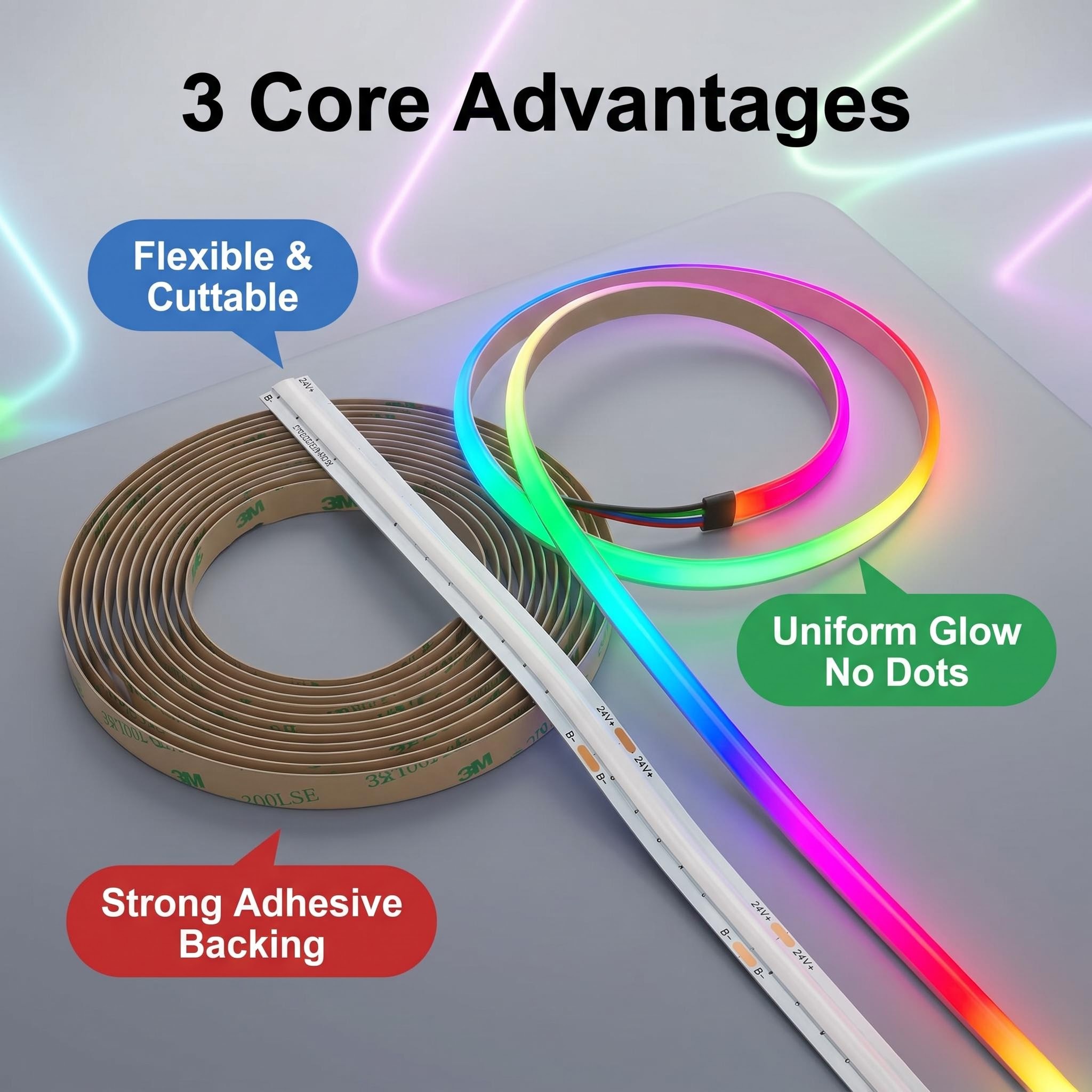
COB strips at 480 LEDs per metre and 10–15W/m normal output provide continuous, shadow-free linear illumination for tunnel soffits and gallery edges where point sources create stroboscopic discomfort. The integrated emergency module reduces output to 3–5W/m (30%, roughly 360–450 lm/m) for 90 minutes from a 24V DC battery tap—often LiFePO4 12.8V 3000mAh with boost converter. The 10mm PCB with 2oz copper handles thermal load in humid, thermally stagnant air; cut length at 50mm allows field termination to fit architectural bays. Luminaire OEMs adding emergency versions to their own fixtures buy this as a subassembly. What it cannot do: survive submersion beyond the IP67 rating duration; prolonged immersion at cable gland points degrades the adhesive backing and corrodes copper traces. Specify additional mechanical clamping, not adhesive alone, in tidal or spray zones.
IK10 Vandal-Resistant Emergency Bulkhead with Microwave Sensor
Tunnel portals and public underpasses combine high humidity with impact risk from maintenance equipment and public traffic. The IK10 polycarbonate or die-cast aluminium enclosure withstands 20 joule impact. Microwave sensing enables maintained operation at reduced output when the space is unoccupied, extending LED lumen maintenance and reducing heat load on the LiFePO4 6.4V 5000mAh pack. Emergency output at 40–50% of normal (5–10W) balances visibility with duration—120 minutes standard, 180 minutes for remote evacuation routes. Lighting wholesalers and distributors stock this for municipal and transit projects. What it cannot do: discriminate between a moving person and water spray or rodents in open portal environments; false triggers waste battery cycles and reduce effective emergency reserve. The sensor requires sensitivity adjustment at commissioning, and the supplier should provide commissioning documentation, not merely a factory default.
Supplier Qualification Checklist for Tunnel and High Humidity Applications
| Verification Item | What to Request or Observe | Red Flag |
|---|---|---|
| SMT and assembly capacity | Factory video or live video call showing Yamaha/Juki placement lines, reflow oven, AOI station | Refusal of live factory viewing; only catalogue photos |
| Battery sourcing and traceability | Cell manufacturer certificate (BYD, EVE, Lishen), lot code traceability, incoming inspection records | “Generic A-grade cells” with no manufacturer named |
| Discharge and duration test records | Test logs for 90 min and 180 min at rated load, ambient 25°C and 55°C | No thermal testing; only room-temperature claims |
| Ageing and hipot test stations | Burn-in room at 60°C for 4 hours, AC 1500V hipot on 100% production | Spot-check only, not routine production |
| Third-party test reports | CB test certificates, ENEC scheme reports, or UL 924 file numbers for the destination market | “CE self-certified” with no accredited body named |
| Sample lead time | 7–15 days for emergency drivers; 10–20 days for complete luminaires | 1–2 days (indicates trader with no stock, drop-shipping) |
| Payment structure | 30% T/T deposit, 70% against B/L or LC at sight for first order; negotiable repeats | 100% advance payment demanded |
| After-sales engineering | Schematic review for maintained/non-maintained wiring, DALI integration support, failure analysis with returned unit | No technical contact, only sales agent |
Price Drivers and Lead Time Reality
The dominant price variable is battery chemistry and capacity. A NiCd 3.6V 4000mAh pack for a reduced-power tube driver costs roughly 30–40% less than an equivalent LiFePO4 6.4V 3000mAh pack, but the LiFePO4 delivers 2× cycle life and passes UN 38.3 transport testing without the hazardous-material surcharges that NiCd incurs under IATA and IMDG. For tunnel projects requiring 500+ units, this transport cost inversion often erodes the NiCd upfront savings.
IP rating drives enclosure cost nonlinearly: IP54 to IP65 adds 15–20% for gasket and breathing valve engineering; IP65 to IP66/IP67 adds another 25–35% for casting integrity, cable gland specification, and pressure testing. IK10 impact rating on the same luminaire requires 3–4mm polycarbonate or reinforced aluminium, adding 10–15% over IK08.
Lead times from real manufacturers with in-house SMT and battery pack assembly run 25–35 days for standard emergency drivers, 40–55 days for complete luminaires with custom optics or DALI programming. Traders quoting 10–15 days either hold no stock or broker surplus from other factories with unverified batch consistency. MOQ for Hymark direct export typically stands at 100 units for emergency drivers, 200–500 units for LED strips depending on CCT and PCB copper weight; sample orders of 1–5 units ship within 10 days against pro-forma invoice.
FOB Shenzhen or CIF destination port terms are standard; facility managers and procurement officers in the UK and Europe should confirm the supplier understands BS 5266-1 maintained circuit requirements and can provide wiring schematics showing the changeover relay logic, not merely a generic driver datasheet. For Middle East and African markets where 220–240V 50Hz mains predominates, verify the input voltage range—AC 85–265V covers all, but a 220–240V-only driver costs less and fails on 110V test rigs during inspection.
Specifications and How to Read Them
| Parameter | Entry Level | Mid Range | High Specification |
|---|---|---|---|
| Input Voltage / Frequency | AC 85-265V, 50/60Hz | AC 100-277V, 50/60Hz | AC 220-240V ±10%, 50/60Hz |
| Normal Mode Driven Load | 18W max | 36W max | 60W max |
| Emergency DC Output Window | 9-42V, 150-350mA constant current | 9-54V, 200-500mA constant current | 24-80V, 250-700mA constant current |
| Sortie d'urgence | 540lm (30% of normal) | 1800lm (50% of normal) | 3600lm (60% of normal) |
| Durée de la situation d'urgence | 90 minutes | 2 hours | 3 heures |
| Battery Chemistry / Capacity | NiCd 3.6V 1500mAh | Li-ion 18650 7.4V 2600mAh | LiFePO4 12.8V 3000mAh |
| Charge Time | 24 hours to 80% | 16 hours to 90% | 6 hours to 90% |
| Cycle Life | 300-500 cycles | 800-1000 cycles | 1500-2000 cycles |
| Test Facility | Manual test key | Auto self-test per EN 62034 | DALI-2 self-test + manual override |
| Wiring Mode | Non entretenu | Maintained or non-maintained | Maintained with changeover relay |
| IP / IK Rating | IP65 / IK08 | IP66 / IK09 | IP67 / IK10 |
| Ambient Temperature | -10°C to +40°C | -20°C to +45°C | -30°C to +55°C |
| Dimensions (L×W×H) | 165×40×30mm | 198×50×35mm | 240×60×42mm |
| Mounting | Clip to luminaire body | Clip + stainless steel bracket | Remote weatherproof enclosure |
How To Read An Emergency Driver Datasheet Line By Line
Input voltage range and frequency tells you which markets the driver ships to without modification. AC 85-265V covers 120V North America and 230V Europe in one SKU. AC 220-240V ±10% is cheaper but fails in 120V territories. Ask for the specific range in writing; some suppliers quote “universal input” then deliver 176-264V units that drop out below 180V.
Driven load in watts is the maximum LED module the driver can feed in normal mode. The emergency inverter section usually handles 30-100% of that figure. A 36W normal driver may only sustain 18W in emergency. Check both numbers; do not assume they match.
DC output voltage window and current show the constant-current inverter’s operating envelope. “9-42V, 150-350mA” means the driver hunts for the forward voltage of your LED module and then holds current steady. If your module’s Vf falls outside the window, the driver cannot regulate. This is the most common compatibility failure between emergency driver and LED module.
Emergency output in lumens and as a percentage of normal matters for EN 1838 compliance. The standard requires minimum 1 lux on escape routes and 0.5 lux in open areas, but achieving that depends on luminaire optics and spacing. A driver rated at 50% lumen output on paper may deliver less if the LED module efficacy drops at low current. Ask for the supplier’s photometric integration test report, not just the driver datasheet.
Emergency duration of 90 minutes, 2 hours or 3 hours is dictated by local regulations. BS 5266-1 calls for 3 hours in the UK for premises where evacuation may be delayed. Southeast Asian markets often accept 90 minutes. The same hardware with different battery configurations achieves different durations; verify the battery pack part number matches your requirement.
Battery chemistry, voltage and capacity determine everything else. NiCd 3.6V 1500mAh is cheap, tolerates temperature extremes, but carries RoHS and disposal restrictions in the EU. Li-ion 18650 7.4V 2600mAh packs more energy, needs PCB protection against over-discharge, and ships under UN 38.3 restrictions. LiFePO4 12.8V 3000mAh costs most, runs coolest, delivers 1500+ cycles, but weighs more and needs wider mounting space. Request the cell manufacturer’s name and model; “generic Li-ion” invites substitution.
Charge time and cycle life trade against each other. Fast charge shortens cycle life. A 6-hour charge to 90% on LiFePO4 is achievable because the chemistry accepts higher C-rates. NiCd charged in 24 hours to only 80% indicates a trickle-charge design that preserves cycle count but leaves capacity unused. Ask for the test cycle definition: IEC 62034 specifies 50 cycles with duration check after each.
Test facility ranges from manual test key (press monthly, record in log) through self-test per EN 62034 (automatic monthly function test, annual duration test with indicator LED) to DALI-2 (reported to central BMS with addressable fault logging). Manual test is cheapest but creates compliance liability if records lapse. DALI adds £15-25 to driver cost but eliminates site visits for regulatory inspections.
Maintained or non-maintained wiring determines how the driver sits in circuit. Non-maintained: driver only energises when mains fails. Maintained: driver feeds lamp continuously via changeover relay, switching to battery on failure. Maintained wiring needs an additional switched live; verify your luminaire terminal block has enough poles.
IP and IK rating for tunnel and high-humidity applications starts at IP65 (dust-tight, protected against water jets). IP66 (powerful water jets) or IP67 (temporary immersion to 1m) is prudent for tunnel soffits with condensation and wash-down maintenance. IK08 (5 joule impact) resists tool strikes; IK10 (20 joule) is specified for road tunnels with vibration and debris. IP ratings are tested to EN 60598-2-22; ask for the test report number and issuing laboratory.
Ambient temperature range is often overstated. The -30°C to +55°C figure in the high-specification column applies to the driver electronics; the battery pack may be derated above +45°C or below -10°C. Ask for separate battery temperature curves. Tunnel portals see -20°C in winter; internal sections may reach +40°C from vehicle heat and ventilation failure.
How To Qualify A Real Manufacturer From A Trading Office
In-house or partnered SMT and assembly capacity is the first filter. A real manufacturer owns or has exclusive use of pick-and-place lines for driver PCB assembly. Ask for photos with date stamps, or better, a video call showing the line running your product. Trading offices show generic factory images from unrelated facilities. Hymark operates SMT at the JIALINGHANG facility in Guangdong; battery pack assembly and final driver integration occur on the same site.
Battery sourcing and traceability separates compliant suppliers from liability risks. Request the cell manufacturer’s certificate of conformity (CATL, EVE, BAK for LiFePO4; Samsung, LG, Panasonic for Li-ion 18650). Traceability means lot numbers on cells matching the pack serial number and the UN 38.3 test report. Random substitution with untested cells is common when trading offices switch suppliers for price.
Discharge and duration test records should exist for every production batch, not just the type test. A real manufacturer runs 100% duration discharge on sampled units from each batch, or at minimum a hipot and functional test on every unit. Ask to see the last three months’ test logs with batch numbers, discharge curves, and pass/fail criteria. EN 62034 requires duration verification; BS 5266-1 inspectors in the UK will ask for these records during site audits.
Ageing and hipot test stations indicate process depth. Hipot (high potential) testing at 1500V AC or 2x rated voltage plus 1000V checks insulation integrity. Ageing burn-in at +45°C ambient for 2-4 hours catches infant mortality in capacitors and solder joints. Trading offices skip both and rely on supplier warranties. Ask for the test voltage, duration, and acceptance standard (IEC 61347-2-7 for emergency lighting inverters).
Third party test reports for the destination market must match the product variant you receive. A CE test report for a 36W driver does not cover the 60W version. A UL 924 report for non-maintained wiring does not cover maintained. Check the report covers: EN 60598-2-22 (luminaire requirements), EN 61347-2-7 (emergency inverter), EN 62034 (automatic test), and EN 1838 (lighting performance). For UKCA, verify the report references UK-adopted standards and the approved body number if applicable.
Sample lead time reveals capacity allocation. A trading office quotes 2-3 weeks because they must negotiate with the real factory. A manufacturer with available SMT capacity quotes 7-10 days for driver samples, 2 weeks for complete battery-inverter assemblies. Hymark’s sample lead time is 10-15 days for configured emergency drivers, including battery pack matching and discharge verification.
Payment structure indicates confidence and cash flow. Trading offices often demand 100% T/T in advance because they lack credit with their upstream supplier. Established manufacturers accept 30% deposit, 70% against copy of bill of lading, or L/C at sight for orders above $30,000. Escrow terms for first orders are reasonable; insistence on full advance payment is a red flag.
After-sales engineering capability means technical staff who can read your luminaire’s IES file and confirm driver compatibility, not just sales staff forwarding emails. Ask a specific question: “My LED module has Vf 38V at 350mA but drops to 34V at 200mA. Will your inverter remain in regulation?” A trading office cannot answer. Hymark’s application engineering reviews module datasheets and confirms match before order confirmation.
Trade Terms Buyers Actually Meet
FOB (Free On Board) means the supplier delivers to the port and loads on the vessel; you pay ocean freight, insurance, and destination charges. For emergency lighting from Shenzhen or Ningbo, FOB is standard for orders above $5,000. You control the shipping line and insurance terms.
CIF (Cost Insurance Freight) adds ocean freight and basic insurance to the supplier’s scope. Your risk transfers at the port of loading, same as FOB, but you do not arrange the booking. CIF suits buyers without freight forwarding relationships. Verify the insurance clause: “all risks” versus “free of particular average” makes a difference if containers wash overboard.
CFR (Cost and Freight) is CIF without insurance. Rare in practice; most buyers add insurance or accept CIF.
EXW (Ex Works) means you collect from the factory door. You handle export clearance, trucking to port, and all documentation. Only use EXW if you have a China-based logistics agent; otherwise customs delays and demurrage costs exceed any price saving.
L/C (Letter of Credit) protects both parties. Your bank pays the supplier against presentation of conforming documents: commercial invoice, packing list, bill of lading, certificate of origin, and test reports. L/C adds $300-800 in bank charges and requires precise document matching. Discrepancies give the bank grounds to refuse payment. Use L/C for first orders above $20,000 or where payment terms extend beyond 60 days.
T/T (Telegraphic Transfer) is wire payment. 30% deposit confirms production start; 70% balance before shipment or against copy B/L. Never pay 100% in advance for a first order. If the supplier insists, negotiate escrow through Alibaba Trade Assurance or similar.
HS code for LED emergency drivers is 8504.40 (static converters). LED luminaires for tunnels fall under 9405.10. Correct classification determines import duty and whether the product needs import licence. Chinese suppliers often use 9405.40 for mixed shipments; verify with your customs broker.
CE and UKCA marking are self-declared for these product categories under the Low Voltage Directive and Electromagnetic Compatibility Directive. The supplier must hold the technical construction file and test reports; you as importer hold liability if the file is deficient. Ask for the DoC (Declaration of Conformity) with the supplier’s name and address matching the invoice, not a generic template. UKCA requires UK-adopted standards and from 2025 an approved body for some categories; emergency lighting inverters currently remain self-certifying but check UK government updates.
UN 38.3 battery test report is mandatory for lithium battery transport by air (IATA) or sea (IMDG). The report covers eight tests: altitude simulation, thermal cycling, vibration, shock, external short circuit, impact/crush, overcharge, and forced discharge. Each battery chemistry and cell model needs its own report. The report must be less than 12 months old at time of shipment, or the batteries need re-testing. Ask for the UN 38.3 test summary with the cell manufacturer’s name, watt-hour rating, and laboratory accreditation.
Packing list should show net weight, gross weight, dimensions per carton, and battery watt-hours if lithium. Customs in the Middle East and Africa inspect packing list against physical shipment; discrepancies trigger detention.
Certificate of origin (Form A or CO) may be required for duty preference under trade agreements or for tender compliance. China has preferential arrangements with ASEAN, Chile, New Zealand, and others. The supplier obtains this from the local chamber of commerce or CIQ office. Lead time 3-5 days; request at order confirmation, not after shipment.
What The Standards Require And What To Request
EN 60598-2-22 specifies construction of emergency luminaires: battery enclosure separation, charge indicator visibility, and endurance of materials. It does not certify a supplier; it sets the bar the product must meet. Request the test report with luminaire photos showing construction details.
EN 1838 defines escape route lighting levels: 1 lux minimum on the centreline, 0.5 lux minimum anywhere on the route, with uniformity ratio 40:1 maximum. The emergency driver lumen output is only one variable; luminaire spacing, mounting height, and road surface reflectance determine compliance. Ask the supplier for spacing tables or software files for your tunnel geometry.
EN 62034 covers automatic test systems. Self-test drivers must perform monthly functional tests and annual duration tests, with visual fault indication. DALI-2 adds remote reporting. The standard does not mandate DALI; it specifies what any automatic system must do. Request the test cycle timing and fault code definitions.
BS 5266-1 is the UK application standard. It mandates 3 hours duration for premises where early evacuation is not expected, including road tunnels with traffic management systems. It references EN 60598-2-22 for product construction but adds installation and commissioning requirements. UK inspectors check logbooks, not just product labels.
UL 924 is the North American standard for emergency lighting and power equipment. It includes 90-minute duration, voltage regulation, and transfer time limits. Products listed to UL 924 carry a mark from UL or an NRTL; the mark is on the product, not just the datasheet. If your project specifies UL 924, verify the mark and file number.
AS/NZS 2293 covers emergency lighting in Australia and New Zealand. Part 1 specifies design and installation; Part 2 covers inspection and maintenance. The standard requires 90-minute duration and specific exit sign luminance levels. Battery packs must comply with AS/NZS 60896 or IEC 60896; lithium batteries need additional approval from the local electrical safety regulator.
IEC 62471 addresses photobiological safety of lamps and lamp systems. LED emergency drivers do not emit light directly, but the complete luminaire must be assessed for blue light hazard if the LED module exceeds threshold luminance. Request the RG group classification from the luminaire manufacturer, not the driver supplier, unless Hymark supplies the complete assembly.
Tunnel & High Humidity Area Lighting Price and What Drives It
| Class | Typical Rating or Output | Duration or Runtime | Indicative FOB USD |
|---|---|---|---|
| Basic non-maintained emergency driver module only | 3W DC output, 200–300 lm equivalent | 90 minutes | $12–$18 |
| Mid-range maintained emergency driver for LED tube | 5–10W DC, 400–800 lm at 10–100% switchable | 90 min or 3 hours | $22–$35 |
| High-output emergency driver for LED high bay | 15–25W DC, 1500–2500 lm at 10–100% | 90 min to 3 hours | $45–$75 |
| Complete IP65/IP66 tri-proof luminaire with integral emergency | 4000–6000 lm normal, 400–1200 lm emergency | 3 heures | $85–$140 |
| Heavy-duty tunnel luminaire with emergency twin-spot backup | 10000–20000 lm normal, 2000–4000 lm emergency | 3 heures | $180–$320 |
Prices assume single-colour SMD or COB LED packages, LiFePO4 or Li-ion 18650 battery packs, and standard IP66 aluminium enclosures. MOQ typically 200–500 units for FOB Shenzhen pricing. Sample orders at 1.3–1.5× unit cost, 10–15 day lead time.
What Separates a Manufacturer from a Trading Office
A trading office quotes from a generic price list and cannot explain why one battery cell performs differently at 45°C ambient versus 55°C. A real manufacturer controls the build and holds test records. Verify these points during qualification.
SMT and final assembly capacity. Ask for photos with date stamps of the SMT line, reflow oven temperature profiles, and the assembly stations where battery packs are soldered or connected. A manufacturer running 0805 and 1206 passive components plus 3535 LED packages in-house will quote 7–12 day production lead times for established designs. A trading office quoting 3–5 days is either holding no stock or forwarding your order to an unknown third factory.
Battery sourcing and cell traceability. The battery pack is usually the largest single cost item on an emergency product, typically 25–35% of FOB for LiFePO4 and 20–28% for NiCd. Demand the cell manufacturer’s name (BYD, EVE, Lishen, BAK for cylindrical lithium; Saft or local equivalents for NiCd) and lot numbers. A qualified supplier provides UN 38.3 test summaries per lot for lithium cells and can produce the MSDS and dangerous goods packaging certificates for sea freight. Without this, your shipment stops at the port.
Discharge and duration test records. EN 60598-2-22 and BS 5266-1 require that the luminaire deliver the rated emergency output for the full duration at the declared temperature range. A manufacturer maintains test logs showing voltage, current, and lumen maintenance at 0 minutes, 90 minutes, and end of discharge. Ask for a sample test report from the last 30 days, not a generic template from 2019.
Ageing and hipot stations. Burn-in for 24–48 hours at 40°C ambient catches infant failures in drivers and changeover relays. Hipot testing at 1500V AC or 3000V DC verifies isolation between mains and battery circuits. A factory without these stations ships failures to your warehouse.
Third party test reports for your destination market. The standards you need depend on the end market: EN 60598-2-22 and EN 1838 for the EU and UK; UL 924 for North America; AS/NZS 2293 for Australia and New Zealand; NFPA 101 references for some Middle East projects. Do not accept “CE available” as an answer. Ask for the test report number, the issuing laboratory, and the scope of the report (does it cover the exact wattage and battery configuration you are ordering?). A trading office forwards a report that may not match your SKU.
Sample lead time and payment structure. A manufacturer with in-house SMT and battery assembly ships samples in 10–15 days against 30% T/T deposit. A trading office often demands 50% deposit and stretches to 20–25 days because they are negotiating with their actual source. After-sales engineering capability means the supplier can modify output current from 350mA to 700mA or adjust the emergency percentage from 10% to 100% without redesigning the PCB. Ask for a technical change example from the last quarter.
Real Cost Structure Breakdown
The table below shows approximate cost allocations for a mid-range maintained emergency driver for LED tube, FOB Shenzhen at $28 in 500-unit volume.
| Cost Element | Approximate % of FOB | Notes |
|---|---|---|
| Battery pack (LiFePO4 3.2V 2600mAh or Li-ion 18650 3.7V 2200mAh) | 26–32% | Largest single item; UN 38.3 required for lithium |
| Driver and inverter electronics (constant current output, changeover relay) | 18–24% | Includes MCU for self-test or DALI interface if fitted |
| LED package (where integral luminaire, not driver-only) | 12–18% | SMD 2835 or 3030, 120–150 lm/W |
| Enclosure and hardware (IP66 die-cast aluminium or polycarbonate) | 10–14% | Gland entries, stainless steel brackets |
| Test and certification amortised over batch | 5–8% | Third party testing, CB report, EMC |
| Assembly labour | 6–9% | Lower for driver modules, higher for sealed luminaires |
| Export packing (carton, pallet, desiccant) | 2–3% | ISPM-15 pallets for most destinations |
| Inland freight to port | 1–2% | Shenzhen or Ningbo |
| Sea freight (lithium restrictions apply) | 3–5% | IMDG Code Class 9, limited carrier options |
| Insurance and finance | 1–2% | |
| Manufacturer margin | 8–12% |
For a complete luminaire with integral emergency, add 15–20 percentage points to enclosure, hardware, and LED package lines. Battery and certification remain the two dominant costs.
Why lithium restricts freight options. IATA and IMDG regulations limit lithium cells and batteries to specific UN-certified packaging, state-of-charge below 30% for air, and declaration as Class 9 dangerous goods. This eliminates some low-cost freight forwarders and adds $0.50–$1.20 per unit to landed cost. NiCd and NiMH face fewer restrictions but carry lower energy density and shorter cycle life, typically 300–500 cycles versus 800–1500 for LiFePO4.
Why the Cheapest Quote Costs More
A quote 20–30% below the bands in the opening table normally reflects one of three shortcuts:
- Smaller cell. A 1500mAh Li-ion 18650 instead of 2200mAh or 2600mAh, achieving 90 minutes at reduced output but failing the 3-hour requirement in EN 1838 or BS 5266-1.
- Reduced emergency output level. 5% or 10% of normal instead of 100%, meeting the letter of some standards for escape route lighting but producing inadequate illuminance for tunnel working environments where maintenance crews need visibility.
- Untested design. No third party thermal testing, no photometric file, no verification that the driver maintains constant current as battery voltage decays from 4.2V to 2.8V.
Five Year Running Cost Comparison
Assume 500 units installed in a tunnel or high-humidity industrial facility, operating 12 hours per day normal, tested monthly.
| Scenario | Purchase Price | Battery Replacement (Year 3–5) | Testing Labour (5 years) | Expected Failure Rate | 5 Year Total |
|---|---|---|---|---|---|
| Low-cost untested driver, 1500mAh cell, 10% emergency | $14 FOB × 500 = $7,000 | 60% replace by Year 3 at $8/unit = $2,400 | Manual test key, 15 min/unit × 12 × 5 = 750 hrs @ $35/hr = $26,250 | 15% annual failure, replacement units and labour ≈ $18,000 | $53,650 |
| Mid-range tested driver, LiFePO4 2600mAh, self-test, 100% emergency | $28 FOB × 500 = $14,000 | 20% replace by Year 5 at $9/unit = $900 | Self-test automated, annual physical check 2 hrs/unit × 5 = 1000 hrs @ $35/hr = $3,500 | 3% annual failure ≈ $5,600 | $24,000 |
| Premium driver with DALI, 3-hour duration, 5-year cell warranty | $48 FOB × 500 = $24,000 | Warranty covers replacement | DALI automated logging, 1 hr/unit × 5 = 500 hrs @ $35/hr = $1,750 | 1.5% annual failure ≈ $5,200 | $30,950 |
The low-cost option doubles the five-year cost through labour, failures, and premature battery degradation. The mid-range tested driver with self-test facility per EN 62034 delivers the lowest total cost of ownership. The premium DALI option suits facilities where central monitoring and automated compliance reporting justify the higher upfront outlay.
What to Request in Your RFQ
Specify these parameters to receive comparable quotes:
- Input voltage range: AC 85–265V or 220–240V or 100–277V
- Emergency duration: 90 minutes, 2 hours, or 3 hours
- Emergency output as percentage of normal: 10%, 50%, 100%, or switchable
- Battery chemistry: LiFePO4, Li-ion 18650, or NiCd, with capacity in mAh
- Test facility: manual test key, self-test per EN 62034, or DALI
- Wiring: maintained or non-maintained
- IP rating: IP65 minimum for high humidity, IP66 or IP67 for tunnel jet-wash cleaning
- Ambient temperature range: -20°C to +50°C standard, or extended
- Third party test reports for the destination market and specific standard
Request sample lead time, production lead time at 500 and 2000 units, and whether the supplier holds battery assembly in the same facility as driver production. Ask for two references in your region for installations running 18 months or longer.
Industry Applications for Tunnel & High Humidity Area Lighting
Road and Rail Tunnel Infrastructure
| Sector | Typical Installation | Recommended Specification | Why This Product Fits |
|---|---|---|---|
| Road and Rail Tunnels | Ceiling-mounted linear luminaires at 5–8m spacing, 24/7 operation | IP66, IK10, LiFePO4 3.2V 6000mAh, 3 hours at 50% normal output, AC 100-277V input, self-test per EN 62034 | Corrosion-resistant housing withstands exhaust gases, vibration and wash-down; high-temperature cells rated to 60°C ambient |
| Underground Metro Stations | Platform edge and concourse soffit mounting, maintained wiring | IP65, NiCd 3.6V 4000mAh or Li-ion 18650 7.4V 2600mAh, 90 minutes at 100% output, DALI test facility, EN 1838 compliance | Maintained operation allows continuous illumination; DALI integration matches station BMS protocols |
A contractor specifying for a 3.2km road tunnel in Southeast Asia would normally require 3-hour emergency duration at not less than 50% of the 4000lm normal output, giving 2000lm per luminaire in emergency mode. The driver input accepts AC 100-277V at 50/60Hz, outputs DC 180-260V at 150mA constant current, and drives a 25W LED load from a LiFePO4 3.2V 6000mAh pack. Charge time from full discharge is 24 hours. The battery pack must survive 500 cycles at 80% depth of discharge. Ambient temperature in tunnel crown positions reaches 55°C in summer; LiFePO4 cells tolerate this better than standard Li-ion, though at 15-20% higher pack cost. Buyers should request discharge duration test records for the specific cell batch and temperature bin, not generic cell datasheets. EN 60598-2-22 requires ingress protection to at least IP65 for tunnel luminaires; specify IP66 if high-pressure jet cleaning is used for soot removal.
Car Parks and Underground Structures
| Sector | Typical Installation | Recommended Specification | Why This Product Fits |
|---|---|---|---|
| Multi-Storey Car Parks | Soffit-mounted LED tubes and high bays, switched normal circuit | IP65, Li-ion 18650 7.4V 2600mAh, 2 hours at 100% output or 3 hours at 50%, non-maintained wiring, manual test key | Condensation cycles from vehicle exhaust and temperature swing; non-maintained avoids energy waste during occupied hours |
| Basement Plant Rooms and Cable Tunnels | Wall or pipe-stanchion mounted twin spots, limited access | IP66, NiCd 4.8V 3000mAh, 90 minutes at 100% output, changeover relay, BS 5266-1 minimum 1 lux on floor | Twin spots aim at valve walkways; NiCd tolerates sub-zero plant room starts where Li-ion discharge efficiency drops |
A London basement car park retrofit illustrates typical procurement constraints. Normal lighting uses 150W LED high bays at 8m spacing; emergency conversion requires 50% output (75W equivalent, ~7500lm) for 3 hours from a Li-ion 18650 7.4V 5200mAh pack. The emergency driver input is AC 220-240V 50Hz, output DC 120-200V at 350mA constant current. Non-maintained wiring means the emergency driver only energises on mains failure; this saves charge cycles but requires the normal switching to be fail-safe. The buyer should verify that the supplier’s ageing test station records hipot at 1500VAC for 60 seconds and functional discharge at 25°C and at 0°C, because car park soffits in winter can reach 2-4°C. Sample lead time for a configured emergency driver with custom output window is 15-20 days from a manufacturer with in-house SMT; 35-45 days if the driver PCB is outsourced.
Industrial Plants and Process Areas
| Sector | Typical Installation | Recommended Specification | Why This Product Fits |
|---|---|---|---|
| Food and Beverage Processing | High-bay and linear over production lines, wash-down regimes | IP69K, LiFePO4 3.2V 3000mAh, 90 minutes at 100% output, -20°C to +60°C ambient, self-test | Daily chemical wash-down demands highest ingress rating; LiFePO4 thermal stability reduces fire risk near steam lines |
| Chemical and Pharmaceutical | Hazardous area adjacent zones, battery-backed escape route lighting | IP66, NiCd 3.6V 4000mAh, 3 hours at 50% output, EN 60598-2-22 compliance documentation | NiCd chemistry accepted where lithium transport and storage restrictions apply; proven 500-cycle minimum life |
A dairy processing hall in the Middle East runs ambient 45°C with 90% RH and weekly caustic wash-down. The specification calls for IP69K high bays with emergency drivers rated to 60°C ambient. The LiFePO4 3.2V 3000mAh pack delivers 3 hours at 4W emergency output (approximately 400lm, 10% of normal 40W LED high bay output), which meets EN 1838 minimum 0.5 lux on escape routes given the luminaire spacing. The constant current inverter output is DC 25-40V at 100mA. Charge time is 16 hours. Cycle life is 800 at 80% DOD. The buyer should ask for the supplier’s UN 38.3 test summary for the specific battery pack, not the cell level, because IATA and IMDG require pack-level documentation for air and sea freight. A real manufacturer will have this on file; a trading office will request it from an upstream supplier, adding 2-3 weeks to documentation turnaround.
Water and Wastewater Treatment
| Sector | Typical Installation | Recommended Specification | Why This Product Fits |
|---|---|---|---|
| Sewage and Stormwater Tunnels | Handrail or wall-mounted linear luminaires, corrosive atmosphere | IP68, Li-ion 18650 7.4V 5200mAh, 3 hours at 100% output, H₂S-resistant potting, AS/NZS 2293 or EN 60598-2-22 | Submersion risk from surcharge events; sealed driver and battery pack essential |
| Pump Station Wet Wells | Pendant or side-entry fittings, maintenance access lighting | IP66, NiCd 4.8V 4000mAh, 90 minutes at 100% output, changeover relay with delayed activation | NiCd available for immediate replacement without lithium shipping delays; proven in continuous damp |
A wastewater treatment contractor in Latin America specified IP68 linear luminaires for a 2.5m diameter sewer tunnel with methane extraction. The emergency driver runs from AC 85-265V input to DC 36-48V at 200mA output, driving a 10W LED strip load. The Li-ion 18650 7.4V 5200mAh pack gives 3 hours at 10W (100% output, ~1000lm/m from 2835 SMD at 120 LEDs/m, 14.4W/m normal, 6500K, CRI>80). The PCB is 10mm width with 2oz copper for thermal spreading in stagnant air. The supplier must demonstrate in-house or partnered SMT capacity for the LED strip PCB, because tunnel lengths of 200-400m require consistent colour binning and forward voltage matching across reels. Ask for reel-to-reel photometric test records, not sample-only measurements.
Cold Storage and Refrigerated Logistics
| Sector | Typical Installation | Recommended Specification | Why This Product Fits |
|---|---|---|---|
| Cold Stores (-25°C to +2°C) | High-bay aisle lighting, motion-controlled normal operation | IP65, NiCd 3.6V 4000mAh or special low-temp Li-ion, 2 hours at 100% output, -30°C start capability | NiCd retains capacity at -20°C where standard Li-ion loses 40% discharge efficiency; Li-ion requires heater pad or low-temp electrolyte variant |
| Blast Freezer Loading Bays | Linear or high-bay, rapid temperature cycling | IP66, LiFePO4 3.2V 3000mAh with preheat circuit, 90 minutes at 100% output, 15-minute preheat before test | LiFePO4 cell chemistry accepts preheat draw without capacity penalty; maintains EN 1838 output after cold soak |
A European distribution centre specified emergency lighting for a -22°C frozen goods store with 16m aisles. Normal lighting uses 200W LED high bays at 12m mounting height; emergency requires 50% output (100W equivalent, ~10,000lm) for 2 hours. The NiCd 3.6V 4000mAh pack was selected over Li-ion because the -20°C start test (mandatory under BS 5266-1 for cold stores) showed 85% of rated capacity available versus 55% for standard Li-ion 18650 at equivalent cost. The emergency driver input is AC 220-240V, output DC 140-200V at 450mA. Charge time is 20 hours. Cycle life is 500 minimum. The buyer should confirm the supplier has a temperature chamber capable of -30°C discharge testing, not just ambient verification. A real manufacturer will show timestamped test records with cell batch numbers; absence of these indicates outsourced testing or no validation.
Supplier Qualification Checklist for Tunnel and High Humidity Projects
Buyers evaluating a “Tunnel & High Humidity Area Lighting Supplier in China” should verify the following before placing production orders:
Production and Traceability
– In-house or directly partnered SMT line for driver PCB and LED strip PCB assembly, with reel-to-reel soldering capability for 10mm and 12mm strip widths.
– Battery pack assembly with cell-level barcode traceability, not pre-built packs from unverified upstream suppliers. Ask for cell manufacturer name (e.g., EVE, Lishen, BAK for LiFePO4; Saft, Varta, or qualified Chinese cell makers for NiCd).
– Ageing test station with minimum 4-hour burn-in at 40°C ambient for 100% of emergency drivers; hipot test at 1500VAC for 60 seconds.
Test Records and Documentation
– Discharge duration test records at rated ambient and at temperature extremes, with cell batch numbers matching the pack serial numbers.
– Third-party test reports for the destination market: ENEC or CB for Europe, UL 924 for North America, AS/NZS 2293 for Australia/New Zealand. Do not accept “tested to” claims; request report numbers and issuing body names for verification.
– UN 38.3 test summary for the complete battery pack, including T1-T8 test results and 1.2m drop test on the shipping carton configuration.
Sample and Production Logistics
– Sample lead time: 10-15 days for standard configurations from in-house SMT; 25-30 days if custom output window or non-standard battery chemistry.
– Production MOQ: typically 500-1000 units for emergency drivers, 100-200 reels for LED strips (50m/reel), with price breaks at 3000 and 10000 units.
– Payment structure: 30% deposit, 70% against copy of bill of lading for first orders; 20/80 or open account terms after 12-24 months trading history.
– Lead time: 25-35 days production after deposit for standard products; 45-60 days for custom IP68 housings or special battery configurations.
After-Sales Engineering
– Dedicated application engineer contact for output window recalculation when the LED load changes.
– Firmware update capability for self-test and DALI variants, not hardware-only fixed timers.
– Failure analysis with returned unit teardown and root-cause report within 10 working days.
Price drivers for tunnel and high humidity emergency lighting include: IP rating (IP65 to IP68 adds 15-25% housing cost), battery chemistry (LiFePO4 20-30% premium over Li-ion 18650, 40-50% over NiCd), duration (3-hour versus 90-minute adds 60-80% battery capacity), and test facility (DALI adds 8-12% to driver BOM cost). Buyers should weight these against replacement access costs; a tunnel luminaire requiring lane closure for maintenance justifies higher upfront specification more than a ground-floor car park fitting.
Ordering and Importing Step by Step
Three mistakes that most often leave a delivered batch unusable, and the fix for each:
Mistake 1: Ordering an emergency driver with an output window that does not match the host fixture’s LED module voltage and current draw. Fix: Record the fixture’s forward voltage (Vf) and operating current (mA) from the driver label or datasheet before selecting the emergency driver model.
Mistake 2: Specifying a duration or illuminance level below what the local code requires for the tunnel classification. Fix: Confirm the required emergency duration—90 minutes for most road tunnels under BS 5266-1, 2 hours for some rail applications, or 3 hours where local regulations demand—and the minimum lux level on the carriageway surface, typically 1 lux average for escape routes per EN 1838.
Mistake 3: Missing lithium battery or conformity documentation at customs. Fix: Require UN 38.3 test summary reports and the correct HS code (8507.60 for lithium-ion batteries) before shipment booking; confirm the destination market’s conformity mark is printed on the product label and matched by a valid test report in the supplier’s file.
Step 1: Record Host Fixture Parameters
The emergency driver must match the fixture it serves. Collect these values from the normal driver label or luminaire datasheet:
| Parameter | Typical Range for Tunnel/High Bay Fixtures | What to Record |
|---|---|---|
| Normal wattage | 50W–200W for LED high bays; 20W–60W for LED tubes/linear | Exact W |
| LED forward voltage (Vf) | 20V–60V DC for high bays; 9V–42V DC for tubes | Vf min and Vf max |
| Operating current | 350mA–700mA for high bays; 100mA–300mA for tubes | mA |
| Driver architecture | Constant current (CC) or constant voltage (CV) | CC or CV |
For Hymark emergency drivers, the output window must sit within the fixture’s Vf range. Example: a 100W LED high bay with Vf 36V–52V at 500mA needs an emergency driver with an output window covering 36V–52V DC at 500mA ±5%. A mismatch causes either no emergency output or LED overcurrent failure.
Step 2: Confirm Duration and Emergency Output Level
| Application | Typical Duration Requirement | Emergency Output as % of Normal |
|---|---|---|
| Road tunnel, general | 90 minutes | 10%–50% depending on tunnel class; confirm with EN 1838 or local tunnel authority |
| Rail tunnel / underground station | 2 hours or 3 hours | Often 25%–100% for safety-critical zones |
| High humidity industrial | 90 minutes | 10%–25% for escape lighting |
Ask the supplier for the duration test record showing the actual lumen maintenance at 90 minutes, 2 hours, and 3 hours at the rated ambient temperature. EN 60598-2-22 requires the emergency output to remain above the declared percentage for the full duration.
Step 3: Choose Maintained or Non-Maintained
Maintained: The emergency lamp operates during normal mains supply via a changeover relay; on failure, the battery feeds the same lamp. Required where the emergency luminaire is the only source of light in the tunnel zone. Wiring: switched live, neutral, permanent live to the emergency driver.
Non-maintained: The emergency lamp only illuminates on mains failure. Lower battery capacity and cost. Wiring: unswitched permanent live and neutral only.
For tunnel applications, maintained is more common because the same fitting provides normal and emergency lighting, reducing fixture count in aggressive environments.
Step 4: Decide Test Facility Type
| Type | Wiring Complexity | Best For |
|---|---|---|
| Manual test key | Simple two-wire; key switch initiates 30-second or full duration test | Small installations, sites with dedicated maintenance staff |
| Self-test (EN 62034) | Additional signal wire or built-in timer; automatic monthly brief test, annual duration test | Large tunnel portfolios, reduced maintenance access |
| DALI self-test | DALI bus connection to central monitoring; status and fault reporting | Smart tunnel control systems, remote asset management |
Specify the DALI device type if integrating with an existing tunnel SCADA: emergency DALI devices typically use DALI-2 Type 0 or Type 1 commands for test and status.
Step 5: Confirm Mains Voltage and Frequency
| Market | Nominal Voltage | Frequency | Tolerance to Confirm |
|---|---|---|---|
| UK, Europe | 230V AC | 50Hz | 220V–240V |
| Middle East | 230V AC | 50Hz or 60Hz | 220V–240V; confirm 50/60Hz compatibility |
| Southeast Asia | 220V AC or 230V AC | 50Hz | 198V–253V |
| Africa | 220V AC or 230V AC | 50Hz | Varies; confirm 85V–265V if grid unstable |
| Latin America | 127V AC or 220V AC | 60Hz | Often dual-voltage 100V–277V needed |
Hymark emergency drivers for tunnel and high-bay applications typically cover AC 85V–265V 50/60Hz or AC 100V–277V 50/60Hz. Confirm the input range on the specific model; undervoltage from weak grid infrastructure causes false triggering or failed charging.
Step 6: Confirm Conformity Mark and Test Report
Ask the supplier to provide, for your file:
- Third-party test report to EN 60598-2-22 for the complete emergency luminaire or emergency driver combination
- Photometric test showing emergency illuminance distribution, referenced to EN 1838
- EMC test to EN 55015 and EN 61547 if required by local regulations
- For UK: evidence of conformity assessment for UKCA marking, or valid CE marking with EU-type examination for Northern Ireland
- For UL 924 markets: UL test report for the emergency driver; note that UL 924 covers the emergency power supply, not the complete luminaire unless specifically tested
- For AS/NZS 2293: test report from an accredited Australian or New Zealand laboratory
Do not accept a supplier’s claim of certification without seeing the test report number, issue date, and product description matching your ordered model.
Step 7: Check IP and Ambient Temperature for Mounting Position
| Mounting Zone | Typical IP Requirement | Typical IK Requirement | Ambient Temperature |
|---|---|---|---|
| Tunnel soffit / wall, protected | IP65 | IK08 | -20°C to +40°C |
| Tunnel soffit, exposed to wash water | IP66 or IP67 | IK08 or IK09 | -20°C to +50°C |
| High humidity industrial, chemical exposure | IP66 | IK08 | -10°C to +45°C |
| Open cut / portal area | IP66 | IK09 | -25°C to +50°C |
Confirm the emergency driver’s rated ambient: most lithium-based emergency drivers derate above +35°C. A driver rated for +45°C ambient will maintain 3-hour duration; one rated only to +25°C may fail duration at +40°C tunnel summer temperatures.
Step 8: Agree MOQ Sample Approval and Mass Production
| Item | Typical Hymark Parameter | What to Negotiate |
|---|---|---|
| Sample lead time | 7–14 days for standard models | Confirm if custom output window adds time |
| Sample cost | Often 1.5×–2× unit price; credited against first order | Request credit note structure |
| MOQ | 100–500 units depending on model complexity | Lower MOQ possible for shared-platform drivers |
| Mass production lead time | 25–35 days after sample approval | Confirm battery procurement buffer; LiFePO4 cells often 4-week lead time |
| Payment structure | 30% deposit, 70% before shipment for new customers; L/C negotiable above USD 50,000 |
Require the production sample to come from the same SMT line and battery batch as mass production. Record the battery cell barcode or lot number for traceability.
Step 9: Require Batch Duration Test Records
For every production batch, request:
- Discharge duration test log showing voltage at 0, 30, 60, 90, 120, 180 minutes against the rated load
- Battery capacity check: actual mAh versus nominal (LiFePO4 3.2V 3000mAh should deliver ≥2700mAh at 0.2C discharge)
- Hi-pot test record: 1500V AC or 2U+1000V DC per IEC 61347-2-7, with leakage current limit
- Ageing test: 4-hour minimum burn-in at full load, ambient +25°C ±5°C
A real manufacturer maintains these records by serial number; a trading office cannot produce them without requesting from the actual factory.
Step 10: Arrange Lithium Battery Shipping Documents
Lithium batteries are Class 9 dangerous goods for air and sea freight:
| Requirement | Detail |
|---|---|
| UN 38.3 test summary | Required for all lithium-ion and LiFePO4 cells >100Wh or batteries; request copy with supplier name matching shipper |
| IATA/IMDG packing | UN 3480 (standalone batteries) or UN 3481 (packed with equipment); tunnel emergency drivers usually UN 3481 |
| Watt-hour marking | Calculate: nominal voltage (V) × rated capacity (Ah). Example: 3.2V × 3.0Ah = 9.6Wh per cell; 4 cells in series = 38.4Wh battery pack |
| Freight mode | Air freight: stricter quantity limits, higher cost; sea freight: more flexible, 25–35 day transit to Europe; consider sea-air via Dubai for Middle East |
If the supplier cannot provide UN 38.3 documentation with their entity as the test applicant, the shipment risks customs detention or carrier refusal.
Step 11: Confirm Carton and Pallet Packing and Labelling
| Item | Caractéristiques techniques |
|---|---|
| Inner carton | Corrugated 5-ply, individual driver in anti-static bag with desiccant |
| Units per carton | Typically 20–50 depending on driver size; confirm gross weight ≤15kg for manual handling |
| Outer carton marking | Model number, quantity, date code, battery chemistry symbol, UN 3481 handling label if applicable |
| Pallet | IPPC-treated wood or plastic; 500kg–800kg maximum; stretch-wrapped with corner boards |
| Container loading | 20GP or 40HQ; confirm stack height limit for lithium battery segregation if mixed cargo |
Request carton drop test video or ISTA 2A transit test report for new packaging designs.
Step 12: Commissioning and First Annual Test Plan
On-site requirements before handover:
| Task | Standard Reference | Acceptance Criteria |
|---|---|---|
| Functional test: simulate mains failure | BS 5266-1 clause 7 | All emergency lamps achieve required illuminance within 5 seconds |
| Duration test: full discharge | BS 5266-1 clause 8 | 90 minutes, 2 hours, or 3 hours as specified; battery voltage above minimum cut-off |
| Self-test system verification | EN 62034 | Monthly brief test initiates automatically; annual duration test schedules correctly |
| DALI address programming | DALI-2 Part 103 | Each driver responds to unique short address; status bits readable |
| Logbook entry | BS 5266-1 | Date, test type, result, lux meter serial number, technician signature |
Schedule the first annual duration test before the warranty expires to establish battery degradation baseline. LiFePO4 packs typically show <20% capacity loss after 500 cycles; Li-ion 18650 may show 30% loss after 300 cycles in +40°C tunnel environments.
Related Hymark Products
LED Emergency Driver For LED Tubes
Emergency conversion kits for T8 and T5 LED tubes and batten fittings.
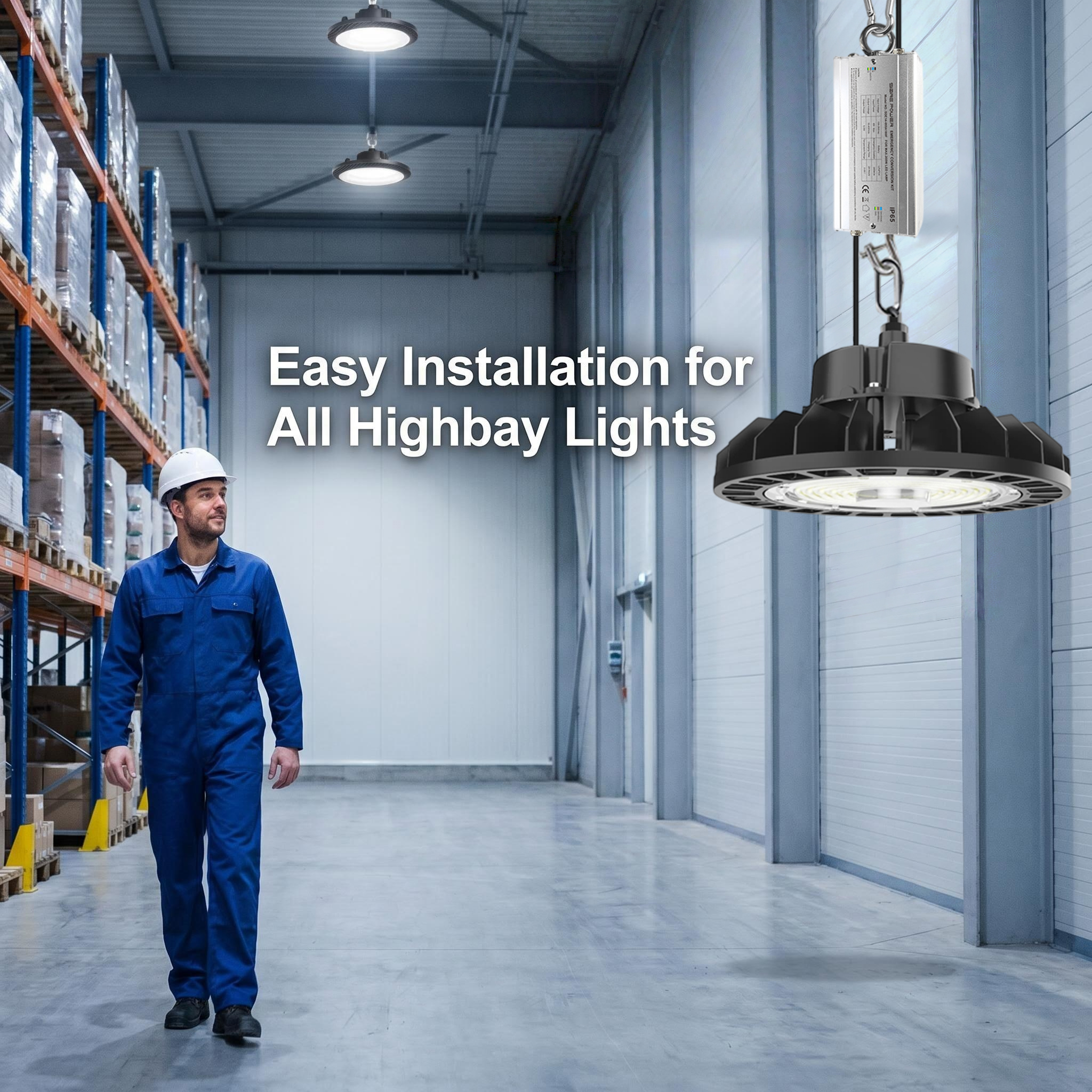
LED Emergency Driver For LED High Bays
High wattage emergency drivers for UFO and linear high bays in warehouses, plants and logistics centres.
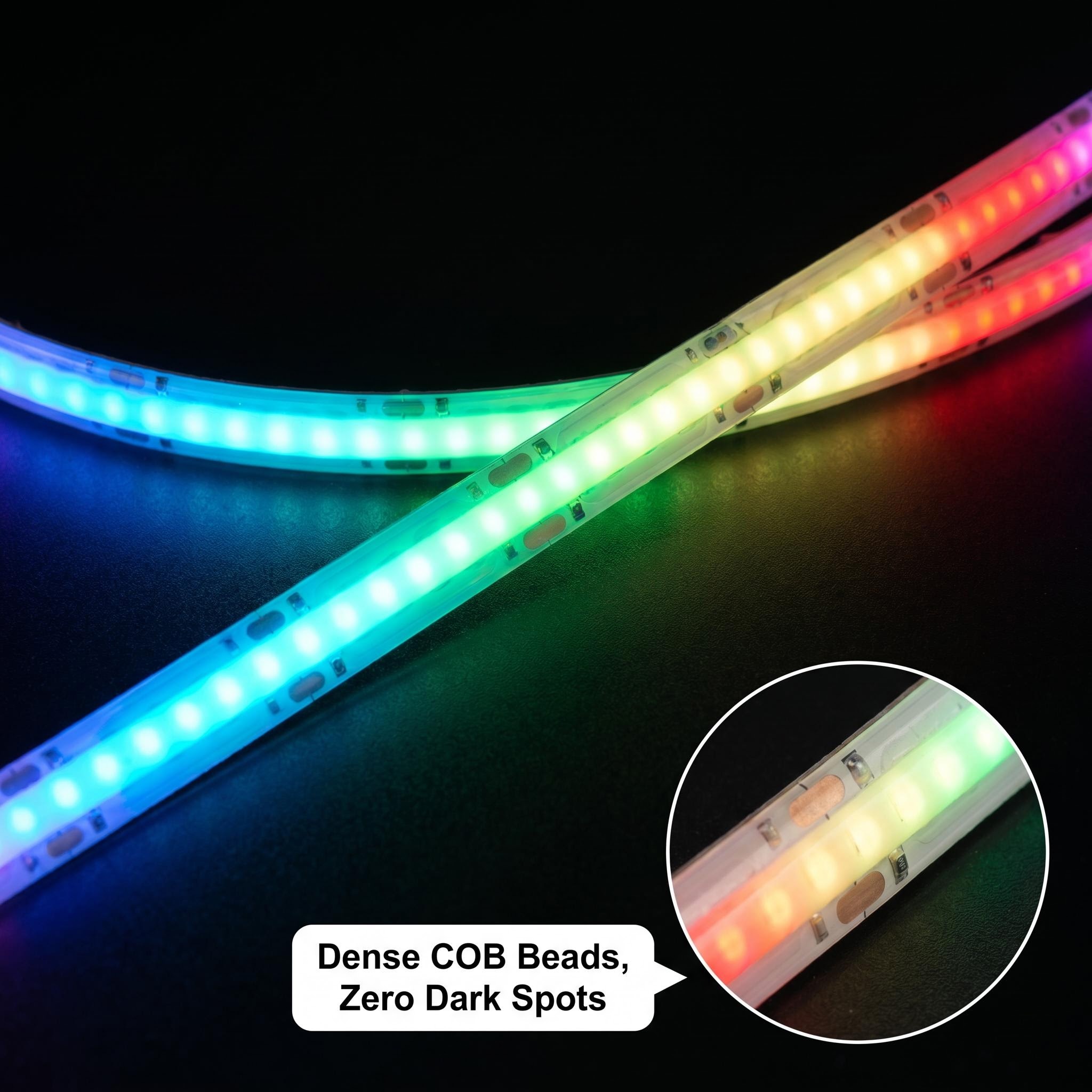
Bandes LED COB
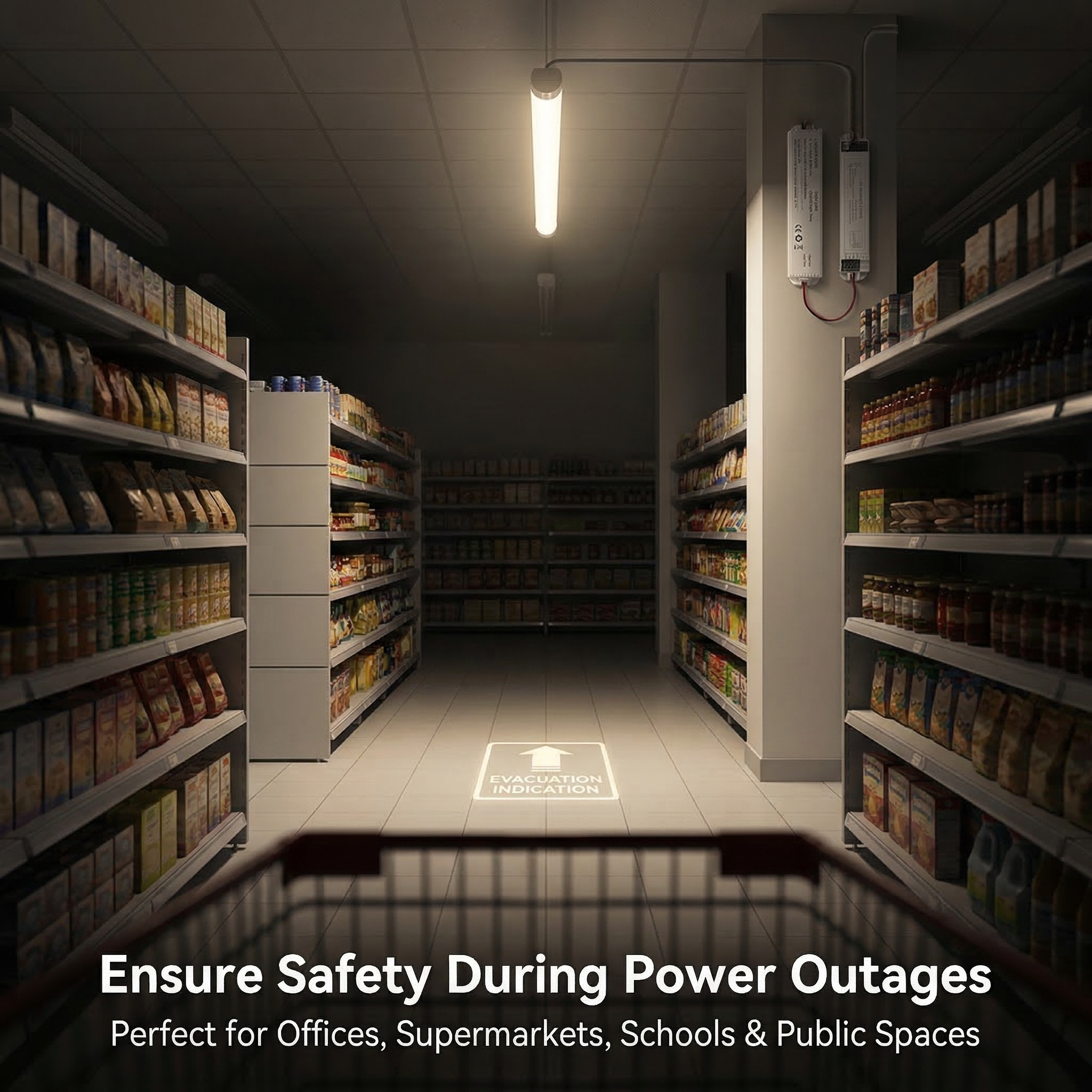
Dotless COB strip with continuous light lines for cove, profile and architectural detailing.
Frequently Asked Questions About Tunnel & High Humidity Area Lighting
Minimum Order Quantity And Price Drivers
Q: What is the minimum order quantity and what drives per-unit price for tunnel-rated emergency modules?
MOQ is 200 units for standard IP65 emergency drivers, 500 units for custom-labelled cartons. Price drivers are: battery chemistry (LiFePO4 3.2V 3000mAh costs 15-20% more than NiCd 2.4V 1500mAh), emergency duration (3-hour versus 90-minute reserve), self-test firmware, and whether the constant-current output window is narrow (e.g., DC 50-80V at 350mA) or wide-range (DC 25-120V at 200-700mA). IP66 sealing and anti-corrosion coating on the steel chassis add 8-12%.
Fixture Compatibility And Output Specification
Q: How do I confirm your emergency driver suits my tunnel high-bay or linear fixture?
Match three numbers: the driver’s output voltage window in DC volts must cover your LED module’s forward-voltage sum at operating temperature; its constant-current mA rating must be within 10% of the normal driver’s output; and the driven load in watts must not exceed the emergency driver’s rated limit (typically 10W, 15W, or 25W for tunnel high-bays). Ask for a photometric report showing emergency output in lumens and as a percentage of normal output—EN 1838 requires minimum 50% for escape routes, but many tunnel operators specify 100% for 90 minutes.
Emergency Duration And Battery Chemistry
Q: What emergency duration and output options are available, and which battery chemistry do you use?
Standard durations are 90 minutes, 2 hours, and 3 hours. Output options span 3W to 25W emergency, translating to 300-2500 lumens depending on LED efficacy and optic loss. Battery packs are LiFePO4 3.2V (1500mAh to 6000mAh, 500-800 cycles), Li-ion 18650 3.7V (2000mAh to 3500mAh, 300-500 cycles), or NiCd 2.4V/3.6V/4.8V (1200mAh to 4000mAh, 200-300 cycles). LiFePO4 charges in 16-20 hours; NiCd in 20-24 hours. LiFePO4 tolerates 0°C to 60°C ambient; NiCd performs to -20°C but contains cadmium, which faces import restrictions in several EU markets.
Wiring Configuration And Test Facility
Q: Do you supply maintained, non-maintained, or combined wiring, and what test options are built in?
All three configurations are available. Non-maintained is standard for tunnels: the unit activates only on mains failure. Maintained uses a changeover relay to switch the emergency module into circuit during normal operation, required when the fitting has no separate switched live. Combined offers both modes selectable by terminal wiring. Test options are manual test key (standard), automatic self-test per EN 62034 (weekly function, annual duration), and DALI-2 emergency test facility for integration into tunnel SCADA systems.
Certification And Destination Market Compliance
Q: Which test reports and conformity marks can you supply for my market?
Ask the supplier to provide third-party test reports covering: EN 60598-2-22 for luminaire construction, EN 1838 for photometric performance, EN 62034 for self-test function, and IEC 61347 for driver safety. For the UK, request BS 5266-1 compliance documentation; for North America, UL 924; for Australia, AS/NZS 2293. The supplier should show CB test certificates or in-country accreditation. Do not accept a photocopied CE mark without the accompanying Declaration of Performance and technical construction file reference number.
Lithium Battery Shipping And Documentation
Q: How do lithium batteries affect shipping mode and required documents?
LiFePO4 and Li-ion 18650 packs require UN 38.3 test summary reports for all modes. Air freight (IATA DGR) limits lithium content per cell to 1g for ion, 2.5g for metal; most 18650 cells are below this, but packs over 100Wh need dangerous-goods declaration and carrier approval. Sea freight (IMDG Code) is less restrictive per kilogram but requires proper shipping name, UN number (UN3481 for packed with equipment), and limited-quantity or excepted-quantity marking. Lead time extends 3-5 days for DG documentation. NiCd ships as environmentally hazardous substance under UN3028, also restricted but with different packaging requirements.
Lead Time Sample Policy And Payment Terms
Q: What is your lead time, sample policy, and typical payment structure?
Standard lead time is 25-30 days after order confirmation for quantities under 1000 units; 35-45 days for 5000+ units or custom firmware. Samples ship in 5-7 days from stock against a refundable deposit of USD 150-300 per unit. Payment terms are 30% T/T deposit, 70% balance against copy of B/L for first orders; L/C at sight available for orders above USD 50,000. FOB Shenzhen or CIF destination port; EXW available if you hold your own freight contract. Pallet packing is 48 cartons per 1100mm x 1100mm IPPC-marked pallet, gross weight 380-420kg.
Warranty Spare Parts And Engineering Support
Q: What warranty, spare parts availability, and installation support do you offer?
Standard warranty is 3 years on the electronics, 2 years on LiFePO4 packs, 1 year on NiCd. Extended to 5 years/3 years on request with annual inspection protocol. Spare battery packs and driver PCBs are stocked for 7 years from last production date. After-sales engineering provides wiring diagrams for maintained/non-maintained changeover, DALI address programming guides, and commissioning checklists aligned to BS 5266-1 or local equivalent. OEM branding on carton labels and laser-etched housings is available from 1000 units with 7-day artwork turnaround.
Important Notice
Specifications, output and duration figures and price ranges in this guide are indicative and are provided
for planning purposes only. Actual emergency output, duration, battery life, ingress protection and available conformity documentation
differ by model and by destination country, and emergency lighting design remains the responsibility of the project designer. Buyers
must confirm their own mains voltage and frequency, the emergency lighting standard enforced locally, the host fixture compatibility
and their import requirements before placing an order. All figures are subject to written confirmation in the final proforma invoice
issued by Hymark.
Sourcing Tunnel & High Humidity Area Lighting from Hymark
What to Request Before You Place an Order
A qualified tunnel and high-humidity supplier should provide discharge test records that match your specification exactly. Ask for the constant current inverter output window in DC volts and mA, the driven load in watts, and the battery chemistry with voltage and capacity: LiFePO4 3.2V 3000mAh packs deliver roughly 500 to 800 cycles, while Li-ion 18650 3.7V 2600mAh cells offer higher energy density but shorter cycle life. NiCd 3.6V 1500mAh to 4000mAh packs remain relevant for extreme temperature sites. Confirm the charge time—typically 24 hours for full recharge—and whether the unit supports self-test or DALI test facility per EN 62034. For maintained versus non-maintained wiring, verify the changeover relay rating and coil consumption.
Request IP65 or IP66 ingress protection as baseline for tunnel soffits and portal zones; IP67 for jet-washable niches. The ambient temperature range matters: LiFePO4 performs from -20°C to +60°C, Li-ion narrows to 0°C to +45°C for charging. Ask for third-party test reports covering EN 60598-2-22, EN 1838 or BS 5266-1 for UK projects, UL 924 for North American specifications, and AS/NZS 2293 for Australasian jobs. Do not accept unverified claims; the report number and issuing laboratory should be traceable.
Why Hymark Fits This Specification
Hymark operates as the premium brand of JIALINGHANG ELECTRONIC CO., LTD., founded in 2013, with a 2017 strategic shift to LED emergency technology and high-performance LED strips. Product design and R&D are managed in-house; manufacturing runs through partnered facilities with SMT and assembly capacity dating to 2013. The range covers LED emergency drivers for LED high bays and LED tubes, full power output emergency drivers, COB LED strips and SMD LED strips—products suited to tunnel luminaire retrofits and humid industrial envelopes.
Emergency duration is selectable at 90 minutes, 2 hours or 3 hours. Input voltage ranges span AC 85-265V or 100-277V depending on driver model. Output windows are quoted in DC volts and mA to match your host fixture’s LED module. OEM and ODM branding, export carton packing, and FOB or CIF terms are available. Sample lead time runs 7 to 10 working days for standard configurations; bulk orders carry 25 to 35 day lead times depending on battery chemistry and test facility specification.
Get Your Specification Quoted
Send the host fixture type and wattage, the emergency duration your code requires, your mains voltage and frequency, and your destination port. Hymark returns a quotation within 24 hours via WhatsApp or email with inverter output details, battery specification, IP rating and packing configuration matched to your tunnel or high-humidity project.
Get a Factory Direct Quote on Tunnel & High Humidity Area Lighting
JIALINGHANG ELECTRONIC CO., LTD. has been in LED lighting since 2013 and has focused on
LED emergency technology and high performance LED strips since 2017. Hymark products are co-designed with our
dedicated manufacturing partners, built with selectable emergency duration and maintained or non-maintained wiring, and function
tested before packing. Send us the host fixture type and wattage, the emergency duration your local code requires, your mains
voltage and your destination port and we will return a quotation within 24 hours.


 English
  Spanish
  Arabic
  French
  German
  Russian
  Portuguese
  Italian
  Vietnamese