
Emergency Exit Sign Buyer Guide
A real emergency exit sign factory in China controls its own SMT line or has a partnered surface-mount facility under daily engineering supervision, not a trading office that outsources every order to the lowest bidder. For buyers sourcing for projects in the UK, Europe, the Middle East or Southeast Asia, this distinction determines whether the 3.2V LiFePO4 1800mAh battery pack inside the sign actually delivers the 90-minute or 3-hour duration stamped on the housing, or fails the first annual test.
What Separates Manufacturer from Trader
In-house production depth. Ask to see SMT capacity for LED modules and driver boards, battery pack welding stations, and final assembly lines. A factory worth qualifying can show you ageing racks where finished signs run 48-hour burn-in at 25°C ambient before packing, and hipot test stations verifying 1500V AC isolation between live and accessible metal. Traders show catalogues; manufacturers show process control records.
Battery traceability and chemistry. The sign’s emergency output—typically 50 to 70 lumens for a 2W LED legend plate—depends on a battery that survives 500+ deep discharge cycles. LiFePO4 3.2V packs at 1800mAh to 3000mAh dominate current export production for their thermal stability and 800-cycle life. Li-ion 18650 3.7V 2000mAh alternatives cost 15–20% less but carry stricter UN 38.3 transport documentation and degrade faster above 45°C ambient. NiCd 3.6V 700mAh still appears in budget tenders but faces disposal restrictions across the EU. Request cell supplier certificates and lot-level discharge curves, not just finished-product claims.
Test facility verification. EN 60598-2-22 and EN 1838 require the sign to maintain minimum 50 lux on the floor directly below and 5 lux along the escape route centre line. EN 62034 defines the self-test automation that cycles the sign through monthly function tests and annual duration tests without manual intervention. A factory with embedded firmware engineers can demonstrate DALI address programming and fault logging; a trader cannot explain why the changeover relay failed to latch at 85V AC input.
Documentation Buyers Should Request
| Item | What to Verify | Red Flag |
|---|---|---|
| Third-party test report | Scope covers the exact model, voltage range (AC 85-265V or 220-240V per destination), and standard (EN 60598-2-22, UL 924, AS/NZS 2293) | Report is for a “similar” product or missing battery chemistry |
| Discharge duration record | Signed test log showing 90 min or 3 hours at rated load, ambient temperature noted | No raw data, only a pass/fail certificate |
| Battery UN 38.3 | Test summary for the cell and pack configuration shipped | Missing or referring to a different cell model |
| IP/IK rating evidence | IP65 dust/water and IK08 impact tested to EN 60598-2-22 | Self-declared with no lab reference |
Sample Lead Time and Payment Structure
A factory with stocked LED modules and battery cells typically ships samples in 5–7 working days; a trader quoting 15–20 days is likely back-to-back ordering. Sample cost for a single maintained/non-maintained convertible sign with self-test runs $35–55 FOB Shenzhen depending on legend language (running man left/right, arrow direction) and housing material (ABS versus polycarbonate). Bulk production MOQ usually sits at 200–500 pieces for custom legends, 1000 pieces for standard EN running man variants. Payment terms of 30% deposit, 70% against bill of lading are standard for first orders; 60-day open account requires established trade references or credit insurance.
After-Sales Engineering Capability
Sign failures in the field are almost always firmware or battery management issues, not LED failures. A factory with resident electronics engineers can remotely diagnose self-test error codes and ship replacement driver boards with matched firmware versions. A trader routes you through a WeChat group with no technical escalation path. Before placing volume, test this: send a deliberately ambiguous fault description and measure how many hours until a schematic-level answer arrives.
Types and Configurations of Emergency Exit Sign
| Type or Class | Typical Rating or Output | Duration or Runtime | Best Suited For | Notes |
|---|---|---|---|---|
| Maintained LED Exit Sign with NiCd Battery | 3W normal / 3W emergency (100%) | 90 min to 3 hours | Public buildings, retail, corridors where sign must stay lit during normal hours | Continuous operation wears NiCd faster; expect 300-500 cycles at 70% capacity retention |
| Non-Maintained LED Exit Sign with LiFePO₄ Battery | 0W normal / 2W-4W emergency (0%→100%) | 2 hours to 3 hours | Offices, warehouses, industrial sites with normal lighting already present | Standby only; fails dark if battery depleted; LiFePO₄ yields 1500-2000 cycles at 3.2V 1500-3000mAh |
| Self-Test Maintained Exit Sign with Li-ion 18650 | 2W normal / 2W emergency (100%) | 90 min to 2 hours | Hotels, hospitals, schools requiring automated compliance logging | EN 62034 defines test intervals; 18650 pack at 3.7V 2200-2600mAh; monthly functional and annual duration tests |
| DALI-Addressable Exit Sign with Central Monitoring | 1.5W-3W normal / 1.5W-3W emergency | 90 min to 3 hours | Smart buildings, BMS integration, large campuses | Requires DALI-2 control gear; EN 62386-202 for emergency; wiring separate from mains switching |
| Edge-Lit Slim Panel Exit Sign (IP20 to IP44) | 2W-4W / 150-350 lm emergency output | 90 min to 2 hours | Modern commercial interiors, ceiling-recessed or surface-mounted | 5-10mm thickness; 220-240V 50Hz typical; not for wet locations without IP65 variant |
| Weatherproof Exit Sign (IP65 to IP67, IK08) | 3W-5W / 200-400 lm emergency output | 2 hours to 3 hours | Car parks, tunnels, external building perimeters, cold stores | Polycarbonate or aluminium housing; -20°C to +50°C ambient; LiFePO₄ preferred for low-temperature discharge |
Maintained LED Exit Sign with NiCd Battery
Maintained exit signs run the LED legend continuously from the normal supply and switch to battery inverter output on mains failure. A typical unit draws 3W at 220-240V 50Hz normal operation and delivers identical 3W through a DC 3.6V NiCd 700-1500mAh pack via constant current circuitry at 350mA. The battery receives trickle charge during normal hours; charge time to 90% capacity is 24 hours after a full discharge. Electrical contractors and facility managers in UK and European public buildings specify these for EN 1838 compliance in corridors where occupants need continuous visual confirmation of the escape route. The limitation is cycle life: NiCd chemistry manages roughly 300-500 deep discharges before capacity drops below 80%, and memory effect requires periodic full discharge maintenance. Buyers should ask suppliers for IEC 60598-2-22 test reports and discharge duration records from hipot and ageing test stations, not just a generic CE declaration.
Non-Maintained LED Exit Sign with LiFePO₄ Battery
Non-maintained signs remain dark during normal operation and illuminate only when the changeover relay detects mains failure, drawing zero watts standby and switching to a 3.2V LiFePO₄ pack at 1500-3000mAh for 2W-4W emergency output. The inverter typically delivers DC 3.0-3.6V at 600-900mA constant current to the LED module. Charge time from flat is 12-16 hours. This configuration suits warehouses and industrial sites across Southeast Asia and Latin America where normal lighting is already adequate and energy costs matter. The trade-off is functional visibility: if the battery fails between tests, the sign gives no indication until an emergency occurs. Procurement officers should verify the supplier runs 100% discharge duration tests on finished units, not just incoming battery inspection, and holds UN 38.3 transport documentation for lithium shipments.
Self-Test Maintained Exit Sign with Li-ion 18650
Self-test exit signs automate the EN 62034 test regime: monthly functional tests and annual full-duration tests with visual fault indication via LED status or remote signal. A maintained unit using 3.7V Li-ion 18650 cells at 2200-2600mAh delivers 2W normal and 2W emergency for 90 minutes to 2 hours, with inverter output at DC 2.8-4.2V and 500-700mA. Hotels, hospitals and schools in the Middle East and Africa buy these to reduce manual testing labour and demonstrate compliance to fire authorities. The limitation is battery management complexity: the PCB must balance cell voltage and monitor temperature; a supplier without in-house SMT and firmware programming typically sources boards externally with limited traceability. Buyers should request third-party EN 62034 test reports for the complete sign, not just the battery or driver in isolation.
DALI-Addressable Exit Sign with Central Monitoring
DALI-2 emergency signs communicate individual address status over a two-wire bus to a central controller, reporting battery health, lamp failure and duration test results per EN 62386-202. Maintained or non-maintained wiring configurations are possible; typical output is 1.5W-3W at DC 3.2-3.7V depending on battery chemistry. M&E consultants and lighting designers specifying smart buildings in Europe and the UK favour this for integration with building management systems. The constraint is infrastructure: dedicated DALI wiring must run to each sign, and commissioning requires address programming. A trading office without firmware engineering support cannot troubleshoot DALI communication faults; verify the manufacturer has after-sales engineering capability and provides DALI application controller compatibility lists.
Edge-Lit Slim Panel Exit Sign
Edge-lit signs use side-mounted LEDs with light-guide panel technology to achieve 5-10mm profile thickness, outputting 150-350 lumens emergency from 2W-4W at 220-240V 50Hz. Typical specification includes 60-120 LEDs per metre on edge strips, CRI 70-80, colour temperature 6000-6500K cool white for legend visibility, and cut-length or panel size fixed at factory. Surface-mount or recessed ceiling installation suits modern commercial interiors in Europe and Southeast Asia. IP20 to IP44 variants exist; IP44 withstands splashing water but not jet cleaning or outdoor exposure. The limitation is lumen depreciation: edge-lit panels lose uniformity if LED strips degrade unevenly, and repair requires replacing the entire panel rather than individual LEDs. Luminaire OEMs adding emergency versions should confirm the supplier’s SMT line handles 2835 or 4014 LED packages at the required density.
Weatherproof Exit Sign (IP65 to IP67, IK08)
Weatherproof signs seal polycarbonate or die-cast aluminium housings with gaskets to achieve IP65 dust-tight and water-jet resistant, or IP67 temporary immersion, plus IK08 mechanical impact resistance. A 3W-5W LED module with LiFePO₄ 3.2V 3000mAh pack delivers 200-400 lumens emergency for 2-3 hours, with inverter output DC 3.0-3.6V at 800-1200mA. Operating ambient is typically -20°C to +50°C; LiFePO₄ chemistry maintains discharge efficiency below 0°C where Li-ion 18650 performance collapses. Car parks, tunnels and external building perimeters in the UK, Middle East and Africa use these. The trade-off is cost and weight: sealed housings and corrosion-resistant hardware add 30-50% over indoor equivalents, and battery replacement requires opening gasketed compartments that degrade with thermal cycling. Buyers should ask for IP test reports to IEC 60529 and impact test records to IEC 62262, not rely on supplier-stated ratings.
Supplier Qualification Checklist for Factory Verification
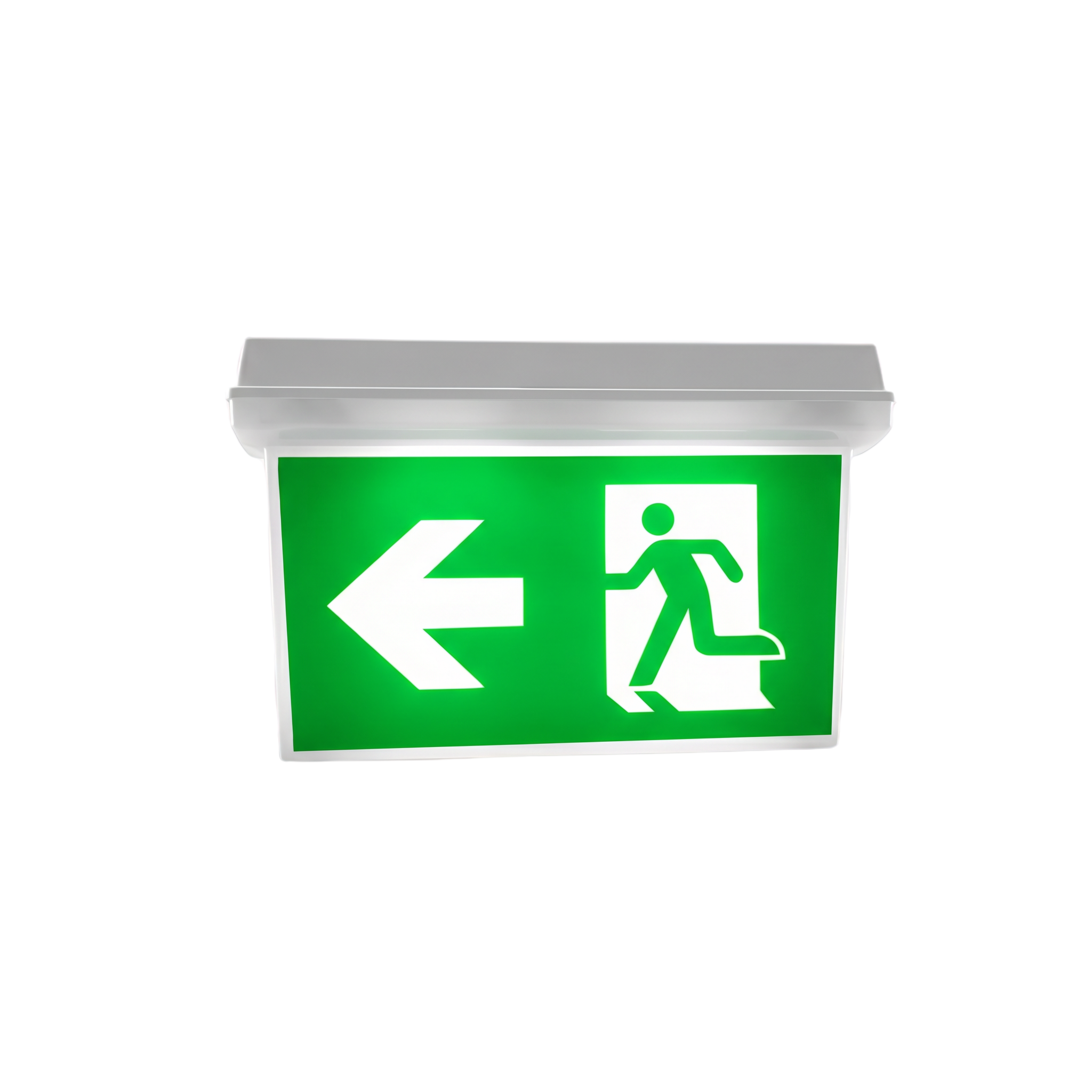
The table above defines what to specify; the following verifies who actually builds it. A real manufacturer demonstrates in-house or directly partnered SMT capacity for LED driver PCBs, not just final screw-driver assembly of purchased modules. Battery sourcing traceability matters: ask for cell supplier certificates, lot codes, and whether packs are welded in-house or imported complete. Discharge and duration test records should show 100% of units, not sampling; ageing test stations typically run 4-8 hours minimum, and hipot testing to 1500V AC or 2U+1000V per IEC 61347-2-7 should appear in production logs. Third-party test reports for the destination market—EN 60598-2-22 and EN 1838 for Europe, BS 5266-1 for UK, UL 924 for North America, AS/NZS 2293 for Australasia—must cover the complete sign model number, not component-level reports repurposed. Sample lead time from a genuine factory is 7-14 days for existing tooling; 4-6 weeks indicates probable subcontracting or trading office buffer. Payment structure typically runs 30% T/T deposit, 70% against copy of B/L for orders under $50,000; requests for 100% advance on first orders suggest weak factory cash flow or intermediary risk. After-sales engineering capability means schematic access, firmware update procedures for self-test and DALI variants, and replacement battery pack availability with matching connector and protection PCB for 5-7 years.
Specifications and How to Read Them
| Parameter | Entry Level | Mid Range | High Specification |
|---|---|---|---|
| Housing | ABS plastic, white | Steel sheet, powder coat white | Aluminium extrusion, anodised |
| Legend material | Acrylic screen-printed | Acrylic laser-etched | PMMA laser-etched, UV-stable |
| Normal LED source | SMD 2835, 50 LEDs, 3W | SMD 2835, 80 LEDs, 5W | SMD 2835, 120 LEDs, 8W |
| Normal luminous flux | 150 lm | 300 lm | 500 lm |
| Emergency output | 50 lm, 33% of normal | 120 lm, 40% of normal | 250 lm, 50% of normal |
| Emergency duration | 90 minutes | 120 minutes | 180 minutes |
| Input voltage / frequency | AC 220-240V 50Hz | AC 85-265V 50/60Hz | AC 100-277V 50/60Hz |
| DC output window | 3.6V DC, 350mA constant current | 3.6V DC, 500mA constant current | 6.4V DC, 700mA constant current |
| Driven load (emergency) | 1.3W | 1.8W | 4,5 W |
| Battery chemistry | NiCd 3.6V 600mAh | Li-ion 18650 3.6V 2200mAh | LiFePO4 6.4V 3000mAh |
| Charge time to 80% | 24 hours | 6 hours | 4 hours |
| Cycle life at 25°C | 300 cycles | 500 cycles | 800 to 1000 cycles |
| Test facility | Manual test key | Auto self-test per EN 62034 | DALI-2 emergency, self-test |
| Wiring mode | Non-maintained only | Maintained or non-maintained | Maintained or non-maintained |
| IP / IK rating | IP20, IK02 | IP42, IK04 | IP65, IK08 |
| Ambient temperature | 0°C to +40°C | -10°C to +45°C | -20°C to +55°C |
| Dimensions (mm) | 310 x 120 x 35 | 340 x 180 x 45 | 380 x 200 x 60 |
| Mounting | Wall only | Wall or ceiling | Wall, ceiling or pendant |
| Sample lead time | 7 days | 10 days | 14 days |
| MOQ | 500 units | 300 units | 100 units |
| EXW unit price indication | USD 4.50 to 6.00 | USD 9.00 to 13.00 | USD 18.00 to 28.00 |
How to Read the Datasheet Line by Line
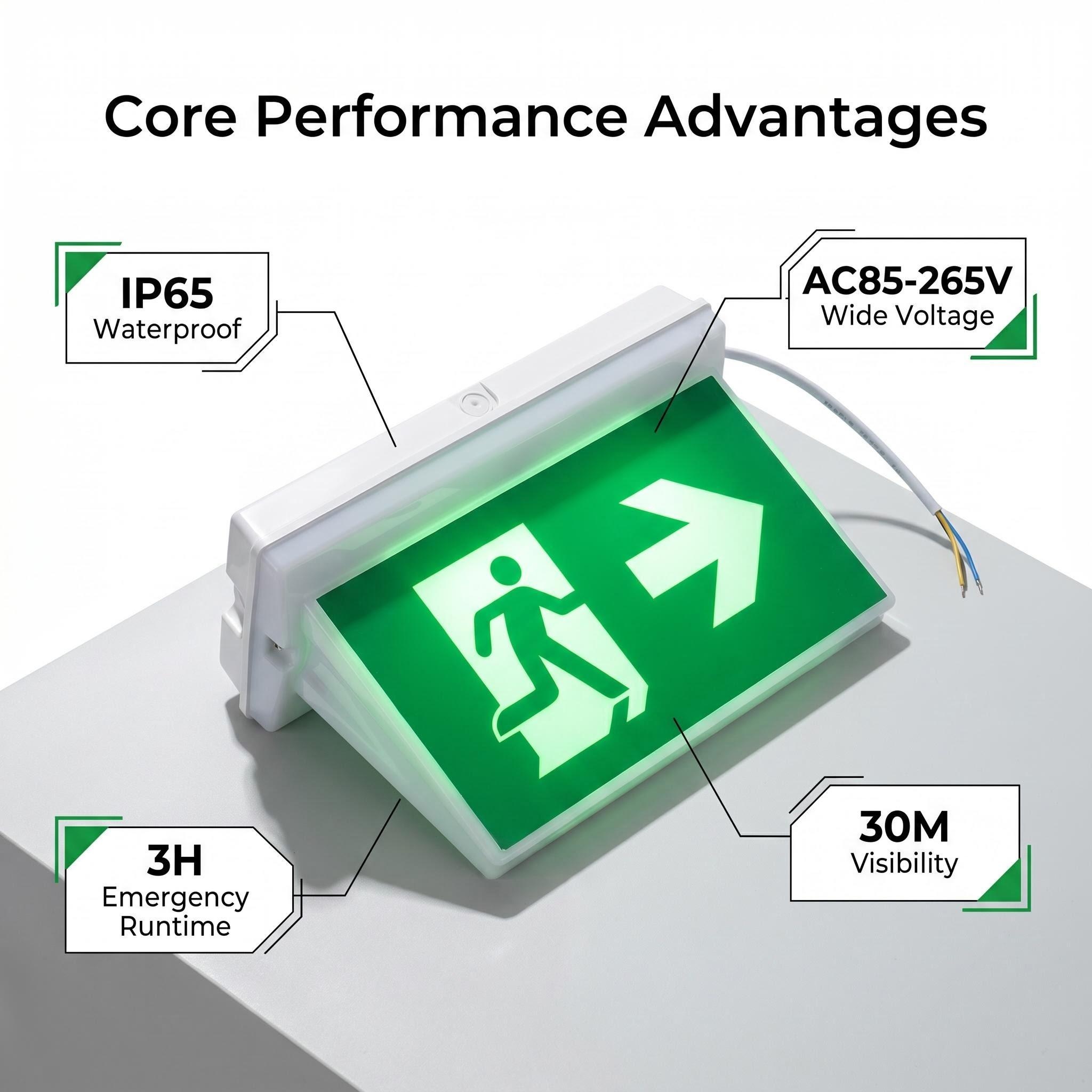
Input voltage range and frequency. A sign rated AC 220-240V 50Hz is built for the UK and European mains. A wider range of AC 85-265V 50/60Hz accepts North American 120V 60Hz as well as Southeast Asian 230V 50Hz without a separate SKU. Check that the label on the sample matches the datasheet; some factories ship 220V-only capacitors in a universal-voltage housing.
Driven load in watts. This is the power the LED legend actually draws in emergency mode, not the battery capacity. EN 1838 requires minimum illuminance on the floor below the sign; 1.3W at 50 lm may meet that in a small corridor, but a high-ceiling warehouse needs 4.5W at 250 lm to achieve the same lux level. Ask for the photometric file or a lux-distance table.
DC output voltage window and current. The inverter inside the emergency pack must match the LED module. A 3.6V 350mA constant-current driver will not run a 6.4V module; the LEDs simply will not light. Verify that the supplier has built the sign with a matched driver, not a generic pack they had in stock.
Emergency output as percentage of normal. EN 60598-2-22 sets no minimum percentage, but BS 5266-1 recommends at least 10% of normal flux for escape route signs. The 33% to 50% range in the table above exceeds that. Be aware that higher percentages need larger batteries and drive cost upward.
Emergency duration. Ninety minutes is the legal minimum in most jurisdictions for escape routes. Two hours appears in UK healthcare and some Middle East codes. Three hours is specified for high-occupancy buildings in parts of Southeast Asia and for certain Australian installations under AS/NZS 2293. Confirm the local requirement before specifying; a 90-minute sign will fail inspection where 180 minutes is mandated.
Battery chemistry, voltage and capacity. NiCd 3.6V 600mAh is the legacy choice. It tolerates temperature extremes but contains cadmium, which faces RoHS restrictions and transport complications. Li-ion 18650 3.6V 2200mAh offers higher energy density and roughly double the cycle life, but demands UN 38.3 testing for air or sea freight. LiFePO4 6.4V 3000mAh runs cooler, delivers 800 to 1000 cycles, and is increasingly preferred for maintained installations where daily cycling occurs. Ask for the cell brand and model; unnamed cells often come from secondary market sources.
Charge time and cycle life. A 24-hour charge time for NiCd reflects the trickle-charge chemistry. Li-ion and LiFePO4 packs reach 80% in four to six hours because the charger is active, not trickle. Cycle life is tested at 25°C; at 40°C ambient, expect 30% to 40% reduction. Request the IEC 62034 or EN 62034 test report if the supplier claims self-test compliance.
Test facility. Manual test key means a technician visits each sign monthly or annually and holds a key switch. Self-test per EN 62034 automates duration and function tests, logging failures to a status LED. DALI-2 emergency adds digital reporting to the building management system. DALI signs cost 40% to 60% more than manual equivalents; specify only where the BMS infrastructure exists.
Maintained versus non-maintained wiring. Non-maintained: the sign is dark in normal mains present, illuminates only on power failure. Maintained: the sign is lit continuously from the normal supply, switches to battery on failure. Maintained wiring needs a changeover relay rated for continuous duty; verify the relay brand and contact rating. Some suppliers wire non-maintained packs as maintained by bridging terminals, which overheats the relay after months of operation.
IP and IK rating. IP20 is indoor dry locations only. IP42 resists dripping water and finger contact. IP65 is jet-proof for car parks, tunnels, and external canopies. IK02 withstands 0.2 joule impact; IK08 withstands 5 joule, equivalent to a 1.7kg mass dropped from 300mm. Industrial and transport environments should specify IK08 minimum.
Ambient temperature range. The 0°C to +40°C of entry-level ABS housings reflects battery limitation, not LED limitation. LiFePO4 and quality Li-ion cells extend to -20°C, though output drops 15% to 20% at the cold extreme. Above 45°C, NiCd suffers memory effect and Li-ion ages rapidly. If your project is in the Gulf or sub-Saharan Africa, demand the high-temperature cycle test data.
Dimensions and mounting. A 310 x 120 mm sign is legible at 15m viewing distance under EN 1838. A 380 x 200 mm sign extends that to 30m. Ceiling mounting needs a mounting plate with drop-rod holes; wall mounting needs keyhole slots at 50mm centres. Pendant mounting is rarely standard; confirm the supplier has tooled the extrusion end-caps for cable entry.
What Drives Price in the Quotation
Battery chemistry is the largest single variable. Moving from NiCd 600mAh to LiFePO4 3000mAh adds USD 3.50 to 5.00 at cell level, plus charger redesign. Housing material adds USD 2.00 to 4.00 between ABS and aluminium extrusion. Legend production method separates screen-printed acrylic at cents per unit from laser-etched PMMA with lifetime fade resistance. Test electronics scale from a resistor and key switch through microcontroller-based self-test to DALI-2 protocol chips and isolation transformers. IP and IK ratings demand gasket design, tempered glass or polycarbonate diffusers, and impact-tested mounting hardware.
A buyer comparing two quotes at USD 6.00 and USD 14.00 for apparently the same sign should ask: which battery, which test facility, which ingress protection, and what ambient temperature range is guaranteed.
Supplier Qualification: Factory or Trading Office
SMT and assembly capacity. A real manufacturer owns or leases SMT lines for LED module production, not just final assembly. Ask for photos of the pick-and-place machines, the reflow oven brand, and the AOI station. If the supplier only has a screwdriver-and-bench operation, they are buying modules from a third party and cannot control LED bin consistency or solder joint reliability.
Battery sourcing and traceability. Demand the cell manufacturer’s name and the batch code format. A qualified factory receives cells with millivolt-matched sets and welds them in-house or at a partnered pack facility. They keep cell incoming inspection records: open-circuit voltage, internal resistance, and capacity spot checks. Trading offices rarely hold these records; they rely on the pack supplier’s word.
Discharge and duration test records. Every production batch should be sampled for full 90-minute or 180-minute discharge at rated load. Ask to see the test log: date, batch number, ambient temperature, initial and final lumen output, and pass/fail. A factory with ageing stations runs 100% of packs for 24 hours before final assembly to catch early cell failures.
Ageing and hipot test stations. Ageing burns in electronics at 40°C to 45°C for 4 to 8 hours. Hipot (dielectric withstand) tests the mains-to-earth isolation at 1500V AC or 2000V DC for the duration specified in EN 60598-2-22. Both need dedicated racks, not bench power supplies. Hipot failure means insulation breakdown; a factory without hipot is shipping a fire risk.
Third party test reports. Do not accept “CE certificate” as a phrase. Ask for the test report number, the laboratory name, the standard edition (EN 60598-2-22:2014 or 2021), and the report scope: does it cover the exact model, the exact battery, and the exact legend? For UK export, ask whether the report supports UKCA marking and whether the lab is UKAS-accredited or has a UK approved body number. For UL 924 entry to North America, the report must be from a UL-registered test facility, not a general EMC lab.
Sample lead time. A factory with in-house SMT and battery pack lines can produce customised samples in 10 to 14 days. A trading office quoting 3 days is shipping stock from a warehouse; the sample may not represent your specification. A factory quoting 30 days may be outsourcing every subassembly.
Payment structure. Factories typically ask 30% T/T deposit, 70% against copy of bill of lading. Trading offices often demand 50% deposit and 50% before shipment because they lack credit with their upstream suppliers. Letters of credit (L/C at sight) are accepted by established manufacturers but add USD 200 to 400 in bank fees; trading offices frequently refuse L/C because their small volume triggers unfavourable terms.
After-sales engineering capability. Ask who reviews your mounting drawings, who calculates spacing for EN 1838 compliance, and who provides the DALI application controller configuration file. A factory employs application engineers; a trading office forwards your questions to the factory with a 24-hour delay and often garbles the technical detail.
Trade Terms and Export Practicalities
FOB Shenzhen or FOB Ningbo. The supplier delivers to the port, clears export customs, and loads the container. You arrange ocean freight, marine insurance, and destination customs. FOB is standard for buyers with freight forwarders in their own market.
CFR (Cost and Freight). Supplier pays to the destination port. Risk transfers on the ship at origin; you still need marine insurance. CFR suits buyers who want one invoice but still control customs clearance.
CIF (Cost, Insurance, Freight). Supplier includes marine insurance to the destination port. The insurance is typically Institute Cargo Clauses (C), which excludes condensation and rough handling damage. Specify ICC (A) if the goods are high-value or the route is rough.
EXW (Ex Works). You collect from the factory door. Useful if you have a consolidation container in Shenzhen collecting from multiple suppliers. You bear all export clearance cost and risk.
T/T (Telegraphic Transfer). Bank wire, 30/70 or 50/50 structure. Fast, low fee, no documentary protection. Standard with established suppliers.
L/C (Letter of Credit). Bank-to-bank payment against presented documents. Protects against non-shipment but not against defective goods. Adds cost and delays release of funds by 3 to 7 days. Recommended for first orders above USD 50,000.
HS code. Emergency exit signs with built-in battery fall under 9405.10 (lamps and lighting fittings, of a kind used for motor vehicles) or 9405.40 (other electric lamps and lighting fittings), depending on customs interpretation. Some jurisdictions classify the battery pack separately under 8507.60. Confirm the supplier’s declared HS code matches your freight forwarder’s expectation to avoid customs delays.
CE and UKCA marking. CE is the EU conformity mark; UKCA is the post-Brexit UK equivalent. The supplier must hold the technical construction file and the test report supporting the mark. You, as importer, are legally responsible for verifying this. For UKCA, the approved body must be UK-based or have a recognised EU equivalent until the current transitional arrangement ends.
UN 38.3 battery test report. Mandatory for lithium batteries shipped by air (IATA) or sea (IMDG). The report covers altitude simulation, thermal test, vibration, shock, external short circuit, impact/crush, and forced discharge. Each battery model and capacity needs its own report. Ask for the UN 38.3 test summary in the format required by the 2023 IATA Dangerous Goods Regulations, Section IB or Section II as applicable. Without this, the airline or shipping line rejects the cargo.
Packing list and certificate of origin. The packing list must show quantity, gross and net weight, dimensions per carton, and battery UN number if lithium. The certificate of origin (Form A or EUR.1 for EU preference, or a simple commercial certificate for other markets) supports any duty preference claim and satisfies some tender requirements in the Middle East and Africa.
Carton and pallet packing. Individual signs in PE bags, 10 to 20 per carton, carton dimensions typically 400 x 250 x 300 mm, gross weight 8 to 12 kg. Palletised as 50 to 60 cartons per 1.2m x 1.0m pallet, stretch-wrapped and strapped. Battery cartons need lithium handling labels if applicable. Sea freight to UK or Europe: 28 to 35 days. Air freight: 5 to 8 days, subject to lithium acceptance by the carrier.
MOQ and lead time. Entry-level signs: 500 units, 25 to 30 days. Mid-range: 300 units, 30 to 35 days. High specification with custom legend: 100 units, 35 to 45 days including legend tooling. Repeat orders typically shave 5 to 10 days. Sample policy: one unit at EXW price plus courier, refundable against first production order if the order exceeds 500 units.
Emergency Exit Sign Price and What Drives It
| Class | Typical Rating or Output | Duration or Runtime | Indicative FOB USD |
|---|---|---|---|
| Basic non-maintained LED exit sign, plastic body | 2W LED panel, 50–70 lm emergency output | 90 minutes | $4.50–$7.00 |
| Steel-cased maintained exit sign with legend kit | 3W LED, 80–120 lm, 10–20% of normal output | 2 hours | $8.00–$14.00 |
| IP65 maintained exit sign with LiFePO4 pack | 3.5W LED, 120–150 lm, 15–25% of normal output | 3 heures | $14.00–$22.00 |
| Self-test/DALI-compatible steel exit sign | 3W LED, 100–140 lm, with EN 62034 auto-test | 2–3 hours | $18.00–$28.00 |
| UL 924-listed exit sign for North America | 5W LED, 270 lm minimum per UL 924, 100% output | 90 minutes | $22.00–$38.00 |
Prices assume MOQ of 500–1000 pieces, single-colour legends, and standard carton packing. Custom legends, laser-etched pictograms, or aluminium extrusion housings add 15–35%. Prices are indicative only; binding quotations require confirmed specifications and destination terms.
Battery Cells and Pack Chemistry
The battery pack is typically the largest single cost driver in an emergency exit sign. Three chemistries dominate Chinese export production:
- NiCd 3.6V 600–1500mAh: $1.80–$3.50 per pack. Cycle life 300–500 cycles. Charge time 24 hours. Acceptable for 90-minute duration at low output, but falling out of favour in the EU due to RoHS cadmium restrictions and disposal liability.
- Li-ion 18650 3.7V 2000–2600mAh: $3.50–$6.00 per pack. Cycle life 500–800 cycles. Charge time 6–8 hours. Higher energy density permits 2–3 hour duration in compact housings. Requires UN 38.3 test summary for air freight; IATA Packing Instruction 965 Section IA or IB applies.
- LiFePO4 3.2V 1500–3000mAh: $4.50–$8.50 per pack. Cycle life 1000–2000 cycles. Charge time 4–6 hours. Superior thermal stability, wider ambient temperature range (typically -10°C to +55°C versus 0°C to +45°C for standard Li-ion). Preferred for Middle Eastern and African projects where ambient temperatures exceed 40°C.
A 3-hour maintained exit sign drawing 3.5W emergency load at 3.2V DC requires roughly 3200mAh effective capacity after ageing derating. Buyers should request cell-level traceability: supplier name, batch code, and discharge test records at 0.2C and 1C rates.
Driver and Inverter Electronics
The emergency inverter module converts battery DC to LED drive current. Key cost factors:
- Constant current output window: 3V–12V DC at 150–350mA for single LED arrays; 12V–24V DC at 100–250mA for longer strings. Tighter regulation (±3% versus ±10%) adds $0.80–$1.50.
- Changeover relay: Electromechanical relay versus solid-state switching. Relay adds $0.40–$0.70 but provides galvanic isolation; solid-state is silent and faster (<10ms) but requires careful thermal design.
- Self-test or DALI facility: EN 62034-compliant auto-test circuitry with fault logging adds $2.50–$4.50. DALI-2 emergency integration (IEC 62386-202) adds $4.00–$7.00. Manual test key only: negligible cost.
Input voltage range affects magnetics cost: 220–240V single winding versus 100–277V wide-range input with reinforced insulation. The latter adds $1.20–$2.00.
LED Package and Legend Assembly
- SMD 2835 LED: 0.1W per die, 120–130 lm/W at 65mA. A 2W exit sign uses 18–24 LEDs.
- Light guide panel versus diffuser film: Laser-dot LGP with PMMA diffuser yields 75–85% uniformity; basic diffuser film 55–70%. LGP adds $0.60–$1.10.
- Legend film: Photoluminescent vinyl versus LED-illuminated legend. Dual-purpose maintained signs use both: LED for active illumination, photoluminescent for battery-depleted fallback. Photoluminescent film meeting PSPA Class B or C adds $0.90–$1.80 per face.
Enclosure Hardware and IP Rating
- ABS plastic body, IP20: $1.80–$3.00 injection-moulded housing. Suitable for dry interior locations.
- Steel sheet 0.6–0.8mm, powder-coated, IP42: $3.50–$5.50. Standard for UK BS 5266-1 installations.
- Die-cast aluminium with gasket, IP65: $6.50–$10.00. Required for car parks, tunnels, industrial corridors in the Middle East and Southeast Asia where dust and humidity are present.
IK rating (impact resistance) is rarely specified below IK07 for exit signs; IK08–IK09 adds $1.00–$2.50 for toughened polycarbonate lenses or steel guards.
Test Certification Cost Amortisation
Third-party approval is the second-largest line item after batteries. A buyer should understand what the supplier has actually obtained versus what is claimed:
- EN 60598-2-22 and EN 1838 testing: Full photometric, duration, and temperature-rise testing at an accredited laboratory costs $8,000–$15,000 per product family. Spread over a 2000-piece production run: $4.00–$7.50 per unit.
- UL 924 listing: $25,000–$45,000 initial evaluation, plus quarterly factory surveillance. Amortised over North American export volumes, adds $10.00–$18.00 per unit.
- AS/NZS 2293: $6,000–$10,000 for Australian market access.
Request the test report number, laboratory name (SGS, TÜV Rheinland, Intertek, BSI, UL), and scope of approval. A “CE certificate” issued by an unaccredited body is not equivalent to EN 60598-2-22 test evidence.
Assembly Labour and Export Packing
- Assembly labour (Guangdong/Dongguan basin): $0.80–$1.40 per unit for PCB loading, battery welding, wiring, and functional test. Higher for complex maintained/DALI variants.
- Ageing and hipot: 100% hipot test at 1500V AC/1 minute (or 3000V for Class I metal bodies); 2–4 hour ageing burn-in. Stations cost $15,000–$30,000 each. Factories with 4+ stations running two shifts indicate genuine capacity, not trading-office outsourcing.
- Carton packing: 10–12 pieces per carton, 0.045–0.06m³, 8–11kg gross. Palletised: 40 cartons per 1.2m×1.0m pallet. FCL 20GP holds 8000–11000 pieces depending on housing depth.
Freight and Regulatory Charges
Lithium cells restrict options. UN 38.3-tested cells packed with equipment (UN 3481) ship under less restrictive rules than standalone cells (UN 3480), but air freight still requires cargo-only aircraft for quantities above 35kg net lithium content on some carriers. Sea freight (IMDG Code Section 3.4, limited quantities) is cheaper but adds 25–35 days to European hubs, 18–22 days to Jebel Ali.
| Freight Mode | Cost per Piece to UK/EU | Cost per Piece to Middle East | Lithium Restriction |
|---|---|---|---|
| Sea freight FCL Shenzhen-Rotterdam | $0.35–$0.55 | $0.25–$0.40 | UN 3481, limited quantities acceptable |
| Sea freight LCL | $0.60–$0.90 | $0.45–$0.70 | Same; consolidation delays possible |
| Air freight cargo-only | $1.80–$3.00 | $1.20–$2.00 | UN 38.3 summary mandatory; some carriers restrict Li-ion to 30% SOC |
| Express courier | $3.50–$6.00 | $2.50–$4.50 | Strictest; samples only above 2–5kg |
Destination duties and VAT are buyer responsibilities under FOB terms. UK import duty on emergency lighting (HS 9405.10) is typically 0–3.7%; EU 2.7–4.5%; Middle Eastern GCC states 5%. VAT at 20% (UK), 19–22% (EU), or 5% (UAE) applies on CIF value plus duty and clearance.
Why the Cheapest Quote Is Cheaper
A $3.80 FOB exit sign normally indicates one or more of the following:
- Smaller cell: NiCd 600mAh or unbranded Li-ion 1200mAh, achieving 90 minutes only at reduced output (40–50 lm, below EN 1838 minimum 50 lm for escape routes under 2m width). Ask for the lumen output at 60-minute and 90-minute points, not just the initial reading.
- Reduced emergency output: 5% of normal output instead of 10% or 15%. EN 1838 requires minimum 1 lux on the floor; a 5% sign may comply only in very small, white-walled rooms, not typical corridors.
- Untested design: No third-party EN 60598-2-22 report, or a report borrowed from a different factory. The CE mark is self-declared and unverified.
- No self-test: Manual test key only. For a 200-unit installation, annual testing under BS 5266-1 costs £8–£12 per fitting in labour; self-test reduces this to £2–£3 for fault-response only.
Five-Year Running Cost Comparison
Assumptions: 100 maintained exit signs, 3W LED normal, 3.5W emergency, 2-hour duration, installed in UK commercial building, tested per BS 5266-1.
| Cost Item | Budget Sign (NiCd 1200mAh, Manual Test) | Mid-Range Sign (Li-ion 2200mAh, Self-Test) | Premium Sign (LiFePO4 3000mAh, DALI-2) |
|---|---|---|---|
| Unit FOB | $6.50 | $14.00 | $24.00 |
| Landed cost per unit (est.) | £7.80 | £16.80 | £28.80 |
| Initial capital | £780 | £1,680 | £2,880 |
| Battery replacement Year 3 (NiCd/Li-ion/LiFePO4 life) | £320 (100 × £3.20) | £0 | £0 |
| Battery replacement Year 5 (Li-ion) | £0 | £480 (100 × £4.80) | £0 |
| Annual testing labour: manual 30 min/unit | £800 | £0 (automated) | £0 (automated) |
| Annual testing labour: fault-response only | £0 | £200 | £150 |
| Expected failure rate (5 years): untested design | 12–18 units | 4–6 units | 2–3 units |
| Replacement units + labour at Year 4 | £520 | £180 | £110 |
| Five-year total | £2,420 | £2,360 | £3,140 |
| Annualised cost per unit | £4.84 | £4.72 | £6.28 |
The mid-range self-test Li-ion sign nearly matches the budget sign on total cost of ownership while providing documented compliance and reducing liability exposure. The premium LiFePO4/DALI option costs more but eliminates battery replacement within the five-year window and provides centralised fault reporting for large estates.
Supplier Qualification Checklist
Use this to distinguish manufacturer from trading office:
| Checkpoint | What to Request | Red Flag |
|---|---|---|
| SMT capacity | Photos of Yamaha/Juki pick-and-place lines, reflow oven profiles for LED driver boards | “We partner with a factory”; no date-stamped photos |
| Battery traceability | Cell supplier invoice or delivery note, UN 38.3 test summary for the exact cell model | “Generic battery, same as brand name”; no batch codes |
| Discharge duration records | 100% discharge test log for your order batch, with date, load, duration, pass/fail | Spot-check only; no per-unit records |
| Ageing and hipot stations | Video of burn-in room with 50+ units under test, hipot tester brand (Chroma, GW Instek) | No ageing; hipot “done by PCB supplier” |
| Third-party reports | EN 60598-2-22 test report number, laboratory accreditation (ILAC-MRA signatory), date of issue | Report older than 5 years with no design revision record; report for different company name |
| Sample lead time | 7–12 working days for customised legend or housing colour | 3–5 days (indicates stock trading, not manufacture) |
| Payment structure | 30% T/T deposit, 70% against B/L or LC at sight for first order; 30/70 open account after 2 years | 100% advance for “new customer discount”; insistence on Western Union |
| After-sales engineering | Schematic and wiring diagram for maintained/non-maintained variants; DALI application note | Only generic leaflet; no technical contact name |
At Hymark, we maintain in-house SMT for driver PCBs, partnered cell assembly for LiFePO4 and Li-ion packs with full traceability, and 100% discharge duration recording. Sample lead time is 10 working days for standard legends, 15 working days for custom laser-etched pictograms. MOQ is 500 pieces per legend variant; mixed-container loading permitted across emergency product lines.
Industry Applications for Emergency Exit Sign
Commercial Offices and Fit-Outs
| Sector | Typical Installation | Recommended Specification | Why This Product Fits |
|---|---|---|---|
| Commercial Offices and Fit-Outs | Recessed ceiling or surface-mounted above corridor intersections | 3-hour duration, 120 lm minimum exit sign luminance per EN 1838, maintained wiring, self-test facility, AC 220-240V 50Hz input | Open-plan spaces require visible signage from multiple angles; frequent fit-out changes demand modular mounting |
| Hospitals and Clinics | Wall-mounted at 2.0-2.5m height along patient circulation routes | 3-hour duration, 150-200 lm output for high-visibility environments, maintained or combined maintained/non-maintained wiring, DALI test interface | Critical care paths cannot tolerate signage failure; 24-hour occupancy requires maintained operation |
| Schools and Universities | Surface-mounted in corridors, stairwells, and assembly halls | 2-hour or 3-hour duration, 120 lm output, non-maintained wiring acceptable, manual test key, IK08 rating | High traffic and occasional vandalism demand robust housings; budget constraints favour simpler test systems |
| Retail and Shopping Malls | Suspended or surface-mounted at changes of direction | 3-hour duration, 150 lm output, maintained wiring for display continuity, self-test, IP40 minimum | Extended opening hours and public liability exposure require maintained operation and automated testing |
| Warehouses and Logistics Centres | Wall-mounted at racking aisle ends and egress routes | 3-hour duration, 120 lm output, non-maintained wiring, IP65 housing, IK10 rating, -10°C to +40°C ambient | Dust, forklift impact, and temperature variation demand sealed, impact-resistant enclosures |
| Car Parks and Stairwells | Wall-mounted at each level and stair landing | 3-hour duration, 120-150 lm output, IP65 minimum, non-maintained wiring, LiFePO4 3.2V 3000mAh pack | Moisture, vehicle exhaust fumes, and low ambient temperatures exclude standard indoor housings |
Commercial offices and fit-outs present a specification split between base build and tenant improvement. The base build M&E consultant typically mandates 3-hour duration to satisfy BS 5266-1 or local equivalent, with maintained wiring so the exit sign remains illuminated during normal hours as part of the architectural lighting scheme. A self-test facility per EN 62034 reduces facilities management labour, cycling the unit through a brief functional test at 30-day intervals and a full-duration test annually. The luminaire OEM or contractor should verify that the supplier’s inverter output window—commonly DC 12-80V at constant current—matches the LED module’s forward voltage. Battery chemistry matters for cycle life: LiFePO4 3.2V 3000mAh delivers roughly 500-800 full cycles versus 300-500 for NiCd 3.6V 1500mAh, but LiFePO4 carries a 15-20% unit cost premium and requires UN 38.3 test documentation for air freight.
Hospitals and Clinics
Healthcare procurement normally specifies maintained operation because corridor lighting runs continuously; a non-maintained sign that extinguishes during normal hours creates confusion. EN 1838 requires 2 cd/m² minimum luminance for internally illuminated signs, which translates to approximately 150-200 lm from a 300 × 150 mm sign face depending on diffuser transmission. The DALI test interface is preferred over standalone self-test in hospitals because the building management system can log test results and generate compliance reports for fire authority inspection. Battery sourcing traceability is critical: the supplier should provide cell manufacturer certificates and batch codes, as thermal runaway in a lithium pack installed above patient beds carries severe liability. A charge time of 24 hours to 90% capacity is standard for Li-ion 18650 3.7V 2200mAh packs; faster charge rates reduce cycle life.
Schools and Universities
Educational estates balance first cost against replacement labour costs over a 10-15 year holding period. Non-maintained wiring is acceptable where corridors are naturally lit or where normal lighting is switched manually, reducing cable runs and switchgear complexity. The IK08 rating (5 joule impact resistance) is a practical minimum for secondary schools; IK10 (20 joule) adds approximately 8-12% to housing cost but pays back in reduced vandalism replacement. Manual test key operation satisfies regulatory inspection requirements but demands a maintenance schedule; self-test adds 10-15% to unit cost. Battery capacity can be smaller than healthcare specifications: 2-hour duration from a NiCd 3.6V 1500mAh pack driving a 2W LED load is achievable, though 3-hour LiFePO4 is increasingly specified for new build.
Retail and Shopping Malls
Retail operators face dual pressure: fire authority compliance and brand presentation. Maintained wiring ensures the exit sign forms part of the illuminated wayfinding scheme during trading hours. The self-test facility is nearly standard in mall specifications because manual testing across 200+ units during trading hours is impractical. Output level sits at the higher end of EN 1838 requirements—150 lm rather than 120 lm minimum—because competing light sources from shop fronts reduce effective contrast. Suppliers should demonstrate discharge duration test records for the complete unit, not the battery in isolation: a constant current inverter rated at DC 9-36V 350mA may deliver 3 hours at 3W but only 90 minutes at 5W if the battery capacity is marginal.
Warehouses and Logistics Centres
Industrial procurement prioritises environmental resilience over aesthetic refinement. IP65 sealing against dust ingress and water jets is essential; IP54 is insufficient for pressure-washed ceilings or forklift spray from wet floors. The ambient temperature range of -10°C to +40°C excludes NiCd batteries in unheated warehouses below 0°C, where capacity drops 30-40%. LiFePO4 maintains 80% capacity at -10°C and is now specified for cold storage adjacencies. Non-maintained wiring is standard because high-bay normal lighting provides ample working illumination. The supplier’s hipot test station should be verified: 100% production testing at 1500V AC for 60 seconds between mains and output circuits is the minimum to catch insulation faults in potted inverters.
Car Parks and Stairwells
Underground and multi-storey car parks combine moisture, temperature cycling, and poor maintenance access. IP65 is the practical minimum; IP66 adds cost with limited benefit unless direct jet washing is routine. Battery chemistry selection is constrained: Li-ion 18650 packs require protection circuitry against over-discharge at low temperatures, adding cost and failure modes. NiCd remains viable in temperate climates for 2-hour duration but carries environmental disposal obligations in EU markets. The 3-hour duration is standard for UK and Middle East specifications; 90 minutes suffices for some Southeast Asian jurisdictions where local codes follow older editions. Contractors should request third-party test reports for the complete sign assembly against EN 60598-2-22, not component certificates: the standard tests structural integrity of housing, legibility of pictogram under emergency output, and endurance of the changeover relay at rated switching cycles.
Supplier Qualification Checklist
Battery traceability separates manufacturers from assemblers. Request cell manufacturer datasheets and UN 38.3 test summaries for lithium packs; NiCd suppliers should demonstrate RoHS compliance documentation. Discharge duration test records should show batch testing at 25°C and at limit temperature, not room-temperature spot checks. Ageing and hipot test stations indicate in-house capacity: ask for photos of the production line, specifically the burn-in rack where assembled inverters run for 2-4 hours before final test. SMT capability is verifiable by component date codes on driver PCBs; trading offices typically source completed drivers from anonymous subcontractors.
Sample lead time of 5-7 working days suggests stock holding or rapid assembly; 15-20 days indicates offshore driver sourcing. Payment structure reveals manufacturer confidence: 30% deposit, 70% against copy of bill of lading is standard; 100% advance for samples is a warning signal. After-sales engineering capability is tested by requesting a wiring diagram for maintained/non-maintained changeover with a specific luminaire OEM’s LED module; a trading office forwards the query with 48-hour delay, a manufacturer returns a marked-up drawing with inverter output window confirmation.
Third party test reports for the destination market must name the product model exactly as ordered, not a similar predecessor. ENEC or CB reports for EN 60598-2-22 cover European markets; UL 924 for North America requires different pictogram geometry and colour conventions. AS/NZS 2293 for Australia mandates specific “Running Man” variants and 90-minute duration for Class P signs. Verify report validity dates: test house accreditation cycles mean reports over 3 years old may not satisfy current importer declarations.
Ordering and Importing Step by Step
The three mistakes that most often leave a delivered batch of emergency exit signs unusable are easy to prevent with one extra check each:
Wrong output window. The emergency driver’s DC output range does not match the LED module voltage-current curve of the host fixture. Fix: Record the fixture’s nominal LED voltage and current before you order, then confirm the inverter’s output window covers it with margin.
Duration or illuminance below code. The sign delivers 90 minutes when the project specifies 3 hours, or the legend luminance falls below 2 cd/m² required by EN 1838. Fix: State the required duration and minimum legend luminance in the purchase order, and require batch test records proving compliance.
Missing lithium battery or conformity documentation at customs. UN 38.3 test summaries absent, or the CE/UKCA test report lacks the correct standard references. Fix: Request shipping documents and test report copies before payment, not after the container arrives.
Three Pre-Order Checks That Define Specification
Record the host fixture type, wattage and driver architecture
Exit signs are either self-contained with the inverter and battery inside the housing, or powered by an external emergency driver. For OEM orders where Hymark supplies emergency modules to fit your existing signs, specify:
- Normal mode LED load in watts: typically 2W to 5W for LED exit legends, up to 8W for combined exit and luminaire units
- LED module forward voltage range: common windows are DC 9-42V or DC 20-80V for constant current inverters
- LED current in mA: 150mA, 250mA, 350mA or 700mA constant current outputs are standard; verify the inverter output window overlaps your module’s V-I curve
- Driver architecture: integrated driver in the sign body, or remote driver box mounted in ceiling void
If the supplier cannot state the output window in DC volts and mA, they are assembling from generic modules without matching validation.
Confirm required duration and emergency output level
Code minimums by market:
| Market | Standard | Minimum Duration | Legend Luminance | Sortie d'urgence |
|---|---|---|---|---|
| UK, EU | EN 1838, EN 60598-2-22 | 90 minutes | 2 cd/m² minimum at any point, 0.5 cd/m² average over legend | 100% of rated normal output for self-contained; or defined lumen package for maintained |
| USA | UL 924, NFPA 101 | 90 minutes | 50 foot-candles face illumination, 0.06 foot-candles floor level | Per listed rating |
| Australia/NZ | AS/NZS 2293 | 90 minutes | 30 cd/m² internally illuminated, 10 cd/m² externally illuminated | As designed for 90 min |
For Hymark emergency exit sign modules, typical configurations are:
– 90 minutes at 100% output (3W LED load) from LiFePO4 3.2V 3000mAh
– 3 hours at 100% output (3W LED load) from LiFePO4 3.2V 6000mAh or Li-ion 18650 7.4V 3400mAh twin-cell
– 3 hours at reduced output (50-70% of nominal, ~1.5W-2W) from smaller LiFePO4 packs
Charge time to 90% capacity: 24 hours for LiFePO4, 16-20 hours for Li-ion 18650. Cycle life: 500-800 full depth cycles for LiFePO4, 300-500 for Li-ion 18650, 200-300 for NiCd 3.6V or 4.8V packs.
Choose maintained or non-maintained operation
- Non-maintained: Sign illuminates only on mains failure. Wiring: permanent live and neutral to inverter; switched live not connected. Simpler installation, lower energy use.
- Maintained: Sign illuminates continuously, switches to battery on failure. Wiring: permanent live, switched live, neutral. Requires changeover relay rated for continuous duty at normal load. Verify the relay contact rating exceeds the normal mode LED current with margin.
Three Supplier Capability Checks
Verify in-house or partnered SMT and assembly capacity
A manufacturer runs surface-mount lines for LED PCBs and inverter boards; a trading office sources finished boards from anonymous subcontractors. Ask:
- PCB assembly location: street address, not city only
- SMT line count and capacity: can they show current production of emergency-specific boards with battery management ICs, or only generic LED strips?
- Battery pack assembly: in-house spot-welding and protection circuit integration, or purchased finished packs?
Hymark maintains partnered SMT capacity with direct oversight of emergency inverter board production; battery pack assembly is in-house with cell-level traceability.
Confirm battery sourcing and traceability
Request:
– Cell manufacturer and model: e.g., EVE Energy LiFePO4 32700 6000mAh, or Samsung INR18650-35E 3500mAh
– Cell batch code and date of manufacture
– Protection circuit specification: over-charge, over-discharge, short-circuit thresholds in volts and amps
– UN 38.3 test summary for the exact cell model, not just the brand
Trading offices often cannot provide cell batch codes; they buy finished packs from battery wholesalers with no upstream traceability.
Require discharge and duration test records, ageing and hipot stations
A qualified supplier keeps:
- Duration test logs: Each batch or production run, discharge at declared load to end voltage, with timestamped voltage and lumen readings. For EN 60598-2-22 compliance, the sign must deliver 90 minutes (or ordered duration) at not less than the declared emergency output.
- Ageing records: 24-hour minimum burn-in at 40°C ambient for electronics; 12-hour charge/discharge cycle for battery packs before final assembly.
- Hipot test: AC 1500V or 1800V, 5mA leakage limit, 60 seconds, between mains input and accessible metal/SELV output, recorded per unit or per batch sample.
Ask to see a blank test record template before order, and specify that filled records accompany shipment.
Three Documentation Requirements Before Payment
Third party test reports for the destination market
Do not accept “CE certified” as a phrase. Request the test report and check:
| Market | Required Standard | What the Report Must Show |
|---|---|---|
| EU, UK | EN 60598-2-22 | Construction, duration, temperature, changeover function |
| EU, UK | EN 1838 | Illuminance, luminance, uniformity for exit signs |
| EU, UK | EN 62034 (if self-test/DALI) | Automatic test system performance |
| UK specifically | BS 5266-1 | System design, installation, commissioning |
| USA | UL 924 | Fire and electrical safety, duration |
| Australia/NZ | AS/NZS 2293.3 | Classification, construction, performance |
Check the report date: standards update. EN 60598-2-22:2014+A1:2020 is current; older versions may not cover LED-specific clauses. Verify the report covers the exact model number you are ordering, not a “family” representation.
Sample lead time and approval gate
Standard sample lead time for Hymark emergency exit signs: 7-12 working days for tooled housings, 15-20 days if custom legend film or housing colour required. Specify in the purchase order:
- One fully representative sample including battery pack and inverter
- Sample approval in writing before mass production commencement
- Maximum 2 revision cycles included; additional cycles at defined cost
Payment structure typical for first orders: 30% deposit on order, 70% against copy of shipping documents. For samples: 100% in advance, or pro forma with wire transfer.
After-sales engineering capability
Confirm the supplier provides:
- Wiring diagrams for maintained and non-maintained configurations
- Commissioning test procedure aligned with BS 5266-1 or local equivalent
- Fault diagnosis support: voltage readings at test points, LED fault indication codes
- Spare battery pack availability with identical cell specification, 5-year horizon minimum
Numbered Ordering and Import Checklist
-
Record host fixture parameters. LED load in watts, forward voltage range in DC volts, operating current in mA, physical space for inverter/battery module in millimetres.
-
Confirm duration and output. 90 minutes, 2 hours or 3 hours; 100% or reduced percentage of normal output; minimum legend luminance in cd/m² for the destination standard.
-
Select maintained or non-maintained wiring. Three-wire (permanent live, switched live, neutral) or two-wire (permanent live, neutral) terminal configuration; changeover relay rating if maintained.
-
Decide test facility. Manual test key (push-button on housing), automatic self-test per EN 62034 (monthly function, annual duration), or DALI-2 integrated emergency testing with central reporting.
-
Confirm mains voltage and frequency. AC 220-240V 50Hz for UK/EU/Middle East/Africa/Southeast Asia/Latin America; AC 120V 60Hz for USA/Canada; AC 100-277V 50/60Hz for projects requiring wide-range input.
-
Specify conformity mark and required test report. CE for EU, UKCA for Great Britain, UL Listed for USA, RCM for Australia. Request report number and issuing laboratory before deposit payment.
-
Check IP rating and ambient temperature for mounting position. IP20 for indoor dry locations; IP65 for dusty or splashing environments; IP66 for hose-down areas. Ambient range: -10°C to +40°C standard; -20°C to +50°C for cold storage or Middle East external applications. Lithium battery discharge capacity derates below 0°C; specify if low-temperature operation required.
-
Agree MOQ and sample approval gate. Hymark standard MOQ: 100-200 units for standard legends, 500 units for custom legend languages or housing colours. Sample cost: typically 1.5-2x unit price, credited against first production order of 500+ units.
-
Require batch duration test records. Per production batch or per 500 units, whichever is smaller: discharge curve at rated load, ambient temperature during test, end-of-duration voltage and lumen output.
-
Arrange lithium battery shipping documents. For LiFePO4 or Li-ion packs: UN 38.3 test summary, MSDS/SDS, dangerous goods declaration if air freight (IATA PI 965 Section IB or II, depending on watt-hour rating). For sea freight: IMDG Code Class 9 documentation. Watt-hour calculation: (nominal voltage × capacity in Ah). Example: 3.2V × 3Ah = 9.6Wh; 7.4V × 3.4Ah = 25.16Wh. Below 100Wh per pack, transport restrictions reduce; above 100Wh, stricter packaging and quantity limits apply.
-
Confirm carton and pallet packing. Individual carton: inner foam or corrugated protection for polycarbonate legend face. Outer carton quantity: typically 10 or 20 units. Pallet: Euro pallet 1200×800mm or standard 1100×1100mm export pallet, maximum 12-15 cartons per layer, 2-3 layers, stretch-wrapped. Gross weight per carton: 8-12kg depending on battery size. Label: product code, quantity, gross/net weight, UN 38.3 lithium battery handling label if applicable, country of origin.
-
Plan commissioning and first annual test. On receipt: visual inspection, mains present indicator, simulate failure (remove mains or operate test key), verify 90-minute minimum duration or ordered duration, record legend luminance with lux meter at 2m if required by project specification. First annual test: full duration discharge per BS 5266-1 or EN 62034 automatic test cycle; replace any unit failing to complete duration. Log results for fire authority inspection.
Price Drivers and Lead Time Summary
| Factor | Impact on Price | Impact on Lead Time |
|---|---|---|
| Standard legend (Running Man, EXIT in English) | Baseline | 25-30 days mass production |
| Custom legend language or pictogram | +15-25% for film tooling | +7-10 days for film and first article |
| Custom housing colour (RAL match) | +10-15% for powder coat batch | +5-7 days |
| 3-hour duration vs 90-minute | +20-30% for larger battery | No change if standard pack |
| LiFePO4 vs NiCd | +10-15% for LiFePO4 | No change; LiFePO4 preferred for cycle life |
| Self-test or DALI module vs manual test | +25-35% for electronics | +3-5 days for additional PCB assembly |
| Wide-range input 100-277V vs 220-240V | +8-12% for power stage | No change |
Trading offices typically quote 10-15% below manufacturer direct for identical specifications, but without batch test records, with unverifiable cell sources, and with no engineering support for commissioning failures. The cost of a single site visit to replace failed units exceeds the initial savings.
Related Hymark Products
Panneaux de sortie de secours
Single and double sided LED exit signs with running man or lettered legend, surface or recessed mounting and integral battery backup.
Frequently Asked Questions About Emergency Exit Sign
Q: What is the minimum order quantity and how does quantity affect unit price?
MOQ is typically 500 pieces for standard exit sign housings in white or green acrylic, with price breaks at 1,000 and 3,000 units. Below MOQ, factory line changeover costs dominate; a 300-piece order often carries 15-25% premium versus 500-piece pricing. Custom pictogram films or laser-cut legend plates add tooling fees of $120-180 regardless of quantity. OEM colour housing runs minimum 2,000 pieces to cover injection mould setup.
Q: How do I confirm the exit sign electronics suit my host fixture or mounting configuration?
Request the supplier’s inverter output table: constant-current emergency drivers for exit signs typically deliver DC 12-48V at 150-350mA, driving 1-5W LED load. For bulkhead or recessed ceiling mounts, verify the legend panel size against your aperture—common formats are 300x150mm, 400x200mm, or 600x200mm for wide-corridor viewing distances. Ask for a dimensional PDF and photometric file showing minimum 2cd/m² luminance per EN 1838; if you are integrating the module into your own housing, confirm the inverter fits your internal cavity and thermal profile.
Q: What emergency duration and output options are available, and what do they cost?
Standard offerings are 90 minutes, 2 hours, or 3 hours duration. A 90-minute NiCd 3.6V 700mAh pack driving 2W output costs roughly 30% less than a 3-hour LiFePO4 6.4V 1500mAh configuration. The 3-hour LiFePO4 option suits markets with extended egress requirements or where generator backup is unreliable. Normal output is 3-8W; emergency output is typically 100% of rated for LED exit signs because the load is already minimal, unlike downlights where emergency may be 10-30% of normal lumens.
Q: What is the difference between maintained and non-maintained wiring, and which does the supplier support?
Non-maintained wiring uses a switched live to the inverter; the exit sign illuminates only on mains failure. Maintained wiring requires a permanent live plus switched live, keeping the sign illuminated during normal operation via internal changeover relay. Most Chinese factories ship non-maintained as default because it reduces component count and wiring errors. If you need maintained, specify explicitly and confirm the relay rating—typically 250VAC 2A—and that the inverter PCB includes the extra terminal block position.
Q: What battery chemistry is used, and what is the realistic replacement interval?
NiCd 3.6V 700mAh packs last 3-4 years in ambient 25°C before capacity drops below 80%; Li-ion 18650 3.7V 2200mAh or 2600mAh cells reach 5-6 years; LiFePO4 3.2V 1500mAh packs achieve 8-10 years and 500-800 cycles. NiCd tolerates 0°C to 45°C but contains cadmium, restricted in EU WEEE streams. LiFePO4 carries higher cell cost—roughly 2x NiCd—but eliminates mid-life replacement labour. Ask for the cell manufacturer’s UN 38.3 test summary and whether the pack is welded or spring-contacted; welded packs fail less in vibration.
Q: What test reports and conformity marks can the supplier provide for my destination market?
For UK and EU markets, ask for EN 60598-2-22 and EN 1838 test reports covering the complete sign, not just the LED module. EN 62034 self-test functionality requires separate documentation if offered. BS 5266-1 compliance is verified through the same EN test base but with UK-specific pictogram approval. For North America, UL 924 is the applicable standard; Middle East and Southeast Asia typically accept IEC basis with local CB certificate conversion. Do not accept a supplier’s claim of holding these; request report numbers and verify with the issuing laboratory.
Q: How do lithium batteries affect shipping mode, documents, and lead time?
Li-ion and LiFePO4 packs classified as UN 38.3 Section II require the supplier to provide the UN 38.3 test summary, MSDS, and 1.2m drop-test certificate. IATA rules limit lithium content per package; exit signs with packs under 100Wh generally fly as PI966 or PI967, but many freight forwarders consolidate sea freight for orders over 2,000 pieces to avoid airline surcharges of $0.15-0.25/kg. Sea freight IMDG Code SP188 applies for smaller shipments. NiCd ships without these restrictions but faces reverse logistics complexity in Europe. Sample lead time with lithium is 7-10 days longer due to courier documentation.
Q: What is the production lead time, sample policy, and payment structure?
Standard lead time is 25-35 days after confirmed artwork and deposit. First orders add 5-7 days for legend film confirmation. Samples of existing housings ship in 5-7 days; custom legend samples take 10-12 days. Payment is typically 30% TT deposit, 70% against copy of B/L; LC at sight accepted above $50,000 order value with 2-3% bank charge addition. For OEM branding, confirm whether silkscreen or adhesive label—silkscreen adds 3 days curing but survives better in humid climates. Ask for pre-shipment inspection protocol: hipot 1.5kV AC 60s, discharge duration burn-in 120% of rated time, and luminous intensity spot-check at 3-metre distance.
Important Notice
Specifications, output and duration figures and price ranges in this guide are indicative and are provided
for planning purposes only. Actual emergency output, duration, battery life, ingress protection and available conformity documentation
differ by model and by destination country, and emergency lighting design remains the responsibility of the project designer. Buyers
must confirm their own mains voltage and frequency, the emergency lighting standard enforced locally, the host fixture compatibility
and their import requirements before placing an order. All figures are subject to written confirmation in the final proforma invoice
issued by Hymark.
Sourcing Emergency Exit Sign from Hymark
A qualified emergency exit sign supplier must demonstrate control over the components that determine compliance and longevity. The battery pack is the critical path: LiFePO4 3.2V cells at 1500mAh to 3000mAh, or Li-ion 18650 3.7V alternatives, each with distinct trade-offs. LiFePO4 delivers roughly 500 to 800 cycles at wider temperature tolerance but carries higher cell cost and weight. Li-ion 18650 offers higher energy density for compact housings yet demands stricter thermal management. NiCd 2.4V to 4.8V packs remain available for legacy specifications but face shipping restrictions and shorter cycle life. Ask to see discharge curves at 25°C and at the ambient limit of the claimed range, plus UN 38.3 test summaries for any lithium chemistry shipment.
In-house SMT and final assembly capacity separates manufacturers from trading offices. Verify stencil printing, reflow profiling, and AOI stations for the LED driver board and inverter sections. A legitimate factory maintains ageing racks for 100 percent burn-in of emergency modules—typically 2 hours at rated load—and hipot test stations at 1500V AC or 3750V AC depending on insulation class. Duration test records should show batch sampling at 90 minutes, 2 hours, and 3 hours against the rated emergency output in lumens, not just percentage claims.
Third-party test reports for the destination market are the buyer’s responsibility to request and validate. EN 60598-2-22 and EN 1838 govern European placements; BS 5266-1 adds UK-specific maintained circuit and minimum luminance requirements. UL 924 applies to North American installations, AS/NZS 2293 to Australia and New Zealand. A supplier should provide test reports referencing these standards without obstruction; absence of willingness is itself a disqualifier.
What Hymark Offers Under This Model
JIALINGHANG ELECTRONIC CO., LTD. operates the Hymark brand with R&D and product design managed internally, executed through manufacturing partnerships with facilities active since 2013. The emergency exit sign range is co-engineered in-house with selectable maintained or non-maintained wiring, self-test or DALI test facility options, and output configurations from 2W to 5W emergency mode corresponding to 50 to 150 lumens depending on legend size and viewing distance. Input voltage spans AC 85-265V for universal markets or AC 220-240V for regional specificity. Battery configurations use LiFePO4 3.2V 1500mAh to 3000mAh packs, with charge times of 16 to 24 hours to full capacity and cycle life documented per batch.
Sample lead time runs 5 to 7 working days for standard legends; OEM legend films and housing colours add 10 to 14 days. Production lead time is 25 to 35 days for orders above MOQ, which starts at 100 units for standard models and 300 units for custom legend or housing programmes. Payment structures are negotiable, with 30 percent deposit standard for first orders. Export packing uses individual carton boxes with foam inserts, 10 to 12 units per outer carton, palletised for FOB Shenzhen or CIF to nominated port.
How to Move to Specification
Send the host fixture type and normal wattage, the emergency duration your code requires—90 minutes, 2 hours, or 3 hours—your mains voltage and frequency, and your destination port. Hymark returns a quotation within 24 hours with inverter output window in DC volts and mA, battery specification, and wiring diagram for maintained or non-maintained installation. Contact via WhatsApp or email through jialinghang.com.
Get a Factory Direct Quote on Emergency Exit Sign
JIALINGHANG ELECTRONIC CO., LTD. has been in LED lighting since 2013 and has focused on
LED emergency technology and high performance LED strips since 2017. Hymark products are co-designed with our
dedicated manufacturing partners, built with selectable emergency duration and maintained or non-maintained wiring, and function
tested before packing. Send us the host fixture type and wattage, the emergency duration your local code requires, your mains
voltage and your destination port and we will return a quotation within 24 hours.


 English
  Spanish
  Arabic
  French
  German
  Russian
  Portuguese
  Italian
  Vietnamese