
LED Emergency Driver Buyer Guide
A real emergency battery pack factory in China controls SMT placement, PCBA assembly and battery pack formation under one roof or within a directly managed partner network, not through a trading office that sources from anonymous tier-two workshops. The difference shows up in traceability: a manufacturer can tell you the cell batch code of the LiFePO4 3.2V 2200mAh or Li-ion 18650 3.7V 2600mAh pack in your sample, the discharge curve at 25°C and 55°C ambient, and the exact inverter output window—typically DC 50-250V at 150-350mA for panel drivers, DC 25-80V at 200-500mA for tube and linear drivers—while a trader forwards a generic PDF.
This page covers the seven checkpoints that separate a qualified supplier from a middleman: in-house production capacity, battery chemistry and sourcing documentation, duration and ageing test records, third-party report scope for your destination market, sample lead time and payment structure, and whether after-sales engineering can resolve a field failure without blaming the host fixture.
In-House SMT and Assembly Capacity
Ask for video or live verification of SMT lines, reflow ovens and final assembly stations. A factory building LED emergency drivers for LED panel lights, tubes and linear lights should handle constant-current inverter boards with changeover relays in-house. Partnered assembly is acceptable only if the supplier owns the BOM and conducts incoming QC on every lot. Trading offices rarely have this visibility; they quote 10-15% below factory gate and disappear when a batch fails hipot at 1500V AC.
Battery Sourcing and Traceability
The battery determines whether your 90-minute, 2-hour or 3-hour duration holds after 500 cycles. Demand:
- Cell chemistry and capacity: LiFePO4 3.2V 2200-3000mAh for 1500+ cycle life; Li-ion 18650 3.7V 2000-2600mAh for higher energy density in tight housings; NiCd 3.6V 1500-2500mAh only where local code still permits cadmium
- Discharge test records: continuous discharge at rated emergency output watts until undervoltage cutoff, with temperature logged at 20°C and at the supplier’s claimed upper ambient limit
- UN 38.3 test summary for lithium shipments: altitude simulation, thermal test, vibration, shock, external short circuit, crush, overcharge, forced discharge
- Cell supplier name: tier-one names include EVE, Lishen, BAK; ask for the MSDS and cell specification sheet in English
A factory with traceability can pull the cell batch tied to your PO. A trader forwards whatever is cheapest that week.
Duration and Ageing Test Stations
EN 60598-2-22 and BS 5266-1 require the emergency output to meet the declared lumen percentage—typically 10% of normal output for escape lighting, higher for high-risk task areas—throughout the full duration. Verify the supplier runs:
- Full-duration discharge: every production batch, not just design validation, at 90 minutes or 3 hours as rated
- Ageing room: drivers stored at 45-55°C for 7-30 days to accelerate capacitor and battery degradation, then retested for duration compliance
- Hipot station: 1500V AC or 2U+1000V DC between mains and output, with leakage current logged per unit
Ask for the last three months’ test pass-rate data. A real factory tracks this; a trader has never seen the room.
Third-Party Reports for Your Market
Do not accept a generic “CE certificate” or “UL listed” claim. For each destination, request the test report scope summary and verify it covers:
| Market | Standard | What the Report Must Cover |
|---|---|---|
| UK | BS 5266-1, EN 60598-2-22, EN 1838, EN 62034 | Duration, lumen output, changeover time, self-test function if claimed |
| EU/EEA | EN 60598-2-22, EN 1838, EN 62034, IEC 61347 | LVD and EMC compliance; factory production control if claiming CE via module D |
| USA | UL 924, NFPA 101 | 90-minute duration, 10.8V battery cutoff for 12V systems, temperature rating |
| Middle East | Often BS or EN adopted locally | SASO or local conformity mark on report; verify voltage 220-240V 50Hz |
| Southeast Asia | Varies: TISI, SNI, or EN adopted | Check if CB report with national differences exists |
| Australia/NZ | AS/NZS 2293 | Duration, spacing, maintained/non-maintained wiring compliance |
The supplier should email the report number, testing laboratory name and date. You then verify directly with the lab or accreditation body. Hymark provides this documentation package on request; we do not ask buyers to trust a logo on a brochure.
Sample Lead Time and Payment Structure
| Quantity | Factory Lead Time | Trading Office Lead Time | Typical Payment |
|---|---|---|---|
| 1-5 samples | 5-10 working days | 3-5 days (pulls from stock) | 100% TT in advance or PayPal |
| 20-100 pilot units | 15-20 working days | 10-15 days (relays order) | 30% deposit, 70% before shipment |
| 500+ units | 25-35 working days | Unreliable; often extends | 30% deposit, 70% LC at sight or TT |
A real factory quotes longer for samples because they build from your exact BOM. A trader’s three-day sample may be a generic driver with different output current than your host fixture requires.
After-Sales Engineering Capability
Field failures in emergency lighting are life-safety events, not warranty negotiations. Verify the supplier has:
- Application engineer response: technical reply within 24 hours on output compatibility, wiring diagrams for maintained versus non-maintained circuits, DALI self-test integration
- Failure analysis protocol: returned units opened, photographed, battery and inverter tested separately, root cause report with batch traceability
- Spare parts availability: replacement battery packs and inverter modules available for 5-7 years minimum
A trading office forwards complaints to their source factory and adds two weeks to every response.
Types and Configurations of LED Emergency Driver
Reduced-Power Maintained Emergency Driver
| Type or Class | Typical Rating or Output | Duration or Runtime | Best Suited For | Notes |
|---|---|---|---|---|
| Reduced-Power Maintained | 3W–10W emergency, 30–50% of normal lumen output | 90 min, 2 hr, 3 hr | LED panels, LED tubes, linear office fittings | Maintained wiring; relay changes over to battery inverter on mains failure; EN 60598-2-22 and EN 1838 compliance required |
| Full-Power Non-Maintained | 10W–60W emergency, 100% of normal output | 90 min, 2 hr, 3 hr | LED high bays, industrial linear, open-area luminaires | Non-maintained wiring; larger LiFePO4 or NiCd pack; higher cost per unit |
| Self-Test Integrated | 3W–30W, 30–100% selectable | 90 min or 3 hr | Commercial buildings, retail chains, warehouses | EN 62034 or BS 5266-1 automatic test cycle; DALI or standalone versions |
| Manual-Test Basic | 3W–15W, 30–50% | 90 min | Small retail, residential, cost-sensitive projects | Test key or remote switch; no automatic logging |
| External-Battery Modular | 10W–100W, 100% | 2 hr, 3 hr, 5 hr | Custom OEM fixtures, retrofit projects, high-temperature environments | Battery pack remote-mounted; driver head 0.6–2.0m cable; IP65 battery box option |
| Strip-Specific Constant-Voltage | 12V or 24V DC output, 10W–60W | 90 min, 3 hr | COB LED strips, SMD strips in coves, signage, architectural accents | CC/CV inverter; match strip voltage; no relay needed if non-maintained |
Reduced-power maintained drivers dominate the office and commercial panel market. A typical unit drives a 30W LED panel at 10W emergency output, roughly 350–400 lumens versus 2,800 lumens normal, for 3 hours using a Li-ion 18650 11.1V 2,200mAh pack or LiFePO4 9.6V 3,000mAh pack. The changeover relay switches the LED module from mains driver to constant-current inverter output (typically 25–75V DC at 150–350mA) within 0.25 seconds. Maintained wiring means the emergency circuit is live during normal operation; installers must run a permanent live and switched live to the driver terminals. Electrical contractors and M&E consultants specify these for open-plan offices where EN 1838 requires 1 lux minimum on escape routes. What this class cannot do is deliver full normal output during a power failure—the lumen drop is inherent to the battery size and cost constraint. Buyers should ask suppliers for discharge curves at 25°C and at the ambient ceiling temperature of the actual project, because lithium-ion capacity falls 15–20% at 45°C and charging efficiency drops above 50°C.
Full-Power Non-Maintained Emergency Driver
Full-power non-maintained drivers target industrial and high-bay applications where escape route lighting must match normal task illumination. A 50W LED high bay running at 100% emergency output needs a LiFePO4 12.8V 12,000mAh pack or NiCd 12V 8,000mAh pack, delivering 3 hours at 50W with inverter output of 25–54V DC at 900–1,200mA. Input voltage range is typically AC 100–277V or 220–240V depending on market. Non-maintained wiring simplifies installation: the driver sits dormant until mains failure, drawing only 0.5–1.5W trickle charge. Luminaire OEMs adding emergency versions to their high-bay lines favour this class because it avoids redesigning the optical chamber—emergency output equals normal output. The trade-off is size and cost. The battery pack occupies 200mm × 120mm × 80mm or more, and unit cost runs 3–4× that of a reduced-power 10W driver. What it cannot do is operate in maintained mode without a separate mains relay and permanent live feed, which most non-maintained drivers lack. Facility managers in warehouses and manufacturing plants are the typical buyers; they need compliance with BS 5266-1 or NFPA 101 but do not want two separate lighting systems.
Self-Test Integrated Emergency Driver
Self-test integrated drivers embed automatic test circuitry per EN 62034 or BS 5266-1 clause 7. A 30-minute functional test runs monthly; a 3-hour duration test runs annually. DALI-2 versions report status to the building management system; standalone versions flash an LED indicator on the driver housing. Typical ratings span 3W to 30W emergency output, with 30%, 50% or 100% selectable by DIP switch or resistor. Battery chemistry is usually LiFePO4 3.2V 3,000mAh cells in series for cycle life of 500–800 full discharges versus 300–500 for standard Li-ion 18650. Charge time to 90% capacity is 16–24 hours. Lighting designers and specifiers for retail chains and multi-site office portfolios drive demand here; they need audit trails for fire authority inspections without manual testing labour costs. The limitation is complexity and failure mode: if the test microcontroller fails, the unit may report false “healthy” status or nuisance-trip during test. Buyers should request the supplier’s firmware version control and field-return data. What this class cannot do is retrofit easily into existing manual-test luminaires without rewiring or replacing the driver head entirely.
Manual-Test Basic Emergency Driver
Manual-test basic drivers serve price-sensitive markets where automatic testing is not mandated. A test key or remote push-button initiates a lamp-on check and optional duration test. Typical ratings are 3W to 15W at 30–50% output, with 90-minute duration using NiCd 3.6V 1,500mAh or Li-ion 7.4V 1,800mAh packs. Input is AC 85–265V for global compatibility; output window is 12–50V DC at 100–300mA constant current. Charge time is 12–16 hours. Cycle life is shorter—NiCd achieves 500 cycles at 50% depth of discharge—so replacement every 3–4 years is realistic. Electrical contractors in Southeast Asia, Africa and Latin America specify these for small retail, residential stairwells and budget hotel projects. The trade-off is labour: someone must physically trigger and log tests, and missed tests invalidate compliance. What this class cannot do is satisfy EN 62034 or insurance requirements in markets like the UK, EU or Australia where self-testing is effectively standard. Wholesalers stocking this SKU should confirm with buyers whether local enforcement actually requires automatic testing or merely “suitable provision for testing” under older codes.
External-Battery Modular Emergency Driver
External-battery modular systems separate the inverter/driver head from the battery pack via 0.6m to 2.0m cable, allowing the battery to mount in a cooler or more accessible location. Ratings run 10W to 100W, with 100% output common because the battery volume constraint is relaxed. Battery options include LiFePO4 12.8V 20,000mAh for 5-hour duration at 40W, housed in an IP65 die-cast aluminium box with IK08 impact resistance. The driver head itself may be IP20, mounted inside the luminaire chassis. Ambient temperature range splits: driver head rated −10°C to +50°C, battery box rated −20°C to +45°C. Charge time scales with capacity, 20–30 hours to full. OEM luminaire manufacturers and retrofit specialists buy this class when integrating emergency into existing high-temperature fixtures—foundries, boiler rooms, bakery ovens—where internal battery temperatures would exceed 60°C and destroy lithium cells. The limitation is installation cost: two mounting points, cable routing, and larger packing volume. What it cannot do is compete on price with self-contained drivers for standard ceiling panels; the cable, connector and second enclosure add 15–25% to BOM cost. Buyers should verify the connector is polarised and locking, not a generic barrel jack, because reverse polarity or vibration dropout causes field failures.
Strip-Specific Constant-Voltage Emergency Driver
Strip-specific drivers feed 12V or 24V DC directly to COB or SMD LED strips, bypassing the need for a relay changeover within the strip itself. Typical output is 10W to 60W at 12V DC (830–5,000mA) or 24V DC (420–2,500mA), with 90-minute or 3-hour duration. Battery packs are Li-ion 11.1V 4,400mAh for 12V systems, LiFePO4 25.6V 3,000mAh for 24V systems. These drivers do not use constant-current inverters because strips incorporate their own current-limiting resistors or mini-ICs; instead they employ DC-DC boost/buck regulation with over-discharge cutoff at 2.8V per cell. Input voltage is AC 100–240V. Charge time is 8–12 hours. Cycle life is 400–600 for Li-ion, 800–1,200 for LiFePO4. Lighting designers for architectural coves, hospitality backlighting and retail signage specify these. The critical match is voltage: a 24V strip on a 12V emergency driver loses 50% lumen output immediately, while a 12V strip on a 24V driver burns out within seconds. What this class cannot do is drive mixed 12V and 24V loads on the same circuit; each voltage needs a dedicated driver or a manually selectable output, which adds cost. Buyers should request the supplier’s strip compatibility list, including tested models from major strip manufacturers, because not all 24V strips draw uniform current across their length.
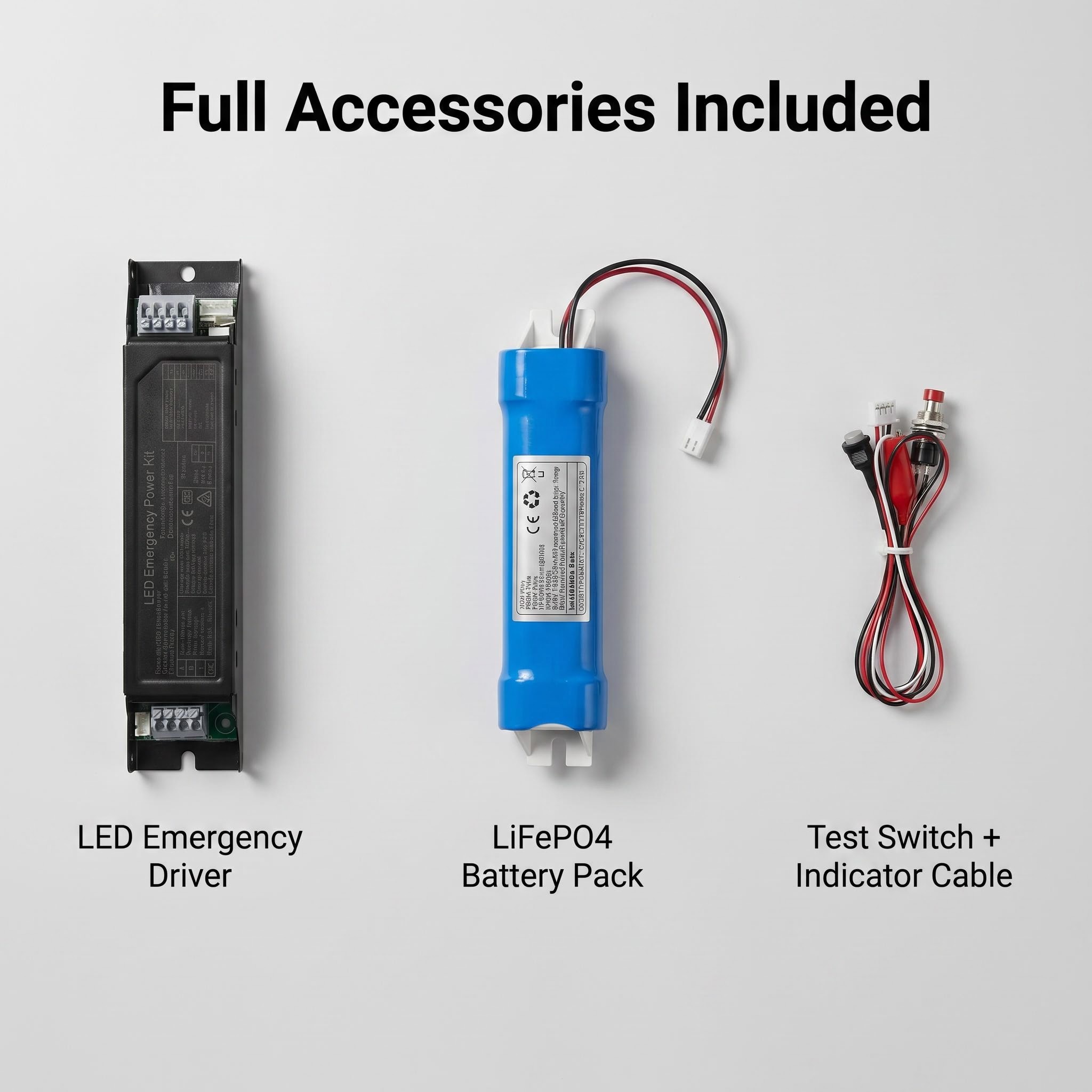
Specifications and How to Read Them
| Parameter | Entry Level | Mid Range | High Specification |
|---|---|---|---|
| Tension d'entrée | AC 85-265V 50/60Hz | AC 100-277V 50/60Hz | AC 220-240V 50Hz or AC 120-277V 60Hz |
| Driven Load (Normal) | 10-25W | 15-40W | 20-60W |
| DC Output Voltage Window | 18-36V | 25-50V | 30-60V |
| DC Output Current | 150-300mA | 200-400mA | 250-500mA |
| Sortie d'urgence | 3W (12-15% of normal) | 5W (15-20% of normal) | 8W (15-25% of normal) |
| Durée de la situation d'urgence | 90 minutes | 120 minutes | 180 minutes |
| Battery Chemistry | NiCd 3.6V 1500mAh | Li-ion 18650 3.7V 2600mAh | LiFePO4 3.2V 3000mAh |
| Charge Time | 24 hours | 16 hours | 12 hours |
| Cycle Life | 300-500 cycles | 500-800 cycles | 1500-2000 cycles |
| Test Facility | Manual test key | Self-test per EN 62034 | Self-test + DALI-2 |
| Wiring Mode | Non entretenu | Maintained or non-maintained | Maintained or non-maintained |
| Indice de protection IP | IP20 | IP30 | IP65 |
| IK Rating | IK02 | IK04 | IK07 |
| Ambient Temperature | 0°C to +35°C | -10°C to +45°C | -20°C to +50°C |
| Dimensions (L×W×H) | 120×35×22mm | 160×42×28mm | 200×50×35mm |
| Mounting | Plastic clip | Metal bracket + screws | Metal bracket + anti-vibration |
How to Read an LED Emergency Driver Datasheet
Input Voltage Range and Frequency
This line tells you where the driver will survive. AC 85-265V 50/60Hz means it accepts anything from Japanese 100V to UK 240V without a tap change. A narrower AC 220-240V 50Hz unit costs less but dies in a 110V market. Check that the frequency matches: 50Hz-only units in 60Hz countries run the battery charger hot.
Driven Load in Watts
This is the normal-mode LED load the driver can switch and supply, not the emergency output. A 40W rated driver feeding a 50W panel will overheat the changeover relay and likely fail within months. The emergency output is always lower, typically 10-25% of normal, because the battery cannot store enough energy to replicate full luminaire output for 90-180 minutes.
DC Output Voltage Window and Current
The driver must match the LED module’s forward voltage. A panel with 48V LED string needs a driver output window covering 40-55V DC. The current figure, in mA, determines how hard the LEDs run in emergency. Constant-current output is mandatory for stable light output as battery voltage sags during discharge. Ask for the current regulation curve across the full voltage window.
Emergency Output in Lumens and Percentage of Normal
EN 1838 requires minimum illuminance on escape routes, not a specific percentage. A 4000lm panel dropping to 600lm in emergency (15%) may comply in a wide corridor but fail in a narrow stairwell. The datasheet should state both the raw lumen figure and the percentage so you can check against your lux calculations. Self-test drivers per EN 62034 must verify this output automatically.
Durée de la situation d'urgence
90 minutes is the baseline for most markets. BS 5266-1 and EN 60598-2-22 accept 90 minutes for standard premises. Three-hour duration (180 minutes) is common for healthcare, assembly buildings, and high-risk areas. The battery capacity scales almost linearly: a 90-minute Li-ion pack at 2600mAh becomes roughly 5200mAh for 180 minutes at the same wattage. Check whether the duration is guaranteed at end of discharge voltage or only at fresh charge.
Battery Chemistry Voltage and Capacity
NiCd 3.6V packs at 1500-2000mAh are cheapest but carry cadmium content that restricts import in EU and several Asian markets. Li-ion 18650 at 3.7V 2600mAh offers better energy density but needs UN 38.3 test reports for air freight and IMDG documentation for sea freight. LiFePO4 3.2V at 3000mAh gives the longest cycle life, 1500-2000 cycles, and the safest thermal profile, but the lower nominal voltage needs more cells in series for higher-wattage drivers. Verify cell brand: unnamed “Chinese domestic” cells versus BAK, EVE, or Lishen affects cycle life by 30% or more.
Charge Time and Cycle Life
NiCd typically needs 24 hours for full charge, Li-ion 16 hours, LiFePO4 12 hours. Cycle life is quoted at 80% depth of discharge; shallow cycling in maintained mode where the battery rarely drains extends this significantly. Ask for the test method: IEC 62034 Annex B specifies 50 cycles for type testing, but factory ageing should run 200+ cycles on sample basis.
Test Facility
Manual test key is minimum: insert key, switch to emergency, time 90 minutes, check light output. Self-test per EN 62034 automates duration and functional tests on schedule; the driver reports fault via LED indicator or volt-free contact. DALI-2 adds digital reporting to the building management system, with addressed fault logging. DALI drivers cost 40-60% more and need compatible infrastructure.
Maintained or Non-Maintained Wiring
Non-maintained: emergency circuit live only when mains fails. Maintained: emergency LED runs continuously from a switched live, with battery backup on mains failure. Maintained wiring needs an extra switched line to the driver; the datasheet wiring diagram must show terminal allocations clearly. Some drivers accept either mode with DIP switch or wiring change; others are mode-specific.
IP and IK Rating
IP20 suits interior ceiling voids. IP65 with sealed cable glands is needed for car parks, tunnels, and external soffits. IK02 withstands light touch; IK07 (2 joules) survives typical warehouse impact. Higher ratings need metal enclosures and thicker gaskets that add 20-30% to unit cost and dimensions.
Ambient Temperature Range
Battery capacity collapses below 0°C: a Li-ion pack rated 2600mAh at 25°C delivers roughly 1800mAh at -10°C. Drivers for cold stores or exterior Nordic mounting need heaters or LiFePO4 chemistry with wider temperature tolerance. High-temperature derating above 45°C affects charger life; check whether the datasheet specifies output reduction or shortened warranty above threshold.
Dimensions and Mounting
Measure your luminaire cavity. Entry-level plastic clips suit T-bar ceilings. Industrial high-bay drivers need metal brackets with anti-vibration mounts. The battery pack may be separate from the inverter module; confirm cable length between units, typically 150-300mm, and whether extension is permitted.
LED Strip Specifications (Where Emergency Drivers Feed Strip Luminaires)
| Parameter | Typical Value | Notes |
|---|---|---|
| Working Voltage | DC 24V or DC 48V | Match driver output window |
| Power per Metre | 10-20W/m | Higher density increases battery load |
| Lumens per Metre | 1000-2000lm/m | Check at 25°C, not nominal |
| LEDs per Metre | 120-240 | 2835 or 2216 SMD; COB continuous |
| CRI | Ra 80 or Ra 90 | Ra 90 for retail and healthcare |
| Colour Temperature | 3000K, 4000K, 5700K | 4000K most common for emergency |
| Cut Length | 50mm or 100mm | Determines luminaire modularity |
| Reel Length | 5m or 10m | Check continuous run limit |
| Largeur du circuit imprimé | 8mm, 10mm, 12mm | Wider copper for higher current |
| Copper Weight | 2oz or 3oz | 3oz reduces voltage drop on long runs |
| IP Class | IP20, IP65, IP67 | IP67 with gel coat for exterior |
Strip-fed emergency luminaires need the driver output voltage to match the strip cut-length voltage. A 48V strip with 100mm cut length at 24V per cut needs series-parallel wiring consideration. The emergency driver’s DC output window must cover the installed strip voltage after wiring losses.
Supplier Qualification: Factory versus Trading Office
SMT and Assembly Capacity
A real manufacturer owns or directly contracts surface-mount lines for LED driver PCBs. Ask for photos with date stamps, or better, video of reflow ovens running your product. Trading offices source from multiple anonymous factories and cannot guarantee process consistency. Check whether the supplier builds the inverter PCB in-house or buys complete inverter modules from a third party; the latter adds a margin and obscures traceability.
Battery Sourcing and Traceability
Request the cell manufacturer’s name and model number, not “Li-ion battery 3.7V”. A factory with direct cell supplier relationships holds MSDS, UN 38.3 test summaries, and batch certificates for each cell lot. Trading offices often accept whatever battery the anonymous factory installs this month. Ask for cell arrival inspection records: voltage, internal resistance, and dimensional checks on sample basis.
Discharge and Duration Test Records
Every production batch should have discharge test records against EN 60598-2-22 Annex A or equivalent. The record shows initial battery voltage, load voltage at 30/60/90 minutes, and light output at end of duration. A factory running 100% discharge testing on sample basis (typically 5-10% AQL) keeps these records for years. A trading office has nothing.
Ageing and Hipot Test Stations
Ageing runs the assembled driver at 40°C ambient for 4-8 hours under load before final test. Hipot (dielectric withstand) at 1500V AC or 3000V AC checks isolation between mains and output. Ask for station photos and daily calibration stickers on hipot equipment. Missing or expired calibration means the test is theatre.
Third Party Test Reports for Destination Market
Do not accept “CE certificate” as a document; CE is self-declared. Ask for the test report from a notified body or accredited lab showing EN 60598-2-22 and EN 61347-2-7 testing for the specific model. For UK, UKCA marking needs UK-issued or UK-recognised test evidence. For UL 924, the report must cover the exact battery and LED load combination you intend. AS/NZS 2293 needs Australian or New Zealand accreditation. A trading office forwards whatever the factory once obtained for a different product; verify model numbers match character for character.
Sample Lead Time
A factory with in-house SMT and battery assembly delivers samples in 7-14 days. Longer suggests outsourcing or queueing behind other customers. Complex DALI variants or custom enclosures may stretch to 21 days. Trading offices often quote 3-5 days because they ship existing stock, but that stock may not match your final specification.
Payment Structure
Factories typically want 30% T/T deposit, 70% against copy of B/L for first orders, shifting to 30/70 or open account after relationship establishment. Trading offices sometimes offer more flexible terms because they carry less fixed cost; this is a warning sign, not a benefit. Letters of credit (L/C at sight) add $200-400 bank charges and 3-5 days to documentation; factories resist L/C for orders under $10,000. A factory that insists on 100% advance for samples is not unusual; one that demands 100% advance for production is.
After-Sales Engineering Capability
Ask who answers technical questions after shipment. A factory engineer can explain why a driver flickers with a specific LED module and suggest capacitor or resistor changes. A trading office forwards your email to the factory and waits. Test this before ordering: send a wiring diagram with a genuine technical question and measure response time and depth.
Trade Terms and Export Practicalities
FOB, CIF, CFR, EXW
EXW (Ex Works) means you arrange everything from factory gate; cheapest base price, maximum logistics burden. FOB (Free On Board) puts the supplier responsible until goods cross the ship’s rail at named port; you pay ocean freight and insurance. CFR (Cost and Freight) adds freight to your port but risk transfers at origin; you still insure. CIF (Cost Insurance Freight) adds insurance to CFR. For LED emergency drivers, FOB Shenzhen or FOB Ningbo is standard; CIF adds roughly $0.30-0.50 per unit for sea freight to European base ports. Air freight multiplies this by 8-12 times.
T/T and L/C
T/T (telegraphic transfer) is wire transfer, 30/70 most common. L/C at sight is bank-guaranteed payment against compliant documents; costs $200-500 and adds 5-10 days. Some Middle East and African buyers require L/C by local regulation; confirm factory acceptance before quoting.
HS Code
LED emergency drivers typically fall under 8504.40 (static converters) or 8539.31 (parts of lighting equipment). Correct classification affects duty rate: 0-4% in EU under 8504.40, potentially higher if misclassified as battery. The supplier should state the code they use; verify against your customs broker.
CE and UKCA Marking
CE marking on the driver label indicates self-declaration to the Low Voltage Directive (2014/35/EU) and EMC Directive (2014/30/EU). The supplier must hold technical construction file and test evidence. UKCA replaces CE for Great Britain (England, Scotland, Wales); Northern Ireland accepts CE under Windsor Framework. A driver with only CE cannot legally enter Great Britain post-Brexit. Ask for UKCA test evidence separately; it may not exist.
UN 38.3 Battery Test Report
Every lithium battery shipment needs UN 38.3 testing: altitude simulation, thermal cycling, vibration, shock, external short circuit, crush, overcharge, forced discharge. The report covers the cell and the completed battery pack. Validity is indefinite for the tested design but must match the actual shipped product. IATA rules for air freight additionally require state-of-charge maximum 30% and specific packaging. Sea freight under IMDG needs proper shipping name “LITHIUM METAL BATTERIES” or “LITHIUM ION BATTERIES” on the dangerous goods declaration. A supplier without UN 38.3 documentation stops at customs.
Packing List and Certificate of Origin
The packing list states carton dimensions, gross/net weight, and item count. A 200×50×35mm driver in individual box packs 50 units per carton of 380×280×220mm, approximately 12kg gross. Certificate of origin (CO) from China Council for Promotion of International Trade (CCPIT) or customs may be required for preferential tariff under trade agreements; confirm with your broker whether FORM A, FORM E, or standard CO applies to your destination.
MOQ and Lead Time
Standard emergency drivers run 500-1000 units MOQ for factory-direct pricing. Below MOQ, expect 15-25% price premium or refusal. Lead time from confirmed order: 15-25 days for standard models, 30-45 days for DALI or custom output windows. LiFePO4 battery availability can extend this if cell supply is tight. Sample policy: 1-5 units at 1.5-2× production unit price, often non-refundable against first order.
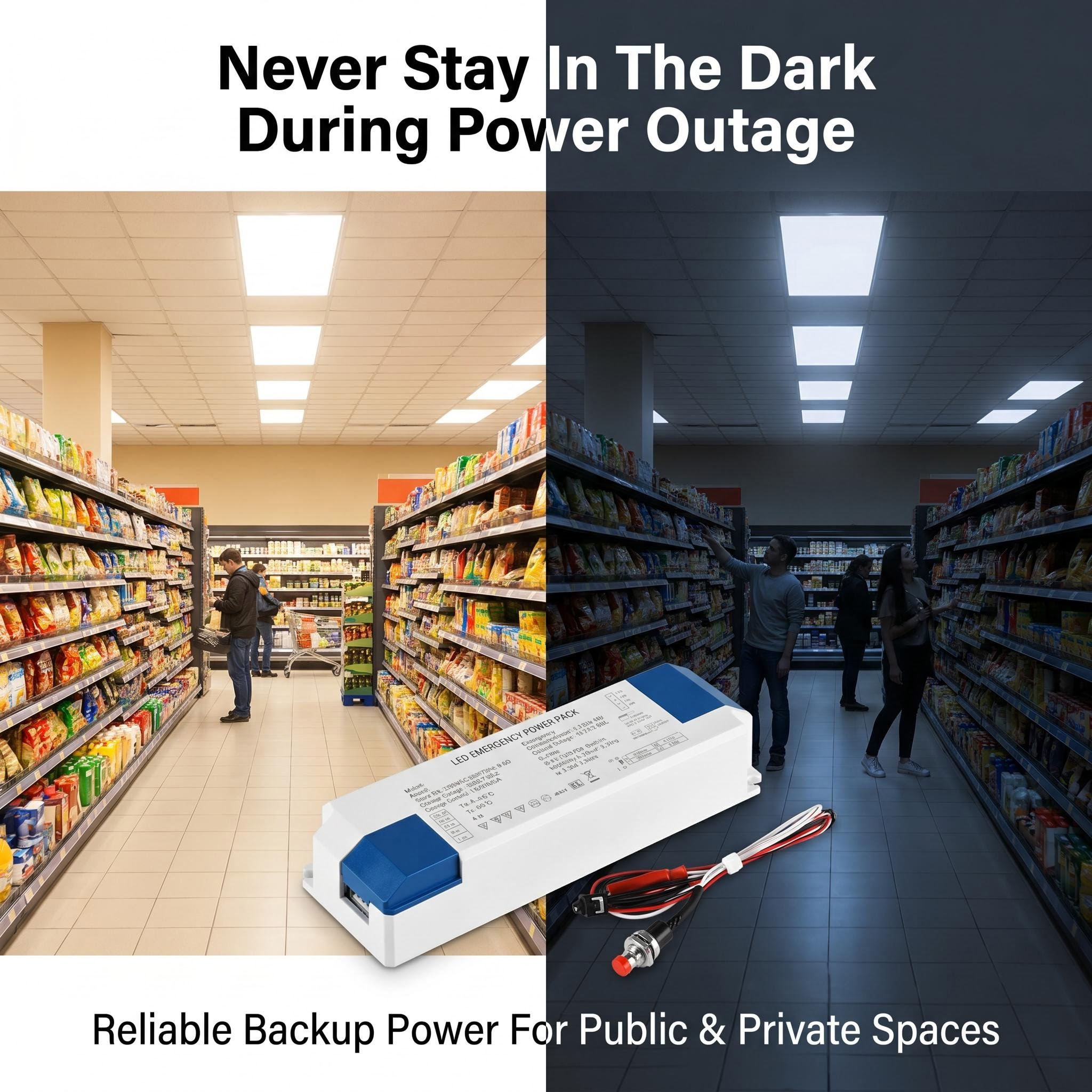
LED Emergency Driver Price and What Drives It
| Class | Typical Rating or Output | Duration or Runtime | Indicative FOB USD |
|---|---|---|---|
| Economy 3-5W | 3W emergency, ~25-35% of normal LED load | 90 minutes | $4.50 – $7.00 |
| Standard 5-10W | 5W emergency, ~50% of normal LED load | 90 minutes | $7.50 – $12.00 |
| Standard 10-15W | 10W emergency, ~50% of normal LED load | 90 minutes to 2 hours | $12.00 – $18.00 |
| Full Power 15-25W | 15-25W emergency, 100% normal output | 90 minutes to 3 hours | $18.00 – $28.00 |
| Full Power 25-40W | 25-40W emergency, 100% normal output | 2 to 3 hours | $28.00 – $45.00 |
| DALI Self-Test Integrated | 10-25W, programmable test intervals | 90 minutes to 3 hours | $32.00 – $55.00 |
Prices assume single-unit sample quantities at 500-1000 piece MOQ. Lithium-based packs carry a 15-25% premium over NiCd equivalents in the same wattage class. Full-power output (100% of normal luminaire lumen package) requires larger cell capacity and higher-rated inverter components.
Battery Cells and Pack Assembly
The battery pack is typically the largest single cost component in any LED emergency driver, often representing 30-45% of ex-factory material cost. Buyers should verify cell origin and traceability:
- LiFePO4 3.2V cells: 1500mAh to 5000mAh per cell, configured in series for 6.4V or 9.6V packs. Cycle life 800-1500 cycles. Safer chemistry, wider temperature tolerance (-20°C to +60°C), but 20-30% heavier and larger than Li-ion for equivalent energy density. UN 38.3 test report required for air freight; IMDG Code Section 3.3 applies for sea freight in limited quantities.
- Li-ion 18650 3.7V cells: 2000mAh to 3500mAh, higher energy density, lighter weight. Cycle life 500-800 cycles. Stricter transport restrictions: many airlines require Class 9 dangerous goods declaration, cargo-only aircraft routing, and 30% state-of-charge limit.
- NiCd 1.2V cells: 600mAh to 2500mAh, lower upfront cost, robust to deep discharge, but memory effect, cadmium content, and shorter cycle life (300-500 cycles) make them increasingly restricted under EU Battery Directive and RoHS exemptions.
A 10W emergency driver running 90 minutes at 6.4V requires roughly 2800-3200mAh effective capacity after accounting for inverter efficiency (typically 82-88%) and end-of-life degradation (80% residual capacity per EN 60598-2-22). A supplier quoting significantly below this either undersizes the cell or rates duration at fresh-cell condition rather than aged condition.
Driver and Inverter Electronics
The constant-current inverter stage, changeover relay, and charging circuit constitute 20-30% of material cost. Key variables:
- Output window: 9-42V DC at 150-700mA for panel and linear applications; 18-60V DC at 100-500mA for high-bay drivers. Wider voltage range requires larger inductors and higher-voltage MOSFETs.
- Changeover relay: Mechanical relay adds $0.80-$1.50 but ensures galvanic isolation; solid-state switching is cheaper but may fail closed, preventing emergency activation.
- Input voltage range: 85-265V universal covers global markets; 220-240V only for UK/Europe reduces component cost 8-12% but limits re-export flexibility.
Enclosure Hardware and Thermal Design
Metal enclosures with IP20 rating for internal luminaire mounting cost $1.50-$3.00; IP65 rated polycarbonate or die-cast housings for external battery pack mounting add $4.00-$7.00. Thermal interface material and potting compound for vibration resistance (IK07-IK08) add further cost.
Test and Certification Cost Amortisation
Third-party testing to EN 60598-2-22, EN 1838, EN 62034 or UL 924 typically costs $8,000-$25,000 per product family depending on test house and scope. For a 1000-piece production batch, this amortises at $8-$25 per unit. A supplier without current test reports either absorbs this cost across larger volumes or ships untested designs. Buyers should request:
- Test report number and issuing laboratory accreditation (ILAC-MRA signatory)
- Photometric data showing emergency output in lumens and percentage of normal output at rated duration
- Temperature test records at Ta max (typically +25°C or +35°C ambient per EN 60598-2-22)
Assembly Labour and Export Overhead
SMT placement, through-hole assembly, functional test, and ageing burn-in represent 8-15% of factory cost. In-house SMT capacity indicates vertical integration; reliance on outsourced PCBA suggests longer lead times and less traceability.
Freight and Regulatory Charges
Lithium battery restrictions dominate logistics cost. Sea freight FOB Shenzhen to UK/Europe runs $800-$1,500 per cubic metre for general cargo; lithium-classified goods may incur $200-$400 additional handling fee per shipment. Air freight for lithium cells typically 3-5x general cargo rate and requires MSDS, UN 38.3 summary, and 1.2m drop test documentation.
Destination costs: UK import duty 2.7% on emergency lighting equipment, 20% VAT; EU duty 2.7%, VAT 19-27% depending on member state; Middle East 5% duty plus 5% VAT in GCC states.
Why the Cheapest Quote Differs
A quote 30-40% below the indicative bands above normally reflects one or more of these trade-offs:
- Undersized cell: 18650 2000mAh rated at 90 minutes when the actual constant-current draw requires 2800mAh; emergency duration fails at 60-70 minutes under EN 1838 test conditions
- Reduced emergency output: 10% or 25% of normal lumen package instead of 50% or 100%; meets minimum escape route illumination (1 lux) but leaves insufficient task lighting for safe egress in high-bay or industrial applications
- Untested or partial test report: Single sample passed preliminary review but no formal third-party witness testing; customs clearance risk and liability exposure for the installer
- NiCd substitution in lithium-specified design: Charger circuit optimised for Li-ion voltage curve will undercharge or overcharge NiCd, accelerating failure
Five-Year Running Cost Comparison
| Cost Element | Economy 5W 90min (NiCd) | Standard 10W 2hr (Li-ion) | Full Power 25W 3hr (LiFePO4) |
|---|---|---|---|
| Initial FOB unit cost | $6.00 | $14.00 | $35.00 |
| Battery replacement cycle | Every 2.5 years | Every 4 years | Every 5-6 years |
| Battery replacement cost (fitted) | $4.50 × 2 = $9.00 | $8.00 × 1 = $8.00 | $18.00 × 0 = $0.00 |
| Annual test labour (manual key or self-test) | 15 min × £45/hr × 5 yr = £56 | 5 min automated × £45/hr × 5 yr = £19 | DALI automated, 2 min × £45/hr × 5 yr = £8 |
| Expected failure rate | 12% over 5 yr | 6% over 5 yr | 3% over 5 yr |
| Replacement unit cost (failures) | $6.00 × 0.12 = $0.72 | $14.00 × 0.06 = $0.84 | $35.00 × 0.03 = $1.05 |
| Approximate 5-year total per unit | $15.72 + £56 | $22.84 + £19 | $36.05 + £8 |
The economy option shows lowest first cost but highest lifecycle cost due to shorter NiCd cycle life and labour-intensive manual testing. Full-power LiFePO4 with DALI self-test recovers initial premium through extended battery longevity and automated compliance reporting to BS 5266-1 maintenance schedules.
Supplier Qualification Checklist
| Verification Item | What to Request | Red Flag |
|---|---|---|
| SMT and assembly capacity | Factory video, ISO 9001 scope, equipment list (pick-and-place, reflow, AOI) | Refusal to show production floor; all PCBA “from partner factory” |
| Battery traceability | Cell manufacturer certificate, batch codes, UN 38.3 test summary for exact cell model | Generic MSDS without cell part number; no UN 38.3 |
| Discharge test records | 90-minute or 3-hour load test at Ta max, with voltage and lumen output logged | Single-point test only; no temperature stress data |
| Ageing and hipot stations | Photos of burn-in racks, hipot test voltage (typically 1500V AC or 2U+1000V), duration | No hipot capability; no 100% functional test |
| Third-party reports | Report number, test house, scope covering exact model and destination standard | “CE by self-certification” only; report for different product family |
| Sample lead time | 7-15 days for tooled product; 25-40 days for custom specification | Immediate shipment from stock for non-standard specification |
| Payment structure | 30% TT deposit, 70% before shipment for new customers; LC available at volume | 100% advance for samples; no inspection clause |
| After-sales engineering | Schematic review for your luminaire, wiring diagram for maintained/non-maintained, DALI integration support | No technical contact; only sales communicator |
A real manufacturer maintains discharge test jigs for every wattage and duration combination they advertise. Ask for the specific test record for the configuration you intend to order: 10W at 2 hours on LiFePO4 9.6V 4000mAh, for example, with ambient temperature held at +25°C and output verified at 50% and 100% of rated duration. Trading offices cannot produce this documentation without forwarding the request, introducing delay and information loss.
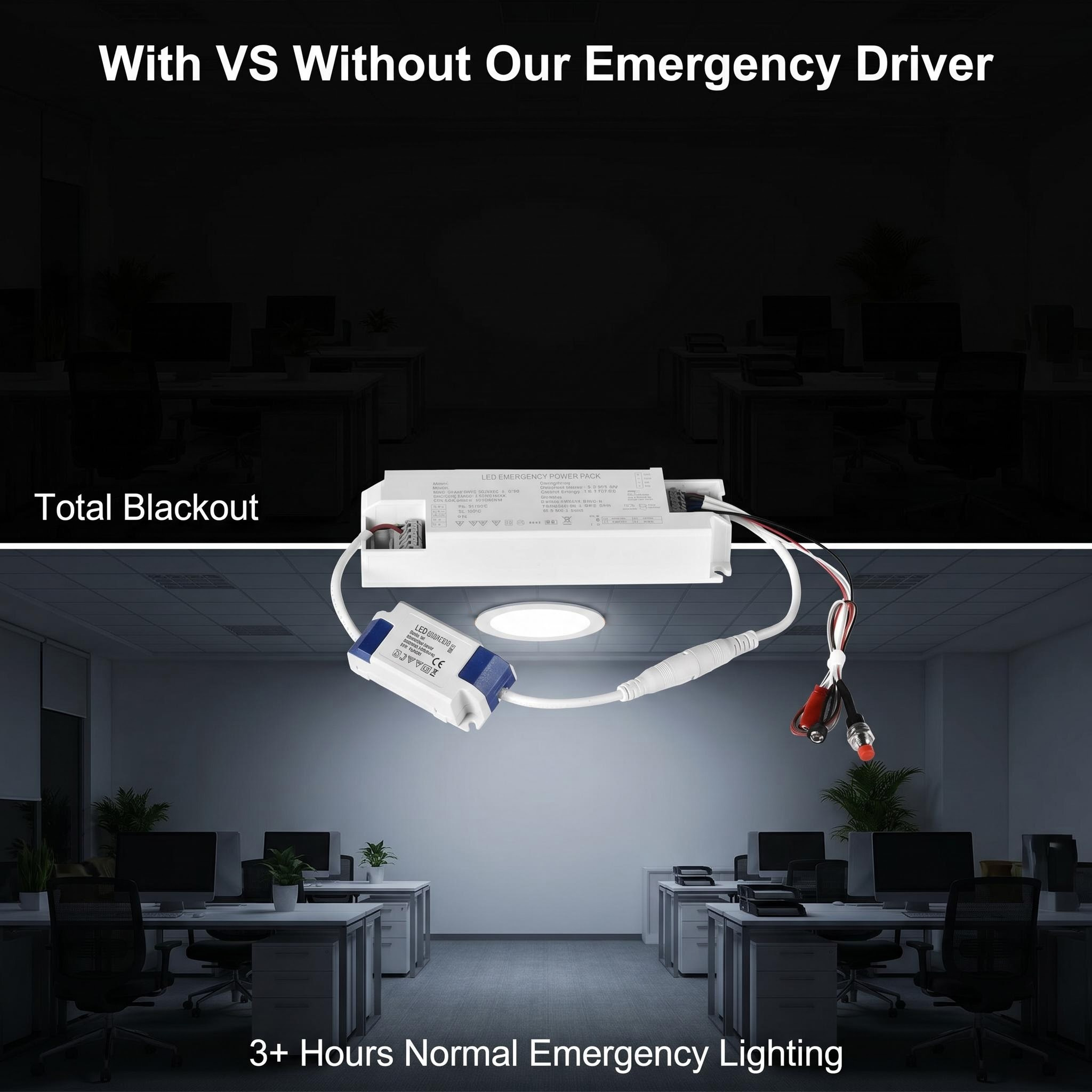
Industry Applications for LED Emergency Driver
| Sector | Typical Installation | Recommended Specification | Why This Product Fits |
|---|---|---|---|
| Commercial Offices and Fit-Outs | Recessed LED panels in suspended ceilings, linear pendants over open-plan floors | 3W–10W emergency output, 90 min duration, maintained or non-maintained wiring, self-test or DALI per EN 62034 | High lumen-per-watt panels need matched emergency drivers; DALI integration suits Building Management Systems |
| Hospitals and Clinics | LED panels in corridors, treatment rooms, operating theatres | 10W–18W full-power emergency output, 3 hr duration, LiFePO4 3.2V 3000–6000mAh, IP44 minimum | Life-safety critical; BS 5266-1 and HTM 06-01 require sustained illumination for evacuation of non-ambulant patients |
| Warehouses and Logistics Centres | LED high bays at 8–14m mounting height, linear aisle lighting | 20W–40W emergency output, 2–3 hr duration, NiCd or LiFePO4 7.2V–14.4V packs, wide AC 100–277V input | High-lumen normal output demands proportionally high emergency lumens; wide voltage range covers 120V and 230V markets |
| Car Parks and Stairwells | Surface-mounted bulkheads, linear batten luminaires, wall-mounted twin spots | 5W–10W output, 90 min–2 hr duration, IP65–IP66, IK08–IK10, Li-ion 18650 7.4V 2200–4400mAh | EN 60598-2-22 requires ingress protection for damp, dusty environments; vandal resistance reduces maintenance |
| Retail and Shopping Malls | LED downlights in ceilings, linear cove strips in display alcoves | 5W–15W emergency, 90 min duration, constant current 250–700mA output window, maintained wiring common | Maintained operation keeps sales floors lit during drills; colour temperature consistency 3000K–4000K protects brand appearance |
| Industrial Plants | LED high bays in process halls, linear weatherproof fittings in packing areas | 15W–50W full-power emergency, 3 hr duration, AC 85–265V or 220–240V, LiFePO4 packs, −20°C to +50°C ambient | Heavy thermal cycling and voltage dips from motor loads; LiFePO4 chemistry tolerates wider temperature than standard Li-ion |
Commercial Offices and Fit-Outs
Open-plan offices typically run 600x600mm LED panels at 30W–40W normal load, producing 3000–4000lm. The emergency driver must deliver at least 10% of normal output—often 300–500lm—to satisfy EN 1838 escape-route lighting levels at floor level. A 3W–5W emergency driver with constant current output 250–350mA at DC 9–36V covers most 30x120cm and 60x60cm panels. Battery chemistry is usually Li-ion 18650 3.7V 2600mAh in 2S1P or 2S2P configuration, giving 90 minutes at 5W with reserve capacity for ageing. Self-test functionality per EN 62034 is standard specification in UK and EU tenders because manual test keys interrupt working hours and create compliance-record gaps. Charge time to 80% after full discharge is typically 16–24 hours. The buyer should request discharge duration test records for the exact LED panel model being paired, not generic driver data, because lumen maintenance varies with LED forward voltage bin.
Hospitals and Clinics
Healthcare procurement officers normally specify 3-hour emergency duration under BS 5266-1 and HTM 06-01, not the 90-minute default. Operating theatres and critical care corridors need full-power maintained lighting—meaning the emergency driver must switch seamlessly without perceptible drop when mains fails. This demands a changeover relay rated for the full LED load, not a simple bypass, and a battery pack sized for 100% output for 180 minutes. LiFePO4 3.2V cells in 4S or 8S configuration at 3000–6000mAh are increasingly preferred over NiCd for their cycle life (500–800 cycles to 80% capacity) and absence of cadmium disposal restrictions. Input voltage range should include 230V ±10% for UK/EU sites and 120V for North American equipment. The supplier must provide hipot and ageing test records for each batch; ask for 100% burn-in at 40°C ambient for minimum 2 hours.
Warehouses and Logistics Centres
High-bay LED fixtures at 100–200W normal load require emergency drivers that can deliver 20W–40W to maintain usable aisle lighting at 10–15 metre mounting heights. The output window is typically DC 25–55V at 700–1050mA constant current. Battery packs scale to 14.4V–25.6V LiFePO4 or NiCd, with capacities 4000–10000mAh depending on duration target. Wide input AC 100–277V is essential because logistics chains often source luminaires globally but install in 120V or 230V territories without redesign. IP54 minimum protects against dust and condensation in unheated sheds; specify IP65 if pressure-washing occurs. The buyer should verify that the supplier’s discharge test records include the actual LED module at 25°C and at 45°C, since lumen depreciation and driver efficiency both shift with temperature.
Car Parks and Stairwells
These environments demand physical durability and environmental sealing above raw output. EN 60598-2-22 requires emergency luminaires in external car parks to survive water jets and mechanical impact; specify IP66 and IK08 as baseline, IK10 where vandalism is recurrent. Emergency output is modest—5W–10W from a bulkhead or 1200mm linear batten is sufficient for 1 lux minimum on the escape route per EN 1838—but the battery must tolerate stagnant air and temperature swings. Li-ion 18650 7.4V 2200mAh packs in 2S1P give 90 minutes at 8W; for 2-hour duration specify 2S2P at 4400mAh. Charge time extends to 20–24 hours for larger packs. Non-maintained wiring is standard in intermittently occupied stairwells; maintained is preferred where CCTV or access control requires continuous illumination. Ask the supplier for salt-mist or cyclic damp-heat test reports if coastal or underground installations are intended.
Retail and Shopping Malls
Retail fit-outs prioritise aesthetic consistency: an emergency driver that forces a 6000K cool-white output into a 3000K warm-white shop interior creates brand-damaging mismatch. Specify constant-current drivers with output windows that match the original LED module voltage-current curve, preserving CCT and CRI. Maintained operation is typical because malls run lighting during all trading hours and drills must not alarm customers. A 10W–15W emergency driver feeding linear LED strips at 24V DC nominal, with output 200–400mA, covers most cove and display applications. Battery chemistry trends toward LiFePO4 6.4V 3000mAh for its flat discharge curve, keeping LED output stable through the 90-minute duration. DALI self-test per EN 62034 is worth the premium in multi-tenant centres where facilities managers need centralised fault reporting across dozens of luminaire types.
Industrial Plants
Process industries impose the harshest electrical environment: voltage sags from motor starting, harmonic distortion from VFDs, and wide ambient temperature swings between night and day shifts. Emergency drivers for these sites need robust input filtering, AC 85–265V or dedicated 220–240V ±15% tolerance, and operating temperature ranges of −20°C to +50°C at minimum. LiFePO4 chemistry outperforms standard Li-ion 18650 below 0°C, retaining 70–80% rated capacity at −10°C versus 50% or less for cobalt-based cells. Full-power emergency output for 3 hours is common specification to cover complete plant evacuation and hazmat response; this demands 15W–50W drivers with battery packs of 12.8V–25.6V and 6000–12000mAh. The buyer should request third-party test reports for IEC 61347-2-7 (emergency lighting DC supplies) and evidence of 100% functional test including simulated mains failure at rated load and temperature.
Ordering and Importing Step by Step
The three mistakes that most often leave a delivered batch of LED emergency drivers unusable are:
Mistake 1: Ordering an output window that does not match the host fixture’s LED module voltage and current draw. Fix: Record the fixture’s forward voltage (Vf) range and rated drive current before contacting any supplier.
Mistake 2: Accepting a duration or emergency illuminance level below what the local code requires. Fix: Confirm whether the project needs 90 minutes, 2 hours, or 3 hours at the required percentage of normal output—10% for escape routes under EN 1838, or specific lux levels under BS 5266-1 or UL 924.
Mistake 3: Missing lithium battery or conformity documentation at customs. Fix: Require UN 38.3 test summaries, MSDS/SDS, and the correct CE, UKCA, or SASO test report references before the deposit payment.
Step 1 Record Host Fixture Parameters
The emergency driver is a slave to the host luminaire. Before any specification is sent to a supplier, document:
| Parameter | What to Record | Typical Range for Hymark-Compatible Fixtures |
|---|---|---|
| Fixture type | LED panel, LED tube, linear batten, LED high bay | — |
| Normal driver wattage | W | 9W to 60W |
| LED module forward voltage (Vf) | V DC | 18V–42V, 36V–80V, or 180V–260V depending on series-parallel architecture |
| LED drive current | mA | 150mA, 200mA, 300mA, 350mA, 500mA, 700mA |
| Normal driver architecture | Constant current (CC) or constant voltage (CV) | CC for most LED panels and high bays; CV for some LED strips |
| Physical space available | mm (L × W × H) | Emergency driver housings range from 120×36×22mm for 3W kits to 200×60×30mm for 15W kits |
| Battery compartment space | mm | LiFePO4 packs need roughly 20% more volume than Li-ion 18650 for equivalent watt-hour capacity |
A real manufacturer can cross-reference this data against their inverter output windows. A trading office forwards the same PDF to three subcontractors. Ask directly: “What is your in-house SMT line capacity for emergency inverter boards, and what output windows do you stock?” Hymark’s assembly lines in Shenzhen run surface-mount for constant-current inverter stages from 9V–24V/150mA up to 60V–80V/700mA, with changeover relays rated for 100,000 operations.
Step 2 Confirm Duration and Emergency Output Level
| Market Standard | Minimum Duration | Emergency Output Requirement | Typical Battery Configuration |
|---|---|---|---|
| EN 60598-2-22 / EN 1838 | 90 minutes | ≥10% of normal luminous flux, or ≥1 lux on centre line of escape route | LiFePO4 3.2V 3000mAh per 4W–5W emergency output; 6.4V 3000mAh for 8W–10W |
| BS 5266-1 (UK) | 1 to 3 hours depending on building risk | Same illuminance targets, with 3 hours for sleeping accommodation | LiFePO4 9.6V 3000mAh or Li-ion 18650 7.4V 2600mAh for longer durations |
| UL 924 (North America) | 90 minutes | Path of egress 1.0 foot-candle average, 0.1 fc minimum | NiCd 4.8V 1200mAh to 9.6V 2500mAh for legacy compatibility; LiFePO4 increasingly accepted |
| AS/NZS 2293 | 90 minutes (Class E) or 240 minutes (Class W) | 0.2 lux minimum on floor for escape routes | LiFePO4 preferred for cycle life in high-temperature ceiling cavities |
Trade-off: NiCd 4.8V 1200mAh costs roughly 40% less than LiFePO4 3.2V 3000mAh but delivers only 300–400 cycles versus 500–800 cycles, and requires replacement every 3–4 years in maintained operation. Li-ion 18650 7.4V 2600mAh sits in the middle on cost, with 500–700 cycles, but carries stricter shipping restrictions.
Ask the supplier: “For a 3-hour duration at 5W emergency output, what is the nominal and end-of-discharge battery voltage, and what discharge test record can you provide for the batch?”
Step 3 Choose Maintained or Non-Maintained Wiring
| Mode | Wiring | Application | Impact on Driver Specification |
|---|---|---|---|
| Non entretenu | Emergency driver fed by switched live; charges only when mains present; switches to battery on failure | Emergency-only luminaires, exit signs | Standard 3-wire (L, N, switched L) input |
| Mis à jour | Emergency driver fed by permanent live; LED module runs from inverter continuously or via changeover relay | Areas requiring normal and emergency function from same fitting | Requires 4-wire (L, N, switched L, permanent L) or integrated changeover relay with separate switched live output |
Hymark’s maintained-capable drivers include a changeover relay that disconnects the normal driver output and connects the inverter output within 0.5 seconds of mains failure. Verify the relay contact rating matches the LED module inrush current.
Step 4 Decide Test Facility Type
| Type | Function | Wiring Complexity | Cost Impact per Unit |
|---|---|---|---|
| Manual test key | User initiates 30-second or full-duration test via external switch | Two additional wires to test switch | Lowest |
| Self-test (EN 62034) | Automatic monthly 30-second and annual full-duration test; status LED | None additional | +15–25% |
| DALI emergency (EN 62386-202) | Addressable test scheduling, fault reporting, central monitoring | DALI bus wiring, compatible control gear | +40–60% |
Self-test drivers require a functional indicator LED visible in the luminaire lens or remote indicator. Confirm the LED colour code: green for healthy, red for fault, yellow for charging.
Step 5 Confirm Mains Voltage and Frequency
| Region | Nominal Voltage | Tolerance | Frequency | Typical Hymark Input Range |
|---|---|---|---|---|
| UK / EU | 230V AC | ±10% | 50Hz | AC 85–265V 50/60Hz |
| Middle East (GCC) | 230V AC | ±6% | 50Hz or 60Hz | AC 85–265V 50/60Hz |
| Southeast Asia | 220V–240V AC | ±10% | 50Hz | AC 85–265V 50/60Hz |
| Africa (most) | 220V–240V AC | ±10% | 50Hz | AC 85–265V 50/60Hz |
| Latin America | 127V or 220V AC | ±10% | 60Hz | AC 85–265V 50/60Hz for universal; AC 100–277V for North American projects |
A driver rated only AC 220–240V will fail or shut down on 127V nominal circuits in Mexico or Brazil. Verify the supplier’s input range on the nameplate, not just the datasheet summary.
Step 6 Confirm Conformity Mark and Test Report
| Market | Required Mark | What the Standard Requires | What to Request from Supplier |
|---|---|---|---|
| EU / EEA | CE (ENEC acceptable) | EN 60598-2-22 for luminaire safety, EN 61347 for control gear, EN 62034 for self-test | Third-party test report with test lab accreditation (ISO 17025); DoC referencing the correct EN numbers |
| UK | UKCA | Same standards as CE, post-Brexit | UK-approved body test report or valid EU-type examination with UKCA transition documentation |
| Saudi Arabia | SASO / SFDA for batteries | SASO 2927 for lighting; IEC 62133 for Li-ion/LiFePO4 cells | SASO certificate of conformity; battery UN 38.3 summary |
| UAE | ECAS / EQM | Same family of EN/IEC standards | ECAS registration for the product category |
| Australia / NZ | RCM (AS/NZS 2293) | AS/NZS 2293.1 for design, AS/NZS 2293.3 for emergency luminaires | RCM declaration; electrical safety certificate from recognised certifier |
| USA / Canada | UL 924 / cUL | UL 924 for emergency lighting and power equipment | UL file number or ETL listing with controlled report |
Critical point: A factory that cannot show you a test report with the product model number, test lab logo, and standard-specific test clauses is assembling uncertified goods. Ask for the report reference before the purchase order.
Step 7 Check IP Rating and Ambient Temperature for Mounting Position
| Mounting Position | Typical Requirement | Hymark Standard Range | Extended Option |
|---|---|---|---|
| Recessed ceiling panel | IP20 | IP20 | — |
| Surface-mounted industrial | IP54 | IP54 with sealed cable glands | — |
| Outdoor canopy or tunnel | IP65 | IP65 with silicone gasket | IP66 |
| High-temperature industrial ceiling (foundries, kitchens) | Ta 45°C | Ta 0°C to +45°C | Ta 0°C to +55°C with derated battery capacity |
| Cold storage | Ta -20°C | Ta 0°C to +45°C | Ta -20°C to +45°C with LiFePO4 (better low-temperature performance than Li-ion 18650) |
LiFePO4 retains roughly 70% of rated capacity at -20°C; Li-ion 18650 drops to 50–60%. NiCd performs better at low temperature but carries toxicity and memory-effect penalties.
IK rating for impact resistance: IK07 (2 joules) for general commercial, IK08 (5 joules) for industrial corridors, IK10 (20 joules) for vandal-resistant applications.
Step 8 Agree MOQ Sample Approval and Mass Production Timeline
| Item | Typical Terms | Notes |
|---|---|---|
| Sample lead time | 7–10 working days for standard models; 15–20 days for custom output window or DALI firmware | Real manufacturers hold blank PCB stock and program in-house; traders add 5–7 days for subcontractor coordination |
| Sample cost | 1.5× to 2× unit price; refundable against first mass order above MOQ | Negotiate refundability in writing |
| MOQ | 500–1000 units for standard models; 2000–3000 for custom PCB or firmware | Lower MOQ possible at +15–20% price premium |
| Mass production lead time | 25–35 days after sample approval and deposit | LiFePO4 cell availability can extend this by 10–15 days during Q4 |
| Payment structure | 30% deposit, 70% against copy of B/L; or 30/70 with inspection release | Avoid 100% advance for first order |
Request the sample from the same production line intended for mass production. Some factories hand-build samples with premium cells, then switch to lower-tier cells at volume.
Step 9 Require Batch Duration Test Records
Every emergency driver batch should carry discharge verification. Ask for:
- 100% functional test: Charging circuit operation, transfer to emergency mode, indicator LED function
- AQL sampling for duration: Typically ISO 2859-1 General Inspection Level II, single sampling plan, AQL 1.0 or 2.5 for critical defects
- Test record content: Date, batch number, ambient temperature, load simulated (watts and Vf), discharge duration to battery cut-off voltage, inverter output stability (voltage regulation within ±10%)
Hymark’s ageing stations run 2-hour duration tests at 25°C ambient on AQL-sampled units from each production lot, with records retained for 5 years.
Step 10 Arrange Lithium Battery Shipping Documents and Freight Mode
| Battery Chemistry | UN Number | Packing Instruction | Sea Freight (IMDG) | Air Freight (IATA) | Courier (DHL/FedEx) |
|---|---|---|---|---|---|
| LiFePO4 (standalone, ≤100Wh) | UN 3480 | PI 965 Section IB | Acceptable; limited quantity provisions may apply | Acceptable; 30% state of charge; max 2 batteries per package for Section IB | Acceptable; shipper declaration required |
| LiFePO4 (installed in equipment, ≤100Wh) | UN 3481 | PI 966 | Standard freight | Standard freight with equipment | Standard freight with equipment |
| Li-ion 18650 (installed) | UN 3481 | PI 966 | Standard freight | Standard freight | Standard freight |
Required documents for every lithium battery shipment:
- UN 38.3 test summary (cell and pack level)
- Material Safety Data Sheet (MSDS) or SDS
- Shipper’s Declaration for Dangerous Goods (air freight)
- Lithium battery handling label (Class 9 miscellaneous dangerous goods)
- Cargo Aircraft Only label if applicable
Freight mode decision:
- Sea freight (FOB Shenzhen/CIF destination): Mandatory for orders above 500kg gross weight; 25–35 days to Europe, 14–21 days to Middle East, 30–40 days to Africa and Latin America. Most cost-effective for LiFePO4 bulk shipments.
- Air freight: Viable for samples and urgent replacements under 100kg; lithium restrictions add 2–3 days to booking time.
- Courier: Door-to-door for samples under 30kg; automatic dangerous goods surcharge of USD 60–120 per shipment.
Step 11 Confirm Carton and Pallet Packing and Labelling
| Caractéristiques techniques | Standard Practice | Custom Option |
|---|---|---|
| Inner carton | Corrugated 5-layer, 20 units per carton with individual anti-static bag | 10-unit carton for heavy drivers (15W+) |
| Carton dimensions | 450×320×280mm typical for 20-unit pack | Adjusted to pallet optimisation |
| Gross weight per carton | 12–18kg | — |
| Pallet configuration | 20 cartons per EU pallet (1200×800mm), 400 units total; 24 cartons per Asia pallet (1100×1100mm) | Heat-treated ISPM-15 pallet for EU, UK, Australia |
| Pallet height | Maximum 1.6m for container loading | 1.8m if top-loading not required |
| Container loading | 20GP: 10 pallets; 40HQ: 22 pallets | — |
| Marking per carton | Model number, quantity, date code, battery chemistry warning, UN 3481/UN 3480 label if applicable | Barcode (EAN-128 or QR) with batch traceability |
Request carton photos before shipment release. Verify that battery packs are separated from metal components with insulating foam or cardboard dividers.
Step 12 Plan Commissioning and First Annual Test
The supplier’s responsibility ends at functioning product. Site compliance depends on correct commissioning:
| Task | Timing | Responsible Party | Documentation |
|---|---|---|---|
| Verify correct luminaire operation in normal mode | Day of installation | Electrical contractor | As-built drawings |
| Record emergency mode activation and duration | Day of installation | Electrical contractor | Commissioning certificate per BS 5266-1 or local equivalent |
| Verify self-test or DALI addressing | Day of installation | Commissioning engineer | DALI scan report or self-test LED confirmation |
| First annual full-duration test | 12 months after commissioning | Facility manager | Logbook entry; replace any unit failing to meet rated duration |
| Battery replacement | Per manufacturer cycle life or when duration falls below 80% of rated | Facility manager | Date-coded battery label for traceability |
Hymark drivers with LiFePO4 3.2V 3000mAh packs indicate end-of-life through reduced duration in self-test; the status LED transitions from green to red when discharge falls below 70% of rated duration, giving 6–12 months’ warning before mandatory replacement.
A supplier that cannot walk through all twelve steps with specific numbers—output window in V and mA, battery cell model and cycle life, test report reference number, and UN 38.3 summary—is not manufacturing. They are brokering. For a life-safety component, that distinction is not negotiable.
Related Hymark Products
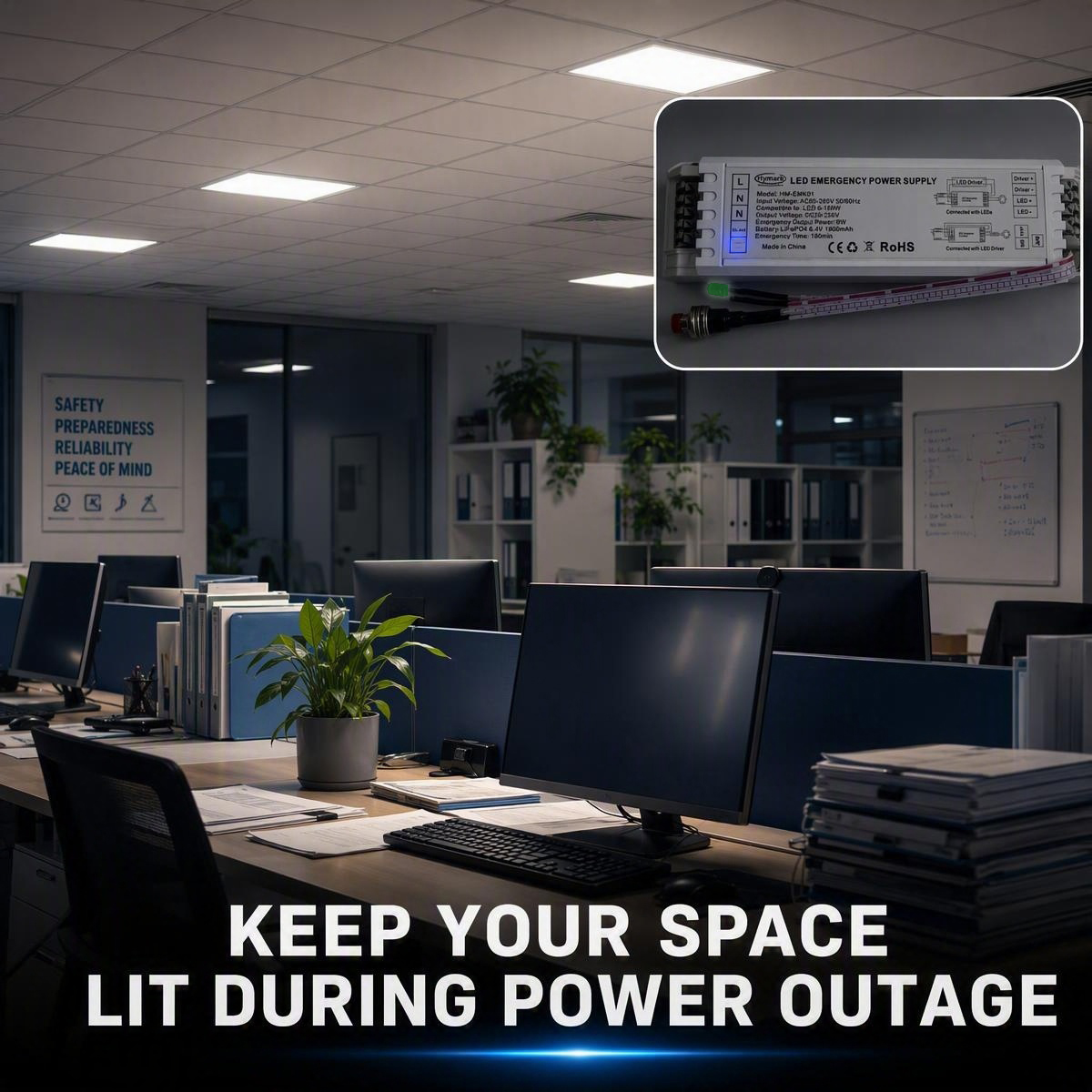
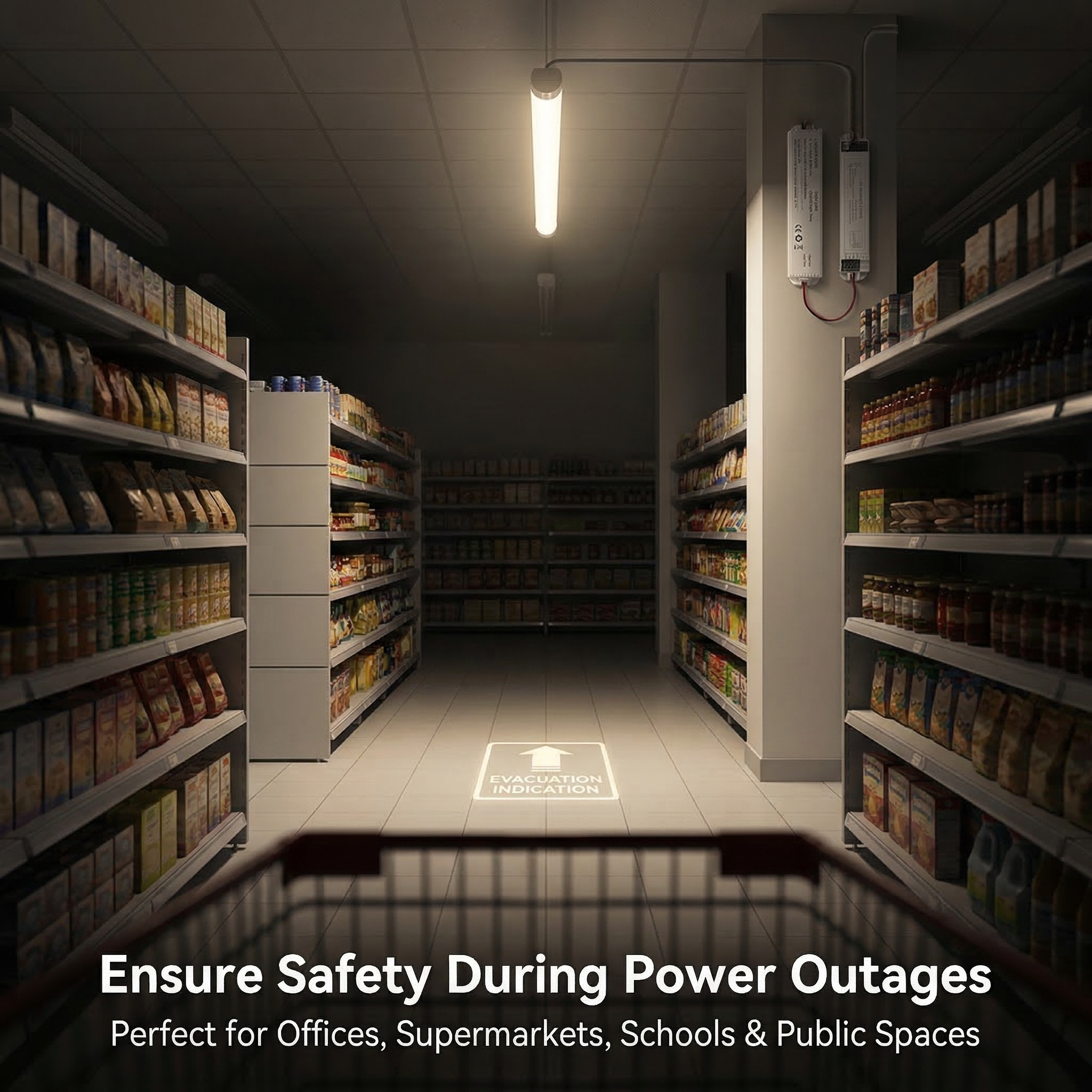
LED Emergency Driver For LED Panel Lights
Emergency drivers sized for 600×600 and 1200×300 LED panels with external drivers.
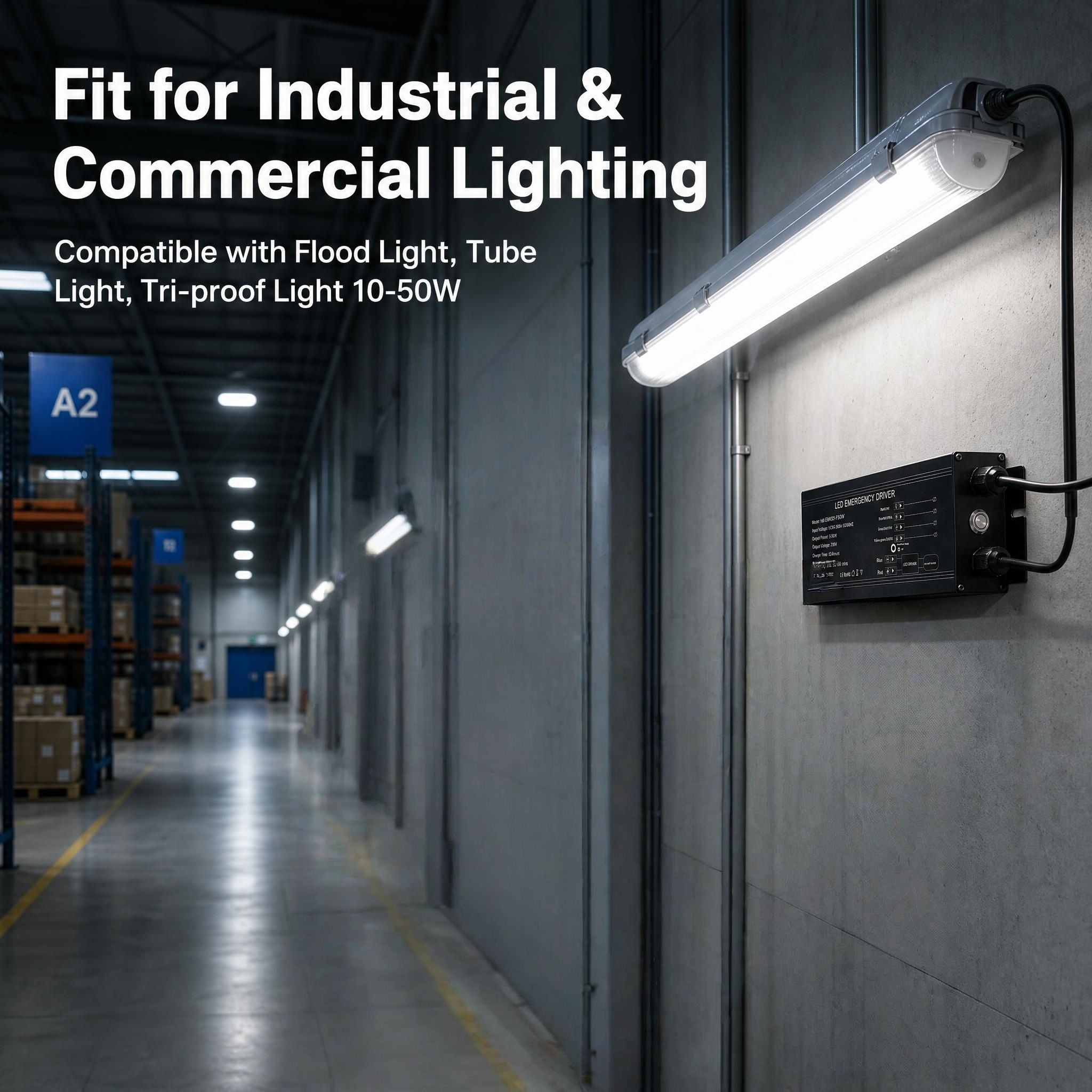
LED Emergency Driver For LED Tubes
Emergency conversion kits for T8 and T5 LED tubes and batten fittings.
LED Emergency Driver For Linear Lights
Slim emergency drivers that fit inside linear and trunking profiles without a separate battery box.
Frequently Asked Questions About LED Emergency Driver
Minimum Order Quantity and Price Drivers
Q: What is the minimum order quantity and what drives unit price?
MOQ is 500 units for standard emergency drivers, 1,000 for OEM-branded product. Price steps cluster at 1,000 and 5,000 units. The main cost drivers are battery chemistry—LiFePO4 adds 15-20% over Li-ion 18650—and output duration: 90-minute packs use 3.2V 1500mAh cells where 3-hour packs need 3.2V 3000mAh or parallel strings. Self-test circuitry and DALI modules add $1.50-$3.00. EN 60598-2-22 compliant housings with IP20 versus IP65 rating shift cost 8-12%. Volume pricing stabilises at full container load.
Confirming Product Suitability for Host Fixtures
Q: How do I confirm your emergency driver suits my existing LED panel tube or linear fixture?
Match three parameters: input voltage range must cover your fixture’s driver output—typically AC 85-265V or 100-277V for wide-range models. Emergency output window in DC volts and mA must sit within your LED module’s forward voltage and current envelope; Hymark drivers cover 50-200V DC at 150-350mA for 10-40W panels, and 100-240V DC at 100-200mA for tubes. Driven load in watts should leave 20% headroom. Request the discharge curve at 25°C ambient to verify lumen maintenance over the full duration.
Emergency Duration and Output Options
Q: What emergency durations and output percentages are available?
Standard durations are 90 minutes, 2 hours and 3 hours per EN 1838 and BS 5266-1. Output levels are 3W, 5W, 8W or 10W depending on battery configuration, translating to roughly 10-50% of normal fixture output. A 40W panel emergency driver at 5W output yields approximately 300-400 lumens, or 25% of normal. Full power output emergency drivers maintain 100% output for 90 minutes using larger LiFePO4 packs, typically 6.4V 6000mAh. Charge time from flat is 16-24 hours.
Maintained Versus Non-Mained Wiring and Self-Test Options
Q: Do you supply maintained and non-maintained versions, and what test facilities are built in?
Both wiring modes are available. Non-maintained uses a switched live to the changeover relay; maintained adds a permanent live so emergency LEDs operate during normal mains. Self-test models per EN 62034 run automatic duration and function tests at 30-day intervals with annual full discharge, reporting via LED status. DALI-2 test facility models integrate with building management systems for remote monitoring. Manual test key versions suit small installations without bus wiring. Specify which protocol your project demands.
Battery Chemistry Replacement Interval and Traceability
Q: What battery chemistry do you use and how often must it be replaced?
Hymark builds with LiFePO4 3.2V 1500-3000mAh, Li-ion 18650 3.7V 2000-2600mAh, or NiCd 3.6V 1200-1800mAh on request. LiFePO4 delivers 500-800 cycles to 80% capacity with calendar life 8-10 years. Li-ion 18650 achieves 300-500 cycles, calendar life 5-7 years. NiCd tolerates wider temperature ranges but requires replacement at 3-4 years. Ask for cell supplier certificates and UN 38.3 test summaries—this proves traceability and transport compliance. Battery packs are field-replaceable via connector, not soldered.
Lead Time Sample Policy and Payment Terms
Q: What is lead time, sample availability and payment structure?
Standard lead time is 25-30 days after order confirmation. Samples ship in 5-7 days from stock; first sample is free, freight collect. Tooling for custom enclosures or silkscreen adds 10-15 days. Payment is 30% deposit, 70% against copy of bill of lading for orders under $50,000. Orders above $50,000 or with repeat customers may negotiate 20% deposit, 80% CAD. Letter of credit accepted at buyer’s cost. OEM packaging samples require 3-day approval cycle before production.
Test Reports Conformity Marks and Destination Market Requirements
Q: Which test reports and conformity marks can you supply for my market?
A qualified manufacturer should provide third-party test reports for the standards your market enforces: EN 60598-2-22, EN 1838 and EN 62034 for UK and EU; BS 5266-1 for Britain specifically; UL 924 for North America; AS/NZS 2293 for Australia and New Zealand; IEC 61347 for driver safety. Ask for CB test certificates as mutual recognition base. Conformity marks—CE, UKCA, RCM, UL listed—must be supported by current reports with the specific model number. Verify report date and scope match your order configuration.
Lithium Battery Shipping Documents and Mode Constraints
Q: How do lithium batteries affect shipping mode and required documents?
LiFePO4 and Li-ion 18650 cells above 100Wh are Class 9 dangerous goods. UN 38.3 test summaries are mandatory for every cell model; MSDS and UN38.3 test report copies must accompany shipment. IATA restricts passenger aircraft to 35kg net lithium content per package; cargo aircraft and sea freight (IMDG Code) allow higher limits. Carton packing is 20 units per inner box, 400 units per pallet with DG labels and 1.2m drop test certification. FOB Shenzhen or CIF destination port. Transit time is 3-5 days air, 25-35 days sea to Europe, 15-20 days to Middle East.
Warranty Spare Parts and After-Sales Engineering
Q: What warranty and spare parts support do you provide?
Standard warranty is 3 years on electronics, 2 years on Li-ion or 5 years on LiFePO4 battery packs. Extended warranty to 5 years total available with MOQ commitment. Spare battery packs and inverter modules are stocked for 7 years after model discontinuation. After-sales engineering provides wiring diagrams for maintained and non-maintained circuits, commissioning checklists per BS 5266-1, and remote troubleshooting via video call. Replacement units ship within 48 hours for warranty claims with fault description and serial number.
OEM Branding Packaging and Installation Support
Q: Can I order OEM branding, custom packaging and installation support?
OEM silkscreen logo and model number on enclosure: MOQ 1,000 units. Custom carton with your branding and multilingual installation sheet: MOQ 2,000 units. Packaging can be neutral for distributor private labelling. Installation support includes dimensioned mounting hole patterns, terminal torque specifications, and cable entry IP rating guidance. Commissioning documents cover initial 24-hour charge cycle, monthly functional test procedure, and annual duration test logging format for compliance records.
Important Notice
Specifications, output and duration figures and price ranges in this guide are indicative and are provided
for planning purposes only. Actual emergency output, duration, battery life, ingress protection and available conformity documentation
differ by model and by destination country, and emergency lighting design remains the responsibility of the project designer. Buyers
must confirm their own mains voltage and frequency, the emergency lighting standard enforced locally, the host fixture compatibility
and their import requirements before placing an order. All figures are subject to written confirmation in the final proforma invoice
issued by Hymark.
Sourcing LED Emergency Driver from Hymark
When you evaluate an emergency battery pack supplier in China, the gap between a trading office and a real manufacturing partner shows up in three places: traceable test data, configurable hardware, and engineering response time. Hymark was built to close that gap.
JIALINGHANG ELECTRONIC CO., LTD. was founded in 2013 as a global LED exporter in general illumination. A strategic shift in 2017 refocused the company on LED emergency technology and high performance LED strips. Hymark launched in 2026 as the premium brand. Products are co-designed and engineered in house through a strategic partnership with dedicated manufacturing facilities that have also been operating since 2013. The company manages R&D, product design and global distribution itself.
What Hymark Supplies
The LED emergency driver range covers LED high bays, panel lights, tubes and linear lights, plus full power output emergency drivers. Technical options include:
| Parameter | Typical Range |
|---|---|
| Normal input voltage | AC 85-265V or 100-277V |
| Emergency output | 3W to 25W DC, constant current inverter at 25-350mA depending on model |
| Emergency light output | 10% to 100% of normal lumen package depending on driver rating |
| Emergency duration | 90 minutes, 2 hours or 3 hours selectable |
| Battery chemistry | LiFePO4 3.2V 1500-6000mAh; Li-ion 18650 3.7V 2000-5200mAh; NiCd 3.6V-4.8V 700-1500mAh |
| Charge time | 24 hours to full capacity |
| Cycle life | LiFePO4 500-800 cycles; Li-ion 300-500 cycles; NiCd 300-400 cycles |
| Test facility | Manual test key, self-test, or DALI interface per model |
| Wiring mode | Maintained or non-maintained selectable |
| Ambient operating range | -10°C to +45°C typical |
| IP rating | IP20 to IP65 depending on enclosure |
What Buyers Should Verify
A supplier claiming EN 60598-2-22, EN 1838, EN 62034, BS 5266-1, UL 924 or AS/NZS 2293 compliance should produce third-party test reports for the destination market, not in-house declarations. Ask for discharge and duration test records from the specific batch, battery cell MSDS and UN 38.3 transport documentation for lithium chemistries, and hipot/ageing station logs. Lead time for samples should be under 10 working days; bulk lead time 25-40 days depending on battery chemistry and order configuration.
How to Move Forward
Send your host fixture type and wattage, the emergency duration your code requires (90 minutes, 2 hours or 3 hours), your mains voltage, and your destination port. Hymark returns a quotation within 24 hours via WhatsApp or email, with selectable emergency duration, maintained or non-maintained wiring, OEM and ODM branding, export carton packing, and FOB or CIF terms.
Get a Factory Direct Quote on LED Emergency Driver
JIALINGHANG ELECTRONIC CO., LTD. has been in LED lighting since 2013 and has focused on
LED emergency technology and high performance LED strips since 2017. Hymark products are co-designed with our
dedicated manufacturing partners, built with selectable emergency duration and maintained or non-maintained wiring, and function
tested before packing. Send us the host fixture type and wattage, the emergency duration your local code requires, your mains
voltage and your destination port and we will return a quotation within 24 hours.


 English
  Spanish
  Arabic
  French
  German
  Russian
  Portuguese
  Italian
  Vietnamese