
Emergency Lighting Buyer Guide
A real iluminación de emergencia fixture manufacturer in China owns the SMT lines, battery pack assembly stations, and ageing ovens that a trading office merely photographs. Buyers should verify in-house or partnered SMT capacity for LED driver PCBs, battery sourcing with cell-level traceability, and discharge test records that match the claimed 90-minute, 2-hour, or 3-hour duration under EN 1838 or UL 924 load conditions.
The right product depends on three variables: the host fixture’s normal wattage and LED forward voltage, the emergency duration mandated by the local code—typically 90 minutes for commercial premises in the UK under BS 5266-1, 90 minutes under NFPA 101 in the US, or 2 hours under AS/NZS 2293—and the third-party test reports or conformity marks the inspector or customs agent expects at destination. EN 60598-2-22 requires emergency output of at least 50 percent of normal output for open areas, with minimum illuminance on the reference plane; EN 62034 governs automatic test systems including self-test and DALI-2 test facility integration. A maintained wiring configuration keeps the emergency luminaire energised during normal operation via a changeover relay; non-maintained wiring switches to battery inverter output only on mains failure. Typical inverter output windows run DC 12-80V at 150-700mA constant current, driving 3W to 25W LED loads from LiFePO4 3.2V 1500-6000mAh packs or Li-ion 18650 3.7V 2000-3500mAh packs, with charge times of 12-24 hours and cycle lives of 500-1500 cycles depending on chemistry depth of discharge.
This page covers supplier qualification: the factory evidence, test infrastructure, documentation, and after-sales engineering that separate a manufacturer from a middleman.
In-House or Partnered SMT and Assembly Capacity
Verify that the supplier runs surface-mount lines for LED driver PCBs or holds a contracted partnership with traceable lot numbers. Ask for the reflow oven temperature profile records and AOI (automated optical inspection) defect rates. A trading office will deflect to “our factory” without naming the partner or showing capacity utilisation figures. Request video walkthrough or live video call with timestamped factory signage.
Battery Sourcing and Traceability
Cell origin determines cycle life and transport compliance. LiFePO4 prismatic cells from tier-one suppliers typically deliver 2000 cycles at 80 percent depth of discharge; Li-ion 18650 cylindrical cells from unbranded sources may fall below 500 cycles. Demand the cell supplier name, batch codes, and UN 38.3 test summaries for lithium chemistries. IATA and IMDG rules require lithium battery shipments to carry the UN 38.3 test report number on the dangerous goods declaration; verify the supplier has this prepared before order confirmation, not after production.
Discharge and Duration Test Records
EN 1838 requires the emergency output to sustain the rated duration after a 24-hour preconditioning charge. A real manufacturer keeps discharge curves for each battery pack SKU: voltage versus time at the rated constant current load, ambient temperature 20-25°C, with end-of-discharge defined at the inverter cut-off threshold. Ask for three consecutive test records from the same production week. Hipot test stations should show 1500VAC or 2U+1000VAC per IEC 61347 dielectric withstand on each driver batch.
Ageing and Environmental Test Infrastructure
LED emergency drivers require 4-8 hour burn-in at 40°C ambient minimum; battery packs need 48-hour formation cycling before assembly. Verify the supplier owns thermal chambers covering -10°C to +50°C operating range, the span required for IP65-rated emergency bulkheads in Middle Eastern installations or Southeast Asian car parks. IK08 or IK09 impact test records matter for twin spot housings and exit sign enclosures in industrial applications.
Third Party Test Reports for Destination Markets
Do not accept “CE available” as certification. Request the accredited test laboratory name, report number, and date for the specific standard: EN 60598-2-22 for EU and UKCA-marked products post-Brexit, UL 924 for North American projects, AS/NZS 2293 for Australia and New Zealand. Cross-check the report scope covers the exact model number and battery configuration you intend to order. A manufacturer with genuine reports provides these within 24 hours; a trading office delays or offers a different model’s certificate.
Sample Lead Time and Payment Structure
Functional samples with correct battery chemistry and output window should ship within 5-10 working days from confirmed specification. Payment terms of 30 percent deposit, 70 percent against copy of bill of lading remain standard for first orders; letter of credit at sight is acceptable for orders above USD 50,000. Be wary of suppliers demanding 100 percent advance for samples—this indicates cash flow stress or intermediary markup recovery.
After-Sales Engineering Capability
Emergency lighting failures in service often trace to inverter-to-LED load mismatch or battery degradation below the minimum voltage threshold. A manufacturer employs application engineers who can read your host fixture’s LED module spec sheet—forward voltage bin, total wattage, driver output topology—and recommend the correct emergency driver output window, whether DC 25-45V at 300mA for a 10W LED panel or DC 50-80V at 150mA for a 12W linear system. Verify the supplier provides wiring diagrams for maintained versus non-maintained configurations and responds to technical queries within one business day across time zones.
Export Practicalities and Price Drivers
FOB Shenzhen pricing for basic emergency exit signs with NiCd 3.6V 1200mAh packs runs USD 8-14 per piece at MOQ 500 units; self-test emergency drivers for LED high bays with LiFePO4 12.8V 3000mAh packs range USD 35-55 at MOQ 200 units. Price drivers include battery chemistry tier, self-test or DALI test facility integration, IP65 versus IP20 enclosure rating, and whether the inverter delivers full power output or reduced emergency wattage. Lead time for production lots is typically 25-35 days after deposit; lithium battery shipments add 3-5 days for dangerous goods documentation. Carton packing is 10-20 units per master carton, palletised for sea freight; air freight for lithium batteries requires UN 4G fibreboard boxes with the 9A label and Class 9 hazard label.
Types and Configurations of Emergency Lighting
| Type or Class | Typical Rating or Output | Duration or Runtime | Best Suited For | Notes |
|---|---|---|---|---|
| Reduced-Power Emergency LED Driver (10–30% normal output) | 3W–15W emergency, 100–500 lm | 90 min or 180 min | LED panels, linear fixtures, downlights in offices and retail | Inverter delivers constant current at 25–80V DC, 150–350 mA; requires separate emergency driver module; EN 1838 minimum 1 lux at floor level achievable at 10% output for typical ceiling heights |
| Full-Power Emergency LED Driver (100% normal output) | Match fixture normal wattage, 1000–5000 lm | 90 min, 120 min or 180 min | Open-plan offices, warehouses, sports halls, high-risk task areas | LiFePO4 6.4V 4000mAh to 12.8V 6000mAh packs common; battery capacity scales linearly with load; BS 5266-1 and EN 1838 require maintained illuminance at full normal level |
| Maintained Emergency Luminaire with Changeover Relay | Normal: full fixture output; Emergency: 10–100% via relay switching | 90 min or 180 min | Corridors, stairwells, cinemas, anywhere occupants must evacuate through familiar routes | Relay switches live neutral to inverter output; permanent live plus switched live wiring required; EN 60598-2-22 clause 22.6 covers changeover function; self-test per EN 62034 standard |
| Non-Maintained Standalone Emergency Unit | 100–400 lm from dedicated emergency lamp head | 90 min or 180 min | Storage areas, plant rooms, infrequently occupied spaces | Single switched or unswitched live feed; no normal mode illumination; cheapest install but fails if battery depleted at time of mains failure |
| Self-Test and DALI-Addressable Emergency Driver | 10–100% of normal output, programmable | 90 min to 180 min, programmable test intervals | Smart buildings, BMS-integrated projects, facilities with large distributed emergency networks | EN 62034 defines automatic test cycle; DALI Type 0 or Type 1 commands trigger duration test and report status; adds 15–25% to driver cost versus manual test key version |
| Emergency Twin Spotlight (LED) | 2 × 3W heads, 600–800 lm total | 90 min or 180 min | Warehouses, loading bays, bulk retail, external canopies | NiCd 3.6V 1200mAh or Li-ion 18650 7.4V 2200mAh typical; IP65 common, IK08 or IK09 for impact; adjustable heads permit beam alignment to exit routes; non-maintained wiring only |
Reduced-Power Emergency LED Drivers
These modules convert battery DC to a regulated current at roughly 10–30% of the fixture’s normal lumen output. A 36W LED panel might drop to 4W emergency, producing 400–500 lm instead of 3,600 lm. The inverter output window is typically 25–80V DC at 150–350 mA, though some narrow-voltage LED arrays need tighter 20–40V bands. Electrical contractors buy these when retrofitting emergency function into existing LED luminaires without replacing the whole fitting. The limitation is strict: EN 1838 spacing calculations must be redone. A corridor that worked at full power may need additional emergency points at reduced output. Battery packs are usually LiFePO4 3.2V 3000mAh or 6.4V 2200mAh, giving 500–800 cycles versus 300–400 for NiCd equivalents. Charge time to 90% capacity is 16–24 hours. Buyers should ask for discharge duration test records at the actual driven load, not at a lower reference load.
Full-Power Emergency LED Drivers
Full-power emergency drivers force the LED module to normal brightness during mains failure, drawing proportionally larger battery current. A 40W LED high bay needs a 12.8V 6000mAh LiFePO4 pack or multiple 18650 Li-ion cells in 4S2P configuration to sustain 180 minutes. The constant-current inverter must match the LED module’s exact voltage-current curve; 50–150V DC at 350–700 mA is typical for high-bay arrays. Luminaire OEMs and M&E consultants specify these for high-risk task areas under BS 5266-1 where normal illuminance must be maintained. The trade-off is battery volume, weight and cost: a 180-minute full-power pack for 50W can exceed 2 kg and occupy 200 × 80 × 60 mm inside the fixture. Thermal management becomes critical; LiFePO4 tolerates 0°C to 60°C ambient better than Li-ion, but sustained discharge above 45°C degrades cycle life below rated 800 cycles.
Maintained Emergency Luminaires with Changeover Relay
Maintained units illuminate normally via mains and switch to inverter output via an internal relay when mains fails. The wiring demands three conductors at the fitting: permanent live, switched live and neutral. Facilities managers and lighting designers specify these for occupied routes where darkness at any time is unacceptable. The changeover relay itself is a wear item; EN 60598-2-22 requires it to survive 5,000 operations minimum. Self-test versions per EN 62034 cycle the relay monthly and flag contact welding or coil failure. What this configuration cannot do is simplify wiring: the permanent live must remain energised even when the switched live is off, or the battery will not charge. Installers sometimes wire these as non-maintained by error, defeating the purpose and breaching compliance.
Non-Maintained Standalone Emergency Units
These units contain their own lamp heads, battery and inverter, activating only on mains failure. They are the lowest-cost entry point for basic life safety compliance. A typical bulkhead or exit sign variant runs 3W–5W from a 3.6V NiCd 1200mAh or 3.2V LiFePO4 1500mAh cell, yielding 100–250 lm for 90 minutes. Electrical contractors in Southeast Asia and Africa favour these for price-sensitive projects: unit ex-factory pricing can run 30–50% below maintained equivalents. The limitation is absolute. If the battery has aged below capacity or the fitting was installed where occupants need working light during normal hours, the non-maintained unit provides nothing until emergency mode triggers. EN 1838 still applies to spacing and minimum 1 lux levels, but the design must assume zero contribution from the emergency unit during normal operation.
Self-Test and DALI-Addressable Emergency Drivers
These drivers embed a microcontroller that performs automatic functional tests at intervals defined by EN 62034: brief functional tests every 4 weeks, duration tests every 6 or 12 months, with status logging. DALI-compatible variants report battery health, lamp presence and elapsed test time to a central BMS. The hardware cost premium is 15–25% over manual-test equivalents, plus commissioning labour. Lighting designers and M&E consultants for UK and European commercial buildings specify these to reduce manual testing labour and generate compliance logs for fire authority inspection. The output stage is identical to reduced or full-power non-addressable drivers; the difference is intelligence. What they cannot fix is poor original design: a DALI-addressable driver on an undersized battery or misaligned luminaire still fails EN 1838 spacing. Buyers should verify that the supplier’s DALI implementation is tested against IEC 62386-202, not merely the generic DALI bus physical layer.
Focos gemelos de emergencia
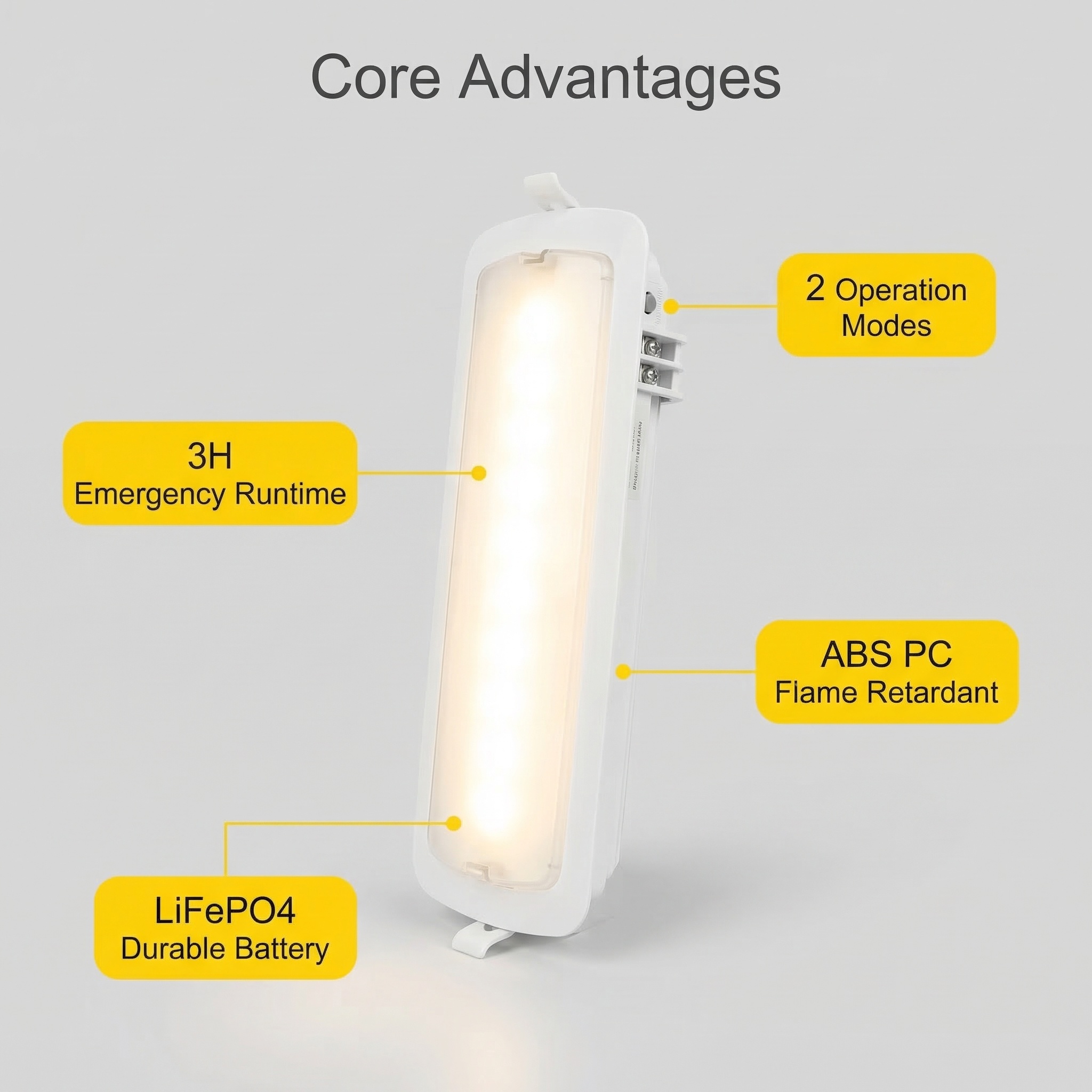
These fittings mount two adjustable LED heads on a central battery housing, directing beams onto exit routes or hazard areas. Each head typically runs 3W from a dedicated optic, producing 300–400 lm per head. NiCd 3.6V 1200mAh packs remain common in budget models; Li-ion 18650 7.4V 2200mAh or LiFePO4 6.4V 2500mAh appear in higher-spec versions offering 180-minute runtime and 500+ cycles. IP65 and IK08 or IK09 ratings suit warehouses and external canopies where impact and moisture are present. The mounting format is surface or pendant; no recessed option exists. Procurement officers for industrial and logistics projects buy these by the pallet for large distribution centres. The constraint is optical control: twin spots create pools of light with hard edges, requiring closer spacing than diffuse panel emergency units to achieve uniform 1 lux minimums. EN 1838 spacing tables for point sources should be consulted rather than linear source assumptions.
Specifications and How to Read Them
| Parameter | Entry Level | Mid Range | High Specification |
|---|---|---|---|
| Normal LED load | 3–10 W | 10–30 W | 30–60 W |
| Salida de emergencia | 180 lm (30 % of normal) | 540 lm (50 % of normal) | 1,200 lm (100 % of normal) |
| Emergency duration | 90 minutes | 120 minutes | 180 minutes |
| Input voltage | AC 220–240 V 50 Hz | AC 85–265 V 50/60 Hz | AC 100–277 V 50/60 Hz |
| DC output window | 9–42 V, 350 mA | 9–60 V, 500 mA | 20–80 V, 700 mA |
| Battery chemistry | NiCd 3.6 V 1,200 mAh | Li-ion 18650 7.4 V 2,600 mAh | LiFePO4 12.8 V 3,000 mAh |
| Charge time | 24 hours | 16 hours | 8 hours |
| Cycle life | 300 cycles | 500 cycles | 1,500–2,000 cycles |
| Test facility | Manual test key | Auto self-test per EN 62034 | Self-test + DALI-2 |
| Wiring mode | Sin mantenimiento | Non-maintained or maintained | Maintained + changeover relay |
| IP / IK rating | IP20 / IK02 | IP65 / IK07 | IP66 / IK08 |
| Ambient temperature | 0 °C to +35 °C | –10 °C to +45 °C | –20 °C to +55 °C |
| Dimensions (mm) | 150 × 45 × 30 | 200 × 60 × 35 | 280 × 80 × 45 |
| Mounting | Surface clip | Recessed bracket + surface | Ceiling + wall + suspended |
| Unit EXW price band | $4.50–$7.00 | $12.00–$22.00 | $35.00–$65.00 |
How to Read the Datasheet Line by Line
Input voltage range and frequency. The entry-level build above accepts only AC 220–240 V at 50 Hz, which covers the UK, Europe, and most of Southeast Asia but excludes Japan (100 V), North America (120 V), and markets with 60 Hz supply. The mid-range and high-spec units at AC 85–265 V or 100–277 V are universal-input designs. Ask for the actual tested range, not just the printed spec; a driver rated 85–265 V should still start at 85 V under full load at –10 °C.
Driven load in watts. This is the normal-mode LED power the emergency module supports, not the module’s own consumption. A 30 W mid-range driver paired with a 40 W LED panel will either fail to light in emergency mode or shut down on overcurrent. The high-specification column shows 30–60 W because that unit uses a constant-current inverter with programmable output, not a fixed resistor drop.
DC output voltage window and current. The inverter steps battery DC up to the LED forward-voltage requirement. A window of 9–42 V at 350 mA means the driver can series-wire LEDs totalling anywhere from roughly 3 to 12 chips (assuming 3 V per chip). If your luminaire uses 24 V COB arrays, the 9–42 V unit works; a 36 V strip needs the 9–60 V or 20–80 V range. Current is fixed: 350 mA, 500 mA, or 700 mA. Match this to the LED datasheet or the normal driver output.
Emergency output in lumens and as a percentage of normal. EN 1838 requires minimum illuminance on the floor, not a fixed lumen number, but buyers need the luminaire figure to calculate spacing. Entry-level units often deliver 30 % of normal output because the inverter and battery are sized for minimum compliance. Mid-range at 50 % gives better uniformity in open-plan offices. High-specification 100 % output means the emergency driver is essentially a second full-power driver; the battery pack is correspondingly larger and more expensive.
Emergency duration. Ninety minutes is the legal minimum in the UK (BS 5266-1), most of Europe, and the Middle East. Two hours appears in some German federal state requirements and in healthcare specifications. Three hours is common for high-occupancy or remote-exit routes in Asia and parts of Africa. The battery capacity scales linearly: a 7.4 V 2,600 mAh Li-ion pack delivers roughly 19 Wh; at 5 W emergency load with inverter losses, that is about 120 minutes.
Battery chemistry voltage and capacity. NiCd 3.6 V 1,200 mAh packs are the cheapest per watt-hour but carry memory-effect risk and cadmium RoHS restrictions in the EU. Li-ion 18650 7.4 V 2,600 mAh (two cells in series) offers better energy density but requires a protection PCB and UN 38.3 test documentation for air freight. LiFePO4 12.8 V 3,000 mAh (four cells in series) is heavier per watt-hour but delivers 1,500–2,000 cycles and tolerates +55 °C ambient without thermal runaway. The voltage must match the inverter design: a 3.6 V NiCd pack cannot drive a 20–80 V output without a boost stage.
Charge time and cycle life. Twenty-four hours for NiCd reflects trickle-charge acceptance; faster charging overheats the cells. The eight-hour LiFePO4 charge time assumes a 0.5 C rate with CC-CV profile. Cycle life is tested to 80 % capacity retention; after 300 NiCd cycles you replace the pack, after 2,000 LiFePO4 cycles you still have 80 % capacity but may want to schedule replacement before it drops below the duration threshold.
Test facility. Manual test key: a button or switch on the module that disconnects mains for a functional check. Self-test per EN 62034: the module runs a 30-second functional test monthly and a full-duration test annually, reporting fault status via LED blink codes. DALI-2: digital addressable interface allowing remote interrogation, scheduled tests, and luminaire-level fault logging. DALI requires a compatible control system; self-test works standalone.
Maintained or non-maintained wiring. Non-maintained: the emergency LED only energises when mains fails. One switched live, one neutral, one earth. Maintained: the emergency LED also serves as normal illumination, fed by a changeover relay that selects mains driver or battery inverter. Maintained wiring needs a permanent unswitched live, a switched live, neutral, and earth—four conductors minimum. Confirm your cable cores before ordering.
IP and IK rating. IP20 is indoor dry location only. IP65 allows jet cleaning in food-processing plants. IP66 is temporary submersion and high-pressure hose-down. IK02 resists 0.2 J impact (finger push). IK07 resists 2 J (0.5 kg dropped 400 mm). IK08 resists 5 J. Warehouse and parking applications need IK07 minimum; IK02 is acceptable above 2.5 m in offices.
Ambient temperature range. Battery chemistry sets the limit. NiCd performs poorly below 0 °C; Li-ion discharges faster but safely at –10 °C; LiFePO4 retains capacity at –20 °C. Above +45 °C, Li-ion cycle life degrades rapidly; LiFePO4 is the only practical choice for boiler rooms or Gulf-region roof voids.
Dimensions and mounting. The entry-level 150 × 45 × 30 mm module fits inside a standard 600 × 600 mm panel light cavity. The high-specification 280 × 80 × 45 mm unit may need an external mounting box or a deep reflector. Check the luminaire OEM’s available void depth before specifying.
LED Strip Emergency Builds
| Parameter | Entry COB Strip | Mid SMD Strip | High COB Strip |
|---|---|---|---|
| Working voltage | DC 24 V | DC 24 V | DC 48 V |
| Power | 10 W/m | 14.4 W/m | 20 W/m |
| Lumens per metre | 800 lm/m | 1,500 lm/m | 2,400 lm/m |
| LEDs per metre | 480 chips/m | 120 LEDs/m (2835) | 480 chips/m |
| CRI | Ra 80 | Ra 90 | Ra 95 |
| Colour temperature | 4,000 K | 3,000 K / 4,000 K / 6,000 K | 2,700 K–6,500 K tunable |
| Cut length | 50 mm | 50 mm | 100 mm |
| Reel length | 5 m | 5 m | 5 m |
| PCB width / copper weight | 8 mm / 2 oz | 10 mm / 3 oz | 12 mm / 4 oz |
| IP class | IP20 | IP65 (gel coating) | IP67 (silicone extrusion) |
Strip emergency drivers for these loads follow the same voltage-window logic: a 24 V strip needs a driver output window reaching 24 V nominal, typically 20–30 V at constant current. The 48 V high-specification strip halves current draw and voltage drop over long runs but needs a driver with 40–60 V output. PCB copper weight matters for thermal management in emergency mode because the inverter may run at lower efficiency than the normal driver; 2 oz copper on an 8 mm board heats noticeably at 10 W/m continuous.
Supplier Qualification: Manufacturer versus Trading Office
SMT and assembly capacity. Ask for photos or video of the SMT line, not the showroom. A real manufacturer runs pick-and-place for LED boards, reflow ovens, and AOI inspection in-house or under long-term contract with a named partner factory. A trading office has none of this; they buy finished modules from three competing workshops and badge them identically. Request the SMT line brand (Yamaha, Juki, Panasonic) and the number of active lines. One line can support roughly $2–3 million annual output; fewer lines than claimed revenue is a warning sign.
Battery sourcing and traceability. The battery is the single most expensive and failure-prone component. A manufacturer should name the cell supplier (EVE, Lishen, BAK, Farasis for LiFePO4; Samsung, LG, Murata for Li-ion 18650) and provide batch codes. Ask for the cell datasheet and the pack assembly drawing. Trading offices often use unbranded cells with rewound labels; these fail UN 38.3 altitude simulation and thermal cycling tests. Traceability means you can link a failed pack in London to a production batch in Shenzhen with date code and cell lot number.
Discharge and duration test records. Every production batch should have 100 % discharge duration testing or at least AQL sampling at a defined level (ISO 2859-1 General I, Level II, AQL 1.0 is common). Ask for a test record showing: battery voltage at start, LED current during discharge, luminous flux at 30 minutes and at end of duration, and whether the unit passed or failed. A manufacturer keeps these for years; a trading office has only the supplier’s word.
Ageing and hipot test stations. Ageing runs the assembled module for 2–4 hours at +45 °C ambient to catch infant mortality in capacitors and solder joints. Hipot (dielectric withstand) tests at 1,500 V AC or 2,000 V DC between mains and output for 60 seconds per EN 61347-1. Ask for the test voltage, duration, and leakage current limit (typically <5 mA). A manufacturer has dedicated racks; a trading office skips this or trusts the sub-supplier.
Third-party test reports for the destination market. The table below shows what buyers should request; the supplier either holds these or does not.
| Market | Required Evidence | Estándar | What to Verify |
|---|---|---|---|
| UK | UKCA technical file or valid CE+UKCA transitional proof | EN 60598-2-22, EN 1838, EN 62034 | Test house accreditation (UKAS or EU notified body) |
| EU | CE DoC, EN test reports | EN 60598-2-22, EN 1838, EN 62034 | Notified body number if Module D involved |
| USA | UL 924 listing or file number | UL 924 | Search UL Online Certifications Directory for file number |
| Australia / NZ | Certificate of Conformity or RCM mark evidence | AS/NZS 2293 | Test report from NATA or equivalent |
| Middle East | SASO, ECAS, or G-Mark depending on country | EN or IEC versions accepted | G-Mark requires Gulf-approved notified body |
Never accept a generic “CE certificate” JPEG; ask for the full test report PDF with product photos, model numbers, and test house letterhead. Verify the test house exists and is accredited for the standard scope.
Sample lead time. A manufacturer with in-house SMT and battery assembly can produce validated samples in 7–10 working days. A trading office quoting 3–5 days is shipping stock they bought speculatively; the sample may not match future bulk production. If the sample lead time exceeds 15 days, the supplier is likely subcontracting the build and has no priority with the factory.
Payment structure. Manufacturers typically ask 30 % T/T deposit, 70 % against copy of B/L for orders under $50,000. Trading offices often demand 50 % deposit or full payment before shipment because they lack credit with their own suppliers. Letter of credit (L/C at sight) is acceptable to established manufacturers for orders above $100,000; trading offices refuse L/C because their upstream supplier will not accept the payment risk. If a supplier insists on 100 % advance payment for a first order, treat this as a red flag.
After-sales engineering capability. Ask a technical question by email: “Can the driver output window be narrowed to 24–28 V for a specific COB array?” A manufacturer answers with a schematic modification or firmware setting within 48 hours. A trading office forwards your question to their supplier and takes a week to paraphrase an unhelpful response. Test this before placing the bulk order, not after receiving defective goods.
Trade Terms and Export Practicalities
FOB (Free On Board). Seller delivers goods to the port of shipment, cleared for export, loaded on vessel. Buyer pays ocean freight, insurance, and destination charges. FOB Shenzhen or FOB Ningbo is standard for Chinese emergency lighting. The seller’s cost stops at the port; from that point, shipping delays and damage are the buyer’s claim against the carrier.
CIF (Cost Insurance Freight). Seller pays freight and marine insurance to the destination port. Insurance is typically Institute Cargo Clauses (C) minimum; ask for (A) coverage if the goods are high value or lithium batteries are involved. CIF does not include unloading, customs clearance, or inland transport at destination.
CFR (Cost and Freight). Same as CIF but without insurance. The buyer arranges marine insurance separately. CFR is rare in lighting because most buyers lack existing cargo policies.
EXW (Ex Works). Buyer collects from the factory gate, arranges all export clearance and transport. EXW saves the seller administration but places the export licence burden on the buyer, which is impractical for most non-Chinese purchasers. Only use EXW if you have a China-based logistics agent.
L/C (Letter of Credit). Bank-guaranteed payment on presentation of compliant documents. Advising bank, negotiating bank, and confirming bank fees add $300–800 per transaction. L/C protects both parties but delays payment 3–5 days for document checking. Manufacturers accept L/C for established relationships; first orders are usually T/T.
T/T (Telegraphic Transfer). Direct bank wire. 30/70 split is industry standard. Never wire to a personal account; the beneficiary must match the company name on the proforma invoice and business licence.
HS code. Emergency lighting with self-contained battery: 9405.10.90 (luminaires). LED emergency drivers sold separately: 8504.40.95 (static converters). Battery packs alone: 8507.60.00 (lithium-ion) or 8507.30.00 (NiCd). Correct classification affects duty rate and whether lithium battery shipping rules apply.
CE and UKCA marking. CE requires a Declaration of Conformity, technical file, and test evidence held by the manufacturer or EU authorised representative. UKCA replaced CE for the GB market from 1 January 2023; Northern Ireland retains CE under the Windsor Framework. A Chinese manufacturer cannot self-declare UKCA without a UK-based responsible person. Ask who holds the technical file and whether the UKCA marking is supported by UKAS-accepted test evidence.
UN 38.3 battery test report. Mandatory for lithium battery air transport (IATA DGR) and sea transport (IMDG Code). The report covers eight tests: altitude simulation, thermal test, vibration, shock, external short circuit, impact/crush, overcharge, and forced discharge. Each battery model and capacity needs its own report. Ask for the UN 38.3 test summary with battery model, watt-hour rating, test laboratory name, and date. Without this, cargo airlines and forwarders will refuse the shipment.
Packing list and certificate of origin. The packing list must match the commercial invoice: quantity, net weight, gross weight, carton dimensions, and HS code per line. Certificate of origin (Form A, CO, or RCEP certificate depending on trade agreement) reduces import duty in some markets. Emergency lighting from China to ASEAN countries under RCEP may qualify for preferential rates with a valid RCEP certificate of origin.
Lead Time and Minimum Order
Entry-level emergency bulk production runs 25–30 days after deposit for 500–1,000 units. Mid-range with Li-ion battery and self-test: 35–40 days because the battery pack requires separate UN 38.3 cell certification and incoming inspection. High-specification with DALI and LiFePO4: 45–55 days, including firmware validation and burn-in.
MOQ is typically 500 units per model for factory-direct pricing. Below MOQ, the unit price rises 15–25 % because SMT line changeover and battery pack assembly are not amortised. Sample policy: one to three units at 1.5×–2× the bulk unit price, refundable against first bulk order. Custom housing or label: add 7–10 days and $300–500 for tooling or silkscreen film.
Price Drivers Summary
| Cost Component | Entry Level % | Mid Range % | High Spec % |
|---|---|---|---|
| LED board and driver | 25 % | 30 % | 35 % |
| Battery pack | 30 % | 35 % | 30 % |
| Housing and optics | 20 % | 15 % | 15 % |
| Assembly and test labour | 15 % | 12 % | 12 % |
| Certification amortisation | 5 % | 5 % | 5 % |
| Margin and overhead | 5 % | 3 % | 3 % |
Battery cost dominates at all levels. A $2.50 NiCd pack versus a $12.00 LiFePO4 pack explains most of the unit price gap between entry and high specification. The mid-range Li-ion 18650 pack sits at roughly $6.50–$8.00 in volume. If a supplier quotes mid-range features at entry-level prices, verify the battery cell brand and the actual capacity tested at 0.2 C discharge to rated endpoint voltage.

Emergency Lighting Price and What Drives It
| Class | Typical Rating or Output | Duration or Runtime | Indicative FOB USD |
|---|---|---|---|
| Basic bulkhead emergency luminaire | 200–300 lm emergency output, ~10% of normal | 90 min | 8.50–14.00 |
| LED exit sign, single-sided | 50–100 lm, EN 1838 viewing distance 20–30 m | 90 min | 6.00–11.00 |
| LED exit sign, double-sided with pictogram kit | 80–120 lm, EN 1838 viewing distance 30–40 m | 90 min | 12.00–19.00 |
| Twin-spot emergency spotlight | 2 × 3W LED heads, 400–600 lm total | 90 min | 18.00–28.00 |
| Weatherproof bulkhead (IP65) | 300–500 lm, polycarbonate diffuser | 90 min | 22.00–35.00 |
| Maintained recessed downlight with emergency module | 500–800 lm, 100% maintained / 10–20% switched | 90 min | 35.00–55.00 |
| High-bay emergency driver kit | 50–100W normal load, 10–20W emergency output | 90 min | 45.00–75.00 |
| Full-power emergency driver (100% output) | 20–60W maintained, LiFePO4 pack | 90 min to 3 hr | 85.00–140.00 |
| DALI self-test emergency system | As above plus EN 62034 automatic test | 90 min to 3 hr | 110.00–180.00 |
These bands assume factory-direct FOB Shenzhen or Ningbo, carton quantities of 20–50 pieces, and exclude destination costs. A 90-minute duration is standard for EN and BS markets; 2-hour and 3-hour variants add 15–25% and 30–50% respectively, almost entirely from larger battery packs.
Real Cost Structure From Factory Floor to Site
The ex-works price of an emergency luminaire or driver module breaks into roughly these shares for a mid-range bulkhead at USD 12 FOB:
| Cost Element | Typical % of FOB | Notes |
|---|---|---|
| Battery pack | 22–30% | LiFePO4 3.2V 2200–3000mAh, or Li-ion 18650 3.7V 2000–2600mAh, or NiCd 3.6V 1500mAh |
| LED module and optics | 12–18% | SMD 2835 or 5730, 80–120 lm/W system, CRI >80, 3000K–6000K |
| Driver / inverter PCB with changeover relay | 15–22% | Constant-current output 150–350 mA, open-circuit protection, charge management IC |
| Enclosure, diffuser, hardware | 10–15% | ABS or polycarbonate, IP20 to IP65 gasket, steel mounting bracket |
| Assembly labour | 6–10% | SMT, through-hole, wiring, potting of battery compartment |
| Test and certification amortised | 8–14% | EN 60598-2-22, EN 1838, EN 62034 or UL 924 third-party testing spread over batch |
| Export carton and pallet packing | 2–4% | UN 38.3 lithium labels if applicable, corner boards, stretch wrap |
| Inland freight to port | 1–2% | Factory to Shenzhen or Ningbo container yard |
The battery pack and the third-party approval are almost always the two largest line items. A LiFePO4 3.2V 3000mAh cell delivers roughly 9.6Wh usable energy; at 4W emergency load that gives 2.4 hours runtime with margin. The same luminaire built with a 1500mAh NiCd pack halves the material cost but drops runtime to 70–80 minutes after 200 cycles, and the cell contains cadmium, which triggers RoHS complications and restricted import rules in the EU.
Beyond FOB, the landed cost accumulates:
| Post-FOB Element | Typical Range | Critical Notes |
|---|---|---|
| Sea freight 20ft FCL | USD 1,500–4,500 depending on lane | Li-ion and LiFePO4 classified as Class 9 dangerous goods; requires UN 38.3 test summary, limited to 30% state of charge for air freight (IATA PI 965 Section IA/IB), sea freight less restrictive under IMDG Code but needs proper packaging and DG declaration |
| Air freight lithium | 1.5×–3× sea freight cost | UN 38.3 mandatory; many forwarders refuse loose lithium cells |
| Marine insurance | 0.15–0.3% of CIF value | |
| Destination duty | 0–15% depending on HS 9405.40 classification and trade agreement | UKCA / CE conformity assessment documentation required for customs release in UK/EU |
| Import VAT | 5–20% | |
| Customs clearance and broker | USD 150–400 per consignment |
A buyer quoting CIF London Gateway should expect 18–28% above FOB for a sea shipment, or 35–55% for air with lithium product.
Why the Cheapest Quote Is Rarely Comparable
The lowest factory price in any RFQ response normally achieves its number through one or more of these reductions:
- Smaller cell: 1800mAh Li-ion instead of 2600mAh, giving 65–75 minutes real output at end of life rather than the rated 90 minutes under EN 1838 test conditions (25°C, full charge, after 24-hour preconditioning charge).
- Reduced emergency output: 5% of normal luminous flux instead of 10%, or 150 lm instead of 300 lm. EN 1838 mandates minimum illuminance on the floor plane; a 5% unit may comply in a small room but fail in a warehouse with high mounting.
- Untested or partial-tested design: No third-party witnessed discharge test, no thermal abuse test on the battery pack, no EMC to EN 55015 / EN 61547. The supplier may hold a generic EMC report for a similar driver but not the luminaire as a system.
- NiCd substitution: Lower upfront cost, 500-cycle life versus 800–1500 for LiFePO4, but cadmium content blocks import into EU member states under REACH and Battery Directive restrictions.
- Omitted self-test: Manual test key only; no EN 62034 automatic test facility, no DALI interface. Adds USD 8–15 to BOM if retrofitted later.
Five-Year Running Cost Comparison
| Scenario | Unit A: Budget Bulkhead | Unit B: Mid-Spec with LiFePO4 | Unit C: DALI Self-Test System |
|---|---|---|---|
| First cost, landed GBP | 14.00 | 22.00 | 38.00 |
| Battery chemistry | NiCd 3.6V 1500mAh | LiFePO4 3.2V 2500mAh | LiFePO4 3.2V 3000mAh |
| Cycle life to 80% capacity | 300–400 cycles | 800–1200 cycles | 1000–1500 cycles |
| Expected battery replacement | Year 2, Year 4 | None in 5 years | None in 5 years |
| Battery replacement cost (parts + labour) | 2 × GBP 18 = 36 | 0 | 0 |
| Annual manual test labour | 30 min × GBP 35/hr = 17.50 | 30 min × GBP 35/hr = 17.50 | Automated, 0.5 hr review = 17.50 |
| 5-year test labour | 87.50 | 87.50 | 8.75 |
| Failure rate (based on component quality) | 8% per annum | 3% per annum | 2% per annum |
| 5-year replacement units | 0.34 units equivalent | 0.13 units equivalent | 0.09 units equivalent |
| 5-year replacement cost | 4.76 | 2.86 | 3.42 |
| 5-year total cost of ownership | GBP 142.26 | GBP 112.36 | GBP 48.17 |
The DALI self-test system (Unit C) shows lower lifetime cost because EN 62034 automatic testing eliminates most manual labour and the LiFePO4 pack outlasts the depreciation period. The budget unit (Unit A) appears cheaper at purchase but costs roughly triple over five years when labour and replacement are counted. These figures assume a UK labour rate; in Southeast Asia or the Middle East, labour is lower but skilled emergency testing technicians are scarcer, so the automation saving may be larger.
Supplier Qualification: Manufacturer Versus Trading Office
A buyer searching “Emergency lighting fixture Manufacturer in China” needs to verify actual production capability, not just a factory gate photograph. These checks separate a real manufacturer from a trading office or assembly broker.
SMT and PCB assembly capacity
Ask for the SMT line configuration: Yamaha or Juki pick-and-place machines, reflow oven length and zone count, AOI (automated optical inspection) coverage. A manufacturer running emergency drivers in volume will have 0402 and 0201 component capability on the same line as the LED board. A trading office will deflect to “partner factory” or provide a generic video. Request the specific line used for your product and a dated production sample with serial number traceable to that line.
Battery sourcing and cell traceability
The battery pack is the highest-failure component in emergency lighting. A qualified manufacturer sources cells directly from tier-one suppliers (EVE, Lishen, BAK for LiFePO4; FDK, Saft, or approved Chinese equivalents for NiCd) and can provide:
– Cell supplier certificate of conformity per batch
– UN 38.3 test summary for the cell model (not the pack, not a similar cell)
– IEC 62133 or UL 1642 cell-level safety report
– Cell lot code embossed on the cell can, matched to pack serial number
Trading offices often buy “matched” cells from secondary market or untested brands; voltage variance after 100 cycles indicates poor cell matching.
Discharge and duration test records
Every production batch of emergency luminaires must undergo discharge testing to verify runtime. A real manufacturer maintains:
– Climate-controlled discharge room at 25°C ± 2°C
– Data-logged discharge curves for each batch, stored for warranty period
– Records of emergency output in lumens at 0.5-hour, 1-hour, and end-of-duration intervals
– Comparison against EN 1838 minimums (1 lux on escape route centre line, 0.5 lux over central band, 0.2 lux over half-width)
Request a discharge curve for your specific SKU. The curve should show stable lumen maintenance above the threshold for the full rated duration; a sharp knee at 45 minutes indicates insufficient cell capacity or high inverter losses.
Ageing and hipot test stations
Reliable manufacturers run 100% production tests:
– Ageing: 4–8 hours at full load with mains/battery cycling to stress solder joints and capacitor formation
– Hipot: 1500V AC or 1800V DC between mains and accessible metal for 1–3 seconds, leakage <5mA, for basic insulation; 3750V for reinforced insulation in Class II units
– Earth continuity: <0.05Ω for Class I luminaires
Trading offices rarely invest in hipot fixtures; they rely on incoming inspection or skip entirely. Ask for the test specification and sample report from your production batch.
Third-party test reports for the destination market
Do not accept a “CE certificate” or “UL file” at face value. Verify:
– The report number is issued by an accredited body (SGS, TÜV, Intertek, BSI, DEKRA) and covers the exact model name and specification you are buying
– The test standard is current: EN 60598-2-22:2021 (not 1998), EN 1838:2013+A1:2022, EN 62034:2012 for self-test
– The report includes photometric data (not just electrical safety) and battery thermal abuse
– For UK market, UKCA marking requires UK-approved body; CE alone is insufficient post-Brexit
– For UL 924 North America entry, the file (E-number) is live on the UL online database and covers the exact configuration
A manufacturer will provide these within 24 hours; a trading office will need “time to check with the factory,” which often means they do not have them.
Sample lead time and payment structure
| Supplier Type | Sample Lead Time | Sample Cost | Production Lead Time | Payment Terms |
|---|---|---|---|---|
| Real manufacturer with stock cells | 5–10 working days | At cost or refundable against order | 25–40 days | 30% T/T deposit, 70% against B/L or L/C at sight |
| Manufacturer with custom cell order | 15–20 working days | Higher, cell MOQ applies | 45–60 days | 30% deposit, balance before shipment |
| Trading office | 10–15 working days (forwarded from factory) | Marked up 20–50% | 35–50 days (buffered) | 50% deposit common, less negotiation leverage |
| Broker with no factory relationship | 20+ days, often missed | Full retail | Unpredictable | 100% advance risk |
A manufacturer with in-house SMT can turn a custom driver revision in 10 days; a trading office adds a communication loop and often miscommunicates technical changes.
After-sales engineering capability
Emergency lighting failures in service are often battery or inverter-related. A qualified manufacturer provides:
– Failure analysis with returned unit: root cause determination (cell degradation, inverter MOSFET failure, relay contact welding, LED open circuit)
– Firmware update path for DALI/self-test units
– Retrofit guidance: can a 90-minute unit be field-upgraded to 3-hour with larger cell pack and revised inverter settings?
– Warranty claim handling with replacement part traceability
Trading offices typically offer a replacement unit from stock with no diagnostic support, leaving the installer to determine whether the replacement will fail identically.
What to Request in Your First RFQ
Send this checklist to any shortlisted supplier. The response quality itself is a filter:
- Cell manufacturer and model number for the proposed battery pack, with UN 38.3 test summary and cycle life at 100% DoD
- Inverter output specification: DC voltage window (e.g., 12–42V), constant-current range in mA, efficiency at emergency load
- Photometric report: emergency output in lumens, percentage of normal output, light distribution per EN 1838
- Third-party safety report number, issuing body, date, and scope (luminaire + battery system)
- Factory address, SMT line count, and whether battery pack assembly is in-house or subcontracted
- Sample lead time from confirmed specification, with serial-numbered sample traceable to production batch
- MOQ per SKU and per mixed container, with carton and pallet dimensions and gross weight
- Lithium shipping classification (UN number, proper shipping name, packing group) and forwarder they use for DG cargo
A trading office will struggle with items 1, 3, and 5 or provide documents that do not match the proposed SKU. A manufacturer will answer directly with technical data and offer a factory visit or live video walkthrough of the test stations.

Industry Applications for Emergency Lighting
| Sector | Typical Installation | Recommended Specification | Why This Product Fits |
|---|---|---|---|
| Commercial Offices and Fit-Outs | Recessed LED panels, suspended linear luminaires, wall-mounted bulkheads | Non-maintained or maintained wiring, 3-hour duration, 10% to 100% emergency output (200 lm to 1000 lm depending on open-plan density), LiFePO4 3.2V 3000mAh, AC 220-240V 50Hz input, self-test or DALI test facility per EN 62034 | Open-plan spaces require uniform escape-route illuminance to EN 1838; DALI integration matches existing building-management systems |
| Hospitals and Clinics | Corridor bulkheads, patient-room downlights, operating-theatre ante-rooms | Maintained wiring mandatory in critical care corridors, 3-hour duration, minimum 50% maintained output or full-switchable output, LiFePO4 3.2V 6000mAh for higher lumen packages, IP44 minimum for cleaning regimes, self-test with 30-day and annual cycle per EN 62034 | BS 5266-1 and HTM 05-02 require maintained lighting in treatment areas; battery reliability affects life-safety compliance during generator changeover |
| Warehouses and Logistics Centres | High-bay LED fittings with emergency drivers, aisle bulkheads, loading-dock luminaires | Non-maintained, 90-minute or 3-hour duration, 10% to 30% emergency output (500 lm to 1500 lm from high-bay), Li-ion 18650 7.4V 2600mAh packs or LiFePO4 for cold stores, AC 100-277V 50/60Hz, IP65, IK08 | High mounting heights and low ambient temperatures in cold-chain facilities degrade NiCd performance; LiFePO4 retains capacity at -10°C to +45°C |
| Car Parks and Stairwells | Surface bulkheads, recessed downlights, twin-spot luminaires | Non-maintained, 3-hour duration, 200 lm to 500 lm per fitting, NiCd 3.6V 1200mAh for cost-sensitive projects or LiFePO4 3.2V 3000mAh for cycle life, IP65 minimum, IK10 for public-access areas, AC 85-265V | EN 60598-2-22 requires impact resistance and moisture sealing; frequent switching in stairwells demands battery chemistry with 500+ cycles |
| Hotels and Residential Common Areas | Corridor bulkheads, lobby downlights, escape-route signage with integral lighting | Maintained or non-maintained depending on local authority interpretation, 3-hour duration, 100 lm to 300 lm, LiFePO4 3.2V 3000mAh, self-test to reduce maintenance access in tenanted buildings, AC 220-240V 50Hz | BS 5266-1 and local fire officer inspections require documented test records; self-test fittings reduce access agreements in managed residential blocks |
| Industrial Plants | Flameproof-rated bulkheads, high-bay emergency drivers, battery packs in separate enclosures | Non-maintained, 90-minute or 3-hour duration, 10% to 100% emergency output (300W high-bay drivers at 30W emergency), LiFePO4 12.8V 9000mAh or custom rack configurations, AC 100-277V or 220-240V, constant-current inverter output 25-80VDC 350-700mA, IP65 | Heavy inductive loads and voltage dips during mains failure demand stable inverter output; separate battery enclosures allow hazardous-area certification without certifying the entire luminaire |
Commercial Offices and Fit-Outs
Open-plan offices in London, Dubai or Singapore typically specify 3-hour duration to match generator-backed buildings or to comply with local fire officer requirements where no generator exists. The normal fitting might be a 40W LED panel producing 3600 lm; the emergency version delivers 360 lm to 1000 lm depending on whether the specifier applies the 10% minimum or a higher fraction for visual comfort during evacuation. Buyers should ask for discharge test records showing the actual lumen maintenance at 180 minutes, not just the battery voltage curve. A LiFePO4 3.2V 3000mAh pack driving a 4W LED module will sustain 500+ cycles but costs 40% more than an equivalent NiCd solution; the trade-off is eliminated memory effect and no cadmium disposal liability under EU Battery Directive 2006/66/EC. Lead time for panel-integrated emergency drivers is 25 to 30 days after PCB and battery approval; samples with self-test firmware require 10 to 14 days because the MCU programme must be matched to the specific LED load.
Hospitals and Clinics
Critical care corridors in NHS trusts or Middle Eastern hospital chains demand maintained wiring so that lamp failure triggers immediate maintenance response, not just battery activation. The emergency driver must deliver 50% of normal output or switch to a separate full-output circuit via changeover relay, with the battery sized for 3 hours at that higher load. A typical specification: LiFePO4 3.2V 6000mAh pack, 8W emergency output from a 16W normal LED module, constant-current inverter 25-40VDC 200-350mA. Charge time to 90% capacity is 16 to 24 hours. Buyers should request hipot test records at 1500VAC for 60 seconds and ageing data at 45°C ambient for 7 days, because patient-area installations leave no tolerance for infant-mortality failures. Payment structures for hospital projects often run 30% deposit, 70% against bill of lading; a manufacturer with in-house SMT can adjust firmware for DALI broadcast commands without re-tooling, whereas a trading office adds 2 to 3 weeks relaying changes through a third-party assembly house.
Warehouses and Logistics Centres
High-bay installations at 8m to 12m mounting height need emergency output of 500 lm to 1500 lm to achieve the 0.5 lux minimum on the floor required by EN 1838 for escape routes. The emergency driver sits in the LED high-bay housing and must tolerate 50°C ambient near the roofline; LiFePO4 cells rated to +60°C outperform Li-ion 18650 chemistries that degrade above 45°C. A 30W emergency output from a 150W high-bay implies a 12.8V 9000mAh LiFePO4 pack or a 7.4V 5200mAh Li-ion configuration with step-up inverter. Cold-store applications below 0°C eliminate NiCd from consideration despite its low cost, because NiCd loses 30% capacity at -10°C where LiFePO4 retains 80%. Buyers should verify the supplier runs temperature-chamber discharge tests, not just ambient bench tests, and holds UN 38.3 Section 38.3 test summaries for the exact battery cell model shipped.
Car Parks and Stairwells
Public-access car parks in UK local authority specifications routinely demand IP65 and IK10, with 3-hour duration because smoke clearance times can exceed 90 minutes in basement levels. A surface bulkhead with NiCd 3.6V 1200mAh delivers 200 lm for 3 hours at 3W emergency load; the same fitting with LiFePO4 3.2V 3000mAh delivers 400 lm or extends cycle life from 300 to 800 cycles. The input voltage range must cover 220-240V 50Hz UK and 230V 50Hz European supplies; for Middle Eastern projects specify AC 85-265V 50/60Hz to cover 415V three-phase derived single-phase with voltage fluctuation. Stairwells with frequent switching from occupancy sensors stress the battery; ask for cycle-test data at one cycle per day for 365 days with capacity fade recorded. A real manufacturer will have battery formation and ageing racks with barcode traceability per cell batch; a trading office cannot produce these records.
Hotels and Residential Common Areas
Managed residential blocks in London subject to LACORS guidance or Dubai Civil Defence inspection require maintained emergency lighting in common corridors and non-maintained in plant rooms. The maintained fitting uses a changeover relay to switch from mains to inverter without lamp extinction; the relay contact rating and LED inrush current must be matched or contact welding results. A typical corridor bulkhead: 8W normal, 3W emergency, LiFePO4 3.2V 3000mAh, self-test with 30-second functional test monthly and 3-hour duration test annually per EN 62034. Self-test reduces access costs in tenanted buildings where entry notices are required; the trade-off is a more complex PCB with MCU and non-volatile memory, adding £4 to £6 to the driver cost. Sample lead time for self-test variants is 12 to 15 days because firmware must be compiled for the specific LED forward voltage and battery impedance.
Industrial Plants
Heavy industrial sites with 400W metal halide or 200W LED high-bays need emergency drivers rated for the full normal load or a defined fraction, with the battery pack often mounted remotely to avoid heat and vibration. A 150W LED high-bay might use an emergency driver delivering 30W at 25-80VDC 350-700mA constant current, powered from a 12.8V 9000mAh LiFePO4 rack in a separate IP65 enclosure. The inverter output window must accommodate LED modules with varying forward voltage; a 25V minimum to 80V maximum covers most mid-power LED arrays, but buyers should confirm the exact Vf bin of their LED module before ordering. Hipot testing at 3000VAC for 60 seconds is standard for industrial-grade drivers versus 1500VAC for commercial. After-sales engineering capability matters when a site has 200 identical high-bays and one batch shows premature battery failure; a manufacturer with in-house battery pack assembly can analyse impedance spectroscopy data and adjust charge voltage thresholds, while a trading office can only request warranty replacement from their upstream supplier.
Ordering and Importing Step by Step
Three mistakes on arrival are common enough that distributors build them into their complaint statistics. First, the emergency output window—typically DC 9–42 V at 150–350 mA constant current or DC 12–60 V at 200–500 mA—does not match the forward voltage of the host fixture’s LED module, so the inverter either fails to strike or runs at wrong current. Fix: record the fixture’s nominal LED voltage and current before ordering and demand the supplier state the inverter window in writing. Second, the ordered duration or lumen output falls below the local code minimum—90 minutes at 50 lx for escape routes under EN 1838, or 90 minutes at 10 % of normal output where the code specifies proportional output. Fix: quote the standard clause number to the supplier and require a signed duration test record for the exact load wattage. Third, lithium battery packs arrive without UN 38.3 test summaries or the destination conformity mark is missing from the carton, causing customs detention or red-tagging. Fix: request the document checklist before payment and specify freight mode in the purchase order.
Pre-Order Fixture and Load Documentation
Record these parameters from the host luminaire before contacting any manufacturer. The inverter must match the LED module, not the other way around.
| Parameter | What to Record | Why It Matters |
|---|---|---|
| LED module forward voltage | DC 24 V, 36 V, 48 V, etc. | Determines inverter output window; a 36 V module on a 9–30 V inverter will not reach full emergency output |
| LED module drive current | 150 mA, 300 mA, 500 mA, 700 mA | Inverter must deliver this current within its constant-current window |
| Normal fixture wattage | 18 W, 25 W, 40 W, 60 W, etc. | Emergency drivers are rated by maximum driven load; oversizing wastes cost, undersizing causes shutdown |
| Driver architecture | Integrated LED driver (mains to LED) or remote driver with DC bus | Affects whether the emergency module needs a changeover relay or direct LED connection |
| Dimming protocol | DALI, 0–10 V, phase-cut, none | Self-test modules must not trigger false alarms on dimmed circuits |
For OEMs adding emergency to their own fixtures, send the LED module datasheet and a sample fixture to the manufacturer for output window confirmation. A verbal “it should work” is not a specification.
Duration and Emergency Output Level
The required duration and output level are set by the installation standard, not by the product catalogue.
- EN 1838 / BS 5266-1: 90 minutes minimum at 1 lx on floor centreline for open areas, 50 lx average on escape routes for new builds, 1 lx minimum at floor centreline for anti-panic areas
- UL 924: 90 minutes at minimum marked foot-candles; typically 1 fc (10.8 lx) for egress paths
- AS/NZS 2293: 90 minutes at not less than 0.2 lx for paths, higher for stairways and changes of level
Emergency output is expressed either as absolute lumens or as a percentage of normal output. Common ratios:
| Application | Normal Output | Salida de emergencia | Percentage |
|---|---|---|---|
| LED panel 600×600 mm | 3600 lm | 360 lm | 10 % |
| LED high bay 100 W | 13000 lm | 1300 lm | 10 % |
| LED tube 18 W | 1800 lm | 180 lm | 10 % |
Some codes permit reduced output; others require maintained full output. Confirm which clause applies to the project and specify the lumen value or percentage in the purchase order. For proportional output, the inverter must be rated for the full fixture wattage even though it only delivers 10 % in emergency mode.
Maintained or Non-Maintained Wiring
- Sin mantenimiento: Emergency module only energises on mains failure. Wiring: switched live to module, module output to LED module via changeover relay. Simplest, lowest cost.
- Actualizado: Emergency module powers LED module continuously or via a switched live with module providing mains-present output. Wiring: permanent live, neutral, switched live, earth to module; module output to LED module. Required where the fitting must be lit during normal operation and emergency.
The module part number changes between maintained and non-maintained versions. Do not assume one SKU covers both.
Test Facility Selection
| Type | Wiring Impact | Cost Impact | Best For |
|---|---|---|---|
| Manual test key | Two-pole switch or dedicated test key switch | Lowest | Small installations with regular maintenance access |
| Self-test (EN 62034) | No additional wiring; module contains timer and relay | +15–25 % module cost | Large estates, reduced maintenance labour |
| DALI self-test | DALI bus to central controller; module reports status | +30–40 % module cost; requires DALI infrastructure | Smart buildings, automated log generation |
Specify the test type in the purchase order. A self-test module shipped when DALI was specified requires site rewiring or controller reprogramming.
Mains Voltage and Frequency by Destination
| Market | Nominal Voltage | Frequency | Typical Tolerance | Notes |
|---|---|---|---|---|
| UK, Europe | 230 V AC | 50 Hz | 220–240 V | CENELEC harmonised |
| Middle East | 230 V AC | 50 Hz | 220–240 V | Some sites 415 V three-phase; emergency modules single-phase |
| Southeast Asia | 220 V AC | 50 Hz | 200–240 V | Philippines 220 V 60 Hz; verify |
| Africa | 220–230 V AC | 50 Hz | 180–250 V | Voltage stability varies; wide-range input preferred |
| Latin America | 127 V or 220 V | 60 Hz | 110–130 V or 200–240 V | Brazil dual voltage; specify input range |
Specify the input voltage range in the purchase order. A 220–240 V only module will fail on 127 V sites. Hymark modules cover AC 85–265 V as standard for global compatibility.
Conformity Marks and Test Reports
Do not accept a generic “CE certificate” as proof of compliance. Ask for:
| Destination | Required Evidence | What to Verify |
|---|---|---|
| UK | UKCA marking; EN 60598-2-22 test report | Report covers the exact model and battery configuration |
| EU | CE marking; EN 60598-2-22, EN 1838, EN 62034 (if self-test) | Declaration of Conformity references correct standards and notified body if applicable |
| Middle East | SASO, ECAS or equivalent per country; often CB report accepted | CB test certificate and national deviation letter |
| Southeast Asia | Philippines BPS, Indonesia SNI, Singapore Safety Mark, etc. | Each country has separate requirements; no regional blanket |
| Africa | SONCAP (Nigeria), NRCS (South Africa), etc. | Often accepts IEC test reports; verify specific country |
| Latin America | INMETRO (Brazil), SEC (Chile), etc. | Local representative may be required for certification |
Request the test report number, issue date, and testing laboratory accreditation before placing the order. A report for a similar product is not a report for your product.
IP Rating and Ambient Temperature for Mounting Position
| Location | Minimum IP | Ambient Range | Battery Chemistry Implication |
|---|---|---|---|
| Indoor clean office | IP20 | 0 °C to +25 °C | Standard Li-ion 18650 or NiCd acceptable |
| Indoor dusty or humid | IP44 | -10 °C to +35 °C | LiFePO4 preferred for wider temperature tolerance |
| Outdoor canopy, car park | IP65 | -20 °C to +45 °C | LiFePO4 3.2 V packs; NiCd if lithium transport restricted |
| Cold store, freezer | IP65 | -30 °C to +10 °C | NiCd or special low-temperature LiFePO4; verify charge acceptance at low temperature |
| Industrial high ambient | IP66 | -10 °C to +50 °C | LiFePO4; standard Li-ion 18650 degrades above +45 °C |
Battery chemistry and capacity:
| Chemistry | Nominal Cell Voltage | Typical Pack Voltage | Capacity Range | Cycle Life | Charge Time | Notes |
|---|---|---|---|---|---|---|
| NiCd | 1.2 V | 3.6 V, 4.8 V, 6.0 V | 600–2500 mAh | 500 cycles | 24 hours | Robust, wide temperature, heavier, memory effect |
| Li-ion 18650 | 3.6–3.7 V | 7.4 V, 11.1 V | 2000–3500 mAh | 500 cycles | 24 hours | Higher energy density; thermal runaway risk if damaged |
| LiFePO4 | 3.2 V | 6.4 V, 9.6 V, 12.8 V | 1500–3000 mAh | 800–1500 cycles | 24 hours | Safest lithium chemistry; flat discharge curve; preferred for 3-hour duration |
Supplier Qualification: Manufacturer versus Trading Office
Verify these capabilities before committing to volume:
SMT and Assembly
– In-house SMT line or partnered factory under direct QC supervision
– AOI (automated optical inspection) after placement
– Functional burn-in station: 100 % of modules loaded for minimum 2 hours at rated output
Battery Sourcing and Traceability
– Cell supplier name and grade (A-grade versus B-grade)
– Batch coding on cells and packs
– BMS (battery management system) for lithium packs: overcharge, over-discharge, cell balancing
Test Records
– Discharge and duration test: every batch, every configuration, recorded by serial number
– Ageing test: 4-hour minimum at +40 °C ambient for sample from batch
– Hipot test: AC 1500 V or 2× rated voltage + 1000 V, whichever is higher, for insulation integrity
Third Party Reports
– Current test reports for the exact destination standard
– Report covers the battery configuration being ordered (voltage, capacity, chemistry)
Sample Lead Time
– Working sample with correct battery and output window: 7–10 working days
– Sample with destination-specific test report: 2–3 weeks
Payment Structure
– Sample: 100 % advance or secure payment platform
– Mass production: 30 % deposit, 70 % against copy of B/L or before shipment; letter of credit for first orders over USD 50,000
After-Sales Engineering
– Technical contact who can explain inverter output window matching
– Warranty claim process with RMA number system
– Spare battery pack availability for 5-year minimum
Ordering and Import Checklist
-
Record host fixture parameters: LED forward voltage (DC V), drive current (mA), normal wattage (W), driver architecture, dimming protocol.
-
Specify emergency duration: 90 minutes, 2 hours, or 3 hours; quote the applicable standard clause (EN 1838 clause 4.2, BS 5266-1 clause 5.3, etc.).
-
Specify emergency output level: Absolute lumens or percentage of normal output; verify inverter can drive the full fixture wattage even at reduced output.
-
Choose maintained or non-maintained wiring: Confirm switched live requirements and changeover relay specification.
-
Select test facility: Manual test key, self-test to EN 62034, or DALI self-test; verify wiring and controller compatibility.
-
Confirm mains voltage and frequency: Specify AC 85–265 V for global compatibility or narrow range for cost reduction where voltage is stable.
-
Confirm conformity mark and test report: State the destination country; require test report number, issue date, and laboratory accreditation in writing.
-
Check IP rating and ambient temperature: Match mounting position; specify battery chemistry accordingly.
-
Agree MOQ and sample approval: Typical MOQ 100–500 units per model; approve sample with duration test record before mass production.
-
Require batch duration test records: Every production batch, every output configuration, signed test record with battery batch code.
-
Arrange lithium battery shipping documents: UN 38.3 test summary for each battery configuration; MSDS; IATA or IMDG compliant packaging; declare freight mode (air, sea, road) in purchase order.
-
Specify carton and pallet packing: Individual carton with model, quantity, battery chemistry label, conformity mark; outer carton with gross weight and dimensions; pallet with ISPM-15 marking if wood; maximum pallet height for container loading.
-
Plan commissioning and first annual test: Record installation date; schedule first functional test within manufacturer-specified period (typically 1 month); schedule annual duration test per EN 62034 or BS 5266-1; establish battery replacement schedule based on cycle life and observed capacity fade.
Related Hymark Products
Iluminación de emergencia
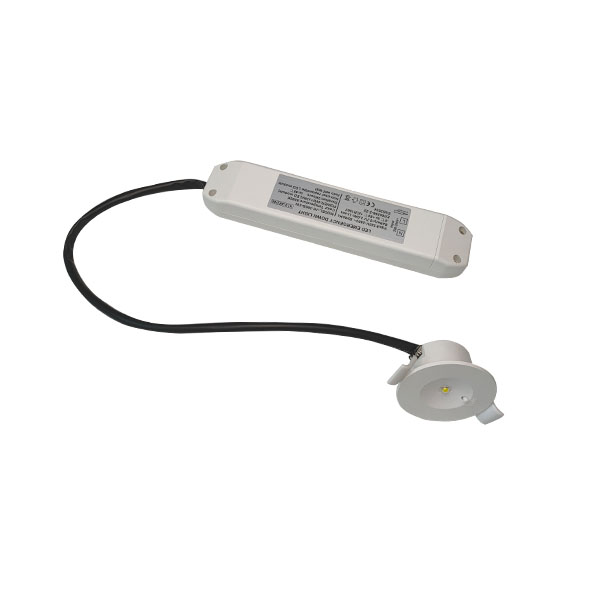
Self-contained emergency lighting with selectable 90 minute to 3 hour duration and maintained or non-maintained wiring.
Frequently Asked Questions About Emergency Lighting
Minimum Order Quantity And Price Drivers
Q: What is the minimum order quantity and what drives unit price?
MOQ is 500 units for standard emergency drivers and 300 units for exit signs or twin spots. Price drops 8-12% at 1,000 units and 15-18% at 5,000 units. Key drivers: battery chemistry (LiFePO4 3.2V 3000mAh costs 40% more than NiCd 3.6V 1500mAh), self-test versus manual test circuitry, and whether the inverter output is constant current (50-350mA window) or constant voltage. Custom silk-screen or carton print adds $0.15-0.30 per unit.
Confirming Compatibility With Host Fixtures
Q: How do I confirm your emergency driver suits my existing LED luminaire?
Match three parameters: input voltage range (AC 85-265V or 100-277V), emergency output window in DC volts and mA (typically 9-42V at 50-350mA for panels and bays; 180-260V for linear tubes), and driven load in watts (3W to 25W). Request the supplier’s discharge curve at 25°C ambient and a compatibility matrix showing tested host fixtures. A real manufacturer keeps records of duration tests (90 min, 120 min, 180 min) against specific LED modules.
Emergency Duration Output And Wiring Options
Q: What emergency durations and output levels are available, and can I choose maintained or non-maintained?
Durations: 90 minutes (standard for UK/Europe per BS 5266-1), 120 minutes, 180 minutes. Emergency output: 10% to 100% of normal lumen output, commonly 300-1,000 lumens depending on host fixture wattage. Non-maintained wiring powers the emergency circuit from mains via changeover relay; maintained wiring keeps the lamp live in normal mode and switches to battery on failure. Specify which at order—PCB layout differs.
Self-Test And DALI Options
Q: What test facilities are available?
Three levels: manual test key (press for 30-second functional test), automatic self-test per EN 62034 (continuous monitoring with 30-second monthly and 90-minute annual discharge tests), and DALI-2 emergency test facility (Type 0 or Type 1) for building management system integration. Self-test adds $2.50-4.00 per unit. DALI requires a DALI bus power supply and certified control gear; verify the supplier has tested compatibility with your BMS brand.
Battery Chemistry Replacement And Cycle Life
Q: What battery chemistries do you offer and how often must they be replaced?
NiCd 3.6V 1500mAh: 3-4 year replacement, 300-400 cycles, widest temperature range (-20°C to +50°C). Li-ion 18650 3.7V 2600mAh: 5-6 years, 500-700 cycles, lighter, requires UN 38.3 test summary for air freight. LiFePO4 3.2V 3000mAh: 8-10 years, 1,500-2,000 cycles, safest thermal profile, highest initial cost. All require annual capacity verification per EN 62034. Replacement interval assumes 25°C ambient; every 10°C above halves cycle life.
Lead Time Samples And Payment
Q: What is lead time, sample policy, and payment structure?
Standard lead time: 25-30 days after deposit for orders under 2,000 units; 35-45 days above. Samples: 2-3 units at production price plus courier, 7-10 days to despatch. First-time orders: 30% TT deposit, 70% against BL copy. Repeat orders with 12-month history: LC at sight acceptable. OEM packaging or silk-screen adds 5-7 days. Request a pre-production sample with battery discharge test report for your specific duration and load before committing to bulk.
Conformity Marks And Test Reports
Q: Which test reports and conformity marks can you supply for my market?
Ask for third-party test reports covering EN 60598-2-22 (construction and marking), EN 1838 (light output and distribution), and EN 62034 (self-test function) for EU/UK entry. For North America: UL 924 or CSA C22.2 No. 141 test data. For Australia: AS/NZS 2293.2. A manufacturer holds original test reports with laboratory accreditation; a trading office forwards PDFs without understanding the technical scope. Verify the report covers your specific battery chemistry, duration, and output wattage—not a generic family certificate.
Lithium Battery Shipping And Documentation
Q: How do lithium batteries affect shipping mode and documents?
Li-ion and LiFePO4 packs above 100Wh per unit require UN 38.3 test summary, MSDS, and dangerous goods declaration for air freight (IATA DGR Section II or IA). Sea freight under IMDG Code: Class 9 UN3480 or UN3481, depending on whether batteries are packed with or in equipment. Charge state must not exceed 30% SOC for air transport. Lead time extends 2-3 days for DG documentation. NiCd ships as general cargo with no special provisions.
Warranty Spare Parts And After-Sales
Q: What warranty and spare parts support do you provide?
Standard warranty: 3 years on electronics, 2 years on NiCd, 3 years on Li-ion, 5 years on LiFePO4. Extended to 5 years total on request with MOQ of 1,000 units. Spare battery packs available as SKU-level items for field replacement. A manufacturer stocks replacement PCBs and can troubleshoot inverter waveforms remotely; a trading office cannot. Ask for MTBF data and whether field failure analysis with root-cause report is included.
OEM Branding Packaging And Engineering Support
Q: Can I get OEM branding, custom packaging, and installation support?
OEM silk-screen and carton print: MOQ 500 units, no tooling charge. Custom label with your model number and barcode: $0.08/unit. Installation guides in local language: provided as PDF for print-ready files; printed inserts at $0.12/unit. Commissioning support: wiring diagrams for maintained versus non-maintained circuits, DALI address programming guides, and lux-level verification methodology per EN 1838. Video call support with application engineer available for first project.
Important Notice
Specifications, output and duration figures and price ranges in this guide are indicative and are provided
for planning purposes only. Actual emergency output, duration, battery life, ingress protection and available conformity documentation
differ by model and by destination country, and emergency lighting design remains the responsibility of the project designer. Buyers
must confirm their own mains voltage and frequency, the emergency lighting standard enforced locally, the host fixture compatibility
and their import requirements before placing an order. All figures are subject to written confirmation in the final proforma invoice
issued by Hymark.
Sourcing Emergency Lighting from Hymark
What to Request in Your First Enquiry
A qualified manufacturer should return a datasheet that lists every figure a certifier or inspector will check. Ask for:
- Emergency output in lumens and as a percentage of normal output: typical ranges are 10% to 100% depending on whether the unit is a reduced-output emergency module or a full-power emergency driver
- Emergency duration: 90 minutes, 2 hours or 3 hours selectable at order
- Input voltage range: AC 85-265V or 100-277V for wide-market drivers, AC 220-240V for UK/EU-specific units
- Output window: DC 9-42V at 150-700mA for constant-current emergency drivers, or DC 3.6-12.6V for direct battery packs
- Driven load: 3W, 5W, 10W, 15W, 25W or higher depending on the fixture type
- Battery chemistry and capacity: LiFePO4 3.2V 1500-3000mAh, Li-ion 18650 3.7V 2000-2600mAh, or NiCd 3.6V 1200-1800mAh
- Charge time to 90% capacity: 16-24 hours for NiCd, 6-8 hours for Li-ion, 4-6 hours for LiFePO4
- Cycle life: 300-500 cycles for NiCd, 500-800 for LiFePO4, 300-500 for standard Li-ion
- Test facility: manual test key, automatic self-test per EN 62034, or DALI-integrated test
- Wiring mode: maintained with changeover relay, or non-maintained
- IP and IK rating: IP20 for indoor drivers, IP65 for weatherproof luminaires, IK08 or IK10 for impact-prone areas
- Ambient temperature range: typically -10°C to +45°C for standard Li-ion, -20°C to +60°C for LiFePO4
How Hymark Structures Supply
JIALINGHANG ELECTRONIC CO., LTD. was founded in 2013 as a global LED exporter in general illumination. A strategic shift in 2017 refocused the company on LED emergency technology and high performance LED strips. Hymark was launched in 2026 as the premium brand. Products are co-designed and engineered in-house through a strategic partnership with dedicated manufacturing facilities that have also been operating since 2013. The company manages R&D, product design and global distribution itself.
The range covers emergency lighting, emergency exit signs, emergency luminaires, emergency twin spotlights, LED emergency drivers for LED high bays, panel lights, tubes and linear lights, full power output emergency drivers, LED strip lights, COB LED strips and SMD LED strips. Orders are supplied with selectable emergency duration, maintained or non-maintained wiring, OEM and ODM branding, export carton packing and FOB or CIF terms.
Send Your Specification for a 24-Hour Quotation
Hymark does not list certificates it has not shown. What it does provide is traceable battery sourcing, discharge and duration test records from in-house ageing stations, and third-party test reports for the destination market when available. The engineering team can advise whether a given driver output window matches your host fixture’s LED module voltage-current curve.
To receive a quotation within 24 hours, send the host fixture type and wattage, the emergency duration your code requires, your mains voltage, and your destination port via WhatsApp or email.
Get a Factory Direct Quote on Emergency Lighting
JIALINGHANG ELECTRONIC CO., LTD. has been in LED lighting since 2013 and has focused on
LED emergency technology and high performance LED strips since 2017. Hymark products are co-designed with our
dedicated manufacturing partners, built with selectable emergency duration and maintained or non-maintained wiring, and function
tested before packing. Send us the host fixture type and wattage, the emergency duration your local code requires, your mains
voltage and your destination port and we will return a quotation within 24 hours.


 English
  Spanish
  Arabic
  French
  German
  Russian
  Portuguese
  Italian
  Vietnamese