
Parking Garage Emergency Fixtures Manufacturerin Buyer Guide
The right parking garage emergency fixture depends on the host luminaire’s normal output, the emergency duration your code requires, and the conformity mark the local inspector will accept. A manufacturer in China can supply these, but buyers must verify that the supplier’s test data matches the standard the project specifies rather than assuming equivalence.
Typical configurations span 3W to 10W emergency output (10% to 100% of normal LED load), with 90 minutes, 2 hours, or 3 hours duration per EN 1838 or UL 924. Input ranges are commonly AC 85-265V 50/60Hz for universal markets or 220-240V for Europe and 100-277V for North America. The emergency driver outputs DC 9-42V at 150-700mA constant current to the LED module via changeover relay, with battery packs of LiFePO4 3.2V 3000-6000mAh (roughly 500-800 cycles, 3-hour charge) or NiCd 3.6V 1500-4000mAh (lower cost, shorter cycle life, heavier). IP ratings for parking garages start at IP65 for dust and jetting water; IP66 y IK08-IK10 suit exposed deck levels with vehicle impact risk. Ambient tolerance of -20°C to +50°C is necessary for unheated structures.
What This Page Covers
This section walks through matching the emergency module to the host fixture’s electrical architecture, selecting maintained versus non-maintained wiring, and the questions to ask a Chinese supplier about test facilities, battery transport certification, and third-party test reports.
Types and Configurations of Parking Garage Emergency Fixtures Manufacturerin
Parking garage emergency lighting spans a wider load and format range than corridor or office applications because the host fixtures themselves vary from low-wattage canopy luminaires to high-bay LED arrays over wide drive aisles. The table below groups the six configurations most often sourced from Chinese manufacturers for retrofit or OEM integration, with the technical figures a buyer needs to match inverter to fixture and to local code.
| Type or Class | Typical Rating or Output | Duration or Runtime | Best Suited For | Notes |
|---|---|---|---|---|
| Reduced-output emergency driver for LED canopy/panel retrofits | 3–5W emergency, 10–30% of normal output | 90 min or 180 min | Single-fixture retrofit in open-deck parking with existing LED canopy or panel | Inverter module installed inside original housing; requires minimum 1.5Ah LiFePO4 or 2.2Ah Li-ion 18650 pack |
| Full-power emergency driver for LED high bays | 20–60W emergency, 100% of normal output | 90 min or 180 min | High-bay aisle lighting in multi-level garages with 6–12m ceiling heights | Needs 12.8V or 25.6V LiFePO4 packs, 4–10Ah; constant-current output 350–700mA matched to LED module Vf window |
| Maintained emergency twin-spot with remote heads | 2×3W LED heads, 600–900lm total | 90 min or 180 min | Structural columns or soffits where no host fixture exists or where host is switched off after hours | Changeover relay switches to battery on mains failure; heads aimable 90° for beam alignment |
| Non-maintained bulkhead with microwave sensor option | 5–10W emergency, 500–1000lm | 90 min, 120 min, 180 min | Stairwells, lift lobbies, ramp transitions in paid parking structures | IP65 enclosure standard; microwave sensor can be wired for maintained use with override |
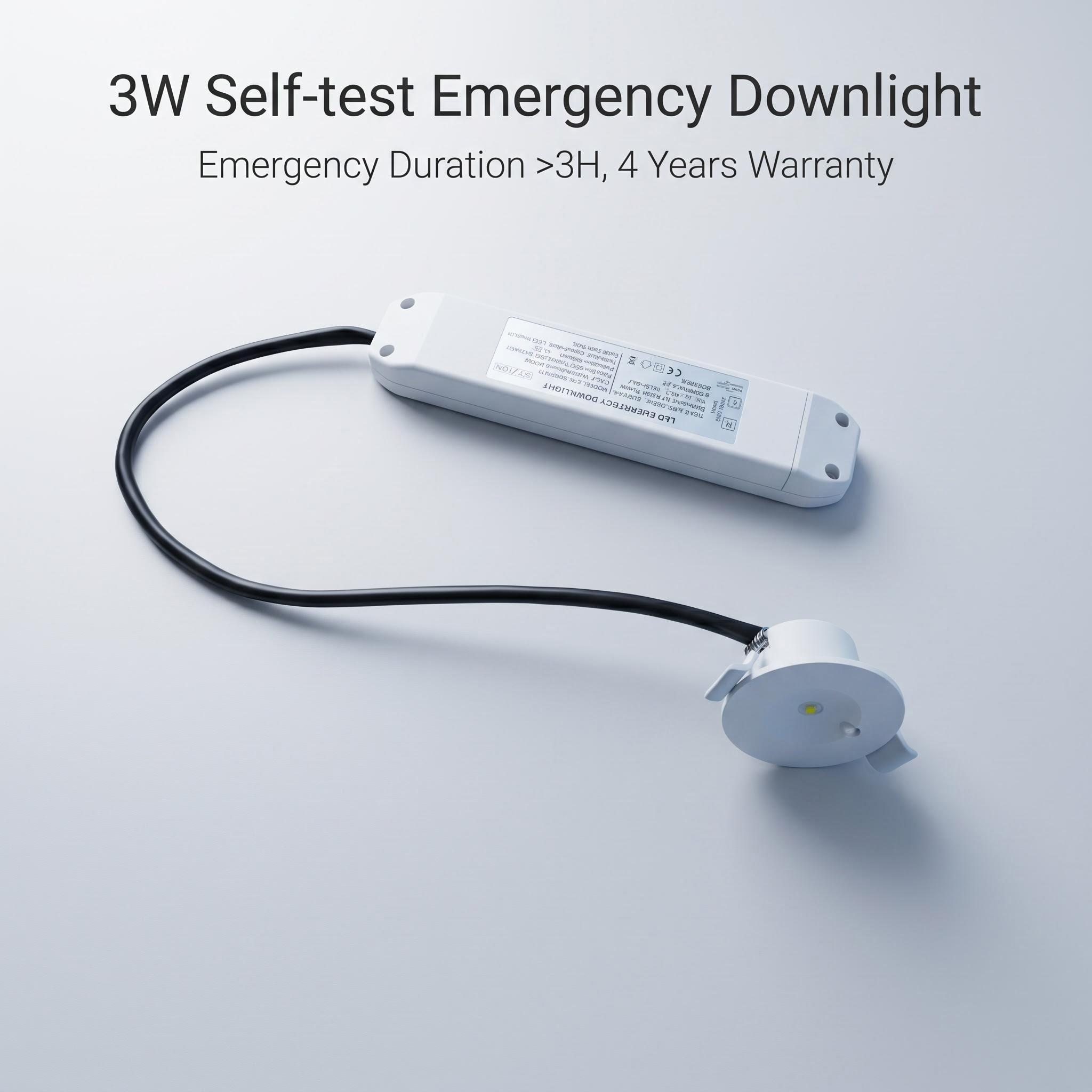
| Self-test/DALI-addressable emergency module | 3–50W scalable, 10–100% output | 90 min or 180 min programmable | Large portfolio operators, REITs, council garages requiring automated compliance logging | EN 62034 functional test every 4 weeks, duration test annually; DALI broadcast or addressed |
| Weatherproof LED strip emergency kit (IP67) | 4.8–14.4W/m, 300–1200lm/m at 3000K–6000K | 90 min or 180 min | Perimeter soffit coves, level-indicator strip lighting, EV bay marking | 24V DC constant-voltage inverter; 60 or 120 LEDs/m; cut length 50mm or 100mm; LiFePO4 6.4V 3–6Ah typical |
Reduced Output Emergency Drivers for LED Canopy and Panel Retrofits
These modules replace the original LED driver inside an existing parking garage canopy or panel fixture with a combined normal/emergency unit, or sit in parallel as a small inverter box wired to the LED module’s emergency terminals. The emergency output is deliberately throttled to 3–5W, yielding roughly 10–30% of normal lumens, because the 90-minute or 180-minute runtime is achieved from a compact LiFePO4 3.2V 1500mAh single-cell pack or a Li-ion 18650 3.6V 2200mAh cell. Input voltage is universal AC 85–265V, and the DC output window is typically 9–42V at 150–350mA constant current. Electrical contractors buy these for retrofit programmes where the existing housing and diffuser are retained; the limitation is that the reduced light level may not satisfy EN 1838 or BS 5266-1 minimum illuminance on the driving surface if the original fixture was already at code minimum. Buyers should ask the supplier for the emergency lumen figure at the actual operating temperature, not the 25°C catalogue number, because LiFePO4 capacity falls roughly 15% at 0°C.
Full Power Emergency Drivers for LED High Bays
Parking garages with ceiling heights above 6m often use LED high bays at 50–150W normal load. A full-power emergency driver must replicate that output to maintain the design lux level during egress. These units drive 20–60W emergency loads from 12.8V or 25.6V LiFePO4 packs sized 4–10Ah, delivering constant current at 350mA, 500mA or 700mA into a Vf window of 30–80V DC. The battery pack is physically large—often a separate metal enclosure beneath the high bay—so the fixture must be rated to support the extra weight or the pack must be remotely mounted within 3m per most wiring codes. Luminaire OEMs adding emergency versions to their high-bay lines buy these in kit form; facility managers buy them for aisle retrofit. The trade-off is cost and space: a 60W full-power system with 180-minute duration can cost three to four times the reduced-output equivalent, and the 25.6V 10Ah LiFePO4 pack weighs approximately 2.5kg.
Maintained Emergency Twin Spotlights with Remote Heads
Where a parking garage column or soffit has no permanent host fixture, or where the host fixture is switched off after hours by a BMS timer, a maintained twin-spot provides both normal and emergency illumination. In maintained wiring, the LED heads are energised continuously from mains via the internal driver; on power failure a changeover relay transfers to battery. Typical heads are 3W each, 300–450lm, with 90° or 180° adjustability. The battery is usually NiCd 3.6V 1.8Ah or Li-ion 18650 3.6V 2.6Ah, giving 90 or 180 minutes. Electrical contractors and installers favour these for concrete column mounting because they are self-contained and do not depend on a host luminaire. What they cannot do is blend architecturally with a linear LED canopy system, and the NiCd option carries temperature and disposal restrictions that LiFePO4 avoids.
Non-Maintained Bulkheads with Microwave Sensor Option
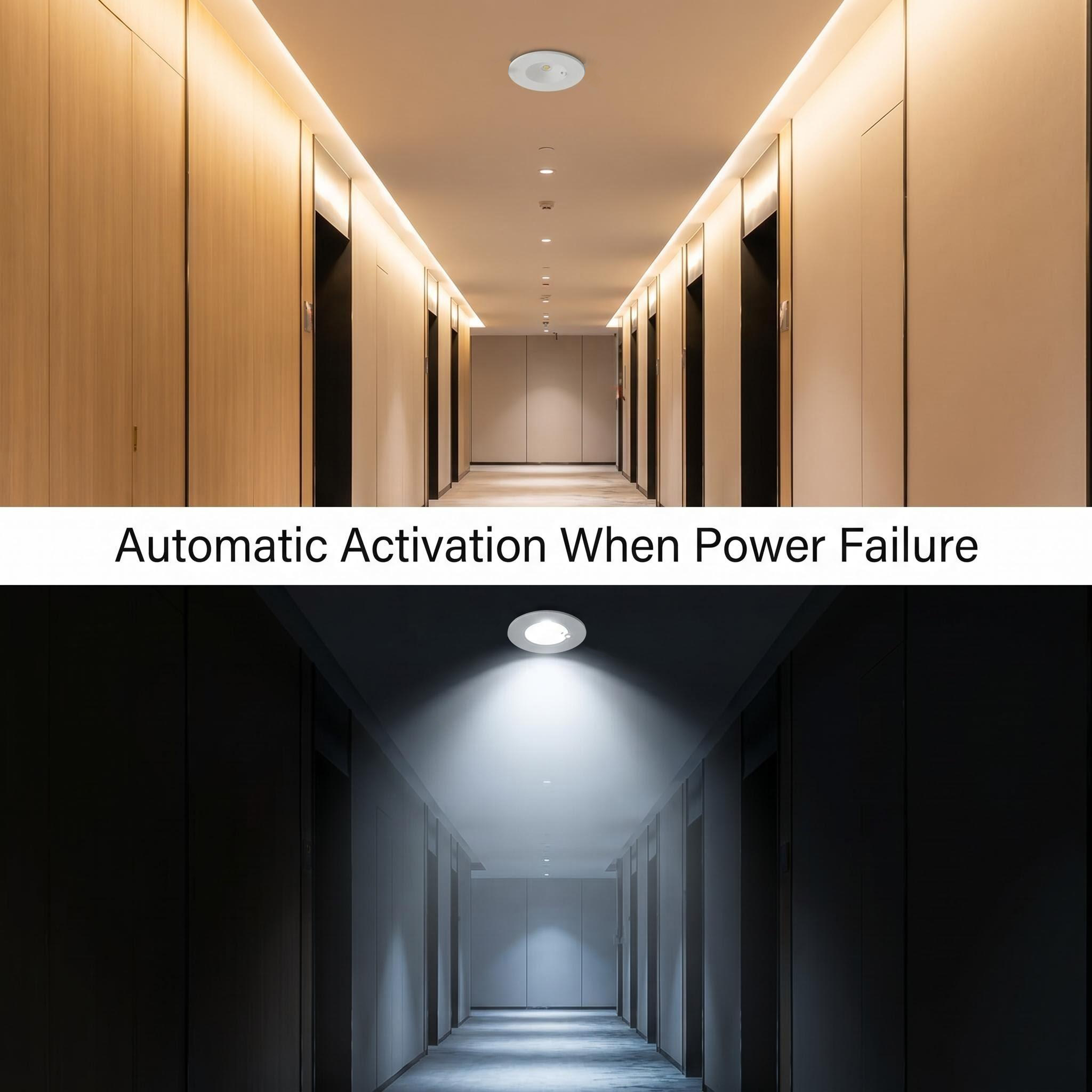
Stairwells, lift lobbies and ramp transitions in parking structures need point-source emergency lighting that is off during normal conditions and energised on mains failure. Non-maintained bulkheads at 5–10W emergency output, 500–1000lm, run from LiFePO4 6.4V 2–4Ah packs for 90, 120 or 180 minutes. The IP65 die-cast enclosure is standard; IK08 or IK10 ratings are available for vandal-prone locations. A microwave sensor can be added for maintained operation with override, keeping the fitting live during occupancy and switching to emergency on power loss. M&E consultants specify these for new-build parking where the emergency lighting is a separate circuit from general illumination. The limitation is that non-maintained fittings require a permanent unswitched live to the inverter; if the circuit is switched, the battery will not charge and the fitting will fail to function in an outage.
Self-Test and DALI-Addressable Emergency Modules
Large parking portfolios—shopping centre car parks, airport multi-storeys, municipal structures—need automated compliance logging rather than manual monthly key-switch tests. A self-test module per EN 62034 performs a functional test every 4 weeks and a duration test annually, reporting status via a local LED indicator or over DALI. The output is scalable from 3W to 50W, with duration programmable at 90 or 180 minutes. The inverter accepts AC 100–277V or 220–240V and delivers DC at the required current; battery packs are LiFePO4 from 3.2V 1.5Ah up to 25.6V 10Ah depending on load. Lighting designers and specifiers for institutional clients favour these because they reduce maintenance labour and generate audit trails. The caveat is that DALI wiring must be planned during construction; retrofitting DALI bus cable through concrete parking decks is often impractical.
Weatherproof LED Strip Emergency Kits
Perimeter soffits, level-indicator strips and EV charging bay markings in modern parking garages increasingly use LED strip for continuous linear effect. An emergency strip kit combines a 24V DC constant-voltage inverter with a LiFePO4 6.4V 3–6Ah pack, stepping up to 24V for 90 or 180 minutes. Strip specifications run from 4.8W/m (60 LEDs/m, 300lm/m, 3000K) to 14.4W/m (120 LEDs/m, 1200lm/m, 6000K), with CRI 80 or 90, PCB width 10mm or 12mm, and 2oz copper for thermal management. Cut lengths are 50mm or 100mm depending on LED pitch. IP67 extrusion is standard for parking soffit exposure to condensation and road salt. Wholesalers and distributors stock these for architectural lighting contractors; the constraint is that long runs need voltage-drop calculation—at 14.4W/m, a 5m strip draws 3A at 24V, and the inverter must be sized for inrush as well as steady load.
Supplier Qualification for Parking Garage Emergency Fixtures
A buyer shortlisting Chinese manufacturers for parking garage emergency fixtures should verify four areas beyond the catalogue photograph. First, request the photometric emergency file in .ies or .ldt format for the actual emergency wattage, not the normal mode, because glare and uniformity are checked at emergency output. Second, ask for the battery cell specification sheet: LiFePO4 32700, Li-ion 18650 or NiCd C-cell, with cycle-life claim and temperature-derating curve. Third, confirm the inverter’s output window matches the host LED module’s Vf; a 30–42V inverter will not drive a 50V COB array. Fourth, for lithium-based products, request UN 38.3 test summary documentation and the supplier’s IATA/IMDG shipping classification, because lithium batteries over 100Wh or in aggregate consignments trigger dangerous-goods procedures that add cost and documentation. Hymark builds emergency luminaires and drivers across these six configurations with AC 85–265V or 100–277V input options, LiFePO4 and Li-ion 18650 battery platforms, and self-test or DALI variants; sample lead time is 7–10 days, MOQ from 100 units, and full carton/pallet packing for FOB Shenzhen or CIF terms to UK, Europe, Middle East, Southeast Asia, Africa and Latin America.
Specifications and How to Read Them
| Parameter | Entry Level | Mid Range | High Specification |
|---|---|---|---|
| Input voltage | AC 85-265V 50/60Hz | AC 100-277V 50/60Hz | AC 220-240V 50Hz or AC 120-277V 60Hz |
| Driven load | 3-10W | 8-25W | 20-60W |
| DC output window | 12-80V at 150-350mA constant current | 12-120V at 200-500mA constant current | 24-240V at 250-700mA constant current |
| Salida de emergencia | 300-500 lm, 10% of normal | 800-1500 lm, 25-50% of normal | 2000-4000 lm, 50-100% of normal |
| Emergency duration | 90 minutes | 2 hours | 3 horas |
| Battery chemistry | NiCd 3.6V 1200mAh | Li-ion 18650 3.7V 2600mAh | LiFePO4 3.2V 3000mAh |
| Charge time | 24 hours | 16 hours | 8-12 hours |
| Cycle life | 300-400 cycles | 500-700 cycles | 800-1200 cycles |
| Test facility | Manual test key | Auto self-test per EN 62034 | Self-test + DALI-2 |
| Wiring mode | Sin mantenimiento | Maintained or non-maintained | Maintained with changeover relay |
| IP/IK rating | IP20, IK04 | IP65, IK07 | IP66, IK10 |
| Ambient temperature | 0°C to +40°C | -10°C to +45°C | -20°C to +50°C |
| Housing | Steel with powder coat | Die-cast aluminium | Die-cast aluminium with epoxy finish |
Reading the Input Voltage and Frequency Line
The input range tells you where the driver electronics will survive. A wide-range 85-265V unit works on any grid from 100V Japan to 240V UK without rewiring. A 220-240V-only unit is cheaper but will fail immediately on 120V. Frequency is almost always 50/60Hz dual-rated; verify this if your market includes Saudi Arabia (60Hz) or Nigeria (50Hz) on the same SKU. For parking garages in the Middle East, check whether the specifier wrote 230V ±10%—that demands a true 207-253V operating window, not just a nominal 220-240V label.
Understanding Driven Load and DC Output
“Driven load” means the LED module wattage the emergency inverter must support. The DC output window—expressed as voltage range and current—must overlap the LED module’s forward-voltage curve. A 25W LED high bay might sit at 36V forward voltage; the emergency driver must output 36V at roughly 700mA. Constant-current output is non-negotiable for LED longevity; voltage-mode emergency inverters will cause flicker and premature degradation. Ask the supplier for the V-I curve of their constant-current stage.
Emergency Output Lumens and Percentage of Normal
This is where parking garage specifications live or die. EN 1838 requires minimum 1 lux on the floor centreline for escape routes; BS 5266-1 adds 0.5 lux for open areas. A 400W metal halide high bay producing 40,000 lumens in normal mode needs at least 2,000 lumens in emergency (5%) to meet open-area requirements. If the emergency driver only delivers 10% of normal, that is 4,000 lumens—comfortable but more battery than necessary. If it delivers 100% (full power output emergency), the battery triples in size and cost. The percentage is a design choice, not a virtue.
Battery Chemistry Trade-Offs
NiCd 3.6V packs are the entry-level fixture. They tolerate temperature abuse, contain no lithium shipping restrictions, and cost roughly one-third of LiFePO4. The downsides: 300-400 cycle life, 24-hour recharge after deep discharge, and cadmium content that blocks import into EU countries under REACH restrictions unless specifically exempted for emergency lighting.
Li-ion 18650 3.7V 2600mAh hits a middle density point—more energy per kilogram than NiCd, 500-700 cycles, 16-hour recharge. The cells require UN 38.3 test reports for air freight and IMDG certification for sea containers. Thermal runaway risk means the battery compartment needs separation from the LED heat sink; verify the supplier’s mechanical design.
LiFePO4 3.2V 3000mAh carries the highest upfront cost and the lowest energy density, but delivers 800-1200 cycles, 8-12 hour recharge, and thermal stability to +60°C without degradation. For parking garages in Dubai or Bangkok where ambient hits 50°C in summer, this is often the only chemistry that survives warranty.
Test Facility and Maintenance Burden
Manual test key: a physical switch or fuse removal that forces battery discharge. Required monthly under BS 5266-1; labour cost is the hidden price.
Self-test per EN 62034: the driver runs automatic duration tests at intervals programmed at factory—typically monthly functional and annual full-duration. A status LED on the housing shows fault codes. Reduces labour but adds roughly 8-12% to driver cost.
DALI-2 emergency: addressable over the DALI bus, reports status to the building management system, allows remote test initiation. Essential for multi-storey parking structures with 500+ luminaires. Verify the supplier implements Part 202 of IEC 62386, not just basic DALI dimming.
Maintained Versus Non-Maintained Wiring
Non-maintained: the emergency circuit is dead in normal mains operation; the battery charges in standby. One cable, one switching level. Suitable for parking garages where the normal lighting is on a separate circuit and the emergency only activates on power failure.
Maintained: the emergency lamp burns continuously from the normal supply via a changeover relay; on mains failure the relay drops and the inverter feeds the lamp from battery. Two live feeds required. Necessary when local code treats the emergency luminaire as part of the working lighting design—common in UK specifications under BS 5266-1. The changeover relay is a wear part; ask for contact material (silver-nickel minimum) and rated mechanical life (100,000 operations).
IP and IK Ratings for Parking Garages
IP65 (dust-tight, protected against water jets) is the practical minimum for open-deck parking exposed to rain washdown and vehicle spray. IP66 (protected against powerful water jets) adds margin for pressure cleaning. IK07 (2 joules impact) resists casual tool drops; IK10 (20 joules) survives deliberate vandalism or vehicle impact in public garages. The entry-level IP20/IK04 build belongs only in enclosed stairwells with no vehicle access.
Ambient Temperature and Derating
Every 10°C above 25°C halves battery cycle life for Li-ion chemistries. A driver rated 0°C to +40°C with Li-ion 18650 cells will deliver its 500-cycle life only if the garage stays below 30°C. In Jeddah or Lagos, specify -20°C to +50°C with LiFePO4 and confirm the supplier has tested full-duration discharge at +50°C, not just storage.
Dimensions Mounting and Mechanical Fit
Parking garage luminaires mount to concrete soffits, cable trays, or pendant drop rods. Entry-level units use 20mm conduit knockouts; high-specification units add M20 cable glands and stainless brackets. For retrofit projects, measure the existing fixing centres before ordering—a 600mm linear emergency module will not fit a 400mm legacy bracket pattern.
Export Trade Terms and Compliance Marks
FOB (Free On Board): supplier delivers to the port of departure; buyer pays ocean freight and insurance. Standard for first orders where the buyer has a freight forwarder.
CIF (Cost Insurance Freight): supplier arranges sea freight to destination port; buyer clears customs. Adds 8-15% to unit cost but reduces buyer logistics burden.
CFR (Cost and Freight): supplier pays freight, buyer arranges insurance. Rarely used; insurance gaps create disputes.
EXW (Ex Works): buyer collects from factory. Lowest nominal price, highest coordination cost. Only for buyers with China customs brokers.
Payment terms: T/T (telegraphic transfer) 30% deposit, 70% against copy of bill of lading is standard. L/C (letter of credit) adds $300-800 bank fees but protects both parties on first transactions over $50,000.
HS code 9405.10 covers battery-operated emergency luminaires; 9405.40 covers emergency lighting sets. Verify the supplier’s customs broker uses the correct subheading—misclassification delays clearance at Felixstowe or Jebel Ali.
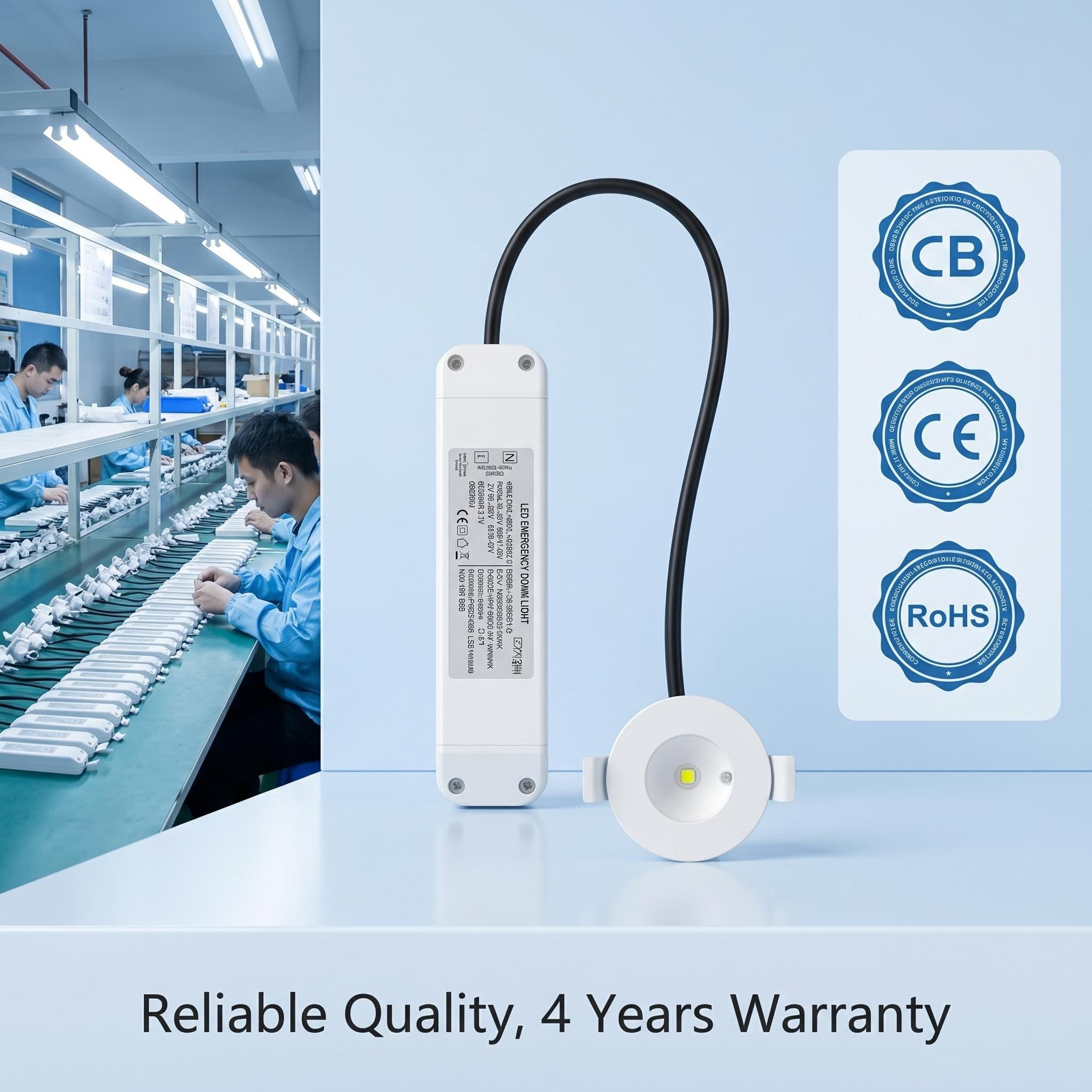
CE marking is mandatory for EU import; UKCA for Great Britain post-Brexit. The supplier must provide a Declaration of Conformity referencing EN 60598-2-22 and EN 1838. Do not accept a CE label on the product without supporting technical file.
UN 38.3 test report is compulsory for lithium battery air or sea transport. The report covers altitude simulation, thermal test, vibration, shock, external short circuit, impact/crush, overcharge, and forced discharge. Ask for the specific battery pack model number on the report—suppliers sometimes show a cell-level report that does not cover their assembled pack with protection circuit.
Packing: standard carton is 4-6 units with foam inserts; pallet is 48-72 cartons. Gross weight per carton typically 18-25 kg for die-cast aluminium emergency bulkheads. Request a packing list with net weight, gross weight, and carton dimensions for your freight forwarder’s cubic metre calculation.
Certificate of origin: required for preferential tariff treatment under bilateral agreements (China-ASEAN, China-Pakistan). Not needed for EU or UK standard duty rates but useful for Middle East customs where origin documentation is strictly checked.
Qualifying the Supplier
Request the factory’s IEC 61347 test reports for the LED control gear, even if you do not need the certificate yourself—this proves the inverter stage was tested for insulation and thermal performance. Ask for photometric files (.ies or .ldt) for three luminaire configurations; absence suggests the supplier has never had their optics measured. For DALI models, request a DALI-2 registration number from the DiiA database. Finally, verify the battery cell brand—Samsung SDI, LG Chem, and BYD publish cycle life data; unbranded cells do not.
Parking Garage Emergency Fixtures Manufacturerin Price and What Drives It
| Class | Typical Rating or Output | Duration or Runtime | Indicative FOB USD |
|---|---|---|---|
| Emergency exit sign, single-face LED, 8–12 m viewing distance | 50–120 lm face luminance | 90 min–3 hr | $12–$28 |
| Emergency bulkhead / maintained luminaire, 3W LED module | 180–250 lm emergency | 90 min–3 hr | $22–$45 |
| Emergency twin-spot, 2 × 3W LED heads | 400–600 lm total emergency | 90 min–3 hr | $35–$65 |
| Emergency driver kit for LED high bay, 10W–20W output | 500–1200 lm at 10–30 % normal | 90 min–3 hr | $45–$95 |
| Full-power emergency driver for LED panel, 20W–40W | 2000–4000 lm, 100 % normal output | 90 min–2 hr | $85–$160 |
| Self-contained emergency luminaire, IP65, 5W–10W LED | 300–800 lm | 90 min–3 hr | $40–$90 |
What Moves Price in a Parking Garage Emergency Fixture
Parking garage environments impose a specific stack of requirements: IP65 minimum against moisture and salt spray, IK08 or IK09 against vehicle impact, wide ambient temperature swings from –20 °C to +45 °C, and sustained output on a 90-minute or 3-hour emergency duration under EN 1838 or AS/NZS 2293. The fixture you receive from a Chinese manufacturer is a sum of discrete cost layers. Understanding each layer lets you match the quote to the actual specification rather than to a product description.
Battery pack — typically the single largest material cost. A 3.2V LiFePO4 3000 mAh pack (roughly 9.6 Wh) supports 3 hours at 3W with headroom, yielding 500–600 charge cycles and stable chemistry across the temperature range. A 3.7V Li-ion 18650 2600 mAh pack (9.6 Wh nominal) costs 15–25 % less but throttles performance below 0 °C and delivers 300–500 cycles. NiCd 3.6V 1500 mAh survives extreme cold and abuse but carries memory-effect degradation and heavier shipping restrictions. For a 10W emergency high-bay driver, the jump to LiFePO4 6.4V 6000 mAh (38.4 Wh) roughly doubles the battery line item.
Driver and inverter electronics — the constant-current inverter stage, changeover relay, and charge management IC. A basic non-maintained inverter with manual test key costs less than a self-test or DALI-2 compatible module meeting EN 62034. The output window matters: 9–42 V DC at 350 mA covers most linear and panel LED loads; 100–240 V DC at higher mA drives high-bay arrays. Wider voltage windows need larger magnetics and more robust MOSFETs.
LED package — in self-contained luminaires, not in driver kits. Mid-power 2835 SMD at 120–130 lm/W is standard; high-CRI 90+ chips or COB arrays add 10–20 %.
Enclosure and hardware — die-cast aluminium with polyester powder coat for IK08/IP65 versus polycarbonate for lower-impact indoor use. Gasket material (silicone vs. EPDM), stainless steel hinge pins, and captive screws affect unit cost by $3–$8.
Test and certification cost amortised over batch — third-party testing to EN 60598-2-22, EN 61347-2-7, or UL 924 runs $8,000–$25,000 per product family depending on complexity. Spread across a 2,000-unit MOQ this adds $4–$12 per piece. A supplier without current test reports cannot absorb this; the buyer either pays it directly or assumes compliance risk.
Assembly labour and overhead — Guangdong and Zhejiang factories run $4.50–$7.50 per labour-hour. Fully potted drivers and automated SMT lines raise capital recovery but lower per-unit variance.
Export logistics — lithium cells trigger UN 38.3 testing and IATA/IMDG restrictions. Air freight from Shenzhen to London or Dubai requires Class 9 dangerous goods handling, adding $1.50–$3.00 per kg and limiting some carriers. Sea freight (FOB Shenzhen/CIF destination) avoids this but extends lead time to 25–35 days. Carton packing typically 6 or 12 units per carton, 50–60 cartons per pallet.
Destination charges — UK import duty on emergency luminaires in HS 9405.10 typically 3.7 %; EU MFN rate 2.7 %; GCC states 5 %. VAT or sales tax applies atop. Customs clearance and broker fees run $150–$400 per consignment.
Why the Cheapest Quote Is Rarely the Same Product
A $18 emergency bulkhead and a $38 unit from the same factory外形 may share a housing. The difference sits in the cell and the inverter. The cheaper quote normally means one of three things:
- Smaller cell: 1500 mAh NiCd or 1800 mAh Li-ion substituting for 3000 mAh LiFePO4, achieving 90 minutes at 25 °C but failing at 3 hours or at –10 °C.
- Reduced emergency output: 120 lm instead of 250 lm, or 5 % of normal instead of 10 %, still labelled “emergency” but not meeting the spacing tables in BS 5266-1 or NFPA 101 for the mounting height.
- Untested design: No current CB test certificate or ENEC mark, no witnessed photometric test, no thermal cycling validation on the battery.
Ask for the specific cell part number, the inverter output window in V and mA, and the test report reference number covering the exact model code on the quote.
Five-Year Running Cost Comparison
| Cost Element | Budget Configuration (NiCd, Manual Test, 90 min) | Mid-Range Configuration (LiFePO4, Self-Test, 3 hr) |
|---|---|---|
| Unit FOB price | $22 | $48 |
| Battery replacement at year 3 | $8 (NiCd 3.6V 1500 mAh) | $0 (LiFePO4 still >80 % capacity) |
| Annual testing labour, manual key | 30 min × 2 tests × $45/hr = $45/year | 15 min × automated self-test × $45/hr = $11/year |
| Expected failure rate years 1–5 | 8–12 % (cell degradation, corrosion) | 2–4 % (electronics only) |
| Replacement units @ year 3–5 | 2 units | 0.5 units |
| 5-year total per installed point | $295–$340 | $103–$118 |
The mid-range configuration pays back in year 2.5 to 3 depending on local labour rates. For a 400-space parking structure with 85 emergency points, the spread is $16,000–$19,000 over five years.
Supplier Qualification Checklist
Request and verify:
- Photometric test report to EN 1838 or AS/NZS 2293 for the exact lumen output and distribution claimed.
- Battery UN 38.3 test summary for the cell model installed, plus MSDS for IATA/IMDG shipping.
- Inverter output specification: constant current in mA, voltage window, and whether maintained or non-maintained wiring is supported.
- IP and IK test certificates from an ILAC-accredited lab, not in-house.
- Self-test or DALI-2 protocol implementation certificate if claimed.
- Sample lead time and whether sample cost is credited against first production order.
Industry Applications for Parking Garage Emergency Fixtures Manufacturerin
Parking garages present a specific set of constraints that separate them from open-air car parks or indoor stairwells: vehicle exhaust fumes, humidity cycles from traffic, low ceiling heights in many retrofit structures, and the need for glare control on reflective concrete surfaces. The emergency fixture must survive these conditions while delivering code-compliant egress illumination. Below are six sectors where parking garage emergency fixtures are specified, with the technical parameters that normally govern selection.
| Sector | Typical Installation | Recommended Specification | Why This Product Fits |
|---|---|---|---|
| Multi-Storey Car Parks | Surface-mounted or pendant luminaires on concrete soffits, often in retrofit positions where original fixtures lacked emergency provision | Non-maintained emergency luminaire, 3W LED module, 300 lm minimum emergency output, 90-minute duration, LiFePO4 3.2V 3000mAh pack, IP65, IK08, -20°C to +50°C ambient | Corrosion resistance against salt and de-icing chemicals; high-impact rating protects against vehicle strike in tight clearance zones |
| Underground Metro Parking | Recessed or surface-mounted units in tunnel-style structures with limited natural ventilation | Maintained wiring with changeover relay, 5W normal / 3W emergency output (60% ratio), 120-minute duration, NiCd 3.6V 4000mAh or LiFePO4 6.4V 1500mAh, IP66, -10°C to +55°C | Maintained operation ensures continuous illumination in permanently low-light environments; higher IP rating against water ingress from drainage failures |
| Hospital and Clinic Basements | Wall-mounted bulkheads at ramp transitions and lift lobbies | Non-maintained, 3.5W LED, 350 lm, 180-minute duration, Li-ion 18650 7.4V 2200mAh pack, self-test facility per EN 62034, IP54 | Extended duration matches hospital backup generator transfer times; self-test reduces maintenance access in sterile or secure zones |
| Retail and Shopping Mall Roof Decks | Pendant or canopy-mounted fixtures under structural decks, often integrated with normal lighting | Maintained or non-maintained, 4W emergency, 400 lm, 90-minute duration, LiFePO4 3.2V 3000mAh, DALI test interface, IP65, IK10 | DALI integration with building management systems; high IK rating against trolley and equipment impact in loading areas |
| Warehouse and Logistics Loading Bays | High-bay adapted emergency units or twin spotlights on racking aisles | Emergency LED driver for high-bay, 10W normal / 5W emergency (50% output), 90-minute duration, LiFePO4 12.8V 1500mAh pack, constant current output 250-350mA, IP54 | Full power output emergency drivers preserve lumen maintenance in high-mounting applications where lux levels must reach the floor |
| Hotel and Residential Podium Parking | Surface-mounted bulkheads on painted concrete, often with architectural constraints | Non-maintained, 3W, 300 lm, 90-minute duration, Li-ion 18650 3.7V 2600mAh, manual test key, IP65, -20°C to +45°C | Compact form factor suits aesthetic limitations; manual test key satisfies simpler maintenance regimes in smaller buildings |
Multi-Storey Car Parks
Concrete soffits in multi-storey structures accumulate chloride-bearing moisture and carbon monoxide. A fixture specified for this sector normally carries IP65 as a minimum and IK08 to survive incidental contact with vehicle mirrors or loading equipment. The emergency output of 300 lm at 3W represents roughly 30-50% of a typical 6-10W normal LED parking bay luminaire, sufficient to meet EN 1838 minimum illuminance of 1 lux on the floor centreline when mounted at 2.5-3.5m height. The LiFePO4 3.2V 3000mAh pack delivers this 3W load for 90 minutes with reserve capacity; charge time from deep discharge is typically 16-24 hours. Cycle life of 500-800 full discharges exceeds the five-year battery replacement interval common in maintenance contracts. Buyers should verify the supplier’s battery datasheet against UN 38.3 for lithium transport, and request third-party test reports for EN 60598-2-22 thermal cycling if the structure experiences large diurnal temperature swings.
Underground Metro Parking
Tunnel-style structures with mechanical ventilation still experience humidity spikes and occasional standing water. Maintained wiring is preferred here because the normal lighting may be the primary working illumination, and a changeover relay ensures instantaneous transfer to battery without dark interval. A 5W normal / 3W emergency ratio (60%) preserves adequate working light during brief outages before generator pick-up. The 120-minute duration exceeds the 90-minute minimum in some jurisdictions where extended egress paths or disabled refuge areas are present. NiCd 3.6V 4000mAh remains common in specifications where temperature extremes punish lithium chemistries, though LiFePO4 6.4V 1500mAh offers lighter weight and lower self-discharge if the ambient range permits. The output window of DC 9-24V at 350mA constant current matches typical LED module requirements. Buyers should confirm the supplier’s IP66 rating covers the complete luminaire including cable entries, not merely the optical compartment.
Hospital and Clinic Basements
Healthcare facilities impose extended-duration requirements because generator transfer and load shedding sequences may exceed standard egress times. The 180-minute duration with Li-ion 18650 7.4V 2200mAh (nominal 16.3Wh) at 3.5W provides margin against code variations and operational contingency. Self-test per EN 62034 automates the 30-second functional and annual duration tests, reducing the need for maintenance staff to access secure or sterile basement corridors. EN 1838 requires 5 lux minimum on escape routes in healthcare premises, so the 350 lm output must be matched to spacing and mounting height during design. Input voltage range of AC 85-265V accommodates both 230V European supplies and 120V equipment in imported medical infrastructure. Buyers should request evidence of electromagnetic compatibility testing to IEC 61347-2-7 if the luminaire will share circuits with medical-grade UPS systems.
Retail and Shopping Mall Roof Decks
Roof deck parking serves retail loading docks and customer parking under weather-exposed canopies. The maintained versus non-maintained decision hinges on whether the normal lighting operates continuously during trading hours or only when occupancy is detected. A DALI test interface enables centralised monitoring of hundreds of units across a large retail estate, with individual address reporting of battery health and lamp failure. The 4W emergency output at 400 lm suits wider spacing than basement applications because ceiling heights often reach 3.5-4m. IK10 rating protects against the higher incidence of trolley and equipment impact in goods-handling zones. The LiFePO4 3.2V 3000mAh pack operates with lower thermal runaway risk than cobalt-based Li-ion if summer canopy temperatures reach 50°C. Buyers should verify DALI compatibility with their BMS protocol version (DALI-1 or DALI-2) and confirm the supplier provides the standard 16-bit short address programming.
Warehouse and Logistics Loading Bays
High-bay parking and loading areas in distribution centres require emergency illumination that reaches the floor from 8-12m mounting heights. A dedicated emergency LED driver rather than self-contained bulkhead is often the correct configuration: the driver converts mains to DC 250-350mA constant current for the existing high-bay LED module, with 10W normal / 5W emergency (50%) preserving sufficient luminous flux for egress. The LiFePO4 12.8V 1500mAh pack (nominal 19.2Wh) at 5W delivers 90 minutes with margin; charge time is 12-16 hours from full discharge. IP54 is generally adequate in covered loading bays but inadequate for open-sided facilities where IP65 is required. Buyers should confirm the driver’s output voltage window matches their LED module’s forward voltage range, typically DC 25-40V for 10W class COB arrays, and verify the emergency driver carries independent thermal protection.
Hotel and Residential Podium Parking
Podium structures beneath residential towers combine architectural visibility with environmental exposure. The non-maintained configuration is standard where normal lighting is switched by photocell or timer and emergency operation is required only during mains failure. The compact bulkhead form factor at 3W and 300 lm suits installations where ceiling space is constrained by ductwork and fire suppression systems. Manual test key satisfies BS 5266-1 requirements where automated testing infrastructure is not justified for small portfolios. The Li-ion 18650 3.7V 2600mAh pack offers energy density advantages for shallow-backbox luminaires, but buyers must confirm the supplier’s cells carry PCM (protection circuit module) against over-discharge in low-temperature conditions. IP65 protects against pressure washing during facade maintenance; the -20°C lower limit accommodates alpine or high-altitude installations.
Supplier Qualification Checklist
Beyond product specification, buyers shortlisting parking garage emergency fixture suppliers should verify: battery cell origin and whether the supplier assembles packs in-house or sources complete modules; availability of photometric files (.ies or .ldt) for lighting calculations to EN 1838; whether the claimed IP and IK ratings are supported by test reports from an accredited laboratory rather than design calculations; and the supplier’s experience with lithium battery transport documentation for air freight (IATA PI 965 Section IB or II) and sea freight (IMDG Special Provision 188). Lead time for customised emergency durations or output levels typically ranges 4-6 weeks from confirmed order; samples with standard 90-minute LiFePO4 packs can usually ship within 5-7 days ex-works. MOQ for OEM branding or custom colour temperature begins at 500-1000 units depending on configuration complexity.
Ordering and Importing Step by Step
Three mistakes regularly leave a delivered batch of parking garage emergency fixtures unusable. First, an output window that does not match the host fixture’s LED driver—fix by recording the host driver’s nominal current and voltage range before ordering. Second, a duration or illuminance level below local code—fix by confirming the required lux on the floor path and the minimum emergency duration in minutes before specifying the battery capacity. Third, missing lithium battery or conformity documentation at customs—fix by requiring UN 38.3 test summaries and the correct CB or national test reports in the shipping file before the vessel sails.
Match the Emergency Module to the Host Fixture
Record these parameters from the luminaire the emergency module will serve:
| Parameter | Typical Range | What to Request |
|---|---|---|
| Host fixture wattage | 20W to 150W for LED high bays or linear parkade fittings | Emergency module rated for at least the host’s nominal LED load |
| LED driver output current | 300mA, 350mA, 500mA, 700mA, 1050mA constant current | Inverter output window matching this current ±5% |
| LED driver output voltage | 25V–42V, 30V–55V, or 180V–260V DC depending on LED string configuration | Inverter output voltage window overlapping the host driver’s nominal range |
| Driver architecture | Constant current DC output, or 1–10V dimmable with switched live | Constant current inverter with changeover relay, or DALI-compatible module if the host uses DALI dimming |
A 60W LED high bay with a 1050mA / 30–55V driver needs an emergency module outputting 1050mA within a 25–60V window to guarantee the LEDs strike at reduced voltage. A 20W linear batten with 350mA / 50–80V needs a narrower 45–85V window. The emergency output in lumens is typically 10% to 30% of normal output—request the supplier’s measured lumen figure at the emergency wattage, not just the percentage.
Confirm Duration and Emergency Output Level Against Local Code
| Market | Standard Reference | Typical Requirement | What to Specify |
|---|---|---|---|
| UK | BS 5266-1, EN 1838 | 1 lux minimum on escape route, 90 minutes duration | Battery capacity verified at 1 hour and 90 minutes |
| Europe | EN 1838, EN 60598-2-22 | 1 lux on floor centre line, 90 minutes or 3 hours for high-risk areas | LiFePO4 3.2V 6000mAh pack for 3 hours at 5W, or Li-ion 18650 7.4V 2600mAh for 90 minutes at 10W |
| Middle East | Often EN-based or local civil defence rules | 90 minutes common, 1 lux minimum | Same as European specification, confirm local civil defence acceptance of EN test reports |
| Southeast Asia | Mix of EN and local standards | 90 minutes or 2 hours | 2-hour NiCd 3.6V 4000mAh or LiFePO4 option |
| Africa | Often project-specified EN or UL | 90 minutes typical | Match to project M&E specification exactly |
| Latin America | Local electrical codes, often IEC-based | 90 minutes to 2 hours | Confirm if INMETRO or local mark required |
The battery capacity in mAh alone is meaningless without the emergency load in watts. A 5W emergency load at 30V needs approximately 167mA at the LED string; with inverter efficiency of 85%, the battery supplies 5.9W. For 90 minutes, that demands 8.8Wh minimum. A LiFePO4 6.4V 3000mAh pack stores 19.2Wh, giving margin for temperature derating and end-of-life capacity fade.
Choose Maintained or Non-Mained Wiring
| Mode | Wiring | Application | Component Required |
|---|---|---|---|
| Sin mantenimiento | Switched live to module, unswitched to LED driver only | Fittings that are normally off or on a separate switch circuit | Changeover relay in module, no permanent live needed to module |
| Actualizado | Permanent live and switched live both to module; module powers LEDs in emergency | Fittings that must stay lit during normal power loss, common in parkades with 24-hour lighting | Maintained module with internal changeover, or external maintained kit |
Parking garages with motion-sensor normal lighting often need maintained emergency mode so the fitting stays lit when the sensor switches the normal circuit off. Confirm with the electrical designer whether the emergency fitting must be maintained before ordering.
Decide Test Facility
| Option | Standard Basis | Cost Impact | Best For |
|---|---|---|---|
| Manual test key | EN 60598-2-22 basic requirement | Lowest | Small installations with dedicated maintenance staff |
| Automatic self-test | EN 62034 | +15–25% module cost | Most commercial parkades; monthly function and annual duration tests automatic |
| DALI self-test | EN 62034, DALI-2 Part 252 | +30–40% module cost, requires DALI infrastructure | Large multi-level garages with building management system integration |
Request the supplier’s self-test protocol: whether it performs a brief monthly lamp check and a full annual duration test, and how the fault signal is presented—LED indicator only, volt-free contact, or DALI broadcast.
Confirm Mains Voltage and Frequency
| Market | Nominal Voltage | Tolerance | Frequency |
|---|---|---|---|
| UK | 230V AC | 220–240V | 50Hz |
| Continental Europe | 230V AC | 220–240V | 50Hz |
| Middle East | 230V AC common, 127V in some legacy systems | 220–240V or 110–127V | 50Hz or 60Hz |
| Southeast Asia | 220V or 230V AC | 200–250V | 50Hz or 60Hz |
| Africa | 220V or 230V AC, some 110V | 180–260V | 50Hz |
| Latin America | 127V or 220V AC | 110–240V depending on country | 50Hz or 60Hz |
Specify the module’s input voltage range. A 100–277V AC 50/60Hz module covers all markets above without stock duplication. A 220–240V-only module is cheaper but restricts re-export.
Confirm Conformity Marks and Test Reports
| Market | Expected Mark or Document | What to Request from Supplier |
|---|---|---|
| UK | UKCA or CE with EN 60598-2-22, EN 1838, EN 62034 test reports | Test reports from accredited lab, not certificates alone |
| EU | CE with EN 60598-2-22, EN 1838, EN 62034 | DoC and test reports for technical file |
| Middle East | SASO, ECAS, or G-Mark depending on country | CB test report with national differences, or specific national certificate |
| Southeast Asia | PSB Singapore, SIRIM Malaysia, others | Inquire if supplier has existing reports; often project-specific testing required |
| Africa | Often project-specific EN test reports accepted | EN test reports with ILAC accreditation |
| Latin America | INMETRO Brazil, others local | Verify if supplier has existing certification or if buyer must arrange in-country testing |
Never assume a CE mark on the label means valid test reports exist. Request the report number, test lab name, and standard edition date. Reports to EN 60598-2-22:2014+A11:2017 are current; older editions may not cover self-test modules.
Check IP Rating and Ambient Temperature for Mounting Position
| Mounting Position | Typical Exposure | Minimum IP | Ambient Range | Battery Chemistry Note |
|---|---|---|---|---|
| Soffit, covered deck | Splash, condensation | IP54 | -10°C to +35°C | LiFePO4 preferred for temperature stability |
| Open deck, exposed to rain | Direct water spray | IP65 | -20°C to +45°C | LiFePO4 or NiCd; Li-ion 18650 degrades above +45°C |
| Below-grade ramp, high humidity | Condensation, salt if coastal | IP65, IK08 | -10°C to +40°C | LiFePO4 with conformal coating on PCB |
| Column-mounted, vehicle impact risk | Physical damage | IP54, IK10 | -20°C to +45°C | NiCd for widest temperature, heaviest |
The charge time for a fully depleted pack is typically 12 to 24 hours. Cycle life varies: NiCd 500 cycles at 20% depth of discharge, Li-ion 18650 500–800 cycles, LiFePO4 1500–2000 cycles. For a 90-minute monthly test plus annual full discharge, LiFePO4 reaches 10–15 years; NiCd may need replacement in 5–7 years.
Agree MOQ Sample Approval and Batch Records
| Step | Action | Typical Parameter |
|---|---|---|
| 1 | Request sample unit | 1–2 units, 2–3 week lead time |
| 2 | Test sample on actual host fixture | Verify lumen output, duration, changeover |
| 3 | Approve sample with written sign-off | Reference sample code, date, test results |
| 4 | Agree MOQ for production | 100–500 units for custom modules; 50 units for standard range |
| 5 | Require batch duration test records | 100% functional test, sampled duration test at 5% or AQL level |
Lead time from sample approval: 4–6 weeks for standard modules, 6–8 weeks for custom output windows or special battery configurations.
Arrange Lithium Battery Shipping Documents
Lithium batteries require UN 38.3 testing for air and sea transport. Request from the supplier:
- UN 38.3 test summary per UN Manual of Tests and Criteria Section 38.3
- IATA DGR classification: UN 3481 (lithium ion packed with equipment) or UN 3091 (lithium metal)
- IMDG Code packing instruction: P903 for sea freight
- Watt-hour rating per pack: below 100Wh for simplified air transport, above 100Wh requires dangerous goods declaration and often cargo-only aircraft
For orders above 500 units, sea freight is economical and avoids air freight restrictions. FOB Shenzhen or CIF destination port are standard terms. Clarify Incoterms 2020 in the purchase order.
Carton and Pallet Packing and Labelling
| Item | Especificaciones |
|---|---|
| Inner carton | Corrugated fibreboard, module in anti-static bag with silica gel |
| Units per carton | 20–50 depending on module weight |
| Carton label | Model number, quantity, battery chemistry warning label, UN 3481 handling label if lithium |
| Outer pallet | ISPM-15 treated wood or plastic, 500–800 kg maximum |
| Pallet dimensions | 1200mm × 1000mm or 1200mm × 800mm for EU compatibility |
| Container loading | 20GP or 40HQ, verify gross weight limit with freight forwarder |
Request packing photos before shipment for first order.
Commissioning and First Annual Test Plan
On-site after installation:
- Verify every fitting operates in normal mode and switches to emergency when supply is isolated
- Record initial duration test: minimum 90 minutes measured with stopwatch and lux meter at floor level
- Mark test date on fitting or in logbook; EN 62034 self-test units still require annual manual verification of the recorded data
- Schedule first annual duration test before warranty expires to validate battery performance
The commissioning record should include: fitting location code, normal wattage, emergency wattage and measured lux, battery type and date code, test facility type, and next test due date.
Related Hymark Products
Luminarias de emergencia
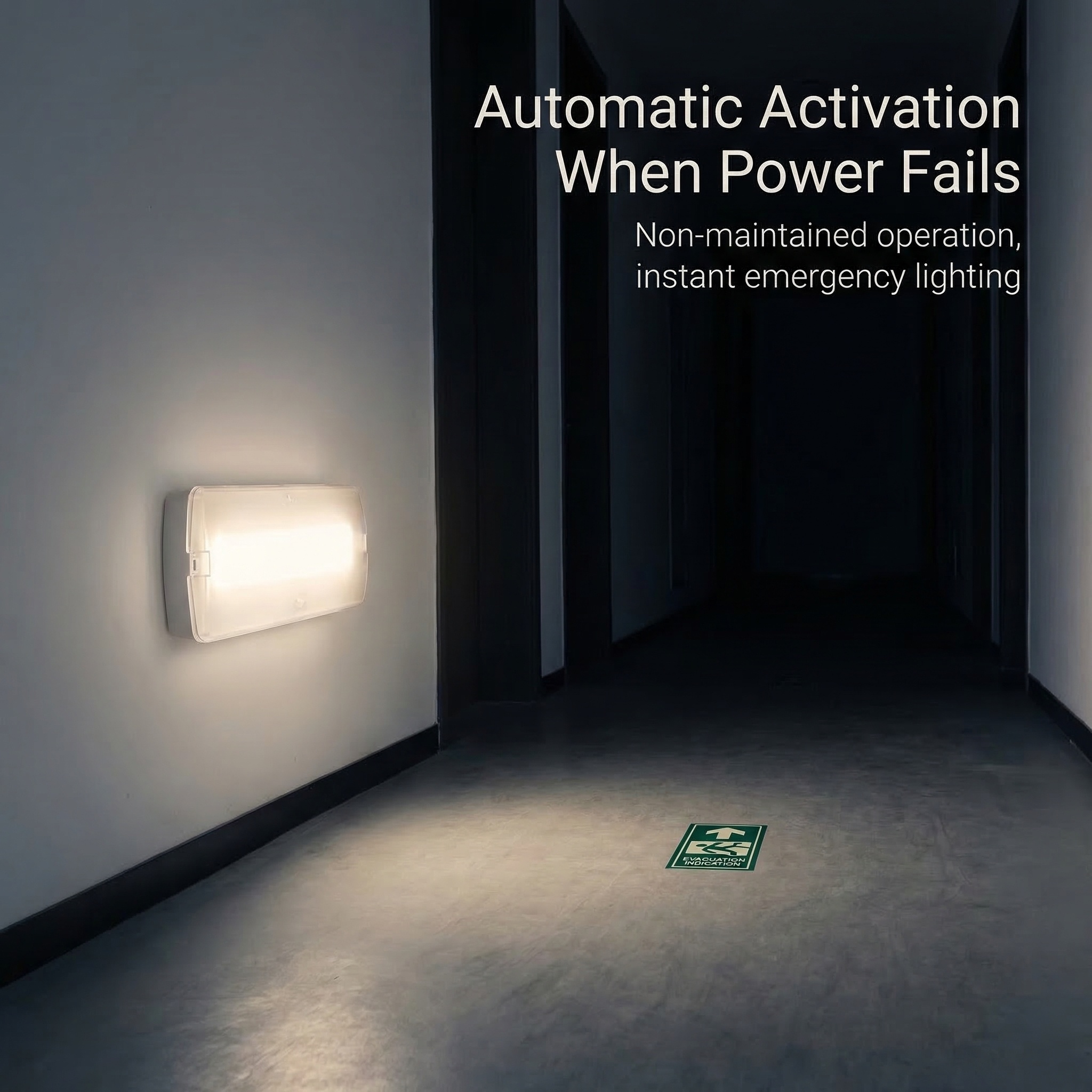
Bulkheads, downlights and surface luminaires built as complete emergency fittings with integral battery and charger.
Frequently Asked Questions About Parking Garage Emergency Fixtures Manufacturerin
Minimum Order Quantity and Sample Policy
Q: What is the minimum order quantity and can I evaluate samples before committing to a container?
MOQ is 500 units for standard IP65 emergency bulkheads and 300 units for twin-spot or exit sign variants. Samples ship within 5 working days against pro-forma invoice; sample cost is netted against first production order. For OEM housings or custom optics the MOQ rises to 1,000 units due to tooling amortisation.
Matching Product to Host Fixture and Local Code
Q: How do I confirm your emergency module suits the LED high bay or linear fixture already specified for the garage?
Request the inverter’s DC output window: typical ranges are 50-240V DC at 150-350mA constant current, or 200-240V DC at 500mA, driving 10W to 60W emergency load. Verify the host fixture’s LED string voltage falls inside this window. For NFPA 101 jurisdictions insist on UL 924 recognised components; for EN 60598-2-22 markets demand the supplier’s test data showing 1 lux minimum on the floor plate after 90 minutes.
Emergency Duration and Output Options
Q: What emergency durations and lumen outputs are available for parking garage applications?
Standard durations are 90 minutes, 2 hours and 3 hours. Emergency output is typically 10% to 100% of normal luminaire output: a 4,000lm high bay can deliver 400lm (10%) for 3 hours or 2,000lm (50%) for 90 minutes from the same LiFePO4 3.2V 6,000mAh pack. Higher percentages need larger Li-ion 18650 7.4V 5,200mAh packs with 8-hour recharge time.
Maintained Versus Non-Mained Wiring and Self-Test
Q: Do you supply maintained, non-maintained, or combined wiring, and what test facilities are built in?
All three modes are available. Maintained wiring uses a changeover relay to switch from mains to inverter; non-maintained leaves the emergency lamp off during normal supply. Options are manual test key, automatic self-test to EN 62034, or DALI-2 emergency test reporting. DALI requires a two-wire bus and compatible control gear; self-test needs no external infrastructure but logs only locally.
Battery Chemistry Replacement Interval and Shipping
Q: What battery chemistries do you use, how often must they be replaced, and how does lithium affect shipping?
NiCd 3.6V 1,800mAh packs last 4 years and ship as general cargo. LiFePO4 3.2V 3,000mAh packs achieve 500-800 cycles, 5-7 year service life, and need UN 38.3 test reports for air freight (IATA PI 965 Section IB) and IMDG documentation for sea freight. Li-ion 18650 7.4V packs offer higher energy density but stricter state-of-charge limits: 30% maximum for air transport.
Lead Time and Payment Terms
Q: What is production lead time and what payment structure do you accept?
Standard products: 25-30 days after deposit. OEM tooled products: 45-55 days. Terms are 30% TT deposit, 70% LC at sight or TT against BL copy for orders under USD 50,000; orders above USD 100,000 can negotiate 20% deposit, 80% 60 days LC. Currency is USD FOB Shenzhen; CIF quotes available for nominated forwarders.
Test Reports Conformity Marks and Destination Markets
Q: Which conformity marks and test reports can you supply for my market?
The supplier should provide EN 60598-2-22 and EN 1838 test reports for CE-marked entry to Europe; BS 5266-1 data sheets for UK projects; UL 924 file numbers or recognition documents for US and Canadian jurisdictions; and AS/NZS 2293 test reports for Australia and New Zealand. Ask for the actual test laboratory name and report date; do not accept generic “compliant” claims without documentation.
Warranty Spare Parts OEM Support and Commissioning
Q: What warranty, spare parts availability, OEM branding, and installation support do you offer?
Standard warranty is 3 years on electronics, 2 years on NiCd, 3 years on LiFePO4. Spare battery packs and inverter modules are stocked for 5 years post-discontinuation. OEM branding adds 7-10 days for laser marking and custom carton print. Installation manuals in English, Spanish, or Arabic are standard; commissioning support is remote video guidance with optional site visit at buyer’s expense.
Important Notice
Specifications, output and duration figures and price ranges in this guide are indicative and are provided
for planning purposes only. Actual emergency output, duration, battery life, ingress protection and available conformity documentation
differ by model and by destination country, and emergency lighting design remains the responsibility of the project designer. Buyers
must confirm their own mains voltage and frequency, the emergency lighting standard enforced locally, the host fixture compatibility
and their import requirements before placing an order. All figures are subject to written confirmation in the final proforma invoice
issued by Hymark.
Sourcing Parking Garage Emergency Fixtures Manufacturerin from Hymark
Matching the Emergency Module to Your Host Fixture
Parking garage luminaires typically run 20W to 150W in LED form, mounted at 2.5m to 4m height with IP65 protection against vehicle spray and condensation. The emergency module must match three parameters: the driver output window in DC volts, the driven load in watts, and the physical space inside the housing.
Hymark emergency drivers for LED high bays and linear luminaires cover input ranges of AC 85-265V or 100-277V, with constant-current inverter outputs from DC 25-42V at 300mA to 700mA, supporting 10W to 60W emergency loads. For a 50W parking bay fixture, specify whether you need 10% (500 lumens), 20% (1,000 lumens) or 50% (2,500 lumens) emergency output. Full-power-output emergency drivers are available for applications where the full normal lumen package is required during egress.
Battery selection involves a direct trade-off. LiFePO4 packs at 3.2V 3000mAh deliver 90 minutes at 6W with roughly 500 to 800 cycles and charge in 24 hours. Li-ion 18650 cells at 3.7V 2600mAh offer higher energy density for compact housings but 300 to 500 cycles. NiCd remains viable for high-temperature environments above 45°C ambient where lithium chemistries degrade, though at 40% heavier weight and memory-effect maintenance.
What Your Code Requires and What to Verify
Parking garages fall under egress lighting standards that vary by destination market. EN 1838 specifies 1 lux minimum on the centreline of escape routes for open deck structures, with 0.5 lux minimum in adjacent areas. BS 5266-1 adds maintained operation where the public has access. UL 924 for North American projects requires 90-minute duration with automatic transfer. AS/NZS 2293 sets 0.2 lux for carpark egress paths with 90-minute or 2-hour duration depending on building classification.
Ask any supplier—not assume—to provide test reports showing compliance with the specific standard your project references. EN 60598-2-22 covers construction and marking of emergency luminaires. EN 62034 addresses automatic test systems including self-test and DALI-2 test facility interfaces. IEC 61347 covers LED control gear safety. Hymark modules are designed with these requirements as the engineering target; verification documentation should be requested during quotation for the specific destination market.
Supplier Qualification Beyond the Data Sheet
A parking garage fixture supplier must demonstrate three capabilities: in-house emergency electronics design, battery pack assembly with traceable cells, and export logistics experience for your region. JIALINGHANG ELECTRONIC CO., LTD. shifted from general LED illumination to emergency technology in 2017, with Hymark launched in 2026 as the premium brand. R&D, product design and global distribution are managed directly by the company, while manufacturing operates through partnered facilities with continuous operation since 2013.
This structure matters for parking garage projects because emergency configurations are rarely off-the-shelf. You will likely need selectable maintained or non-maintained wiring, a specific emergency duration—90 minutes, 2 hours or 3 hours—and OEM branding on the housing or carton. Hymark supplies all three with export carton packing and FOB or CIF terms. MOQ starts at one carton for standard modules; custom driver output windows or IP66 housings require project-level discussion with 4 to 6 week lead times after sample approval.
Lithium battery shipments require UN 38.3 test summary reports for air freight and IATA/IMDG compliance for sea freight. Verify that your supplier has current documentation; Hymark provides this with each shipment upon request.
Requesting Your Specification
Send the host fixture type and wattage, the emergency duration your code requires, your mains voltage and frequency, and your destination port. Hymark returns a configuration match and quotation within 24 hours via WhatsApp or email. Include any specific standard—EN 60598-2-22, UL 924, AS/NZS 2293 or other—so the response addresses compliance verification directly.
Get a Factory Direct Quote on Parking Garage Emergency Fixtures Manufacturerin
JIALINGHANG ELECTRONIC CO., LTD. has been in LED lighting since 2013 and has focused on
LED emergency technology and high performance LED strips since 2017. Hymark products are co-designed with our
dedicated manufacturing partners, built with selectable emergency duration and maintained or non-maintained wiring, and function
tested before packing. Send us the host fixture type and wattage, the emergency duration your local code requires, your mains
voltage and your destination port and we will return a quotation within 24 hours.


 English
  Spanish
  Arabic
  French
  German
  Russian
  Portuguese
  Italian
  Vietnamese