
Power Outage Lighting Buyer Guide
The right power outage lighting supplier in China is not the one with the largest catalogue, but the one whose factory can prove traceability from battery cell to finished driver and keep your shipment from being rejected at customs for the wrong test reports. Buyers in the UK, Europe, the Middle East and Southeast Asia need different proof: EN 60598-2-22 and EN 1838 test summaries for CE-marked markets, BS 5266-1 discharge records for British projects, UL 924 third-party data for North American destinations, or AS/NZS 2293 evidence for Australasia. The rest of this page covers the factory-level checks that separate a real manufacturer from a trading office, and what those checks mean for lead time, sample validity and after-sales support when a driver fails in the field.
In-House SMT and Assembly Capacity
A genuine emergency lighting manufacturer runs surface-mount assembly for the inverter PCB, not just final screw-driver assembly of bought-in modules. Ask for photos or video of the SMT line: Yamaha or Juki pick-and-place machines, reflow ovens with temperature profiling, and AOI stations for solder-joint inspection. A factory without SMT outsources the critical constant-current inverter and changeover relay circuitry, which means they cannot control the output window that drives your LED module. Hymark’s facility in Guangdong runs SMT in-house for emergency driver boards from 3W to 40W emergency output, with output windows from DC 12V 250mA up to DC 50V 700mA depending on the model. Trading offices will show you a workshop with workers screwing black boxes together; the SMT floor is the difference.
Battery Sourcing and Cell Traceability
The battery pack is the single most expensive component and the most common failure point. Ask for the cell manufacturer’s name and model number, not just “lithium battery.” LiFePO4 3.2V 1500mAh to 3000mAh packs dominate three-hour emergency duration designs because they deliver 500 to 800 cycles at 80 percent depth of discharge. Li-ion 18650 3.7V 2000mAh to 2600mAh cells offer higher energy density but shorter cycle life, typically 300 to 500 cycles, and carry stricter UN 38.3 transport restrictions. NiCd 3.6V 700mAh to 1800mAh remains the budget option for 90-minute duration at low wattage, but buyers lose the environmental profile and the longer cycle life. Demand the cell supplier’s COA (Certificate of Analysis) and lot numbers. A factory that cannot provide these is assembling with grey-market cells that will fail the 50°C ambient temperature test in EN 60598-2-22.
Discharge and Duration Test Records
Every emergency driver must prove it hits the rated duration at the rated load. Ask for continuous discharge test logs: a 10W LED high bay emergency driver running for 180 minutes on battery, with lumen output recorded at 60-second intervals. EN 1838 requires emergency egress lighting to deliver minimum 1 lux on the floor at the end of the duration; for anti-panic open areas, minimum 0.5 lux. The test record should show the battery voltage at start, at 50 percent duration, and at cutoff, plus the inverter efficiency percentage. A factory doing its own testing will have ageing racks with dozens of drivers cycling simultaneously. Ask how many units are on test at any given time: a few dozen suggests genuine volume; a handful suggests spot-checking of bought-in goods.
Ageing and Hipot Test Stations
Before a driver leaves the line, it should pass burn-in and dielectric testing. Hipot (high potential) test applies 1500V AC or 1800V DC between input and output for 60 seconds per IEC 61347, checking for insulation breakdown in the transformer and PCB spacing. Ageing runs the driver at 110 percent load for 2 to 4 hours at 45°C ambient to catch infant mortality in capacitors and switching transistors. A trading office cannot show you these stations because they do not own them. Ask for the test protocol document and the daily log sheets.
Third-Party Test Reports for the Destination Market
This is where most shipments get stuck. A supplier showing only a generic “CE certificate” from an unknown body is not enough. For the UK, you need test evidence assessed against BS 5266-1 and EN 60598-2-22, with the UKCA marking process documented. For the EU, EN 62034 for automatic test systems if the driver includes self-test or DALI test facility. For the Middle East, G-Mark or SASO depending on the Gulf state, with specific national deviations. Ask for the test report number, the testing laboratory name, and the scope of the accreditation. Then verify it yourself on the laboratory’s website or the accreditation body’s database. Never accept a PDF at face value.
Sample Lead Time and What It Reveals
A factory with genuine in-house capacity ships samples in 5 to 10 working days for standard emergency drivers, 10 to 15 days for custom output windows or non-standard battery configurations. A trading office quoting 15 to 25 days is buying from a factory themselves and adding margin. The sample should carry the same battery cell lot, the same firmware version, and the same PCB revision as production units. Mark the sample PCB with a permanent marker and compare it to the first production batch: any difference in component placement or silkscreen suggests the sample was sourced from a different line or supplier.
Payment Structure and Factory Financial Health
Real manufacturers typically ask 30 percent deposit, 70 percent against copy of bill of lading for orders below $30,000 FOB Shenzhen. For larger orders or new relationships, some accept 30/40/30 with the final 30 percent after inspection. A supplier demanding 100 percent advance payment, or offering unusually generous 90-day terms without a track record, is a signal to verify. The factory’s registered capital on its Chinese business licence is public information; cross-check it against the order value you are placing.
After-Sales Engineering Capability
When a driver fails in a London office block or a Dubai hotel, you need a technical contact who can read the fault codes, not a sales assistant who forwards emails. Ask for the after-sales process: who analyses returned units, what equipment they use (oscilloscope, programmable DC load, battery analyser), and what the typical turnaround is for failure analysis report. A factory with in-house engineering returns a 2-page report with waveform captures in 5 to 7 days. A trading office returns a replacement unit and no explanation, leaving you vulnerable to repeat failures across the installation.
Types and Configurations of Power Outage Lighting
| Type or Class | Typical Rating or Output | Duration or Runtime | Best Suited For | Notes |
|---|---|---|---|---|
| Full-Power Emergency Driver for LED High Bay | 100W–200W normal; 100% output in emergency | 90 min or 180 min | Warehouses, factories, sports halls | Requires thermal management; LiFePO4 12.8V 4500mAh typical |
| Reduced-Power Emergency Driver for Panels and Tubes | 20W–60W normal; 10%–30% output in emergency | 90 min, 120 min, 180 min | Offices, corridors, retail | EN 1838 minimum 1 lux on escape route; constant current output 25–350V DC |
| Self-Contained Emergency Twin Spotlight | 2 × 3W LED heads; 600–900 lm total | 90 min or 180 min | Small shops, stairwells, temporary sites | Non-maintained wiring standard; IK08–IK10 enclosure |
| Maintained Emergency LED Strip (COB or High-Density SMD) | 10W/m–15W/m; 1000–1500 lm/m; CRI 90+; 2700K–4000K | Battery-backed section 90 min | Display, architectural, safety marking | 24V or 48V system; cut length 50mm–100mm; PCB 10mm–12mm width, 2oz copper |
| Stand-Alone Rechargeable Emergency Bulb (E26/E27) | 13.5W actual; 5000mAh Li-ion; 7200K | 8–10 hours claimed | Residential, informal retail, developing markets | Not EN 60598-2-22 certified as system; self-test absent; buyer must verify lumen maintenance |
| DALI-Addressable Emergency Luminaire with Central Monitoring | Programmable output 5%–100%; automatic duration test | 90 min–180 min programmable | Smart buildings, airports, hospitals | EN 62034 functional safety; requires DALI-2 input; self-test logs timestamped |
Full-Power Emergency Driver for LED High Bays
This class addresses the gap between normal high-bay operation and true emergency egress lighting in high-ceiling industrial spaces. A 150W LED high bay running at full 150W in emergency mode needs a LiFePO4 battery pack at 12.8V nominal, typically 4500mAh to 6000mAh, delivering constant current through a wide output window of 100V–280V DC at 350mA–700mA depending on LED forward voltage configuration. The driver itself accepts AC 85V–265V or 100V–277V and contains a changeover relay with transfer time under 0.25 seconds to avoid visible interruption. Buyers are typically industrial procurement officers and M&E consultants specifying warehouse fit-outs in the Middle East and Southeast Asia. What this cannot do is run indefinitely; thermal rise in the LED module at full power without mains cooling must be modelled, and many suppliers derate to 80% after 60 minutes to protect the battery. A real manufacturer will show discharge test records at 25°C and 45°C ambient, and the buyer should request third-party test reports against IEC 61347 and EN 60598-2-22 for the destination market.
Reduced-Power Emergency Driver for Panels and Tubes
This is the volume configuration for commercial retrofit and new build across Europe and the UK. The emergency driver delivers 10% to 30% of normal luminaire output—commonly 6W emergency from a 40W panel or 3W from a 20W tube—sufficient to meet EN 1838 minimum 1 lux on the centre line of escape routes. Output voltage is typically 25V–80V DC at 150mA–300mA constant current, with battery packs using Li-ion 18650 cells at 3.6V nominal, 2200mAh–2600mAh, arranged in 2S2P or 2S3P for 7.2V or 10.8V system voltage. Charge time is 16–24 hours to full capacity. Electrical contractors and lighting wholesalers buy this in volume for office and retail rollouts. What it cannot do is provide task lighting during an outage; the output is strictly for safe egress, and maintained versus non-maintained wiring must be specified at order—maintained versions require a permanent live plus switched live plus neutral, which many existing installations lack.
Self-Contained Emergency Twin Spotlight
The twin spotlight remains the default for small premises and temporary installations where a full luminaire retrofit is uneconomic. Two adjustable 3W LED heads, each 300–450 lm, mount on a rectangular or circular back box containing the battery and inverter. Enclosure ratings run IP65 and IK08 for internal use, IP66 and IK10 for external or aggressive environments. NiCd battery packs at 3.6V or 4.8V, 1200mAh–1800mAh, still dominate this price band, though LiFePO4 variants at 6.4V are penetrating for longer cycle life—500 cycles versus 300 for NiCd at standard charge regimes. Facility managers and small electrical contractors in Africa and Latin America are the core buyers. What this cannot do is integrate with building management systems; there is no DALI or self-test circuitry in the base configuration, and manual test key compliance to BS 5266-1 requires a maintenance contract with recorded monthly and annual tests.
Maintained Emergency LED Strip
Architectural and display lighting increasingly requires emergency backup that preserves the continuous line of light aesthetic. COB LED strips at 480 LEDs/m or high-density SMD2835 at 240 LEDs/m, 10W/m–15W/m, 1000–1500 lm/m, CRI 90+, colour temperature 2700K–4000K, run at 24V or 48V DC and use battery-backed driver sections every 2.5m–5m. The strip itself is typically IP20 or IP65 depending on silicone coating, with PCB width 10mm–12mm and 2oz copper to handle current density and thermal spread. Battery packs are Li-ion 18650 in 3S2P or 4S2P for 11.1V or 14.8V nominal, 4400mAh–5200mAh, giving 90 minutes at reduced output. Lighting designers and premium retail specifiers buy this for brand environments. What it cannot do is deliver full output across long runs in emergency; voltage drop in 24V systems limits single-feed lengths to 5m–7m, and the battery pack adds 15mm–25mm profile that may conflict with shallow recesses.
Stand-Alone Rechargeable Emergency Bulb
The E26/E27 screw-base rechargeable bulb, typified by 15W rated, 13.5W actual, 5000mAh Li-ion, 7200K colour temperature, 6–8 hour charge time, serves informal retail and residential markets in developing economies where wiring infrastructure is unreliable and product cost is paramount. These units charge when mains is present and switch to internal battery when voltage collapses, with no external driver or changeover relay. Procurement officers for housing projects and informal retail chains in Southeast Asia and Africa are the primary buyers. What this cannot do is satisfy life safety codes in regulated markets; there is no EN 60598-2-22 system certification, no self-test or DALI capability, no lumen maintenance guarantee at 90 minutes, and the 8–10 hour runtime claim assumes gradual dimming rather than constant output. A buyer qualifying a supplier should demand discharge curves at constant load, not just aggregate mAh figures.
DALI-Addressable Emergency Luminaire with Central Monitoring
This class represents the integration of emergency lighting into smart building infrastructure. Each luminaire carries a DALI-2 emergency control gear module per EN 62034, enabling programmed self-test of duration and function, timestamped fault logging, and automatic reporting to a central station. Output is configurable from 5% to 100% of normal, with battery packs typically LiFePO4 at 12.8V, 3000mAh–6000mAh, supporting 90 minute to 180 minute runtime at programmed level. Input is AC 220V–240V or 100V–277V depending on market. M&E consultants, airport and hospital facility managers, and corporate procurement in the UK and Europe specify these. What this cannot do is operate without commissioning; the DALI bus requires addressing, scene programming, and integration with the fire alarm or BMS, adding 2–4 weeks to project handover. A trading office cannot support this; the supplier must demonstrate in-house firmware programming, ageing test stations with 1000-hour minimum records, and after-sales engineering capable of remote diagnostics or on-site recommissioning.
Supplier Qualification Checklist for Power Outage Lighting Buyers
When evaluating a power outage lighting supplier in China, request evidence across six domains before placing trial orders. First, SMT and assembly capacity: ask for photos or video of surface-mount lines handling the specific driver ICs and battery management chips in your specification, not generic factory images. Second, battery sourcing and traceability: demand cell manufacturer certificates and batch codes—Samsung, LG, EVE Energy, or Lishen for Li-ion; BYD or CATL sub-brands for LiFePO4—and verify the supplier holds UN 38.3 test summaries for lithium transport, plus IATA and IMDG shipping compliance records. Third, discharge and duration test records: every SKU should have continuous discharge logs at rated load to declared duration, with temperature and voltage curves, not just pass/fail summaries. Fourth, ageing and hipot test stations: look for 1000-hour minimum ageing rooms at 45°C ambient, and hipot testers rated to 3kV AC or 4kV DC for insulation verification on each unit. Fifth, third-party test reports for the destination market: the supplier should provide CB test certificates, or ENEC, UL, or AS/NZS test reports issued to their own company name, not borrowed or expired documents. Sixth, sample lead time and payment structure: genuine manufacturers typically quote 7–14 days for driver or luminaire samples, 3–5 days for strip samples, and accept 30% T/T deposit with 70% against BL copy; trading offices often demand 50% upfront and quote 3–4 weeks. After-sales engineering capability is revealed by the specificity of responses to wiring configuration questions—maintained versus non-maintained, switched live polarity, DALI addressing—not by generic assurances.
Specifications and How to Read Them
| Parameter | Entry Level | Mid Range | High Specification |
|---|---|---|---|
| Input Voltage | AC 85-265V 50/60Hz | AC 100-277V 50/60Hz | AC 220-240V 50Hz or AC 120V 60Hz market-specific |
| Driven Load (Normal) | 10W LED panel | 40W LED high bay | 150W LED high bay |
| Emergency Output | 300 lm, 30% of normal | 800 lm, 50% of normal | 3000 lm, 100% of normal |
| Emergency Duration | 90 minutes | 2 hours | 3 hours |
| DC Output Window | 12-24VDC 350mA constant current | 25-42VDC 700mA constant current | 100-240VDC 1050mA constant current |
| Battery Chemistry | NiCd 3.6V 1500mAh | Li-ion 18650 3.7V 2600mAh | LiFePO4 3.2V 6000mAh |
| Charge Time | 24 hours | 8 hours | 4 hours |
| Cycle Life | 300-500 cycles | 500-800 cycles | 1500-2000 cycles |
| Test Facility | Manual test key | Automatic self-test per EN 62034 | DALI-2 self-test with reporting |
| Wiring Mode | Non-maintained only | Maintained or non-maintained | Maintained with changeover relay |
| IP / IK Rating | IP20 / IK02 | IP65 / IK08 | IP66 / IK10 |
| Ambient Temperature | 0°C to +35°C | -10°C to +45°C | -20°C to +55°C |
| Dimensions | 120×40×30mm | 180×60×40mm | 280×90×55mm |
| Mounting | Internal box fixing | Internal or remote box | Remote steel enclosure with gland |
How to Read the Datasheet Line by Line
Input voltage range and frequency tells you whether the driver will survive your local grid. AC 85-265V covers most of the world except Japan (100V) and parts of the Middle East where 127V persists. A narrow range such as AC 220-240V usually means cheaper magnetics but no universal stock flexibility. Ask for the actual standby power consumption: below 0.5W is typical for self-test units, but entry-level designs may draw 1-2W continuously.
Driven load in watts is the normal-mode LED power the emergency module supports, not the emergency output. A 40W-rated driver feeding a 60W fixture will overheat; a 150W-rated driver on a 40W fixture wastes money and space. Match this to your luminaire’s LED module precisely.
DC output voltage window and current reveals the driver’s compatibility. Constant-current output at 350mA, 700mA or 1050mA must align with your LED module’s forward voltage curve. The window—say 25-42VDC—must encompass the LED string voltage at operating temperature. Too low and the driver cannot strike; too high and efficiency collapses.
Emergency output in lumens and percentage of normal determines compliance. EN 1838 requires minimum 1 lux on the floor along escape routes for open areas and 0.5 lux for anti-panic areas, but the practical question is whether occupants can navigate stairs and find exits. A 30% output from a 10W panel gives roughly 300 lm; adequate for a small office but marginal for a warehouse. Full-power 100% output, increasingly common with LiFePO4 packs, eliminates the visibility drop but doubles battery cost.
Emergency duration is 90 minutes for most jurisdictions, 2 hours in some Middle Eastern specifications, 3 hours for UK healthcare or high-risk premises. The battery must deliver this at end of life, not when new. Ask for the discharge curve at cycle 500, not cycle 10.
Battery chemistry voltage and capacity drives price and longevity. NiCd 3.6V 1500mAh is cheap, tolerant of temperature, and recyclable through established channels, but carries memory effect and cadmium content that restricts EU use. Li-ion 18650 3.7V 2600mAh offers better energy density but requires PCB protection against over-discharge and thermal runaway. LiFePO4 3.2V 6000mAh costs 40-60% more upfront, delivers 1500-2000 cycles, and withstands 55°C ambient without degradation. For tropical markets or 3-hour duration, LiFePO4 is often the lower total cost of ownership.
Charge time and cycle life interact. A 24-hour charge time on NiCd usually means trickle charging at 0.1C; faster charging reduces cycle life by half. LiFePO4 accepts 0.5C charging, reaching full capacity in 4 hours, but the charger circuit must include cell balancing. Ask for the BMS specification: passive balancing is standard, active balancing extends pack life further.
Test facility determines maintenance burden. Manual test key (monthly functional test, annual duration test per BS 5266-1) suits small installations with dedicated maintenance staff. Automatic self-test per EN 62034 reduces labour but adds £8-15 to unit cost. DALI-2 integration enables centralised reporting and failure logging, essential for campuses or distributed retail chains. Verify whether the DALI implementation is certified to IEC 62386-202 or merely claims compatibility.
Maintained versus non-maintained wiring affects installation cost. Non-maintained: the emergency unit sits dead until mains fails, requiring only switched live and neutral. Maintained: the emergency lamp operates normally via a changeover relay, requiring permanent live, switched live, and neutral. The relay must carry the normal-mode current without welding; specify contact rating at least 1.5× the LED driver input current.
IP and IK rating determines enclosure selection. IP20 suffices for interior office ceilings; IP65 for car parks, toilets, and plant rooms where water spray occurs; IP66 for external canopies and tunnels. IK02 (0.2 joule impact) is inadequate for public spaces; IK08 (5 joule) resists typical vandalism; IK10 (20 joule) for prisons, sports halls, and railway platforms. The glass or polycarbonate diffuser usually limits IK before the steel body does.
Ambient temperature range is where batteries fail first. NiCd performs to -20°C but fades above 35°C. Li-ion above 45°C risks thermal runaway without protection. LiFePO4 operates to 60°C but charging must throttle above 45°C to preserve cycle life. Specify the temperature at the installation point, not the room average: roof voids in Dubai reach 70°C.
Dimensions and mounting must clear the luminaire’s internal space. A 280×90×55mm remote pack will not fit inside a 600×600 panel; specify remote mounting in a ventilated enclosure within 3 metres of the luminaire, using fire-rated cable (mineral-insulated or FP200) for the output circuit.
LED Strip Specifications Where Applicable
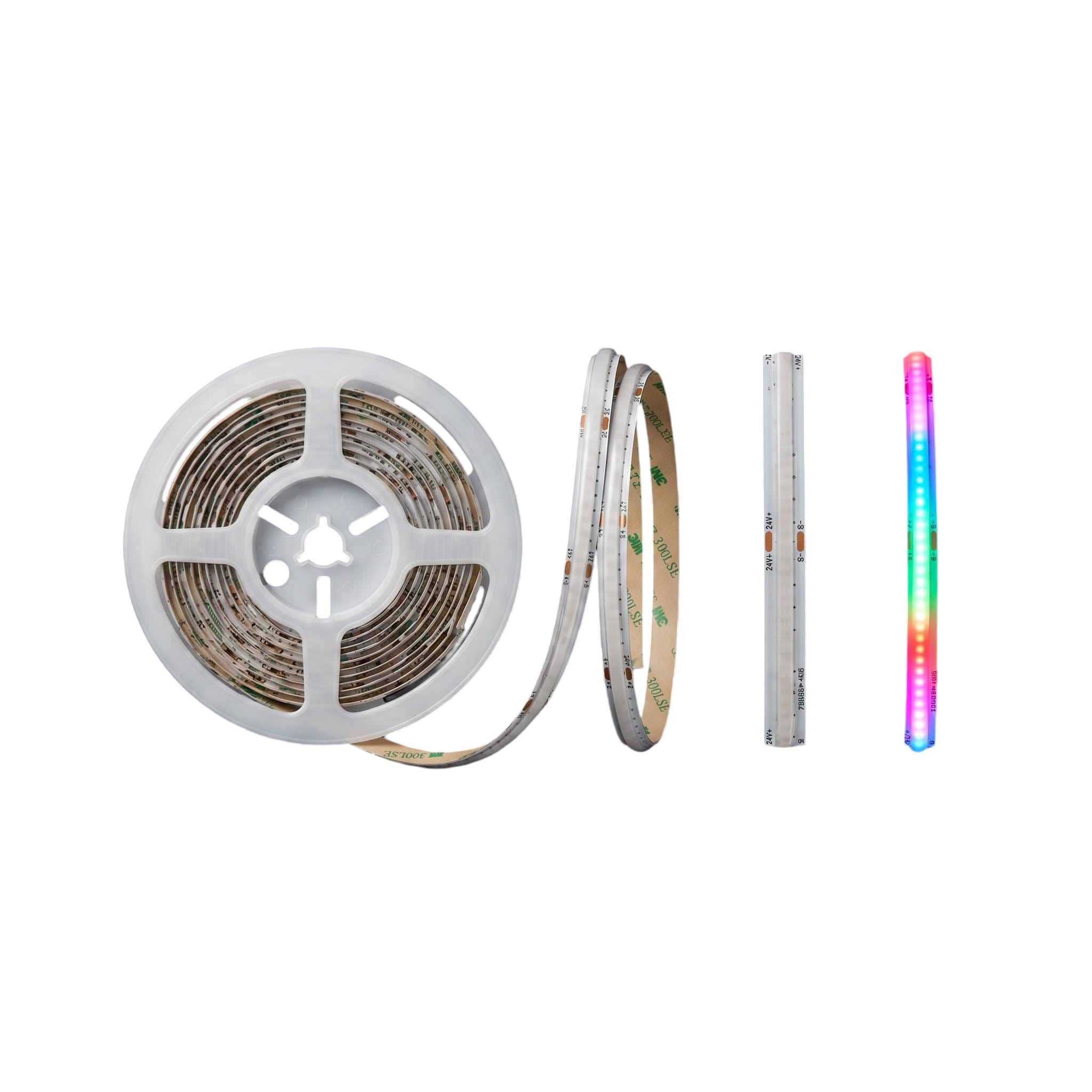
For COB LED strips used in emergency accent or contour lighting, the datasheet adds:
| Parameter | Typical Range |
|---|---|
| Working Voltage | DC 12V or DC 24V, occasionally DC 48V for long runs |
| Power per Metre | 5W/m to 15W/m for standard density, 20W/m for high output |
| Lumens per Metre | 500 lm/m at 5W/m to 2000 lm/m at 15W/m, depending on efficacy |
| LEDs per Metre | COB: 480 chips/m continuous; SMD 2835: 120-240 diodes/m; SMD 5050: 60-120 diodes/m |
| CRI | Ra 80 standard, Ra 90 premium, Ra 98 for retail or gallery applications |
| Colour Temperature | 2700K warm white, 3000K, 4000K neutral, 6000K daylight, tunable 2700K-6500K |
| Cut Length | Every 25mm for 24V, every 50mm for 12V, depending on LED pitch |
| Reel Length | 5 metres standard, 10 metres on request for COB continuous runs |
| PCB Width | 8mm for narrow channels, 10mm standard, 12mm for higher current capacity |
| Copper Weight | 2 oz/ft² (70µm) minimum for 5A+ runs, 3 oz/ft² (105µm) for 10A and minimal voltage drop |
| IP Class | IP20 bare strip, IP65 silicone-coated, IP67 silicone tube, IP68 full encapsulation |
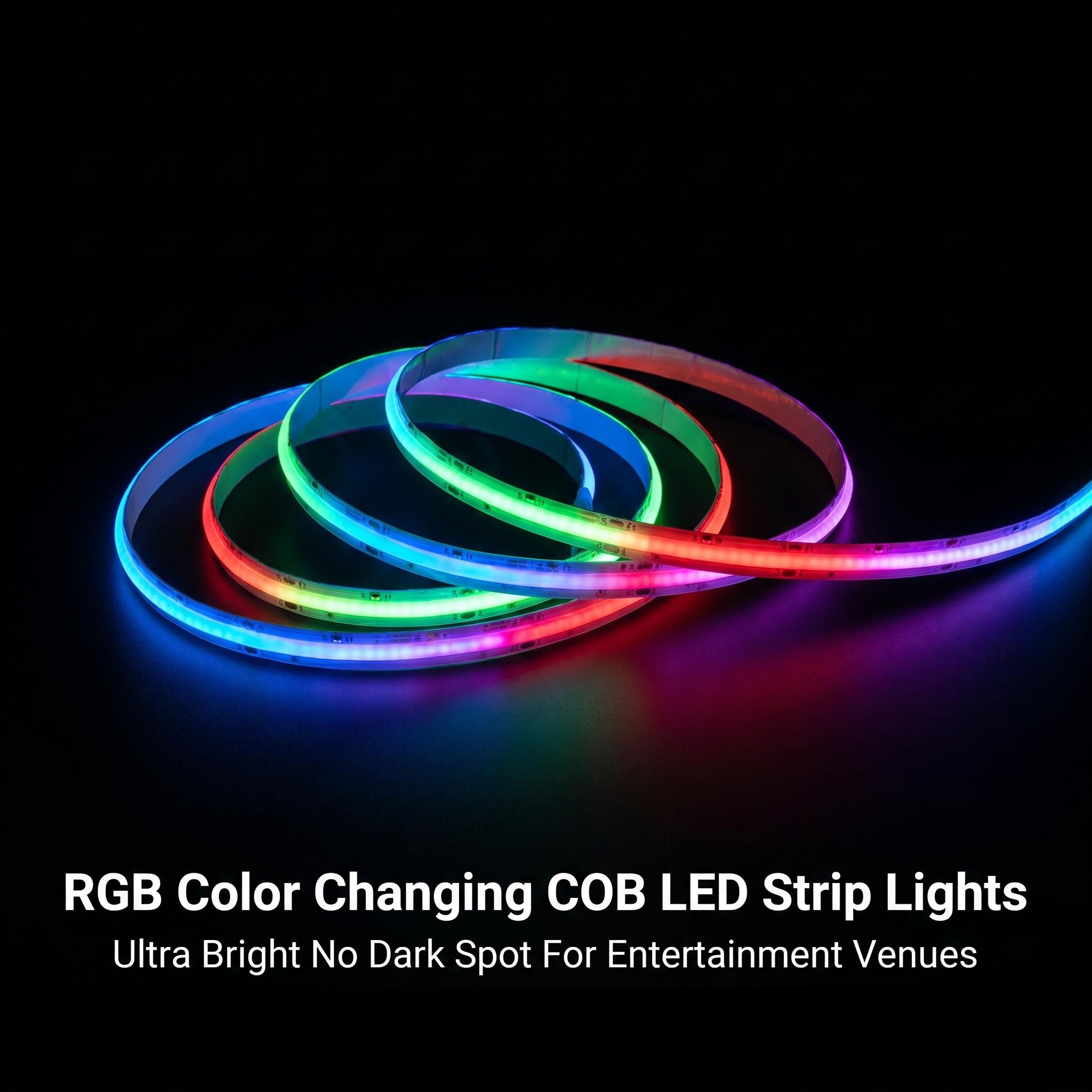
COB strips eliminate the dot effect of SMD packages but run hotter per unit length. Emergency applications using strip for waymarking must verify the strip output at battery voltage, not nominal: a 24V strip fed at 21V from a depleted LiFePO4 pack drops 12-15% in lumens.
Trade Terms and Export Practicalities
FOB (Free On Board) means the supplier delivers to the port of loading, clears export customs, and loads the container. You pay ocean freight, insurance, and destination charges. Typical for first-time buyers who want supplier accountability until the cargo crosses the ship’s rail.
CIF (Cost Insurance Freight) adds ocean freight and insurance to the supplier’s scope. You still handle import clearance and inland delivery. The supplier chooses the shipping line; specify “no transshipment” if port security or lithium battery restrictions require direct sailing.
CFR (Cost and Freight) is CIF without insurance. Rare in lighting; most buyers prefer CIF or arrange their own marine policy.
EXW (Ex Works) leaves all logistics to you. Useful if you have a China-based freight forwarder and want to consolidate multiple suppliers. You bear export clearance cost and complexity, including the 13% VAT refund verification.
L/C (Letter of Credit) protects both parties through bank intermediation but adds $300-800 in bank charges and 5-10 days processing. Common for first orders above $50,000 or markets with currency controls. Specify UCP 600 compliance and allow partial shipment if production batches split.
T/T (Telegraphic Transfer) is standard: 30% deposit on order confirmation, 70% against copy of bill of lading. Never pay 100% in advance for a first order. Some suppliers offer 10-15% discount for 100% T/T upfront; weigh this against the risk of non-delivery.
HS Code for LED emergency luminaires is 9405.10 (electric lamps and lighting fittings, of a kind used for motor vehicles), 9405.40 (other electric lamps and lighting fittings), or 8539.31 (LED lamps) depending on customs interpretation. Emergency drivers with integral battery may classify under 8504.40 (static converters) or 8507.90 (battery parts). Incorrect classification delays clearance; request the supplier’s pre-classification ruling or obtain your own binding tariff information.
CE and UKCA marking are not certificates the supplier “has” but declarations the manufacturer makes. For emergency lighting, the relevant directives are LVD (2014/35/EU), EMC (2014/30/EU), RoHS (2011/65/EU), and RED (2014/53/EU) if wireless testing is included. The supplier must provide the technical construction file, test reports to harmonised standards (EN 60598-2-22, EN 62034, EN 55015, EN 61547), and the signed DoC. UKCA requires UK-recognised standards; EN standards with UK designation remain valid but verify the supplier’s UKCA DoC references BS EN versions, not mainland EU EN versions.
UN 38.3 battery test report is mandatory for lithium battery air or sea transport. The report covers altitude simulation, thermal test, vibration, shock, external short circuit, impact/crush, overcharge, and forced discharge. Each battery cell design and each pack configuration requires separate testing. Ask for the UN 38.3 test summary in the format of ST/SG/AC.10/11/Rev.7 or later, with the supplier’s name as the “manufacturer” and the test laboratory’s name and accreditation. IATA PI 966 (lithium ion with equipment) or PI 967 (lithium ion in equipment) determines packaging; IMDG Code Section 3.3 covers sea freight. Without this, cargo airlines reject the shipment.
Packing list and certificate of origin must match the commercial invoice exactly. For UK-EU trade, REX-registered exporters self-certify origin; otherwise a China Council for Promotion of International Trade (CCPIT) certificate is standard. Some Middle Eastern customs require legalised origin certificates (Saudi Arabia, Iraq); verify before shipment.
Supplier Qualification Checklist
In-house or partnered SMT and assembly capacity separates manufacturers from trading offices. Ask for SMT line specifications: Yamaha, Juki, or Panasonic placement machines with 0402 component capability indicate genuine LED driver production. A supplier showing only final assembly benches with hand soldering likely sources PCBs elsewhere, adding a margin and quality risk. Request video walkthrough or third-party factory audit (SGS, Bureau Veritas, TÜV).
Battery sourcing and traceability is critical. The 18650 cell market includes A-grade (Samsung, LG, Panasonic), B-grade (off-specification but functional), and reclaimed cells from e-waste. Ask for cell manufacturer certificates and batch codes. LiFePO4 cells from EVE, CATL, or BYD are traceable; no-name pouch cells are not. The supplier should hold incoming inspection records for internal resistance and capacity.
Discharge and duration test records must exist for every batch. A manufacturer with ageing stations will show 100% discharge test at rated load for the full duration (90 min, 2 hr, 3 hr) before shipment. Ask for the last three months’ test summary: failure rate, failure mode, corrective action. Hipot test (1500VAC or 2× rated voltage + 1000VAC per IEC 61347-2-7) should be 100% on completed drivers.
Third party test reports for the destination market are what you pay for, not the CE mark itself. Request the full test report (not just the certificate) from an accredited lab: SGS, Intertek, TÜV Rheinland, DEKRA, BSI. Check the report covers the exact model number, voltage range, and battery configuration you are ordering. A report on a 90-minute NiCd version does not cover the 3-hour LiFePO4 version.
Sample lead time reveals production reality. Two weeks suggests stocked components or small-scale hand assembly. Six to eight weeks indicates scheduled SMT runs and battery pack build. Both are valid; the question is whether the sample matches mass production. Insist on production-line samples, not prototypes, for your evaluation.
Payment structure indicates supplier confidence. 30/70 T/T is standard for established relationships. Demands for 50/50 or 100% upfront, especially from a “manufacturer” with no verifiable export history, warrant caution. Escrow through Alibaba Trade Assurance or similar provides interim protection for first orders.
After-sales engineering capability matters when the luminaire fails compliance inspection. Can the supplier explain why the output dropped below 1 lux at 90 minutes? Will they provide revised photometric files for Dialux or Relux? A trading office forwards questions to the factory; a manufacturer has application engineers who understand the interaction between LED forward voltage, battery discharge curve, and inverter efficiency. Ask technical questions before order placement: the depth of response predicts post-sale support.
Power Outage Lighting Price and What Drives It
| Class | Typical Rating or Output | Duration or Runtime | Indicative FOB USD |
|---|---|---|---|
| Domestic rechargeable bulb (E27/B22) | 5–9W normal / 3–5W emergency, 300–500 lm | 3–5 hours | $2.80–$5.50 |
| LED emergency driver for panel/linear | 3–10W emergency, 25–50% of normal lumen output | 90 min–3 hours | $8.50–$18.00 |
| LED emergency driver for high bay | 10–25W emergency, 10–25% of normal lumen output | 90 min–3 hours | $15.00–$32.00 |
| Self-contained emergency luminaire (IP20) | 200–400 lm maintained or non-maintained | 1–3 hours | $12.00–$28.00 |
| Self-contained exit sign | 15–30 lm face illumination to EN 1838 | 90 min–3 hours | $9.00–$22.00 |
| Weatherproof emergency luminaire (IP65+) | 300–600 lm, polycarbonate or die-cast housing | 2–3 hours | $22.00–$45.00 |
| Emergency twin spotlight (halogen/LED) | 2 × 3W LED spots, 200–400 lm each | 90 min–3 hours | $18.00–$38.00 |
Battery Cells and Chemistry as the Dominant Cost Driver
The battery pack typically represents 25–35% of the bill of materials for a self-contained emergency fitting and 30–40% for an emergency driver with integrated battery. The chemistry choice locks in price, weight, transport restrictions and replacement cycle:
- LiFePO4 3.2V cells: 1500–2500 mAh per 18650 format cell, 2000–3500 cycles to 80% capacity, stable thermal profile. Cell cost roughly $1.80–$3.20 per 18650 in volume. A 6.4V 3000 mAh pack (2S1P) for a 10W 90-minute driver lands around $5.50–$9.00 in cell cost alone. UN 38.3 test report required for air freight; IATA Section II or Section IB labeling applies depending on Watt-hour rating (≤100 Wh per package or >100 Wh).
- Li-ion NMC 3.6V 18650 or 26650: 2000–3500 mAh, 500–800 cycles, higher energy density but stricter transport rules. Cell cost $1.50–$2.80 for 18650, $2.80–$4.50 for 26650. A 7.4V 2600 mAh pack (2S1P) for a 5W maintained exit sign runs $4.00–$7.00 cell cost. IATA Dangerous Goods regulations limit passenger aircraft to 35 kg net lithium content per package; cargo aircraft only above that threshold.
- NiCd 1.2V D or AA cells: 1500–4500 mAh, 300–500 cycles, heavier, no lithium transport restrictions, declining availability due to environmental directives. Cell cost $0.80–$1.50 per D-cell. A 3.6V 4000 mAh pack (3D) for a 90-minute bulkhead fitting costs $3.50–$5.50 in cells but adds 180–250 g to the unit weight.
Buyers should request cell supplier certificates (UL1642, IEC 62133, UN 38.3) and batch code traceability. Trading offices often cannot provide cell-level documentation; manufacturers with direct OEM cell relationships can.
Driver and Inverter Electronics
The emergency inverter converts battery DC to LED-usable constant current. Key cost variables:
- Output window: 9–50V DC at 150–350 mA for linear/panel drivers; 20–80V DC at 300–700 mA for high bay drivers. Wider output ranges require larger magnetics and more switching components, adding $1.50–$3.00 to the driver PCB.
- Changeover relay or solid-state switching: Relay-based designs cost $0.60–$1.20 in components but add 50–100 ms switchover time and mechanical wear. Solid-state designs add $1.80–$3.50, switch in <5 ms, and suit maintained wiring schemes where seamless transition matters.
- Self-test microcontroller: Adds $2.00–$4.50 for EN 62034-compliant automatic testing with fault signalling. DALI-2 compatibility for emergency (IEC 62386-202) adds $3.50–$6.00 for the interface and certification integration.
A basic non-maintained driver PCB with relay changeover and manual test key costs $3.50–$6.00 in components. A maintained-capable, self-testing, DALI-compatible board runs $9.00–$16.00.
LED Package and Light Engine
For self-contained luminaires, the LED module represents 10–15% of cost:
- SMD 2835 or 5730 arrays: 80–120 lm/W system efficacy, 80 CRI minimum, 3000 K or 4000 K or 6000 K. A 3W emergency output module (250–350 lm) uses 12–18 LEDs at $0.04–$0.07 per chip in volume.
- COB LED for spot/emphasis: Higher centre-beam intensity, 50–80 lm/W at emergency power, $1.20–$2.50 per COB die for twin spotlight applications.
For emergency drivers sold to luminaire OEMs, the LED cost sits with the customer’s normal fixture; the driver must match the forward voltage and current profile.
Enclosure Hardware and Thermal Design
- Injection-moulded ABS or polycarbonate: $1.80–$3.50 for IP20 exit sign housings; $4.50–$9.00 for IP65 bulkheads with gasket and diffuser.
- Die-cast aluminium: $5.50–$12.00 for high bay emergency housings requiring thermal management for 10W+ emergency operation.
- Optics: Laser-dot or prismatic diffuser for exit signs, $0.80–$2.00; reflector for twin spots, $1.50–$3.00.
Test and Certification Amortisation
Third-party approval for the destination market is typically the second-largest cost line after the battery. Buyers should verify what the supplier actually holds versus what they claim:
- EN 60598-2-22 and EN 1838 testing: Photometric measurement of emergency illuminance distribution, duration test at rated temperature, charge/discharge cycle verification. Test house fees $4,000–$8,000 per product family. CB report to IEC 60598-2-22 adds $2,500–$4,500.
- BS 5266-1 compliance documentation: UK-specific application guide, not a test standard itself, but UK inspectors expect luminaire data sheets referencing it alongside EN 60598-2-22.
- UL 924: North American emergency lighting standard, $8,000–$15,000 for initial listing, annual factory audits $3,000–$5,000. Many Chinese suppliers do not maintain active UL files; buyers should request the UL file number and verify on ul.com.
- AS/NZS 2293: Australian/New Zealand standard, $6,000–$10,000 for test and certification.
Amortised over a 2,000-unit first production run, certification adds $3.00–$7.50 per unit depending on market scope. A supplier quoting $2.00 above material cost for “CE certified” product without named test house documentation is normally self-certifying or omitting the emergency-specific testing.
Assembly Labour and Factory Infrastructure
Real manufacturers maintain in-house or tightly partnered capacity:
- SMT line: Yamaha, Juki or Hanwha pick-and-place for driver PCBs, 0402 to 2835 component handling, AOI inspection. A trading office shows you another factory’s SMT room.
- Battery pack welding: Spot-weld or laser-weld for cylindrical cells, with thermal imaging or X-ray sample inspection. Ask to see the welding station and the cell incoming inspection log.
- Ageing and hipot: 2–4 hour burn-in at 40°C ambient, 100% functional test of switchover and duration. Hipot (dielectric withstand) at 1500V AC or 2U+1000V per EN 61347-2-7. A factory without visible ageing racks is assembling, not verifying.
Labour content is $1.50–$3.50 per unit for emergency drivers, $2.50–$5.00 for self-contained luminaires, depending on automation level and Guangdong versus inland province wage rates.
Export Packing and Freight Mechanics
- Carton: Individual white box plus master carton, 20–40 units per carton, $0.40–$0.80 per unit.
- Pallet: 40 cartons per pallet for sea freight, plastic wrap and corner boards, $0.15–$0.30 per unit.
- Lithium transport: UN 38.3 test summary required for all lithium battery shipments. IATA PI 965 (standalone lithium cells/batteries) restricts air freight to cargo aircraft only for >100 Wh; most emergency product batteries are below this threshold but require Section II labeling and 30% state of charge. Sea freight under IMDG Code Class 9, UN 3481 for lithium ion or UN 3091 for lithium metal, packed with equipment. Freight cost differential: air $4.50–$8.00 per kg from Shenzhen to Europe; sea $280–$450 per cubic metre to Felixstowe or Rotterdam, 28–35 days.
Duty VAT and Clearance at Destination
- EU: 4.7% duty on emergency luminaires (HS 9405.10), 20% VAT on CIF+duty value. Customs clearance €80–€150 per entry.
- UK post-Brexit: 4% duty, 20% VAT, plus CHIEF/CDS entry fee £45–£85.
- Middle East: 5% duty UAE, 15% VAT; Saudi SABER conformity assessment adds $400–$800 per product family registration.
- Southeast Asia: ASEAN-China FTA reduces duty to 0–5% for many products with Form E certificate of origin.
Why the Cheapest Quote Differs
A quote 30–40% below the indicative bands above normally reflects one or more of these reductions:
- Smaller cell: 1200 mAh instead of 2600 mAh, giving 90 minutes instead of 3 hours, or forcing the inverter to run at higher discharge rate with shorter cycle life.
- Reduced emergency output: 10% of normal lumens instead of 25–50%, failing to meet EN 1838 minimum illuminance for the space type.
- Untested design: Self-declared CE with no EN 60598-2-22 test report, no photometric file, no duration verification at rated temperature.
- NiCd substitution without disclosure: Heavier, shorter life, potential REACH compliance issues in EU markets.
- Omitted self-test: Manual test key only, adding labour cost to the building operator over the product life.
Five Year Running Cost Comparison
| Cost Item | Budget Unit (NiCd, Manual Test) | Mid-Range Unit (Li-ion, Self-Test) | Premium Unit (LiFePO4, DALI Self-Test) |
|---|---|---|---|
| Initial FOB per unit | $8.50 | $16.00 | $26.00 |
| Battery replacement at year 3 | $4.50 (NiCd 3.6V 4000 mAh) | $7.50 (Li-ion 7.4V 2600 mAh) | $0 (LiFePO4 2000+ cycles, no replacement) |
| Annual testing labour: manual 30 min @ $35/hr | $17.50/year | $0 (automatic) | $0 (automatic) |
| Annual testing labour: DALI integration 5 min @ $35/hr | N/A | N/A | $2.90/year |
| Expected failure rate: 5% year 1, 8% year 2–5 | 2 units replace @ $8.50 | 1 unit replace @ $16.00 | 0.5 unit replace @ $26.00 |
| 5-year battery/test/failure subtotal | $105.50 | $23.50 | $14.50 |
| 5-year total per installed point | $114.00 | $39.50 | $40.50 |
The budget unit appears cheaper at purchase but costs 2.8× the mid-range unit over five years due to battery replacement and manual testing labour. The premium LiFePO4 unit reaches cost parity with mid-range by year 4–5 and extends to 8–10 year service intervals in practice.
Supplier Qualification Checklist
Request and verify:
- Cell supplier name, cell model, IEC 62133 or UL1642 test report for that exact cell
- Photometric test report to EN 1838 with illuminance distribution diagram
- Duration test record at declared ambient temperature range (typically 0°C to +45°C or -10°C to +55°C)
- Hipot and ageing test station photographs with date stamps
- Third-party report number and issuing body for destination market; verify directly with SGS, TÜV, Intertek or equivalent
- Sample lead time under 10 days indicates stock assembly or trading; 15–25 days indicates production scheduling
- Payment structure: 30% deposit, 70% against B/L for first order is standard; 100% advance for unverified suppliers is a risk signal
- After-sales: named engineer contact, technical drawing revision service, failure analysis commitment with 48-hour photo/video response protocol.
Industry Applications for Power Outage Lighting
| Sector | Typical Installation | Recommended Specification | Why This Product Fits |
|---|---|---|---|
| Commercial Offices and Fit-Outs | Recessed LED panels, linear trunking, surface-mounted bulkheads | AC 220-240V 50Hz input; emergency output 500-1000 lm at 100% of normal; 90-minute duration; LiFePO4 3.2V 3000mAh; self-test to EN 62034; maintained or non-maintained wiring | High occupancy density requires guaranteed full-output escape lighting; self-test reduces maintenance callouts |
| Hospitals and Clinics | Corridor bulkheads, stairwell luminaires, operating theatre ante-rooms | AC 220-240V or 100-277V; 3-hour duration; emergency output 200-500 lm at 10-100% selectable; Li-ion 18650 7.4V 4400mAh; IP44 minimum; DALI test facility to EN 62034 | Patient safety demands longest duration; maintained circuits essential for critical care routes; DALI integrates with BMS |
| Warehouses and Logistics Centres | LED high bays with emergency drivers, twin spotlights at exits | AC 100-277V 50/60Hz; emergency driver output DC 25-40V 350-700mA; driven load 20-60W; 2-hour duration; LiFePO4 12.8V 6000mAh; IP65; IK08 | High mounting requires high-lumen emergency output; wide voltage range covers global distribution centre networks |
| Car Parks and Stairwells | Bulkhead luminaires, recessed canopies, wall-mounted escape route units | AC 85-265V; emergency output 300-600 lm; 90-minute or 2-hour duration; NiCd 3.6V 4000mAh or LiFePO4; IP65; IK10; maintained wiring with changeover relay | Vandal resistance and weatherproofing mandatory; maintained wiring allows normal switching without losing charge state |
| Hotels and Residential Common Areas | Corridor bulkheads, lobby downlights, stairwell fittings | AC 220-240V; emergency output 150-400 lm at 50-100%; 90-minute duration; LiFePO4 3.2V 3000mAh; self-test; non-maintained standard, maintained optional | Guest safety with minimal aesthetic intrusion; self-test essential for multi-unit management companies |
| Retail and Shopping Malls | Track-mounted spots with emergency drivers, linear strips in ceiling coves, exit signs | AC 220-240V; emergency driver output DC 24-36V 500mA; 90-minute duration; Li-ion 18650 7.4V 2600mAh; maintained wiring for display continuity | Sales floor must remain partially lit during evacuation; maintained circuits keep merchandise visible without separate emergency fittings |
Commercial Offices and Fit-Outs
Tenants in Grade A buildings routinely specify full-output emergency conversion to EN 1838, meaning the luminaire delivers 100% of normal luminous flux during failure, not the minimum 10% escape-route threshold. A typical open-plan floor with 400 lx normal task lighting needs emergency panels or linear fittings that sustain 500-1000 lm each for 90 minutes. Buyers should request discharge test records showing the LiFePO4 3.2V 3000mAh pack sustaining constant-current output at 25°C and at 0°C, because lithium capacity drops 15-20% at low temperature and office HVAC may not run during outage. Self-test circuitry to EN 62034 is standard in this sector; verify the supplier’s firmware records 30-day functional tests and annual duration tests with timestamped logs retrievable by maintenance staff.
Hospitals and Clinics
BS 5266-1 and HTM 06-01 in the UK, plus NFPA 101 in North American projects, drive the longest duration requirement: 3 hours for treatment areas and escape routes. A corridor bulkhead in a ward wing normally runs 20W LED, converts to 200-500 lm emergency output, and draws from a Li-ion 18650 7.4V 4400mAh pack configured as 2S2P. The maintained versus non-maintained decision is critical here—corridors serving critical care must stay lit during switchover, requiring a changeover relay that closes within 0.5 seconds. DALI test facility is increasingly specified to integrate with hospital building management systems; ask the supplier for DALI addressability and fault broadcast capability, not merely a manual test key.
Warehouses and Logistics Centres
High-bay spaces at 8-14 metres mounting height need emergency output that reaches the floor at usable intensity. EN 1838 requires 0.5 lx minimum on the centreline of escape routes; at 12 metres this translates to high-bay fittings delivering 3000-5000 lm emergency from 60W normal loads. The emergency driver must output DC 25-40V at 350-700mA to match the LED module’s forward voltage, powered by a LiFePO4 12.8V 6000mAh pack with BMS balancing. IP65 and IK08 protect against dust, moisture, and forklift impact. Wide-input drivers at AC 100-277V suit global distribution networks where the same SKU ships to Dubai on 230V and to Chicago on 277V.
Car Parks and Stairwells
These environments punish equipment. IP65 is the practical minimum; IK10 (20 joule impact) is specified for public access stairwells and pay-machine canopies. A typical bulkhead runs 15W normal, converts via constant-current inverter to 300-600 lm emergency, and carries either NiCd 3.6V 4000mAh—cheaper, heavier, 500-cycle life—or LiFePO4 3.2V 3000mAh at roughly double the cycle count. Maintained wiring is often mandatory in stairwells where occupants need immediate light on switch failure, not a 5-second inverter startup; the changeover relay must be rated for the inductive load of the LED driver. Request salt-spray test records if coastal or de-iced car park installations are planned.
Hotels and Residential Common Areas
Guest corridors and apartment common areas balance safety with aesthetics. Recessed downlights or slim bulkheads at 150-400 lm emergency output, 50-100% of normal, avoid the institutional look of dedicated emergency fittings. Non-maintained wiring is standard—guest room corridors are unoccupied when power fails—but maintained may be required for disabled refuge areas under BS 5266-1. The LiFePO4 3.2V 3000mAh pack in a 10W fitting gives 90 minutes with margin; charge time is 6-8 hours from flat. Self-test is non-negotiable for hotel groups with centralised facilities management; verify the supplier’s self-test protocol includes visual indicator fault signalling at the luminaire, not only remote status.
Retail and Shopping Malls
Mall operators increasingly specify maintained emergency on sales floors to prevent panic and support orderly evacuation. Track-mounted spots with integral emergency drivers keep merchandise illuminated at 50% normal output; the driver outputs DC 24-36V 500mA to match common COB LED modules. Linear LED strips in ceiling coves provide escape-route delineation—specify 14.4W/m, 120 LEDs/m, 3000K, CRI>80, with 24V DC emergency feed from a central inverter or distributed battery packs. Exit signs to EN 60598-2-22 require 2-hour duration minimum in many jurisdictions; the Li-ion 18650 7.4V 2600mAh pack in a 3W LED sign achieves this with 30% reserve. Verify the supplier’s ageing test records: signs run 24 hours at 40°C ambient before final inspection to catch early LED degradation.
Ordering and Importing Step by Step
Three mistakes that most often leave a delivered batch unusable, and the fix for each:
Mistake 1: Ordering an emergency driver with an output window that does not match the host fixture’s LED module voltage and current draw. The driver outputs 50-80V DC at 350mA constant current, but the fixture needs 120-180V DC at 150mA. Fix: Record the existing driver’s output voltage range, current rating, and whether it is constant current or constant voltage before contacting any supplier.
Mistake 2: Accepting a 90-minute duration unit for a project that requires 3 hours, or an emergency output of 10% when the local code demands 50% minimum illuminance. Fix: State the required duration and percentage output in the first line of your enquiry, not as an afterthought.
Mistake 3: Shipping lithium batteries without UN 38.3 test summaries, MSDS, and the correct IATA/IMDG labels, or failing to secure the CE mark test report and DoC that customs in your market expects. Fix: Request documentation templates before placing the order, not when the container is already at port.
Step 1 Record Host Fixture Parameters
The emergency driver must electrically match the fixture it serves. Collect:
| Parameter | What to Record | Typical Hymark Emergency Driver Options |
|---|---|---|
| Normal driver output type | Constant current (CC) or constant voltage (CV) | CC inverter output for LED modules; CV for LED strips |
| Output voltage window | V DC range | 50-80V, 80-120V, 120-180V, 180-240V, 240-280V |
| Output current | mA | 150mA, 200mA, 250mA, 350mA, 500mA, 700mA |
| Normal wattage | W | Emergency drivers rated for 3W, 5W, 8W, 10W, 15W, 20W, 30W, 40W, 50W, 60W load |
| LED module configuration | Series-parallel count | Determines minimum and maximum voltage the inverter must support |
For LED high bays with 100W normal output, a typical emergency driver delivers 10W to 20W (10% to 20%) for 90 minutes or 3 hours. For LED panel lights, 5W to 10W emergency output (10% to 15%) is common. COB LED strips used in accent emergency lighting may run at 3W to 5W per metre, requiring CV output at 12V or 24V DC.
Step 2 Confirm Duration and Emergency Output Level
Match the local code exactly:
| Market | Standard Reference | Typical Minimum Requirements |
|---|---|---|
| UK | BS 5266-1, EN 1838 | 50 lux minimum on escape route, 3 hours duration for premises with sleeping accommodation; 1 hour acceptable for smaller low-risk premises |
| Europe | EN 1838, EN 60598-2-22 | 1 lux minimum on centre line of escape route, 0.5 lux on perimeter; 1 hour or 3 hours depending on national annex |
| USA | NFPA 101, UL 924 | 1 footcandle average, 0.1 footcandle minimum along path; 90 minutes duration |
| Australia/New Zealand | AS/NZS 2293 | 0.2 lux minimum on floor; 90 minutes duration |
| Middle East | Often EN-based or local civil defence rules | Frequently 3 hours duration, 10% to 50% of normal output |
Ask the supplier: “What lumen output does this emergency driver deliver at the specified duration, and what percentage is that of the host fixture’s normal output?” A 50W high bay with 6,000lm normal output might need 600lm emergency (10%) for 3 hours, or 3,000lm (50%) for 90 minutes. The battery capacity and chemistry must be sized accordingly. LiFePO4 3.2V 3000mAh cells in 4S2P configuration yield 12.8V 6000mAh, roughly 76.8Wh. At 80% inverter efficiency, this supports 10W for approximately 6 hours, or 20W for 3 hours.
Step 3 Choose Maintained or Non-Maintained Wiring
| Type | Wiring | Use Case | Component Implication |
|---|---|---|---|
| Non-maintained | Emergency driver fed by permanent live, switched live not connected | Fittings that are normally off; dedicated emergency luminaires | Simpler driver, no changeover relay for mains-to-emergency switching |
| Maintained | Emergency driver fed by permanent live and switched live; lamp illuminated in both modes | Exit signs, stairwell lights, corridors where normal and emergency functions share one fitting | Requires changeover relay or maintained circuit within the driver; wiring labour higher |
Confirm with your installer whether the host fixture has two live feeds available. If not, a maintained unit cannot be installed without additional cabling.
Step 4 Decide Test Facility Type
| Option | Function | Wiring/Protocol | Cost and Complexity |
|---|---|---|---|
| Manual test key | User inserts key or presses button to simulate mains failure; monthly and annual tests required by human operator | No extra wiring | Lowest cost; highest risk of missed tests |
| Self-test (EN 62034) | Driver automatically performs brief functional test monthly and full duration test annually; status LED indicates fault | No extra wiring; driver contains timer and logic | Moderate cost; reliable compliance |
| DALI-2 self-test (EN 62034, DALI Part 252) | Automated testing with status reporting to building management system; fault logging and remote monitoring | Two-wire DALI bus to central controller | Highest cost; essential for large facilities with maintenance contracts |
For a warehouse with 200 emergency high bays, DALI self-test reduces annual labour from approximately 40 man-hours to verification of a software report. For a small retail unit, manual test key may be acceptable if the duty holder records each test.
Step 5 Confirm Mains Voltage and Frequency
| Region | Nominal Voltage | Frequency | Tolerance |
|---|---|---|---|
| UK, Europe | 230V AC | 50Hz | 220-240V |
| USA, Canada | 120V AC or 277V AC | 60Hz | 100-277V |
| Middle East | 230V AC | 50Hz or 60Hz | 220-240V or 100-277V |
| Southeast Asia | 220V AC or 230V AC | 50Hz | 200-240V |
| Africa | 220V AC or 230V AC | 50Hz | 200-240V |
| Latin America | 127V AC or 220V AC | 60Hz or 50Hz | 100-240V |
Specify the input voltage range required. A driver labelled “AC 85-265V, 50/60Hz” covers most global markets. One rated “AC 220-240V, 50Hz” will fail in a 277V US installation. The emergency charging circuit must remain stable across the full input range; voltage sag during mains dips should not trigger false changeover.
Step 6 Verify Conformity Marks and Test Reports
Ask the supplier to provide, for your destination market:
| Document | What It Should Show | Buyer Verification |
|---|---|---|
| Test report to EN 60598-2-22 | Construction, endurance, thermal, fault conditions, battery overcharge protection | Report number, test laboratory accreditation (UKAS, DAkkS, etc.), date within last 5 years |
| Photometric test to EN 1838 | Emergency illuminance distribution, spacing data for the luminaire type | Lumen output at declared duration, not just nominal LED flux |
| EN 62034 self-test report (if applicable) | Automatic test cycle verification | Cycle timing, fault detection logic |
| UL 924 test report (for North America) | Exit sign visibility, unit temperature, battery performance | UL file number verifiable on UL database |
| AS/NZS 2293 report (for Australia/NZ) | Classification, discharge performance, construction | JAS-ANZ or NATA accreditation of test lab |
| CE DoC (for Europe) | Harmonised standards listed, manufacturer or authorised representative named | Cross-check against test reports; ensure not falsified |
| UKCA DoC (for Great Britain) | BS EN standards referenced, UK-based approved body if required | Valid from 1 January 2023 onwards |
Do not accept a supplier’s claim of certification. Request the report number and verify it with the issuing laboratory. Trading offices often hold photocopied reports that do not cover the exact SKU being sold.
Step 7 Check IP Rating and Ambient Temperature for Mounting Position
| Mounting Environment | Minimum IP | Ambient Range | Driver Selection |
|---|---|---|---|
| Clean indoor office | IP20 | -10°C to +35°C | Standard plastic enclosure |
| Dusty warehouse, factory | IP54 | -10°C to +45°C | Sealed metal case, conformal coating on PCB |
| Outdoor soffit, canopy | IP65 | -20°C to +50°C | Gland entry, UV-stable housing |
| Cold store, freezer | IP65 | -25°C to +30°C | Low-temperature LiFePO4 or NiCd; Li-ion 18650 may fail to discharge below -10°C |
| Coastal, chemical plant | IP66, IK08 | -20°C to +45°C | 316 stainless hardware, salt spray tested |
LiFePO4 chemistry tolerates -20°C to +60°C and offers 2,000 to 3,000 cycles. Li-ion 18650 delivers higher energy density but degrades below 0°C and above 45°C, with 500 to 800 cycles. NiCd survives -30°C to +50°C and 1,000 cycles, but carries environmental disposal obligations in many markets.
Step 8 Agree MOQ Sample Approval and Mass Production Lead Time
| Item | Typical Range | What to Negotiate |
|---|---|---|
| Sample lead time | 7 to 15 working days | Whether sample is from current stock or custom-built; custom samples may not match production exactly |
| Sample cost | $50 to $300 per unit | Creditable against first mass order above agreed threshold |
| MOQ | 100 to 500 units for standard drivers; 1,000m for LED strips | Lower MOQ often possible with surcharge of 15% to 30% |
| Mass production lead time | 25 to 45 days after sample approval and deposit | Confirm if battery is in stock or subject to 30-day procurement; LiFePO4 cells often have 4 to 6 week lead times |
| Payment structure | 30% TT deposit, 70% before shipment; or LC at sight for large orders | Avoid 100% advance for first order; retain leverage for documentation compliance |
Insist on a pre-production sample (PPS) that exactly matches the mass production specification, including battery batch code label. Test the PPS for full duration discharge before approving.
Step 9 Require Batch Duration Test Records
A real manufacturer maintains ageing and discharge test stations. Ask for:
- Discharge test log: Random serial numbers from your batch, tested at 100% charge to declared duration, with output voltage and current recorded at 15-minute intervals. EN 60598-2-22 requires the emergency lighting to function for the rated duration at the end of the recharge period specified.
- Hipot test record: 1.5kV AC or 2.5kV AC applied between live and earth for 60 seconds, leakage current below 5mA or 10mA depending on class.
- Ageing record: 48-hour burn-in at +45°C ambient for driver electronics; or 8-hour minimum for complete unit.
Trading offices cannot produce these. A manufacturer with in-house SMT and assembly can show photos of test racks with date stamps. Partnered assembly without direct ownership may still provide records, but verify the partner’s name and location match the production address on the certificate.
Step 10 Arrange Lithium Battery Shipping Documents and Freight Mode
| Chemistry | UN Number | Class | Packaging Requirement |
|---|---|---|---|
| LiFePO4 | UN 3480 (cells/batteries alone) or UN 3481 (in equipment) | 9 | UN-tested packaging, limited to 35kg net per package for passenger aircraft; cargo aircraft only for larger shipments |
| Li-ion 18650 | UN 3480 / UN 3481 | 9 | Same as above; stricter state-of-charge limit, typically 30% maximum for air freight |
| NiCd | UN 2795 | 8 | Corrosive; special provisions apply, generally easier than lithium for air |
Required documents from supplier:
- UN 38.3 test summary for each battery cell model
- MSDS (Material Safety Data Sheet) for battery pack
- Shipper’s declaration for dangerous goods
- IATA DGR or IMDG Code compliant labels on each carton
Freight mode decision:
| Mode | Cost | Transit Time | Battery Restrictions |
|---|---|---|---|
| Sea freight (FCL) | Lowest | 25 to 40 days | Minimal; preferred for lithium |
| Sea freight (LCL) | Moderate | 30 to 45 days | Consolidation may delay; ensure proper segregation |
| Air freight | Highest | 3 to 7 days | Strict lithium limits; consider shipping batteries separately by sea if urgent |
| Express courier | Highest per kg | 3 to 5 days | 100Wh per cell limit typically; expensive for volume |
FOB Shenzhen or CIF destination port are standard terms. For CIF, confirm who arranges local customs clearance and inland delivery. Battery shipments to some Middle Eastern and African ports face additional inspection; allow 3 to 5 days customs buffer.
Step 11 Specify Carton and Pallet Packing and Labelling
| Element | Specification |
|---|---|
| Individual carton | Corrugated double-wall, 5-ply minimum; each driver in anti-static bag with desiccant |
| Carton contents | 20 to 50 units depending on weight; gross weight not exceeding 15kg for manual handling |
| Carton marking | Model number, quantity, date code, barcode, lithium battery handling label if applicable, “This Way Up” arrows |
| Pallet | IPPC-treated wood or plastic, 1.0m x 1.2m Euro or 1.0m x 1.1m Asia standard |
| Pallet load | Maximum 500kg; cartons interlocked, stretch-wrapped, corner boards fitted |
| Container loading | 20GP holds approximately 10 pallets; 40GP holds 20 pallets; do not exceed 21 tonnes for 20GP road weight limits |
Request photos of the loading process. Misdeclared weights cause customs penalties and insurance disputes.
Step 12 Plan Commissioning and First Annual Test
Site activities after delivery:
- Visual inspection: Check each unit for transit damage; verify model label matches specification.
- Wiring verification: Confirm maintained or non-maintained connections match design; polarity correct for DC emergency circuits.
- Functional test: Simulate mains failure using test key or DALI command; verify changeover relay operates within 0.5 seconds, emergency output illuminates.
- Duration test: Full 3-hour (or 90-minute) discharge test on a representative sample, minimum 5% of batch or 10 units, whichever is greater. Record initial and final voltage, lumen output at end of duration.
- Charge recovery: Verify units return to full charge within 24 hours; EN 60598-2-22 requires readiness after the stated recharge period, typically 24 hours.
- Documentation: Log serial numbers, test dates, results; establish schedule for monthly functional tests and annual duration tests per EN 62034 or local code.
The first annual test is the buyer’s responsibility, not the supplier’s. However, a manufacturer with after-sales engineering capability should provide test procedure guidance and troubleshoot failures under warranty. Clarify warranty terms: 3 years for electronics and 2 years for batteries is common; some LiFePO4 packs carry 5-year pro-rata warranties.
A supplier that cannot walk through this checklist item by item, with specific numbers for your host fixture and destination market, is likely a trading office with no direct control over production. The extra diligence before order placement eliminates the cost and delay of a container of mismatched or detained emergency lighting.
Related Hymark Products
COB LED Strips
Dotless COB strip with continuous light lines for cove, profile and architectural detailing.
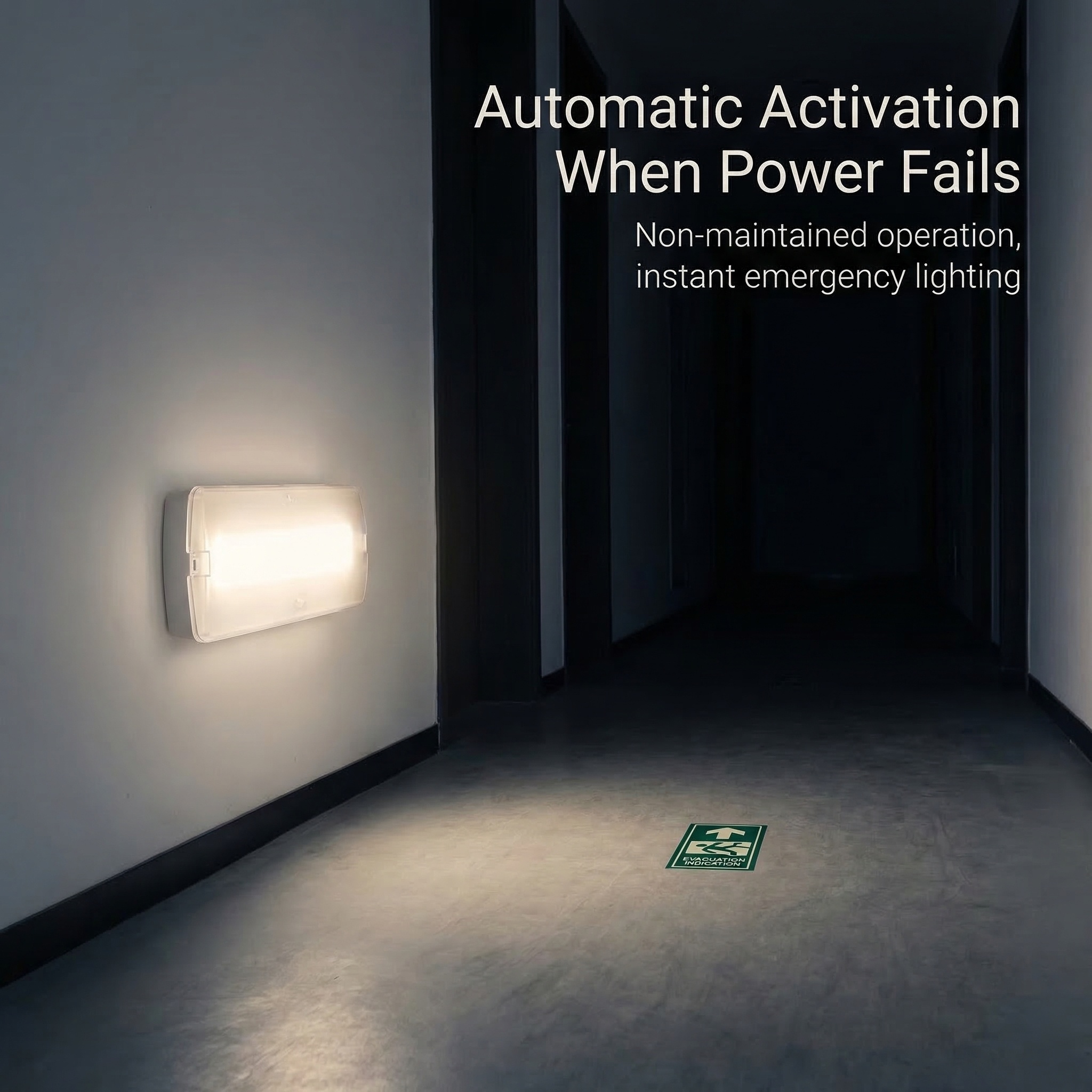
Emergency Lighting
Self-contained emergency lighting with selectable 90 minute to 3 hour duration and maintained or non-maintained wi
ring.
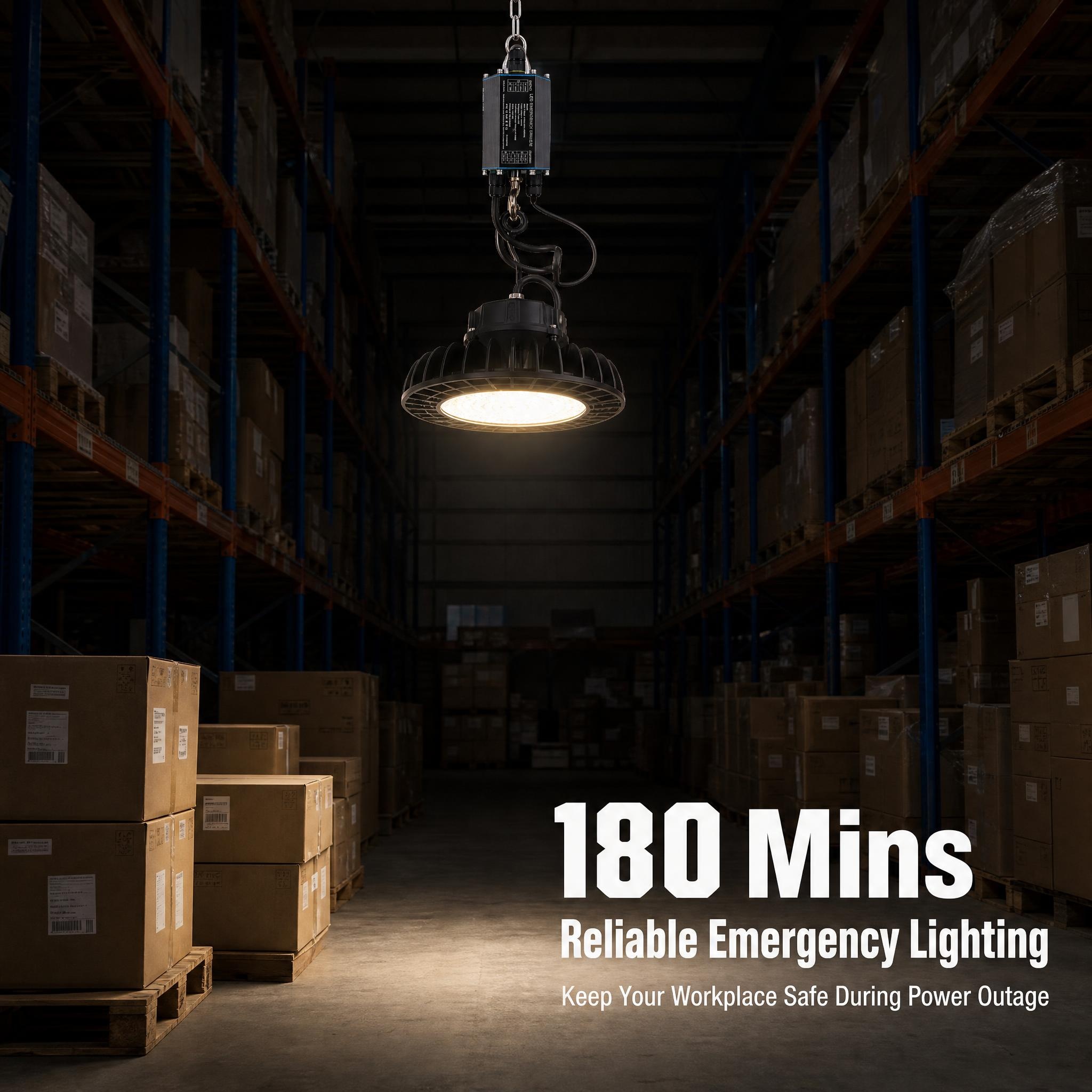
LED Emergency Driver For LED High Bays
High wattage emergency drivers for UFO and linear high bays in warehouses, plants and logistics centres.
Frequently Asked Questions About Power Outage Lighting
Minimum Order Quantity and Sample Policy
Q: What is the minimum order quantity and can I get samples before committing?
MOQ is 500 units for standard emergency drivers and 300 metres for COB LED strips. Samples ship within 5 working days from confirmed payment; sample cost is credited against the first production order. For luminaire OEMs qualifying a new emergency driver for their fixture, request 2-3 samples with different output windows to bracket your LED module’s forward voltage.
Fixture Compatibility and Output Matching
Q: How do I confirm your emergency driver suits my host fixture?
Match three parameters: the LED module’s forward voltage range against the driver’s DC output window (typically 9-42V or 50-200V), the normal forward current against the emergency output in mA (common options: 150mA, 350mA, 500mA, 700mA), and the total LED wattage against the driver’s rated emergency load (3W, 5W, 8W, 10W, up to 60W for high bays). Request the supplier’s LED load compatibility table and discharge curve at your specific mA.
Emergency Duration and Output Options
Q: What emergency duration and light output options are available?
Standard durations are 90 minutes, 120 minutes, and 180 minutes. Emergency output is specified as a percentage of normal output: 10% for basic escape route compliance, 50% for open area anti-panic, or 100% full power where the application demands. A 10W LED panel at 50% emergency output delivers roughly 500-700 lumens for 90 minutes from a LiFePO4 3.2V 3000mAh pack. Higher durations require larger capacity; 180 minutes at 100% output needs Li-ion 18650 7.4V 5200mAh or larger.
Wiring Configuration and Operating Modes
Q: Do you supply maintained or non-maintained wiring?
Both. Non-maintained uses a switched live to the LED driver only; the emergency driver charges in standby and activates on mains failure via changeover relay. Maintained wiring requires a permanent live to the emergency driver so the LED runs through the inverter circuit continuously, with seamless switchover on power loss. Specify your wiring scheme at order; the PCB layout differs and field conversion is not recommended.
Automatic Test Functionality
Q: What self-test options are available and what do they cover?
Three levels: manual test key for monthly functional and annual duration tests; automatic self-test with 30-second monthly and 90-minute annual discharge with fault LED indication; and DALI-2 self-test per EN 62034 with reporting to the building management system. DALI versions require a DALI bus power supply and compatible control gear. Ask for the test schedule firmware version and whether DALI Part 252 (luminaire data) is supported.
Battery Chemistry and Replacement Interval
Q: What battery chemistries do you use and how often must they be replaced?
NiCd 3.6V 1500mAh packs are cheapest but carry memory effect and require replacement every 3-4 years; cadmium content also triggers RoHS and waste battery regulations in EU markets. Li-ion 18650 3.7V 2200-3500mAh packs deliver 500-800 cycles and 4-5 year service life. LiFePO4 3.2V 3000-6000mAh packs achieve 1500-2000 cycles, 5-7 year life, and stable thermal performance up to 60°C ambient. Charge time ranges 16-24 hours for standard trickle charge circuits.
Lead Time and Production Scheduling
Q: What is the production lead time and how does it vary by order size?
Standard lead time is 25-30 days after deposit for orders under 2000 units. Above 5000 units, allow 40-45 days to secure battery cell lots with matched capacity and cycle testing. COB LED strip orders above 10,000 metres require 35 days due to PCB fabrication and copper weight verification. Peak months (August-October for Middle East projects, March-May for UK specification season) add 10-15 days. Lock delivery windows with a 30% deposit and signed production schedule.
Payment Terms and Export Practicalities
Q: What payment terms do you offer and what shipping documents do I receive?
First order: 30% deposit, 70% against copy of bill of lading. Established accounts: 30% deposit, 70% at 60 days from BL date, or LC at sight for orders above USD 50,000. Documents include commercial invoice, packing list, certificate of origin, and full set of original BL. For CE-marked destinations, request the supplier’s EU declaration of conformity and technical construction file reference. For UKCA, ask for UK-approved body assessment if the product falls under designated standards requiring third-party intervention.
Destination Market Certification and Test Reports
Q: Which test reports and conformity marks can you supply for my market?
For EU and UK: EN 60598-2-22 for emergency luminaire construction, EN 1838 for light output and distribution, EN 62034 for automatic test systems. For North America: UL 924 for emergency lighting and power equipment. For Australia and New Zealand: AS/NZS 2293.3 for emergency luminaire performance. Request the specific report number, test laboratory accreditation (ISO 17025), and date of issue; verify the report covers your exact model number and output configuration. Do not accept generic or expired reports.
Lithium Battery Shipping Restrictions
Q: How do lithium batteries affect shipping mode and required documents?
Li-ion and LiFePO4 packs above 100Wh per unit ship as UN 3480 Class 9 dangerous goods by sea (IMDG Code) with mandatory UN 38.3 test summary, MSDS, and shipper’s declaration. Below 100Wh, they may ship as UN 3481 packed with equipment if installed in the luminaire. Air freight (IATA PI 965-970) is restricted to 30% state of charge and limited to cargo aircraft only for standalone batteries; installed batteries travel on passenger aircraft with quantity limits. Sea freight adds 7-10 days but avoids the surcharge and routing restrictions.
Warranty Coverage and Spare Parts
Q: What warranty do you offer and can I source spare parts independently?
Standard warranty is 3 years on the emergency driver electronics, 2 years on NiCd packs, 3 years on Li-ion, and 5 years on LiFePO4. Spare parts available: replacement battery packs with plug connectors (ordered by V and mAh rating), changeover relays, and LED indicator lenses. PCB-level repair is not supported; module swap is the prescribed field repair. Stock spare batteries at 5% of installed base for facilities with 100+ units.
OEM Branding and Custom Packaging
Q: Can I get OEM branding and what packaging options exist?
OEM branding: laser-etched driver housings and printed carton labels at no additional cost above 1000 units per shipment. Custom driver firmware (specific test intervals, DALI addresses pre-set) requires NRE of USD 800-1500 and 2-week validation cycle. Packaging: individual white box with installation wiring diagram, 20 units per master carton, 25 cartons per pallet. Request IP-rated individual poly-bags for humid climate destinations.
Installation and Commissioning Support
Q: What installation and commissioning support do you provide?
Each shipment includes wiring diagrams for maintained and non-maintained circuits, DALI addressing guides where applicable, and commissioning checklists for duration test verification. Video call support is available for first-install training; on-site commissioning engineering is quoted per diem plus travel. For DALI systems, request the ETS file and DALI Part 102 application controller compatibility list before ordering.
Important Notice
Specifications, output and duration figures and price ranges in this guide are indicative and are provided
for planning purposes only. Actual emergency output, duration, battery life, ingress protection and available conformity documentation
differ by model and by destination country, and emergency lighting design remains the responsibility of the project designer. Buyers
must confirm their own mains voltage and frequency, the emergency lighting standard enforced locally, the host fixture compatibility
and their import requirements before placing an order. All figures are subject to written confirmation in the final proforma invoice
issued by Hymark.
Sourcing Power Outage Lighting from Hymark
What to Request Before You Order
A qualified supplier should demonstrate control over the four failure points of emergency gear: cell consistency, inverter calibration, thermal management and firmware traceability. When you contact Hymark, ask for the specific test records that match your application.
For emergency drivers and luminaires, request the discharge log for the exact duration you need—90 minutes, 2 hours or 3 hours—at your driven load in watts. Verify the inverter output window: typically DC 12–60V at 150–350mA for constant-current models, or DC 9–36V at 10–30VDC for constant-voltage types. Confirm the battery chemistry and capacity in writing. LiFePO4 3.2V 3000mAh packs suit 3-hour outputs up to 4W with roughly 500–800 cycles; Li-ion 18650 3.7V 2200–2600mAh packs offer higher energy density for compact drivers; NiCd 3.6V 1200–1800mAh remains viable where transport restrictions block lithium. Ask for the changeover relay specification and whether the self-test or DALI test facility meets EN 62034 timing requirements. State your wiring preference: maintained, with live switched feed to the lamp, or non-maintained, with emergency-only activation.
For LED strips used in secondary escape route marking, confirm the working voltage—12VDC or 24VDC—W/m, lm/m, LEDs per metre, CRI and colour temperature in K. COB strips at 480 LEDs/m and 10W/m deliver continuous light without pixelation; SMD2835 strips at 120–240 LEDs/m offer cut lengths down to 25mm or 50mm depending on PCB design. Specify PCB copper weight: 2oz copper handles longer runs with less voltage drop than 1oz.
How Hymark Structures Export Supply
JIALINGHANG ELECTRONIC CO., LTD. was founded in 2013. The 2017 strategic shift concentrated development on LED emergency technology and high-performance LED strips. Hymark, launched in 2026 as the premium brand, co-designs and engineers products in-house through a strategic partnership with dedicated manufacturing facilities operating since 2013. The company manages R&D, product design and global distribution itself.
The range covers emergency lighting, emergency exit signs, emergency luminaires, emergency twin spotlights, LED emergency drivers for LED high bays, panel lights, tubes and linear lights, full power output emergency drivers, LED strip lights, COB LED strips and SMD LED strips. Orders are supplied with selectable emergency duration, maintained or non-maintained wiring, OEM and ODM branding, export carton packing and FOB or CIF terms.
Lead time runs 15–25 days for standard emergency drivers and 20–30 days for customised luminaires after sample approval. Sample lead time is 5–7 working days for catalogue items. MOQ starts at 100 units for emergency drivers and 500 metres for LED strips, with mixed-product consolidation available. Payment structure is 30% deposit, 70% before shipment for initial orders; negotiable terms follow established trading history.
Standards Documentation to Verify
Do not accept vague compliance claims. EN 60598-2-22 requires emergency luminaires to maintain output at defined points on the escape route; EN 1838 specifies minimum illuminance of 1 lux on the centre line and 0.5 lux on the floor edge for open areas; BS 5266-1 sets testing intervals and log retention; UL 924 governs North American exit and emergency luminance; AS/NZS 2293 applies to Australian installations. Ask the supplier to show third-party test reports for the destination market, not generic declarations. For lithium battery shipments, confirm UN 38.3 test summaries and IATA/IMDG Section II or Section IB packing instructions are available for air and sea freight.
Request Your Quotation
Send the host fixture type and wattage, the emergency duration your code requires—90 minutes, 2 hours or 3 hours—your mains voltage and frequency, and your destination port. Hymark will return a quotation within 24 hours via WhatsApp or email with selectable battery chemistry, inverter output window and carton configuration matched to your specification.
Get a Factory Direct Quote on Power Outage Lighting
JIALINGHANG ELECTRONIC CO., LTD. has been in LED lighting since 2013 and has focused on
LED emergency technology and high performance LED strips since 2017. Hymark products are co-designed with our
dedicated manufacturing partners, built with selectable emergency duration and maintained or non-maintained wiring, and function
tested before packing. Send us the host fixture type and wattage, the emergency duration your local code requires, your mains
voltage and your destination port and we will return a quotation within 24 hours.


 English
  Spanish
  Arabic
  French
  German
  Russian
  Portuguese
  Italian
  Vietnamese