
Emergency Luminaires Buyer Guide
The right emergency luminaire supplier depends on whether your project needs a standalone maintained ceiling unit for a UK office (BS 5266-1, 90 minutes, 300 lm minimum emergency output) or a non-maintained IP65 bulkhead for a Middle East warehouse (EN 60598-2-22, 3 hours, 50% of normal output from a 3.2V LiFePO4 3000 mAh pack). Price spreads are wide: basic plastic bulkheads with NiCd packs run $8–$14 FOB Shenzhen, while steel-cased maintained luminaires with self-test circuitry and Li-ion 18650 packs land at $22–$38, and DALI-addressable units with LiFePO4 chemistry for high-temperature sites push $45–$75 per piece at 500-unit MOQ.
This page covers how to verify actual factory capability versus trading-office packaging: SMT and final assembly ownership, battery traceability and UN 38.3 shipping documentation, discharge test records against EN 1838 duration tables, and the ageing and hipot stations that separate suppliers who age-test every inverter board from those who spot-check.
In-House Assembly Capacity Versus Outsourced Production
A real manufacturer owns or directly partners SMT lines for LED driver PCBs and emergency inverter boards. Ask for PCB copper weight (1 oz standard, 2 oz on high-power emergency drivers), reflow profile records, and whether the changeover relay and constant current inverter output stage are assembled under the same roof or bought as finished modules. Trading offices typically quote 15–20 day sample lead times because they relay drawings to a subcontractor; factories with owned SMT can deliver functional samples in 5–7 days and pre-production units in 10 days.
Battery assembly is the second tell. LiFePO4 3.2V cells and Li-ion 18650 3.7V cells require spot-welding, BMT (battery management testing), and cycle-life verification. Request cell supplier certificates (not factory approvals, but cell-level UN 38.3 test summaries), then ask for discharge curves at 25°C and at the site’s maximum ambient: 45°C for Gulf States, -10°C for Central European unheated plant rooms. A factory with traceability keeps cell lot numbers tied to finished luminaire serials; traders cannot produce this.
Test Records and Ageing Protocols
EN 62034 self-test functionality and EN 1838 photometric compliance must be verified on production units, not just prototypes. Demand discharge and duration test records for the exact battery-lumen combination in your PO: a 5W LED load on 3.2V LiFePO4 3000 mAh should deliver 180 minutes at 350 mA constant current output with end-of-discharge voltage no lower than 2.8V. Hipot testing at 1500V AC for 60 seconds and ageing runs at 45°C for 48 hours catch early inverter failures; ask how many stations are active and what percentage of each batch undergoes full duration burn.
Third party test reports for the destination market are separate from factory internal records. For UK/EU projects, request CB test certificates or ENEC reports against EN 60598-2-22 and EN 61347 from an accredited lab—do not accept “CE compliance” as a certificate. For Australia, AS/NZS 2293.3 test reports; for North America, UL 924 or ULC listing documents. Verify the report covers the exact model number, not a “family” blanket.
Payment Structure and After-Sales Engineering
Factories with real capability accept 30% TT deposit, 70% against copy of B/L for repeat orders, though first orders may require 50/50 or LC at sight. Ask whether after-sales support includes firmware updates for DALI self-test modules, replacement inverter boards with matched output windows (DC 9–42V, 150–700 mA depending on LED load), and engineering review of maintained versus non-maintained wiring diagrams for your specific host fixtures. Trading offices forward emails; manufacturers have application engineers who can recalculate lumen maintenance for a 3-hour duration requirement when the standard assumes 90 minutes.
Export Practicalities for Emergency Luminaires
Lithium battery transport rules govern air and sea freight. LiFePO4 and Li-ion 18650 packs above 100 Wh require UN 38.3 test summaries, MSDS, and IATA/IMDG-compliant packaging with Class 9 hazard labels; factories with battery traceability produce these routinely. Carton packing is typically 10–20 units per carton, 50–80 cartons per pallet for bulkheads; maintained luminaires with steel housings ship 4–8 per carton. FOB Shenzhen pricing excludes freight; CIF to Felixstowe or Jebel Ali adds $1.50–$3.00 per unit depending on volume. MOQ sits at 200–500 units for standard models, 1000+ for custom housings or bespoke CCT.
Types and Configurations of Emergency Luminaires
| Type or Class | Typical Rating or Output | Duration or Runtime | Best Suited For | Notes |
|---|---|---|---|---|
| Full-Power Emergency Luminaire | 100% of normal output (e.g., 600 lm from 600 lm fixture) | 90 min or 180 min | Open-plan offices, retail, corridors where normal task lighting must continue | Requires larger battery pack; LiFePO4 3.2V 6000mAh typical; constant current inverter 25-80VDC 350mA |
| Reduced-Power (Fractional) Emergency Luminaire | 10-50% of normal output (e.g., 150 lm from 600 lm fixture) | 90 min, 120 min, 180 min | Stairwells, storage areas, escape routes where minimum illuminance per EN 1838 suffices | Most common OEM retrofit; Li-ion 18650 7.4V 2200mAh or NiCd 3.6V 4000mAh; inverter 9-42VDC 150-300mA |
| Maintained Emergency Luminaire | Normal output when mains present; switches to emergency output on failure | 90 min minimum per BS 5266-1 | Public buildings, cinemas, hospitals where luminaire must be visibly on at all times | Changeover relay or electronic switch; wiring requires switched live, permanent live, and neutral |
| Non-Maintained Emergency Luminaire | Off during normal mains; illuminates only on power failure | 90 min or 180 min | Industrial warehouses, back-of-house, plant rooms where normal lighting is adequate | Simpler wiring: permanent live and neutral only; lower standby losses; EN 60598-2-22 requires automatic operation |
| Self-Test Emergency Luminaire with Manual Test Key | Emergency output verified automatically per EN 62034; manual override available | 90 min or 180 min | Schools, multi-tenant offices, facilities with limited maintenance staff | Functional test monthly, duration test annually; DALI-2 option for BMS integration; fault flag via LED or bus |
| Recessed/Surface Emergency Downlight or Bulkhead | 200-500 lm emergency; IP20 to IP65; IK07 to IK10 | 90 min or 180 min | Corridors, stairwells, external canopies, parking structures | Die-cast aluminium or polycarbonate; LiFePO4 preferred for -10°C to +55°C ambient; NiCd cheaper but 500 cycles vs 800-1500 |
Full-Power Emergency Luminaires
A full-power emergency luminaire delivers the same luminous flux in emergency mode as it does under normal mains supply, typically 100% output maintained through a dedicated constant-current inverter. The battery pack must scale accordingly: a 15W LED panel normally driven at 48VDC 310mA requires a LiFePO4 12.8V 6000mAh pack or multiple parallel strings to sustain 90 minutes without voltage sag below the LED forward-voltage window. Buyers for premium commercial fit-outs in the UK and Middle East specify these for open-plan offices where EN 1838 minimums of 1 lux on the floor are easily exceeded, but the client wants full visual continuity. The trade-off is cost and physical volume. The battery pack occupies 40-60% more space than a fractional equivalent, and the inverter runs hotter, demanding a metal enclosure with adequate heat sinking. A full-power unit cannot economically be retrofitted into a slim ceiling void; verify minimum recess depth 80-120mm before specifying.
Reduced-Power Fractional Luminaires
Reduced-power or fractional-output emergency luminaires are the workhorse for OEMs adding emergency capability to standard LED panels, battens, and high bays. The inverter delivers 10-50% of normal wattage—commonly 3W, 5W, or 10W emergency output against a 20W, 40W, or 60W normal load—sufficient to meet EN 1838 or UL 924 minimum illuminance on escape routes. The battery pack shrinks to Li-ion 18650 7.4V 2200mAh for a 5W/90-minute duty, or NiCd 3.6V 4000mAh where first cost dominates and cycle life above 500 cycles is acceptable. Electrical contractors and lighting wholesalers buy these in volume for housing developments, warehouses, and hospitality back-of-house. What they sacrifice is task-level lighting during an evacuation; a 150 lm emergency output from a formerly 1500 lm high bay leaves a loading bay dim and hazardous for continued operations. The buyer should confirm the inverter’s output window—typically 9-42VDC at 150mA or 300mA—matches the LED module’s forward voltage at reduced current.
Maintained Emergency Luminaires
Maintained wiring configures the luminaire to be lit continuously during normal conditions, using either a switched live for normal control or an internal changeover relay that selects between mains driver and emergency inverter on power failure. M&E consultants specify these for cinemas, hospitals, and retail malls where a dark luminaire signals a fault to occupants or where building codes mandate permanently illuminated exit paths. The wiring requires three conductors plus earth at the luminaire: permanent live (charging), switched live (normal illumination), and neutral. This complexity raises installation labour cost 15-25% over non-maintained equivalents. Facility managers in Europe and Southeast Asia favour maintained units for public areas because they offer immediate visual confirmation of functional status without waiting for a test cycle. A maintained luminaire cannot be simply swapped into a two-wire non-maintained circuit; the absence of a permanent live will prevent battery charging and render the emergency function inoperative.
Non-Maintained Emergency Luminaires
Non-maintained luminaires remain de-energised during normal mains presence and activate automatically—per EN 60598-2-22 clause 22.7—when supply voltage drops below a threshold typically set at 60-85% of nominal. The wiring requires only permanent live and neutral, reducing cable runs and switchgear complexity. Industrial procurement officers and electrical contractors favour these for warehouses, plant rooms, and car parks where normal lighting is abundant and the emergency function is purely statutory. The standby power draw is minimal, often below 0.5W for monitoring circuitry alone. The limitation is psychological: occupants unfamiliar with the space may not recognise an unlit bulkhead as an emergency asset until it illuminates. Non-maintained units also demand rigorous functional testing because no daily visual check occurs; a failed inverter or open battery string will only be detected by the mandated monthly test or annual duration test under BS 5266-1.
Self-Test and DALI-Enabled Emergency Luminaires
Self-test emergency luminaires incorporate an internal timer and load-switching circuit to perform automatic functional tests (typically 1-5 minutes monthly) and full-duration tests (90 or 180 minutes annually) per EN 62034, with status indication via a local LED or remote fault flag. Manual test key override remains mandatory for commissioning and ad-hoc verification. DALI-2 compatible versions add addressability for building management system integration, logging test results with timestamps and lamp/battery health metrics. Lighting designers and specifiers for institutional clients—universities, hospital trusts, airport terminals—demand these to reduce maintenance labour and satisfy audit trails. The electronics add 8-15% to unit cost and a small standby load. A self-test luminaire cannot replace a building’s central emergency monitoring system unless every device is DALI-addressed and the bus is properly terminated; a standalone self-test unit in a remote stairwell still requires physical access to read its fault LED if no bus connection exists.
Recessed Surface and Bulkhead Emergency Formats
The physical enclosure defines final application as much as the electrical architecture. Recessed downlights suit architecturally sensitive corridors and lobbies but demand precise ceiling cut-outs and clearance for battery thermal management—LiFePO4 packs tolerate 0°C to +45°C charging but degrade faster above 50°C ambient. Surface-mounted bulkheads with polycarbonate diffusers and IP65 sealing serve external canopies, car parks, and industrial plant rooms where dust and hose-down occur; IK08 or IK09 impact resistance protects against accidental collision or vandalism. The typical specification runs 200-500 lm emergency output from 3W or 5W LED arrays, 90 minutes duration, with LiFePO4 3.2V 3000mAh or 6.4V 3000mAh packs. Wholesalers and distributors stock these as commodity items for maintenance replacement programmes. What they cannot do is deliver high mounting heights economically: a 5W bulkhead at 4 metres provides adequate floor illuminance for a 2.5-metre-wide corridor per EN 1838, but at 8 metres in a warehouse aisle the same unit falls below minimums, requiring twin-spot or high-bay emergency derivatives instead.

Specifications and How to Read Them
| Parameter | Entry Level | Mid Range | High Specification |
|---|---|---|---|
| Normal LED output | 600 lm | 1,200 lm | 2,000 lm |
| الإنتاج في حالات الطوارئ | 60 lm (10%) | 360 lm (30%) | 600 lm (30%) |
| Emergency duration | 90 min | 180 min | 180 min |
| Input voltage | AC 220-240V 50Hz | AC 100-277V 50/60Hz | AC 85-265V 50/60Hz |
| Driven load | 3W LED module | 8W LED panel | 15W LED high bay |
| DC output window | 9-12V 350mA | 24-36V 500mA | 36-48V 700mA |
| Battery chemistry | NiCd 3.6V 1,500mAh | Li-ion 18650 7.4V 2,200mAh | LiFePO4 12.8V 3,000mAh |
| Charge time | 24 hours | 16 hours | 8 hours |
| Cycle life | 300-500 cycles | 500-800 cycles | 1,500-2,000 cycles |
| Test facility | Manual test key | Auto self-test | Self-test + DALI-2 |
| Wiring mode | غير خاضع للصيانة | غير خاضع للصيانة | Maintained or non-maintained |
| IP/IK rating | IP20 / IK02 | IP65 / IK08 | IP66 / IK10 |
| Ambient temperature | 0°C to +25°C | -10°C to +40°C | -20°C to +50°C |
| Housing | ABS plastic | Die-cast aluminium | Powder-coated steel |
| Dimensions (mm) | 280 × 80 × 45 | 350 × 120 × 80 | 420 × 180 × 95 |
| Mounting | Surface screw | Surface + recessed | Surface + recessed + pendant |
| Sample lead time | 7-10 days | 5-7 days | 5-7 days |
| MOQ | 500 units | 200 units | 100 units |
Reading the Datasheet Line by Line
Input Voltage Range and Frequency
AC 85-265V covers global mains except Japan’s 100V dedicated circuits. AC 100-277V catches North American 277V commercial distribution. AC 220-240V 50Hz is UK and EU standard. Check the label matches your site: a 220-240V unit on 120V will not charge; a wide-range unit on 277V needs verification it does not overshoot the capacitor rating. Frequency tolerance is typically ±2%; 50/60Hz dual rating matters for Middle East and Southeast Asia projects where both frequencies appear.
Driven Load in Watts
This is the normal-mode LED power, not the emergency output. A 15W high bay driver in emergency may drop to 5W or less. The emergency driver must be matched to the LED module’s forward voltage; mismatch causes under-illumination or inverter shutdown. Hymark’s emergency drivers are matched to specific LED forward voltage windows at the factory.
DC Output Voltage Window and Current
Constant-current inverters output 350mA, 500mA or 700mA into a voltage window such as 24-36V. The LED module must sit inside this window. If the module forward voltage is 40V and the inverter tops out at 36V, emergency mode will not start. The changeover relay switches from normal driver to emergency inverter; relay contact rating and switching time affect lamp restart lag.
Emergency Output in Lumens and Percentage of Normal
EN 1838 requires minimum 1 lux on the floor for escape routes, which translates to luminaire output depending on spacing and room geometry. A 600 lm normal downlight falling to 60 lm (10%) meets minimums only at close spacing. 30% output (360 lm from 1,200 lm) gives design margin and is standard for open-area anti-panic lighting. Ask for the photometric file: percentages alone do not prove compliance at your mounting height.
مدة حالة الطوارئ
90 minutes satisfies most jurisdictions; 180 minutes is required for high-risk task areas under BS 5266-1 and some Middle East civil defence codes. 3-hour duration needs larger battery capacity or lower emergency wattage. Duration must be proven at end of declared battery life, not fresh cell performance.
Battery Chemistry Voltage and Capacity
NiCd 3.6V 1,500mAh delivers 5.4Wh. At 80% depth of discharge and inverter efficiency 85%, usable energy is roughly 3.7Wh—enough for 3W emergency load for 74 minutes, marginal for 90-minute claim when aged. Li-ion 18650 7.4V 2,200mAh (2S1P) gives 16.3Wh nominal, 11.1Wh usable, supporting 8W for 83 minutes with margin. LiFePO4 12.8V 3,000mAh delivers 38.4Wh, 26.9Wh usable, running 15W for 107 minutes with reserve. Higher voltage packs need fewer conversion stages, improving efficiency and reducing inverter heat.
Charge Time and Cycle Life
NiCd trickle charges in 24 hours; Li-ion CC-CV charges in 16 hours; LiFePO4 accepts faster charge, 8 hours typical. Cycle life at 25°C: NiCd 300-500 full cycles to 80% capacity; Li-ion 500-800; LiFePO4 1,500-2,000. Temperature accelerates degradation: Li-ion at 45°C loses 20% life per 10°C rise. Ask for cycle life at your ambient maximum.
Test Facility
Manual test key: installer presses monthly, records log. Self-test per EN 62034: automatic 30-second functional test monthly, 90-minute duration test annually. DALI-2 test facility: reports status to building management system, logs individual luminaire pass/fail. DALI requires compatible control gear; verify the DALI address range and bus power draw.
Maintained or Non-Maintained Wiring
Non-maintained: lamp off in normal mode, energises in failure. Maintained: lamp on continuously, fed by normal supply, switches to battery on failure. Maintained wiring needs changeover relay rated for continuous duty and additional terminal blocks. Some jurisdictions require maintained for statutory illuminated signs; check local amendment to EN 60598-2-22.
IP and IK Rating
IP20: indoor dry locations. IP65: jet-proof, suitable for covered external walkways. IP66: powerful jet-proof, plant rooms and parking structures. IK02: 0.2 joule impact, domestic only. IK08: 5 joule, commercial corridors. IK10: 20 joule, warehouses and sports facilities where ball impact or maintenance trolleys occur.
Ambient Temperature Range
Battery capacity derates below 0°C: NiCd retains performance to -20°C; Li-ion and LiFePO4 deliver reduced current and must not charge below 0°C without heating element. Above +25°C, calendar life halves per 10°C for Li-ion. A -20°C to +50°C rated unit likely includes cell heating or chemistry selection; ask for the derating curve.
Dimensions and Mounting
Surface mounting needs clearance for cable entry and battery replacement. Recessed needs ceiling void depth plus 25mm minimum for thermal dissipation. Pendant mounting needs stem length and swivel capability for raked ceilings. Weight affects false ceiling loading: a 2.5kg unit on plasterboard needs toggle fixings, not spring clips.
Battery Documentation and Transport
UN 38.3 Test Report
Lithium batteries must pass UN 38.3 (altitude simulation, thermal, vibration, shock, short circuit, crush, forced discharge) before transport. The report covers the cell and the completed battery pack. Ask for the UN 38.3 summary test report with supplier name matching the shipper; trading offices often hold reports for cells they did not assemble into packs. IATA PI 965 Section IA/IB and IMDG Code SP 188 govern air and sea freight; lithium-ion packs over 100Wh need dangerous goods declaration and Class 9 label. LiFePO4 is chemically safer but still classified as lithium ion for transport.
Trade Terms and Compliance Marking
FOB, CIF, CFR, EXW
EXW factory: buyer arranges all export clearance and freight; lowest supplier price, highest buyer workload. FOB Shenzhen or Ningbo: supplier delivers to port, clears export, buyer arranges ocean freight and import. CFR destination port: supplier pays freight, risk transfers at port of loading, buyer arranges insurance. CIF: supplier arranges freight and minimum insurance, risk still transfers at loading. For emergency luminaires, FOB is standard; CIF adds 8-15% to invoice and may use insurer with slow claims handling.
Payment Structure
T/T 30% deposit, 70% against copy of B/L: standard for repeat orders. L/C at sight: adds 1.5-3% bank charges, protects buyer if documents are clean, delays shipment 1-2 weeks for confirmation. For first orders over USD 50,000, L/C is reasonable; below that, T/T with factory verification is faster.
HS Code
9405.10 for electric luminaires and lighting fittings including searchlights and spotlights; 9405.40 for other electric lamps and lighting fittings. Emergency luminaires with built-in batteries often classify under 9405.10; standalone emergency drivers under 8504.40 (static converters). Correct classification affects duty rate and whether battery rules apply to the shipment.
CE and UKCA Marking
CE requires EU-type examination or self-certification under EN 60598-2-22 and EN 1838. UKCA replaced CE for Great Britain from January 2021; Northern Ireland accepts CE or UKNI. A manufacturer must hold test evidence; ask for the EU-type examination certificate number and issuing body. Do not accept a declaration based on EN 60598-1 alone—Part 2-22 is mandatory for emergency function.
Packing List and Certificate of Origin
Packing list must match carton markings: model, quantity, gross/net weight, battery watt-hour if lithium. Certificate of origin (Form A or CO) affects preferential duty under trade agreements. For UK imports, declare country of origin correctly; incorrect origin can void tariff preference and trigger customs delay.
Supplier Qualification Checklist
SMT and Assembly Capacity
Ask for SMT line photographs with date stamp, or visit. A real manufacturer runs Yamaha or Juki pick-and-place for LED boards, reflow oven, and AOI. Battery pack assembly needs spot welding, not soldering, for cell tabs; ask to see the welding station. Trading offices show you a factory they do not control.
Battery Sourcing and Traceability
Cell brand and batch number must trace to purchase invoice. Samsung, LG, EVE, Lishen are common 18650 sources; LiFePO4 cells come from CATL, BYD, EVE. Ask for cell specification sheet and cycle life data at 1C discharge. Random cell matching causes pack imbalance and early failure.
Discharge and Duration Test Records
Every emergency luminaire must undergo full duration discharge before shipment per EN 60598-2-22. Ask for the test station log: serial number, date, ambient temperature, initial and final voltage, duration achieved. A factory with 20 test stations running 3-hour cycles can test 160 units per day; fewer stations means batch testing or skipped testing.
Ageing and Hipot Test Stations
Ageing burns in electronics at elevated temperature, typically +45°C for 4-8 hours, to precipitate early failures. Hipot (dielectric withstand) tests insulation at 1,500V AC or 2,000V DC between live and earth. Ask for the test voltage, duration and acceptance criterion. Missing hipot records mean insulation faults reach the field.
Third Party Test Reports for Destination Market
ENEC or DEKRA test report for EU; BSI Kitemark for UK; UL report for North America; SAA for Australia. The report must cover the exact model with battery configuration as shipped. A report for NiCd version does not cover Li-ion version; a report for 90-minute duration does not cover 180-minute.
Sample Lead Time
7-10 days for entry-level ABS housing from existing mould; 5-7 days for aluminium die-cast if in stock; custom colour or logo adds 3-5 days. Samples should be production units, not hand-built prototypes; ask for the same serial number format as production.
After-Sales Engineering Capability
Emergency luminaire failures are often wiring or battery, not LED. Ask for technical contact availability, replacement battery part number, and whether firmware updates apply to self-test units. A trading office forwards your email; a manufacturer has application engineers who understand the changeover relay wiring diagram.
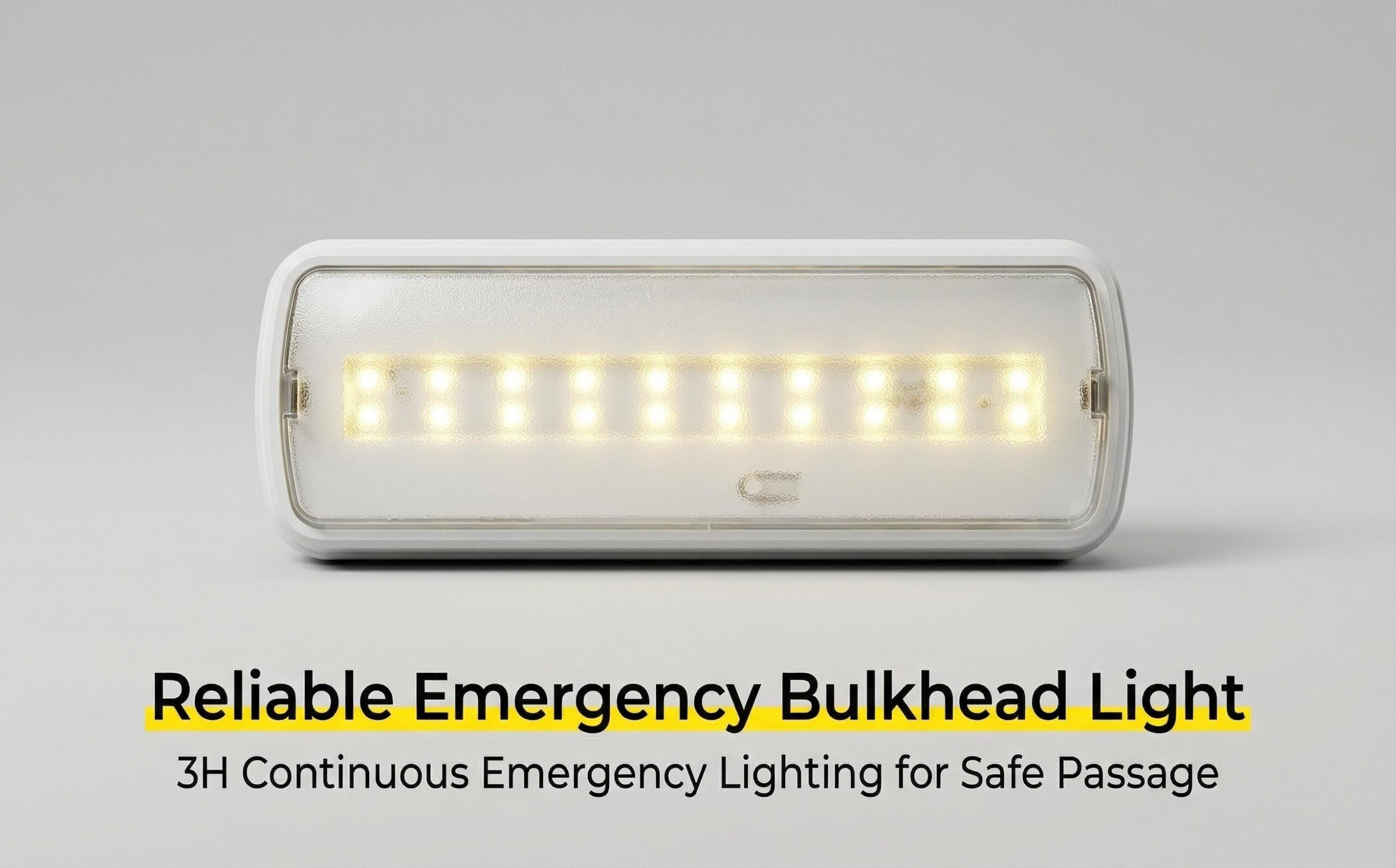
Emergency Luminaires Price and What Drives It
| Class | Typical Rating or Output | Duration or Runtime | Indicative FOB USD |
|---|---|---|---|
| Basic bulkhead non-maintained | 100–150 lm emergency, 3W LED normal | 90 min | $8–14 |
| Mid-range maintained bulkhead | 200–300 lm emergency, 50% of normal, 8W normal | 3 hr | $18–28 |
| High-output LED emergency downlight | 500+ lm emergency, 100% maintained | 3 hr | $32–48 |
| Emergency twin-spot | 2× 3W spots, 600 lm total emergency | 3 hr | $22–35 |
| Weatherproof IP65 maintained | 300 lm emergency, 10W normal | 3 hr | $28–42 |
| DALI self-test maintained panel | 40% of 36W panel = ~1400 lm emergency | 3 hr | $45–65 |
Battery Cells and Pack Chemistry
The battery pack typically absorbs 25–35% of the ex-factory material cost. A 3.2V LiFePO4 3000mAh single-cell pack with PCM protection delivers roughly 3 hours at 3W emergency output, yielding about 9.6Wh usable energy after converter losses. Li-ion 18650 3.7V 2600mAh cells in 2S1P configuration reach 7.4V nominal and suit higher wattage inverters. NiCd 3.6V 700mAh packs survive 500 cycles but carry weight and memory-effect penalties. LiFePO4 offers 2000+ cycles at 80% depth of discharge and tolerates 0°C to 60°C ambient, making it preferable for Middle Eastern and Southeast Asian installations where ambient ceiling temperatures exceed 45°C. Buyers should request cell brand and lot traceability; unnamed “A-grade” cells often mean recycled or B-bin material with 30–50% capacity fade within 18 months.
Driver and Inverter Electronics
The emergency driver combines a constant-current charging circuit, changeover relay or solid-state switch, and DC-AC inverter stage. Output windows vary: 6–60V DC at 150–350mA for linear LED loads, or 9–36V DC at 500mA+ for high-bay arrays. Input voltage range 85–265V AC covers global markets; 220–240V dedicated units save $1–2 in component cost but exclude 120V regions. The inverter efficiency (typically 82–88%) directly affects battery sizing: a 3W LED load at 85% inverter efficiency demands 3.53W from the battery, extending required capacity by 15%. Self-test circuitry per EN 62034 adds $3–5 in BOM cost; DALI-2 test interface adds $6–10 including certification overhead.
Enclosure Hardware and Thermal Design
Steel powder-coated enclosures for bulkheads run $2.50–4.50 depending on gauge (0.4–0.6mm) and corrosion pretreatment. Polycarbonate diffusers rated to IEC 60695-2-11 850°C glow-wire add $1.20–2.00. IP65 gaskets and lens seals cost less than $0.50 in volume but failure to validate at 1 metre submersion destroys batch compliance. IK08 (5 joule impact) versus IK10 (20 joule) polycarbonate diffusers differ by $0.80–1.50 per unit but matter for railway, prison, and industrial applications.
Third-Party Approval Amortisation
EN 60598-2-22 testing for a new luminaire family covers thermal, photometric, and endurance protocols; a complete CB report with EMC runs $8,000–15,000. Spread across a 5,000-unit first batch, this adds $1.60–3.00 per piece. UL 924 for North America demands separate construction review and typically $12,000–20,000. AS/NZS 2293.3 requires local discharge testing and marking compliance, often $4,000–7,000 through an accredited Australian body. Suppliers quoting without named test house reports are either absorbing unbudgeted risk or substituting untested designs.
Freight and Lithium Restrictions
Lithium cells trigger IATA Section II (≤100Wh per pack) or Section IB (100–300Wh) restrictions. Air freight from Shenzhen to London Heathrow runs $4.50–7.00/kg for lithium-labelled cargo versus $3.00–4.50/kg for general cargo; sea freight to Felixstowe at $800–1,200 per 20GP container spreads to $0.15–0.30 per unit for 3,000-piece shipments. UN 38.3 test summary documents must accompany each battery SKU; absence means customs detention at destination.
Why the Cheapest Quote Costs More
A $6.50 bulkhead emergency luminaire typically indicates: 700mAh NiCd or unbranded 1500mAh Li-ion (90 minutes at 1.5W, not 3W), no third-party test report, 50,000-hour LED claim without LM-80 data, and IP20 enclosure relabelled IP44. EN 1838 requires minimum 1 lux on the floor centreline for escape routes; an undertested 100-lumen output at 2.5 metres mounting height may fail this by 40% in photometric calculation. The buyer then faces retrofit labour at £45–75/hour in UK markets, dwarfing initial savings.
Five-Year Running Cost Comparison
| Cost Element | Budget Unit ($8–14 FOB) | Specified Unit ($28–42 FOB) |
|---|---|---|
| Initial unit cost (landed, with duty/VAT) | $14 | $38 |
| Battery replacement at year 3 | $12 (labour-inclusive) | $0 (LiFePO4 still >80% capacity) |
| Annual testing labour: manual 30 min vs DALI automated | $25/year | $3/year |
| Expected failure rate years 1–2 | 8–12% | 2–3% |
| Replacement unit + labour per failure | $45 | $48 |
| Five-year total per installed point | $98–124 | $53–61 |
The specified unit with LiFePO4, DALI self-test, and verified EN 60598-2-22 construction pays back by month 18 in reduced maintenance labour alone. Facility managers with 500+ emergency points should model this at procurement stage; the £20,000–30,000 annual testing labour bill for manual-key systems collapses to £3,000–5,000 under EN 62034 automatic test with DALI reporting.
Supplier Qualification Checklist
In-house or partnered SMT capacity. Ask for SMT line brand (Yamaha, Juki, Panasonic) and LED driver IC programming capability. Trading offices outsource PCB assembly to unnamed workshops with no process control records.
Battery sourcing and traceability. Request cell manufacturer (EVE, Lishen, BYD, Samsung SDI) and lot code system. Verify PCM firmware version if LiFePO4; over-discharge to 2.0V destroys cell chemistry irreversibly.
Discharge and duration test records. Every production batch must undergo full 90-minute or 3-hour discharge at rated load. Ask to see dated test logs with load wattage, initial and final voltage, and pass/fail criteria.
Ageing and hipot stations. Hipot at 1.5kV AC or 3kV DC for basic insulation; reinforced insulation demands 3kV AC or 6kV DC per IEC 61347-1. Ageing racks running 4-hour burn-in at 40°C ambient catch infant mortality in driver electrolytics.
Sample lead time. A genuine manufacturer with stocked cells and driver platforms delivers wired samples in 7–12 working days. Quotations promising 3-day samples from zero tooling indicate trader re-badging existing stock with unverified marking.
Payment structure. 30% T/T deposit, 70% against copy of B/L remains standard for first orders. Demands for 100% advance or Western Union-only terms signal working capital distress or intermediary layering.
After-sales engineering. Request schematic review for maintained versus non-maintained wiring compatibility with your existing luminaire range. A factory with application engineers can supply switchover relay timing diagrams and DALI address programming guides; a trader forwards your email to their upstream supplier with 48-hour delay.
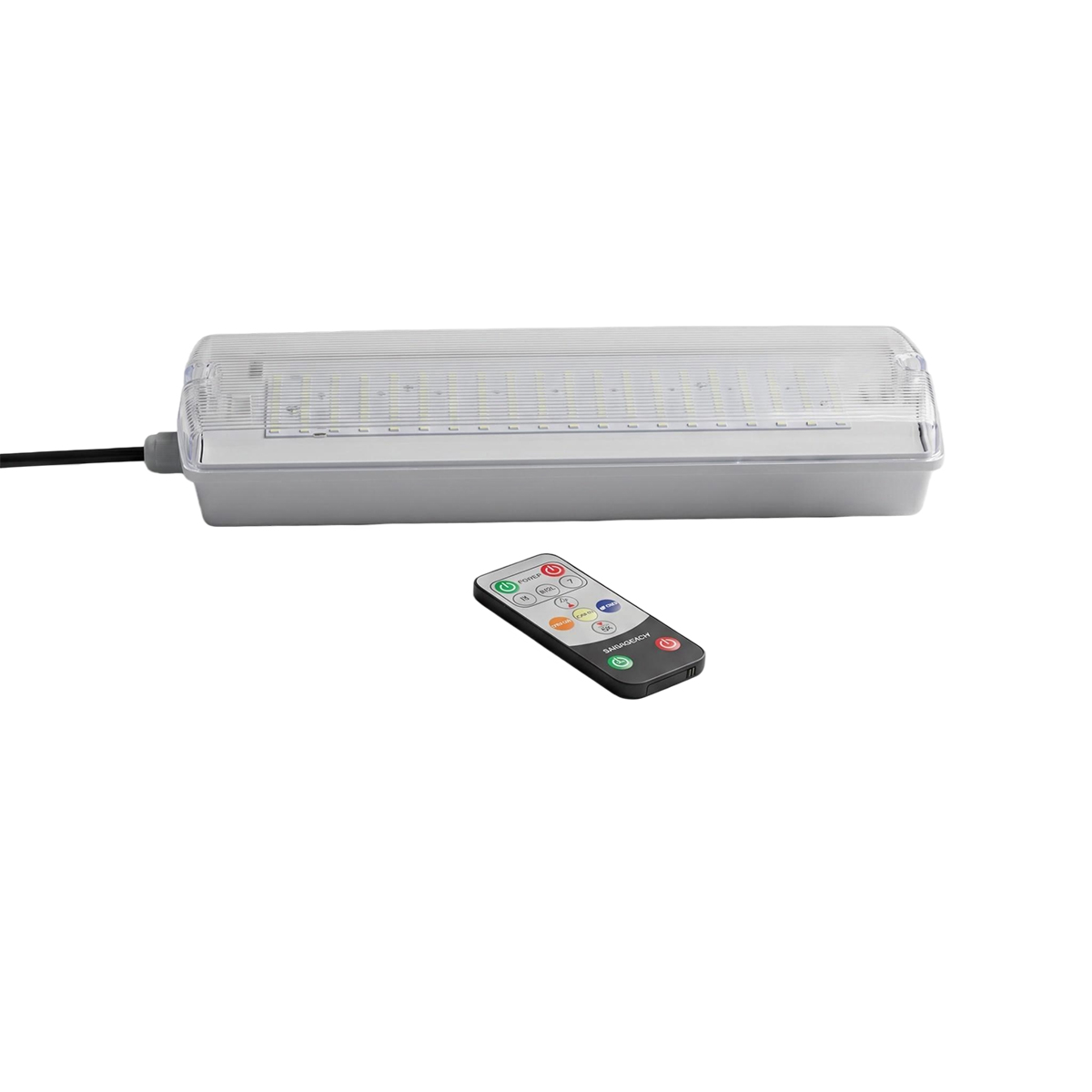
Industry Applications for Emergency Luminaires
| Sector | Typical Installation | Recommended Specification | Why This Product Fits |
|---|---|---|---|
| Commercial Offices and Fit-Outs | Recessed LED panels in suspended ceilings, surface-mounted bulkheads in corridors | 3-hour duration, 50% emergency output (500–1000 lm), maintained or non-maintained wiring, self-test or DALI interface, IP20–IP44 | High occupancy density requires reliable egress path lighting with minimal maintenance disruption; DALI integration suits BMS-managed buildings |
| Hospitals and Clinics | Cleanroom luminaires, corridor bulkheads, operating theatre ante-rooms | 3-hour duration, 100% maintained output (1500–3000 lm), LiFePO4 battery pack 3.2V 6000mAh, IP44–IP65, instant switchover via changeover relay | Critical care areas cannot tolerate dark intervals; maintained wiring ensures continuous illumination; LiFePO4 chemistry offers thermal stability in 24-hour operations |
| Warehouses and Logistics Centres | High-bay emergency fittings above racking, low-level way-guidance on floor routes | 3-hour duration, 50% output (1000–2000 lm) from LED high-bay emergency driver, AC 100–277V input, IP65, IK08 | High ceilings and wide spans need concentrated lumen packages; IK rating protects against forklift impact; wide voltage input suits industrial distribution systems |
| Car Parks and Stairwells | Surface-mounted bulkheads on concrete soffits, recessed wall units in stair cores | 3-hour duration, 50% output (300–600 lm), non-maintained wiring, IP65, IK10, NiCd 3.6V 4000mAh or Li-ion 18650 7.4V 2600mAh | Vandal-prone locations demand maximum mechanical protection; cold ambient performance favours NiCd or specified low-temp Li-ion; EN 1838 minimum 1 lux on escape route applies |
| Hotels and Residential Common Areas | Decorative bulkheads in corridors, recessed downlights in lobbies | 2-hour or 3-hour duration, 50% output (400–800 lm), maintained wiring, self-test, LiFePO4 3.2V 3000mAh, charge time ≤24 hours | Guest safety and insurance compliance require documented test records; maintained circuits suit 24/7 corridor lighting; discreet form factors match interior design requirements |
| Industrial Plants | Flameproof-rated bulkheads in hazardous zones, high-output fittings in process halls | 3-hour duration, 100% output (2000–5000 lm), AC 85–265V or 220–240V, constant current inverter output 25–50V DC 350–700mA, driven load 10–20W, IP66 | Heavy electrical environments need robust EMC performance; high ambient temperatures up to 45°C require battery derating verification; UL 924 or IEC 61347-2-7 compliance for North American or IEC markets |
Commercial Offices and Fit-Outs
Open-plan offices with suspended ceilings typically specify recessed 600×600 mm LED panels with integrated emergency gear. The normal fitting might deliver 3000 lm at 36W; the emergency mode should provide at least 50% of that output—1500 lm—for the full 3-hour duration required under BS 5266-1 for premises with sleeping risk, though offices without overnight occupancy may accept 2-hour duration in some jurisdictions. Input voltage is standard AC 220–240V 50Hz for UK and European markets, or AC 100–277V for Middle East and Southeast Asia projects. The emergency driver output window is typically DC 25–42V at 350mA or 500mA constant current. Battery packs are usually LiFePO4 3.2V configurations at 3000–6000mAh, giving 500–800 cycle life and charge times of 18–24 hours. Self-test functionality per EN 62034 reduces manual testing labour in multi-floor buildings. Buyers should request discharge duration test records for the specific fitting-and-battery combination, not generic cell data.
Hospitals and Clinics
Healthcare premises operate under the strictest emergency lighting requirements. Operating theatres, intensive care units and A&E corridors require maintained wiring with instant changeover relay—no dark interval exceeding 0.5 seconds per EN 60598-2-22. Emergency output is often 100% of normal level: 3000 lm from a 40W panel down to 1500 lm from a 20W bulkhead depending on room size. Battery chemistry matters: LiFePO4 3.2V 6000mAh packs tolerate the continuous trickle charge and elevated ambient temperatures of 24-hour plant rooms better than standard Li-ion, with cycle life of 800–1200 cycles versus 500 for Li-ion 18650 alternatives. Charge time must recover full capacity within 24 hours after a full discharge. IP44 minimum protects against cleaning fluids; cleanroom installations need IP65 sealed housings. Buyers should verify that the supplier’s discharge test records cover the actual fitting at 25°C and at the derated maximum ambient temperature claimed.
Warehouses and Logistics Centres
High-rack warehouses present vertical escape routes where floor-level lux levels must still meet EN 1838 minimums despite mounting heights of 8–15 metres. The emergency luminaire or the emergency driver paired with a LED high-bay normally delivering 15,000–20,000 lm must provide 50% emergency output—typically 1000–2000 lm from the emergency gear—for 3 hours. Input voltage AC 100–277V covers both European 230V and North American 277V industrial supplies. The emergency driver output is DC 35–55V at 500–700mA, driving 10–20W emergency load from a LiFePO4 or Li-ion battery pack sized accordingly: 14.8V 4400mAh for 20W output over 3 hours. IP65 and IK08 protect against dust accumulation and mechanical impact from MHE (materials handling equipment). Non-maintained wiring is usual; the fitting is off during normal operation and energises on mains failure. Buyers should confirm the supplier has hipot test records for the driver-to-battery wiring harness, as high-vault installations are difficult to access for fault rectification.
Car Parks and Stairwells
These are the most physically and environmentally stressed emergency lighting locations. Surface-mounted bulkheads on concrete soffits in open-deck car parks see temperature swings from −10°C to +50°C, condensation, salt spray in coastal locations, and deliberate damage. Specification is typically IP65 minimum, IK10 for impact resistance, 3-hour duration, 50% emergency output of 300–600 lm from a 5–10W emergency load. Battery choice involves trade-offs: NiCd 3.6V 4000mAh operates reliably to −20°C but carries environmental disposal obligations and memory-effect limitations; Li-ion 18650 7.4V 2600mAh packs offer higher energy density but require UN 38.3 transport certification and may need derating below 0°C. Non-maintained wiring is standard. EN 1838 mandates minimum 1 lux average on the centreline of escape routes, with minimum 0.5 lux anywhere on the route; stairways require 5 lux on the leading edge of each tread. Buyers should request third-party test reports showing photometric data for the actual fitting, not generic LED module data, and confirm the supplier’s ageing test protocol includes 72-hour continuous charge followed by full discharge verification.
Hotels and Residential Common Areas
Corridor lighting in hotels must balance life safety compliance with guest experience and interior design. Recessed or semi-recessed downlights of 10–15W normal load typically provide 800–1200 lm; emergency output at 50% gives 400–600 lm for 2-hour or 3-hour duration depending on local building code—BS 5266-1 requires 3 hours for hotel sleeping accommodation. Maintained wiring is almost universal: the fitting is live during normal hours and switches to battery on mains failure, ensuring no dark corridor if a guest triggers a local circuit breaker. Self-test per EN 62034 with 30-second functional test monthly and full duration test annually reduces the facility manager’s compliance burden. Battery is typically LiFePO4 3.2V 3000mAh, charge time ≤24 hours, cycle life 600–800. Decorative housings may compromise heat dissipation; buyers should verify the supplier’s thermal test records show battery temperature stays below 45°C in the installed configuration, not in free air.
Industrial Plants
Process industries add hazards beyond standard commercial premises: flammable atmospheres, corrosive vapours, electromagnetic interference from VSDs and welding plant, and ambient temperatures that standard fittings cannot survive. Emergency luminaires for Zone 2 hazardous areas require IEC 60079-0 compliance in addition to EN 60598-2-22; the supplier must demonstrate the flameproof or increased safety enclosure is certified for the battery compartment as well as the LED module. Output levels are high—2000–5000 lm at 100% emergency output from 20–40W emergency load—because process halls are large and escape routes may be obstructed by equipment. Input voltage must tolerate factory distribution variations: AC 85–265V or dedicated 220–240V with ±10% tolerance. The constant current inverter output is typically 25–50V DC at 350–700mA. Battery sizing for 3-hour duration at 20W demands 14.8V 6600mAh LiFePO4 or equivalent, with cycle life 500–700 under industrial temperature profiles. IP66 is minimum; IP67 with corrosion-resistant coating may be specified for chemical plants. Buyers should ask for the supplier’s EMC test records to EN 55015 / IEC 61000-3-2, as industrial environments will expose any immunity deficiency immediately.
Ordering and Importing Step by Step
Three mistakes most often leave a delivered batch of emergency luminaires unusable. First, an output window that does not match the host fixture’s LED driver architecture—fix this by recording the fixture’s normal-mode voltage and current before ordering. Second, a duration or illuminance level below local code—fix this by stating the required minutes and lux on the purchase order, not assuming 90 minutes covers every jurisdiction. Third, missing lithium battery or conformity documentation at customs—fix this by requesting UN 38.3 test summaries and the specific mark (CE UKCA, UL, SASO, etc.) before shipment, not after the container lands.
Three Mistakes That Ruin a Batch
| Mistake | Why It Happens | One-Line Fix |
|---|---|---|
| Output window mismatch | Buyer quotes fixture wattage only, not Vf or driver topology | Record normal-mode DC Vf range and mA or watts before RFQ |
| Duration or illuminance shortfall | Assumes 90 min at 10% covers all codes; BS 5266-1 and EN 1838 vary by space type | State required duration (90 min, 120 min, 180 min) and minimum lux at floor level on PO |
| Lithium or conformity docs missing at border | Supplier ships on generic commercial invoice; customs holds UN 38.3 or mark verification | Request UN 38.3 summary, SDS, and conformity evidence before deposit; confirm freight mode accepts lithium |
Step-by-Step Ordering and Import Checklist
1. Record Host Fixture Parameters
The emergency luminaire is only half the system. The inverter or emergency driver must match the fixture’s normal LED module.
- Normal output: lumens and watts at full drive
- LED driver architecture: constant voltage (typically 12V, 24V, 36V, 48V DC) or constant current (250mA, 350mA, 500mA, 700mA, 1050mA typical)
- Vf range of LED module at operating temperature: e.g., 33V–38V for a 100W high bay array
- Physical space inside fixture for inverter module and battery pack: L × W × H in mm
If the emergency output window is 25V–42V at 350mA constant current but the fixture LED string wants 48V at 500mA, the luminaire will not reach rated emergency output or will shut down on under-voltage protection.
2. Confirm Duration and Emergency Output Level
| Application | Typical Requirement | What to Specify |
|---|---|---|
| UK escape routes per BS 5266-1 | 3 hours at minimum 1 lux on centre line, 0.5 lux over width | 180 min duration; state luminaire lumen output in emergency mode |
| EU escape routes per EN 1838 | 1 hour or 3 hours depending on national annex; 1 lux minimum | Match national annex; 90 min or 180 min |
| US per NFPA 101 / UL 924 | 90 minutes; 1 fc (10.8 lux) initial on path of egress | 90 min; note UL 924 requires specific minimums not identical to EN |
| Middle East (SASO/GCC) | Often 120 min or 180 min based on civil defence | Confirm with local fire authority |
| Australia AS/NZS 2293 | Class C or D; 90 min or 120 min typical | Class and duration on specification |
Emergency output as percentage of normal: typically 10% for self-contained maintained or non-maintained, but high-performance units achieve 30%–100% depending on inverter and battery sizing. A 4000-lumen normal fixture at 10% gives 400 lumens emergency; at 100% full-power emergency, the same fixture needs a 24W–50W inverter and correspondingly larger battery.
3. Choose Maintained or Non-Maintained Wiring
- غير خاضع للصيانة: Emergency lamp off during normal mains; energises on failure. Two-wire supply to luminaire. Simpler installation, lower energy use.
- تمت صيانته: Emergency lamp energised continuously via changeover relay; switches to battery on mains failure. Three-wire supply (L, N, switched live). Required in some jurisdictions for certain space types; check local wiring rules.
State the requirement on the PO. A maintained unit shipped for non-maintained wiring will have unused terminals and possible confusion at commissioning.
4. Decide Test Facility
| Option | Wiring Complexity | Best For |
|---|---|---|
| Manual test key | Simple; two-pole key switch or push button on fitting | Small installations; sites with dedicated maintenance staff |
| Self-test (EN 62034) | Automatic monthly and annual functional tests; status LED | Large estates; reduced maintenance labour |
| DALI self-test | DALI addressable; reports to central BMS | Smart buildings; remote monitoring requirements |
Self-test and DALI units carry cost premium of 15%–30% over manual test. Factor commissioning time saved: a 500-luminaire DALI system avoids 500 manual annual key operations.
5. Confirm Mains Voltage and Frequency
| Market | Typical Supply | Tolerance Required |
|---|---|---|
| UK / EU | 220–240V AC 50Hz | 85–265V or 220–240V nominal |
| US / Canada | 120V AC 60Hz or 277V AC 60Hz | 100–277V wide range preferred for North America |
| Middle East | 220–230V AC 50Hz or 127V AC 60Hz (Saudi) | Verify per country; Saudi Arabia mixed |
| Southeast Asia | 220V AC 50Hz (most); 110V in Philippines | 85–265V covers all |
| Africa | 220–240V AC 50Hz; unstable in rural areas | Wide range 85–265V with surge protection advised |
| Latin America | 127V, 220V, 240V; 50Hz or 60Hz | 100–277V, 50/60Hz dual rating essential for multi-country projects |
A luminaire rated 220–240V only will fail or degrade on 277V US circuits or on sustained 260V in poor-regulation grids.
6. Confirm Conformity Mark and Test Report for Destination Market
Do not accept a supplier’s claim of certification. Request and verify:
- UK: UKCA marking; test report to BS EN 60598-2-22 and BS EN 1838; for self-test, EN 62034
- EU: CE marking; EN 60598-2-22, EN 1838, EN 62034 where applicable; IEC 61347 for control gear
- US: UL 924 listing; NFPA 101 compliance demonstrated
- Australia / New Zealand: RCM marking; AS/NZS 2293.3 test evidence
- Saudi Arabia: SASO IECEE recognition; EER registration for energy-related products if applicable
- UAE / GCC: G-Mark or ECAS depending on emirate; specific civil defence approval in Dubai, Abu Dhabi
Request the test report number, issuing laboratory (ISO 17025 accredited), and date. Cross-check accreditation scope includes EN 60598-2-22 or the relevant standard. Reports older than 5–7 years may not cover current standard editions.
7. Check IP Rating and Ambient Temperature for Mounting Position
| Location | Minimum IP | Ambient Range | Battery Impact |
|---|---|---|---|
| Clean interior offices | IP20 | 0°C to +25°C | Standard Li-ion or NiCd acceptable |
| Corridors, retail | IP20–IP40 | 0°C to +30°C | قياسي |
| Car parks, under-canopy | IP54–IP65 | -10°C to +40°C | LiFePO4 preferred for wider temperature; NiCd tolerates cold better than Li-ion |
| Industrial, dust/wet | IP65–IP66 | -20°C to +50°C | LiFePO4 3.2V packs, -20°C to +60°C rated; derate duration below 0°C |
| Exterior, coastal | IP66–IP67, IK08–IK10 | -20°C to +50°C | Marine-grade powder coat; battery in insulated compartment |
A Li-ion 18650 pack rated for 0°C–45°C will lose 30%–50% effective capacity at -10°C, falling below required duration. LiFePO4 3.2V 3000mAh cells maintain 70%+ capacity at -10°C but cost 20%–40% more per watt-hour.
8. Agree MOQ and Sample Approval Before Mass Production
| Item | Typical Range | What to Negotiate |
|---|---|---|
| Sample lead time | 7–15 working days | Request first article with production-intent PCBA and battery |
| Sample cost | 1×–3× unit price; often credited against first order | Confirm credit policy in writing |
| MOQ per model | 100–500 units | Split MOQ across 2–3 related models if range needed |
| Mass production lead time | 30–45 days after sample approval and deposit | Confirm raw material hold period if order delayed |
| Payment structure | 30% deposit, 70% against copy of B/L; or L/C at sight for large orders | Avoid 100% advance for new supplier relationship |
Require the sample to include the exact battery cell part number, inverter firmware version, and LED batch code. Photograph the sample internals for comparison to production units during factory audit or incoming inspection.
9. Require Batch Duration Test Records
Per EN 60598-2-22 and BS 5266-1, every production batch must undergo functional duration testing. Request:
- Discharge test records for the production batch: date, ambient temperature, load in watts, duration achieved in minutes
- Hipot (dielectric strength) test: typically 1500V AC or 2000V AC, 1 minute, <5mA leakage
- Ageing test: 24-hour minimum burn-in at rated load before final test
A supplier with in-house test stations should provide batch-specific records within 24 hours of request. Absence suggests testing is skipped or spotty.
10. Arrange Lithium Battery Shipping Documents and Freight Mode
| Battery Chemistry | UN Number | Packing Instruction | Freight Mode Restrictions |
|---|---|---|---|
| Li-ion 18650 (typical 3.7V, 2200–3500mAh) | UN 3481 (in equipment) or UN 3480 (standalone) | PI 966 Section II or PI 965 | IATA: 30% SOC max for standalone; IMDG: less restrictive; some carriers refuse lithium entirely |
| LiFePO4 3.2V (typical 1500–3000mAh) | Same UN numbers | Same packing instructions | Often viewed more favourably due to thermal stability, but same regulatory classification |
Documents required:
- UN 38.3 test summary for the exact cell model and manufacturer
- Material Safety Data Sheet (SDS) in destination language or English
- Shipper’s Declaration for Dangerous Goods if applicable
- Lithium battery handling label (Class 9) and cargo-only aircraft label if applicable
Freight mode decision:
- Air freight: Fastest; most restrictive on lithium; highest cost; use for samples or urgent small batch
- Sea freight (FCL/LCL): Standard for production; IMDG Code Section 3.4 for limited quantities may apply; book with carrier accepting lithium
- Rail freight (China–Europe): Intermediate; accepts lithium under ADR/RID; 15–18 days transit
Incoterms: FOB Shenzhen/CIF port of destination are standard. CIP (Carriage and Insurance Paid to) is preferable if buyer wants supplier to manage freight to named place. Clarify who arranges customs clearance and pays duties.
11. Carton and Pallet Packing and Labelling
- Individual carton: 5-layer corrugated, double-wall; max gross weight 15kg for manual handling, 25kg if mechanical handling expected
- Inner packing: EPS or EPE foam inserts holding luminaire with battery compartment upright; polycarbonate diffusers protected from point pressure
- Pallet: 1200mm × 1000mm Euro pallet or 1100mm × 1100mm Asia standard; max height 1800mm including pallet for container loading
- Container loading: 20GP fits 10–12 pallets; 40HQ fits 24–26 pallets depending on luminaire dimensions
- Labelling per carton: product code, quantity, gross/net weight, UN 3481 lithium mark if applicable, handling symbols (fragile, this way up), barcode
- Pallet label: destination, PO number, carton count, total weight
Request packing photos before shipment. A luminaire shipped on its side with battery above inverter risks connector strain and intermittent fault.
12. Commissioning and First Annual Test Plan
Document for the installing contractor:
- Commissioning: Function test every luminaire within 24 hours of installation per BS 5266-1; record normal and emergency operation; verify charging indicator; log any fitting that fails to achieve full duration
- Monthly (if manual test): Key test or functional test per local code; 30-second minimum discharge to prove operability
- Annual: Full duration discharge test; replace any unit not achieving 80% of rated duration; clean fittings and lenses
- Self-test/DALI systems: Download annual report; verify 100% of addresses responded; investigate failures within 48 hours
Provide the site owner with a commissioning certificate template and a maintenance logbook format. This closes the compliance loop and protects the installer against liability.
Supplier Qualification: Manufacturer Versus Trading Office
Verify the following before placing deposit:
| Capability | What to Ask For | Red Flag |
|---|---|---|
| In-house or partnered SMT and assembly | Factory audit video or live video call showing SMT line, reflow oven, AOI station, assembly jigs | Refuses live video; sends only stock photos |
| Battery sourcing and traceability | Cell manufacturer name (e.g., EVE, Lishen, BAK for LiFePO4; Samsung, LG, Murata for Li-ion 18650); cell datasheet; incoming inspection records for voltage and internal consistency | Vague “A-grade Chinese cell”; no batch traceability |
| Discharge and duration test records | Sample batch test report with actual discharge curves | Claims “all tested” but no records available |
| Ageing and hipot stations | Photo of burn-in rack with timestamp; hipot tester brand (Chroma, GW Instek, etc.) | No dedicated test area; ad-hoc testing |
| Third-party test reports | Report number, lab name, scope of accreditation; request direct verification from lab | Report from unknown lab; accreditation not verifiable |
| After-sales engineering | Dedicated technical contact; warranty claim procedure; spare parts availability for 5 years | Only sales contact; no engineering escalation path |
A real manufacturer will answer technical questions about inverter topology (constant current versus constant voltage, flyback versus buck-boost), battery management system features (cell balancing, over-temperature cutoff), and firmware update capability. A trading office will deflect to “I will ask factory” or provide inconsistent answers across conversations.
Related Hymark Products
مصابيح الطوارئ
Bulkheads, downlights and surface luminaires built as complete emergency fittings with integral battery and charger.
Frequently Asked Questions About Emergency Luminaires
Minimum Order Quantity and Sample Policy
Q: What is your MOQ and can I order a sample before committing to a full container?
MOQ is 100 units for standard emergency luminaires, 300 units for custom SKUs with OEM branding. Samples ship within 5 working days from confirmed payment; sample cost is 1.5× unit price and credited against the first production order. For projects under 500 units, air freight from Shenzhen (SZX) to Dubai or London runs 3–4 days; sea freight FOB Shenzhen to Felixstowe or Jebel Ali is 22–28 days.
Fixture Compatibility and Output Matching
Q: How do I confirm your emergency luminaire suits my host fixture’s normal output and mounting?
Request the photometric file and driver compatibility sheet. Hymark emergency luminaires are built with constant current inverter output windows of DC 9–42V at 150–700mA, or DC 120–240V for linear high-bay applications, covering 10W to 60W LED modules. Match the emergency output target: EN 1838 requires minimum 1 lux on the escape route for open areas and 5 lux for anti-panic zones, typically 300–800lm emergency (10–30% of normal 3000lm output) depending on optic and ceiling height. Provide your host fixture’s LED board voltage, current and physical dimensions for a fit-check against our 295mm, 595mm and 1195mm housing lengths.
Duration Options and Battery Chemistry
Q: What emergency durations and battery chemistries are available, and what do they cost?
Standard durations are 90 minutes, 2 hours and 3 hours. A 90-minute LiFePO4 3.2V 3000mAh pack driving 4W emergency output costs roughly 15–20% less than a 3-hour Li-ion 18650 7.4V 2600mAh configuration. NiCd 3.6V 1500mAh remains available for markets restricting lithium transport but carries shorter cycle life (300–400 versus 500–800 for LiFePO4) and 6-hour charge time versus 4 hours for lithium. State your duration, output wattage and ambient temperature range (our standard is –10°C to +45°C, with +55°C option) for an exact battery specification.
Maintained Versus Non-Maintained Wiring
Q: Do you supply maintained, non-maintained or switchable versions?
All three. Non-maintained uses a changeover relay energised only on mains failure; maintained runs the emergency LED continuously via the inverter with battery backup on loss of supply; switchable maintained allows local control via a switched live input. Maintained wiring adds approximately 8–12% to unit cost due to the relay and additional terminal block. Specify BS 5266-1 or EN 1838 maintained requirements for sleeping accommodation or theatrical applications where the standard demands maintained escape lighting.
Self-Test and DALI Integration
Q: What test facilities are built in, and is DALI self-test available?
Manual test key is standard. Automatic self-test per EN 62034 (3-minute functional test monthly, 90-minute duration test annually) adds 6–10% to unit cost. DALI-2 Type 0 emergency control gear for integration with building management systems is available on orders above 500 units, adding 12–15% and requiring a commissioning address scan on installation. Non-DALI self-test units provide a fault relay output for remote monitoring; confirm whether your BMS expects volt-free contacts or DALI bus communication.
Lithium Battery Shipping and Documentation
Q: How do lithium battery packs affect shipping mode and required documents?
LiFePO4 and Li-ion packs above 100Wh require UN 38.3 test summary, MSDS and IATA/IMDG Section II or Section IB labelling depending on watt-hour rating. Our standard 3.2V 3000mAh single-cell packs are 9.6Wh—below the 100Wh threshold—permitting air freight without dangerous goods declaration if properly labelled and packed at 50% state of charge. Multi-cell 7.4V 2600mAh packs (19.2Wh) remain Section II. Sea freight containers from Shenzhen to Mombasa or Lagos face fewer restrictions but still require UN 38.3 for customs clearance. We palletise 12 units per carton, 50 cartons per pallet; wooden pallets are ISPM-15 stamped for EU and UK ports.
Test Reports and Market Conformity
Q: Which test reports and conformity marks can you supply for my destination market?
We do not hold certificates on your behalf; we supply the product and third-party test reports for your own conformity assessment. For the UK and EU, ask for EN 60598-2-22 and EN 1838 test reports from a Notified Body; for UL 924 entry to North America, a UL or Intertek test report is required; for AS/NZS 2293 in Australia and New Zealand, seek JAS-ANZ accredited laboratory reports. We maintain discharge and duration test records, ageing logs (48-hour burn-in at 40°C ambient) and hipot test data (1500V AC, 5mA leakage limit) for each production batch. Request these by batch number for your technical file.
Warranty Spare Parts and OEM Branding
Q: What warranty, spare parts availability and OEM branding options do you offer?
Standard warranty is 3 years on the luminaire, 2 years on the battery pack. Extended 5-year warranty on the inverter module is negotiable on orders above 1000 units. Replacement battery packs (LiFePO4 3.2V 3000mAh or Li-ion 18650 7.4V 2600mAh) and LED modules are stocked for 7 years from last production date. OEM branding adds 10 working days for silkscreen and carton artwork approval; MOQ 300 units. Payment structure is 30% TT deposit, 70% LC at sight or TT before shipment for orders under $50,000; LC at sight accepted above $100,000. After-sales engineering support includes wiring diagrams for maintained/non-maintained circuits and commissioning checklists aligned to BS 5266-1 or local equivalent.
Important Notice
Specifications, output and duration figures and price ranges in this guide are indicative and are provided
for planning purposes only. Actual emergency output, duration, battery life, ingress protection and available conformity documentation
differ by model and by destination country, and emergency lighting design remains the responsibility of the project designer. Buyers
must confirm their own mains voltage and frequency, the emergency lighting standard enforced locally, the host fixture compatibility
and their import requirements before placing an order. All figures are subject to written confirmation in the final proforma invoice
issued by Hymark.
Sourcing Emergency Luminaires from Hymark
What Hymark Brings to Emergency Luminaire Sourcing
JIALINGHANG ELECTRONIC CO., LTD. was founded in 2013 as a global LED exporter in general illumination. A strategic shift in 2017 refocused the company on LED emergency technology and high performance LED strips. Hymark launched in 2026 as the premium brand. Products are co-designed and engineered in house through a strategic partnership with dedicated manufacturing facilities that have also been operating since 2013. The company manages R&D, product design and global distribution itself.
The emergency luminaire range covers maintained and non-maintained wiring configurations, with selectable emergency duration of 90 minutes, 2 hours or 3 hours. Emergency output is specified as a percentage of normal luminaire output—typically 10% to 100% depending on model—or as absolute lumen values from 150 lm to 2000 lm in emergency mode. Input voltage ranges span AC 85-265V or 220-240V depending on destination market. Battery packs use LiFePO4 3.2V cells from 1500mAh to 6000mAh, or NiCd 3.6V to 6.0V packs where specified by local code. Charge time runs 24 hours to full capacity. Cycle life ranges from 300 cycles for NiCd to 500-800 cycles for LiFePO4 under standard discharge conditions.
Hymark does not hold certificates on behalf of buyers. What the factory provides are discharge and duration test records per batch, ageing and hipot test station logs, and third party test reports for EN 60598-2-22, EN 1838, EN 62034, BS 5266-1, UL 924 or AS/NZS 2293 compliance that buyers can submit to their own notified body or authority having jurisdiction. Sample lead time is 7-10 working days. Production lead time is 25-35 days depending on battery chemistry and MOQ, which starts at 100 units for standard models and 500 units for OEM configurations. Payment structure is 30% deposit, 70% against bill of lading. Terms are FOB Shenzhen or CIF destination port.
After-sales engineering covers wiring diagram support for maintained versus non-maintained circuits, DALI self-test integration guidance, and battery replacement protocols.
Request Your Specification Review
Send the host fixture type and wattage, the emergency duration your code requires, your mains voltage, and your destination port. Hymark returns a quotation within 24 hours via WhatsApp or email.
Get a Factory Direct Quote on Emergency Luminaires
JIALINGHANG ELECTRONIC CO., LTD. has been in LED lighting since 2013 and has focused on
LED emergency technology and high performance LED strips since 2017. Hymark products are co-designed with our
dedicated manufacturing partners, built with selectable emergency duration and maintained or non-maintained wiring, and function
tested before packing. Send us the host fixture type and wattage, the emergency duration your local code requires, your mains
voltage and your destination port and we will return a quotation within 24 hours.


 English
  Spanish
  Arabic
  French
  German
  Russian
  Portuguese
  Italian
  Vietnamese